What about the rest of Leviticus?

The book of Leviticus has started its run-through in the Daily Office this morning, according our daily lectionary.  But if you’re looking at the actual lectionary table rather than just following the entire Office online you’ll notice that tomorrow we’ll skip from chapter 1 to chapter 8.  Then we’ll skip to 10, then 16-20 in a row, then 26, and that’s it for Leviticus.  Of the 27 chapters, we’ll only cover 9 – just one third of the book!  Some of you might breathe a sigh of relief at this news, others might get indignant and ask “what gives?”

The main point of a Daily Lectionary, yes, is to get the “full counsel of God” into the eyes and ears of every Christian.  You could to Morning and Evening Prayer every day and over the course of the year you get through the entire Bible.  Or rather, the vast majority of the Bible.  The fact is, every Prayer Book lectionary is “incomplete” when it comes to biblical coverage.  Although this occasionally can be a cover for revisionist selectivism and overlooking difficult/unliked passages (I’m looking at you, 1979) the usual reason is perfectly harmless: not all parts of Scripture are equally accessible and equally beneficial to the reader.

Yes, all Scripture is “God-breathed” or “God-inspired” and therefore beneficial for instruction and training in righteousness, but not all parts of Scripture will accomplish that as well as other parts.  To that end, different lectionaries at different times have made different omissions, judging by the needs of and expectations for its congregations.  The earliest Prayer Book lectionary included only four chapters of Leviticus: 18-21.  It also omitted 1 & 2 Chronicles, much of Numbers and Ezekiel, and the entire book of St. John’s Revelation (apart from one or two snippets in the Communion lectionary).  The reasons for these decisions generally revolve around:

  1. simplicity of use (rather than weaving the Chronicles material into 1 & 2 Kings like our new lectionary, just skip them entirely)
  2. potential for misunderstanding (the Laws of the Torah and the Apocalyptic visions of Ezekiel and Revelation are too complex or too obscure for the average reader)
  3. constraint of time (there are only so many days in the year, so unless you read multiple chapters at once you’re not going to cover everything on just 2 readings per morning plus 2 per evening)

With these reasons in mind you can glance at different lectionaries from different centuries and perhaps better understand why some omissions were made in the 17th century and different ones are made today.  With public literacy higher, more study resources readily available, and an evangelical background expectation to read “the Bible in a year” already common, the modern reader is better-equipped to tackle more of the difficult and obscure passages of Scripture.  But it will always be true that some parts of the Bible simply need to be taught and preached for the majority of readers to finally “get” them.

That said, if you’re of a completionist mindset, and want to read the rest of the book of Leviticus yourself, something you can do is device a supplementary lectionary of one extra reading per day and use it during Midday Prayer.  The Saint Aelfric Customary will providing just such a lectionary, and here’s how it finishes the books of Leviticus and Numbers:

April

1  
2  
3 Leviticus 2
4 3
5 4
6 5
7 6
8 7
9 9
10 11
11 12
12 13
13 14
14 15
15 21
16 22
17 24
18 25
19 27
20 Numbers 1
21 2
22 3
23 4
24 5
25 7
26 9
27 10
28 19
29 26
30 27

May

1 Numbers 28
2 29
3 30
4 31
5 32
6 33
7 34
8 35
9 36

Commemorating Saints during Lent

Looking at the calendar of optional commemorations, there are four in a row this week: F. D. Maurice yesterday, Henry Budd today, James Lloyd Breck tomorrow, and Martin Luther King Jr. on Thursday.  Next week has four such commemorations also.  But should we observe these commemoration days?

The first answer is: it’s up to you / your rector.  These are all optional, and the Prayer Book does not mandate how one must handle a weekday Communion service apart from the Red Letter Days.

But if you want to take longstanding tradition and practice into account, things get a bit pickier.  As a penitential season, Lent is best served by maintaining the tenor of penitence at the public worship services.  If four out of seven days in a week is a celebration of a Saint, then there isn’t really much time left for actually observing Lent.  There are also sets of Collects and Lessons for each weekday in Lent that you can find in Lesser Feasts and Fasts and the Anglican Missal and in the Roman liturgy.  I haven’t studied these sources against one another but I suspect they all represent a very similar tradition.  The idea, simply, is that the Church provides for a Lent-focused Communion service every day in Lent, leaving potentially no room for Saints’ days.

Of course, the “Red-Letter Days” take precedence over these; we celebrated the Annunciation last Monday for example.  But among the optional commemorations, there is room for further consideration.  Roman practice has a complex system of liturgical hierarchies: different sorts of holy days take different levels of precedence.  And although post-Vatican-II reforms have simplified their system somewhat, it’s still more developed than most Anglican sources are on the matter.  When it comes down to it, the Romans expect daily mass in their churches and we don’t, so it’s a matter of priority and emphasis.

So if you’re looking for what to do at a weekday Communion service in your church, or for your own devotions at home, you would do well to consider which of the optional commemorations you would “elevate” to observe during Lent, and which you would leave be in order to keep the Lenten disciplines the priority throughout the week.

Ultimately what this is doing is to create a middle class of holy days – what I would prefer to call Minor Feast Days – to stand between the official Major Feast Days and the Commemorations.  How you decide which saints to so elevate is a big question, and one that is better served on its own.  For now, at least, let us remember that Lent is a time of penitence, and it would not serve us well to get carried away with celebrating every commemoration that comes our way.

Fasting Tips

It’s a Friday, and it’s Lent, that means the Prayer Book expects us to be fasting today.  But, unlike the Roman tradition, we aren’t given strict definitions of what to fast from, or how to fast from things in general.  We’re left to the “spirit of fasting”, in danger of a liberal neglect of the discipline, as opposed to the danger of rote fasting out of merely outward obedience.  That said, it probably helps to have some advice, suggestions, and tips regarding how to implement a fast.

If you are not accustomed to fasting (on Fridays, during Lent, or at all) here are some ideas to try:

  • Skip a meal and replace it with a longer prayer time than usual.
  • Simplify your eating for the day: no fancy spices, sauces, or flavors.
  • Eat less: halve all your normal portion sizes.
  • Cut out the extras: no soda, alcohol, desserts, or snacks.
  • If you normally buy a coffee or a snack on the run, don’t.
  • Quantify the money you saved on food (as far as you’re able) and give it away to a homeless person on the street, or to a charity that cares for the poor.

Remember fasting is not a discipline that ultimately is meant to be pursued on its own, but alongside prayer and alms-giving.  Isaiah 58 has a well-known denunciation of ungodly fasting, and as you read through it you’ll find that it props up alms-giving and prayer as correctives to such abuse.  That chapter was often an Office reading for Ash Wednesday for that very reason.

Just remember, both the Prayer Book and Jesus expect God’s people to fast.  Yes, you’re free to do so in your own way, but just be sure you actually do!

Still using the Ash Wednesday Collect?

During the seasons of Advent and Lent, in Prayer Books before the 1970’s, there was a special tradition of repeating the first Collect of the season on every day throughout the season.  For example, this is what you find in the 1662 Prayer Book:

The first Day of Lent commonly called Aſh Wedneſday.

The Collect.
ALMIGHTY and everlaſting God, who hateſt nothing that thou haſt made, and doſt forgive all the ſins of thoſe who are penitent; Create and make in us new and contrite hearts, that we worthily lamenting our ſins, and acknowledging our wretchedneſs, may obtain of thee, the God of all mercy, perfect remiſſion and forgiveneſs; through Jeſus Chriſt our Lord. Amen.

¶ This Collect is to be read every day in Lent after the Collect appointed for the day.

(I kept the “long s” typeface in for fun this time; usually I edit them to the regular S.)

Anyway, notice the rubric underneath the Collect: it is to be used throughout the Lenten season in addition to whatever the Collect of the Day normally would be.  For example, yesterday was the Second Sunday in Lent, so we could have read that Collect followed by the Ash Wednesday Collect near the beginning of the Communion service.  You could even be using this extra Collect in the Daily Office every morning and evening!

Now, there is no such rubric in the 1979 or 2019 Prayer Books.  But there is no prohibition against reviving this traditional practice either.  I’ve made a practice of retaining the Collect for Ash Wednesday (sometimes nicknaming it the “Collect for Lent” or “for the season”) on each Sunday in my congregation.  Yes, it does make an awkward break in the rhythm of the liturgy: people are used to sitting down after the Collect but suddenly they have to wait through a second one.

But this can be a good kind of awkwardness.  This Collect is one of the great gems of our Prayer Book tradition, capturing the wretchedness of our sin and the great love and mercy of God in one beautiful little prayer.  It’s a good interruption to receive in the ordinary course of worship.  I can’t say that anybody has ever come up to me after the worship service to comment on it before, but I do think it is a subtle-but-meaningful tradition to hang on to.

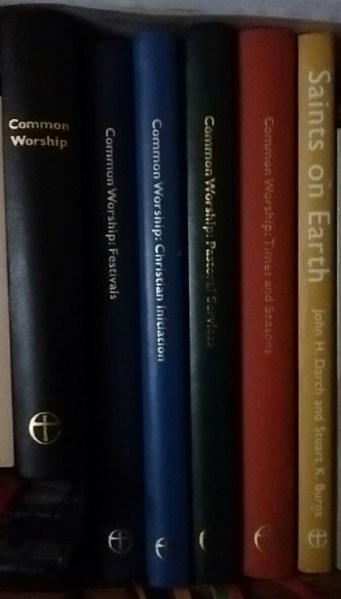
Book Review: Common Worship (2000)

Welcome to Saturday Book Review time!  On most of the Saturdays this year we’re looking at a liturgy-related book noting (as applicable) its accessibility, devotional usefulness, and reference value.  Or, how easy it is to read, the prayer life it engenders, and how much it can teach you.

In honor of my new Bishop being consecrated today – he’s from England – I thought we’d take a look at an English book today: Common Worship, which is currently the Church of England’s official (and I imagine most-used) liturgical text alongside the 1662 Prayer Book which is still legally their standard text.  Common Worship is not strictly speaking a Prayer Book.  It has over 800 pages of liturgical material for the Daily Office, Holy Communion, Baptism, Thanksgiving for a Child, and other occasional worship services that one may design oneself according to the provided rubrics; it does not have material for Holy Matrimony, Confirmation, Ordination, Ministration to the Sick, or Burial.  However, it does have further volumes that provide more material and fill in those blanks.

common worship

If you thought that the American 1979 book had a lot of choices to choose from, this book will blow your mind.  Where the ’79 had two traditional-language Prayers of Consecration and four more in contemporary language, this book has two “Orders” for Holy Communion (both offered in contemporary and traditional language styles), Order One having 8 Prayers of Consecration to choose from!  Order One is the contemporary order of the liturgy, similar to what we’ve got in the American books since 1979; Order Two is the English (1662) order of the liturgy.

The Daily Office, too, is a bit complicated, offering a different form of Morning & Evening Prayer for Sundays distinct from the rest of the week.  Both in how the Office is presented, as well as the Communion, it seems that the expectation (or the cynic might say “agenda”) is for most churches to use the contemporary liturgies (provided first), while acknowledging the legitimacy of the traditional (provided second).  But at least they’re both there – the American 1979 book barely threw a bone to the traditionalists, which resulted in the creation of supplemental books such as the Anglican Service Book.  Our upcoming 2019 prayer book will provide authorizations and rubrics for more traditional orderings of the contemporary liturgy, which is very good, but it’s not going to be quite as user-friendly as the way Common Worship provides the traditional material straight-up.  And who can blame our prayer book committees?  Just look at Common Worship – it takes over 800 pages to cover only half of the liturgical texts required for a full Prayer Book!

On the other hand, this book is remarkably user-friendly considering its cumbersome collection of liturgies.  As long as someone tells you what type of worship service you’re walking into (i.e. Holy Communion, Order One) you can simply look it up in the table of contents, go to page 166, and actually follow along quite easily.  The primary divergence of options is the Prayer of Consecration (Prayers A through H offer a range of styles and emphases) but the way it’s handled here is actually rather brilliant.  The prayers that are in common are printed in the main text of the Communion service, and the different responses from the various sets of prayers are put into the main text, allowing the person in the pew to respond to whichever Prayer of Consecration is being said without having to flip to the appropriate pages and back!  For those who do want to read along with the Priest’s text, page numbers are provided.  The various options for the Prayers of the People are handled the same way: the responses are provided in the main text, and a page number reference is included for those who want to read the actual text of the intercessions that the prayer leader will be reading.

The calendar has grown rather differently in English tradition than American.  Both were the same up to the early 20th century, but the way modern liturgical revision has impacted us is different.  The American Anglican treatment of the calendar is more like the Roman Catholics: Epiphany season lasts from January 6th until Ash Wednesday, and the season after Pentecost (or Trinity) runs from Pentecost or Trinity Sunday until Advent.  In England, things got a bit more nuanced – perhaps hanging on to vestiges of old custom in a different way.  The Epiphany season set forth in Common Worship lasts from January 6th until February 2nd (the feast of the Presentation), after which comes “Ordinary Time”, counted as the 1st-5th Sundays before Lent.  After Trinity Sunday Ordinary Times resumes with up to 22 Sundays “after Trinity” followed by All Saints’ Sunday and Three or Four Sundays “before Advent”, sometimes nicknamed Kingdomtide.  Although this is largely irrelevant to our American context (and may even end up adding confusion to some readers) it can be handy to be familiar with this style of calendar as there are other Anglican provinces across the world that follow a variation of the modern English calendar.

The biggest surprise, looking at this book, is one glaring omission: it has no daily lectionary!  The Communion & Holy Day lectionary is elaborate, with multiple sets of readings in case a church has two or even three worship services on a given Sunday, and the occasional note for proper readings at Evening Prayer on the “Eve of” a major feast day (termed Festival in this book).  I suppose if one accounts for all of those, and the three-year cycle of lessons, one could draw enough readings together to fill out the week days for the Daily Office.  But that would not be in the spirit of a daily lectionary at all, providing disjointed readings from day to day, and probably not providing very good coverage of the Bible at all.  In short, this is so Sunday-focused that it seems to give tacit assent to the loss of the daily office in the public eye.

The ratings in short:

Accessibility: 3/5
Despite the massive collection of optional material and “choose-your-own-adventure” nature to the liturgical planning authorized in this book, it is surprisingly easy to navigate if you’re following along with one service.  (If you’re the liturgical planner using this book to prepare a service then boy have you got some studying to do!)

Devotional Usefulness: 2/5
Extra canticles can be great; different forms of confessions and creeds can be interesting from time to time (if not really necessary); having the traditional and modern styles available in one volume is lovely.  The theological precision and accuracy may be an open question for some of the Communion Prayers of Consecration, depending upon one’s point of view.  This could have been a 3, but without a daily lectionary or prayers for funerals and weddings, this book falls to a 2.

Reference Value: 2/5
There is a lot of stuff in here which is interesting, but little that we can use, outside of the Church England.  What is authorized for our liturgy simply is not the same as this book.  What we can glean (or even use) from this book include its wealth of additional Canticles, original confessions and creedal material which we could use for private devotion or even in teaching, and comparative studies in how the calendar and lectionary evolved across the pond.

Before our Texts for Common Prayer started coming together, I knew of a number of ACNA churches that made use of Common Worship to some degree or another, rather than rely solely on the 1979 book.  By this point, we’ve got everything we need such that we don’t need to rely on external sources such as this.  Furthermore, it is our bishops who authorize liturgical texts, not local priests, so must of us probably aren’t even allowed to use Common Worship in our public liturgy.  It’s a neat resource to poke through if you’ve got it, but since its whole text is freely available online, there’s not really any reason to get a hard copy unless you really want to build up a liturgical library.  (I’ve only got a copy because someone else was downsizing his library!)

Canticles for Lent

One of the fun resources in the 2019 Prayer Book is the collection of Supplemental Canticles for the Daily Office.  As we proceed through this season of Lent, there are two Canticles in particular that stand out as appropriate for regular use at this time.

First is the Benedictus es.  This Canticle is taken from the Greek Old Testament version of Daniel 3, known separately in our Bibles as “The Song of the Three Young Men” – when Hananiah, Azariah, and Mishael were in the fiery furnace alongside the fourth man, the pre-incarnate Christ.  There are two hymns in that passage, and this Canticle is a summary of the first one.  Liturgically, this Canticle is offered directly in the Morning Prayer text itself, presented as an option in place of the Te Deum during Lent.  This Customary recommend using it on Ash Wednesday, the First Sunday of Lent, Palm Sunday, and on weekdays throughout the season.  (For the 2nd through 5th Sundays, it may be prudent to bring back the Te Deum in recognition that though Lent continues, Sundays are not fast days; and though it is still a penitential season, we are still celebrating the victorious Christ.)

From the Supplemental Canticles,  #3, the Kyrie Pantokrator, may be used in place of the Nunc dimittis (the second Canticle in Evening Prayer) on Ash Wednesday, the First Sunday of Lent, Palm Sunday, and every weekday throughout the season.  This Canticle is also from the Greek Old Testament, entitled in English as the Prayer of Manasseh.  It is a prayer of penitence attributed to the wicked King Manasseh (2 Chronicles 33:10-20, especially verses 18 & 19).  As with the Benedictus es above, this Canticle is shortened a bit from its original version; also some of its hyperbolic language is toned down so as not to confuse the average reader.  This Canticle, in particular, is a marvelous offering of penitential worship.  In this age where so many of us run fast and loose with sin, the strong language of condemnation and grace in the Kyrie Pantokrator could do us a world of spiritual good.

And it’s got an awesome name, to boot!

Consecrating a Bishop

Perhaps the least-often-used portion of any Prayer Book is the liturgy called “The Form and Manner of Ordaining and Consecrating a Bishop“.  Granted, the original Prayer Books actually did not include the Ordinal (saving those liturgies for a separate volume), and perhaps the nomenclature has varied a little over the centuries, but it remains consistently true that the least-often-observed liturgy is that for the consecration of a new bishop.

The Lenten Ember Days are upon us (today, Friday, and Saturday), which are a set of days, quarterly throughout the year, set aside for fasting and prayer for those preparing for ordination.  And because we in my diocese (the Anglican Diocese in New England) are on the cusp of consecrating our second diocesan bishop, this seemed like a good opportunity to look at the liturgy for such an occasion.

The liturgy begins, as for other ordinations and for Confirmation, and even as an option for Holy Matrimony, with a presentation of the candidate: the Bishop-Elect is announced and he is asked to re-state his commitment to the Scriptures and the Church.  The Archbishop (or other Bishop serving as the Chief Consecrator) then makes this statement:

Dear Brothers and Sisters in Christ, it is written in the Gospel of Saint Luke that our Savior Christ continued the whole night in prayer, before he chose and sent forth his twelve Apostles. It is written also in the Acts of the Apostles, that the disciples at Antioch fasted and prayed before they sent forth Paul and Barnabas by laying their hands upon them. Let us, therefore, following the example of our Savior and his Apostles, offer up our prayers to Almighty God, before we admit and send forth this person presented to us, to do the work to which we trust the Holy Spirit has called him.

What follows is the Litany for Ordinations, common to the Ordination liturgies for Deacons, Priests, and Bishops, but it should be noted that the repeated Scriptural references to fasting and praying are things that the people should have been undertaking before this point.  If you’re in the New England diocese, you’ve got only a couple days left to meet this biblical expectation before the consecration service is upon us.  If you’re resident elsewhere, you’re certainly welcome to fast and pray for us and with us, also!

The Propers (Collect and Lessons) follow the Litany:

Almighty God, who by your Son Jesus Christ gave many excellent gifts
to your holy Apostles, and charged them to feed your flock;
give your grace to all Bishops, the Pastors of your Church,
that they may diligently preach your Word, duly administer your Sacraments,
and wisely provide godly Discipline;
and grant to your people that they may obediently follow them,
so that all may receive the crown of everlasting glory,
through the merits of our Savior, Jesus Christ, your Son, our Lord,
who lives and reigns with you and the Holy Spirit, world without end. Amen.

Isaiah 61:1-11; Psalm 100;
1 Timothy 3:1-7 or Acts 20:17-35
John 21:15-19 or John 20:19-23 or Matthew 28:18-20

A Major Feast Day or Sunday may override those lessons, but in our case in New England, with a Saturday ordination scheduled, no such exception applies.

After these readings, the homily, and the Creed, follows the Exhortation and Examination.  Where the Deacon and Priest get a somewhat-lengthy exhortation first, which outlines the definition and duty of those Orders, the Bishop-Elect is brought almost immediately to the Examination.  Curiously the Examination for the new bishop is almost but not quite the same as the Examination for a new priest.  In brief the questions are about:

  1. The supremacy of the Scriptures for doctrine and teaching
  2. The study of the Scriptures in order to teach and correct
  3. The diligent removal of false doctrines
  4. The renunciation of ungodly desires and commitment to being an example of life
  5. The maintenance of peace among all people
  6. The faithful preparation and conferral of Holy Orders upon others
  7. The merciful posture towards the poor and needy

For contrast, the Priest’s vows are

  1. basically the same as #1 above
  2. minister the doctrine, sacraments and discipline of the Church
  3. mostly the same as #3 above
  4. diligence in prayer and study of the Scriptures, like #2 above
  5. personal and family life as examples, like #4 above
  6. mostly same as #5 above
  7. obedience to the bishop and other ministers as appointed

So a progression of duty can be discerned by this comparison.  The authority of the Scriptures, and the teaching thereof, is the utmost priority of the ordained minister.  That is then applied to the correction of false teachers and the living of a godly life to be an example to others and an agent of peace.  The final vow(s) are the most specific to the particular Order.  In general, the Bishop-Elect is subjected to greater scrutiny and stricter vows than the Priest, and it should be remembered that the Bishop has already undertaken the Priestly and Diaconal vows.

Just like in Holy Baptism and Holy Communion, and most (if not all) of the other sacramental rites, the heart of the Ordination liturgy is summarized in a central prayer and declaration (or speech-act).  The Archbishop prays:

Almighty God, and most merciful Father, of your infinite goodness you have given your only Son Jesus Christ to be our Redeemer, and to be the author of everlasting life. After he had made perfect our redemption by his death and resurrection, and was ascended into heaven, he poured down his gifts abundantly upon his people, making some Apostles, some Prophets, some Evangelists, some Pastors and Teachers, for edifying and perfecting his Church. Grant to this your servant such grace, that he may be ever ready to propagate your Gospel, the good news of our reconciliation with you; and use the authority given to him, not for destruction, but for salvation; not for hurt, but for help; so that, as a wise and faithful steward, he will give to your family their portion in due season, and so may at last be received into everlasting joy.

This, more than anywhere else in the liturgy up to this point, summarizes the Order of Bishop: he is to be a minister of the propagation of the Gospel, and receives authority that is meant to help people attain to salvation.  The words of consecration are what some call a speech-act, a pronouncement or declaration in God’s name:

Receive the Holy Spirit for the Office and Work of a Bishop in the Church of God, now committed to you by the Imposition of our Hands; in the Name of the Father, and of the Son, and of the Holy Spirit.

which is then followed by a further prayer:

Most merciful Father, send down upon this your servant your heavenly blessing; so endue him with your Holy Spirit, that he, in preaching your holy Word, may not only be earnest to reprove, beseech, and rebuke, with all patience and Doctrine; but may he also, to such as believe, present a wholesome example in word, in conversation, in love, in faith, in chastity, and in purity; that, faithfully fulfilling his course, at the Last Day he may receive the crown of righteousness, laid up by the Lord Jesus, our righteous Judge, who lives and reigns with you and the same Holy Spirit, one God, world without end.

The new Bishop is then handed a copy of the Bible, accompanied by further words of exhortation for his new ministry.  Traditionally (provided for in our liturgy, though not required) he also receives a crosier (pastoral staff) symbolizing the shepherding role, anointing with holy oil on his forehead symbolizing the grace of God upon him as a Spirit-endued leader, a pectoral cross symbolizing the authority whom he will continue to serve, an episcopal ring symbolizing his marriage to Christ, and a miter symbolizing the authority he bears and whence it comes.

The celebration of Holy Communion follows, and that’s that!
St. Gregory the Great

Today is the commemoration of Saint Gregory the Great, who was the Bishop of Rome from 590 to 604.
To musicians he is remembered as the author (or perhaps just compiler) of a great deal of plainchant that came to bear his name: Gregorian Chant.
To Anglicans he is remembered as the one who sent St. Augustine and his team to England, where, based in Canterbury, the Anglo-Saxons were re-evangelized and the Church there reinvigorated.
To Roman Catholics he is remembered as one of the 36 ‘Doctors of the Church’.
To the Eastern Orthodox he is remembered as the author of the Dialogues, chronicling the lives and miracles of various early Saints, especially including Saint Benedict.
To many Bishops he is remembered as the author of the Liber regulae pastoralis – for centuries the definitive book on how a Bishop is to order his life.
To the Reformer John Calvin he is remembered as “the last good Pope.”

If we to commemorate him in a Communion service today, there are two main options for Collects and Lessons.

Of a Teacher of the Faith

Almighty God, you gave your servant Gregory the Great special gifts of grace to understand and teach the truth revealed in Christ Jesus: Grant that by this teaching we may know you, the one true God, and Jesus Christ whom you have sent; who lives and reigns with you and the Holy Spirit, one God, for ever and ever. Amen.

Proverbs 3:13-26; Psalm 119:89-106; 1 John 1:1-10; Matthew 13:47-52

Of a Pastor

O God, our heavenly Father, you raised up your faithful servant Gregory the Great, to be a bishop and pastor in your Church and to feed your flock: Give abundantly to all pastors the gifts of your Holy Spirit, that they may minister in your household as true servants of Christ and stewards of your divine mysteries; through Jesus Christ our Lord, who lives and reigns with you and the Holy Spirit, one God, for ever and ever. Amen.

Isaiah 6:1-8; Psalm 71:17-24; 1 Peter 5:1-11 or Acts 20:24-35; Matthew 24:42-50

What one would do is choose either of these sets, and stick with them wholesale; don’t mix and match between them.  Decide how you’re going to commemorate St. Gregory, identify what aspect of his legacy and sainthood you wish to highlight to the congregation, and choose the Propers (Collect & lessons) accordingly.

A further recommendation of this Customary, because this is an optional commemoration and not a Prayer Book “red letter day”, would be to use two readings (plus Psalm) instead of three.  Remember also that you can omit the Nicene Creed, which the rubrics require only for Sundays and Major Feast Days.

And, of course, there’s nothing stopping you from reading and praying an Antecommunion service on your own – that is, going through the Communion liturgy up to the Offertory and ending it there with the Lord’s Prayer!

On Private Confession

So with Lent around the corner, let’s talk about the sacramental rite of Confession and Absolution.  In the upcoming 2019 Prayer Book, this is a simple matter: go to the “Rites of Healing” section and use that brief liturgy with your priest.  A traditional practice is to make a confession on Shrove Tuesday in preparation for Ash Wednesday.  This is part of the genius of Pre-Lent; having three and a half weeks to prepare for Lent meant you had time to prepare your Confession, which you could make on the day before Ash Wednesday, and then Lent would be the season of penitence in light of the confession you already made. Rather than 40 days of self-examination, it was 40 days of spiritual warfare to grow in grace after that confession.

Shrove

Now, one of the big objections raised against confession to a priest is that it’s a “Catholic” practice, and we’re “Protestants.”  While I could quibble with the terminology, I think it’ll be easier simply to argue in favor of the practice of Private Confession – that it is, and always has been, an option in classical Anglicanism.

Consideration #1 – the Exhoration

The Exhortation(s) in the Communion service invite those who are penitent to come to the priest for absolution and counsel. This is a public announcement to a private invitation. Reading this as a public confession is completely against the context, as the public confession follows shortly thereafter. That invitation is meant to eradicate “any scruples or doubt” in the individual conscience.  Even now, that invitation still exists in the Exhortation:

If you have come here today with a troubled conscience, and you need help and counsel, come to me, or to some other priest, and confess your sins; that you may receive godly counsel, direction, and absolution. To do so will both satisfy your conscience and remove any scruples or doubt.

Consideration #2 – Theological Consistency

The theology of priestly absolution is supported in the explicit wording of the Absolution in the Daily Office and in the Words of Ordination in the “Ordering of Priests” liturgy at the very moment of laying-on of hands.  The wording hasn’t really changed since 1662:

Receive the Holy Spirit for the Office and Work of a Priest in the Church of God, now committed to you by the Imposition of our Hands. If you forgive the sins of anyone, they are forgiven. If you withhold forgiveness from anyone, it is withheld. Be a faithful minister of God’s holy Word and Sacraments; in the Name of the Father, and of the Son, and of the Holy Spirit.

The authority of the priest to absolve is further supported in the text of the Daily Office’s words of absolution, again substantially unchanged since the originals:

Almighty God, the Father of our Lord Jesus Christ, desires not the death of sinners, but that they may turn from their wickedness and live. He has empowered and commanded his ministers to pronounce to his people, being penitent, the absolution and remission of their sins…

Consideration #3 – a classical prayer book example

Until 1979 the Prayer Books did not provide a liturgy for private confessions, but they did provide a model for how it could be done.  The practical example of this invitation to private confession is modeled in the Ministration of the Sick, in which the sick person is invited to confess to the priest (using very similar phraseology to the Exhortation).  You can see the whole liturgy here, but the specific words are as follows.

Here shall the sick perſon be moved to make a special Confession of his sins, if he feel his conscience troubled with any weighty matter.  After which Confession, the Prieſt shall absolve him (if he humbly and heartily desire it) after this sort:

OUR Lord Jesus Christ, who hath left power to his Church to absolve all sinners who truly repent and believe in him, of his great mercy forgive thee thine offences: And by his authority committed to me, I absolve thee from all thy sins, In the Name of the Father, and of the Son, and of the Holy Ghost. Amen.

The 1662 Prayer Book is anything but a Papist document; it should be noted that the Lutherans also generally maintained a sacramental (or almost-sacramental) status for absolution by a pastor in their theological tradition.

Consideration #4 – why Private Confession was absent from the old Prayer Books

One might question why the old prayer books, if my arguments are correct, didn’t simply provide a liturgy for private confession.  The answer is simple: a private confession is by definition not “common prayer” and therefore didn’t need to be in the Prayer Book itself.  The only part of a private confession that needs (or ought) to be scripted is the priestly absolution, and the minister already has three statements of absolution in the Prayer Book to choose from (Daily Office, Communion, Visitation of the Sick); there need not be any further liturgical form to the saying of a private confession.

That being said, it’s nice to have a brief summary of private confession to a priest in the modern prayer books.  Even though it’s not strictly necessary, having set forms and structure for the confessee can help him or her feel more comfortable in the moment, and cut down on the awkward of feelings of “am I doing this right?”  The only thing that matters is honest contrition about the sins being confessed, so having a liturgical form can help reduce the awkwardness of knowing “how” to say it.

Book Review: the 1979 BCP

Welcome to Saturday Book Review time!  On most of the Saturdays this year we’re looking at a liturgy-related book noting (as applicable) its accessibility, devotional usefulness, and reference value.  Or, how easy it is to read, the prayer life it engenders, and how much it can teach you.

In 1979, after several years of experimentation and trial-use liturgies, the Episcopal Church (USA) promulgated a revolutionary new Prayer Book.  It was a massive tome, compared to its predecessors, with all sorts of exciting new features.  The Daily Office and Communion services were offered in both traditional and contemporary English.  Multiple rites (especially prayers of consecration) for the Communion service were provided.  The minor offices of Noonday Prayer and Compline were added.  The Imposition of Ashes, the Liturgy of the Palms, a Good Friday liturgy, instructions for a traditional approach to Holy Saturday, and an Easter Vigil liturgy all brought catholic tradition into the Prayer Book (where high church parishes previously had to rely upon supplementary material if they wanted to hold such traditions).  The liturgies for Ministration to the Sick and the Dying were expanded.  A new translation of the Psalter was made.  The additional prayers for the Daily Office turned into a massive compilation of over 100 prayers and thanksgivings, neatly ordered and numbered for ease of use.  New lectionaries were made.  There’s a new (longer) catechism.  Additional “historical documents” were appended to the volume, along with The 39 Articles of Religion.

Pretty much all of these were firsts for the Prayer Book tradition.  It is hard to speak ill of that, especially when much of the expanded content was already in use by many traditionalists, and its inclusion in the Prayer Book enabled further standardization and propagation of said practices, even breaking the highchurch / lowchurch barrier.

But there are a number of issues that have been raised with this book.

The changes in style, order, and content to the primary liturgies (Daily Office and Communion) are major departures from all previous Prayer Books.  Many of the changes to the Roman Rite in the wake of their 2nd Vatican Council were imitated in our changes to the Anglican liturgies, especially in the calendars and the order of the Communion service. Some would describe the 1979 book’s results as a bland and generic western catholicism that is neither Roman nor Anglican.

The Baptism liturgy contains perhaps the most criticized feature of the 1979 book: the “baptismal covenant.”  It takes the biblical and traditional idea of the baptized person(s) committing him/herself to Christ, and expands it into a whole contract – or covenant – by which the individual is united to Christ.  Internet articles abound in picking apart just how poorly this innovation to the Baptism liturgy was devised.  On a related note, some also point out that the way this book emphasizes (and arguably redefines) Holy Baptism, the rite of Confirmation ends up being pushed aside as extraneous – a concern that is further highlighted by the fact that Confirmation was no longer the requirement for entry to Holy Communion.  The liturgies for Holy Matrimony and Ordination have also been somewhat liberalized from previous books.

There is also the question of the contemporary language itself.  This was very strongly desired by many Episcopalians at the time, and very strongly opposed by others.  While that controversy and argument still exists today, I think there is a little more peaceful coexistence between the two views now.  But the quality and precision of the contemporary English is still somewhat up for grabs.  As we’ve seen in the process of creating our 2019 Prayer Book, the delicate interplay between faithfulness to the wording of the Bible, consistency with the wording of previous Prayer Books, and accessibility of style and vocabulary to the modern reader is a difficult game to play.  Our recent examination of the Daily Office “lesser litany” illustrates this well.  Or, more bluntly, a quick reading of the 1979 book’s Eucharistic Prayer C makes it immediately obvious that some of this book is too much a product of its generation and lacks that ‘timeless’ quality that will appeal to the next generation(s) thereafter.  (That prayer is nicknamed the “Star Wars” or “Star Trek” Prayer.)

For better and for worse, this has been the standard Prayer Book for the majority of Anglicans in this country for a few decades now.  It was my first Prayer Book, too, and I used it faithfully and happily for about four years before I began to see just how different it was from the 1662 book.  At that point I started weaning myself off of it, using the new ACNA materials available and drawing from more traditional material to “fill in the gaps” for the time being.  I learned that the Prayer Book tradition’s roots look quite different from the 1979 book… but that isn’t the case for a lot of people; to many this book is the Prayer Book, and (if they’re in the ACNA) the 2019 will be the next Prayer Book.  In a way, I think that perspective is more damaging.  The 1979 book, for all its innovation, still does have a strong “Prayer Book” origin to it, and if you familiarize yourself with classical prayer book tradition then you can find that traditional core to the ’79 pretty easily and use it fruitfully.  But without that second foot in Anglican history, one’s use of the ’79 is going to be rather blind and untethered, tossed on the sea of alternate liturgies and options that transformed a 600-page book into 1,000.

The ratings in short:

Accessibility: 2/5
Due to the multiple versions and options of the primary liturgies, and the fact that most of the pastoral and episcopal liturgies are typically intended to be part of a Communion service, the page-flipping required to hold one worship service directly from this book is terribly excessive.  If you’re a liturgy nerd, or very patient, or have a cheat-sheet-style bookmark with all the page numbers for the service, then you can do it.  But this book doesn’t make it easy.  Also due to the page-flipping required, it’s easy to miss the rubrics at the end of sections which sometimes point to even more options.  Judicious use of “go to page ___” instructions would have mitigated some of these challenges, and I think the 2019 book looks like it’s learning that particular lesson.

Devotional Usefulness: 3/5
If you can get past the accessibility issues, there are plenty of good things in this book to feed the Christian soul.  Despite the changes, the Daily Office and Communion services still contain good, godly, biblical, and even Anglican prayers.  There is a fair bit of chaff to omit here and there, but it’s usually not too intrusive.  The prayers at time of death and anointing of the sick are also handy references for pastoral emergencies.  Though I’m happy to never have to use its baptism, confirmation, matrimony, or ordination services.

Reference Value: 1/5
Honestly, because the 2019 book is looking to be very similar to the 1979 in terms of general content, there’s basically no reason to pull this book off the shelf anymore.  We can trace the historical changes from 1928 to 1979 to 2019, but that’s largely of academic interest, and of little use to the average church-goer or minister.  Furthermore, because most of the changes from the 1979 to the 2019 are “roll-backs” toward classical Anglican content, the 1979 book represents a sort of liturgical dead end: the tradition went too far in one direction, and now we’ve reeled it in somewhat.

So we’re at a point now where I no longer give out copies of the 1979 Prayer Book to anyone.  I’m not an Episcopalian, it’s #notmyprayerbook, and I’d much rather point people to the corrected, more traditional and biblical 2019 material.  That being said, I’m not a hater.  The 1979 is where I first delved into the Anglican tradition, and my extensive study of that book gave me a leg-up in understanding what’s going on with the 2019 book.  The 1979 BCP has served its purpose, done its time, and is now ready to enjoy a (very) quiet retirement.