St. Gregory the Great

Today is the commemoration of Saint Gregory the Great, who was the Bishop of Rome from 590 to 604.
To musicians he is remembered as the author (or perhaps just compiler) of a great deal of plainchant that came to bear his name: Gregorian Chant.
To Anglicans he is remembered as the one who sent St. Augustine and his team to England, where, based in Canterbury, the Anglo-Saxons were re-evangelized and the Church there reinvigorated.
To Roman Catholics he is remembered as one of the 36 ‘Doctors of the Church’.
To the Eastern Orthodox he is remembered as the author of the Dialogues, chronicling the lives and miracles of various early Saints, especially including Saint Benedict.
To many Bishops he is remembered as the author of the Liber regulae pastoralis – for centuries the definitive book on how a Bishop is to order his life.
To the Reformer John Calvin he is remembered as “the last good Pope.”

If we to commemorate him in a Communion service today, there are two main options for Collects and Lessons.

Of a Teacher of the Faith

Almighty God, you gave your servant Gregory the Great special gifts of grace to understand and teach the truth revealed in Christ Jesus: Grant that by this teaching we may know you, the one true God, and Jesus Christ whom you have sent; who lives and reigns with you and the Holy Spirit, one God, for ever and ever. Amen.

Proverbs 3:13-26; Psalm 119:89-106; 1 John 1:1-10; Matthew 13:47-52

Of a Pastor

O God, our heavenly Father, you raised up your faithful servant Gregory the Great, to be a bishop and pastor in your Church and to feed your flock: Give abundantly to all pastors the gifts of your Holy Spirit, that they may minister in your household as true servants of Christ and stewards of your divine mysteries; through Jesus Christ our Lord, who lives and reigns with you and the Holy Spirit, one God, for ever and ever. Amen.

Isaiah 6:1-8; Psalm 71:17-24; 1 Peter 5:1-11 or Acts 20:24-35; Matthew 24:42-50

What one would do is choose either of these sets, and stick with them wholesale; don’t mix and match between them.  Decide how you’re going to commemorate St. Gregory, identify what aspect of his legacy and sainthood you wish to highlight to the congregation, and choose the Propers (Collect & lessons) accordingly.

A further recommendation of this Customary, because this is an optional commemoration and not a Prayer Book “red letter day”, would be to use two readings (plus Psalm) instead of three.  Remember also that you can omit the Nicene Creed, which the rubrics require only for Sundays and Major Feast Days.

And, of course, there’s nothing stopping you from reading and praying an Antecommunion service on your own – that is, going through the Communion liturgy up to the Offertory and ending it there with the Lord’s Prayer!

On Private Confession

So with Lent around the corner, let’s talk about the sacramental rite of Confession and Absolution.  In the upcoming 2019 Prayer Book, this is a simple matter: go to the “Rites of Healing” section and use that brief liturgy with your priest.  A traditional practice is to make a confession on Shrove Tuesday in preparation for Ash Wednesday.  This is part of the genius of Pre-Lent; having three and a half weeks to prepare for Lent meant you had time to prepare your Confession, which you could make on the day before Ash Wednesday, and then Lent would be the season of penitence in light of the confession you already made. Rather than 40 days of self-examination, it was 40 days of spiritual warfare to grow in grace after that confession.

Shrove

Now, one of the big objections raised against confession to a priest is that it’s a “Catholic” practice, and we’re “Protestants.”  While I could quibble with the terminology, I think it’ll be easier simply to argue in favor of the practice of Private Confession – that it is, and always has been, an option in classical Anglicanism.

Consideration #1 – the Exhoration

The Exhortation(s) in the Communion service invite those who are penitent to come to the priest for absolution and counsel. This is a public announcement to a private invitation. Reading this as a public confession is completely against the context, as the public confession follows shortly thereafter. That invitation is meant to eradicate “any scruples or doubt” in the individual conscience.  Even now, that invitation still exists in the Exhortation:

If you have come here today with a troubled conscience, and you need help and counsel, come to me, or to some other priest, and confess your sins; that you may receive godly counsel, direction, and absolution. To do so will both satisfy your conscience and remove any scruples or doubt.

Consideration #2 – Theological Consistency

The theology of priestly absolution is supported in the explicit wording of the Absolution in the Daily Office and in the Words of Ordination in the “Ordering of Priests” liturgy at the very moment of laying-on of hands.  The wording hasn’t really changed since 1662:

Receive the Holy Spirit for the Office and Work of a Priest in the Church of God, now committed to you by the Imposition of our Hands. If you forgive the sins of anyone, they are forgiven. If you withhold forgiveness from anyone, it is withheld. Be a faithful minister of God’s holy Word and Sacraments; in the Name of the Father, and of the Son, and of the Holy Spirit.

The authority of the priest to absolve is further supported in the text of the Daily Office’s words of absolution, again substantially unchanged since the originals:

Almighty God, the Father of our Lord Jesus Christ, desires not the death of sinners, but that they may turn from their wickedness and live. He has empowered and commanded his ministers to pronounce to his people, being penitent, the absolution and remission of their sins…

Consideration #3 – a classical prayer book example

Until 1979 the Prayer Books did not provide a liturgy for private confessions, but they did provide a model for how it could be done.  The practical example of this invitation to private confession is modeled in the Ministration of the Sick, in which the sick person is invited to confess to the priest (using very similar phraseology to the Exhortation).  You can see the whole liturgy here, but the specific words are as follows.

Here shall the sick perſon be moved to make a special Confession of his sins, if he feel his conscience troubled with any weighty matter.  After which Confession, the Prieſt shall absolve him (if he humbly and heartily desire it) after this sort:

OUR Lord Jesus Christ, who hath left power to his Church to absolve all sinners who truly repent and believe in him, of his great mercy forgive thee thine offences: And by his authority committed to me, I absolve thee from all thy sins, In the Name of the Father, and of the Son, and of the Holy Ghost. Amen.

The 1662 Prayer Book is anything but a Papist document; it should be noted that the Lutherans also generally maintained a sacramental (or almost-sacramental) status for absolution by a pastor in their theological tradition.

Consideration #4 – why Private Confession was absent from the old Prayer Books

One might question why the old prayer books, if my arguments are correct, didn’t simply provide a liturgy for private confession.  The answer is simple: a private confession is by definition not “common prayer” and therefore didn’t need to be in the Prayer Book itself.  The only part of a private confession that needs (or ought) to be scripted is the priestly absolution, and the minister already has three statements of absolution in the Prayer Book to choose from (Daily Office, Communion, Visitation of the Sick); there need not be any further liturgical form to the saying of a private confession.

That being said, it’s nice to have a brief summary of private confession to a priest in the modern prayer books.  Even though it’s not strictly necessary, having set forms and structure for the confessee can help him or her feel more comfortable in the moment, and cut down on the awkward of feelings of “am I doing this right?”  The only thing that matters is honest contrition about the sins being confessed, so having a liturgical form can help reduce the awkwardness of knowing “how” to say it.

Book Review: the 1979 BCP

Welcome to Saturday Book Review time!  On most of the Saturdays this year we’re looking at a liturgy-related book noting (as applicable) its accessibility, devotional usefulness, and reference value.  Or, how easy it is to read, the prayer life it engenders, and how much it can teach you.

In 1979, after several years of experimentation and trial-use liturgies, the Episcopal Church (USA) promulgated a revolutionary new Prayer Book.  It was a massive tome, compared to its predecessors, with all sorts of exciting new features.  The Daily Office and Communion services were offered in both traditional and contemporary English.  Multiple rites (especially prayers of consecration) for the Communion service were provided.  The minor offices of Noonday Prayer and Compline were added.  The Imposition of Ashes, the Liturgy of the Palms, a Good Friday liturgy, instructions for a traditional approach to Holy Saturday, and an Easter Vigil liturgy all brought catholic tradition into the Prayer Book (where high church parishes previously had to rely upon supplementary material if they wanted to hold such traditions).  The liturgies for Ministration to the Sick and the Dying were expanded.  A new translation of the Psalter was made.  The additional prayers for the Daily Office turned into a massive compilation of over 100 prayers and thanksgivings, neatly ordered and numbered for ease of use.  New lectionaries were made.  There’s a new (longer) catechism.  Additional “historical documents” were appended to the volume, along with The 39 Articles of Religion.

Pretty much all of these were firsts for the Prayer Book tradition.  It is hard to speak ill of that, especially when much of the expanded content was already in use by many traditionalists, and its inclusion in the Prayer Book enabled further standardization and propagation of said practices, even breaking the highchurch / lowchurch barrier.

But there are a number of issues that have been raised with this book.

The changes in style, order, and content to the primary liturgies (Daily Office and Communion) are major departures from all previous Prayer Books.  Many of the changes to the Roman Rite in the wake of their 2nd Vatican Council were imitated in our changes to the Anglican liturgies, especially in the calendars and the order of the Communion service. Some would describe the 1979 book’s results as a bland and generic western catholicism that is neither Roman nor Anglican.

The Baptism liturgy contains perhaps the most criticized feature of the 1979 book: the “baptismal covenant.”  It takes the biblical and traditional idea of the baptized person(s) committing him/herself to Christ, and expands it into a whole contract – or covenant – by which the individual is united to Christ.  Internet articles abound in picking apart just how poorly this innovation to the Baptism liturgy was devised.  On a related note, some also point out that the way this book emphasizes (and arguably redefines) Holy Baptism, the rite of Confirmation ends up being pushed aside as extraneous – a concern that is further highlighted by the fact that Confirmation was no longer the requirement for entry to Holy Communion.  The liturgies for Holy Matrimony and Ordination have also been somewhat liberalized from previous books.

There is also the question of the contemporary language itself.  This was very strongly desired by many Episcopalians at the time, and very strongly opposed by others.  While that controversy and argument still exists today, I think there is a little more peaceful coexistence between the two views now.  But the quality and precision of the contemporary English is still somewhat up for grabs.  As we’ve seen in the process of creating our 2019 Prayer Book, the delicate interplay between faithfulness to the wording of the Bible, consistency with the wording of previous Prayer Books, and accessibility of style and vocabulary to the modern reader is a difficult game to play.  Our recent examination of the Daily Office “lesser litany” illustrates this well.  Or, more bluntly, a quick reading of the 1979 book’s Eucharistic Prayer C makes it immediately obvious that some of this book is too much a product of its generation and lacks that ‘timeless’ quality that will appeal to the next generation(s) thereafter.  (That prayer is nicknamed the “Star Wars” or “Star Trek” Prayer.)

For better and for worse, this has been the standard Prayer Book for the majority of Anglicans in this country for a few decades now.  It was my first Prayer Book, too, and I used it faithfully and happily for about four years before I began to see just how different it was from the 1662 book.  At that point I started weaning myself off of it, using the new ACNA materials available and drawing from more traditional material to “fill in the gaps” for the time being.  I learned that the Prayer Book tradition’s roots look quite different from the 1979 book… but that isn’t the case for a lot of people; to many this book is the Prayer Book, and (if they’re in the ACNA) the 2019 will be the next Prayer Book.  In a way, I think that perspective is more damaging.  The 1979 book, for all its innovation, still does have a strong “Prayer Book” origin to it, and if you familiarize yourself with classical prayer book tradition then you can find that traditional core to the ’79 pretty easily and use it fruitfully.  But without that second foot in Anglican history, one’s use of the ’79 is going to be rather blind and untethered, tossed on the sea of alternate liturgies and options that transformed a 600-page book into 1,000.

The ratings in short:

Accessibility: 2/5
Due to the multiple versions and options of the primary liturgies, and the fact that most of the pastoral and episcopal liturgies are typically intended to be part of a Communion service, the page-flipping required to hold one worship service directly from this book is terribly excessive.  If you’re a liturgy nerd, or very patient, or have a cheat-sheet-style bookmark with all the page numbers for the service, then you can do it.  But this book doesn’t make it easy.  Also due to the page-flipping required, it’s easy to miss the rubrics at the end of sections which sometimes point to even more options.  Judicious use of “go to page ___” instructions would have mitigated some of these challenges, and I think the 2019 book looks like it’s learning that particular lesson.

Devotional Usefulness: 3/5
If you can get past the accessibility issues, there are plenty of good things in this book to feed the Christian soul.  Despite the changes, the Daily Office and Communion services still contain good, godly, biblical, and even Anglican prayers.  There is a fair bit of chaff to omit here and there, but it’s usually not too intrusive.  The prayers at time of death and anointing of the sick are also handy references for pastoral emergencies.  Though I’m happy to never have to use its baptism, confirmation, matrimony, or ordination services.

Reference Value: 1/5
Honestly, because the 2019 book is looking to be very similar to the 1979 in terms of general content, there’s basically no reason to pull this book off the shelf anymore.  We can trace the historical changes from 1928 to 1979 to 2019, but that’s largely of academic interest, and of little use to the average church-goer or minister.  Furthermore, because most of the changes from the 1979 to the 2019 are “roll-backs” toward classical Anglican content, the 1979 book represents a sort of liturgical dead end: the tradition went too far in one direction, and now we’ve reeled it in somewhat.

So we’re at a point now where I no longer give out copies of the 1979 Prayer Book to anyone.  I’m not an Episcopalian, it’s #notmyprayerbook, and I’d much rather point people to the corrected, more traditional and biblical 2019 material.  That being said, I’m not a hater.  The 1979 is where I first delved into the Anglican tradition, and my extensive study of that book gave me a leg-up in understanding what’s going on with the 2019 book.  The 1979 BCP has served its purpose, done its time, and is now ready to enjoy a (very) quiet retirement.

Last Sunday after Epiphany: liturgical colors

In a couple days it’ll be the last Sunday before Lent begins.  I have seen, and participated in, a couple different conversations about the liturgical color appropriate for that day, and so thought it prudent to compile the different perspectives and their major arguments

Before we begin, though, there’s a prologue question that should be addressed: “Who cares?”  Granted, the Prayer Book tradition has never mandated a particular scheme for liturgical colors, and granted, the Puritan party of Reformers held the day for a while in Anglican practice whereby liturgical colors were not used by the majority of ministers.  If that is the way you like it then there’s not a lot we can do for you here.  The use of liturgical colors is one of the church’s many and ancient practices for providing visual aids to worship and teaching.  As long as the colors are used in a consistent fashion, they can convey different postures and moods befitting different occasions.  Black for mourning, white for joy, purple for penitence, and so on.  But the key here is that these colors have to be used consistently with their use and meaning, otherwise they will only ever be fashion accessories and a frivolous game of ecclesiastical dress-up.  That’s why getting the colors right, if you’re using them in the first place, matters.

The Traditional Option

If you’re using the historic calendar and lectionary, this Sunday is “Quinqagesima” – the last Sunday before Lent – and Western tradition is unanimously clear: the liturgical color is purple.  The Pre-Lent season is nearing its end, Lent is almost here, the Alleluias have already been “buried”, there is no question: it’s purple.  Easy!  Done.

The Modern Calendar

Anglicanism has no history of its own when it comes to the liturgical color tradition; we’re just one of the several pieces of Western Catholicism in this matter.  Therefore, when Anglicans switched to the modern calendar developed in the Roman Catholic Church, the standard color practice was also imitated.  So if catholicity is your primary concern in choosing liturgical colors, or you’re just looking for the quick and easy answer, then do what the majority of Western tradition does in the modern calendar: it’s white.  Done.

But, but, but…

Not everyone’s happy with this idea, though.  Some argue for green, others for purple.  So let’s look at these arguments and compare with them with the reasons for using white.

The argument for green stems largely from a concern for the integrity of the Calendar as a whole and a rejection of the way the Last Sunday after Epiphany is treated.  This Sunday, wrapping up the modern Epiphany season, is always about the transfiguration of Jesus on the mountaintop.  But, Green Advocates point out, the Transfiguration is already a feast day in the calendar: August 6th.  To read it in the Gospel lesson this Sunday and wear white is basically to double that holy day in the calendar.  This is an inappropriate imbalance, they say, and this Sunday should be normalized to green along with the rest of Epiphanytide.

The argument for purple is a sort of hybrid approach to the modern calendar, drawing in some of the mindset of the old. Instead of looking at it as the Last Sunday after Epiphany it’s the Last Sunday before Lent, and the very observance of Christ’s Transfiguration as a prelude to Christ’s Passion supports this case.  This Sunday is basically the Pre-Lent Sunday of the modern calendar, and thus, in line with pre-1970’s liturgical practice, this Sunday is best characterized by purple.

So why does the Roman order (and all standard Protestant recommendations) appoint white for this day?  Part of the answer is a liturgical symmetry: both of the green seasons (after Epiphany, after Trinity) begin and end with a white Sunday (1st after Epiphany, Last after Epiphany, Trinity Sunday, Christ the King Sunday).  This may be rebutted by some: Christ the King Sunday shouldn’t be white either, and like the transfiguration is best left to its “proper” place in the calendar (Transfiguration to its feast on August 6th, Christ the King to its mini-season with Ascension Day and Sunday after).  But, I would point out, these arguments to take white away from these Last Sundays at the end of the green seasons, especially to replace them with green, are also arguments against the very nature of those Sundays in the modern calendar.  In short, a color scheme revision isn’t enough, these objections cut all the way to the lectionary, and will not be solved unless or until the lessons for “transfiguration” and “christ the king” Sundays are also changed.

Even the appeal for purple runs into trouble along similar lines.  The argument for purple has the advantage of befitting the readings – especially now in Year C where the Epistle lesson happens also to be the traditional Epistle for Quinqagesima! – but still requires a slight re-write of the calendar.  We have the Last Sunday after or of Epiphany, but purple requires the name to be Last Last Sunday before Lent.  It is natural, in the liturgical context of the modern calendar, to reconsider this Sunday as a Pre-Lent purple sort of day, but you have to change its name in the Prayer Book in order to justify it fully.

The Saint Aelfric Customary’s Recommendation

I sympathize with all these arguments.  It’s ecumenical to stick with the Roman order and wear white; it’s annoying to double a feast day like the Transfiguration; it would be nice to bring back some of the historic Pre-Lent purple.

The arguments for green, I think, run into too many counter-arguments that create even more tension within the calendar, and ultimately lead in a direction of a complete overhaul.  I’m not opposed to a complete overhaul; for the most part I’d like to see the calendar restored to the way it was before the radical revisions of the 1960’s and 70’s.  But changing this one Sunday from white to green isn’t really going to help us get there.

The idea of using purple in the modern calendar may primarily be my own imagination; I don’t remember if I’ve actually heard anyone else suggest it before.  It’s less disruptive to the calendar’s color scheme as a whole than choosing green, but it’s still clearly against the spirit of the modern calendar.

So, honestly, I still think white is the way to go.  It may not be the best solution, but at least let’s think of it this way: this is our last hurrah before Lent, let’s do our best to enjoy it and sing Alleluia before we bury it for six and half weeks.

Dealing with Psalm 137

It’s day 28, Evening Prayer… almost finished with the month, we’re zipping through all these short Psalms near the end of the Psalter, and then suddenly BAM! you slam into Psalm 137.

Oh it starts normally enough.  The lament of the community in exile in Babylon over the loss of Jerusalem is a sad thing; this month it is especially timely with the book of Lamentations at the same time.  How can God be worshiped away from His (destroyed) House, in the midst of a heathen land?  What will become of us if (and when!) memory fades of that glorious Temple?  Translated into Christian experience today, we see a world around us steeped in sin and ask similar questions: how long until the music of worship fades in our own hearts?  How much will we succumb to the paganizing forces in natural human culture?  Will churches and denominations continue to decline into obscurity?

Blessed shall he be who takes your children * and throws them against the stones

Wait, what? Where did that come from?  I thought this was a sad psalm, but all of a sudden it takes such and angry and sadistic turn at the end.  And it just stops there, like that’s a perfectly okay last word to have.  What does a Christian do with this?  This angry and vengeful rebuke of the Edomites who were complicit in the destruction of Jerusalem as they basically cheered the Babylonians on feels a little too extreme.  As the popular meme goes, “that escalated quickly!”

As Anglicans, we pray through the Psalter every month at least, so we really need to know how to tackle with this, lest we have a crisis of faith and biblical fidelity every month.

Reminder #1 – Vengeance is the Lord’s

Prayers for vengeance can be found in many places throughout the Bible, especially the Old Testament.  This does not conflict with the also-biblical teaching that God is the one who avenges evil; indeed, such prayers reinforce the doctrine, putting our desire for revenge into the hands of the Just One.

In the New Testament, a new pattern emerges: prayers for mercy upon the evildoers, even as they kill the faithful.  Jesus prayed for those who arrested him and those who crucified him.  Saint Stephen prayed the same as he was stoned to death.  The readings for the Communion service on St. Stephen’s Day, by the way, highlight this interesting contrast between Old and New Testament tendencies regarding vengeance.  Regardless of whether the victim is praying for mercy or not, however, the New Testament upholds the doctrine that God will judge and avenge wrongdoing.

Reminder #2 – You can bring your anger to God

One of the frequent shortcomings in modern piety is the misunderstanding that you have to (or even just should) come to church happy.  Jesus is our lover and our joy, and therefore we must be happy in his presence.  Such an attitude can be very damaging for those who are hurting!  Thankfully there has been some popular movement toward recovering a sense of common lament before God, recognizing the pain and brokenness and drear of our lives.  But anger, I suspect, is probably not quite as readily accepted.  Wrath quickly turns to sin, as the Bible teaches, so perhaps it is understandable that we don’t have many examples of anger in the Psalms.  Psalm 109 is one of the angriest psalms besides this one.

So what about those babies dashed against the rocks?

Frankly, I hope this verse will always make you uncomfortable.  It takes a very deep and profound anger to wish such a curse on anyone.  The trauma the Judean exiles experienced – the trauma of many refugees to this day – is not an experience that most people have, and I hope you and I never do.  This verse is coming from that place of extreme pain.  It may not come from your own place of brokenness and hurt, but it does come from someone’s brokenness and hurt, and you and I are offering that pain to God with them.

Just as we pray the happy Psalms like 98, 99, and 100 whether we’re feeling joyful or not, just as we pray the penitential Psalm 51 whether we’re actually in a contrite mood or not, also do we pray Psalm 137’s profound anger regardless of the state of our own heart.
Ultimately, this psalm is one of the most helpful case studies in liturgical worship, as it puts into the mouth of the worshiping community words that likely none of us in a given church would ever say in our own extemporaneous prayers!  As rough ’round the edges as this psalm is, I thank God that it’s in the Bible.  It teaches us that we can pray even at our angriest.  It teaches how to pray with others at their angriest.  And it shows us anger that still faithfully conforms itself to the ultimate judgment of God.

George Herbert, the Country Parson

George Herbert (1593-1633) lived a short but saintly life, remembered for being a caring pastor in the English church, and as one of the great metaphysical poets of the day.  If you are a student of literature, especially poetry, Herbert is (or ought to be) a familiar name to you already.

But in the memory of the Church, his commemoration in our calendar, and especially to a liturgy blog such as this, George Herbert’s greatest gift to posterity is his short book A Priest to the Temple or, the Countrey Parson.  It went through multiple publications including well after his death, and was a classic manual for pastors for centuries.  I made a point of reading this book annually for four or five years, and it has made its way into my own pastoral mindset, practice, and writing noting…

This lovely short book briefly walks through all sorts of subjects: the pastor’s lifestyle, education, study, and household, his prayer life, preaching, and handling of the church building and people, his teaching and ministering to the sick and his circuit of visitations, pastoral discipline, legal counsel, and medical aid, his leadership, library and love for others.

I’ll leave you with chapter 6 on the pastor’s prayer life and liturgical example (with modernized spelling).

The Country Parson, when he is to read divine services, composes himself to all possible reverence; lifting up his heart and hands, and eyes, and using all other gestures which may express a hearty, and unfeigned devotion. This he does, first, as being truly touched and amazed with the Majesty of God, before whom he then presents himself; yet not as himself alone, but as presenting with himself the whole Congregation, whose sins he then bears, and brings with his own to the heavenly altar to be bathed, and washed in the sacred Laver of Christs blood. Secondly, as this is the true reason of his inward fear, so he is content to express this outwardly to the utmost of his power; that being first affected himself, he may affect also his people, knowing that no Sermon moves them so much to a reverence, which they forget again, when they come to pray, as a devout behaviour in the very act of praying.

Accordingly his voice is humble, his words treatable, and slow; yet not so slow neither, to let the fervency of the supplicant hang and die between speaking, but with a grave liveliness, between fear and zeal, pausing yet pressing, he performs his duty.

Besides his example, he having often instructed his people how to carry themselves in divine service, exacts of them all possible reverence, by no means enduring either talking, or sleeping, or gazing, or leaning, or half-kneeling, or any undutiful behaviour in them, but causing them, when they sit, or stand, or kneel, to do all in a strait, and steady posture, as attending to what is done in the Church, and every one, man, and child, answering aloud both “Amen,” and all other answers, which are on the Clerks and peoples part to answer; which answers also are to be done not in a huddling, or slubbering fashion, gaping, or scratching the head, or spitting even in he midst of their answer, but gently and pausably, thinking what they say; so that while they answer, “As it was in the beginning, &c.” they meditate as they speak, that God hath ever had his people, that have glorified him as well as now, and that he shall have so for ever. And the like in other answers.

This is that which the Apostle calls a reasonable service, (Rom. 12:1). when we speak not as Parrots, without reason, or offer up such sacrifices as they did of old, which was of beasts devoid of reason; but when we use our reason, and apply our powers to the service of him, that gives them.

If there be any of the gentry or nobility of the Parish, who sometimes make it a piece of state not to come at the beginning of service with their poor neighbours, but at mid-prayers, both to their own loss, and of theirs also who gaze upon them when they come in, and neglect the present service of God, [the parson] by no means suffers it, but after diverse gentle admonitions, if they persevere, he causes them to be presented [chastised]: or if the poor Church-wardens be affrighted with their greatness, notwithstanding his instruction that they ought not to be so, but even to let the world sink, so they do their duty; he presents [chastises] them himself, only protesting to them, that not any ill will draws him to it, but the debt and obligation of his calling, being to obey God rather then men.

Reading the Lamentations

Our Daily Office readings for the evening continues through the Jeremianic literature with the book of Lamentations.  We’ve worked our way through the book of Jeremiah itself already, and touched upon the book of his assistant, Baruch, and are now reading from Lamentations, which is traditionally attributed to Jeremiah’s hand.

An unusual amount of biographical information about Jeremiah himself is preserved in the middle of the book bearing his name; it relates his dicey interaction with the leadership of Jerusalem.  He prophesies doom and gloom for Jerusalem, and the leaders of the people generally see this as an act of treason – how can it possibly be God’s will to lead the Gentiles to victory and destroy His own temple?  The end of the book of Jeremiah is another historical note about the fall of Jerusalem largely repeating material in 2 Kings 24.

This rather depressing ending sets up for a sort of appendix, which we know as the Lamentations. This is a series of five Hebrew poems, alphabetic acrostics of varying length and elaborateness, each bewailing the destruction of Jerusalem from a different point of view, be it the third-person perspective of an observer, personifying the city itself, and others. Despite the mournful subject of all five laments, some very famous glimmers of hope shine through: “The steadfast love of the LORD never ceases, his mercies never come to an end; they are new every morning; great is thy faithfulness” (3:22-23).  You may be familiar with a famous hymn inspired by these verses.  Perhaps, after reading chapter 3, you may be so moved to sing that hymn as an Evening Prayer Canticle, or an Anthem after the Collects.

Structurally, the book of Lamentations is very simple.  Each chapter is its own poem.  Apart from the Hebrew acrostics, other elements show up from time to time: there are call-and-response elements pop up, as if some of these poems were used for a liturgical community lament around the wrecked Temple.  The varying of perspective, too, enables one to embody the experience of the city itself, or the Temple itself, looking at the destruction and devastation from several angles.

Spiritually, one of the simplest appropriations of this book in a Christ-centered manner is to connect the Old Testament Temple building to the New Testament Temple of Christ’s Body, which was destroyed on that first Good Friday and “rebuilt in three days” as Jesus promised (John 2:21).  Indeed, parts of this book will be read again during Holy Week, in which that bewailing of the destruction of all we hold dear is given an explicit Christocentric context.

This time around, perhaps it’s best to try to keep the historical setting of the Lamentations in mind for now; walk with Jeremiah and/or the Hebrew survivors of the Babylonian destruction of Jerusalem in 586BC, and mourn with them.  Come Holy Week, we’ll use some of these words again to mourn with the disciples (and all of faithful humanity) over the even more grievous destruction of the Temple that is Jesus himself.

Less-than-Occasional Prayers

In both Morning and Evening Prayer, after the three Collects, the rubrics in our liturgy states:

The Officiant may invite the People to offer intercessions and thanksgivings.

In older Prayer Books, a handful of suggested prayers and collects were printed in this place, indicating those certain prayers for the crown, state, society, and so on, were appropriate for that point in the Daily Office.  In the 1979 and 2019 Prayer Books, no such collection is provided immediately, but a larger collection of “additional” or “occasional” Prayers and Thanksgivings is provided in an appendix of sorts near the back of the book.  This is, basically, the modern equivalent of the earlier, traditional, collection.

UPDATE — This order has been revised: https://wordpress.com/post/saint-aelfric-customary.org/1898

On the ACNA page for Texts for Common Prayer, and thus what will probably show up in the 2019 Prayer Book, is a list of 123 prayers and collects.  A few of them are occasion-specific (like for a birthday, or for someone’s healing) but most of them are perfectly appropriate for general use.  To this end, it is the recommendation of this Customary to work through all (well, most) of these prayers on a regular basis towards the end of Morning and Evening Prayer.  This is a two-week rotation of prayers, averaging about 4 or 5 prayers per Office.

Week I                              Office                          Week II

95-96, 107-108             Sunday Morning          97, 99-102
98, 103, 106, 109-110   Sunday Evening           104-105, 111-113

1-5                               Monday Morning         6-10
11-15                           Monday Evening          16-19

26-31                           Tuesday Morning         25, 32-37
70-73                           Tuesday Evening         38-41

48-53                           Wednesday Evening     42-47

78-82                           Thursday Morning       90-94
114, 120-123                Thursday Evening        115-119

54-58                           Friday Evening             59-63

20-24                           Saturday Morning        64-69
85-89                           Saturday Evening            74-77, 84

Let’s look at why this scheme is recommended the way it is.

Sunday, being the principle day of worship for the church gathered, has the section of prayers labeled At Times of Prayer and Worship as well as the prayers on Death, the Departed, and the Communion of Saints, as that is when most of the saints on earth are gathered.  The assigned prayers skip around, numerically, in order to avoid prayers that are too similar from being read at the same Office.

On Monday the prayers start at the beginning of the list, covering the section For the Church.  In general, the prayers for the morning are more specific and the prayers for the evening are more general or topical.

Tuesday morning covers the next section, For the Nation, again arranging the prayers so that too-similar collects aren’t prayed on the same day.  Depending upon which country you hail from, certain prayers along the way will be appropriate to omit (mainly in the USA versus Canada distinction).  In the evening, one day dips into the Personal Devotions list and the other starts the For Society section.

Wednesday morning is omitted, because that’s a traditional time for saying the Great Litany.  The evening finishes the For Society section and begins the next section, Intercessions For Those in Need.

Thursday morning skips ahead to more of the Personal Life and Personal Devotions sections, while Thursday evening (in light of the day’s traditional Eucharistic theme) covers most of the Thanksgivings.

Friday morning (like Wednesday morning) is omitted so you focus on the Great Litany.  The evening covers the rest of the prayers For Those in Need where Wednesday left off.

Saturday covers the prayers about Creation and Family Life, as well as Personal Life and Devotion.  The creation theme matches the Morning Prayer Collect recommended for Saturdays (Collect for Sabbath Rest), and the family section is chosen to match the fact that Saturday is often a “day off with the family” for much of the working world.  The remaining personal devotions also serve as a sort of introspective preparation for corporate worship on the following morning.

For sake of simplicity, “Week I” should line up with odd-numbered weeks in the liturgical calendar, and “Week II” with even-numbered weeks.  For example, yesterday was (in modern reckoning) the 7th Sunday after the Epiphany, so this week could be considered an odd-numbered week.

Book Review: An Anglican Prayer Book

Welcome to Saturday Book Review time!  On most of the Saturdays this year we’re looking at a liturgy-related book noting (as applicable) its accessibility, devotional usefulness, and reference value.  Or, how easy it is to read, the prayer life it engenders, and how much it can teach you.

In 2008 the Anglican Mission in the Americas (then AMiA) published An Anglican Prayer Book to provide their congregations with historic Anglican liturgy in contemporary idiom.  The project was aided by the late Rev. Dr. Peter Toon, then President of the Prayer Book Society of the USA.  I don’t know how widely-used this book ended up being, given the colorful and complicated history of AMiA’s founding, leaving, and partially re-joining the ACNA, eventually splitting from its parent province Rwanda, and the complicated leadership debacle surrounding its founding Bishops.  Their Prayer Book, sometimes nicknamed “the blue book”, however popular or obscure, was a gem of a resource.  It contains an entire Prayer Book, omitting only a Psalter, and very closely preserves traditional Anglican liturgy in contemporary English.

Its language style is plain and simple, and strikes me as a little less awkward than that found in Common Prayer 2011.  It might even go in the other direction, feeling a bit calm and informal by comparison.  Also in contrast to CP2011, this book seems to produce more of a low-church feel to it.  Take, for example, this excerpt from the Absolution in the Daily Office:

He has commanded and authorized his Ministers to assure his people that they will receive absolution and forgiveness of their sins when they repent of their sins.

Compare this to the historic wording:

[He] hath given power, and commandment, to his Ministers, to declare and pronounce to his people, being penitent, the Absolution and Remission of their sins…

The language of the original may be understood to say that the Minister actually declares or enacts God’s pardon upon the penitent, whereas the language of An Anglican Prayer Book specifies that the Minister merely assures the penitent of God’s pardon.  Similar subtleties can be found throughout this book, especially in its contemporary version of the 39 Articles of Religion, where the minutiae of wording and grammar have sparked centuries of theological debate.  Thankfully, this book isn’t trying to re-write the Articles of Religion according to a particular agenda (in this case low-church evangelical), but admits up front that this translation is provided for ease of reading, and only the original text is authoritative.  Still, the nature and style of this book is clearly better-suited to the evangelical than the anglo-catholic.

One of the unique features of this book is that it combines Morning and Evening Prayer together into one liturgy, noting which Canticles and Collects belong to which time of day.  Because it sticks with the traditional material and adds nothing of what is supplied in the 1979-2019 tradition, this doesn’t take up a ton of space, and very much helps to shorten the length of the book overall.

Another interesting feature of this book is that it the Communion liturgy has three Prayers of Consecration: one based on the English 1662, one based on the American 1928, and one based on the Canadian 1962.  This allows for variation in churchmanship, local tradition and familiarity, and just plain variety.  The first half of the liturgy is the same, and the last section is presented one version at a time; you have to skip to the correct page in order to follow along.

Because of its simplicity, small size, and traditional brevity, you’d think that this book should be easy to use.  But it actually isn’t all that user-friendly.  Part of it is the typeface: the rubrics are in a lighter grey color, and not in italics, which often makes them harder to distinguish from the regular spoken text.  The page-flipping, while not as complex as in the 1979 Prayer Book, is more cumbersome than the historic Prayer Books, and there are no page number guides within the liturgy texts to tell you where to go.

The greatest triumphs of this book, however, are the lectionaries.  The Daily Lectionary (bafflingly stuck near the back of the book instead of the front near the actual Office liturgy) is very simple to use.  It is the 1871 version of the 1662 Prayer Book’s daily lectionary, which sticks close to the original one-chapter-per-read method, but breaks up the longer chapters in half so they’re less cumbersome for the average reader.  I haven’t studied it carefully (let alone used it before), but I think it may give the new ACNA daily lectionary a run for its money in terms of overall quality.

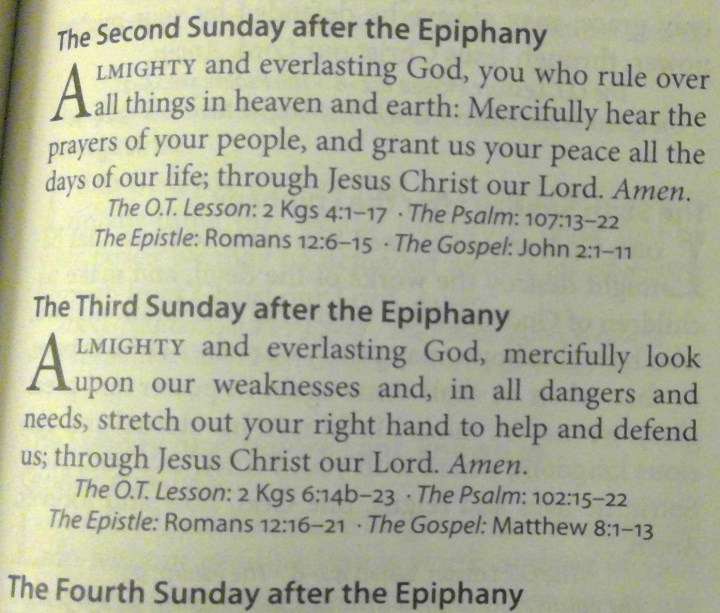
The Communion lectionary, too, is assembled in what I consider the best way possible: united with the Collects.  The traditional Prayer Books printed the Collect, Epistle, and Gospel each in full text together for every Sunday and Holy Day of the year.  This makes a book quite lengthy of course, so the space-saving option (and especially smart in this age of multiple options for Bible translations) is to print the Collect with the verse references for the lessons.  Behold:
win_20190222_19_21_08_pro.jpg

In my opinion, this is what the 2019 Prayer Book ought to do.  Granted, with a 3-year lectionary you’d need to specify “Year A: OT, Psalm, Epistle, Gospel“, but that wouldn’t take up a ton of space and would cut out an extra bit of page-flipping situation from having the Collects and Lectionary in two different places (like the 1979 book does).  I fear this is not a lesson our book will learn, though I did suggest it to them a couple times.

Also, this book is noteworthy for adding an Old Testament lesson & Psalm to the historic lectionary which featured only an Epistle & Gospel.  This, I believe, was the right way to contemporize the Communion lectionary, not rehash another version of the modern (or modernist!?) 3-year lectionary, as the 2019 book is doing.

The ratings in short:

Accessibility: 3/5
While not as simple as traditional Prayer Books, this book still has a relatively small learning curve.  As I noted above, its primary hindrances are due to presentation, not structure.

Devotional Usefulness: 4/5
Although some features in this book lean in the low-church direction, it still has everything you need for an Anglican devotional life.  The lectionaries are sound and the daily prayers are thorough.  It lacks all the bells and whistles of modern Prayer Books (such as special liturgies for Palm Sunday and similar days), but that’s not an issue for personal use.

Reference Value: 2/5
This book has had a relatively low impact in American Anglican liturgical development; I’ve never met anyone who uses (or used) it as their congregation’s primary prayer book.  I’ve known someone who used its daily lectionary, and I’ve known a church that uses its additions to the historic Communion lectionary, but never the book wholesale.  Really, apart from the added lessons to the Communion lectionary, this book has nothing to offer the liturgical world.  There are quite a few modern adaptations of the old liturgies out there, these days, making this book feel like one of the most redundant prayer books on my shelf.

At the end of the day, this isn’t a book I’d recommend adding your liturgy collection unless

  1. you really like collecting different prayer books, or
  2. your parish uses the historic lectionary and you want an OT & Psalm added, or
  3. you like studying different ways traditional language can be modernized.


A Pre-Lent Hymn: Come, labor on!

Although we don’t officially have the Pre-Lent season on the books, there’s no reason we can’t learn from that mindset and explore ways of incorporating the old wisdom of the church into modern practice.  For example, let’s consider a hymn that encapsulates something of the Pre-Lent spirit.

Come, labor on.
Who dares stand idle on the harvest plain
while all around him waves the golden grain?
And to each servant does the Master say,
“Go work today.”

Come, labor on.
The enemy is watching night and day,
To sow the tares, to snatch the seed away;
While we in sleep our duty have forgot,
He slumbered not.

Come, labor on.
Away with gloomy doubts and faithless fear!
No arm so weak but may do service here;
By feeble agents, may our God fulfill
His righteous will.

Come, labor on.
Claim the high calling angels cannot share;
to young and old the gospel gladness bear.
Redeem the time; its hours too swiftly fly.
The night draws nigh.

Come, labor on.
No time for rest, till glows the western sky,
till the long shadows o’er our pathway lie,
and a glad sound comes with the setting sun,
“Servants, well done!”

This song links to the Gospel both on Septuagesima Sunday (Matthew 20, the parable of the successively-hired laborers in the vineyard) and on Sexagesima (Luke 8, the parable of the sower and four types of soil).  The call to join in the Lord’s labor, to bear fruit, to put in our all for Christ, is excellent preparatory thematic material to rally the troops, as it were, before the spiritual disciplines of Lent begin.

It may already be too late to appoint this hymn for your Sunday morning worship services in the next two Sundays, but there’s nothing stopping you from using it on your own and recommending it to others as a great-ready-for-Lent sort of devotion!