Reading Acts at this time of year

We saw a few weeks ago how the book of Acts has a prominent place in the modern Communion lectionary through Easter week.  We’ve seen that the book of Acts may be read from in place of the Old Testament lesson through Easter season.  Now it’s time to look at why Acts shows up at this time of year, in the Communion lectionary, and at none other time.

The book of Acts holds a unique position in the canon of Scripture.  It is not an Epistle, nor is it a Gospel.  It’s like the Epistles in that it’s looking at the life of the Church after Jesus ascended; it’s like the Gospels in that it’s a collection of narratives.  Its very introduction makes it out to be a sort of sequel to the Gospel according to Saint Luke.  Ultimately its literary contribution to the Bible is much more like the historical books of the Old Testament – showing us the power and presence of God in the world through his people.  That likeness, perhaps, is why the book of Acts is almost always provided in place of the Old Testament lesson in the Communion lectionary.

As for the time of year… Acts has a particular focus on the life of the Church immediately after the Gospel work of Christ Jesus.  It re-tells the story of his ascension, it tells the story of the Day of Pentecost, and provides first-hand insight into the immediate history of a few of the apostles, as well as some of the missionary and church-planting ministry of St. Paul and others.  As the great feast of Easter (due in part to the ancient custom of holding baptisms at the Easter Vigil) has a particular liturgical emphasis on new life in Christ, it was only natural that the book of Acts came to be a go-to book in the season following.  Let’s take a look at how the book of Acts is read in the ACNA Sunday Communion lectionary:

Year A

Easter II – 2:14a, 22-32 – Peter preaching Christ from the Old Testament
Easter III – 2:14a, 36-47 – Peter preaching repentance unto faith in Christ
Easter IV – 6:1-9, 7:2a, 51-60 – diaconate established, Stephen martyred
Easter V – 17:1-15 – Paul is attacked for preaching the Gospel to Greeks as well as Jews
Easter VI – 17:22-34 – Paul preaches to the Gentiles
after Ascension – 1:1-14 – the ascension of Jesus

Year B

Easter II – 3:12a, 13-15, 17-26 – Peter preaching repentance unto faith in Christ
Easter III – 4:5-14 – Peter and John examined by the Jews for healing in the name of Jesus
Easter IV – 4:23-37 – the church rejoices and grows in generosity
Easter V – 8:26-40 – Philip preaches to and baptizes the Ethiopian eunuch
Easter VI – 11:19-30 – the church grows among Gentiles and is generous abroad
after Ascension – 1:15-26 – the replacement of Judas with Matthias

Year C

Easter II – 5:12, 17-22, 25-29 – the apostles are arrested for preaching Christ
Easter III – 9:1-19a – Saul (to be Paul) converts on the road to Damascus
Easter IV – 13:14b-16, 26-29 – Paul preaches Christ mostly from the Old Testament
Easter V – 13:44-52 – Paul is abused for his conviction to preach to the Gentiles
Easter VI – 14:8-18 – Paul and Barnabas heal a cripple
after Ascension – 16:16-34 – Paul exorcises a demon, is imprisoned, and preaches to his jailer

Noting the Patterns

If you just look at the chapter and verse numbers, it’s hard to see there’s any rhyme or reason to these tours through Acts.  But when you note what those readings contain, similar contours can be traced in each of the three years of the lectionary cycle.  The first three Sundays mostly follow a pattern of preachingresistancetriumph & growth.  Easter V and VI then deal with the spread of the Gospel among the Gentiles, typically to the chagrin and anger of the Jewish synagogue members.

The odd Sunday in this sequence is the Sunday after the Ascension.  In Year A it just repeats the Acts 1 lesson from Ascension Day; in Year B it (sensibly) deals with something that occurred between the ascension and Pentecost.  But in Year C it seems to be rolled into the Eastertide progression of readings from Acts, noting some of Paul’s ministry (and abuse) among the Gentiles.

Advice

When preparing for Eastertide and the Sunday after Ascension, the preacher(s) ought to make a decision: either commit to using the Acts readings each Sunday along the way, or commit to using none of them during this period.  These readings are not paired with the Gospel or Epistle, much less the Collect of the Day, but form a sequence of five or six Sundays exploring the spread of the Gospel from the apostles to the Jews to the Gentiles.  Whether they are the preaching focus or not, they form a sequence that ought to be carried through from start to finish, if they are to be used at all.

In my case, I was committed this year to preaching the “Epistle” texts from Revelation, so I opted not to use the Acts lessons, preferring to have OT lessons that would match the Gospels so there’d be more unity to the liturgy on a given day.

Whatever you decide is appropriate, be sure you stick with it through the season to maximize the liturgical benefit, one way or the other!
Book Review: Book of Common Praise 2017

Welcome to Saturday Book Review time! On most of the Saturdays this year we’re looking at a liturgy-related book noting (as applicable) its accessibility, devotional usefulness, and reference value. Or, how easy it is to read, the prayer life it engenders, and how much it can teach you.

Sadly, the ACNA has no province-wide plan for creating a new hymnal. This makes sense – different congregations have their favorite hymnals (often the 1940 or the 1982), and the growing preference for contemporary praise music is not especially conducive to printing in a book considering the majority of it is released as lead sheets (lyrics & chords) that only rarely include a written melodic line, let alone a written-out accompaniment.

However, one of the sub-jurisdictions of the ACNA, the Reformed Episcopal Church (REC), has has recently released an official hymnal for their churches: The Book of Common Praise 2017. It was brought to my attention in late 2017, soon after it was released, and my church and I got our hands on a box of copies the following summer. I intended to wait a few months to study this new hymnal on my own before switching over to it (in part in case I decided not to switch!) but my congregation seemed eager to use books that weren’t physically older than their Vicar, so we dove in pretty quickly.

Their immediate reactions were positive: the print is slightly larger and clearer than the 1940 hymnal.

My immediate reaction was mixed: I didn’t like font and typeface, it reminded me of a hymnal I didn’t particularly like from my congregationalist days. I also found that two hymns I really like were omitted from this book: Christ the fair glory of the holy angels (a fantastic song for Michaelmas) and Therefore we before him bending (a gloriously pious set of lyrics for Holy Communion, sometimes set as their own song and sometimes appended to the hymn Now my tongue the mystery telling).

But these losses were soon mostly balanced out by the inclusion of other songs missing from previous hymnals such as Amazing Grace! and of some newer songs I like such as In Christ alone my hope is found and Before the throne of God Above. (Technically Before the throne is a 19th century hymn but it was given a new melody in 1997 and thus repopularized amidst the Contemporary Christian Music crowd for a decade or so, which is the version found here.)

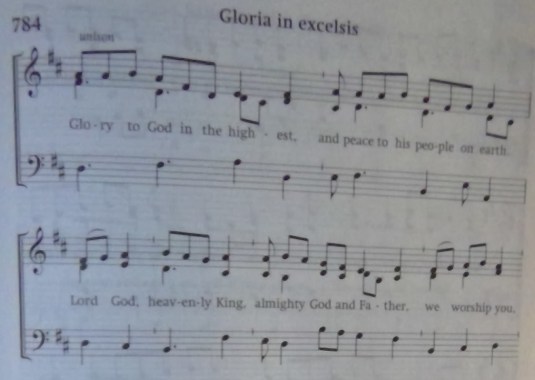
This hymnal puts the service music (including several settings of Anglican chant!) in back of the regular hymns, avoiding the formatting annoyance of the 1982 hymnal, which is an excellent decision. Its settings of various parts of the liturgy are still mostly keyed to the traditional-language forms, though there is one contemporary-language setting for the Communion service parts. I’ve tried the Gloria in excelsis with my congregation and it works fine.

WIN_20190517_14_11_02_Pro (2)

Another feature of this book, which I very much appreciate, is that they made a point of improving the balance of the number of hymns for each season of the church year. (You may recall the 1940 hymnal has an enormous glut of Christmas songs and a deplorable dearth of Advent and Lent songs!) Here’s the breakdown of the hymns in this 2017 book:

#1-198 The Church Year

  • Advent (26); Christmas (56); Epiphany (12); Lent (10); Passiontide (18); Easter (26); Ascension (13); Whitsunday [Pentecost] (5); Trinity Sunday (1); Saints’ Days and Holy Days (17); All Saints (10); Martyrs (4)
  • Hymns of Thanksgiving (11); National Hymns (9)

#219-251 The Daily Office: Morning (15); Evening (18)

#252-320 Sacraments and Other Rites

  • Baptism (5); Holy Communion (37); Confirmation (6); Matrimony (3)
  • Ordination and Ember Days (4); Consecration of a Church (5); Burial (3)

#321-639 General Hymns

  • The Holy Trinity, Praise to God, Jesus (Advent of, Life & Ministry, Name of, Help of, Praise to), Holy Spirit, Holy Scripture, Church, Mission, Christian Vocation, Christian Walk, Christian Warfare, Christian Duty, Penitence, Kingdom of God, The Lord’s Day, Church Triumphant

#640-800 Service Music

  • Index, Explanation of Anglican Chant
  • Daily Office Sung Responses, Canticles
  • Explanation of Simplified Anglican Chant, Simplified Anglican Chants (12)
  • Holy Communion: 5 Complete Services, plus Miscellaneous

Then follow 68 pages of Indices (indexes)!

There is so much in this book, it’s amazing. The liturgical index is excellent: it suggests hymns to match with the OT, Epistle, and Gospel lesson of each Sunday in the year as well as the Collect of the Day! Of course, this is for the REC Prayer Book, which uses the traditional one-year cycle of Collects & Lessons, so you really have to do your homework in order to “translate” that index into the modern ACNA 3-year lectionary cycle.

The season of Lent is still vastly underrepresented compared to the other seasons of the year, but that is compensated for the fact that the “Penitence” section of the General Hymns here include 21 hymns, which is a lot more than either of its predecessor books.

The Preface and introductory notes are also pleasantly specific about the process and goals that went into the creation of this book, reflecting a transparency similar to how the ACNA’s liturgical task force went about assembling the 2019 Prayer Book. Although, because this book was made by and for a relatively smaller group of people, the hands of its chief editor are a bit more visible than I would have expected – a number of new songs written or arranged by him have stood out to me in my exploration of this book over the past nine months.

The rating in short…

Accessibility: 4/5
The sections are well-labeled both in the Table of Contents and within the pages of the book so you can see where you are as you flip through. The collection of indexes are very comprehensive and hardly leave a stone unturned. If your church uses the traditional one-year lectionary, this is a 5/5, but for those of us (the majority) who don’t, the fact that it’s keyed to that different set of readings is a bit of a complication.

Devotional Usefulness: 5/5
The only thing it lacks, from my perspective, is more than a single option for modern-language Communion liturgy musical settings. There is so much devotional opportunity here, and it’s much better balanced than the 1940 or 1982 hymnals still in use today.

Reference Value: 5/5
Every index a music planner could need is in here. You can probably find some beloved hymns it lacks, but at 639 hymns (albeit doubling entries with an alternative melody choice) it’s got the larger portion of classic and recent Anglican hymnody.

In all it’s not quite a perfect hymnal, but it is absolutely the best one I’ve ever seen, held, or used. The ACNA does not have an official hymnal, but this is the book that I would heartily promote to fill that role.

A Canticle for Eastertide

We’ve already looked at the Pascha Nostrum, but there are other ways to distinguish the Easter season in the Daily Office!  Among our Supplemental Canticles provided at the end of the Daily Office section of the Prayer Book are four that are labeled as appropriate for the Easter season.

#1 Magna et mirabilia (Song of the Redeemed, Rev. 15)

The rubrics indicate this canticle is appropriate both for Advent and for Easter.  Since Advent has fewer options, this Customary recommends this canticle serve as the first canticle during Advent, rather than Easter.

#5 Cantemus Domino (Song of Moses, Ex. 15)

This canticle is a prime choice for the Easter Vigil as a response to the reading of the crossing of the Red Sea.  And it’s also great for the Daily Office – consider making use of it as an alternative to the Te Deum on weekdays throughout the season!

#6 Dignus es (Song to the Lamb, Rev. 4 & 5)

This canticle is indicated as being appropriate both for Eastertide and Ascensiontide.  This customary appoints Canticle 6 in place of the Te Deum in Morning Prayer for the weekdays starting on Ascension Day through Pentecost Week.

#7 Cantate domino (Sing unto the Lord, Ps. 98)

Historically, this canticle was appointed as the alternative for the Magnificat, presumably for the days on which that text, the Song of Mary, was appointed to be read in the New Testament lesson.  That is how this Customary recommends Canticle 7 continue to be used, and thus not have a particularly Easter-related role.

Nunc Dimittis doing double duty

Most liturgical ingredients in the Prayer Book tradition are set into one particular function with little or no variance.  The Daily Office has its own opening and closing sentences, the Communion liturgy has its own acclamations and dismissals, each major liturgy has its own prayer of confession (though the rubrics now allow cross-pollination  to some extent), and every canticle has its particular home.

But the Nunc dimittis has two appointments in the Prayer Book, such that it’s even printed in the book twice.  It is the second canticle of Evening Prayer, and it is the anthem/canticle in Compline (the night office).  This is a particularly odd repetition, since Evening and Compline are both pretty similar in function and usually near one another in time (evening, bedtime).

The reason for this is that in the English Reformation when Archbishop Thomas Cranmer assembled the first Common Prayer Book he reduced the monastic offices from seven in the day and one at night down to two: Morning (Matins) and Evening (Vespers).  There are elements of three monastic morning offices wrapped up in Anglican Morning Prayer, and elements of Vespers & Compline wrapped up in Anglican Evening Prayer.

So what happens when you try to bring back in one of those “extra” monastic offices?  You get little hints of repetition with the Anglican Daily Office.  In the case of the Nunc dimittis its original home was the night office, Compline, which the Prayer Book tradition rolled into Evening Prayer.  Thus in modern books that bring Compline back to Anglican liturgy, we’ve got a situation where the Nunc dimittis has two homes.

If this doesn’t bother you, well and good.  But if you are someone who regularly prays both Evening Prayer and Compline, and desires to highlight separate identities for both offices, then there is something you can do about that: the 2019 Prayer Book has an appendix to the Daily Office section labeled Supplemental Canticles for Worship.  This is an expansion of what earlier Prayer Books (before 1979) did: offering usually two options of a Canticle for each slot (that is, position of response after each reading in the Morning & Evening offices).  Now, instead of 8 or 9 total Canticles with specific directions on which ones to use where, we have 15 Canticles, 10 of which provide minimal guidance as to their expected use.  If you want to make use of these and reduce the repetition of the Nunc dimittis between Evening Prayer and Compline, consider the following pattern of alternatives:

The Second Canticle, the Nunc dimittis, is to be recited on Saturdays and Sundays, and on other days throughout the year not superseded by the following.

Canticle 4, the Quaerite Dominum, is to be used in its place on the First Sunday of Advent and on weekdays throughout the season.

Canticle 3, the Kyrie Pantokrator, is to be used in its place on Ash Wednesday, the First Sunday of Lent, Palm Sunday, and every weekday throughout the season.

Canticle 9, the Deus misereatur, is to be used in its place on Monday through Friday during Epiphanytide and Trinitytide, and on the occasion that the text of the Nunc dimittis is part of the New Testament Lesson.

Book Review: The 1982 Hymnal

Welcome to Saturday Book Review time!  On most of the Saturdays this year we’re looking at a liturgy-related book noting (as applicable) its accessibility, devotional usefulness, and reference value.  Or, how easy it is to read, the prayer life it engenders, and how much it can teach you.

Like many traditionalists, I don’t really like this hymnal.  So let’s make a point of starting with the positives.

+1 It matches the contemporary rites.  Made to pair with the 1979 Prayer Book, this hymnal is the first in the Episcopalian tradition to feature contemporary-language Service Music.  Carried into the ACNA, this remains a useful feature.  A few translation elements have changed since then (“And also with you” has returned to the properly historical and biblical “And with your spirit” for example), but for the most part those discrepancies are easily adapted from the 1979 liturgy to the 2019.

+2 It has a lot of options for service music.  In total there are 288 chant tunes and melodies for the various Office Canticles and Prayers, Mass parts, and other commonly-sung parts of the Office and Communion liturgies.  Add in the fact that it retains some traditional-language material alongside the contemporary, and you’ve got yourself a large collection of choices and resources built in to the hymnal.  This is very empowering for a choir or congregation, having so many possibilities accessible in one volume without having to purchase expensive choir music or whatever else.

+3 It brings in a few popular hymns that the previous hymnal lacked.  I commented last week that the 1940 hymnal doesn’t have Amazing grace! in it; this book does.  And, with a total of 720 hymns (compared to 600 in the 1940), this hymnal didn’t have to sacrifice a ton of songs in order to make room for new and imported ones.

But there are a number of shortcomings to this hymnal.  Depending upon your preferences and views, some of these might be minor or major to you; I’ll list what I consider to be the main offenders.

-1 The formatting is inconsistent.  Sometimes you get a fantastic four-part-harmony arrangement complete with the last verse’s descant on top, making for an excellent resource for congregation, choir, and keyboardist alike.  But sometimes you just get a melody line with no accompaniment.  If you want to play along on the piano or organ, too bad, you’ve got to purchase the giant TWO-VOLUME accompanist edition of the hymnal.  Ain’t nobody got time fo’ dat.  Plus, a lot of the hymns in this book are printed with uneven line or page jumps.  You can see the range of good and bad in this sample:

WIN_20190508_13_11_30_Pro

-2 A number of classic hymns have undergone changes to the lyrics.  To some extent, yes, there is a longstanding history of lyrics getting edited for reasons of theological preference or for clipping long songs into shorter versions.  But this hymnal goes a few steps too far, doing violence to the poetry of classic songs in the interest of gender-neutral language.  Perhaps the most prominent offender is Be thou my vision.  The second verse reads:

Be thou my wisdom, and thou my true word;
I ever with thee and thou with me, Lord;
thou my great Father; thine own may I be;
thou in me dwelling, and I one with thee.

compared to the original:

Be thou my wisdom, and thou my true word;
I ever with thee and thou with me, Lord;
thou my great Father, I thy true son;
thou in me dwelling, and I with thee one.

The theological implication (not to mention biblical language) of sonship is discarded.  The assurance of belonging in Christ (“thy true son”) is replaced with aspiration (“may I be”).  Plus, for the many, many people who already know the original version, this is a constant tripping point, stumbling over these awkwardly re-worded phrases.  Come thou fount of ev’ry blessing is also subject to some distracting word changes, and I’m sure there are other examples I haven’t found on my own.

-3 The ordering of the music is awkward.  Unlike the 1940 hymnal, the Service Music is printed in this book first.  If you’re in a choir, or the congregation uses the service music section a lot, that’s fine.  But if, like in many places, it’s primarily a book to pick up in order to sing hymns, this can be annoying (and downright confusing for newcomers), having to flip past S1 thorugh S288 before getting to hymn #1.

Furthermore, the hymns aren’t organized as logically as they could be.  Simplifying the Table of Contents…

  • #1-46 The Daily Office (Morning, Noon, Evening, Compline)
  • #47-293 The Church Year
  • #294-299 Holy Baptism
  • #300-347 Holy Eucharist
  • #348-361 Confirmation, Marriage, Burial, Ordination, Consecration
  • #362-634 General Hymns
  • #635-709 The Christian Life
  • #710-715 Rounds and Canons
  • #716-720 National Songs

Why Rounds and Canons need their own section, and why National Songs aren’t appended to the Church Year section, is beyond me.  The separation of The Christian Life from the related sub-sections of the General Hymns also seems strange to me.

Last of all, I should point out that the indexes are rather limited in this book compared to a number of others.  It has no liturgical index, recommending hymns for particular Sundays and Holy Days like in the 1940, but that is to be expected with the lengthy and complex 3-year lectionary cycle.  However, this hymnal also lacks a metrical index, which is admittedly probably only an issue for creative music ministers who want to look at alternative tune possibilities and make particularly detailed comparisons.

The rating in short…

Accessibility: 3/5
It’s well-labeled and has the basic Table of Contents and index that you need.  But you’ll probably need those resources more than you would with other Anglican hymnals.

Devotional Usefulness: 3/5
It has the positive usefulness of providing service music and additional hymns that older hymnals don’t or can’t provide.  But the liberal hand of editing has left its mark, which tampers with (and occasionally ruins) a number of hymns along the way.

Reference Value: 4/5
Compared to its predecessors, the extra-large collection of Service Music makes this hymnal rather handy to have around, especially for the contemporary-language worshiper.  And, with 720 hymns, it’s just plain got a lot of music in it too, lyrical tampering and format problems notwithstanding.

Ultimately, this hymnal is one I would recommend for two groups of people: choristers or congregations who routinely set many parts of the liturgy to music/chant, and music ministers who want to draw upon this book as a supplementary resource.  I would not recommend this hymnal as an ordinary hymnal for a church, especially considering the financial commitment for the accompanist who’ll need an extra $80 for that edition.

No Friday Fast Yet

Hey, TGIF y’all! I’m sure you’re all excited for the weekly Friday fast. I hate to disappoint you, but I’ve got to remind you, there is no fasting on Fridays this season. (Unless some extraordinary circumstances arise, I suppose.) As it says in the calendar section of our prayer book, on page 689:

The weekdays of Lent and every Friday of the year (outside the 12 Days of Christmas and the 50 days of Eastertide) are encouraged as days of fasting. Ember Days and Rogation Days may also be kept in this way.

Fasting, in addition to reduced consumption, normally also includes prayer, self-examination, and acts of mercy.

So, during the 50 days of Eastertide (which includes the mini-season of Ascensiontide) we are not to fast: this is a season of feasting! Keep finding and enjoying that discount Easter chocolate and candy! Don’t be skimpy with that bottle of single malt or gin that your new favorite parishioner* bought you for Easter! Choose that nicer meal at the restaurant, give that server a bigger tip, and if you’re feeling really counter-cultural keep saying “Happy Easter!” to people.

Because, as we keep saying in church, Christ is risen; the Lord is risen indeed! It’s not just a church thing, it’s a liturgical thing, and that means we all can be involved. Remember how Ebeneezer Scrooge learned to keep Christmas in his heart every day of the year? If he could do that, surely you can keep Easter in your heart for 40 or 50 days!

(Okay, yes, some of you readers might be getting up-in-arms about whether Easter is 40 or 50 days long. We’ll deal with that later, I promise. For now, hush up and go eat more chocolate.)

* Sadly, this is purely a hypothetical situation. Oh well, there’s always next year, haha!

Hymn: the way, truth, life

There’s a perfect hymn for Saints Philip and James Day which works perfectly with both the Collect and the Gospel lesson:

1 Thou art the Way: to thee alone
from sin and death we flee;
and he who would the Father seek,
must seek him, Lord, by thee.

2 Thou art the Truth: thy Word alone
true wisdom can impart;
thou only canst inform the mind,
and purify the heart.

3 Thou art the Life: the rending tomb
proclaims thy conquering arm,
and those who put their trust in thee
nor death nor hell shall harm.

4 Thou art the Way, the Truth, the Life:
grant us that Way to know,
that Truth to keep, that Life to win,
whose joys eternal flow.  Amen.

This lovely reflection on Jesus as the way, truth, and life, is an excellent pairing with yesterday’s holy day.  And also, as I commented in that post, the 5th Sunday of Easter will also be a good candidate for singing this hymn, as its collect is derived from the traditional collect for Philip & James.  Check it out; consider appointing it for your church’s worship service that day if you’re on the modern calendar; or just enjoy it on your own!

The Easter Anthems – Pascha Nostrum

The Pascha Nostrum is a beautiful set of anthems that Anglican tradition uses at Easter.  It is built upon three scriptural references: 1 Corinthians 5:7-8, Romans 6:9-11, and 1 Corinthians 15:20-22, each bookended with an Alleluia for good measure.

It has always been in Anglican Prayer Books, but its location has changed in modern practice.  Traditionally, it was placed among the Propers (the Collects and Lessons), for Easter Day; in modern books it is placed in the Morning Prayer liturgy.  It’s interesting to note how the rubrics for this canticle have changed over the years.

1662 BCP:

At Morning Prayer, instead of the Psalm: O Come, let us, &c. these Anthems shall be sung or said.

1928 BCP:

At Morning Prayer, instead of the Venite, the following shall be said, and may be said throughout the Octave.

2019 BCP:

During the first week of Easter, the Pascha Nostrum, without antiphons, is used in place of the Invitatory Psalm, and it may be used throughout Eastertide.

What stays the same? its function.  This Canticle is always used in place of the Venite in Morning Prayer.  What has changed? its duration of use.  The implication back in 1662 is that this canticle (or set of anthems) only gets used on Easter Day.  By 1928 in the US, it was authorized throughout the octave – that is, the first eight days of Eastertide.  Now, it is appointed (not merely authorized) throughout Easter Week and authorized for the rest of Eastertide.  With this increased anticipated use, it’s no wonder that modern prayer books have opted for printing this canticle directly in the Morning Prayer liturgy, so it’s more accessible!

There is also a custom in some places of using the Pascha Nostrum in place of the Gloria in excelsis Deo near the beginning of the Communion service, under the modern rubrics that allow other hymns of praise to take its place.  Especially in church cultures where nobody is really praying the Daily Office, this can be a great way of introducing elements of the Office liturgies to the congregation.  Such points of contact and familiarity will prove helpful when trying to make that move toward teaching people to pray the Office.

So many Psalms!

There are a lot of Psalms kicking around this time of year.  Today, Good Friday, has quite a few available to us.  In the classical Prayer Books this was one of the very few days in the year that got its own set of Psalms for the Daily Office, interrupting the 30-day cycle.

Morning Prayer: 22, 40, 54
Evening Prayer: 69, 88

Looking at the modern liturgy of our 2019 BCP, it’s not quite as heavy-handed on the Office, but the options still give a similar range:

Friday Morning Prayer: 40
Good Friday Service: 22 or 40:1-16 or 69:1-22
Friday Evening Prayer: 102

Saturday Morning Prayer: 88
Holy Saturday Service: 130 or 88 or 31:1-6
Saturday Evening Prayer: 91

You’ll notice that there is a little overlap between the Psalms offered in the primary service and the Psalms offered in the Daily Office, and a lot of overlap with the traditional Prayer Book Psalms.  Although the execution and placement has changed, it’s nice to see that the contents of our venerable tradition have not been lost entirely.

If you’re a worship planner for your congregation, you should observe that the primary worship service for Friday and Saturday in the Triduum offer three choices of Psalms… and our lectionary has a three-year cycle.  This is not presented as a rule, but it is a logical assumption that we should cycle between those three Psalms year by year.  If you want to cast an eye back to general Western tradition, the Gradual Psalm for Good Friday was from Psalm 54 and Psalm 42 for Holy Saturday, neither of which are appointed in our Prayer Book.  You could, however, add them to the Daily Office Psalmody on their proper days (the former is already there in the classical Prayer Books anyway).

Furthermore, whether you’re a worship planner or not, something anyone can do is add Psalms to the recitation of the Daily Office on one’s own.  Assuming you’re able to know what Psalm the main liturgy at church will use later today, you can fill in the other Psalm options to your recitation of the Office.  So if Psalm 69 is featuring at the Good Friday liturgy today, then consider adding Psalm 22 to Morning Prayer; perhaps you can grab Psalm 54 from the classical Prayer Books also, to add to Evening Prayer.

Same deal with Holy Saturday; take a look at the Psalms appointed, and consider how you might use up ones “left out” this year.  I mean, hey, it’s the Triduum… there’s no such thing as praying too much on days like these!

Hold Your Peace

One Holy Week tradition that does not get a shout-out in the Prayer Book but has a standard following in some places is the practice of omitting The Peace after the Confession & Absolution in the Communion service.  The rubrics of our Prayer Book do not provide for such an omission, so it is a tradition that should only be adopted by the permission of your diocesan Bishop.

Or, if you want to explore this option without breaking the rubrics, keep the verbal exchange of peace (Celebrant The Peace of the Lord be always with you. People And with your spirit.) but halt the further exchange of peace, which the rubric identifies as optional: “Then the Ministers and People may greet one another in the Name of the Lord” (underline added).

The idea behind this practice is that in the Garden of Gethsemane Judas betrayed Jesus with a kiss (Matt. 26:48-49, Mark 14:44-45, Luke 22:47-48).  As I wrote to my congregation a couple years ago:

This normal, friendly, even reconciliatory part of the liturgy is such a regular part of the service that its omission can be something of a shock, even a disappointment to some people.  The reason for its omission, though, is significant: in the Garden of Gethsemane, Jesus was betrayed by Judas with a kiss.  Normally a sign of greeting and peace, Judas transformed it that night into a sign of betrayal and the marking of a target for the soldiers to arrest.

Thus, on Palm Sunday and throughout Holy Week, we also “hold our peace,” as it were.  We remember the wicked deception of Judas, and remind ourselves that we, also, all to easily use signs of peace as covers for internal hatred.  How easily we lie through our teeth to “get along” while harboring ill will towards our neighbor.  Or, how easily we go through the motions of the liturgy while harboring a coldness of heart against our Lord and our God!

It is also worth noting that the exchange or passing of the peace is not an element in traditional Prayer Book worship.  Until the liturgical revision of the mid-20th century, it simply was not a part of the liturgy for us.  Understanding that it is a modern insertion to our liturgy, between the Comfortable Words and the Offertory, may perhaps give us further cause for consideration as to how our liturgy works, what elements are truly needed and important, and hone our interaction with it.