The Fraction: when to break the bread

On the night that he was betrayed, our Lord Jesus Christ took bread; and when he had given thanks, he broke it*…

And so when we celebrate Holy Communion, to this day, the celebrant breaks the bread.  The question we’re looking at in this entry in the walk-through of the Communion liturgy is when to break the bread.  The rubrics in the 2019 BCP, immediately above the words of institution in the prayer of consecration (pages 116 and 133) read thus:

At the following words concerning the bread, the Celebrant is to hold it, or lay a hand upon it, and here* may break the bread; and at the words concerning the cup, to hold or place a hand upon the cup and any other vessel containing the wine to be consecrated.

This is very nearly the only rubric in the prayer book tradition that tells the priest or bishop what to do with his hands during the prayers.  The Roman Rite is very specific – when to elevate, how many signs of the cross to make – but ours is very simple and free.  But the celebrant must touch the bread or the paten, and each vessel with wine to be consecrated.  This is as far as we go (at least officially) regarding the idea of “sacramental intent” – the notion that the priest only consecrates what he intends to consecrate, and nothing by mistake.  Physically indicating that which is to be consecrated for the Holy Communion is thus both an imitation of our Lord’s “taking” before blessing and breaking, as well as an act of verification regarding exactly what is about to be consecrated.

I have seen Anglican celebrations even by bishop where these rubrics have been ignored… please be sure you heed them!

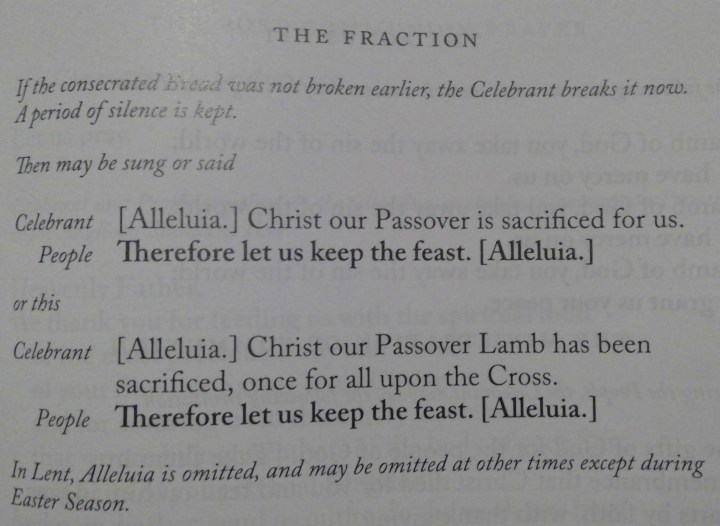
But what’s interesting here for the 2019 Prayer Book is that it says the bread may be broken during the words of institution.  Those who are used to the 1979 Prayer Book’s liturgy may be surprised – there is a distinct “Fraction” or “Breaking of the Bread” soon after the prayer of consecration.  But the classical Anglican pattern is actually to break the bread during the words of institution.  In our new prayer book we have the choice of doing the fraction at this point or as a special act after the prayers of consecration and Lord’s Prayer.  This is what it looks like:

fraction

This is much like what is found in the 1979 Prayer Book and the modern Roman Rite, with the one difference being that instead of the traditional wording of the Pascha nostrum (“[Christ] our passover”) the celebrant can say another version of it.  Why two versions?

  • “… is sacrificed for us” indicates an immediacy to the Sacrifice of Christ.  Some will take this as an acceptably high theology of the sacrament, others may deem it too close to the Roman notion of the sacrifice of the Mass.
  • “… has been sacrificed for us, once for all upon the Cross” puts more scripture verses together to emphasize the Cross and ensure that the people are directed backwards thither in time.

That both are presented as acceptable options here indicate that insofar a present sacrifice can be inferred in the celebration of Holy Communion, it is one that is communicative of the one sacrifice of Christ on the Cross, and not a repeat or addition thereto.  As Anglicans we can speak of a participation in the Holy Communion with Christ’s once-for-all sacrifice, even those of the “lower” Reformed stripe.

If your practice is to make the Fraction at this point, and use these two dialogues, consider using the first one most of the year and the second one during Lent and other occasions where the centrality of the Cross is made more explicit.

Anyway, back to the big question of the day: when should we break the bread?  And why do we have choices?

Option 1: Break the Bread during the Prayers

This is the theological preference of the Calvinists and (I presume) Zwinglians.  By breaking the bread at this point it emphasizes our remembrance of the Last Supper and de-emphasizes any notion of eucharistic sacrifice or offering.  Because most Anglicans-in-exile under Queen Mary’s reign spent their time with French Calvinists, the Elizabethan settlement saw the fraction enshrined in the same place in the liturgy.  So we have this as the standard pattern for every Book of Common Prayer with the probable exception of the original (1549) which doesn’t seem to specify.  Anglican precedent, therefore, pushes us firmly in this direction.  However…

Option 2: Break the Bread after the Prayers

That nice ritual breaking of the bread after the prayers is more historic, being the universal order before the Reformation.  The Lutherans retained it, too, likely due to their higher sacramentology compared to the Calvinists, et al.  And they rejected the Roman notion of eucharistic sacrifice as much as the rest of us, so that ought to assuage those who fear this form of the fraction is too “papist.”  To break the bread at this point, then, is to realign our liturgy with the greater ecumenical and historic consensus.  This is also in the “biblical” order.  Notice what we read: Jesus “took bread; and when he had given thanks, he broke it.”  The sequence is taking, praying, and breaking.  So why should we not let the priest finish “giving thanks” before breaking the bread?

Please Not Option 3: a bit of both

One practice I’ve come across (which seems quite common in my experience, though I haven’t traveled much) is for the celebrant to “snap” the bread during the words of institution without actually breaking it.  This, ideally, adds a dramatic effect in the midst of the prayers.  On my first celebration of the eucharist as a newly-ordained priest, I had perfect beginner’s luck and did this perfectly without breaking the bread on my first Sunday.  It took weeks to replicate that success.  But after a couple years I learned more about the theological reasons for the two different placements of the Fraction.  And so I took the advice given me: choose one point or the other.  People know what breaking bread is, means, and sounds like – you don’t have to pretend to demonstrate it for them, it doesn’t make things more dramatic or meaningful.

Readings Review & Planning Propers 10/21

What we’re doing on this blog on Mondays is looking back and forth at the Daily Office readings (or lessons) so we can better process together what the Scriptures are saying, and list the recommended Propers for the Communion or Antecommunion service for each day of the week.

Readings Review

Last week: 2 Kings 4-9, 1 John – 3 John, 2 Maccabees 8,10, 1 Maccabees 7,9,13,14, Isaiah 1, Matthew 28, Mark 1-3

This week: 2 Kings 10-14, 2 Chronicles 26, Acts 1-5:11, Isaiah 2-8, Mark 4-8:10

Special reading for St. James of Jerusalem’s Day on Wednesday: James 1

As is often the case with biblical authors, the Morning Prayer readings includes the opening section of the saint-of-the-day’s book.  We saw this with St. Luke last week, and St. James this week.  There is some unresolved debate regarding exactly who the various people named James are, in the New Testament, but we can say, regardless of the possible confusions of identity, that the James who became bishop of Jerusalem, whose authority we see in action in Acts 15, is most definitely the author of the Epistle bearing James’ name.

As for the Gospel according to St. Mark, there are a few different ways that this book can be outlined.  One of the simpler theories is that, after a 15-verse introduction, the book is in roughly two “halves”: the demonstration of Jesus’ authority, and the testing of Jesus’ authority (especially his persecution and suffering).  The change from the first half to the second takes place in the latter part of chapter 8, putting our readings this week solely in the first half of the book, and leaving us ready to transition over next week to the push-back, resistance, and persecution that would lead to the death of our Lord.  So for now, consider the Gospel lessons to be various stories that show us the divinity of Jesus in his ministry.  Next week, we’ll see that claim put to the test…

Planning Propers

This is the week of Proper 24 (or 18th after Trinity in the traditional calendar), so keep in mind that the historic Prayer Book default is that a mid-week Eucharist will repeat the Collect & Lessons (the propers) for yesterday.  Otherwise, we recommend…

  • Monday 10/21 = Votive *
  • Tuesday 10/22 = Votive
  • Wednesday 10/23 = SAINT JAMES OF JERUSALEM
  • Thursday 10/24 = Votive
  • Friday 10/25 = Votive
  • Saturday 10/26 = St. Alfred the Great

* A Votive is a “Various Occasion” (page 733 in the BCP 2019).  The traditional appointments are Holy Trinity on Sunday, Holy Spirit on Monday, Holy Angels on Tuesday, of the Incarnation on Wednesdays, of the Holy Eucharist on Thursdays, the Holy Cross on Fridays, and of the Blessed Virgin Mary on Saturdays.

Celebrating Saint Luke’s Day

Happy Saint Luke’s Day!

How do we observe this day with the 2019 Prayer Book in hand?  I thought you’d never ask….

Morning Prayer

At the Invitatory (Psalm 95) use the antiphon for “All Saints’ and other major saints’ days” on page 30.

For the Canticles, use the traditional celebratory Te Deum laudamus and the Benedictus.

The second lesson is special for this holy day: Luke 1:1-4.  It’s very short, but it “introduces” St. Luke to us in the very first worship service of the day.

Use the Collect of the Day for St. Luke’s Day, not Proper 23.

It’s still Friday, so don’t forget the Great Litany at the end of Morning Prayer.  You can even name St. Luke in its commemoration of the saints near the bottom of page 95.

Holy Communion or Antecommunion

Use the Acclamation for All Saints’ Day: “Worthy is the Lord our God…

Make sure you include the Gloria in excelsis and the Nicene Creed, as this is a major feast day.

The lessons and Psalm are Ecclesiasticus (Sirach) 38:1-14, Psalm 147:1-11, 2 Timothy 4:1-13, and Luke 4:14-21.

At the end of the Prayers of the People, feel free to name St. Luke in the fill-in-the-blank spot when mentioning the fellowship of the Saints.

Consider using Galatians 6:10 as the Offertory Sentence (page 149).

The Proper Preface to be used is the one for All Saints’ Day.

Midday Prayer

Consider using Psalm 125, as it is a festive option in the rubrics.

Evening Prayer

For the Canticles, use the traditional Magnificat and the Nunc dimittis.

If you use the second set of Suffrages on page 48, name St. Luke in the commemoration of the Saints.

Use the Collect of the Day for St. Luke’s Day, not Proper 23.

Check your hymnal for a song pertinent to St. Luke’s Day to sing or read as the anthem after the three Collects!

Two (and a half) Communion Rites?

One of the most noteworthy features of the 2019 Prayer Book is the fact that it has two Communion Rites: the “Anglican Standard Text” on pages 105-122 and the “Renewed Ancient Text” on pages 123-138.  The former is drawn from the historic Prayer Book tradition, especially from the American 1928 book, the latter is based upon On the Apostolic Tradition attributed to Hippolytus of Rome, which can be read online, and which I commented upon in a recent book review.

What follows is some commentary and comparison on the rites that we have.  If you want to get straight to the “practical advice” portion of this entry, skip down to the end.

As the 2019 Prayer Book introduces these two rites on page 104

The Anglican Standard Text is essentially that of the Holy Communion service of the Book of Common Prayer of 1662 and successor books through 1928, 1929, and 1962.   The Anglican Standard Text is presented in contemporary English and in the order for Holy Communion that is common, since the late twentieth century, among ecumenical and Anglican partners worldwide.

The Renewed Ancient Text is drawn from liturgies of the Early Church, reflects the influence of twentieth century ecumenical consensus, and includes elements of historic Anglican piety.

What exactly are the differences between the two rites?  Not many.

  1. The Prayers of the People – the Anglican Standard Text is a modernization of the historic prayers; the Renewed Ancient Text is litany of short biddings to prayer.
  2. The Confession of Sins – the Anglican Standard Text is a modernization of the historic prayer; the Renewed Ancient Text is a shorter prayer taken from the 1979 book.
  3. The Communion Prayers are where the primary differences are to be found.
  4. The words spoken when ministering Communion to the people are different (long and short, respectively).
  5. The Post-Communion Prayer is shorter in the Renewed Ancient Text.

Rubrics permit any of these elements to be swapped out between the two rites.  While some might complain that this adds to the “choose-your-own-adventure” nature of modern liturgy, it also highlights an underlying unity of these two rites.  Their order of service is identical, all the same elements are the there, their theology is meant to be understood as being the same.

Let’s take a look at the Communion Prayers in these two rites, specifically the “eucharistic canon” beginning after the Sursum Corda and Preface.

The Anglican Standard Text has ten paragraphs of text on pages 116-117.  These paragraphs can be summarized as follows:

  1. All praise and glory is yours…”  This is the beginning of the anamnesis, or remembrance, thankfully hailing what Christ has done for us on the Cross.
  2. So now, O merciful Father…” This is the epiclesis, or invocation of the Holy Spirit.  You can read more about that here, as it has quite the history.
  3. At the following words concerning the bread…”  This is a rubric, not spoken text, hence the italics.
  4. For on the night that he was betrayed…”  These are the first half of the Words of Institution, speaking the words of our Lord himself, drawn from 1 Corinthians 11 which may be our oldest written record of such words.
  5. Likewise, after supper, Jesus took the cup…”  These are the second half of the Words of Institution.
  6. Therefore, O Lord and heavenly Father…”  This is a return to the anamesis (remembrance), linking such remembrance to “these holy gifts” of bread and wine.
  7. And we earnestly desire your fatherly goodness…”  The vertical bar on the left margin indicates that this paragraph may be skipped.  There used to be a Long Form and Short Form of the Communion Prayers, but they were so similar that the Short Form was ditched in the 2018 draft, and the solution for a “short form” was to render two paragraphs optional.  It should be noted that in the 1662 book, there were no further prayers after the Words of Institution, so this optional omission also could be understood as an option for those who prefer the shorter 1662 prayers over the longer prayers of 1928.
  8. And here we offer and present to you…” This is the oblation, or self-offering, drawing upon the language of Romans 12:1.  Elements of these sentences are also echoed in the Prayer of Humble Access.
  9. And although we are unworthy…”  Here comes the second optional paragraph, and it carries a penitential tone, also similar to the Prayer of Humble Access.  This is an appropriate place for the celebrant to strike his breast too, as it is a sobering moment to remember that even with a Confession and Absolution behind us, we still approach the throne of grace only on the merits of Christ.
  10. By him, with him, and in him…”  You’ve got to end important prayers with a doxology!

Now let’s see how the Renewed Ancient Text does the job, from pages 132-134.

  1. Holy and gracious Father…”  This, too, begins with an anamnesis, or, remembrance.  Instead of going deep to focus on the Cross, it swings wide to encompass more of the overall Gospel story, practically summarizing the Jesus portion of the Creed.
  2. At the following words concerning the bread…” The exact same rubrics as paragraph 3 are printed here.
  3. On the night that he was betrayed…” Same as #4 above.
  4. Likewise, after supper, Jesus took the cup…” Same as #5 above.
  5. Therefore we proclaim the mystery of faith…”  The “mystery of faith” gives the congregation something to say in the midst of the prayers of consecration, which, I’ve heard, was apparently a demand among some in the mid-20th century…?  Whateverso, this is functionally the same as paragraph #6 above, if less wordy about it.
  6. We celebrate the memorial of our redemption…” This paragraph goes across the page flip, taking us from the anamnesis (remembrance) to the epiclesis (invocation, or calling-down of the Holy Spirit).  The fact that this comes after the Words of Institution instead of before is perhaps the most significant theological divergence between our two Rites.  Read more about that here.  This paragraph also hints at a bit of an oblation, though not as extant as paragraph #8 above.
  7. All this we ask through your Son Jesus…” The same doxology above is repeated here, just with a different lead-up text.

Now, the title of this article says Two and a half Communion Rites…. what’s the half?

Let’s return to the introductory text on page 104 again.

The Anglican Standard Text may be conformed to its original content and ordering, as in the 1662 or subsequent books; the Additional Directions give clear guidance on how this is to be accomplished.

The Additional Directions in question are found on pages 142-143, where you will find the 1662 Order spelled out, section by section.  Even printed in the Anglican Standard Text itself are two footnotes in the Communion Prayers to show how those paragraphs change for the 1662 Order.  In short, paragraph #2 may be omitted and paragraphs #6-10 may be moved to the position of the Post-Communion Prayer.  Perhaps we can explore that in detail in a later article.

What’s interesting to note, here, though, is that the introductory text allows this re-ordering for any classical prayer book, not just the 1662.  So if you want to copy the 1928 Prayer Book’s sequence of Gospel, Creed, Sermon, and have the Offertory before the Prayers of the People in order to allow the Comfortable Words to lead right into the Sursum Corda, you can!  All of that theoretical stuff we’ve explored in those past commentary articles can indeed be used licitly, under the auspices of the 2019 Prayer Book.

Seeing the differences between the Anglican Standard Text and the Renewed Ancient Text, when should we use which?

For the purposes of the Saint Aelfric Customary, there are two principles at work here which give conflicting answers.

  1. A classical Anglican approach
  2. A “completionist” approach

According to the former, one set of advice is that we should always and only use the Anglican Standard Text.  Perhaps skip the omitted paragraphs if you need to save time on the liturgy, or want to evoke the shorter English prayers instead of the longer American ones.

According to the latter, there should be “a time for each rite, and for each rite a time.”  In that view, I would recommend using the Renewed Ancient Text for most of the Advent-Christmas-Epiphany cycle, and on the occasional incarnation-themed holy day at other times of the year, like the Annunciation.  Then use the Anglican Standard Text in the longer Lent-Easter-Trinitytide cycle of the year.

At the end of the day, we’ve got the historical Anglican option, which is narrow-but-deep in its focus on the Cross, and we’ve got the historic reconstruction option, which is shallow-but-wide in its treatment of the Gospel story.  Both have their value and merits, though you will definitely find people, myself included, with a clear favorite of one over the other.  Let me end it this way: in light of our history, we can overlook the Renewed Ancient Text, and on the same token, we can not overlook the Anglican Standard.  An honest Anglican may either use both, or use just the Standard.
Readings Review & Planning Propers 10/14

What we’re doing on this blog on Mondays is looking back and forth at the Daily Office readings (or lessons) so we can better process together what the Scriptures are saying, and list the recommended Propers for the Communion or Antecommunion service for each day of the week.

Readings Review

Last week: 1 Kings 20-22, 2 Kings 1-3, 2 Chronicles 20, 1 Peter 4-5, 2 Peter, Jude, 1 John 1:1-2:6, Malachi 2-4, 1 Maccabees 1-2, 2 Maccabees 6-7, Matthew 25-27:56

This week: 2 Kings 4-9, 1 John – 3 John, 2 Maccabees 8,10, 1 Maccabees 7,9,13,14, Isaiah 1, Matthew 28, Mark 1-3

Special reading for St. Luke’s Day on Friday: Luke 1:1-4

The first hint of the end of the year makes its appearance this coming week: the book of Isaiah begins on Saturday the 19th in Evening Prayer.  In every Prayer Book lectionary (without exception, as far as I’m aware) Isaiah is saved for the end of the year, such that it is the big Old Testament focus in the Daily Office leading up to Christmastide.  Although many of the OT Prophets contain passages that prophesy of the advent of Christ, Isaiah has the most.  It helps that it’s the longest of those books, but even besides that Isaiah does spend an unusual amount of text looking ahead to the Christ, or Messiah, or Anointed One, whom we know to be Jesus of Nazareth, God-with-us.

Before we get there, though, we have to finish our survey of the Maccabean age.  Expect another post on that soon!

In Morning Prayer we have a rapid-fire wrap-up of the Epistles this week.  Having just walked through Peter and Jude’s writings, we’re completing the batch with John’s.  It might seem odd reading them out of order (Jude after Peter, rather than after John), but as I’ve pointed out before, the thematic similarities between 2 Peter and Jude make it very beneficial to read them together.  Plus that leaves us this current stretch of days to focus on John’s final exhortations to love God and keep his commandments, before calling it a day on the year’s second round of epistle-reading.  Acts will be next, followed by the Revelation, to finish off the year in Morning Prayer.

Planning Propers

This is the week of Proper 21 (or 15th after Trinity in the traditional calendar), so keep in mind that the historic Prayer Book default is that a mid-week Eucharist will repeat the Collect & Lessons (the propers) for yesterday.  Otherwise, we recommend…

  • Monday 10/14 = Votive *
  • Tuesday 10/15 = Votive or St. Theresa of Ávila, nun and reformer
  • Wednesday 10/16 = Votive or Hugh Latimer & Nicholas Ridley, martyrs
  • Thursday 10/17 = St. Ignatius of Antioch, bishop and martyr
  • Friday 10/18 = SAINT LUKE
  • Saturday 10/19 = Votive

* A Votive is a “Various Occasion” (page 733 in the BCP 2019).  The traditional appointments are Holy Trinity on Sunday, Holy Spirit on Monday, Holy Angels on Tuesday, of the Incarnation on Wednesdays, of the Holy Eucharist on Thursdays, the Holy Cross on Fridays, and of the Blessed Virgin Mary on Saturdays.

How not to use music in church

Don’t worry, this is not going to be a style-bashing article.  Although we have looked almost exclusively at traditional hymnody on this blog, I have always maintained that there is a place for contemporary songs and styles in the liturgy.  There is more work involved when it comes to discerning the value and use of a new song, if at least because no previous generations have already done that work for us, but I don’t proclaim an “inherent value” of one style over another.  Chant is precious, hymnody is precious, and the various culture-specific expressions of worship music are precious too, at least in their home cultural contexts.

Rather, when I come up with a title “How not to use music in church“, I am concerned with the function of music in the liturgy.  The basic worship-related axiom for us as Anglicans must always be this: the Prayer Book is our liturgy.  Everything else, including music, is brought in to support the frame and plan of worship set out therein.  An opening song is not to “get people in the mood,” but to open the door between heaven and earth; an offertory song is not to “fill time during the collection”, but to reflect on the sermon, or the theme of offering, or begin meditation on the Communion; a closing song is not to “go out with a bang”, but to wrap up the themes heard that morning and/or send the people out into the world to do all the good works the Lord has prepared for them to walk in.  We take our cues from the Book of Common Prayer; it shows us how to worship, and keeps the Scriptures at the forefront, provided we don’t drown it in excessive music (or excessive incense, or excessive spontaneous prayer, or anything else).

To this end, I encourage you to read this article that came up earlier this week: https://www.patheos.com/blogs/ponderanew/2018/04/20/a-call-to-reject-the-orgasmic-worship-experience-and-return-to-liturgy/

I know not everyone will read it, so I’ll give a brief summary.  The author is critiquing the methodology of popular megachurch-inspired “worship”, which uses music in very powerful ways.  He uses the analogy of a sexual experience, where a standard set of five songs works like this:

  1. Set the mood (while people are still settling into the service)
  2. Musical foreplay (building momentum)
  3. Experience ecstasy (the song that goes big and all-out)
  4. Bask in the afterglow (a quiet, restful, meditative song in which to “linger”)
  5. Get up and make breakfast (last song starting gentle but ends with a bang)

Some call this emotional manipulation.  I’ve called it “addict spirituality.”  Whatever you call it, the problem is this: music is used as a substitute not only for liturgy, but for biblical reflection and intellectual participation.  This is worship according to the doctrine of “Sola Feels” as some, snarkier than I, have put it.

Where the article I linked to above falls short, I think, is setting out the clear corrective to the obvious abuse-with-music problem.  The Prayer Book liturgy does have emotional ups and downs, a rise and relax, high points and lows.  The steps of Collect of the Day, Old Testament reading, Psalm, Epistle, Gradual/Sequence music, and Gospel, form an upward movement leading us closer and closer to Jesus, until we plateau at the Sermon and Creed (in whichever order).  Similarly, the Prayers, Confession, and Great Thanksgiving form another upward movement toward the high point of walking up the aisle and receiving Holy Communion.

These can be emotionally-experienced too, but we needn’t force that like megachurch liturgy does with its music sets.  It can be oh-so-tempting for some evangelical Anglicans to mimic the worship forms of their former church homes, or of the large “successful” church down the street.  But we have to remember that this model of worship they put forth is manipulative, sexualized, and encourages addiction rather than devotion.  We would not do well to try to import such practices into our own.  The liturgy already has ups and downs, highs and lows, variations of intensity, which are much more time-tested, much more biblical in pattern, and contain far more Scripture in its prayers and dialogues than a megachurch music set can ever hope to achieve.

Can some of their individual pieces of music find a home in our liturgy?  Absolutely!  But, just as with traditional hymns, the music minister or priest has to use wisdom and discernment to apply the right pieces of music to the right parts of the worship service such that the liturgy is reinforced, not shaken apart.

Here a Proper Preface is normally sung or said.

Following on the heels of the Sursum Corda, the celebrant comes to the Proper Preface.  Together, this whole sequence forms the “Great Thanksgiving” or prefatory prayers of the Eucharistic Canon.  Make sure you read about the Sursum Corda before reading this, so you have the context settled.

The “Preface” is essentially a single-sentence addition to the Great Thanksgiving.  It specifies a particular reason why it is “right, our duty and our joy always and everywhere to give thanks” to God.  It is called a “Proper” Preface because it is proper to a particular occasion or season.

The 1662 Prayer Book offers five Proper Prefaces:

  1. upon Christmas Day, and seven days after
  2. upon Easter Day, and seven days after
  3. upon Ascension Day, and seven days after
  4. upon Whitsunday, and six days after [that’s Pentecost Week]
  5. upon the Feast of Trinity only

Because there were just five, these were provided directly in the liturgy itself, rather than in an appendix after the main text.  This state of affairs continued until the 1979 Prayer Book brought in a larger number of Proper Prefaces to cover every season of the church year.  I’m assuming these are, for the most part, imported from general Western Catholic practice, and not entirely made up by 1970’s Episcopalian revisionists, though I haven’t personally investigated their history.  Feel free to comment if you know!

Remarkably, the 2019 Prayer Book did not roll back this expansion, but actually added to them.  A few from the 1979 book’s list have been removed, but several more have been added, such that we have 34 Proper Prefaces to choose from!  Before the traditionalists chime in with renewed accusations of choose-your-own-adventure liturgies, however, it should be noted that these are not all “choices”, but Proper to particular occasions.  You can read them in full at this link; here I will just list them:

  1. The Lord’s Day (that is, any Sunday between Trinity and Advent)
  2. At Any Time (these two are for your weekday services not celebrating a saint)
  3. At Any Time
  4. Advent (throughout the season)
  5. Christmas (throughout the season, unless it’s one of the major saints’ days)
  6. Epiphany
  7. Presentation, Annunciation, and Transfiguration (some books nickname this Preface “Theophany”)
  8. Lent
  9. Holy Week
  10. Maundy Thursday
  11. Easter
  12. Ascension (all ten days!)
  13. Pentecost
  14. Trinity Sunday
  15. All Saints’
  16. Christ the King
  17. Apostles and Ordinations (including Ember Days)
  18. Dedication of a Church
  19. Baptism
  20. Holy Matrimony
  21. Burial or Commemoration of the Faithful Departed
  22. Penitential Occasions (because of the reference to the temptation of Jesus, this is a good one to use on the First Sunday of Lent!)
  23. Rogation Days or Thanksgiving Day
  24. Canada Day or Independence Day
  25. Remembrance Day or Memorial Day
  26. Common of a Martyr
  27. Common of a Missionary or Evangelist
  28. Common of a Pastor
  29. Common of a Teacher of the Faith
  30. Common of a Monastic or Religious
  31. Common of an Ecumenist
  32. Common of a Renewer of Society
  33. Common of a Reformer of the Church
  34. Common of Any Commemoration

Those last ones, #26-34, line up with the “Commons of Saints” Collects and lessons.

Now for a big question: How do I know which one to use?

The answer is usually simple: look at the Collect for the Day on pages 598-640.  Underneath each one, it will tell you which Preface to use.  Propers 1 through 28 do not note any Preface, which indicates three things:

  1. You can go with the classical prayer book pattern and not use a Preface at all.
  2. You can use the Lord’s Day Preface if it’s a Sunday.
  3. You can use the “At Any Time” Preface if it’s a weekday.

There, simple, all decided.

Perhaps, on very rare occasions, you may find it appropriate to use a Preface that is not normally appointed.  If the congregation (or greater social context) is experiencing a major crisis or a major celebration, perhaps a more penitential or thankful Preface, respectively, will be appropriate.  But on the whole, the Prefaces are not things to play mix-and-match with; they are Propers, just like the Collects and the Lessons, and are to be used as appointed.  They reinforce the liturgy as it stands; to meddle with them on your own is to seize control of the liturgy beyond your pay-grade, O priest!

And, a word of advice to those who publish service programs or bulletins… don’t make it a habit of including the full text of the Preface.  It’s just one sentence, let the people listen to their priest for ten seconds.  Besides, at certain times of year it changes fairly rapidly, and unless you’re really on top of the liturgy yourself you might make an error with it.  Best leave it in the hands of the celebrant and let him take the blame if something goes wrong! 😉

If you peruse other liturgical books, like the ASB, you will find some more beautiful Prefaces that are not included in the 2019 Prayer Book.  The jury is still out if The Saint Aelfric Customary will recommend any such extra Prefaces.

Readings Review & Planning Propers

What we’re doing on this blog on Mondays is looking back and forth at the Daily Office readings (or lessons) so we can better process together what the Scriptures are saying, and list the recommended Propers for the Communion or Antecommunion service for each day of the week.

Readings Review

Last week: 1 Chronicles 16, 1 Kings 15-19, James 3-5, 1 Peter 1-4:6, Zechariah 9-15, Malachi 1, Matthew 21-24

This week: 1 Kings 20-22, 2 Kings 1-3, 2 Chronicles 20, 1 Peter 4-5, 2 Peter, Jude, 1 John 1:1-2:6, Malachi 2-4, 1 Maccabees 1-2, 2 Maccabees 6-7, Matthew 25-27:56

There’s something appropriate about the convergence of St. Matthew’s Passion this week alongside the reading of selections from 1 & 2 Maccabees.  The suffering of God’s people at the hands of hostile non-believers – that is, martyrdom – is always best understood juxtaposed against the Cross.

You’ll also notice that although Kings & Chronicles are still swapping back and forth from time to time, but less often for the first half of October.  The reason for this is that at the end of 1 Kings and for the first half of 2 Kings there are a lot of stories about the Prophets, rather than of the Kings.  The result of this is that there are more chapters to read from 2 Kings before getting to a period of history where 2 Chronicles has anything to add in.  Of course, if you’re using our Supplemental Midday Lectionary then there are still plenty of “duplicate chapters” in 2 Chronicles to read along the way this month.

Planning Propers

This is the week of Proper 21 (or 15th after Trinity in the traditional calendar), so keep in mind that the historic Prayer Book default is that a mid-week Eucharist will repeat the Collect & Lessons (the propers) for yesterday.  Otherwise, we recommend…

  • Monday 10/7 = Votive *
  • Tuesday 10/8 = Votive
  • Wednesday 10/9 = St. Robert Grosseteste or Votive
  • Thursday 10/10 = St. Palinus or Votive
  • Friday 10/11 = St. Philip the Deacon
  • Saturday 10/12 = Votive

* A Votive is a “Various Occasion” (page 733 in the BCP 2019).  The traditional appointments are Holy Trinity on Sunday, Holy Spirit on Monday, Holy Angels on Tuesday, of the Incarnation on Wednesdays, of the Holy Eucharist on Thursdays, the Holy Cross on Fridays, and of the Blessed Virgin Mary on Saturdays.

The Sursum Corda

When it’s time to begin the Communion Prayers, our liturgy begins with a dialogue usually called The Sursum Corda, which is Latin for “Lift up your hearts,” since that’s the first line of the dialogue.

Except it isn’t anymore, is it?

Celebrant: The Lord be with you.
People: And with your spirit.

Yeah, we actually preface the preface dialogue with this salutation.  It’s interesting to note that this is not how it’s always been.  The classical Prayer Books barely ever use that exchange; the preface of the Communion prayers is not one of those places.  It is there in the Roman Rite, and that’s one reason why it’s in our modern liturgies too: a move to return toward general Western liturgical practice.

Another reason for bringing back that salutary exchange is a functional issue: the modern liturgy has a lot of starting and stopping leading up to this point, and a new “start” is needed.  The confession and absolution ended with the Peace, which is often a huge interruption to the liturgy.  Announcements often take place there, which is an interruption to the liturgy.  The offertory is often drawn out with music and the presentation of the elements and all that… the interaction between priest & people in a worship-minded context is all but lost.  “The Lord be with you…” is practically needed to “restart” the worship service at this point.

Classically, the offering would be taken, then the Prayers of the People, Confession, and Absolution followed.  Then the Comfortable Words were read, after which the Priest shall proceed saying, Lift up your hearts.  There was a direct link from the comfort of divine forgiveness to the Communion: “You are fully pardoned and forgiven and Christ, so lift up your hearts and let us give thanks…!”  That context is lost in the modern arrangement of the liturgy.

Celebrant: Lift up your hearts.
People: We lift them up to the Lord.

This, the actual sursum corda, is where the eucharist, or Great Thanksgiving, begins.  We lift our hearts to God, pursuing a sort of ascent from earthly to heavenly matters.  The ministry of the Word has done its work and the ministry of the Altar, or Table, is setting in.

Celebrant: Let us give thanks to the Lord our God.
People: It is right to give him thanks and praise.

Initially, I was heartbroken when the final BCP text was released, and this was the last response from the people.  Clasically that line read “It is meet and right so to do” and our draft liturgies for most of the past few years read “It is just and right so to do“, which I thought was an excellent modernization of the traditional text.  Why did this matter to me?

It is just and right so to do. / It is right to give him thanks and praise.

The message is the same but the emphasis is reversed.  The old way emphasized the properness, fittingness, rightness, that we ought to give thanks to God.  The new way emphasizes the thanks and praise we are to offer.  Look at what the priest says next:

It is right, our duty, and our joy, always and everywhere to give thanks to you, Father Almighty, Creator and heaven and earth…

There we see the rightness of giving thanks to God spelled out clearly.  So between the priest’s two lines (let us give thanks and it is right) the whole message is present.  What falls to the people is to repeat and reinforce one or other part of that whole; the old way emphasized what the priest was about to say next; the new way emphasizes what the priest just said.  In that light, my initial sense of indignation over the last-minute change has been somewhat ameliorated.  In the 1979 Prayer Book, the whole section almost completely lost the “rightness” aspect of giving thanks to God, leaving only joy and love – which is still biblical, but incomplete, as worship is not just invited but commanded in the Scriptures.

Anyway, all this is just the beginning, what follows next is the Proper Preface, which is basically a sentence of purpose – a reason why we should give thanks to God.  The classical Prayer Book tradition had just a few Prefaces for certain holidays, and most of the year would skip it, but modern liturgies have promulgated ever-larger collections of Prefaces that may be used.  We’ll look at those next week, but I mention them now because they complete the thought that is begun here.

Singing Psalm 121

We all know that the Psalms were originally meant to be sung.  There is, wonderfully, a new movement these days, mostly grassroots, to put music to the Psalms and put them into the hands of the congregations.  I’ve jumped on that bandwagon a little, providing an explanation of Simplified Anglican Chant, and I know others others on YouTube and even in the ACNA have made resources to encourage and enable to chant the psalms.

The wonderful thing about chant is that it provides you with some very simple music that you can then apply to any set of lyrics.  You don’t have to “learn a whole song”, just memorize a few notes and get a feel for where in each half-verse to move from note to note, and you’re good to go.  What makes Anglican Chant different from historic Plainchant is that 1, the chant tunes are written in more recent times and are rarely “tied down” to any particular Psalm or Canticle, and 2, ours come with classical four-part harmonies allowing a choir (or at least a keyboardist) to beautify the music.

What I thought would be fun to try today is providing a set of examples of how one short Psalm can be done in different styles of chant.  This will, I think, help clarify how the more “complicated” forms of chant work, by working our way up to them through some simpler forms.

Here’s the text as used:

1 I will lift up my eyes un|to the | hills; *
from | whence | comes my | help?
2 My help comes | from the | Lord, *
who | has made | heaven and | earth.
3 He will not let your | foot be | moved, *
and he who | keeps you | will not | sleep.
4 Behold, he who keeps | Israel *
shall | neither | slumber nor | sleep.
5 The Lord himself | is your | keeper; *
The Lord is your defense | upon | your right | hand,
6 So that the sun shall not burn |you by | day, *
nei|ther the | moon by | night.
7 The Lord shall preserve you| from all | evil; *
indeed, it is he | who shall | keep your | soul.
8 The Lord shall preserve your going out and your | coming | in, *
from this time | forth for|ever|more.

– Sample 1 –

Omitting the usual Gloria Patri at the end of the Psalm, here it simply read aloud with the musical rhythm of the ending of each verse in mind.  Always make sure you can read the Psalm comfortably before you sing or chant it!


– Sample 2 –

Now let’s use Fr. Ben Jeffries’ Simplified Plainchant.


– Sample 3 –

Next let’s move up to Simplified Anglican Chant. This and the following images are from the hymnal, Book of Common Praise 2017.

simplifiedchant740


– Sample 4 –

Now we’re ready for a fully-fledged Anglican Chant.  First let’s go for a Single Chant, which means each verse gets the same tune.

singlechant653


– Sample 5 –

Last of all, here’s a Double Chant, meaning the repeated tune spans two verses.

doublechant660