Here a Proper Preface is normally sung or said.

Following on the heels of the Sursum Corda, the celebrant comes to the Proper Preface.  Together, this whole sequence forms the “Great Thanksgiving” or prefatory prayers of the Eucharistic Canon.  Make sure you read about the Sursum Corda before reading this, so you have the context settled.

The “Preface” is essentially a single-sentence addition to the Great Thanksgiving.  It specifies a particular reason why it is “right, our duty and our joy always and everywhere to give thanks” to God.  It is called a “Proper” Preface because it is proper to a particular occasion or season.

The 1662 Prayer Book offers five Proper Prefaces:

  1. upon Christmas Day, and seven days after
  2. upon Easter Day, and seven days after
  3. upon Ascension Day, and seven days after
  4. upon Whitsunday, and six days after [that’s Pentecost Week]
  5. upon the Feast of Trinity only

Because there were just five, these were provided directly in the liturgy itself, rather than in an appendix after the main text.  This state of affairs continued until the 1979 Prayer Book brought in a larger number of Proper Prefaces to cover every season of the church year.  I’m assuming these are, for the most part, imported from general Western Catholic practice, and not entirely made up by 1970’s Episcopalian revisionists, though I haven’t personally investigated their history.  Feel free to comment if you know!

Remarkably, the 2019 Prayer Book did not roll back this expansion, but actually added to them.  A few from the 1979 book’s list have been removed, but several more have been added, such that we have 34 Proper Prefaces to choose from!  Before the traditionalists chime in with renewed accusations of choose-your-own-adventure liturgies, however, it should be noted that these are not all “choices”, but Proper to particular occasions.  You can read them in full at this link; here I will just list them:

  1. The Lord’s Day (that is, any Sunday between Trinity and Advent)
  2. At Any Time (these two are for your weekday services not celebrating a saint)
  3. At Any Time
  4. Advent (throughout the season)
  5. Christmas (throughout the season, unless it’s one of the major saints’ days)
  6. Epiphany
  7. Presentation, Annunciation, and Transfiguration (some books nickname this Preface “Theophany”)
  8. Lent
  9. Holy Week
  10. Maundy Thursday
  11. Easter
  12. Ascension (all ten days!)
  13. Pentecost
  14. Trinity Sunday
  15. All Saints’
  16. Christ the King
  17. Apostles and Ordinations (including Ember Days)
  18. Dedication of a Church
  19. Baptism
  20. Holy Matrimony
  21. Burial or Commemoration of the Faithful Departed
  22. Penitential Occasions (because of the reference to the temptation of Jesus, this is a good one to use on the First Sunday of Lent!)
  23. Rogation Days or Thanksgiving Day
  24. Canada Day or Independence Day
  25. Remembrance Day or Memorial Day
  26. Common of a Martyr
  27. Common of a Missionary or Evangelist
  28. Common of a Pastor
  29. Common of a Teacher of the Faith
  30. Common of a Monastic or Religious
  31. Common of an Ecumenist
  32. Common of a Renewer of Society
  33. Common of a Reformer of the Church
  34. Common of Any Commemoration

Those last ones, #26-34, line up with the “Commons of Saints” Collects and lessons.

Now for a big question: How do I know which one to use?

The answer is usually simple: look at the Collect for the Day on pages 598-640.  Underneath each one, it will tell you which Preface to use.  Propers 1 through 28 do not note any Preface, which indicates three things:

  1. You can go with the classical prayer book pattern and not use a Preface at all.
  2. You can use the Lord’s Day Preface if it’s a Sunday.
  3. You can use the “At Any Time” Preface if it’s a weekday.

There, simple, all decided.

Perhaps, on very rare occasions, you may find it appropriate to use a Preface that is not normally appointed.  If the congregation (or greater social context) is experiencing a major crisis or a major celebration, perhaps a more penitential or thankful Preface, respectively, will be appropriate.  But on the whole, the Prefaces are not things to play mix-and-match with; they are Propers, just like the Collects and the Lessons, and are to be used as appointed.  They reinforce the liturgy as it stands; to meddle with them on your own is to seize control of the liturgy beyond your pay-grade, O priest!

And, a word of advice to those who publish service programs or bulletins… don’t make it a habit of including the full text of the Preface.  It’s just one sentence, let the people listen to their priest for ten seconds.  Besides, at certain times of year it changes fairly rapidly, and unless you’re really on top of the liturgy yourself you might make an error with it.  Best leave it in the hands of the celebrant and let him take the blame if something goes wrong! 😉

If you peruse other liturgical books, like the ASB, you will find some more beautiful Prefaces that are not included in the 2019 Prayer Book.  The jury is still out if The Saint Aelfric Customary will recommend any such extra Prefaces.
Readings Review & Planning Propers

What we’re doing on this blog on Mondays is looking back and forth at the Daily Office readings (or lessons) so we can better process together what the Scriptures are saying, and list the recommended Propers for the Communion or Antecommunion service for each day of the week.

Readings Review

Last week: 1 Chronicles 16, 1 Kings 15-19, James 3-5, 1 Peter 1-4:6, Zechariah 9-15, Malachi 1, Matthew 21-24

This week: 1 Kings 20-22, 2 Kings 1-3, 2 Chronicles 20, 1 Peter 4-5, 2 Peter, Jude, 1 John 1:1-2:6, Malachi 2-4, 1 Maccabees 1-2, 2 Maccabees 6-7, Matthew 25-27:56

There’s something appropriate about the convergence of St. Matthew’s Passion this week alongside the reading of selections from 1 & 2 Maccabees.  The suffering of God’s people at the hands of hostile non-believers – that is, martyrdom – is always best understood juxtaposed against the Cross.

You’ll also notice that although Kings & Chronicles are still swapping back and forth from time to time, but less often for the first half of October.  The reason for this is that at the end of 1 Kings and for the first half of 2 Kings there are a lot of stories about the Prophets, rather than of the Kings.  The result of this is that there are more chapters to read from 2 Kings before getting to a period of history where 2 Chronicles has anything to add in.  Of course, if you’re using our Supplemental Midday Lectionary then there are still plenty of “duplicate chapters” in 2 Chronicles to read along the way this month.

Planning Propers

This is the week of Proper 21 (or 15th after Trinity in the traditional calendar), so keep in mind that the historic Prayer Book default is that a mid-week Eucharist will repeat the Collect & Lessons (the propers) for yesterday.  Otherwise, we recommend…

  • Monday 10/7 = Votive *
  • Tuesday 10/8 = Votive
  • Wednesday 10/9 = St. Robert Grosseteste or Votive
  • Thursday 10/10 = St. Palinus or Votive
  • Friday 10/11 = St. Philip the Deacon
  • Saturday 10/12 = Votive

* A Votive is a “Various Occasion” (page 733 in the BCP 2019).  The traditional appointments are Holy Trinity on Sunday, Holy Spirit on Monday, Holy Angels on Tuesday, of the Incarnation on Wednesdays, of the Holy Eucharist on Thursdays, the Holy Cross on Fridays, and of the Blessed Virgin Mary on Saturdays.

The Sursum Corda

When it’s time to begin the Communion Prayers, our liturgy begins with a dialogue usually called The Sursum Corda, which is Latin for “Lift up your hearts,” since that’s the first line of the dialogue.

Except it isn’t anymore, is it?

Celebrant: The Lord be with you.
People: And with your spirit.

Yeah, we actually preface the preface dialogue with this salutation.  It’s interesting to note that this is not how it’s always been.  The classical Prayer Books barely ever use that exchange; the preface of the Communion prayers is not one of those places.  It is there in the Roman Rite, and that’s one reason why it’s in our modern liturgies too: a move to return toward general Western liturgical practice.

Another reason for bringing back that salutary exchange is a functional issue: the modern liturgy has a lot of starting and stopping leading up to this point, and a new “start” is needed.  The confession and absolution ended with the Peace, which is often a huge interruption to the liturgy.  Announcements often take place there, which is an interruption to the liturgy.  The offertory is often drawn out with music and the presentation of the elements and all that… the interaction between priest & people in a worship-minded context is all but lost.  “The Lord be with you…” is practically needed to “restart” the worship service at this point.

Classically, the offering would be taken, then the Prayers of the People, Confession, and Absolution followed.  Then the Comfortable Words were read, after which the Priest shall proceed saying, Lift up your hearts.  There was a direct link from the comfort of divine forgiveness to the Communion: “You are fully pardoned and forgiven and Christ, so lift up your hearts and let us give thanks…!”  That context is lost in the modern arrangement of the liturgy.

Celebrant: Lift up your hearts.
People: We lift them up to the Lord.

This, the actual sursum corda, is where the eucharist, or Great Thanksgiving, begins.  We lift our hearts to God, pursuing a sort of ascent from earthly to heavenly matters.  The ministry of the Word has done its work and the ministry of the Altar, or Table, is setting in.

Celebrant: Let us give thanks to the Lord our God.
People: It is right to give him thanks and praise.

Initially, I was heartbroken when the final BCP text was released, and this was the last response from the people.  Clasically that line read “It is meet and right so to do” and our draft liturgies for most of the past few years read “It is just and right so to do“, which I thought was an excellent modernization of the traditional text.  Why did this matter to me?

It is just and right so to do. / It is right to give him thanks and praise.

The message is the same but the emphasis is reversed.  The old way emphasized the properness, fittingness, rightness, that we ought to give thanks to God.  The new way emphasizes the thanks and praise we are to offer.  Look at what the priest says next:

It is right, our duty, and our joy, always and everywhere to give thanks to you, Father Almighty, Creator and heaven and earth…

There we see the rightness of giving thanks to God spelled out clearly.  So between the priest’s two lines (let us give thanks and it is right) the whole message is present.  What falls to the people is to repeat and reinforce one or other part of that whole; the old way emphasized what the priest was about to say next; the new way emphasizes what the priest just said.  In that light, my initial sense of indignation over the last-minute change has been somewhat ameliorated.  In the 1979 Prayer Book, the whole section almost completely lost the “rightness” aspect of giving thanks to God, leaving only joy and love – which is still biblical, but incomplete, as worship is not just invited but commanded in the Scriptures.

Anyway, all this is just the beginning, what follows next is the Proper Preface, which is basically a sentence of purpose – a reason why we should give thanks to God.  The classical Prayer Book tradition had just a few Prefaces for certain holidays, and most of the year would skip it, but modern liturgies have promulgated ever-larger collections of Prefaces that may be used.  We’ll look at those next week, but I mention them now because they complete the thought that is begun here.

Singing Psalm 121

We all know that the Psalms were originally meant to be sung.  There is, wonderfully, a new movement these days, mostly grassroots, to put music to the Psalms and put them into the hands of the congregations.  I’ve jumped on that bandwagon a little, providing an explanation of Simplified Anglican Chant, and I know others others on YouTube and even in the ACNA have made resources to encourage and enable to chant the psalms.

The wonderful thing about chant is that it provides you with some very simple music that you can then apply to any set of lyrics.  You don’t have to “learn a whole song”, just memorize a few notes and get a feel for where in each half-verse to move from note to note, and you’re good to go.  What makes Anglican Chant different from historic Plainchant is that 1, the chant tunes are written in more recent times and are rarely “tied down” to any particular Psalm or Canticle, and 2, ours come with classical four-part harmonies allowing a choir (or at least a keyboardist) to beautify the music.

What I thought would be fun to try today is providing a set of examples of how one short Psalm can be done in different styles of chant.  This will, I think, help clarify how the more “complicated” forms of chant work, by working our way up to them through some simpler forms.

Here’s the text as used:

1 I will lift up my eyes un|to the | hills; *
from | whence | comes my | help?
2 My help comes | from the | Lord, *
who | has made | heaven and | earth.
3 He will not let your | foot be | moved, *
and he who | keeps you | will not | sleep.
4 Behold, he who keeps | Israel *
shall | neither | slumber nor | sleep.
5 The Lord himself | is your | keeper; *
The Lord is your defense | upon | your right | hand,
6 So that the sun shall not burn |you by | day, *
nei|ther the | moon by | night.
7 The Lord shall preserve you| from all | evil; *
indeed, it is he | who shall | keep your | soul.
8 The Lord shall preserve your going out and your | coming | in, *
from this time | forth for|ever|more.

– Sample 1 –

Omitting the usual Gloria Patri at the end of the Psalm, here it simply read aloud with the musical rhythm of the ending of each verse in mind.  Always make sure you can read the Psalm comfortably before you sing or chant it!


– Sample 2 –

Now let’s use Fr. Ben Jeffries’ Simplified Plainchant.


– Sample 3 –

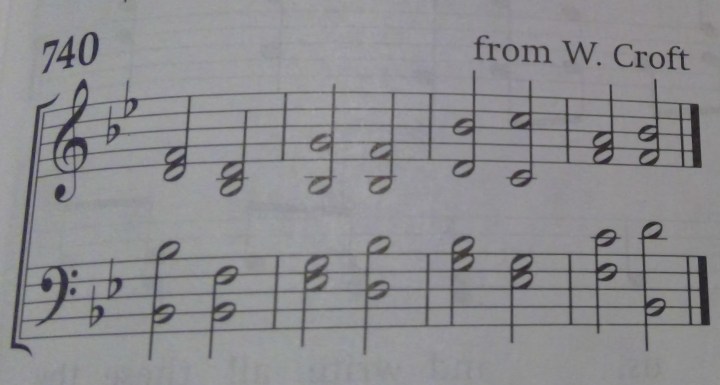
Next let’s move up to Simplified Anglican Chant. This and the following images are from the hymnal, Book of Common Praise 2017.

simplifiedchant740


– Sample 4 –

Now we’re ready for a fully-fledged Anglican Chant.  First let’s go for a Single Chant, which means each verse gets the same tune.

singlechant653


– Sample 5 –

Last of all, here’s a Double Chant, meaning the repeated tune spans two verses.

doublechant660

The Offertory Sentences

One of the stranger experiences for someone accustomed to the 1979 Prayer Book (or similar resources), going into the 2019 book, might be the Offertory.  It’s handled pretty much the same in this book as the 1979: the prayer over the offering is hard-wired into the main text of the liturgy, which is a minor change, and probably not too jarring to adapt to.  But when you flip the pages over to the list of Offertory Sentences, that’s where things might get weird.

You see, the 1979 Prayer Book has a reputation for being absolutely drowned in choices.  Several Eucharistic Rites, contemporary and traditional language versions of the Offices and Collects, countless “_ or _” prayers, you name it, the 1979 book is full of options.  And its list of 8 Offertory Sentences and 1 “bidding” to choose from for the Celebrant to read at the beginning of the Offertory seemed like plenty of choices (page 376-7 of that book).  But turn to page 149 in the 2019 Prayer Book and you find twenty Offertory Sentences to choose from, spanning three pages!  What gives, 2019?  We thought the liturgy was getting more streamlined and simple, why so many choices?  And why for such a paltry moment in the liturgy?

As usual, the answer can be found with quick consultation with the classical prayer books.  Take up the 1662 Prayer Book, flip to the appropriate portion of the Communion liturgy (page 241 in my Cambridge Press copy, I don’t know how standardized they are), and you find that the Communion Sentences are printed right into the primary text of the service, not in an appendix after.  And there are twenty of them!  (Interestingly, not quite the same twenty.)  The 1662 rubric for their use is as follows:

Then shall the Priest return to the Lord’s Table, and begin the Offertory, saying one or more of these sentences following, as he thinketh most convenient in his discretion.

This sounds rather like the handling of the Opening Sentences in the Daily Office, which also have undergone a radical re-purposing since at least 1928.

The 2019 Prayer Book, meanwhile, calls for only “one of the provided sentences of Scripture.

Chances are that most celebrants will continue saying one of the three or four that they’d memorized from the 1979 Prayer Book’s shorter list, and not give this any more thought.  And that’s okay.  But it’s worth exploring this renewed list of Offertory Sentences.  Like the Comfortable Words they may feel redundant in function, but when taken seriously they can provide an excellent “bible study” on giving, generosity, and charity.  Our rubrics technically don’t permit us to read more than one, not that I can imagine any bishop telling us off for violating that, so perhaps the best way to go about exploring these with the congregation is using them on a rotation, week by week.  These sentences exist in our liturgy, after all, not just to “kill time” or warn people that the money plate is coming, but actually to teach them about the spiritual discipline of charity, alms-giving, or tithing.

Just for kicks, let’s make a text-based Venn Diagram comparing the 1662 and 2019 lists:

1662 only: Psalm 41:1, Proverbs 19:17, Tobit 4:7b, Luke 19:8, 1 Corinthians 9:7, 1 Corinthians 9:11, 1 Corinthians 9:13-14, Galatians 6:6-7, 1 Timothy 6:6-7, 1 Timothy 6:17-19.

1662 & 2019: Tobit 4:8-9, Matthew 5:16, Matthew 6:19-21, Matthew 7:21, 2 Corinthians 9:6-7, Galatians 6:10, Hebrews 6:10, Hebrews 13:16*.

2019 only: Deuteronomy 16:16-17, Psalm 50:14*, Psalm 96:8*, Matthew 25:40, Luke 10:2, Acts 20:35, Romans 10:14-15, Romans 12:1*, 2 Corinthians 8:9, Ephesians 5:2*, 1 Peter 2:9, 1 John 3:17.

The 1928 Prayer Book has sixteen Sentences, not simply a reduction from the 1662 list, but supplying new verses – some of which are preserved in subsequent books, and two which are unique to it but are now found in our post-Offertory prayer: 1 Chronicles 29:11* & 14.

* These are the eight listed in the 1979 book, in addition to the following: Matthew 5:23-24, Revelation 4:11.  Interesting that that book had only one Sentence in common with the 1662 list.

If at all possible, take up a copy of the 1662 Prayer Book, though, and read through its Offertory Sentences in its printed order.  It’s not just a list thrown together (which I think is likely the case with ours), but the progression from one to the next is logical, ideas building from one to the next.  With only a little finesse, you can make the whole “list” into a coherent Exhortation!

Readings Review & Planning Propers 9/24

Readings Review

Last week: 1 Kings 6-11, Hebrews 5-10, Habakkuk 3, Zephaniah, Haggai, Zechariah 1, Matthew 12:22-16:12
This week: 1 Kings 12-14, 2 Chronicles 12-15, Hebrews 11-13, James 1-2, Zechariah 2-8, Matthew 16-20
Special reading coming up on Sunday for St. Michael’s Day: Revelation 12:7-12

We touched on this a few weeks ago, but something we’ll see this week is the beginning of some regular jumping back and forth between Kings and Chronicles in the Morning Prayer Old Testament track.  This will occur regularly from this week into early November.  It may be annoying for your bookmark(s), but it will make for a fuller coverage of events going through that history.  In general, Chronicles emphasizes the positive things to say about various kings of Judah, such as Asa’s religious reforms this week, whereas Kings takes a number of ‘digressions’ to talk about the prophets instead of the kings.

In Evening Prayer, the Gospel readings have reached the “home stretch”, as it were.  With the Transfiguration reached last night, everything is geared toward Jerusalem, and the death and resurrection of our Lord.  The Gospel according to St. Matthew still has a lot of final parables and things to get through, but we should remember that their primary context is now “with his eyes on the Cross.” Keep that in mind as you read, this week and next.

Planning Propers

This is the week of Proper 20 (or 14th after Trinity in the traditional calendar), so keep in mind that the historic Prayer Book default is that a mid-week Eucharist will repeat the Collect & Lessons (the propers) for yesterday.  Otherwise, we recommend…

  • Tuesday 9/24 = Votive *
  • Wednesday 9/25 = Votive or St. Sergius
  • Thursday 9/26 = Votive
  • Friday 9/27 = Votive
  • Saturday 9/28 = Votive
  • and remember that Sunday is the feast of SAINT MICHAEL AND ALL ANGELS!

* A Votive is a “Various Occasion” (page 733 in the BCP 2019).

Your Own Commemorations

I recently read a reflection on the Church’s calendar, in which the author says: “The church year means that we don’t accidentally exclude a truth or event that is important for the life of our souls.”  What a clear and simple way to explain such a profound truth!

There are a number of truths and events that are important to our individual lives, too: birthdays, wedding anniversaries, baptism and confirmation anniversaries, graduations, new jobs, new homes, and so forth.  Dates and events like these form the skeleton of a Family Calendar that helps dictate the liturgy of your ordinary life.  It’s quite a neat comparison to how the Church Calendar sets up the framework for the liturgy of worship.

But there are a few spots where the Family Calendar and the Church Calendar might, and in a way should, intersect.  Just as there was once a tradition of a Family Bible with the names, birthdays, and death days and so forth, we can do the same with our Prayer Books.  Every Prayer Book has a calendar of commemorations, sometimes called “black-letter days”.  These calendars vary from book to book, and since they’re all technically optional, an implicit suggestion is that local churches can add to (or ignore) this calendar as is appropriate for their context.  The addition of St. Aelfric in this Customary is an example of that.

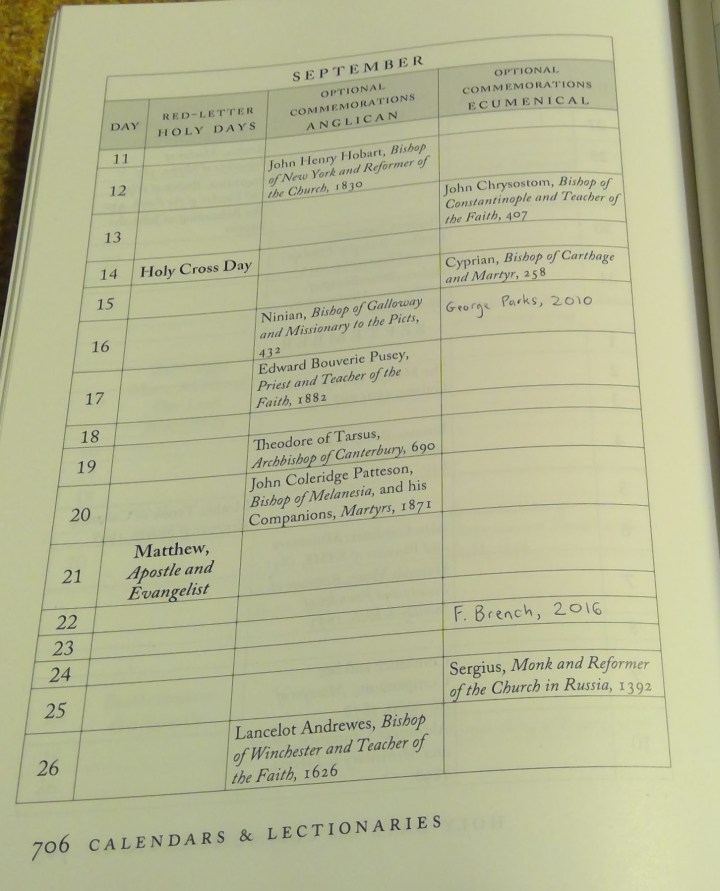
In that spirit, it can be a good idea for individuals to add in their own special commemorations in their own prayer books – not frivolous occasions, but ones that can and should be remembered in prayer somehow, such as deaths of family members and friends.  If you’re a parish priest, the death dates of members of your flock may be worth recording too.  It can help with the grieving process, it can help us remember the departed in an appropriate context, and even remind us to reach out to others who may be grieving more long-term.  I’ve already got seven names in my book, two of them are this month:

WIN_20190922_20_09_48_Pro

The distinction between Anglican and Ecumenical commemorations may be somewhat irrelevant for this purpose; this is more a third, “Personal”, category anyway.

Also keep in mind that the Prayers of the People in the Anglican Standard Text (on page 111) has a fill-in-the-blank spot in which the names of the departed may be remembered.  One tradition is to name the departed on or close to their death date (sometimes called their obit), and another tradition is to name all of them at the All Soul’s Day service (which for most of us Anglicans actually will probably be All Saints’ Sunday).  Whatever you do or don’t do, remember that your copy of the Prayer Book is your copy; invest your spiritual life into it!

Stewardship and St. Matthew’s

Today in the Offices and Eucharist we pray:

Lord Jesus, you called Matthew from collecting taxes to become your apostle and evangelist; grant us the grace to forsake all covetous desires and the pursuit of inordinate riches, so that we may follow you as he did and proclaim to the world around us the good news of your salvation; for with the Father and the Holy Spirit you live and reign, one God, now and forever. Amen.

Combined with his story from Matthew 9:9-13 and the other lessons from today’s Communion (Proverbs 3:1-12, 2 Timothy 3:1-17), we have a day that provides a solid groundwork for a “stewardship” sermon or devotion.  Perhaps that is an evangelical buzzword, I’m not sure if everyone uses it with the same connotation – this is an opportunity to talk to people about money and what they do with it.

St. Matthew was a corrupt lover of money before he followed Christ.  Although the Bible doesn’t give us any specifics of his life post-call, it stands to reason that he, like the others, lived a life radically dedicated to his Lord: his priorities changed from “covetous desires and the pursuit of inordinate riches” over to the proclamation of “the good news of… salvation.”  This is a transformation that is part and parcel of Christian living for everyone.  For some of us the love of money is manifest in the insane hoarding of wealth – buying that summer cottage and new yacht while neglecting the tithe and basic charity; for others it is the more subtle beast of “waiting for the next pay-raise” before finally trusting God with generous giving; for others the love of money is the miserly life in constant fear on the edge of poverty.  Money can rule the heart of rich, comfortable, and poor, alike.  All need the transformation of heart.

What makes this feast day particularly interesting in timing in Year C of the Sunday Communion lectionary is that (this year at least) we’ve been hearing about a lot of hospitality and wealth related lessons from Luke 14-16.  St. Matthew’s Day fits right in to this context, giving us a concrete example of a person who experienced this reformation of heart regarding money.  To make this clear, here are the Gospel lessons from September 1st, 8th, 15th, and 22nd in the 2019 Prayer Book:

  • Luke 14:7-14 = be hospitable to those who can’t repay you
  • Luke 14:25-33 = renounce all to be Christ’s disciple
  • Luke 15:1-10 = Jesus is hospitable with sinners in order to draw them to salvation
  • Luke 16:1-13 = parable of dishonest manager, you cannot serve two masters

Obviously it’s too late to go back and turn September into Stewardship Sermon Series Month.  But in your own devotions today may be a good time to glance back, put some of these pieces together, and reflect on your personal relationship with money versus your personal relationship with our Lord.  And if your reflections bear fruit in the form of an article or bulletin note or other communication for your congregation, all the better!

Readings Review & Planning Propers 9/16

What we’re doing on this blog on Mondays is looking back and forth at the Daily Office readings (or lessons) so we can better process together what the Scriptures are saying, and list the recommended Propers for the Communion or Antecommunion service for each day of the week.

Readings Review

Last week: 1 Kings 1-5, 1 Chronicles 28, Ephesians 5:18-6, Hebrews 1-5, Micah 6-7, Nahum, Habakkuk 1-2, Matthew 8:18-12:21
This week: 1 Kings 6-11, Hebrews 5-10, Habakkuk 3, Zephaniah, Haggai, Zechariah 1, Matthew 12:22-16:12
Special reading Saturday for St. Matthew’s Day: Matthew 9:9-13

The Old Testament lessons in Evening Prayer are still powering through the Minor Prophets (or slogging through, depending upon how you feel about them).  In the next few days we finish up the middle group of minor prophets, covering the “late kingdom era”, that is, the prophets who served at the royal court in the final century of Judah’s existence as a kingdom.  Later this week we’re starting into the last three (Haggai, Zechariah, and Malachi) who wrote during the Second Temple Era, that is, during the rebuilding of Jerusalem after the exile in Babylon was complete.  The short book of Haggai is one with which I’m particularly familiar, having preached through it a few years ago.  Click here to find eight articles and sermons about Haggai and his themes!

Meanwhile in Morning Prayer we started the Epistle to the Hebrews last week, and are now working our way through the thickest part of that book culminating in chapters 9 and 10.  The gist of Hebrews is basically “Jesus is better than __!” where the blank is just about anything important from the Old Testament religion.  The priesthood descended from Aaron is the particular focus of what Jesus fulfills and transforms in chapters 9 and 10, and have much to teach us about priestly sacrificial atonement.

Planning Propers

This is the week of Proper 19 (or 13th after Trinity in the traditional calendar), so keep in mind that the historic Prayer Book default is that a mid-week Eucharist will repeat the Collect & Lessons (the propers) for yesterday.  Otherwise, we recommend…

  • Monday 9/16 = Votive (of the Holy Spirit) * or St. Ninian
  • Tuesday 9/17 = Votive (of the Holy Angels)
  • Wednesday 9/18 = Ember Day I
  • Thursday 9/19 = Votive (of the Holy Eucharist) or St. Theodore of Tarsus
  • Friday 9/20 = Ember Day II
  • Saturday 9/21 = SAINT MATTHEW

* A Votive is a “Various Occasion” (page 733 in the BCP 2019) and label in parentheses are simply a traditional suggestion.

Praying concerning 9/11

The 11th of September has been dubbed “Patriot Day” by the US government, but is popularly known simply as “9/11”, and it commemorates those who lost or gave their lives on this day back in 2001 when four airplanes were hijacked by terrorists and used as weapons against iconic American buildings.  (Those of us in Massachusetts are perhaps especially resistant to the name “Patriot Day” because we already have a state holiday called “Patriots Day” which commemorates the beginning of the American Revolutionary War, close to April 19th.)

The American Church is not required to observe this day, of course, being a minor national observance.  But although it is of lowly status compared to other national days such as Independence Day, it is a day that weighs heavily on many of our hearts.  Ask someone “where they were on September 11th” and you’ll usually get a vivid answer (provided you ask someone who’s not much younger than 30).  This being the case, it will probably “feel right” bring this into our prayer life today.  Let’s explore some possibilities.

Occasional Prayers #27 & 28 for the Peace of the World are good places to start.  #33 for our Enemies is also an important prayer to take up, lest old anger set in.  Any other prayer for the nation in that section could be appropriate for today, as we take in the scope of how 9/11 impacted civil and foreign policy, and the way we’ve looked at ourselves and the rest of the world ever since.  More generally, #40 for all sorts and conditions of men is a traditional prayer recommended for Morning Prayer, and although it is more sweeping in scope and generic in the specifics, it can be helpful for putting things in context and perspective.

If you want to make a bigger splash in your prayers today, so to speak, pray the great Litany, making sure to include the “Supplication” section at the end.  Wednesday is one of the traditional days of the week that the Litany was appointed to be said anyway, so this is definitely worth considering.