9 Months to go…

Are you expecting?
Well you should be; as nine months from now the Church will be celebrating the birthday of her Lord.  Today is the Feast of the Annunciation, as some will point out the “real” feast of the incarnation – when Jesus was conceived in the womb of the Virgin Mary.  This holy day is placed, quite logically, nine months before Christmas Day.  If you thought radios and shops playing Christmas music in early November is excessive, how about starting the countdown clock nine months early? 😉

Simply realizing that the Annunciation is celebrated at an appropriate time of the year relative to Christmas can give one a newfound appreciation for this holiday.  But there is more.

There was also an ancient belief that great persons died on the same day they were conceived – there was a sort of symmetry to their lives.  (Perhaps this was more of a poetic assertion than an actual biological belief, I don’t know.)  Whateverso, the Annunciation, March 25th, is often very close to Holy Week and Easter, the sequence of days that commemorate Christ’s death and resurrection.  A couple years ago March 25th was Good Friday itself, perfectly lining up our Lord’s conception with his death.

Liturgically, this means we hold off (or transfer) celebrating the Annunciation to the Monday after the Sunday after Easter Day, rather than celebrating it during Holy Week or Easter Week.  But it is worthwhile to note, in those years, the confluence of liturgical events.

This year, with a later Easter, the Annunciation gets to stand on its own date quite unaffected by the Holy Week schedule and goings-on.  The season of Lent is still around us, of course, still giving an ominous sort of context to this celebration.  Just as Mary was overshadowed by the Holy Spirit, so is this holy day overshadowed by the Lenten season, reminding us of the dire destiny of Mary’s newly-conceived son.  This, more than Christmas, is perhaps a better time to sing those songs about how Jesus was born in order to die on the Cross.  Christmas is a festal holiday and season in its own right, we don’t need to drown its joy in reminders of Good Friday; the Annunciation however is much more ripe for that combination of moods.

Also, one last reminder: this is a holy day, a Red Letter Day, a major feast day.  And that means your Lenten fasts and disciplines are suspended for the day.  Go and celebrate the obedience of our Lady and the conception of our Lord!

Book Review: Common Worship Festivals

Welcome to Saturday Book Review time!  On most of the Saturdays this year we’re looking at a liturgy-related book noting (as applicable) its accessibility, devotional usefulness, and reference value.  Or, how easy it is to read, the prayer life it engenders, and how much it can teach you.

The first companion volume to Common Worship (reviewed last week) is entitled Festivals.  In the Church of England’s terminology, a Festival is what we’d call a Major Feast Day, or Major Holy Day, or a Red-Letter Day: these are the prayer-book-prescribed days of devotion that fill out the liturgical calendar with specific commemorations beyond simply following the seasons.  This volume also contains a more detailed explanation of the calendar set out in Common Worship, and lists the “Lesser Festivals”, or minor feast days or black-letter-day commemorations.

common worship

One might wonder how these features might merit its own volume.  What more is there to be said about them than what’s already in the Prayer Book or the primary volume of Common Worship?  In the spirit of modern liturgy – which has an insatiable appetite for variety and occasional-specific liturgical features – this book provides special prayers for each holy day.  Instead of simply just a Collect and set of lessons, as Prayer Book tradition has appointed, Common Worship: Festivals now provides the liturgical colour, Invitation to Confession, variant on the Kyrie, Collect, lessons, Gospel Acclamation, Intercessions for the Prayers of the People, Introduction to the Peace, Prayer “at the Preparation of the Table”, Preface and Extended Preface for the Prayer of Consecration, Post-Communion Prayer, Blessing, Acclamation, and extra sentences of Scripture for most of the 29 Festivals in the English calendar.  Those extra resources alone contribute about 100 pages to the book.  The calendar, with detailed rubrics and instructions and liturgical color notes,

It then has a further 50 pages that function similar to parts of the Episcopalian book Lesser Feasts and Fasts, providing a Collect and the occasional specific reading suggestion for the various “Lesser Festivals” or commemorations in the calendar.  Similarly, it provides materials for other Eucharistic occasions such as the “Common of the Saints” and “Special Occasions” not unlike the “votive mass” tradition.  This book also provides chant music for many of the Prefaces and Communion Prayers, which would be very helpful for the celebrant to have in the same volume!

The remaining pages of the book go on to reprint the “Order One” Communion Service from the primary volume of Common Worship.  Why?  Because this volume isn’t just a reference book, it’s able to be used as a Mass Book or Missal all on its own.  People can show up to church on a Sunday and grab the black book (Common Worship) or they can show up on a Festival Day and grab this dark blue book instead.  That makes this book actually functional on its own, which is a smart move.

Of course, outside of the Church of England, there is very little room in our authorized liturgy for additions or substitutions as this volume presents.  Perhaps the Acclamations, Blessings, and material for the Prayers of the People may be permitted by our rubrics in the 2019 Prayer Book, and maybe the special Collects & lessons for the black-letter days will be optional too (we have to wait and see what the new book actually specifies about them).  That makes this book’s value to us mainly one of a limited reference role in the rare opportunity that we can use some of its contents without having to get permission from our bishop.

The ratings in short:

Accessibility: 4/5
Functionally, this book is remarkably usable, albeit mostly because it has one “Order” for Holy Communion and no other liturgies included.

Devotional Usefulness: 2/5
Common Worship: Festivals is only for the Communion service; no notes are provided for the Daily Office.  As such outside of England, only a priest or other liturgical planner will be able to use this book.  Within the C of E, folks in the pew can use it on Festival Days, but there still isn’t really anything “to take home” as it were.

Reference Value: 2/5
Having extra Collects and prayers and things for the major and minor feast days can be handy resource.  If that’s all you need this book for, then it’s not worth going out of your way to buy it, and there are a lot of pages therein that you simply won’t need.


Don’t forget the Great Litany!

It’s a Friday in Lent.  If you haven’t already, you probably should go back and pray the Great Litany today.  Lent is, after all, a season of heightened spiritual discipline, especially in the areas of fasting, alms-giving, and prayer, as we were reminded on Ash Wednesday, and praying the Litany is probably one of the basic-but-important ways we can fulfill the latter discipline.

Besides, in historic prayer books, the Litany was appointed to be said at the end of Morning Prayer on every Sunday, Wednesday, and Friday, regardless of the liturgical season.  So the least we can do is pick it up during Lent if we normally neglect it.

An interesting feature of the Great Litany’s structure, which perhaps originated in the 1979 book, is the separating of its ending (the “Supplication”) into an optional section.  Classical Prayer Books were much simpler, the Litany was one distinct string of prayers to be used wholesale.  The modern distinction of the Supplication in its final section is handy if you want to shorten the Litany a little bit, or evade its particularly “grim” tone toward the end.  It also means that we can draw upon the Supplication portion by itself as an extra devotion “in times of trouble or distress” as the rubrics suggest.

But for Fridays in Lent, we probably should just pray the whole thing and not cut any corners.

For glory and for beauty

This morning’s Old Testament lesson is Exodus 28 (or excerpts thereof) in the ACNA Daily Lectionary.  Shortly after chapter 20 is where lots of people who attempt to read the Bible cover-to-cover start to falter and lose momentum… all this stuff about the Tabernacle and its furnishings starts to wear on the reader.  Chapter 28 details the vestments for Aaron the Priest and his sons.  This might be interesting at first, but 43 verses of it can feel rather tedious.  So let’s give a bit of insight into this chapter, which will perhaps stir up some interest and clarity!

A refrain that bookends this chapter (found in verses 2 and 40) is “for glory and for beauty.”  This is a significant structural device in the writing style of this chapter, which is related to a variety of literary devices and structures found throughout the Old Testament.  This simple refrain both introduces and concludes the entire “vestment law” contained in this chapter, and sheds light on the purpose of everything therein.  All the attention to detail, all the colors and pieces that come together to form the whole.  Even the symbolism which is explained in the text, such as the Breastplate of Justice having twelve precious stones that represent the twelve tribes of Israel that the priest bears on his heart, is subject to this “glory and beauty” principle.  It’s not just symbolic, but it’s glorious and it’s beautiful.

Some traditions are (or are a least stereotyped to be) overly-focused on one side of this or the other.  “Everything about the OT vestments was symbolic, and we can preach the Gospel from that!” says one group of people, who often overlook the “glory and beauty” principle and thus fail to make any connection to the use of vestments in the New Testament.  Others may focus on the glory and beauty and forget about the explicit symbolism, and thus go on to make up their own symbols for their own modern sense of vestiture.  But it is important that we take in the whole teaching of chapter 28: vestments exist to glorify God and to be beautiful to the human eye, and they carry with them explicit symbolic weight.

Therefore, as we look to Christian vestments, we must remember the same principle: is the detail and appearance of our vestments glorifying to God, or is it simply thrown together?  Is it beautiful, or merely functional?  Further, various Christian vestments carry certain symbolic meanings – are these symbols known to our congregations?  Does the appearance of a particular vestment cooperate with its symbolic purpose or reinvent it?

Liturgical vestments aside, the “glory and beauty” principle could even be considered, to some degree, for how everyone dresses when going to church.  The reason for wearing one’s “Sunday best” is not mere tradition, but actually has a root in seeking to be glorifying to God (testifying that He is Worthy) and beautiful to the human eye (that person values worship)!

I’m not going to get into the specifics of Anglican vestments here, but if you want to read some of the absolute basics, the Anglican Pastor blog has a beginner’s guide.  It’s very much from a “current practice” perspective, without much historical scope, but it’ll get you started toward understanding what you’ll see today in a lot of churches.

Glorious Lent: a hymn for the season

“You’re fasting during Lent?!  What are you, a closet Catholic?”  Alas, these all-too-common accusations are born of great ignorance of Christian history (including Anglicans and Protestants), not to mention ignorance of the Scriptures.  This penitential season is a time, among other things, of fasting.  It simply is a part of the season; to omit fasting is to ignore everything that the Church announces, in her liturgy, on Ash Wednesday.

And this fasting is glorious!

Consider this 6th century hymn that has adorned Anglican hymnals for a while:

The glory of these forty days
We celebrate with songs of praise;
For Christ, by whom all things were made,
Himself has fasted and has prayed.

Alone and fasting, Moses saw
The loving God who gave the law;
And to Elijah, fasting, came
The steeds and chariots of flame.

So Daniel trained his mystic sight,
Delivered from the lions’ might;
And John, the Bridegroom’s friend, became
The herald of Messiah’s name.

Then grant us, Lord, like them, to be
Full oft in fast and pray’r with thee;
Our spirits strengthen with thy grace,
And give us joy to see thy face.

O Father, Son, and Spirit, blest,
To thee be ev’ry pray’r addressed,
Who art in threefold name adored,
From age to age, the only Lord.  Amen.

What a glorious thing it is to observe a holy Lent!  Fasting so often comes with negative baggage; disciplines of self-denial are so easily looked down upon with disdain today.  Yet songs like this capture the glorious end of self-denial such as fasting: strengthening in God’s grace, similitude with great saints of old like Moses, Elijah, Daniel, and John the Baptizer, not to mention our Lord Jesus himself.  It is a curious thing for a Christian to imagine that he or she could aspire to holiness without utilizing even the most basic of tools championed by the great cloud of witnesses that have come before us.

Let hymns like this encourage you and build you up, this Lenten season.  Yes we have great sins to bewail and repent of, but we also have much to celebrate in the healing- and strengthening-power of God!

St. Joseph, a “New” Feast

When you go through the classical Prayer Book tradition, compared with modern Prayer Books such as ours in the ACNA, you’ll find that the list of Holy Days, or Major Feast Days, or Red-Letter Days, has grown rather noticeably.  A number of Anglo-Catholics were probably already “unofficially” adding some of these feasts to the Prayer Book calendar in practice, which perhaps helps to remind us that these are not truly “new” feasts in the modern Prayer Books, but simply old traditions that the early Prayer Books omitted and 20th century Anglicans have decided to bring back.  Saint Joseph’s Day, on March 19th, is one of those holidays.

The Collect and lessons look to be the same in our Prayer Book as in the 1979:

O GOD, who from the family of your servant David raised up Joseph
to be the guardian of your incarnate Son and the spouse of his virgin mother:
Give us grace to imitate his uprightness of life and his obedience to your commands;
through Jesus Christ our Lord, who lives and reigns with you and the Holy Spirit, one God, forever and ever.

2 Samuel 7:4,8-16; Psalm 89:1-4(5-18)19-29; Romans 4:13-18; Luke 2:41-52

There aren’t a lot of stories about Joseph in the Bible.  Most of his active presence therein is in Matthew 1 & 2, where he is visited by the Archangel Gabriel, and then leads the family to Bethlehem, Egypt, and Nazareth.  But our version of the Revised Common Lectionary covers most of those in Advent and Christmastide.  So instead we get the Gospel story in Luke 2 about the Finding of Jesus in the Temple.  In the historic calendar (before the 1970’s) that Gospel was appointed for the First Sunday after the Epiphany.  But the modern Epiphany season leaves that story out entirely, apparently giving it over to Saint Joseph’s Day instead.  It may not be the most interesting or even the most actively Joseph-centric Gospel story with Joseph, but that’s what we’ve ended up with.

Much more interesting, I daresay, are the other readings.  2 Samuel 7 and Psalm 89 together set up a wonderful emphasis on the covenant of eternal kingship God established with David and his descendants.  This is mentioned in the Collect as well, and expanded further in the Epistle, which adds the covenant with Abraham into the mix.  Joseph, therefore, is presented as the last step in that family succession (alongside Mary of course) from Abraham and David to Jesus.  The human parentage and family of Jesus is what legitimizes God’s fulfillment of all the previous covenants in Jesus – the faithful offspring of Abraham, the eternal King of Israel.

There’s more to be said about Joseph, of course, and the Collect hints at some of that.  Imitating Saint Joseph’s uprightness and obedience is a shout-out to the stories in Matthew 1 & 2, wherein Joseph gets the incredibly rare introduction as “a righteous man.”  Virtually every biblical hero character has reported flaws and sins; Joseph has scarcely a blemish recorded in sacred writ!  A role model he is, indeed.

So there are quite a number of directions one can go in observing St. Joseph’s Day today, and hopefully this is a helpful starting point.

Still using the Ash Wednesday Collect?

During the seasons of Advent and Lent, in Prayer Books before the 1970’s, there was a special tradition of repeating the first Collect of the season on every day throughout the season.  For example, this is what you find in the 1662 Prayer Book:

The first Day of Lent commonly called Aſh Wedneſday.

The Collect.
ALMIGHTY and everlaſting God, who hateſt nothing that thou haſt made, and doſt forgive all the ſins of thoſe who are penitent; Create and make in us new and contrite hearts, that we worthily lamenting our ſins, and acknowledging our wretchedneſs, may obtain of thee, the God of all mercy, perfect remiſſion and forgiveneſs; through Jeſus Chriſt our Lord. Amen.

¶ This Collect is to be read every day in Lent after the Collect appointed for the day.

(I kept the “long s” typeface in for fun this time; usually I edit them to the regular S.)

Anyway, notice the rubric underneath the Collect: it is to be used throughout the Lenten season in addition to whatever the Collect of the Day normally would be.  For example, yesterday was the Second Sunday in Lent, so we could have read that Collect followed by the Ash Wednesday Collect near the beginning of the Communion service.  You could even be using this extra Collect in the Daily Office every morning and evening!

Now, there is no such rubric in the 1979 or 2019 Prayer Books.  But there is no prohibition against reviving this traditional practice either.  I’ve made a practice of retaining the Collect for Ash Wednesday (sometimes nicknaming it the “Collect for Lent” or “for the season”) on each Sunday in my congregation.  Yes, it does make an awkward break in the rhythm of the liturgy: people are used to sitting down after the Collect but suddenly they have to wait through a second one.

But this can be a good kind of awkwardness.  This Collect is one of the great gems of our Prayer Book tradition, capturing the wretchedness of our sin and the great love and mercy of God in one beautiful little prayer.  It’s a good interruption to receive in the ordinary course of worship.  I can’t say that anybody has ever come up to me after the worship service to comment on it before, but I do think it is a subtle-but-meaningful tradition to hang on to.

Book Review: Common Worship (2000)

Welcome to Saturday Book Review time!  On most of the Saturdays this year we’re looking at a liturgy-related book noting (as applicable) its accessibility, devotional usefulness, and reference value.  Or, how easy it is to read, the prayer life it engenders, and how much it can teach you.

In honor of my new Bishop being consecrated today – he’s from England – I thought we’d take a look at an English book today: Common Worship, which is currently the Church of England’s official (and I imagine most-used) liturgical text alongside the 1662 Prayer Book which is still legally their standard text.  Common Worship is not strictly speaking a Prayer Book.  It has over 800 pages of liturgical material for the Daily Office, Holy Communion, Baptism, Thanksgiving for a Child, and other occasional worship services that one may design oneself according to the provided rubrics; it does not have material for Holy Matrimony, Confirmation, Ordination, Ministration to the Sick, or Burial.  However, it does have further volumes that provide more material and fill in those blanks.
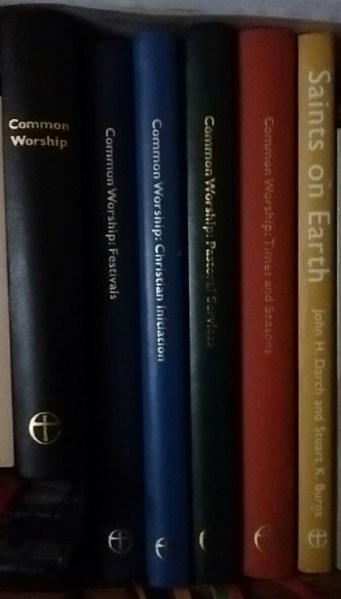
common worship

If you thought that the American 1979 book had a lot of choices to choose from, this book will blow your mind.  Where the ’79 had two traditional-language Prayers of Consecration and four more in contemporary language, this book has two “Orders” for Holy Communion (both offered in contemporary and traditional language styles), Order One having 8 Prayers of Consecration to choose from!  Order One is the contemporary order of the liturgy, similar to what we’ve got in the American books since 1979; Order Two is the English (1662) order of the liturgy.

The Daily Office, too, is a bit complicated, offering a different form of Morning & Evening Prayer for Sundays distinct from the rest of the week.  Both in how the Office is presented, as well as the Communion, it seems that the expectation (or the cynic might say “agenda”) is for most churches to use the contemporary liturgies (provided first), while acknowledging the legitimacy of the traditional (provided second).  But at least they’re both there – the American 1979 book barely threw a bone to the traditionalists, which resulted in the creation of supplemental books such as the Anglican Service Book.  Our upcoming 2019 prayer book will provide authorizations and rubrics for more traditional orderings of the contemporary liturgy, which is very good, but it’s not going to be quite as user-friendly as the way Common Worship provides the traditional material straight-up.  And who can blame our prayer book committees?  Just look at Common Worship – it takes over 800 pages to cover only half of the liturgical texts required for a full Prayer Book!

On the other hand, this book is remarkably user-friendly considering its cumbersome collection of liturgies.  As long as someone tells you what type of worship service you’re walking into (i.e. Holy Communion, Order One) you can simply look it up in the table of contents, go to page 166, and actually follow along quite easily.  The primary divergence of options is the Prayer of Consecration (Prayers A through H offer a range of styles and emphases) but the way it’s handled here is actually rather brilliant.  The prayers that are in common are printed in the main text of the Communion service, and the different responses from the various sets of prayers are put into the main text, allowing the person in the pew to respond to whichever Prayer of Consecration is being said without having to flip to the appropriate pages and back!  For those who do want to read along with the Priest’s text, page numbers are provided.  The various options for the Prayers of the People are handled the same way: the responses are provided in the main text, and a page number reference is included for those who want to read the actual text of the intercessions that the prayer leader will be reading.

The calendar has grown rather differently in English tradition than American.  Both were the same up to the early 20th century, but the way modern liturgical revision has impacted us is different.  The American Anglican treatment of the calendar is more like the Roman Catholics: Epiphany season lasts from January 6th until Ash Wednesday, and the season after Pentecost (or Trinity) runs from Pentecost or Trinity Sunday until Advent.  In England, things got a bit more nuanced – perhaps hanging on to vestiges of old custom in a different way.  The Epiphany season set forth in Common Worship lasts from January 6th until February 2nd (the feast of the Presentation), after which comes “Ordinary Time”, counted as the 1st-5th Sundays before Lent.  After Trinity Sunday Ordinary Times resumes with up to 22 Sundays “after Trinity” followed by All Saints’ Sunday and Three or Four Sundays “before Advent”, sometimes nicknamed Kingdomtide.  Although this is largely irrelevant to our American context (and may even end up adding confusion to some readers) it can be handy to be familiar with this style of calendar as there are other Anglican provinces across the world that follow a variation of the modern English calendar.

The biggest surprise, looking at this book, is one glaring omission: it has no daily lectionary!  The Communion & Holy Day lectionary is elaborate, with multiple sets of readings in case a church has two or even three worship services on a given Sunday, and the occasional note for proper readings at Evening Prayer on the “Eve of” a major feast day (termed Festival in this book).  I suppose if one accounts for all of those, and the three-year cycle of lessons, one could draw enough readings together to fill out the week days for the Daily Office.  But that would not be in the spirit of a daily lectionary at all, providing disjointed readings from day to day, and probably not providing very good coverage of the Bible at all.  In short, this is so Sunday-focused that it seems to give tacit assent to the loss of the daily office in the public eye.

The ratings in short:

Accessibility: 3/5
Despite the massive collection of optional material and “choose-your-own-adventure” nature to the liturgical planning authorized in this book, it is surprisingly easy to navigate if you’re following along with one service.  (If you’re the liturgical planner using this book to prepare a service then boy have you got some studying to do!)

Devotional Usefulness: 2/5
Extra canticles can be great; different forms of confessions and creeds can be interesting from time to time (if not really necessary); having the traditional and modern styles available in one volume is lovely.  The theological precision and accuracy may be an open question for some of the Communion Prayers of Consecration, depending upon one’s point of view.  This could have been a 3, but without a daily lectionary or prayers for funerals and weddings, this book falls to a 2.

Reference Value: 2/5
There is a lot of stuff in here which is interesting, but little that we can use, outside of the Church England.  What is authorized for our liturgy simply is not the same as this book.  What we can glean (or even use) from this book include its wealth of additional Canticles, original confessions and creedal material which we could use for private devotion or even in teaching, and comparative studies in how the calendar and lectionary evolved across the pond.

Before our Texts for Common Prayer started coming together, I knew of a number of ACNA churches that made use of Common Worship to some degree or another, rather than rely solely on the 1979 book.  By this point, we’ve got everything we need such that we don’t need to rely on external sources such as this.  Furthermore, it is our bishops who authorize liturgical texts, not local priests, so must of us probably aren’t even allowed to use Common Worship in our public liturgy.  It’s a neat resource to poke through if you’ve got it, but since its whole text is freely available online, there’s not really any reason to get a hard copy unless you really want to build up a liturgical library.  (I’ve only got a copy because someone else was downsizing his library!)

Canticles for Lent

One of the fun resources in the 2019 Prayer Book is the collection of Supplemental Canticles for the Daily Office.  As we proceed through this season of Lent, there are two Canticles in particular that stand out as appropriate for regular use at this time.

First is the Benedictus es.  This Canticle is taken from the Greek Old Testament version of Daniel 3, known separately in our Bibles as “The Song of the Three Young Men” – when Hananiah, Azariah, and Mishael were in the fiery furnace alongside the fourth man, the pre-incarnate Christ.  There are two hymns in that passage, and this Canticle is a summary of the first one.  Liturgically, this Canticle is offered directly in the Morning Prayer text itself, presented as an option in place of the Te Deum during Lent.  This Customary recommend using it on Ash Wednesday, the First Sunday of Lent, Palm Sunday, and on weekdays throughout the season.  (For the 2nd through 5th Sundays, it may be prudent to bring back the Te Deum in recognition that though Lent continues, Sundays are not fast days; and though it is still a penitential season, we are still celebrating the victorious Christ.)

From the Supplemental Canticles,  #3, the Kyrie Pantokrator, may be used in place of the Nunc dimittis (the second Canticle in Evening Prayer) on Ash Wednesday, the First Sunday of Lent, Palm Sunday, and every weekday throughout the season.  This Canticle is also from the Greek Old Testament, entitled in English as the Prayer of Manasseh.  It is a prayer of penitence attributed to the wicked King Manasseh (2 Chronicles 33:10-20, especially verses 18 & 19).  As with the Benedictus es above, this Canticle is shortened a bit from its original version; also some of its hyperbolic language is toned down so as not to confuse the average reader.  This Canticle, in particular, is a marvelous offering of penitential worship.  In this age where so many of us run fast and loose with sin, the strong language of condemnation and grace in the Kyrie Pantokrator could do us a world of spiritual good.

And it’s got an awesome name, to boot!

Reading Proverbs

For most of this month, so far, our Daily Office Lectionary has been leading us through the book of Proverbs in Evening Prayer.  It’s a different style of writing than most of the rest of the Bible, but it’s not all that difficult to read.

Or at least it wasn’t for the first 9 chapters.  Over the weekend we reached chapter 10, and something in the style has changed – you may find it suddenly more of a slog to get through.  The ideas are jumping around, the analogies and pictures aren’t consistent anymore, it’s as if the nice writing style suddenly collapsed and we’re stuck with a high school student’s bad attempt at plagiarism.  What happened?

Chapters 1-9 of the book of Proverbs are a series of speeches or coherent discourses – usually a paragraph or two long – extolling the virtues of wisdom.  “Listen to your father” (that is, your teacher), the writer opines, “Wisdom calls to you from the streets; receive her invitation“.  It may not be everyone’s favorite or familiar writing style, but at least the sentences connected to each other.

Starting in chapter 10, most of the rest of the book is comprised of individual proverbs, or sayings.  Occasionally you’ll find a bunch grouped together with a discernible logic, but much of the time they seem random.  The good news is also the bad news: they are random.

Okay, that’s not 100% true.  Writings like these are preserved oral teachings.  A teacher would recount strings of proverbs to his students, who would memorize them in turn.  The book of Proverbs makes this abundantly clear when you read it in Hebrew: from one proverb to the next, there is usually a word in common, or a case of rhyme or assonance, or a thematic link, or some other mneumonic device to help you remember what comes next.  Translated into Greek or Latin or English or any other language, most of those subtle memory-helpers are simply lost; all we can see is perhaps the occasional repeated word or repetition of a theme or metaphor.  The intricate word-play is usually lost in translation.

Now, unless you have a personal goal of memorizing the Proverbs, that isn’t a big deal – you don’t need those memory markers if you’re not planning on memorizing them anyway.  After all, this is the age of print and of digital data; you can read these almost anywhere you go.  However, the fact that these proverbs are presented in virtually random order can make them difficult to read.  How can you process and internalize one idea when the very next verse hits you with a completely different idea?

The book of Proverbs, therefore, is one of the few parts of the Bible that is not really served very well by a daily lectionary.  Most of the proverbs in and after chapter 10 are literally stand-alone verses, and are thus best read and considered individually.  The chapter-a-day approach of a daily lectionary like ours is like a fire-hose of proverbs!  So if you want to study and/or meditate on the proverbs, you’ll need to do so outside of the liturgy.  Perhaps you can grab a verse or two from the evening’s reading and revisit them after Evening Prayer concludes (or even during Evening Prayer in an appropriate period of silence).  Perhaps you can devise your own reading plan through this book that works more slowly, and thus spend time with smaller batches of proverbs apart from the Daily Office.

In the meantime, enjoy the fire-hose of divine wisdom!