The classical Prayer Books presented the Church Calendar in a very practical manner, essentially providing a how-to guide with lists and tables aiding the worshiper in the process of figuring out how to identify the nearest Sunday and construct the calendar in one’s head. The Calendar as presented here is somewhat more explanatory, giving some commentary along with the directions. It begins with a general introduction, summarizing the Early Church’s definition of the date of Easter, how a large portion of the Calendar (the Paschal Cycle) is constructed around it, and how another portion of the year is constructed around Christmas (the Incarnation Cycle). This is an excellent starting point for understanding the complexities of the Church Calendar tradition, though there are further layers that may be explored.
There are as many as five overlapping cycles that together form the calendar: the Paschal, the Incarnation, the Sanctoral, the Natural, and the National.
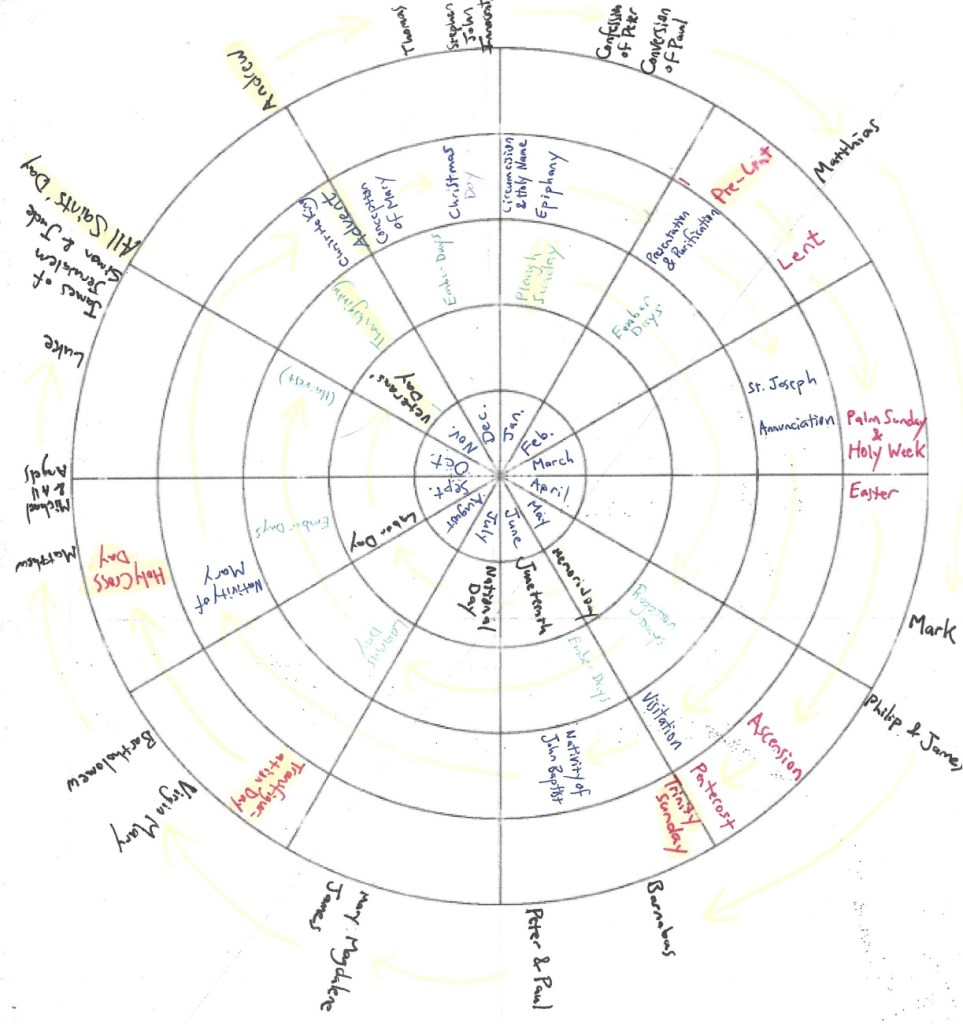
The Paschal Cycle begins with Ash Wednesday (or the Pre-Lent Sundays where those are observed), moves through Lent and Holy Week in Easter, then to the Ascension, and culminating in Pentecost and Trinity Sunday. In the late summer another 40-day iteration of the cycle repeats, starting with the Transfiguration and ending with Holy Cross Day.
The Incarnation Cycle can be said to begin in March with the feast of Saint Joseph followed by the Annunciation. This is significant as it links with the Paschal Cycle: there was a Jewish tradition that the prophets and other great men of faith died on the same day that they were conceived, and the Annunciation on March 25th is very close to the average date of Good Friday. This is, incidentally, one of the historic arguments for the veracity of the date of Christmas being in late December or early January. The Incarnation Cycle then continues with the biblical chronology with the feast of the Visitation in May and the Nativity of Saint John the Baptist in June. Christ the King Sunday kicks off the season of Advent which leads to Christmas, which includes the Circumcision and Holy Name of Jesus, and is followed by the Epiphany (or Manifestation of Christ to the Gentiles) and culminates in the feast of the Presentation of Christ in the Temple on February 2nd. A Marian Cycle can also be gleaned within the Incarnation Cycle, adding the Conception of Mary on December 8th and her Nativity on September 8th. Neither of these are listed in the Calendar of 2019 but they can be found in other calendars, such as the former commemoration as a black-letter day in the 1662 Prayer Book.
The Sanctoral Cycle is formed by the list of Saints’ Days. Most Saints’ Days are appointed by the traditional dates of their martyrdom or death (or their nativity into eternal life), though some originate from the dates of churches dedicated to them (as in the case of Michael the Archangel) or of their relics being translated and installed in a new location. As the Church Year is typically said to begin with the season of Advent, the Sanctoral Cycle is also said to begin at roughly the same time with the feast of Saint Andrew, the first-called among the twelve apostles (cf. John 1:35-41). The feast of the Holy Innocents of Bethlehem provides a point of connection between the Sanctoral and Incarnation Cycles, landing as it does on the fourth day of Christmas. And the Sanctoral Cycle effectively reaches its climax on November 1st with All Saints’ Day, collecting together every Saint, known and unknown, remembered or forgotten, in one great festival towards the end of the year.
Those are the three major ecclesiastical components of the Christian Calendar, focused on the great theological themes of the Gospel and the biblical accounts of God’s works and servants. The other two cycles are by no means bereft of theological import and significance, but they are distinct (and “lesser”) in the sense that they are determined by sources other than God’s special revelation, and are therefore considerably more malleable from age to age and from place to place.
The Natural Cycle follows the seasons of the earth. In traditional English accounting, it could be said to begin with Plough Sunday (near the feast Epiphany) celebrating the return to work after the Christmas holidays and blessing the ploughs before seed-time begins in the Spring. The Rogation Days (immediately before Ascension Day) are further days of prayer, typically after the planting season has finished and the agricultural process shifts into waiting and nurturing mode. Lammas Day (August 1st) was a sort of first-fruits celebration for the grain harvest, and the autumn harvest festival (Thanksgiving Day in our calendar) brings the natural agricultural year to a close. The proximity of Thanksgiving with the beginning of the Advent season is serendipitous – the language of harvest is prominent both on the farm and in the eschatological discourses found in the Scripture lessons in (and leading up to) Advent. Additionally, the quarterly Ember Days punctuate the four seasons. Of course, in other climates and hemispheres, the Natural Cycle will look considerably different, and other links to the Church Year need to be gleaned and celebrated.
Lastly, the National Cycle is subject to the state – every country has its own set of holidays and commemorations, although there are several overlapping observances. In the United States of America, there is a distinct summer-time focus beginning with Memorial Day, moving through Flag Day and Juneteenth to the climactic Independence Day in July, and winding down towards Labor Day in September. Veterans Day in November also pops up as a solemn complement to Memorial Day, roughly splitting the year in half between them. Canada also observes its chief national day in July and Labor Day in September, and November 11th is Remembrance Day which is also a major observance in Britain. While national days can carry political overtones which are detrimental to Christian worship, they can be rightly observed by the Church in such a way that Christ is proclaimed not only as King, but as King of kings, recognizing the legitimate place for earthly authority within the providence of God, and the Christian calling to be good citizens and subjects during their earthly pilgrimage.

