Readings Review & Planning Propers

What we’re doing on this blog on Mondays is looking back and forth at the Daily Office readings (or lessons) so we can better process together what the Scriptures are saying, and list the recommended Propers for the Communion or Antecommunion service for each day of the week.

Readings Review

Last week: 1 Chronicles 16, 1 Kings 15-19, James 3-5, 1 Peter 1-4:6, Zechariah 9-15, Malachi 1, Matthew 21-24

This week: 1 Kings 20-22, 2 Kings 1-3, 2 Chronicles 20, 1 Peter 4-5, 2 Peter, Jude, 1 John 1:1-2:6, Malachi 2-4, 1 Maccabees 1-2, 2 Maccabees 6-7, Matthew 25-27:56

There’s something appropriate about the convergence of St. Matthew’s Passion this week alongside the reading of selections from 1 & 2 Maccabees.  The suffering of God’s people at the hands of hostile non-believers – that is, martyrdom – is always best understood juxtaposed against the Cross.

You’ll also notice that although Kings & Chronicles are still swapping back and forth from time to time, but less often for the first half of October.  The reason for this is that at the end of 1 Kings and for the first half of 2 Kings there are a lot of stories about the Prophets, rather than of the Kings.  The result of this is that there are more chapters to read from 2 Kings before getting to a period of history where 2 Chronicles has anything to add in.  Of course, if you’re using our Supplemental Midday Lectionary then there are still plenty of “duplicate chapters” in 2 Chronicles to read along the way this month.

Planning Propers

This is the week of Proper 21 (or 15th after Trinity in the traditional calendar), so keep in mind that the historic Prayer Book default is that a mid-week Eucharist will repeat the Collect & Lessons (the propers) for yesterday.  Otherwise, we recommend…

  • Monday 10/7 = Votive *
  • Tuesday 10/8 = Votive
  • Wednesday 10/9 = St. Robert Grosseteste or Votive
  • Thursday 10/10 = St. Palinus or Votive
  • Friday 10/11 = St. Philip the Deacon
  • Saturday 10/12 = Votive

* A Votive is a “Various Occasion” (page 733 in the BCP 2019).  The traditional appointments are Holy Trinity on Sunday, Holy Spirit on Monday, Holy Angels on Tuesday, of the Incarnation on Wednesdays, of the Holy Eucharist on Thursdays, the Holy Cross on Fridays, and of the Blessed Virgin Mary on Saturdays.

Book Review: The Lutheran Service Book

Welcome to Saturday Book Review time!  On most of the Saturdays this year we’re looking at a liturgy-related book noting (as applicable) its accessibility, devotional usefulness, and reference value.  Or, how easy it is to read, the prayer life it engenders, and how much it can teach you.

It’s been a couple weeks but we left off with a couple non-Anglican liturgical books, and today we’re picking that trend back up again with The Lutheran Service Book (2006), which is basically the official liturgical text for the Lutheran Church – Missouri Synod (LCMS).

This book is basically a Prayer Book and Hymnal in one, which is super handy.  What’s strange about it, from an Anglican perspective, is the ordering of its contents.

Introductory Contents:
Church Year, Sunday & Holy Day lectionaries, Dates of Easter, Glossary, instructions for chanting psalms

Most of this makes sense to us, the only oddity is that the Sunday / Holy Day lectionaries are placed up front with the calendar – historically that’s where we would have the Daily Office Lectionary, though the 2019 BCP has all its lectionaries toward the back instead.

Interestingly, this book includes two choices for the Calendar and Sunday lectionary: one is their version of the 3-year Revised Common Lectionary (essentially the same as ours, only minor differences), and the other is the traditional one-year calendar and lectionary (essentially the same as in the classical Prayer Books).  Although I’m not surprised the 2019 Prayer Book didn’t provide both calendar & lectionary options, I kind of wish it had.

The chanting instructions make sense here because the first primary section of this book is:

The Psalms

Yes, all 150 are here, and they’re even pointed for chant!  For example, from Psalm 15:

O Lord, who shall sojourn | in your tent? *
Who shall dwell on your | holy hill?

He who walks blamelessly and does | what is right *
and speaks truth | in his heart.

So that’s pretty useful.  The chant style is very similar to Simplified Anglican Chant, which is great.  Functionally it’s strange that the psalter should be put first like this: this means that you “have to know” where the right worship service starts in the book, increasing the necessary page-flipping.  But in another sense, giving the Psalms place of preference is a theological statement: this is where our worship begins.  Virtually every worship service in the liturgical tradition utilizes the psalms, and biblically they are our greatest model for faithful prayer.

The Divine Service

The next nearly-60 pages are taken up with five “Settings” of the Divine Service, or Holy Communion.  “They have five different eucharistic texts!?” you ask.  Yes.  But they are all extremely similar to one another.

The primary difference between the order of service here and in the 2019 Prayer Book is that this starts with a confession and absolution, rather than placing it after the Prayers of the People.  Setting One’s confession prayer in particular is clearly based upon our confession in the Daily Office.  For the Creed, both the Nicene and Apostles’ are offered.  Two sequences of Communion Prayers are typically offered, one placing the Words of Institution before the Lord’s Prayer, and the other after.  In general, the style and wording of the prayers – particularly the Communion prayers – progress from traditional to contemporary as you look through from Setting One to Setting Five; the last of which sounds the most like the 1979 Prayer Book.

Another fascinating, and consistent, feature of the Lutheran liturgy is the use of the Canticle Nunc dimittis as a Post-Communion praise, just like how the classical Prayer Books employed the Gloria in excelsis.  This has prompted and encouraged me to explore different Canticle options after the administration of Holy Communion in my own church’s worship services, rather than always simply employing a Communion Hymn.

Another curiosity, perhaps marking the most obvious distinction between the five Settings, is the music.  Settings One through Four each have a particular collection of Service Music printed right into them.  This is useful for those who desire to use them, though a bit odd from my observing perspective, as it ties you to particular combinations of musical settings with the variations of prayers.  I assume it’s permissible for them to mix and match text and music, but it just seems an odd way of printing it.  Whateverso, the range of styles are interesting: different forms of chant (some like plainchant, some like Anglican Chant, including the Old Scottish Chant of the Gloria in Setting Three).  Setting Five has no music printed in it, though, preferring the simplicity of spoken liturgy, and indicating a few hymns to sing in place of the standard Kyrie and GloriaSanctus and Agnus Dei.

The Daily Offices

Where the Daily Offices hold pride of place in Anglican Prayer Books, the Lutheran Service Book starts them on page 219, after the Communion settings.  These, too, include musical settings of various Canticles and Psalms right in the text, as well as other chanted parts for the dialogues and blessings and whatnot.  Five Offices are provided: Matins, Vespers, Morning Prayer, Evening Payer, and Compline.  Again this is a “huh?” moment for Anglicans, as Matins & Vespers are the Morning & Evening Offices.

As it turns out, Matins and Morning Prayer are very similar in this book, containing largely the same elements.  Like the Communion Settings, the music and chant is the most obvious difference between the two,   Matins is the most like the Prayer Books’ Morning Prayer; the Morning Prayer in this book lacks the Te Deum and rearranges the prayers after the Canticle.

None of these offices include Confessions or the Apostles’ Creed, which is another difference between this book and our tradition.

Vespers and Evening Prayer are similar to one another, but start markedly different: Vespers more resembling the Prayer Book tradition, and Evening Prayer starting off with that curious “Service of Lights” thing in the 1979 Prayer Book.

Compline is very similar to as it is found in modern Anglican Prayer Books.  I assume, since it was not taken up in most Protestant liturgical books during the Reformation, that it saw the least amount of editing and change in unofficial use, such that when it started to reappear in the late 20th century it had undergone the least amount of denominational divergence.

Other Services and Resources

From here the book includes a collection of other liturgies that a Prayer Book would be expected to have: Holy Baptism, Confirmation, Holy Matrimony, Funeral Service, Responsive Prayers, a Litany, Corporate and Private Confessions & Absolution, Daily Prayer for Families, a Daily Lectionary, table of Psalms for the Offices (though not covering the whole psalter or the whole year), Occasional Prayers, the Athanasian Creed, and Luther’s Small Catechism.  All this is comparable to what one would expect in an Anglican Prayer Book, and much of its contents are recognizably similar to our own.

The first “Other Service”, however, does not have an Anglican counterpart (unless you delve into England’s controversial Common Worship).  It’s called Service of Prayer and Preaching, and it seems to be a what-to-do-on-a-Sunday-morning-when-the-ordained-minister-is-away sort of service.  Opening Verses, an Old Testament Canticle (known to us as #8 Ecce Deus), Scripture readings, dialogued responses, a congregational reading from part of the catechism, Sermon or Catechetical Instruction, (Offertory) Hymn, several Prayers, a New Testament Canticle (known to us as the Pascha Nostrum), and a closing Blessing.

The Hymns

636 hymns follow, arranged by Church Season, Person & Work of Christ, the Christian Church, the Christian Life, other Times and Seasons, additional Service Music, and National Songs.  Naturally there are quite a lot more German Chorales here than in a typical Anglican hymnal (though the 2017 hymnal has quite a few!), and several hymns well-known to us with different arrangements – occasionally entirely different tune settings.  For example Here, O my Lord, I see Thee face to face is set to FARLEY CASTLE instead of PENITENTIA, and At the Lamb’s high feast we sing is set to SONNE DER GERECHTIGKEIT instead of SALZBURG (ALLE MENSCHEN).

The ratings in short:

Accessibility: 3/5
Page-flipping within a particular worship service (especially the Sunday Communion) is minimal.  The main challenge is making sure you know what service you’re actually doing (five Communion rites, remember).  If you’re trying to use this for the Daily Office then things are rather more complex as you have to hunt for the lectionary and psalms with rather more vigor than a typical Anglican Prayer Book.

Devotional Usefulness: 3/5
This book is not the sum total the LCMS expression of Lutheran worship, but all the basics are here.  As Anglicans we could use this book and find a faithful approximation of our own liturgical tradition.  The Communion Prayers are all significantly shorter than ours (even shorter than what’s in the 1662 Prayer Book), but on the whole theologically compatible with ours.  The lack of clarity regarding daily psalmody would be a loss, however.  This book also has a nice collection of hymns that could supplement our own hymnals.  And to be fair, if I was a Lutheran, I’d rate this as either a or a 5, depending upon what I’d thereby know of the historic liturgies before this book.

Reference Value: 2/5
It’s hard to rate this score.  For most of us, we have no reason to pick up the liturgical text of a different tradition, even one so closely-related as the Lutherans.  The similarities of English-language Lutheran worship with Prayer Book worship also makes it clear that they have taken several queues from us.  As such, this Lutheran Service Book is probably best understood as an expression of historic Lutheran worship using the Anglican Prayer Book as a useful filter from time to time.  If you really want to explore historic Lutheran liturgy, you probably have to pick up the Book of Concord or something to that effect.  But I haven’t done that yet.

Imagery in Zechariah 14

If Evening Prayer has been tough to get through lately, I understand; Zechariah is not an easy book for a lot of people to read.  It is one of the most apocalyptic texts in the Old Testament (after Daniel), which really just takes the challenges of prophetic literature and dials them up to 11.

It goes beyond the purpose and scope of this blog to provide a Bible Study, not to mention the time availability of this chronically-fatigued stay-at-home-dad, but there are definitely a few features of the last chapter of Zechariah, that we’ll be reading tonight, which I can point out.

Behold, a day is coming for the Lord, when the spoil taken from you will be divided in your midst.  For I will gather all the nations against Jerusalem to battle…

The chapter begins with a “Day of the Lord” reference.  Like “D-Day” when talking about the second world war, the Day of the Lord is a title for the time of a great invasion, a the decisive turning point in the great spiritual war.  We understand this in two parts: first, the Cross, and second, the return of Christ.  There are many moments in history that serve as pictures for these moments of ultimate spiritual importance, such as the conquest of Jerusalem by the Babylonians, the desecration of the Temple by the Greeks, the destruction of Jerusalem by the Romans… yet all these serve merely as pictures of the greater judgment that takes place when Christ was crucified and when Christ will return again.

It is an error of certain Protestant sects to mis-read Old Testament prophetic literature, especially the apocalyptic writings, without Christ in mind.  What follows in this chapter, to finish the book, is not a visual prediction of future events, but a prototype or foreshadowing of judgment day when Christ returns to Earth to consumate his kingdom forever.  Don’t try to figure out what’s going to happen to the geography of Palestinian mountains and valleys in verses 4 & 5, but rather, focus on the fact that “the Lord my God will come, and all the holy ones with him” at the end of the age.

There shall be a unique day, which is known to the Lord, neither day nor night, but at evening time there shall be light,” (14:6), because Christ himself is the light of the world.

On that day living waters shall flow out from Jerusalem,” (14:7) just as Jesus promised of the Holy Spirit in John 4:14 and especially 7:37-39.

And the wealth of all the surrounding nations shall be collected, gold, silver, and garments in great abundance.” (14:14) Think of texts like Isaiah 60, which also depict the nations bringing their wealth to Jerusalem to honor the Lord.  These are pictures, not of earthly nations paying homage to the earthly nation of Israel, but of gentile believers turning to worship the God of Israel – Jesus.  So don’t get carried away with the images of wars and horrible plagues and panics; those are exactly what sin is.  Only the victory of the returning Christ will bring all the terrors of sin to an end in this world; the epic apocalyptic style just makes spiritual reality more vivid.

Similarly, we aren’t literally going to go to Jerusalem “year after year to worship the King, the Lord of hosts, and to keep the Feast of Booths” (14:16), for that holy day has been and subsumed under the New Pentecost – the gift of the Holy Spirit.  No longer must we celebrate the days of the Exodus when our forefathers dwelt in booths (or tents) and received the Word of God on tablets of stone; rather we now celebrate the greater present reality that we ourselves are dwellings of the Holy Spirit (1 Corinthians 6:19).  That’s why in Revelation, the end-times city image doesn’t have a temple building at all (Revelation 12:2).

Thanks be to God!

The Sursum Corda

When it’s time to begin the Communion Prayers, our liturgy begins with a dialogue usually called The Sursum Corda, which is Latin for “Lift up your hearts,” since that’s the first line of the dialogue.

Except it isn’t anymore, is it?

Celebrant: The Lord be with you.
People: And with your spirit.

Yeah, we actually preface the preface dialogue with this salutation.  It’s interesting to note that this is not how it’s always been.  The classical Prayer Books barely ever use that exchange; the preface of the Communion prayers is not one of those places.  It is there in the Roman Rite, and that’s one reason why it’s in our modern liturgies too: a move to return toward general Western liturgical practice.

Another reason for bringing back that salutary exchange is a functional issue: the modern liturgy has a lot of starting and stopping leading up to this point, and a new “start” is needed.  The confession and absolution ended with the Peace, which is often a huge interruption to the liturgy.  Announcements often take place there, which is an interruption to the liturgy.  The offertory is often drawn out with music and the presentation of the elements and all that… the interaction between priest & people in a worship-minded context is all but lost.  “The Lord be with you…” is practically needed to “restart” the worship service at this point.

Classically, the offering would be taken, then the Prayers of the People, Confession, and Absolution followed.  Then the Comfortable Words were read, after which the Priest shall proceed saying, Lift up your hearts.  There was a direct link from the comfort of divine forgiveness to the Communion: “You are fully pardoned and forgiven and Christ, so lift up your hearts and let us give thanks…!”  That context is lost in the modern arrangement of the liturgy.

Celebrant: Lift up your hearts.
People: We lift them up to the Lord.

This, the actual sursum corda, is where the eucharist, or Great Thanksgiving, begins.  We lift our hearts to God, pursuing a sort of ascent from earthly to heavenly matters.  The ministry of the Word has done its work and the ministry of the Altar, or Table, is setting in.

Celebrant: Let us give thanks to the Lord our God.
People: It is right to give him thanks and praise.

Initially, I was heartbroken when the final BCP text was released, and this was the last response from the people.  Clasically that line read “It is meet and right so to do” and our draft liturgies for most of the past few years read “It is just and right so to do“, which I thought was an excellent modernization of the traditional text.  Why did this matter to me?

It is just and right so to do. / It is right to give him thanks and praise.

The message is the same but the emphasis is reversed.  The old way emphasized the properness, fittingness, rightness, that we ought to give thanks to God.  The new way emphasizes the thanks and praise we are to offer.  Look at what the priest says next:

It is right, our duty, and our joy, always and everywhere to give thanks to you, Father Almighty, Creator and heaven and earth…

There we see the rightness of giving thanks to God spelled out clearly.  So between the priest’s two lines (let us give thanks and it is right) the whole message is present.  What falls to the people is to repeat and reinforce one or other part of that whole; the old way emphasized what the priest was about to say next; the new way emphasizes what the priest just said.  In that light, my initial sense of indignation over the last-minute change has been somewhat ameliorated.  In the 1979 Prayer Book, the whole section almost completely lost the “rightness” aspect of giving thanks to God, leaving only joy and love – which is still biblical, but incomplete, as worship is not just invited but commanded in the Scriptures.

Anyway, all this is just the beginning, what follows next is the Proper Preface, which is basically a sentence of purpose – a reason why we should give thanks to God.  The classical Prayer Book tradition had just a few Prefaces for certain holidays, and most of the year would skip it, but modern liturgies have promulgated ever-larger collections of Prefaces that may be used.  We’ll look at those next week, but I mention them now because they complete the thought that is begun here.

Leading up to All Saints’ Day

There are three major feast days in October, in the modern calendar, and with All Saints’ Day on November 1st we get a pretty close succession of four holidays in close proximity.

This unusually “thick” part of the calendar actually make for an excellent introduction to why we have Saints Days at all in the Anglican tradition.  Even though it’s been a staple of the Prayer Book order since Day One, there are many life-long self-identifying Anglicans who know almost nothing about the purpose of these holidays, and are even uncomfortable with talking about “saints” at all.  This is a real shame!  The discipleship value, not to mention spirituality, is great, and to lose this part of our tradition leaves a gap that can only be filled with lesser things.  So if you need or want an introduction to why we celebrate saints days, or know someone else who needs such an explanation, here’s an article using the next four holy days as an example: https://leorningcniht.wordpress.com/2016/10/31/the-testimony-of-the-saints/

In the meantime, consider yourself reminded of the upcoming holy days:

  • Friday the 18th is St. Luke’s Day
  • Wednesday the 23rd is St. James of Jerusalem’s Day
  • Monday the 28th is Sts. Simon & Jude’s Day
  • Friday the 1st of November is All Saints’ Day, which the calendar permits may also be celebrated on the Sunday immediately following (see page 688 of the BCP 2019).  This is one of the last vestiges of an Octave – wherein the holy day continues its observance for a full week after its official date.

My birthday present to you

October 1st is The Saint Aelfric Customary’s birthday!  Regular weekday blog posts began on this day (albeit a Monday) last year, and I must say I’m quite chuffed at the traction this little blog has gained in twelve months.  Not that this is a high-traffic website of provincial fame, of course, but I am gratified to be supplying one person’s “favorite” blog, and supplementing another person’s education in Anglican liturgy, and indulging the curiosity of quite a few others.

So my present to you on this birthday of sorts is an index.  Okay, that sounds kind of boring, but bear with me.  If you look at the menu near the top of the page, assuming you’re reading this on the regular website, you will now see a slightly different lineup of menu headers: Post FeedCommentaryCustomary, and Book Reviews.  The first is the normal feed of new posts, the Customary is the “table of contents” for the SÆC itself, which I’ve not made much progress on yet, the Book Reviews page is an index I’ve maintained for those, but what’s new is the Commentary page, and I encourage you to check it out: https://saint-aelfric-customary.org/commentary/.

There you will find an index of a large portion of the past year’s blog posts, handily sorted by category so you can quickly & easily look up a subject to see if there’s something we’ve already explored.  Together they form a loose commentary on elements of the new Prayer Book, and on Anglican liturgy in general.  You’ll find it in 14 sections:

  1. Liturgical Principles in General
  2. Principles of the liturgical calendar
  3. Seasons of the liturgical calendar
  4. Holy Days in the liturgical calendar
  5. Commemorations in the liturgical calendar
  6. Canticles & Psalms
  7. Collects & Occasional Prayers
  8. The Daily Office
  9. The Holy Communion
  10. Other Rites
  11. Lessons of Scripture
  12. Music (hymnody & chant)
  13. Practical & Procedural Advice
  14. Recordings of Sample Services

So now, if there’s something specific you want to look into, there’s your place to browse more easily!

Readings Review & Planning Propers 9/30

What we’re doing on this blog on Mondays is looking back and forth at the Daily Office readings (or lessons) so we can better process together what the Scriptures are saying, and list the recommended Propers for the Communion or Antecommunion service for each day of the week.

Readings Review

Last week: 1 Kings 12-14, 2 Chronicles 12-15, Hebrews 11-13, James 1-2, Zechariah 2-8, Matthew 16-20

Next week: 1 Chronicles 16, 1 Kings 15-19, James 3-5, 1 Peter 1-4:6, Zechariah 9-15, Malachi 1, Matthew 21-24

The “crazy visions” of Zechariah are drawing to a close and we’re getting to the second half of the book, populated by oracles – messages from God to various contemporaries of Zechariah.  The visions of chapters 1-6 in particular were apocalyptic in nature, functioning on one level to encourage the then-leaders of Jerusalem to continue rebuilding the Temple (much like Haggai did in the previous book), and on another level providing pictures of judgment that would only find their proper fulfillment in the ministry of Christ Jesus.  The oracles of Zechariah, primarily in chapters 9-4, speak against the oppressive regimes of foreign powers such as Persia, foretell the coming Christ (or Messiah), and look forward to when God’s people will be perfectly cleansed and united under their Good Shepherd.

Appropriately, our readings from the Gospel of St. Matthew are also reaching an apocalyptic section as the coming week unfolds: our Lord’s parables after his triumphal entry in Jerusalem become increasingly focused on the Kingdom of God and the day of judgment.  At the end of the week we’ll read through chapter 24’s famous discourse about the destruction of the Temple (which was fulfilled about 35 years later).

The Old Testament lessons in Morning Prayer, meanwhile, continue through the much more mundane writing style of Israelite history.  As the kings of Israel and Judah get increasingly apostate from the true worship of the Lord, the narrative spends less time with them and more time with the prophets, especially Elijah, who were faithful to Him.

Planning Propers

This is the week of Proper 21 (or 15th after Trinity in the traditional calendar), so keep in mind that the historic Prayer Book default is that a mid-week Eucharist will repeat the Collect & Lessons (the propers) for yesterday.  Otherwise, we recommend…

  • Monday 9/30 = St. Jerome or Votive *
  • Tuesday 10/1 = St. Remigius or Votive
  • Wednesday 10/2 = Votive
  • Thursday 10/3 = Votive
  • Friday 10/4 = St. Francis of Assisi or Votive
  • Saturday 10/5 = Votive

* A Votive is a “Various Occasion” (page 733 in the BCP 2019).  The traditional appointments are Holy Trinity on Sunday, Holy Spirit on Monday, Holy Angels on Tuesday, of the Incarnation on Wednesdays, of the Holy Eucharist on Thursdays, the Holy Cross on Fridays, and of the Blessed Virgin Mary on Saturdays.

Happy Michaelmas!

On this special occasion of celebrating the feast of St. Michael and All Angels with the whole congregation on a Sunday morning, I thought it would be fun to share our liturgy here.  The Communion rite we’re using is the Anglican Standard Text, as usual.

OPENING HYMN: Christ the fair glory of the holy angels

ACCLAMATION: Worthy is the Lord our God: / To receive glory and honor and power.

COLLECT FOR PURITY, SUMMARY OF THE LAW, KYRIE,

GLORIA IN EXCELSIS sung to the setting #784 in the Book of Common Praise 2017

CHILDREN’S MINISTRY MOMENT

  • Revelation 12:7-12, followed by a 1-minute Children’s sermon
  • explanation: my church has two children, ages 2 and 4, so they spend most of the liturgy playing in a separate room.  I’m a big believer in including young children in the liturgy, but sometimes they need space to move around, and our context is so small that it wouldn’t work so well at the moment.  Soon the older will be able to sit/draw/play/read quietly in the worship space with the adults, and this addition to the liturgy will be removed.
    Normally, this ministry moment includes a few-verse Bible reading followed by a one-minute teaching, but on this occasion the short reading is actually the same as the Epistle Lesson, so it’s just being moved up here wholesale.  Yes it’s a strange way to tinker with the liturgy, and no I’m not crazy about it, but I’ve got to minister to everyone I can with the very limited resources and manpower available.

HYMN: Ye holy angels bright

COLLECT OF THE DAY, OLD TESTAMENT LESSON: Genesis 28:10-17

PSALM: 103, SEQUENCE HYMN: Life and strength of all thy servants

GOSPEL LESSON: John 1:47-51

THE SERMON, THE NICENE CREED, THE PRAYERS OF THE PEOPLE

THE CONFESSION AND ABSOLUTION OF SIN, THE PEACE

OFFERTORY HYMN: Bread of heav’n on thee we feed

THE SURSUM CORDA, leading to the Preface for Trinity Sunday

THE SANCTUS, THE PRAYER OF CONSECRATION, THE LORD’S PRAYER

THE FRACTION, THE PRAYER OF HUMBLE ACCESS, THE AGNUS DEI

THE MINISTRATION OF COMMUNION

POST-COMMUNION CANTICLE: #6 Dignus es (from page 84)

THE POST-COMMUNION PRAYER, THE BLESSING

CLOSING HYMN: Ye watchers and ye holy ones

THE DISMISSAL

Singing Psalm 121

We all know that the Psalms were originally meant to be sung.  There is, wonderfully, a new movement these days, mostly grassroots, to put music to the Psalms and put them into the hands of the congregations.  I’ve jumped on that bandwagon a little, providing an explanation of Simplified Anglican Chant, and I know others others on YouTube and even in the ACNA have made resources to encourage and enable to chant the psalms.

The wonderful thing about chant is that it provides you with some very simple music that you can then apply to any set of lyrics.  You don’t have to “learn a whole song”, just memorize a few notes and get a feel for where in each half-verse to move from note to note, and you’re good to go.  What makes Anglican Chant different from historic Plainchant is that 1, the chant tunes are written in more recent times and are rarely “tied down” to any particular Psalm or Canticle, and 2, ours come with classical four-part harmonies allowing a choir (or at least a keyboardist) to beautify the music.

What I thought would be fun to try today is providing a set of examples of how one short Psalm can be done in different styles of chant.  This will, I think, help clarify how the more “complicated” forms of chant work, by working our way up to them through some simpler forms.

Here’s the text as used:

1 I will lift up my eyes un|to the | hills; *
from | whence | comes my | help?
2 My help comes | from the | Lord, *
who | has made | heaven and | earth.
3 He will not let your | foot be | moved, *
and he who | keeps you | will not | sleep.
4 Behold, he who keeps | Israel *
shall | neither | slumber nor | sleep.
5 The Lord himself | is your | keeper; *
The Lord is your defense | upon | your right | hand,
6 So that the sun shall not burn |you by | day, *
nei|ther the | moon by | night.
7 The Lord shall preserve you| from all | evil; *
indeed, it is he | who shall | keep your | soul.
8 The Lord shall preserve your going out and your | coming | in, *
from this time | forth for|ever|more.

– Sample 1 –

Omitting the usual Gloria Patri at the end of the Psalm, here it simply read aloud with the musical rhythm of the ending of each verse in mind.  Always make sure you can read the Psalm comfortably before you sing or chant it!


– Sample 2 –

Now let’s use Fr. Ben Jeffries’ Simplified Plainchant.


– Sample 3 –

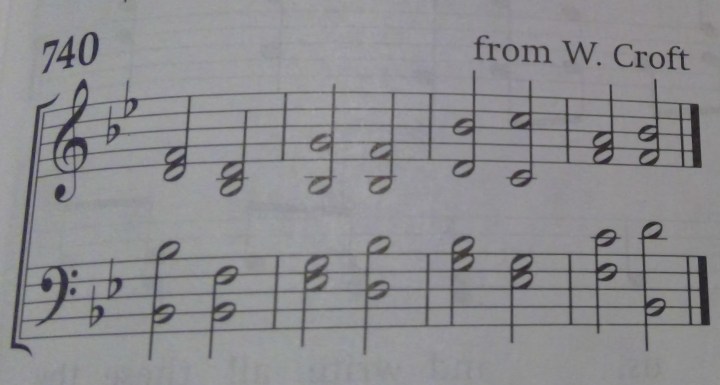
Next let’s move up to Simplified Anglican Chant. This and the following images are from the hymnal, Book of Common Praise 2017.

simplifiedchant740


– Sample 4 –

Now we’re ready for a fully-fledged Anglican Chant.  First let’s go for a Single Chant, which means each verse gets the same tune.

singlechant653


– Sample 5 –

Last of all, here’s a Double Chant, meaning the repeated tune spans two verses.

doublechant660

The Offertory Sentences

One of the stranger experiences for someone accustomed to the 1979 Prayer Book (or similar resources), going into the 2019 book, might be the Offertory.  It’s handled pretty much the same in this book as the 1979: the prayer over the offering is hard-wired into the main text of the liturgy, which is a minor change, and probably not too jarring to adapt to.  But when you flip the pages over to the list of Offertory Sentences, that’s where things might get weird.

You see, the 1979 Prayer Book has a reputation for being absolutely drowned in choices.  Several Eucharistic Rites, contemporary and traditional language versions of the Offices and Collects, countless “_ or _” prayers, you name it, the 1979 book is full of options.  And its list of 8 Offertory Sentences and 1 “bidding” to choose from for the Celebrant to read at the beginning of the Offertory seemed like plenty of choices (page 376-7 of that book).  But turn to page 149 in the 2019 Prayer Book and you find twenty Offertory Sentences to choose from, spanning three pages!  What gives, 2019?  We thought the liturgy was getting more streamlined and simple, why so many choices?  And why for such a paltry moment in the liturgy?

As usual, the answer can be found with quick consultation with the classical prayer books.  Take up the 1662 Prayer Book, flip to the appropriate portion of the Communion liturgy (page 241 in my Cambridge Press copy, I don’t know how standardized they are), and you find that the Communion Sentences are printed right into the primary text of the service, not in an appendix after.  And there are twenty of them!  (Interestingly, not quite the same twenty.)  The 1662 rubric for their use is as follows:

Then shall the Priest return to the Lord’s Table, and begin the Offertory, saying one or more of these sentences following, as he thinketh most convenient in his discretion.

This sounds rather like the handling of the Opening Sentences in the Daily Office, which also have undergone a radical re-purposing since at least 1928.

The 2019 Prayer Book, meanwhile, calls for only “one of the provided sentences of Scripture.

Chances are that most celebrants will continue saying one of the three or four that they’d memorized from the 1979 Prayer Book’s shorter list, and not give this any more thought.  And that’s okay.  But it’s worth exploring this renewed list of Offertory Sentences.  Like the Comfortable Words they may feel redundant in function, but when taken seriously they can provide an excellent “bible study” on giving, generosity, and charity.  Our rubrics technically don’t permit us to read more than one, not that I can imagine any bishop telling us off for violating that, so perhaps the best way to go about exploring these with the congregation is using them on a rotation, week by week.  These sentences exist in our liturgy, after all, not just to “kill time” or warn people that the money plate is coming, but actually to teach them about the spiritual discipline of charity, alms-giving, or tithing.

Just for kicks, let’s make a text-based Venn Diagram comparing the 1662 and 2019 lists:

1662 only: Psalm 41:1, Proverbs 19:17, Tobit 4:7b, Luke 19:8, 1 Corinthians 9:7, 1 Corinthians 9:11, 1 Corinthians 9:13-14, Galatians 6:6-7, 1 Timothy 6:6-7, 1 Timothy 6:17-19.

1662 & 2019: Tobit 4:8-9, Matthew 5:16, Matthew 6:19-21, Matthew 7:21, 2 Corinthians 9:6-7, Galatians 6:10, Hebrews 6:10, Hebrews 13:16*.

2019 only: Deuteronomy 16:16-17, Psalm 50:14*, Psalm 96:8*, Matthew 25:40, Luke 10:2, Acts 20:35, Romans 10:14-15, Romans 12:1*, 2 Corinthians 8:9, Ephesians 5:2*, 1 Peter 2:9, 1 John 3:17.

The 1928 Prayer Book has sixteen Sentences, not simply a reduction from the 1662 list, but supplying new verses – some of which are preserved in subsequent books, and two which are unique to it but are now found in our post-Offertory prayer: 1 Chronicles 29:11* & 14.

* These are the eight listed in the 1979 book, in addition to the following: Matthew 5:23-24, Revelation 4:11.  Interesting that that book had only one Sentence in common with the 1662 list.

If at all possible, take up a copy of the 1662 Prayer Book, though, and read through its Offertory Sentences in its printed order.  It’s not just a list thrown together (which I think is likely the case with ours), but the progression from one to the next is logical, ideas building from one to the next.  With only a little finesse, you can make the whole “list” into a coherent Exhortation!