Commemorating the Martyrs of Sudan

May 16th is noted, in our calendar of commemorations, not for a particular saint, but for a whole group: the Martyrs of Sudan.

Originally, this date was chosen to commemorate this group of martyrs because on this day in 1983 the Anglican leaders in Sudan made a public stand for the faith, knowing that under Sharia Law they were destined for execution.  And in the two decades of civil war that followed, millions lost their lives for Christ.  A further wave of attacks against Christians swept the country in 2011, soon before South Sudan was separated as a new (and Christian-friendly) country.

Many of the Sudanese bishops who survived the wars lived in exile; most of the clergy ministered without pay.  Hardly a church building was left standing.  To this day, rebuilding destroyed communities and healing broken families and lives is a massive effort.  The Sudanese diaspora across the world, including in the United States, also need prayer, ministry, healing, and new life rebuilding.

But the blood of the martyrs has been fruitfully sown: the population of South Sudan has gone from 10% Christian in the 1990’s to 60% Christian in 2012, the majority of whom are Roman Catholics and Anglicans.

As this is a mere commemoration in our calendars, there are no major changes to our daily round of worship, unless you hold a Communion or Antecommunion service for this day.  But we can add a Collect to the additional prayers at the end of the daily office, like this one:

Almighty God, you gave your servants in Sudan boldness to confess the Name of our Savior Jesus Christ before the rulers of this world, and courage to die for this faith: Grant that we may always be ready to give a reason for the hope that is in us, and to suffer gladly for the sake of our Lord Jesus Christ; who lives and reigns with you and the Holy Spirit, one God, for ever and ever. Amen.

We could also make a point of praying the Great Litany today with the Sudanese church and diaspora in mind.

Sources:

http://www.satucket.com/lectionary/Sudan.htm

http://50days.org/2013/05/the-martyrs-of-sudan-yesterday-today-tomorrow/

https://en.wikipedia.org/wiki/Christianity_in_Sudan#Persecution_of_Christians_in_Sudan

Nunc Dimittis doing double duty

Most liturgical ingredients in the Prayer Book tradition are set into one particular function with little or no variance.  The Daily Office has its own opening and closing sentences, the Communion liturgy has its own acclamations and dismissals, each major liturgy has its own prayer of confession (though the rubrics now allow cross-pollination  to some extent), and every canticle has its particular home.

But the Nunc dimittis has two appointments in the Prayer Book, such that it’s even printed in the book twice.  It is the second canticle of Evening Prayer, and it is the anthem/canticle in Compline (the night office).  This is a particularly odd repetition, since Evening and Compline are both pretty similar in function and usually near one another in time (evening, bedtime).

The reason for this is that in the English Reformation when Archbishop Thomas Cranmer assembled the first Common Prayer Book he reduced the monastic offices from seven in the day and one at night down to two: Morning (Matins) and Evening (Vespers).  There are elements of three monastic morning offices wrapped up in Anglican Morning Prayer, and elements of Vespers & Compline wrapped up in Anglican Evening Prayer.

So what happens when you try to bring back in one of those “extra” monastic offices?  You get little hints of repetition with the Anglican Daily Office.  In the case of the Nunc dimittis its original home was the night office, Compline, which the Prayer Book tradition rolled into Evening Prayer.  Thus in modern books that bring Compline back to Anglican liturgy, we’ve got a situation where the Nunc dimittis has two homes.

If this doesn’t bother you, well and good.  But if you are someone who regularly prays both Evening Prayer and Compline, and desires to highlight separate identities for both offices, then there is something you can do about that: the 2019 Prayer Book has an appendix to the Daily Office section labeled Supplemental Canticles for Worship.  This is an expansion of what earlier Prayer Books (before 1979) did: offering usually two options of a Canticle for each slot (that is, position of response after each reading in the Morning & Evening offices).  Now, instead of 8 or 9 total Canticles with specific directions on which ones to use where, we have 15 Canticles, 10 of which provide minimal guidance as to their expected use.  If you want to make use of these and reduce the repetition of the Nunc dimittis between Evening Prayer and Compline, consider the following pattern of alternatives:

The Second Canticle, the Nunc dimittis, is to be recited on Saturdays and Sundays, and on other days throughout the year not superseded by the following.

Canticle 4, the Quaerite Dominum, is to be used in its place on the First Sunday of Advent and on weekdays throughout the season.

Canticle 3, the Kyrie Pantokrator, is to be used in its place on Ash Wednesday, the First Sunday of Lent, Palm Sunday, and every weekday throughout the season.

Canticle 9, the Deus misereatur, is to be used in its place on Monday through Friday during Epiphanytide and Trinitytide, and on the occasion that the text of the Nunc dimittis is part of the New Testament Lesson.

Reading 1 John in Eastertide

This evening we begin reading the epistle 1 John at Evening Prayer, and will go through it over the course of the whole week.  As I noted with 1 Peter a little while ago, this is an appropriate daily lectionary experience because it matches up with the Sunday Communion lectionary on one of the three years of its rotation.  It doesn’t match up perfectly in real time, of course, but the idea of reading 1 John in Eastertide is achieved both in Year B on Sundays and in the middle of May in daily Evening Prayer.

What makes 1 John an Easter-appropriate epistle such that it got assigned to this season in one year of the Communion lectionary?  In part, it’s an echo of the historic lectionary for Eastertide, which features 1 John and 1 Peter and James as the Epistle lessons through the season.  Digging deeper, the style of 1 John is very similar to the Gospel of St. John, which also gets heavy coverage in Eastertide and other major festal seasons and occasions throughout the year.  1 John has emphases on community, belonging, love, and release from sin, which all connect easily with the tradition of reading Acts in Eastertide, and the more general “result of the resurrection” frame of mind that this season is all about.

The opening prologue to 1 John also betray the unusual status of this book.  It is billed as an epistle of John but its writing style is much more like a homily or address.  Thus it makes for great reading and hearing but a far more difficult study than a more orderly epistle like those of St. Paul (at least in my opinion).  Despite the general challenge of making sense of how this book is structured and organized, the opening verses are one of my personal favorite passages of Scripture.

If you’d like a homily to accompany you in Evening Prayer today, here you go:

Book Review: The 1982 Hymnal

Welcome to Saturday Book Review time!  On most of the Saturdays this year we’re looking at a liturgy-related book noting (as applicable) its accessibility, devotional usefulness, and reference value.  Or, how easy it is to read, the prayer life it engenders, and how much it can teach you.

Like many traditionalists, I don’t really like this hymnal.  So let’s make a point of starting with the positives.

+1 It matches the contemporary rites.  Made to pair with the 1979 Prayer Book, this hymnal is the first in the Episcopalian tradition to feature contemporary-language Service Music.  Carried into the ACNA, this remains a useful feature.  A few translation elements have changed since then (“And also with you” has returned to the properly historical and biblical “And with your spirit” for example), but for the most part those discrepancies are easily adapted from the 1979 liturgy to the 2019.

+2 It has a lot of options for service music.  In total there are 288 chant tunes and melodies for the various Office Canticles and Prayers, Mass parts, and other commonly-sung parts of the Office and Communion liturgies.  Add in the fact that it retains some traditional-language material alongside the contemporary, and you’ve got yourself a large collection of choices and resources built in to the hymnal.  This is very empowering for a choir or congregation, having so many possibilities accessible in one volume without having to purchase expensive choir music or whatever else.

+3 It brings in a few popular hymns that the previous hymnal lacked.  I commented last week that the 1940 hymnal doesn’t have Amazing grace! in it; this book does.  And, with a total of 720 hymns (compared to 600 in the 1940), this hymnal didn’t have to sacrifice a ton of songs in order to make room for new and imported ones.

But there are a number of shortcomings to this hymnal.  Depending upon your preferences and views, some of these might be minor or major to you; I’ll list what I consider to be the main offenders.

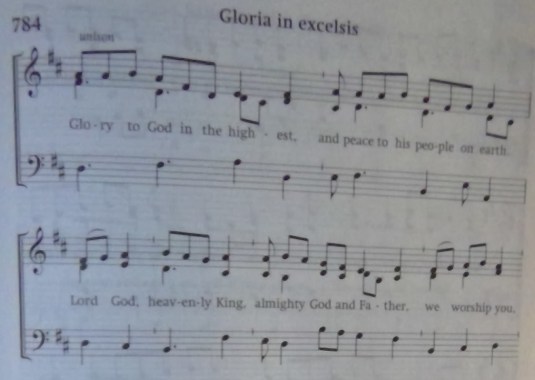
-1 The formatting is inconsistent.  Sometimes you get a fantastic four-part-harmony arrangement complete with the last verse’s descant on top, making for an excellent resource for congregation, choir, and keyboardist alike.  But sometimes you just get a melody line with no accompaniment.  If you want to play along on the piano or organ, too bad, you’ve got to purchase the giant TWO-VOLUME accompanist edition of the hymnal.  Ain’t nobody got time fo’ dat.  Plus, a lot of the hymns in this book are printed with uneven line or page jumps.  You can see the range of good and bad in this sample:

WIN_20190508_13_11_30_Pro

-2 A number of classic hymns have undergone changes to the lyrics.  To some extent, yes, there is a longstanding history of lyrics getting edited for reasons of theological preference or for clipping long songs into shorter versions.  But this hymnal goes a few steps too far, doing violence to the poetry of classic songs in the interest of gender-neutral language.  Perhaps the most prominent offender is Be thou my vision.  The second verse reads:

Be thou my wisdom, and thou my true word;
I ever with thee and thou with me, Lord;
thou my great Father; thine own may I be;
thou in me dwelling, and I one with thee.

compared to the original:

Be thou my wisdom, and thou my true word;
I ever with thee and thou with me, Lord;
thou my great Father, I thy true son;
thou in me dwelling, and I with thee one.

The theological implication (not to mention biblical language) of sonship is discarded.  The assurance of belonging in Christ (“thy true son”) is replaced with aspiration (“may I be”).  Plus, for the many, many people who already know the original version, this is a constant tripping point, stumbling over these awkwardly re-worded phrases.  Come thou fount of ev’ry blessing is also subject to some distracting word changes, and I’m sure there are other examples I haven’t found on my own.

-3 The ordering of the music is awkward.  Unlike the 1940 hymnal, the Service Music is printed in this book first.  If you’re in a choir, or the congregation uses the service music section a lot, that’s fine.  But if, like in many places, it’s primarily a book to pick up in order to sing hymns, this can be annoying (and downright confusing for newcomers), having to flip past S1 thorugh S288 before getting to hymn #1.

Furthermore, the hymns aren’t organized as logically as they could be.  Simplifying the Table of Contents…

  • #1-46 The Daily Office (Morning, Noon, Evening, Compline)
  • #47-293 The Church Year
  • #294-299 Holy Baptism
  • #300-347 Holy Eucharist
  • #348-361 Confirmation, Marriage, Burial, Ordination, Consecration
  • #362-634 General Hymns
  • #635-709 The Christian Life
  • #710-715 Rounds and Canons
  • #716-720 National Songs

Why Rounds and Canons need their own section, and why National Songs aren’t appended to the Church Year section, is beyond me.  The separation of The Christian Life from the related sub-sections of the General Hymns also seems strange to me.

Last of all, I should point out that the indexes are rather limited in this book compared to a number of others.  It has no liturgical index, recommending hymns for particular Sundays and Holy Days like in the 1940, but that is to be expected with the lengthy and complex 3-year lectionary cycle.  However, this hymnal also lacks a metrical index, which is admittedly probably only an issue for creative music ministers who want to look at alternative tune possibilities and make particularly detailed comparisons.

The rating in short…

Accessibility: 3/5
It’s well-labeled and has the basic Table of Contents and index that you need.  But you’ll probably need those resources more than you would with other Anglican hymnals.

Devotional Usefulness: 3/5
It has the positive usefulness of providing service music and additional hymns that older hymnals don’t or can’t provide.  But the liberal hand of editing has left its mark, which tampers with (and occasionally ruins) a number of hymns along the way.

Reference Value: 4/5
Compared to its predecessors, the extra-large collection of Service Music makes this hymnal rather handy to have around, especially for the contemporary-language worshiper.  And, with 720 hymns, it’s just plain got a lot of music in it too, lyrical tampering and format problems notwithstanding.

Ultimately, this hymnal is one I would recommend for two groups of people: choristers or congregations who routinely set many parts of the liturgy to music/chant, and music ministers who want to draw upon this book as a supplementary resource.  I would not recommend this hymnal as an ordinary hymnal for a church, especially considering the financial commitment for the accompanist who’ll need an extra $80 for that edition.

2 Peter and Jude Together

As you go through the Daily Office this week, you might notice something surprising about the Epistle readings in the evenings.  We just finished 1 Peter, we’re getting into 2 Peter, but next is not 1 John, but Jude!  The Epistles are almost finished… but why is Jude moved before John instead of read after like it’s found in the order of the New Testament in the Bible?

Part of the reason might be chronology – some of the Epistles are offered in our daily office lectionary according to the order in which they were written.  It is very likely that St. John’s epistles were written later in his life, post-dating pretty much the entire rest of the apostolic writings.

But most likely, in this case, Jude is read immediately after 2 Peter because they are very similar books.  For those who tend to be more “critical” of the biblical text, 2 Peter is sometimes looked upon as a “correction” to Jude.  Not a correction in that Jude was wrong, exactly; more a correction in that Jude makes some confusing and obscure references, and 2 Peter offers similar teachings with cleaner Old Testament references.

In its extremely brief length, the Epistle of Jude manages to make references to

  • the origin of demons: “that did not keep their own position” (v6)
  • Sodom and Gomorrah’s indulgence “in unnatural lust” (v7)
  • a dispute between the devil and Michael the Archangel over the body of Moses (v9)
  • a cited quote from the (very) apocryphal book of Enoch (v14-15)

Despite these difficult lines, Jude has two very popular texts, one at its beginning and one at its end:

I found it necessary to write appealing to you to contend for the faith which was once for all delivered to the saints.

and

Now to him who is able to keep you from falling and to present you without blemish before the presence of his glory with rejoicing, to the only God, our Savior through Jesus Christ our Lord, be glory, majesty, dominion, and authority, before all time and now and for ever. Amen.

The previous epistle, 2 Peter, contains a similar warning against false teachers and false brethren who practice immoralities, but does so without quite so many oblique references.  Chapter 2 references the flood, Sodom and Gomorrah, Baalam, and the steadfastness of God’s holy angels.  So when you get to reading Jude on Sunday, keep Friday’s reading from chapter 2 in mind.  The similarities will be very helpful.

Apart from that, 2 Peter has a few unique contributions regarding the eyewitness authority of the apostles, which in turn is subordinate to the witness of the Scriptures (cf. chapter 1); and also reiterates some of the points regarding suffering already covered in 1 Peter.

It’s helpful that these books are short, too, so that we can read through them in fairly rapid succession and be able to notice the connections between them.  Still, it’s a good thing our lectionary moves Jude up next to Peter!

Praying with St. Julian of Norwich

Today’s entry in the calendar of commemorations is St. Julian of Norwich.  Two quick clarifications are in order.  First, Julian is (in this case) a woman’s name.  Second, the W in Norwich is silent, so pronounce it ‘norrich’.  (Sorry, I had an history professor in college who heavily pronounced the W all the time, and it was ridiculously embarrassing.)

Saint Julian of Norwich was an ordinary medieval woman of some social status and means.  She was born in England around 1342, and had a severe illness at thirty in which she received last rites and had a series of sixteen visions of Christ.  She wrote about her visions, Revelations of Divine Love, shortly afterward, and near the end of the century wrote a longer treatise explaining them in greater detail.

For most of her life, after her near-death experience, she lived as an anchoress.  An anchorite (male) or anchoress (female) is sort of a cross between a monastic and a hermit.  As the name suggests, one is anchored to the spot, living in a small cell block attached to a church.  As an anchoress, therefore, she lived simply, singly, on the charity of others.  She had a window into the church building through which she could hear Mass and receive Communion, and a window to the outside through which she could speak with visitors and offer spiritual wisdom and advice.  Near the end of her life she was visited by another medieval woman who came to be remembered as a Saint, Margery Kempe.

You can read more of about her life here.

Apart from her name appearing in our calendar, St. Julian shows up in one other place in our Prayer Book: the Occasional Prayers section.  There, prayer #92 on page 673 reads:

O God, of your goodness, give me yourself, for you are enough for me. I can ask for nothing less that is completely to your honor, and if I do ask anything less, I shall always be in want. Only in you I have all. Amen.

In this Customary’s recommended rotation of praying these Occasional Prayers every two weeks, I came across this prayer on the day after Ash Wednesday, and immediately took a liking to it.  In my own emotional and spiritual life at that point, I badly needed to refresh a sense of satisfaction in Christ alone.  Words like “for you are enough for me” and “Only in you I have all” are expressions of faith and trust and reliance that I needed to meditate upon, and so this little prayer became a quiet theme for me throughout Lent.  It wasn’t seasonally appropriate one way or the other, it had no connection to the liturgy as such, it was simply a piece of my private devotions for a few weeks.  This is legitimate and good; the classical three-fold rule of worship identifies private devotions as necessary to the Christian life alongside the daily office and the sacraments.

And yet, common prayer, or at least a Prayer Book, can aid us in our private devotions.  The 123 Occasional Prayers offered near the back of our Prayer Book include over 20 labelled as being for Personal Life or Devotion.  This means that 1, they aren’t meant for common worship as such, and 2, some will befit your prayer life better than others.  There are some in there that I actually rather dislike.  But my opinions will change with my mood and spiritual condition over time, I’m sure, and St. Julian’s prayer may not minister to me as profoundly in another year.

So I encourage you to explore these prayers for your own prayer life, and explore the people commemorated in our calendar.  You never know who and what the Holy Spirit will use to minister to you both within and apart from the liturgy!

Hymn: At the lamb’s high feast

Easter is one of those holidays, like Christmas, that has some really famous, really well-loved, really satisfying hymns to sing.  Jesus Christ is ris’n today or its twin, Christ the Lord is ris’n today, are so classic I’m tempted to say “Easter just wouldn’t be Easter without singing that song!”  There are, of course, many other Easter hymns of lesser fame that are quite fantastic for the holiday, and one of my favorites in that middle category is At the lamb’s high feast we sing.  Set to the tune SALZBURG, it bears a grandeur both lyric and melodic that deserves higher praise than it usually seems to get.

At the lamb’s high feast we sing
Praise to our victorious King,
Who hath washed us in the tide
Flowing from his pierced side;
Praise we him, whose love divine
Gives his sacred blood for wine,
Gives his body for the feast,
Christ the victim Christ the priest.

That first stanza sets us firmly in the Easter celebration, makes a baptismal reference (as is traditional in the Easter celebrations), and then moves seamlessly to a eucharistic reference.  I especially appreciate how his sacrifice is described in the active sense: he gives his blood and body; he’s not just Christ the victim, but also Christ the priest!  This is, in my opinion, an emphasis that we often lack when discussing the atonement.

The second stanza continues:

Where the Psachal blood is poured,
Death’s dark angel sheathes his sword;
Israel’s hosts triumphant go
Thro’ the wave that drowns the foe.
Praise we Christ, whose blood was shed,
Paschal victim, Paschal bread;
With sincerity and love
Eat we manna from above.

The baptismal and eucharistic references remain, but are couched in more overtly Old Testament imagery, invoking the Passover and the Crossing of the Red Sea as the foreshadowings or prototypes of these two Sacraments of the Gospel.  It even manages (in the last two lines of this stanza) to reference the Easter Anthem (The Pascha Nostrum) and invoke the context of the teachings of 1 Corinthians 10, linking the Old Testament (particularly Exodus) waters and manna images to the New Covenant sacraments.

Mighty victim from the sky,
Hell’s fierce pow’rs beneath thee lie;
Thou hast conquered in the fight;
Thou hast brought us life and light;
Now no more can death appall,
Now no more the grave enthrall;
Thou hast opened paradise,
And in thee thy saints shall rise.

The brief Passover reference at the beginning of stanza 2 – the sheathing of the destroying angel’s sword – is explored here in full force.  The death and resurrection of our Lord Jesus Christ has brought about a great victory.  Jesus is a “mighty victim from the sky”, yet, “Hell’s fierce powers” lie beneath him.  He has conquered, he has brought us from death to life, and those evils can never reign over us again; the hope of our own resurrection to eternal life is sealed for sure.

This leads the hymn to a great doxological ending:

Easter triumph, Easter joy,
Sin alone can this destroy;
From sin’s pow’r do thou set free
Souls new-born, O Lord, in thee.
Hymns of glory, songs of praise,
Father unto thee we raise;
Risen Lord, all praise to thee
With the Spirit ever be.  Amen.

That second line always bugs me – “sin alone can this destroy“… It is obviously meant that sin is the object, not the subject, of the verb destroy: Easter triumph and joy alone can destroy sin.  But there’s just no decent way to get the word order sorted out with perfect clarity without destroying the rhyme scheme of the lyrics.  You just have to roll with the poetry, which we moderns and post-moderns are not generally very good at doing.  Getting over that shortcoming in ourselves, however, this is a logical and fitting apex for the hymn.  Christ’s victory is over sin itself, and in his Gospel we find freedom.  And thus we praise the triune God, Father, Risen Lord, and Spirit.

There’s still plenty of Easter Sundays left… get it into your congregation’s hands if you haven’t already!  It works as a communion hymn, offertory/doxology hymn, processional, recessional… nearly anywhere in the liturgy where singing can be found!

The Collect for Easter III

Yesterday’s Collect of the Day, which as usual serves throughout this week in the Daily Office, has an interesting history and pedigree.  In the historic Prayer Books it served for the Second Sunday after Easter, which was Good Shepherd Sunday.  In the 1979 Prayer Book, this Collect traveled to the another part of the year to serve for Proper 15 (mid/late August).  And now in the 2019 BCP it’s back in the same relative position in Eater, the Third Sunday of Easter.

Almighty God, you gave your only Son to be for us both a sacrifice for sin and an example of godly living: Give us grace thankfully to receive his inestimable benefits, and daily to follow the blessed steps of his most holy life; through Jesus Christ our Lord, who lives and reigns with you and the Holy Spirit, one God, for ever and ever.  Amen.

So let’s take a look at what makes this Collect so versatile.

Theologically speaking, this Collect works incredibly efficiently at drawing together models and doctrines of the atonement.  Jesus is both a sacrifice for sin (substitutionary atonement or something like that) and an example to imitate (moral example).  These models then lend themselves to a double application: we are to be thankful in the reception of his grace and daily to follow (or in the classical and perhaps more honest wording, daily endeavor to follow) in the footsteps of his sinless life.  The call to thanks-giving, our Eucharistic sacrifice, and to faithful obedience, our Christian duty, go hand-in-hand.  With such lofty and gospel-central themes, this prayer could make its home nearly anywhere in the Christian year, though Eastertide is most natural as the celebration of the resurrection of Christ most directly begs the question of what we are to do next.  And since the Easter Vigil and Day collects tend to focus on baptism and the resurrection life, it is only logical to move on to a eucharistic (thanks-giving) theme thereafter.

Paired with the Good Shepherd readings in the historic lectionary, this collect serves as a first line of application for the image of Jesus as our good shepherd.  Recognizing what the Shepherd does for the sheep and recognizing his voice, we learn to give thanks and to follow him.

But now, in the 2019 Prayer Book’s version of the modern lectionary, this collect is paired with Gospel lessons that deal with post-resurrection appearances of Jesus in Luke 24 or John 21.  The good shepherd connection is replaced with a “response to the resurrection” sort of mentality. Rather than latching onto a specific image (Jesus the Good Shepherd) this Collect works in tandem with the general Eastertide theme: resurrection and new life.  It may make the prayer itself feel a bit more arbitrary, but it still gets the job done.

Book Review: The 1940 Hymnal

Welcome to Saturday Book Review time!  On most of the Saturdays this year we’re looking at a liturgy-related book noting (as applicable) its accessibility, devotional usefulness, and reference value.  Or, how easy it is to read, the prayer life it engenders, and how much it can teach you.

When the church I currently serve was first planted, the former Episcopalians got in touch with their previous church and were donated a big box of hymnals.  The church had closed a camp location some years previously, and so they had a pile of hymnals they didn’t use or need anymore.  And, as it turned out, they were “obsolete” – they were copies of The 1940 Hymnal.  As a keyboardist, and still new to Anglican hymnody, I wasn’t sure what to make of this: how different was this book from the newer one I was getting to know at my then-home church?

I quickly came to appreciate the 1940 hymnal a lot, and cherish its resources.  Being from 1940, it was appointed to work alongside the 1928 Prayer Book, which has the historic one-year calendar and lectionary for the Sunday Communion services.  As a result, things were simple enough that it was able to provide recommended hymns for each Sunday and Major Feast Day of the year in a Liturgical Index in the back, along with other indexes that are standard to virtually all hymnals (author/source, tune, meter, first line of text, topic).  For the years that my church followed the 1662 BCP’s lectionary, this was immensely useful for me; otherwise that index is little more than of historical interest.

The Contents of the 1940 Hymnal are as follows:

  • #1-111 The Christian Year
  • #112-136 Saints’ Days and Holy Days
  • #137-138 Thanksgiving and National Days
  • #149-184 Morning and Evening
  • #185-228 Sacraments and other Rites of the Church
  • #229-234 Litanies
  • #235-252 Hymns for Children
  • #253-265 Missions
  • #266-600 General Hymns
    • #266-277 The Blessed Trinity
    • #278-315 The Praise of God
    • #316-367 Jesus Christ our Lord
    • #368-379 The Holy Spirit
    • #380-398 The Church as God’s gift
    • #399-403 Holy Scripture, the Church’s gift
    • #404-490 Personal Religion
    • #491-548 Social Religion
    • #549-581 The Church Militant
    • #5822-600 The Church Triumphant
  • Directions for Chanting
  • The Choral Service
  • Morning & Evening & Occasional Canticles
  • Service Music for the Holy Communion

Most of these sections subdivide further into smaller units.  Some of these sections are labeled in ways that suggest the liberalizing trend in the Episcopal Church even back then.

At the end of each liturgical season section is a list of appropriate selections from the General Hymns that would also do well to fill out the season, which I found very helpful.  A rather mixed blessing, however, came in the balance of the number of hymns for each season.  There are 111 season-based hymns in here, and 34 of them are for Christmas!  Twelve days of the year get nearly a third of the hymns.  Advent got short-changed.  Lent was a bit lacking in representation, too, especially when looking among the General Hymns for good penitential lyrics.

There are also a lot Office hymns: 11 for the Morning, 1 for Noon, 1 for the Afternoon, and 22 for the Evening.  Clearly, Choral Evensong was a lot more common back then than it is now.

There are a few cross-denominational popular hymns that are conspicuously absent from this hymnal, most notably Amazing Grace.

But on the whole, this is a hymnal that I really came to love.  Every hymn has a full 3-or-more-part piano choral arrangement and/or keyboard accompaniment.  The print is clear (if a bit faded in the physically older copies we used).

Accessibility: 4/5
Like most hymnals, this is well-organized; and like most Anglican hymnals, it is conformed to the Calendar.  The indexes are easy to navigate.  You don’t need a separate edition for the pianist to accompany the singers.

Devotional Usefulness: 3/5
Some of its sacrament-related hymns lean high-church.  Some of its national and “social religion” hymns may feel a bit too “worldly”.  The calendar and the translation of the liturgy are out of date if you’re using a modern prayer book.  There is a distinct lack of songs dealing with subjects like penitence and the Holy Spirit.  Depending upon how you feel about these issues, this rating may bump or down a notch accordingly.

Reference Value: 4/5
If you only have a “contemporary” hymnal, like the Episcopalian hymnal of 1982, then this book is of immense value in preserving a number of gems that got lost in the update, and I highly recommend you get your hands on a copy of this if you like to read or sing hymns.

My church used this hymnal for eight years, seven of which I was the music minister rummaging through it for songs to sing each Sunday.  I became well-acquainted with its shortcomings, but on the whole was very happy with it, and was in no rush to “upgrade” away from it.  If you’re a music minister, or a hymn enthusiast, this almost definitely belongs in your collection.

Reading 1 Peter in Eastertide

This evening the Daily Office Lectionary begins its trek through the epistle 1 Peter.  As you may recall, 1 Peter is one of the three books that gets highlighted in the Epistle lesson slot during Eastertide in the Sunday Communion lectionary.  It’s kind of neat that we get to read this book in the month of May, either to reinforce or contextualize the Sunday readings if it’s that year, or giving us the book’s coverage on the years that don’t touch upon it on Sundays.

The First Epistle of St. Peter is a sobering book to read; it deals plainly with the subject of enduring persecution, noting that many churches in the region of Cappadocia have already begun to experience that.  As such, the letter looks keenly at the eschaton, the End of history, while acknowledging that the “Last Days” are already begun.  The letter also looks firmly back, at Jesus Christ, firmly grounding the Christian’s identity in the completed work of Christ.  Related to that, 1 Peter also contains one of the most strongly-worded teachings about Holy Baptism, if couched in one of the most difficult contexts in the entire New Testament.  It even makes space for ethical and pastoral instruction.

In Year A of the Sunday Communion lectionary, the suffering-related texts tend to get omitted.  It’s understandable, when choosing highlights to summarize the book in the Easter season. but still obviously a bit of a loss compared to the depth of the book itself.  So the Daily Office, here, is where we really get to dig into this (and every) book.  In an evangelical culture so used to focusing on the writings of St. Paul, a careful read of this book can be a refreshing perspective check.  Enjoy it!