Book Review: The Bay Psalm Book

Welcome to Saturday Book Review time!  On most of the Saturdays this year we’re looking at a liturgy-related book noting (as applicable) its accessibility, devotional usefulness, and reference value.  Or, how easy it is to read, the prayer life it engenders, and how much it can teach you.

Today we’re stepping outside the Anglican tradition and looking at a gem of American history.  The first book ever published and printed in North America was The Bay Psalm Book in 1640, a mere twenty years after the pilgrims arrived in Massachusetts.  It has gone through many re-printings since then, and probably has some more legible successors in recent times, but I happened upon a facsimile print of the first edition, complete with blocky type and funny 17th century spelling.  On its own, it’s a cool historical curiosity.  But its actual contents have proven useful to me, and even found their way into my church’s worship from time to time.

The Bay Psalms Book is basically a psalter: all the psalms are re-translated such that they conform to common poetic meters in English such that they can be set to hymn tunes.  This book does not assign any tunes, it’s simply the text of the metric psalms.  What I have done, then, is take up some of a psalm from this book, fix up the spelling (and modernize the grammar a little if possible) and pick a tune that my congregation will know.

Psalm 67, for example (odd spelling and italics included), reads thus:

God gracious be to us & give
his blessing us unto,
let him upon us make to shine
his countenance alſo.*

That there may be the knowledg of
thy way the earth upon,
and alſo of thy ſaving health
in every nation. **

O God let thee the people prayſe,
let all people prayſe thee.
O let the nations** rejoyce,
and let them joyfull bee:

For thou ſhalt give judgement unto
the people righteouſly,
alſo the nations upon earth
thou ſhalt them lead ſafely.

O God let thee the people prayſe
let all people prayſe thee.
Her fruitfull increaſe by the earth
ſhall then forth yeilded bee:

God ev’n our owne God ſhall us bleſſe.
God I ſay bleſſe us ſhall,
and of the earth the utmoſt coaſts
they ſhall him reverence all.

* The “long s” – ſ – looks like an lowercase f, but if you look carefully it doesn’t have the horizontal line through the center.  There was a general rule when to use ſ or s, but it doesn’t seem to be strictly followed in this book.

** Twice in this psalm you have to pronounce “nations” with three syllables: na-ti-ons.  This kind of thing happens with similar words throughout the book, making it rather difficult for the modern reader to pick up on.

Now try singing that to the hymn tune AZMON (popular with the song “O for a thousand tongues to sing“).

Pretty cool, huh?  What you can do with a book like this is look up the Psalm for the Communion service on a given Sunday, check if its verses are readable and singable for your congregation, and then bring them into the worship service set to a tune they know… then they’ll both read/pray the Psalm and sing a paraphrase of it!

A note on Psalm-singing: in liturgical worship, Anglican or otherwise, the text of the liturgy is very important.  It matters what we say, and why we say it.  To mess around with the wording or translation, therefore, is not good practice.  So I would never recommend metric psalms as a replacement for the Psalmody in the Daily Office or Communion services.  Let the official psalter translation do its work.  Metric versions such as in The Bay Psalms Book can be refreshing and interesting and even beneficial at times, but should never replace the actual text of our liturgy.

The ratings in short…

Accessibility: 5/5
This book is nice and simple; there’s an explanatory introduction, the text of 150 psalms, and nothing else.  The header tells you what psalm(s) are on the page below, so you can thumb through the book quickly and easily as you search for the one your want.

Devotional Usefulness: 3/5
You have to supply the music.  You have to be able to read the imperfect print (if you get a facsimile edition) and ignore the funny spellings.  You have to figure out how to pronounce some of the words like a 17th century British colonist.  It can be done, and it can be beneficial, but much of this book just “won’t do it” for worshipers in the 21st century.  Whenever I’ve used it in my church, it’s always been limited in scope and edited for clarity of language.

Reference Value: 3/5
There are modern metric psalm translations out there, so you don’t really need to seek this one out.  This is great if you like colonial American history, or the history of bible/psalm translation, or the history of Christian worship.  The introduction provides a little insight into puritan theology of worship, too.

Learning from the Liturgy: Ascension Day

Happy Ascension Day, everyone!
Here’s what I wrote for my congregation last year about this holy day:

Fr. Brench's avatarLeorningcnihtes boc

Ascension Day is perhaps the most under-celebrated important holiday in the calendar.  Representing one of the lines of the Creeds (“he ascended into heaven and is seated at the right hand of the Father”), this holiday marks a significant turning point in the Gospel story and sets the stage for how the Christian’s relationship with God is defined.  We often think of it as an awkward point between the Resurrection of Jesus (Easter) and the Descent of the Holy Spirit (Pentecost), but even in itself the Ascension is a major event.  What I’m setting out to do in this post is draw from the various Scriptural and traditional resources of the Church’s liturgy to explore some of the basic teachings and implications of this great and underappreciated day in the year.

The Event of the Ascension

Christ’s ascension is described in three books: Mark, Luke, and Acts.

In Mark’s Gospel…

View original post 2,092 more words

The Rogationtide Collects

Yesterday, today, and tomorrow are the Rogation Days – days devoted to prayer for the year’s crops.  We’ve mentioned ‘Rogationtide’ briefly recently.  Now that they’re here, let’s narrow in on the liturgical feature of these days that is the most natural to into our daily rounds of prayer: the Collects of the Day.  (We can, and probably ought to, use these as the Collect of the Day in Morning and Evening Prayer on these three days.)

Almighty God, Lord of heaven and earth: We humbly pray that your gracious providence may give and preserve to our use the harvests of the land and of the seas, and may prosper all who labor to gather them, that we, who are constantly receiving good things from your hand, may always give you thanks; through Jesus Christ our Lord, who lives and reigns with you and the Holy Spirit, one God, for ever and ever. Amen.

This Collect reflects the more historical form of the Rogation Days.  It is not the same as the Collect in the 1928 Prayer Book, but takes a rather more expansive view in its petition, now praying for the harvest of land and sea, God’s gift and preservation of both, the prospering of those who labor in those harvests, and for our own sense of thankfulness.

But nowadays the majority of our population aren’t farmers or fishermen, so we’ve got a second Collect for other forms of employment:

Almighty God, whose Son Jesus Christ in his earthly life shared our toil and hallowed our labor: Be present with your people where they work; make those who carry on the industries and commerce of this land responsive to your will; and give us all a right satisfaction in what we do, and a just return for our labor; through Jesus Christ our Lord, who lives and reigns with you, in the unity of the Holy Spirit, one God, now and for ever.  Amen.

This Collect is a good expression of a biblical theology of work.  We recognize Jesus’ sharing in our labor (implying his decades as a carpenter with St. Joseph), the need to be responsive to God’s will in the workplace (that is, being a faithful worker, judging by several parables of Jesus), a healthy satisfaction in our labor (understanding we were made for work), and a just return (the biblical injunctions concerning paying workers properly).  On their own, any of these four elements of the prayer could be twisted – the first to insubstantial piety, the second to undirected zeal, the third to idolatry, and the fourth to un-tethered social justice championship.  But collected together they form a healthier balance of biblical teaching concerning work and labor and employment.

So make sure you make use of these prayers today and tomorrow! Perhaps one in the morning and one in the evening?  Or both each time?  If you’re a teacher/preacher, that second Collect can also make excellent Bible Study material, especially if you bring up the Scripture readings it’s paired with: Ecclesiasticus 38:27-32, Psalm 107:1-9, 1 Corinthians 3:10-14, and Matthew 6:19-24.

Catholic Anglicanism

There are three major figures, patron saints if you like, who stand behind me as inspiration for the creation of this Customary. Aelfric is the obvious one of course, and you can read more about him here. He represents a reforming strand of thought: correcting malpractices, tightening the morality of the monasteries, translating things into English (Anglo-Saxon), and writing many sermons to refresh the theological tradition in his land.

The second is Saint Augustine of Canterbury, who represents a catholicizing strand of movement. The old British church had gotten stuck – the Anglo-Saxon invaders weren’t converting to Christianity very quickly, and their relationship with the rest of the western church was getting frayed – they even celebrated Easter on a different day, throwing most of the liturgical calendar off from one another! Saint Augustine and his team began the missionary movement that rekindled the church in Britain and eventually brought them into closer union with Rome and the universal church (East and West had not yet parted ways at that point).

The third figure is King Charles the martyr, who died for the causes of Crown and Church at the hands of a Puritan Parliament. He represents the particularly Anglican Way of Christianity: neither Roman in its catholicism nor Puritan in its reformation.

Yesterday, May 26th, was the feast of Saint Augustine of Canterbury, so I thought it a good opportunity to share a video about the catholic side of Anglicanism.

Book Review: Saint Dunstan’s Plainsong Psalter

Welcome to Saturday Book Review time!  On most of the Saturdays this year we’re looking at a liturgy-related book noting (as applicable) its accessibility, devotional usefulness, and reference value.  Or, how easy it is to read, the prayer life it engenders, and how much it can teach you.

One of the more unusual music volumes in my collection is Saint Dunstan’s Plainsong Psalter.  It was kindly bought for me as a Christmas gift by my parents-in-law a couple years ago, which was quite a surprise (though considering the vast length of my Amazon Wish Lists, it’s pretty easy for me to be surprised by gifts).  There was brief concern on my part, as I had just purchased stack of old books of chant, mass parts, choral services for the Daily Office, and so forth… would this book be redundant?

It turns out no, what this provides is a little different, and a lot more organized.  The title indicates that this book contains the Psalms marked for plainchant, but it has so much more inside.  It has some information and history of plainchant, including instructions on how to read and sing it.  It also provides chant settings (and text) for the entire Morning and Evening Office according to classical Prayer Book tradition!  With the resources in this single volume, you can chant the entire Morning Prayer (Matins) or Evening Prayer (Evensong) service, including the Scripture lessons.

It includes a walk-through of the ritual/ceremonial for a solemn chanted Office, and provides several chant tones for several Canticles that could be used at the Morning and Evening Office, even including the Athanasian Creed, and some Marian Anthems for those who want to high-church it up at the end of Evensong.  At the back, there’s a table of tones – an index of chant tunes, basically – which is a helpful study resource both for one who wants to learn to sing the chants regularly, and for one who wants to study this fascinating corner of music history.

It’s also worth noting that the plainchant tunes for the Psalms are not quite the same as in the traditional Roman Rite, but reflect the British variants that developed over the course of history.  So although this is a very “old-fashioned” traditional book, it is not crypto-Papist, but celebrates our Anglican heritage.

Of course, all the worship text is in traditional Prayer Book English.

WIN_20190524_10_46_38_Pro (2)

The ratings in short…

Accessibility: 3/5
With all the resources and explanations in this book, it is inevitably a bit tricky to navigate at first.  If you want to sing an Office, you need a bookmark in the Psalms section, in the Office liturgy section, and in the Canticles section.

Devotional Usefulness: 4/5
If you want to chant some or all of the Office, and don’t know how, this book will both teach you and provide everything you need for it.  All you need besides this is the Collect of the Day and Scripture readings appointed in your Prayer Book.  I give it a 4 instead of a 5 only because of all the explanatory text that makes the book a bit unwieldy… a more “professional” chorister or chanter would use a more streamlined book with fewer helps.

Reference Value: 5/5
If you don’t want to chant the Office, then this book is of purely academic value.  But its academic value is superb.  The history of chant, the application of chant in English practice, how to arrange and order a solemn Daily Office service, all make this book quite handy on your shelf even if you never intend to chant the Psalms in your church.

Saint Dunstan’s Plainsong Psalter is available from Lancelot Andrewes Press.

Psalm 118 Flashback

It’s the 24th day of the month, and that means Psalm 118 is on the docket for the rounds of daily prayer today.  With Eastertide well in progress this psalm may give you a bit of a flashback, as Psalm 118 plays prominent roles in Holy Week and Easter.

14 The Lord is my strength and my song, * and has become my salvation.
15 The voice of joy and deliverance is in the dwellings of the righteous; * the right hand of the Lord brings mighty things to pass.
16 The right hand of the Lord is exalted; * the right hand of the Lord brings mighty things to pass.
17 I shall not die, but live, * and declare the works of the Lord.
18 The Lord has chastened and corrected me, * but he has not given me over to death.
19 Open unto me the gates of righteousness, * that I may go into them, and give thanks unto the Lord.
20 This is the gate of the Lord; * the righteous shall enter into it.
21 I will thank you, for you have heard me, * and have become my salvation.
22 The same stone which the builders refused * has become the chief cornerstone.
23 This is the Lord’s doing, * and it is marvelous in our eyes.
24 This is the day that the Lord has made; * we will rejoice and be glad in it.
25 Help me now, O Lord; * O Lord, send us now prosperity.
26 Blessed is he who comes in the Name of the Lord; * we bless you from the house of the Lord.
27 God is the Lord, who has shown us light; * bind the sacrifice with cords, even to the horns of the altar.
28 You are my God, and I will thank you; * you are my God, and I will exalt you.
29 O give thanks unto the Lord, for he is gracious; *  his mercy endures for ever.

The verses in blue are the parts of this Psalm appointed for Easter Day.  The verses in red are the parts appointed for Palm Sunday.  The verses in purple are appointed for both.  (Easter Saturday also repeats much of this part of the psalm too.)

The Palm Sunday (Liturgy of the Palms) portion, verses 19-29, are pretty explicit in their attribution to Palm Sunday.  “Open to me the gates” invokes the entrance of Christ into Jerusalem, Jesus is “the righteous” who “shall enter” through “the gate of the Lord.”  The crowd’s cry of “Blessed is he who comes in the name of the Lord” is found here, as is the prophetic line “bind the sacrifice with cords, even to the horns of the altar”, which is what Palm Sunday goes on to observe – the crucifixion of Jesus.

Easter Day captures the more ‘positive’ verses of this psalm.  That is the day we celebrate that the Lord “has become my salvation,” that Jesus “shall not die, but live.”  Verses 22-24, which are shared on both days, proclaim a truth Jesus attributed to himself: I am the “stone which the builders refused” (Matthew 21:42, Mark 12:10, Luke 20:17), which St. Peter remembered well in his life thereafter (Acts 4:11, 1 Peter 2:7).  That, above all others, is “the day that the Lord has made” in which we are to “rejoice and be glad in it.”

Of course, when we’re praying this Psalm in its entirety on its own, outside the context of Palm Sunday or Easter Day, we need not let those liturgical usages of the psalm dictate the fullness of its interpretation.  But its allusions to the death and resurrection of Christ are inescapable, and the Christian must always see and acknowledge the echoes both of Calvary and the empty tomb sounding back through centuries into the words of this psalm, rebounding again to us as we pray, chant, and sing these words.

Eastertide: 40 days or 50?

The length of the Easter season is one of those subjects that can start internet fights.  Some say it’s 50 days long, beginning on Easter Day and ending on the Day of Pentecost.  Others retort that it’s 40 days, beginning on Easter Day and ending with the Ascension.  Meanwhile, perhaps the majority of church-goers look on in bewilderment or bemusement.  Why does it matter?  What’s the big deal?  Surely there are bigger fish to fry.

Let’s explore this debate in chronological order, so we can see how this disagreement came about, and why it matters to those who argue about it.

The Classical Prayer-Book Tradition

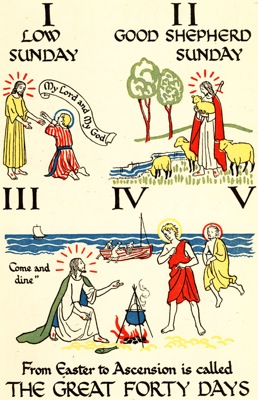
The changing of the seasons were not marked out quite so overtly in the old prayers books as they are in the new.  The Sunday Collects and Lessons were not typically marked out into season-based sections like they are in the 2019 book, so you had to rely upon the specific “name” of each Sunday, and the short list of Proper Prefaces early in the Communion prayers.  In both cases, Easter and Ascension are treated separately.  This sets out a demarcation: Eastertide ends when Ascension Day kicks in.  Thus we get images like this from Enid Chadwick’s beloved bookMy Book of the Church’s Year:

19

Note, “THE GREAT FORTY DAYS”… that’s Eastertide.

The emphasis this takes is on the gospel narrative of events: Jesus was raised from the dead, met with his disciples at various times, and ascended to the right hand of the Father 40 days later.  This also lines up the calendar with the Apostles’ Creed: “the third day he rose again; he ascended into heaven, and is seated at the right hand…”  In the ascension we see Jesus as Priest, making intercession for us, and Jesus as King, seated at the right hand of God.  It is a festal season, and closely related to Easter, but it takes on a theological emphasis that is distinct from Easter before it and Pentecost after it.

The Modern (or modernist?) Prayer-Book Tradition

The 1979 Prayer Book (and probably others like it) changed this up quite dramatically.  First of all, the name “Sunday after the Ascension” was changed to “the 7th Sunday of Easter”.  Ascensiontide still got its own Proper Preface, but a new feature of the liturgy – the opening acclamation – was provided for various seasons of the year, and the Easter acclamation (Alleluia, Christ is risen / The Lord is risen indeed, alleluia!) was appointed for the entire stretch from Easter to Pentecost.  Ascension Day and Ascensiontide were not removed from the calendar, but they were rolled into the Easter season, turning “the great forty days” into “the great fifty days.”

Now, there is a biblical precedent for this perspective: two of the primary Old Testament feasts (Passover and Tabernacles) are fifty days apart, and became the Christian Easter and Pentecost.  By emphasizing the fifty days, instead of the forty plus ten, the new calendar system highlights the Old Testament precedent for the Gospel.

The 2019 Prayer-Book Tradition

What we receive in the 2019 Prayer Book is something of a mixed bag when it comes to the length of Easter.  As usual, Ascension still has its own Preface.  Like the 1979 book, Ascensiontide has no acclamation of its own; it still gets the Easter call-and-response.  But the name of the Sunday in this season is back to “The Sunday after Ascension,” so there’s room for debate if it counts as Easter or not.  Room for debate, that is, until you read the calendar rubrics on page 689.  When discussing days of discipline, denial, and special prayer, it says:

The weekdays of Lent and every Friday of the year (outside the 12 Days of Christmas and the 50 days of Eastertide) are encouraged as days of fasting. Ember Days and Rogation Days may also be kept in this way.

This rather seals the deal: the 2019 Prayer Book sets forth a 50-day Eastertide.

HOWEVER,

Unlike the 1979 Prayer Book, there is a nuance, or a balance: the 7th Sunday of Easter is not “the seventh Sunday of Easter,” but the “Sunday after the Ascension.”  So although the “season” is still “Eastertide” in one sense, it has entered into a different phase: new Sunday nomenclature, new Proper Preface.

So if you’re a “50 days of Easter” kind of person, pay this balance (not to mention our historical tradition!) more careful attention.  We are apparently encouraged to use the 50-day language, according to our calendar rubrics.  But the Sunday after the Ascension is informed more by Ascension Day than by Easter Day.  Whether you call that ten day period the last part of Eastertide or Ascensiontide, be sure to afford it the distinct theological and Gospel-narrative emphasis it was meant to communicate.  On that Sunday, tell people “Christ is risen!” is no longer just about his resurrection, but about his rising bodily into heaven.  Make sure the Easter songs and hymns give way to songs and hymns about the ascension of Christ.  Crown him with many crowns and Hail the day that sees him rise are perhaps the two most famous examples.

If you want to read more about Ascension Day and its mini-season (or subset of Easter, if you insist), click here!  In my experience this is one of the most under-rated parts of the church year, and it has much to offer.

Why liturgy in the first place?

If you’re following this blog on Facebook, or directly, or via email subscription, chances are you’re already committed to the Anglican way of liturgical worship.  You may or may not have much to say about why you like or prefer liturgy over the free church tradition.  But you’ve probably been asked before by other Christians why you and/or your church worships the way it does.

Liturgy is not our “style”.  It is not our “flavor”.  It’s actually a part of who we are as Christians; it’s how we’re Christians.  Don’t fall into the trap of assuming or pretending that it’s a simple matter of preference.  No, it’s a principle.

For more on this, here’s a new video:

Subject Index:

  • 0:00 The challenge of understanding liturgy
  • 2:44 Why (and not why) we’re committed to liturgical worship
  • 6:15 Look at the whole, not the individual
  • 8:04 Many of us today struggle with liturgy

Reading Acts at this time of year

We saw a few weeks ago how the book of Acts has a prominent place in the modern Communion lectionary through Easter week.  We’ve seen that the book of Acts may be read from in place of the Old Testament lesson through Easter season.  Now it’s time to look at why Acts shows up at this time of year, in the Communion lectionary, and at none other time.

The book of Acts holds a unique position in the canon of Scripture.  It is not an Epistle, nor is it a Gospel.  It’s like the Epistles in that it’s looking at the life of the Church after Jesus ascended; it’s like the Gospels in that it’s a collection of narratives.  Its very introduction makes it out to be a sort of sequel to the Gospel according to Saint Luke.  Ultimately its literary contribution to the Bible is much more like the historical books of the Old Testament – showing us the power and presence of God in the world through his people.  That likeness, perhaps, is why the book of Acts is almost always provided in place of the Old Testament lesson in the Communion lectionary.

As for the time of year… Acts has a particular focus on the life of the Church immediately after the Gospel work of Christ Jesus.  It re-tells the story of his ascension, it tells the story of the Day of Pentecost, and provides first-hand insight into the immediate history of a few of the apostles, as well as some of the missionary and church-planting ministry of St. Paul and others.  As the great feast of Easter (due in part to the ancient custom of holding baptisms at the Easter Vigil) has a particular liturgical emphasis on new life in Christ, it was only natural that the book of Acts came to be a go-to book in the season following.  Let’s take a look at how the book of Acts is read in the ACNA Sunday Communion lectionary:

Year A

Easter II – 2:14a, 22-32 – Peter preaching Christ from the Old Testament
Easter III – 2:14a, 36-47 – Peter preaching repentance unto faith in Christ
Easter IV – 6:1-9, 7:2a, 51-60 – diaconate established, Stephen martyred
Easter V – 17:1-15 – Paul is attacked for preaching the Gospel to Greeks as well as Jews
Easter VI – 17:22-34 – Paul preaches to the Gentiles
after Ascension – 1:1-14 – the ascension of Jesus

Year B

Easter II – 3:12a, 13-15, 17-26 – Peter preaching repentance unto faith in Christ
Easter III – 4:5-14 – Peter and John examined by the Jews for healing in the name of Jesus
Easter IV – 4:23-37 – the church rejoices and grows in generosity
Easter V – 8:26-40 – Philip preaches to and baptizes the Ethiopian eunuch
Easter VI – 11:19-30 – the church grows among Gentiles and is generous abroad
after Ascension – 1:15-26 – the replacement of Judas with Matthias

Year C

Easter II – 5:12, 17-22, 25-29 – the apostles are arrested for preaching Christ
Easter III – 9:1-19a – Saul (to be Paul) converts on the road to Damascus
Easter IV – 13:14b-16, 26-29 – Paul preaches Christ mostly from the Old Testament
Easter V – 13:44-52 – Paul is abused for his conviction to preach to the Gentiles
Easter VI – 14:8-18 – Paul and Barnabas heal a cripple
after Ascension – 16:16-34 – Paul exorcises a demon, is imprisoned, and preaches to his jailer

Noting the Patterns

If you just look at the chapter and verse numbers, it’s hard to see there’s any rhyme or reason to these tours through Acts.  But when you note what those readings contain, similar contours can be traced in each of the three years of the lectionary cycle.  The first three Sundays mostly follow a pattern of preachingresistancetriumph & growth.  Easter V and VI then deal with the spread of the Gospel among the Gentiles, typically to the chagrin and anger of the Jewish synagogue members.

The odd Sunday in this sequence is the Sunday after the Ascension.  In Year A it just repeats the Acts 1 lesson from Ascension Day; in Year B it (sensibly) deals with something that occurred between the ascension and Pentecost.  But in Year C it seems to be rolled into the Eastertide progression of readings from Acts, noting some of Paul’s ministry (and abuse) among the Gentiles.

Advice

When preparing for Eastertide and the Sunday after Ascension, the preacher(s) ought to make a decision: either commit to using the Acts readings each Sunday along the way, or commit to using none of them during this period.  These readings are not paired with the Gospel or Epistle, much less the Collect of the Day, but form a sequence of five or six Sundays exploring the spread of the Gospel from the apostles to the Jews to the Gentiles.  Whether they are the preaching focus or not, they form a sequence that ought to be carried through from start to finish, if they are to be used at all.

In my case, I was committed this year to preaching the “Epistle” texts from Revelation, so I opted not to use the Acts lessons, preferring to have OT lessons that would match the Gospels so there’d be more unity to the liturgy on a given day.

Whatever you decide is appropriate, be sure you stick with it through the season to maximize the liturgical benefit, one way or the other!

Book Review: Book of Common Praise 2017

Welcome to Saturday Book Review time! On most of the Saturdays this year we’re looking at a liturgy-related book noting (as applicable) its accessibility, devotional usefulness, and reference value. Or, how easy it is to read, the prayer life it engenders, and how much it can teach you.

Sadly, the ACNA has no province-wide plan for creating a new hymnal. This makes sense – different congregations have their favorite hymnals (often the 1940 or the 1982), and the growing preference for contemporary praise music is not especially conducive to printing in a book considering the majority of it is released as lead sheets (lyrics & chords) that only rarely include a written melodic line, let alone a written-out accompaniment.

However, one of the sub-jurisdictions of the ACNA, the Reformed Episcopal Church (REC), has has recently released an official hymnal for their churches: The Book of Common Praise 2017. It was brought to my attention in late 2017, soon after it was released, and my church and I got our hands on a box of copies the following summer. I intended to wait a few months to study this new hymnal on my own before switching over to it (in part in case I decided not to switch!) but my congregation seemed eager to use books that weren’t physically older than their Vicar, so we dove in pretty quickly.

Their immediate reactions were positive: the print is slightly larger and clearer than the 1940 hymnal.

My immediate reaction was mixed: I didn’t like font and typeface, it reminded me of a hymnal I didn’t particularly like from my congregationalist days. I also found that two hymns I really like were omitted from this book: Christ the fair glory of the holy angels (a fantastic song for Michaelmas) and Therefore we before him bending (a gloriously pious set of lyrics for Holy Communion, sometimes set as their own song and sometimes appended to the hymn Now my tongue the mystery telling).

But these losses were soon mostly balanced out by the inclusion of other songs missing from previous hymnals such as Amazing Grace! and of some newer songs I like such as In Christ alone my hope is found and Before the throne of God Above. (Technically Before the throne is a 19th century hymn but it was given a new melody in 1997 and thus repopularized amidst the Contemporary Christian Music crowd for a decade or so, which is the version found here.)

This hymnal puts the service music (including several settings of Anglican chant!) in back of the regular hymns, avoiding the formatting annoyance of the 1982 hymnal, which is an excellent decision. Its settings of various parts of the liturgy are still mostly keyed to the traditional-language forms, though there is one contemporary-language setting for the Communion service parts. I’ve tried the Gloria in excelsis with my congregation and it works fine.

WIN_20190517_14_11_02_Pro (2)

Another feature of this book, which I very much appreciate, is that they made a point of improving the balance of the number of hymns for each season of the church year. (You may recall the 1940 hymnal has an enormous glut of Christmas songs and a deplorable dearth of Advent and Lent songs!) Here’s the breakdown of the hymns in this 2017 book:

#1-198 The Church Year

  • Advent (26); Christmas (56); Epiphany (12); Lent (10); Passiontide (18); Easter (26); Ascension (13); Whitsunday [Pentecost] (5); Trinity Sunday (1); Saints’ Days and Holy Days (17); All Saints (10); Martyrs (4)
  • Hymns of Thanksgiving (11); National Hymns (9)

#219-251 The Daily Office: Morning (15); Evening (18)

#252-320 Sacraments and Other Rites

  • Baptism (5); Holy Communion (37); Confirmation (6); Matrimony (3)
  • Ordination and Ember Days (4); Consecration of a Church (5); Burial (3)

#321-639 General Hymns

  • The Holy Trinity, Praise to God, Jesus (Advent of, Life & Ministry, Name of, Help of, Praise to), Holy Spirit, Holy Scripture, Church, Mission, Christian Vocation, Christian Walk, Christian Warfare, Christian Duty, Penitence, Kingdom of God, The Lord’s Day, Church Triumphant

#640-800 Service Music

  • Index, Explanation of Anglican Chant
  • Daily Office Sung Responses, Canticles
  • Explanation of Simplified Anglican Chant, Simplified Anglican Chants (12)
  • Holy Communion: 5 Complete Services, plus Miscellaneous

Then follow 68 pages of Indices (indexes)!

There is so much in this book, it’s amazing. The liturgical index is excellent: it suggests hymns to match with the OT, Epistle, and Gospel lesson of each Sunday in the year as well as the Collect of the Day! Of course, this is for the REC Prayer Book, which uses the traditional one-year cycle of Collects & Lessons, so you really have to do your homework in order to “translate” that index into the modern ACNA 3-year lectionary cycle.

The season of Lent is still vastly underrepresented compared to the other seasons of the year, but that is compensated for the fact that the “Penitence” section of the General Hymns here include 21 hymns, which is a lot more than either of its predecessor books.

The Preface and introductory notes are also pleasantly specific about the process and goals that went into the creation of this book, reflecting a transparency similar to how the ACNA’s liturgical task force went about assembling the 2019 Prayer Book. Although, because this book was made by and for a relatively smaller group of people, the hands of its chief editor are a bit more visible than I would have expected – a number of new songs written or arranged by him have stood out to me in my exploration of this book over the past nine months.

The rating in short…

Accessibility: 4/5
The sections are well-labeled both in the Table of Contents and within the pages of the book so you can see where you are as you flip through. The collection of indexes are very comprehensive and hardly leave a stone unturned. If your church uses the traditional one-year lectionary, this is a 5/5, but for those of us (the majority) who don’t, the fact that it’s keyed to that different set of readings is a bit of a complication.

Devotional Usefulness: 5/5
The only thing it lacks, from my perspective, is more than a single option for modern-language Communion liturgy musical settings. There is so much devotional opportunity here, and it’s much better balanced than the 1940 or 1982 hymnals still in use today.

Reference Value: 5/5
Every index a music planner could need is in here. You can probably find some beloved hymns it lacks, but at 639 hymns (albeit doubling entries with an alternative melody choice) it’s got the larger portion of classic and recent Anglican hymnody.

In all it’s not quite a perfect hymnal, but it is absolutely the best one I’ve ever seen, held, or used. The ACNA does not have an official hymnal, but this is the book that I would heartily promote to fill that role.