Book Review: Ritual Notes (11th ed.)

Welcome to Saturday Book Review time!  On most of the Saturdays this year we’re looking at a liturgy-related book noting (as applicable) its accessibility, devotional usefulness, and reference value.  Or, how easy it is to read, the prayer life it engenders, and how much it can teach you.

Ever wondered when and how to make the sign of the cross during the Communion prayers, as the celebrant?  Or what the order of the procession and recession should be?  How do we know when to wear a cope, or which liturgical colors to use.  How do you cense an altar, and when is it appropriate to do so?  These are questions of ritual, and although the Anglican tradition has virtually no official ritual directions whatsoever, there is widespread custom insofar as such rituals are observed at all.  To learn these customs, we turn to books called customaries which attempt to put into words the ritual actions of church tradition.  Among the classical high church Anglican customaries is the book Ritual Notes, originally published in 1894 (available online), though there are a few other classics out there.  Ritual Notes underwent a total of eleven editions, the last being published in 1964.  Once the 1979 Prayer Book came out, the break with pre-established liturgical tradition was too great; either a new or hybridized approach to ritual and ceremony had to be devised, or a Ritual Notes -using parish would have to stay with with the 1928 Prayer Book.  And indeed, many did, including the churches of the Anglican Continuum, who are primarily responsible for the recent re-prints of Ritual Notes, especially its 11th and final edition.  That is the copy that someone gave to me, and thus the copy on which I am commenting.

Written theoretically for the 1662 Prayer Book, its expectations work better with the American 1928 Prayer Book, or better yet, with some sort of Anglican Missal that brings the language and practice of our worship more in line with that of Rome.  This book, therefore, is scorned by many lowchurchmen as a crypto-Papist abberation.  Such an accusation may not be applicable to its earlier editions, but in the 11th edition the Roman language and terminology is used throughout.  Low Mass, High Mass, Solemn Mass, requiem masses, the exposition and benediction of the blessed sacrament, supplemental Kalendar laws that flesh out the Prayer Book calendar with Roman observances, all this and more smacks of Romanism.

Despite appearances and language, however, this book does bring Roman elements into an Anglican context.  Although the Prayer Book is supplemented more than some would like, the Prayer Book remains the center of the ritual and liturgy that Ritual Notes constructs.  The aim is not to make Anglican more Roman, but to promote Western Catholicism in general.  In that spirit, there is quite a lot in this book that can be a useful resource to all Anglicans, regardless of liturgical and theological partisanship.  In that light, let’s take a look at the Table of Contents.

Part I: General Considerations

  • ch. 1 The Church’s Ornaments
  • ch. 2 Vestments
  • ch. 3 Liturgical Colours
  • ch. 4 Ceremonial Actions
  • ch. 5 Concerning the Church’s Worship

Part II: The Holy Mass

  • ch. 6 General Considerations Concerning the Mass
  • ch. 7 The Parts of the Mass
  • ch. 8 Low Mass
  • ch. 9 High Mass
  • ch. 10 Sung Mass
  • ch. 11 The Canons of Certain Provinces
  • ch. 12 Various Modern Adaptations of Ceremonial
  • ch. 13 Mass on Certain Special Occasions
  • ch. 14 Votive and Requiem Masses
  • ch. 15 Certain Ceremonies Associated with the Mass

Part III: The Divine Office

  • ch. 16 General Considerations Regarding the Office
  • ch. 17 The Parts of the Office
  • ch. 18 The Ceremonial of the Office
  • ch. 19 Other Matters Concerning the Office

Part IV: The Christian Year

  • ch. 20 The Kalendar
  • ch. 21 The Church’s Seasons
  • ch. 22 The Ceremonies of Certain Days of the Year

Part V: The Occasional Offices and Other Services

  • ch. 23 Holy Baptism
  • ch. 24 Holy Matrimony
  • ch. 25 Certain Pastoral Offices
  • ch. 26 The Offices of the Dead
  • ch. 27 Exposition and Benediction
  • ch. 28 Processions

Part VI: Pontifical Services

  • ch. 29 General Considerations
  • ch. 30 Certain Lesser Ceremonies of the Bishop
  • ch. 31 Common Pontifical Functions in Full Form
  • ch. 32 Simplified Episcopal Ceremony
  • ch. 33 Some Functions of the Pontifical

As you can see, there are sections that may be extremely useful to reference if you want to have a special solemn service, as well as sections that you and your parish might never touch with a ten foot pole.  I would particularly commend the chapters on Vestments and Liturgical Colours as useful reading for all clergymen.  Even if you end up holding to a different custom, it’s important to know one of (if not the) standard customs regarding these things.

A few pictures help illustrate elements of the service, and when appropriate there are multiple parallel columns to help the reader track through either different prayers of consecration or different groups of servers and assistants working in parallel during the liturgy.

The ratings in short:

Accessibility: 3/5
All the “catholic” liturgical terminology is used, but also defined and explained.  If you’re new to high ceremonial, this book will feel a bit overwhelming.  But it’s not overly-complicated, so it’s a great resource.

Devotional Usefulness: 4/5
This isn’t a book you pray with, so in a sense this is an N/A answer.  But if you aim to use high church ceremonial in a worship service, this book is invaluable.  Although some elements of it are “out-dated” according to the 2019 Prayer Book (such as the traditional calendar versus our modern one), other features of it which were less compatible with the 1979 book are actually more applicable to the 2019 liturgy once again.

Reference Value: 5/5
Even if you disagree vehemently with its Anglo-Catholic stance, what it provides is an excellent benchmark of Western Catholic ritual and ceremony.  You may find arguments among Anglo-Catholic priests today over which edition is the best (apparently usually between the 9th and 11th), but the failings of individuals aside, this book is a goldmine for learning about “traditionalist” worship.

Project Canterbury has the first edition available online for free; the link is provided near the beginning of this review.  A reprint of the 11th edition is made available for sale online.  I’m not sure I would say this is a book that absolutely every priest should have on his shelf, but instead perhaps every parish church should have in its library.  For some it’s the gold standard of public worship, but for the rest of us it’s still a marvelous reference.

The Gospel lesson is in the evening now?

You may have noticed yesterday that the Gospel according to St. John started its second sequential read-through of the year in the evening, even though for most of the year so far the gospel lesson has been in the morning (and epistle in the evening).  You may be wondering why did it switch to the evening?

If you’re familiar with classical prayer books and their various daily lectionaries, this may be especially jarring.  The traditional pattern, with very few exceptions, is that the New Testament lessons in Morning Prayer are from the Gospels and from the Epistles in Evening Prayer.  If all you’ve know is the 1979, then maybe you’re still adapting from its weird daily lectionary and didn’t even notice that this little switch has taken place.

On one hand, the daily office lectionary in the 2019 prayer book represents a huge stride toward the style of the 1549/1552/1559/1662 daily lectionary.  But this treatment of the New Testament lessons is a surprising exception.  So let’s take a look at the logic behind this.  (I should be a good role model and cite my sources, but I don’t remember where I read all this, so you’ll just have to trust me on this.  Or look through the Prayer Book Q&A stuff yourself.)

How the original daily lectionary worked:

  • Most of the Old Testament and about half of the Ecclesiastical Books were read through, continuously, from Office to Office.  This meant you had to read Morning and Evening Prayer daily in order to keep up.
  • The Gospels and Acts were read through three full times in Morning Prayer.
  • The Epistles were read through three full times in Evening Prayer.  (Revelation was omitted.)

How the 2019 daily lectionary works:

  • Most of the books Genesis through Chronicles, plus extracts from three Ecclesiastical Books, is read through the year in Morning Prayer.
  • Most of the rest of the OT, and extracts from the Maccabees, is read through the year in Evening Prayer.
  • The New Testament is read once through the year in Morning Prayer.
  • Most of the New Testament is read once through the year in Evening Prayer.

The idea here is an accommodation to the reality that many individuals, not to mention churches, do not say the daily offices daily.  In the old lectionary, if you only say MP, or only EP, you’ll be reading every other chapter of the OT, and miss half of the NT entirely.  In the new one, basically the whole NT is covered in both offices, but in opposite orders (Gospels together, Epistles together).  That way if an individual or church has a pattern of only saying one office per day, the morning and evening “halves” of the lectionary can be turned into a two-year cycle to ensure that the most Bible coverage is attained.

The only downside to this plan, as far as I can tell, is that those who do read the whole lectionary in a year has to keep track of four continuous books at a time, instead of three.  But then again, if you’re spiritually disciplined enough and mature enough to be saying both offices every day (or almost every day), I guess you can probably handle tracking four books of the Bible in tandem.  I just hope you’ve got enough ribbons on your Bible! 😉

Praying Psalm 110 with Jesus

The first of this morning’s psalms, Psalm 110, is one of those psalms that confuses a lot of readers who don’t regularly pray the psalms.  Well heck, for all I know Psalm 110 might also confuse some of you, too.  I honestly don’t know the level of erudition among my readership here.  A bunch of you are clergymen, a bunch aren’t, but are astute readers of Scripture, so who knows.  If you already know this then pat yourself on your back and move on with your day happy in the knowledge that you Know The Thing!

Anyway, the Psalm begins with a bit of odd wordplay in the very first verse.

The Lord said unto my Lord, “Sit at my right hand, *
until I make your enemies your footstool.

Who is speaking?  Who are the two Lords?  Unless we figure that out, none of the rest of this will have any context, or make any sense.  I once asked a Bible Study group who those two lords are, and got some interesting tentative theories and guesses, but I don’t recall if anyone figured it out.  Perhaps one person did.  Honestly it is a tricky one on its own.  But if you read the Gospels, you’ll find the answer.  From the end of Matthew 22:

Now while the Pharisees were gathered together, Jesus asked them a question, saying, “What do you think about the Christ? Whose son is he?” They said to him, “The son of David.”  He said to them, “How is it then that David, in the Spirit, calls him Lord, saying, “‘The Lord said to my Lord, “Sit at my right hand, until I put your enemies under your feet”’?  If then David calls him Lord, how is he his son?”  And no one was able to answer him a word, nor from that day did anyone dare to ask him any more questions.

So, according to our Lord, Psalm 110 is prayed in the voice of King David, who begins by speaking of the Lord (God the Father) addressing the Lord (God the Son) to sit at his right hand until victory is complete.  Reading on through the Psalm, the Father invites the Son to “rule in the midst of your enemies” which is certainly seen in the persistence of the Church throughout the world and history.  The offerings described in verse 3 are the fruit of our lips, the sacrifice of praise and thanksgiving, and most especially the celebration of Holy Communion – our most great thanksgiving (hence ‘eucharist’).  In verse 4 God the Father confirms the priesthood of Jesus, which the epistle to the Hebrews expounds throughout its middle chapters.  Jesus, at the right hand of the Father, will also judge, smite kings, and slay the wicked, as the remaining verses describe.

Psalm 110, therefore, is a celebration of Jesus as priest and king.  Around him is gathered his royal priesthood, the Church, who join him in prayer, worship, suffering, and glory.  So when you take up your Prayer Book this morning and pray or chant this psalm, consider the journey with Christ it takes you on as you celebrate, with all prayer-book-users, our glorious Lord and Savior.

Book Review: The ‘Very Pure Word of God’

Welcome to Saturday Book Review time!  On most of the Saturdays this year we’re looking at a liturgy-related book noting (as applicable) its accessibility, devotional usefulness, and reference value.  Or, how easy it is to read, the prayer life it engenders, and how much it can teach you.

Does it feel like there’s been a bit more ‘Anglo-Catholic’ content here lately compared to other resources?  Maybe a larger proportion of them write about liturgy than the evangelicals, I don’t know.  But our book today is most definitely of an evangelical perspective.  As the title suggests, the book is about the biblical (and reformed) basis of the 1662 Prayer Book.  More specifically, the title is drawn from a phrase in the Preface to the 1549 Prayer Book:

It is more profitable, because here are left out many things, whereof some be untrue, some uncertain, same vain and superstitious: and is ordained nothing to be read, but the very pure word of God, the Holy Scriptures, or that which is evidently grounded upon the same; and that in such a language and order as is most easy and plain for the understanding, both of the readers and hearers.

as reproduced on page 796 in the 2019 BCP

The primary thrust of this book is a four-fold thesis.  Peter Adams argues that the 1662 BCP…

  1. is intentionally formed by Biblical truth, and focused on the gospel of Christ;
  2. is a guard and correction against un-Biblical and anti-Biblical doctrines and practices;
  3. puts forth the Bible as the chief instrument of ministry, to be read and preached intentionally and systematically;
  4. provides responses to God that express Bible truths and use Bible words.

With these points in mind, the author has two primary audiences in mind: those who use the Prayer Book but downplay its reformed protestant nature, and those who are reformed protestants that downplay the Prayer Book.  He, therefore has a few strong words for Anglo-Catholics, Charismatics, and self-professed Anglicans who don’t use the Prayer Book.  Whether you’re on the same specifically ‘Reformed’ page as he is or not, though, there are some good challenges and analyses in this little book.

I’ll get my negative feedback out of the way first.  There is a section, where he deals with the Sacraments of Baptism and Communion, in which he basically argues for the Regulative Principle of worship, yet acknowledges the Normative Principle for other liturgies of the Church.  Personally, I sharply disagree with the notion that the regulative principle has any real place in Anglicanism, and I believe our formularies say the same.  (If you’re unfamiliar with the regulative and normative principles debate, I’ve touched on the subject in a commentary on Article of Religion #20.)

On the whole, though, this 70-page booklet (rather more of a pamphlet or a tract, really) is a useful piece of literature.  It’s part of the ‘Anglican Foundations’ series put out by the Latimer Trust, a foundation devoted to promulgating conservative Evanglicalism in England.  It’s peppered with footnotes, yielding a very large bibliography, which is a useful resource in and of itself for the student of Anglican studies.  The book explores the historical context of the Prayer Book tradition (both religious and political), explores the biblical foundation of the Prayer Book, briefly comments on some key parts of the Prayer Book, and is meticulously broken down into clearly-titled sections making it very much like a Q&A catechism.  If you have a question about the Prayer Book, you can basically look at the Table of Contents, and find what you’re looking for.

Being 66 pages long, plus bibliography, though, means that it’s just a surface-level exploration.  That means that if you’ve got a Anglican seminary degree behind you already, you probably know most of the information in here.  This book is really more of a gateway to the subject of Prayer Book history, and primarily functions as an appeal for the reformed protestant faith as expressed in the BCP.

However, lest you get the impression that this is an annoyingly partisan book, and liturgically dogmatic, check out this excerpt:

peteradam

When you kick around Anglican- or Prayer-Book-related groups on Facebook for a while, you will see these tendencies at play: those who worship as if the BCP never existed, and those who slavishly proclaim the perfection of the 1662 or the 1928 or whichever… even if they themselves don’t actually use those books wholesale!  So I appreciate the honesty of the author here, where he’s able to uphold the 1662 BCP as the gold standard, and yet not require slavish adherence to its every letter without taking our contemporary context into account.

The ratings in short:

Accessibility: 5/5
This booklet is written with lots of short clearly-marked sections, making it very easy to read through or to peruse at will.  It’s not written for academics, and it assumes no prior knowledge.

Devotional Usefulness: N/A
This is not a devotional book.  Though if it does it’s job, you’ll want to go grab a Prayer Book and worship!

Reference Value: 3/5
The historical information is a handy introduction to Prayer Book history.  Some of his analysis, and his theological lens, will be questioned by those with different viewpoints; and because this is just short book there isn’t space devoted to counter-argumentation.  Though the bibliography is a great resource for those who want to study more.

All in all, even though I’m not 100% on board with all of his views and assertions, I would still probably loan this book to a parishioner interested in the Prayer Book tradition, especially one coming from a Protestant background who’d most immediately benefit from a protestant-heavy defense of the BCP.  If you’re in a parish with an Anglo-Catholic congregation, however, this may ruffle a few feathers.  Though it’s not bad to see why evangelical Anglicans (should) love the Prayer Book!  It is supposed to be the book that unites the churchmanship parties, after all.

Singing Simplified Anglican Chant

Ideally, both according to Prayer Book tradition as well as the general history Christian worship, the Psalms are most appropriate sung, not simply read aloud.  And when people talk about singing, that universally means chanting (until, say, the 14th century when modern European music began to emerge out of the Greco-Roman chant tradition).  Among the early Anglican Reformers, chant did get a new lease on life in the English language thanks to composers like John Merbecke, but for the most part among Anglicans the chant tradition went into hibernation in the 17th and 18th centuries, finally to re-emerge in 19th century as “Anglican Chant.”

Anglican Chant is distinct from plainchant or Gregorian chant in that it has contemporary harmonizations – a choir or congregation can chant together in four-part harmony.  Thus it utilizes the melodic simplicity of plainchant and the harmonic beauty of English hymnody.  Anglican Chant also stands distinct from ancient plainchant in that it has very little over-arching regulation on matching tunes to texts.  So there is much more room for freedom of expression, new chant tunes and combinations, and even in pointing the text (meaning, lining up the text with the notes).

Why Anglican Chant?  The singing of “metric psalms” enjoyed pride of place for those couple centuries when chant was in remission.  Metric psalms are perhaps easier for us to sing because they use familiar tunes and styles.  The downside of metric psalms, however, is that the Psalms are not written in English poetic rhythms or rhyme schemes, necessitating an entirely new translation.  This means neglect of the beautiful Psalter in our Prayer Books, less standardization of the actual translation (so the formation value is less prominent), and a much looser translation overall in order to force thousands-of-years-old poems into modern poetic styles.  If you use plainchant, or Anglican chant, you don’t have to re-translate the Psalms, but sing the text as it stands.  And to those of us who care deeply about the Word of God, that should be a very important consideration indeed!

There are videos on YouTube such as this one which can help you learn Anglican Chant.  There are also books and hymnals that have detailed written explanations.  But what I’d like to introduce you to here is Simplified Anglican Chant.  As the name suggests, this is a simpler version of the Anglican Chant you’ll hear and see in the videos and books above.

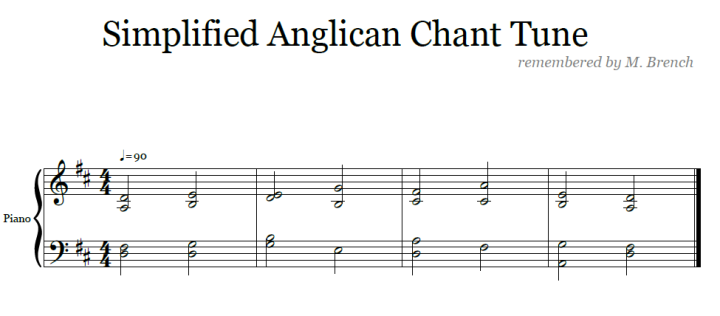
Simplified Anglican Chant is notated as four measures of music with two sets of notes each.  Each measure equals one half-verse of Psalm text.  Thus one full line of Simplified Anglican Chant equals two verses in the text of the Psalm.*  The majority of the half-verse is sung on the first note; the last ‘strong’ syllable is where you switch to the second note.

If you have the Book of Common Praise 2017, you’ll find an excellent explanation of this, complete with pictures, at “hymn” #738a.  Hymns #739-750 are twelve different Simplified Anglican Chant tunes.

Whether you have that book or not, however, you can take a look at this video I put together a little while ago.  In it, I go over some of the basics described above, and then demonstrate a few verses of Psalm 96 (which is among this morning’s appointed psalms, by the way).

The sample tune I used is not one of the twelve in the hymnal; it’s just one I vaguely remembered from when I was in a church choir nearly nine years ago.

simplified anglican chant

* From the 2017 hymnal: “But what if a psalm contains an odd number of verses rather than an even number?  Rather than finish the chant formula halfway through, which would be musically unfulfilling, the congregation can repeat the second half of the chant formula (measures 3 and 4) for the last verse of the psalm.

When to sing the “Gloria in excelsis”

After the penitential rite at the beginning of the Communion service follows this rubric:

The Gloria or some other song of praise may be sung or said, all standing.  It is appropriate to omit the song of praise during penitential seasons and days appointed for fasting.

Placement of the Gloria…

For those who grew up accustomed to the Roman Rite or the 1979 Prayer Book, this is expected – the Gloria is the standard historic hymn of praise following the Kyrie, signalling the movement from penitence to absolution, from abjection to joy, from unworthiness in God’s sight to worthiness, from fear to perfect love.  What many don’t realize is the peculiar tradition of the classical Anglican Prayer Books in placing the Gloria after the Communion and Post-Communion Prayer!

Thus, when we read in the rubric on page 107 & 125 that the Gloria “may be sung or said”, what we ought to see here is the permission to save it for its traditional placement near the end of the liturgy.  The reason for saving the Gloria for that point in the liturgy is that there it functions as an expression of unadulterated praise to God in light of his saving work on the Cross that we have just memorialized in prayer and received in the Sacrament.  So the flow of penitence-to-praise at the beginning of the service doesn’t really apply, but the celebration post-communion is certainly much grander.  It’s also interesting to note that in Lutheran tradition they tend to keep the Gloria in its traditional (Roman) position near the beginning after the Kyrie but also have a special post-communion canticle like the Prayer Book tradition, though in their case the Nunc dimittis.  Now that’s a much more sober (or sobering) way to reflect upon the reception of the consecrated elements!

Instead of the Gloria…

I know lots of congregations that have a contemporary “praise and worship set” in place of the Gloria.  Although this provokes the ire of hymns-only traditionalists, this can rightly capture the spirit of the modern prayer book (and traditional Roman) rite, as the Gloria is a song of pure praise.  Indeed, in my own church, we long had a hymn or contemporary song of praise in addition to the Gloria.  As long as you find lyrics that are very God-centered, they’ll fulfill the same function as the Gloria.  But keep in mind, how many times does the Gloria mention “us” or “me”?  If you’re appointing songs in its place, try to make sure that they live up to that standard of pure and undistracted adoration.

During Advent and Lent, though, it is customary to omit the Gloria, whether you’ve got it near the beginning or the end of the liturgy.  The 1940 hymnal even has, in its liturgical index, suggestions for which hymns could replace the Gloria during those seasons.  This is an excellent place to use a season-specific hymn, as they typically capture the tone and mood of the season in a very appropriate manner, and thus support the shift of emphasis that the liturgical calendar is meant to convey to us.

Singing the Gloria…

Last of all, it’s worth noting that the rubric states “sung or said“, as if to imply that it’s more appropriate to sing the Gloria than to read it.  This is where the otherwise-bloated 1982 hymnal can be a valuable resource, as it provides a number of musical settings for the contemporary translation of the Gloria that our new Prayer Book continues to use.  The Book of Common Praise 2017 has only one setting in the contemporary language, which is original to that edition, I believe, and has worked pretty well with my own congregation.  But sometimes it’s nice to have options.

You could even take a page out of medieval tradition and change the musical setting of the Gloria for different times of year or occasions!  For example, my congregation sings it on major feasts and high Sundays, but just says it on ‘normal’ Sundays.

Psalm 67 in Evening Prayer

Since at least the 1662 Prayer Book, Psalm 67 has been an alternative option to the Nunc dimittis – the second canticle in Evening Prayer.  When Thomas Cranmer first compiled the Prayer Book, he telescoped the 7-fold daily monastic office into two: Morning and Evening, so that anyone could pray them.  The service of Evening Prayer thus ended up with the traditional Vespers (evening) canticle: the Magnificat, and the traditional Compline (night) canticle: the Nunc Dimittis.  He then appointed a psalm as an alternative to each canticle, usually with the express purpose of standing in for the canticle when the text of the canticle is found in one the day’s lessons.

Modern Prayer Books, however, following popular Anglican devotion since the beginning, bring Compline back as a minor office, and the Nunc dimittis is therefore a dual resident: it lives both in Evening Prayer and in Compline.  If you regularly pray both Evening Prayer and Compline most days, then it may be a good idea to substitute the Nunc for a different canticle, as I’ve suggested before here.

However, today may not be the day to do that.  Psalm 67 is the typical replacement for the Nunc through the majority of the year, but tonight Psalm 67 is one of the regular psalms at Evening Prayer.  So unless you want to say Psalm 67 twice in the same office tonight, perhaps it’s best you don’t use it as a canticle today!

The Penitential Rite in the Communion liturgy

Early in the Communion liturgy, on page 106 and 124 of BCP 2019, we come to the “penitential rite” portion.  The rubric there states:

Then follows the Summary of the Law, or The Decalogue (page 100).

The Kyrie or the Trisagion follows.  A “vanilla” use of this page of the liturgy would therefore go as follows: Collect for Purity, the Celebrant reads the Summary of the Law, the Kyrie follows, then on to the Gloria.  But with this option of the Decalogue (or Ten Commandments), what should we do?

We should begin with a little history.  This part of the original Prayer Books contained the Decalogue only.  And it wasn’t a shortened version with congregational responses; it was the full text of the Decalogue in Exodus 20 plus congregational responses.  That was the norm, every Communion.  By 1928 in the US, more options had arisen.  The Decalogue was still the default, but shortened versions were suggested, so it wouldn’t be quite so belabored.  The Summary of the Law was added as an option after, and the Kyrie was to follow the Summary of the Law if the Decalogue was omitted.  So there were three primary choices for the penitential rite in the 1928 Prayer Book:

  1. Decalogue (full text or shortened)
  2. Decalogue (full or short) + Summary of the Law
  3. Summary of the Law + Kyrie

A rubric also noted that The Decalogue may be omitted, provided it be said at least one Sunday in each month.  There was also this optional prayer that concluded the penitential rite:

O ALMIGHTY Lord, and everlasting God, vouchsafe, we beseech thee, to direct, sanctify, and govern, both our hearts and bodies, in the ways of thy laws, and in the works of thy commandments; that, through thy most mighty protection, both here and ever, we may be preserved in body and soul; through our Lord and Savior Jesus Christ.  Amen.

Proponents of the historic prayer book tradition often complain that modern books have too many choices and options… this is one area where a classic book actually has more options than the 2019 prayer book!

With this background in mind, we should acknowledge that even though The Summary of the Law is implicitly the default penitential rite in the two 2019 Communion services, we should continue to make use of the Decalogue, conveniently provided on the pages immediately before the Communion liturgy begins.  It would be wise to adopt at least the rule of thumb of the 1928 prayer book: that we use the Decalogue at least one Sunday a month.  This Customary would add to that the weekly (and weekday) use of the Decalogue throughout the seasons of Advent and Lent, and on other appropriate times such as feasts of St. John the Baptist (a very Law-heavy preacher), or other penitential occasions.

One other observation that should be made is the text of the congregational responses in the Decalogue.  As I observed in January of last year, “The Decalogue has undergone some significant rewording.  Instead of asking God to “give us grace to keep this law” we ask for him to “incline our hearts to keep this law”, which is (again) more faithful to the old Prayer Books, and is more theologically specific.  We don’t just need “grace” to do better, but our hearts need reorientation.”  If you’re accustomed to the language of the 1979 prayer book, make sure you take note of this improvement, and perhaps point it out to your congregation (which I believe I did by the beginning of Lent that year).

What does “Proper 9” mean, anyway?

You have probably seen reference to this before, on this blog if nowhere else lately, that the previous two Sundays have been called “Proper 8” and “Proper 9”.  If you look inside our 2019 Prayer Book (as well as the old 1979) you’ll see these names in the Collects and Calendar sections.  There’s a further bit of explanation in the new book, which you might find handy – “PROPER 9 Week of the Sunday from July 3 to July 9” – but still doesn’t answer the question – what does “Proper” mean?

The term proper originally referred to parts of the Mass that changed from day to day or week to week: it was a feature of the Mass that was proper to a particular occasion or date.  Traditionally this included things like the Introit, Collect, Epistle, Gradual, Gospel, Offertory Sentence, Communion Sentence, and so on, but in the Prayer Book tradition the Propers were simplified to three things: Collect, Epistle, Gospel.  These three things are printed together, for each Sunday and Major Holy Day of the year, in the Prayer Book, such that you don’t actually need a Bible in hand to follow the entire Communion service.  The advent of the three-year lectionary, with its further addition of an Old Testament lesson and Psalm, has made such a feature much too large to fit in the Prayer book, so now our Communion lectionary is just a table of lessons, rather than the actual texts themselves.

With the radical revisions of the 1970’s came a revolutionary new liturgical calendar.  Pre-Lent was gone, Epiphanytide was almost completely revamped, and the season after Trinity Sunday was utterly rewritten.  You can read a little about how the historic Trinitytide season worked on this page.  The modern calendar, which our 2019 Prayer Book has inherited (this is my only significant complaint about the new book), does not build on “Sundays after Trinity” like the historic one, but instead has a set of “Propers” – that is, collects and lessons, tied to the secular calendar dates from late May until about four weeks before Christmas when Advent starts.  This means, given the shifting date of Easter from year to year, that although “Proper 29” will always be the last one before Advent, the first Proper Sunday will be different each year.  On average it starts around Proper 5 in roughly the second week of June.

One odd feature is the fact that Proper 1 is the week of the Sunday from May 8 to May 14, which is so early that neither it nor Proper 2 will ever be used on a Sunday!  They exist solely to provide for weekday Communion services of those weeks when Pentecost is that early, because the modern calendar has (again, sadly) one away with the Pentecost Octave.  Don’t worry, the Scripture lessons aren’t wasted, as they are duplicated with the corresponding Sundays in the latter weeks of the modern Epiphanytide.  Yes it’s complicated, but thankfully most people don’t have to worry about the mechanics of all this.  I only explain it here because someone out there is bound to be curious!

You can also look at the rubrics on page 614 for a few further notes about this portion (half) of the year.

To attempt to summarize this long answer into a short one… when you see “Proper 9”, don’t imagine it has any great special meaning.  It’s merely the 9th set of Propers (Collect & Lessons) in a line of Sundays spanning from May through November.  There are 29 in all, and we just jump right in to them after Trinity Sunday each summer.

Book Review: A Manual for Priests of the American Church

Welcome to Saturday Book Review time!  On most of the Saturdays this year we’re looking at a liturgy-related book noting (as applicable) its accessibility, devotional usefulness, and reference value.  Or, how easy it is to read, the prayer life it engenders, and how much it can teach you.

One of the most useful supplementary liturgical texts on my shelf is A Manual for Priests of the American Church by Earl H. Maddux.  Originally produced in 1944, it reached a fifth edition in 1968.  Its subtitle is “Complementary to the Occasional Offices of the Book of Common Prayer” (paired with the 1928).  After the 1979 Prayer Book was released, I don’t believe this book had a successor.  This is partly because the 1979 Prayer Book added to its pages a few things supplied in this book, and partly because what remained useful in this book didn’t really need any updating for those who were disposed to its it.

The book consists of three sections: Offices, Blessings, and an Appendix of extra material.

The “Offices” supplement what’s in the 1928 Prayer Book, adding some instructions for emergency and conditional baptism, admitting catechumens, sacramental confession, communion from the reserved sacrament, blessing civil marriages, ministry to (including anointing of) the sick, prayers for the dying and departed, particular situations for Burial services, and the like.  Much of this is found in the 1979 Prayer Book in one form or another.  The 2019 Prayer Book provides a form of most of this material too.  If you’re a 1928 Prayer Book user, this part of the book is still immediately practically useful; for the rest of us it’s informative reference material to see how some of the “new” parts of our prayer book were previously rendered.

The “Blessings” section is the part that I don’t know if can be found in any newer books.  It begins with a set of rubrics about how priests and bishops are to handle priestly blessings, how to vest, what sort of contexts and permissions are necessary, and starts the list with the blessing of holy water, as that is what’s typically used in blessing nearly any other object or locale.  If you are open to this line of tradition, this collection is invaluable, as it represents an Anglican adaptation of traditional Western liturgical material.  My congregation is not particularly high-church in their devotion and piety, but there have been times when they’ve asked me to bless new crosses, bibles, and the like.  Rendering some of this book’s blessings into contemporary English has been a handy resource for me!  It’s got blessings for advent wreaths, vestments, pictures, pregnant women, children, books, candles, houses, other types of buildings, prayer beads, vehicles, even including…

WIN_20190705_13_40_24_Pro

you know… just in case you’re the chaplain to NASA or something.  Clearly the star-gazing 60’s had an impact on the later editions of this book!

The Appendix section of this book is a sort of catch-all for various bits and bobs.  More blessings and offices, including the Asperges, the Benediction of the Blessed Sacrament, imposition of ashes for Ash Wednesday, and large pile of additional blessings and prayers, fill another 70 pages of the volume.  A few of these features (like ashes for Ash Wednesday) have found their way into modern prayer books, and therefore make for interesting comparative liturgical study as we consider how mid-20th-century highchurchmen sought to restore ancient traditions such as the imposition of ashes into the Anglican context.

The book closes with a set of indexes, making its rather scattered contents much easier to find, especially if you find yourself “is there a blessing/prayer for this?”

As you can probably tell from a number of the features listed in this book by now, this is a decidedly highchurch, Anglo-Catholic, resource.  It is to such a degree that many would consider this in violation of the Anglican formularies by (re-)introducing prayers for the departed, traditions that suggest a “sacerdotal” priesthood, and so-called Roman superstitions concerning the Sacrament of Holy Communion.  A lowchurch or charismatic Anglican may find elements of this book useful on a careful pick-and-choose basis, but on the whole this book is unashamedly Anglo-Catholic.  However, before you dismiss this book entirely on theological-party grounds, it should be noted that this book is presented as complementary to the Prayer Book; nothing in here replaces the authorized Prayer Book.  So let us not regard this book as representing a divisive element who wanted to replace the Prayer Book; that is an extreme to be found elsewhere, not here.

The Saint Aelfric Customary, apart from its primary role of parsing out the execution of the 2019 Prayer Book liturgy in a traditional manner, also aims to provide some supplemental liturgical material, and many of the blessings in this book will be drawn upon, adapted into contemporary English to match our new Prayer Book’s style.  If you are priest with even just a little bit of high-church interest, I recommend this book very highly; it is a useful resource to have around, even if it’s only practically useful once in a blue moon!

The ratings in short:

Accessibility: 4/5
Because it’s been through a few additions, some of its sections, especially the Appendix, aren’t as logically ordered as one might wish.  But the index section in the back is simple, making it easy to find what you’re looking for.  The fact that its material is in traditional English may also be a slight deterrent for those unused to it.

Devotional Usefulness: 2/5
It’s hard to rate this book on this scale.  If you’re an Anglo-Catholic Priest, in a high church 1928 Prayer Book parish, then this book is probably a 4.  For the rest of us priests, though, this is much more of an occasional resource.  If you’re not ordained, this book will almost never be “useful” to you at all.

Reference Value: 3/5
From the standpoint of the History of Liturgy, or liturgiology, this is a really cool text.  You get see, here, several examples of Anglo-Catholic recoveries of traditional liturgical material before it gets appropriated the Liturgical Movement of the 1960’s as represented in the 1979 Prayer Book.  In this sense, then, this book is a fascinating study to anyone interested in the subject.

By way of a last word, this is a book that I think all Anglican priests should know about, most should have, even if only a few will use.