FOUR versions of the Lord’s Prayer!?

Did you know that there are four versions of the Lord’s Prayer in the 2019 Prayer Book?

You may be aware of two already.  In just about every rite in the book, a traditional-language and contemporary-language rendition of the Lord’s Prayer are offered in parallel columns.  But how do we get four versions, then?  On pages 39 and 65, the following rubric can be found:

Either version of the Lord’s Prayer may be ended with “deliver us from evil.  Amen.” omitting the concluding doxology.

You may find that confusing – why would one opt for the shorter version?  Don’t just the Romans do the short version?

This rubric has some interesting history behind it; welcome to “Weird Rubric Wednesday”.

If you look at various Prayer Books before our own you’ll find a pretty clear pattern: the doxology is often omitted from the Lord’s Prayer.  Let’s list it out:

  • Beginning of Morning Prayer:
    1662 Yes, 1928 Yes
  • Among the Prayers of Morning Prayer:
    1662 No, 1928 Unspecified, 1979 Yes, 2019 Yes
  • Beginning of Evening Prayer:
    1662 Yes, 1928 Yes
  • Among the Prayers of Evening Prayer:
    1662 No, 1928 Unspecified, 1979 Yes, 2019 Yes
  • Beginning of the Lord’s Supper:
    1662 No, 1928 No
  • At the reception of Communion:
    1662 Yes, 1928 Yes, 1979 Yes, 2019 Yes
  • Baptism & Confirmation:
    1662 No, 1928 Yes, 1979 Yes, 2019 Yes

You can see a slow trend from a fairly even split of using or omitting the Lord’s Prayer’s doxology toward uniform use of that doxology.  A further detail in this sequence in the 1979 Prayer Book’s introduction of Noonday Prayer and Compline, in which the doxology is omitted from the Lord’s Prayer.  Thus, only in the 2019 Prayer Book has the doxology become ubiquitous.  These “weird rubrics”, however, note the two Offices in which we are formally invited to consider using the short form of the Lord’s Prayer, and it is the same two (Midday and Compline) as appointed in the 1979 Book.

In ordinary practice, the average lay person who doesn’t use the Prayer Book religiously is going to default to the one version he or she knows from Sunday mornings: what is said at the Holy Communion.  If certain Offices omit the doxology, many such people are going to have a big trip-up moment.  So from that practical perspective, one of the factors aiding this slow shift was merely simplifying things so there were fewer things for newcomers to mess up!

Anyway, in your own prayers and use of the 2019 Prayer Book, it is not going to be this Customary’s business to regulate which version of the Lord’s Prayer you ought to use at which points.  It is traditional to use the short version in most Offices and the long version at the Communion.  But if you’re praying all the Offices every day, plus other devotions like the Family Prayer mini-offices, then you’ll be saying the Lord’s Prayer many times a day, and it might be good to change up which version you use just to help avoid turning into a parrot!

Sometimes you should change the biblical text

wrw

Now there’s a title that will get just about any serious Christian a little worried… “sometimes we should change the biblical text”?  What mad heresy is this?

So let’s get straight to the Weird Rubric of the week.  It’s on page 737.

When a Lesson begins with a pronoun, the reader should substitute the appropriate noun.

Yeah, so the title of this article is kind of click-bait… the change to the biblical text here is actually just a swapping out of a pronoun with a noun.  For example, today at Morning Prayer we’ve got a Gospel lesson from Luke 22, starting at verse 39.  “And he came out and went, as was his custom, to the Mount of Olives, and the disciples followed him.”  This is a great example because you can read the entire paragraph and still never find out who “he” is.  Obviously it’s Jesus; it usually will be in the Gospels.  But sometimes it’s not immediately obvious, so it is prudent (and canonical, or rubrical) to replace the first “he” with “Jesus” so the congregation understands what’s being read.

Some who are especially zealous for the integrity of God’s Word may still not like this, so I should point you to another precedent for this practice.  Bible translators already do this!  In the Greek, the New Testament uses pronouns even more often than we do in English, such that in order to render the text more clearly there are plenty of instances where the Greek text says “he” but the English puts in the person’s name.  For example, slightly earlier in Luke 22, you’ll find verse 33 is a quote from Peter and verse 34 is a quote from Jesus. Now, it’s part of a dialogue, so it’s not too confusing to repeat “he” for both speakers, but it’s more clear to put the names in.  Thus does the ESV.

A similar practice, not directly mentioned in the rubrics of the 2019 Prayer Book, is to omit a proposition or connecting word (such as “therefore” or “for” or “but” or “then”) if one is placed at the beginning of a reading.  The length and contents of a lectionary reading, especially at the Holy Communion, has been evaluated already.  It presents a full and complete thought, such that having a connecting word at the beginning can prove more distracting than helpful.  Yes, these connectors remind us that the passage belongs in a larger context, but that is always going to be the case whether there is such a word there or not.  So it’s usually best to drop such words when found at the top of a reading, to allow the text to stand on its own so the hearers can receive it more easily.  Let the preacher deal with the context if and as necessary.

For the most part, this advice is more pertinent to the readings at Holy Communion than in the Daily Office. This is because the Daily Office Lectionary is continuous – nearly every reading picks up where the previous day’s reading left off.  Connecting words and pronouns are thus less distracting, because the previous chapter or passage has already been heard the day before.  In the service of Holy Communion, we almost never have that advantage; and even when we do, there’ll typically have been a whole week past since the previous contiguous lesson, so having those pronouns replaced will still be a helpful reminder.

If you find this a little tricky to keep track of, consider this instruction on page 716:

The public reading of Scripture in the liturgies of the Church is among the most important features of any act of worship. No one should be admitted to this high privilege who has not thoroughly prepared the passage to be read, so that the lesson can be read with clarity, authority, and understanding.

Make sure you practice at public reading!  A smooth reading experience makes a smooth listening experience possible. Today’s “weird rubric” is there to help you make that happen.

Implementing the Archbishop’s Call to Prayer

Archbishop Foley Beach has called the Church to a week of prayer and fasting, beginning today.  You can read his full statement here: http://www.anglicanchurch.net/?/main/page/2052  The question we’re taking up here is that of how to implement his call to prayer, and use the resources which has named, as well as others in the Prayer Book.

First of all, today was already a fast day; this is the first of the Pentecost Ember Days.  The same goes for Friday and Saturday.  But this special call to prayer and fasting is, of course, something a bit beyond the ordinary.

The easiest way to fast and pray for the long-term is to give up one meal per day and replace it with a half-hour (or longer) time of prayer.  I would highly recommend using the Great Litany every day during a Week of Prayer. As its rubrics note (both in the 2019 Prayer Book and in the classical books), it is particularly appropriate for any time of “special entreaty” or disaster or strife.  If a bishop or archbishop asks for a special time of prayer, the Litany should be the first thing we put on our list.

Secondly, Archbishop Beach’s statement lists several Occasional Prayers (found on pages 657-661) that are particularly appropriate for this Week of Prayer.  He lists #39 through #51, which range from prayers for the nation through prayers for various aspects of society.  The Saint Aelfric Customary already has a recommended rotation through the Occasional Prayers; if you follow that then you’ll have covered #39 yesterday morning, #40-43 next Tuesday Evening, #44-47 last night, and #48-51 this evening.  If you’re not one who normally adds these additional prayers to the Daily Office, this week is a good time to give it a try.  There are twelve prayers listed in the Archbishop’s statement, so if you use even just one each Morning and Evening through this Week of Prayer, you’ll cover all of them by the end of next Wednesday.

However you do or don’t structure your prayers during this time, I hope these thoughts will help you participate in this holy call to intercede.  It is a privilege of God’s people that we can plead before the Throne of Grace on behalf of the world; let us not squander the opportunity nor scorn the call.

Weekly exorcism of a rented worship space

In this age of small churches, church plants, and sharing worship space with other institutions and even businesses, we’ve got an unusual situation.  You see, churches and chapels and the like are usually consecrated or dedicated for the holy purpose of divine worship.  This doesn’t mean we are unable to worship anywhere else, but there is something very Gospel-proclaiming about setting aside a physical space or structure for the sole use of the Kingdom of God.  There is also the spiritual world to consider: a place of worship is a place where angels minister among us, and thus it is appropriate to expel first the evil angels, or demons.  This is, of a sort, an exorcism.  And those who meet for worship in a space that is used for non-church purposes during the week are advised to carry out such an exorcism before each worship service.

Says whom? The Book of Common Prayer (2019), on page 523, states:

Shared-use facilities like school auditoriums or community centers are not consecrated and dedicated, but weekly preparation for worship should include spiritual cleansing (exorcising) of any forces of darkness that may have entered, invited or uninvited.

Yup.  Welcome to Weird Rubric Wednesday!

wrw

A number of the “weird rubrics” we’ve looked at in the past are instances of what might feel like loopholes for strange practices or mucking about with the liturgy in strange ways.  This kind of weird rubric, however, is one that is probably more of a surprise to the average reader followed by a huge question mark – how should a church community go about exorcising its worship space every weekend?

There probably are other sources out there, perhaps even historic ones, that provide guidance to this scenario.  The main challenge here is that it is an extremely rare situation for a church to share sacred space with a secular institution, so a rite for our present need is not going to be prominently known from history; I highly doubt that there is a standard official rite for this even among Rome’s massive collection of medieval liturgies.

And so I made one up.  But that sounds sketchy and proprietary, so allow me to explain it properly, yet briefly.

In the confrontation of spiritual evil, there are (up to) seven movements a liturgically-minded devotion or Office might go through:

  1. Adoration of the Holy Trinity (to start with the fundamentals of worship)
  2. Celebration of the Communion of Saints (because we are not alone here)
  3. Veneration of the Cross (where God and the earth did meet in full power)
  4. Confrontation of Evil (now we’re ready to “speak truth to power” as it were)
  5. Confession and Absolution of Sin (where we send evil back to the Cross)
  6. Comfortable Words (let the Word of God speak peace into the situation)
  7. The Peace (close with a blessing or other word or prayer of finality)

This outline is generally in conformity with Deliverance ministries, exorcists, reconciliation of a penitent, and other similar ministries of prayer that deal directly with sin and evil powers.

How you spell this out for the purpose of cleansing/exorcising a worship space, well, may look different depending upon your specific situation and your churchmanship or theology.  As a generally-pretty-loyal-Prayer-Book-Anglican, I see it as right and proper that what I provide is entirely derived from the Prayer Book tradition.  It is not my place to introduce too many new and different intrusions to the life of the Church from what has already been established by canon law.

So here is how I would flesh out this summary into a Rite of Cleansing.

  1. Invocation of the Holy Trinity expanded from the beginning of the Ministry to the Sick
  2. Invocation of the Communion of Saints with Psalm 113, which is traditionally used in liturgies for Marian feast days
  3. Anthem of the Cross from the (2019) Good Friday Liturgy
  4. Prayers of Confrontation, again taken from the Good Friday Liturgy
  5. Sentences against Sin from the Scriptures (mixing steps 5 & 6 above)
  6. Collect from Evening Prayer and Compline for God’s angelic presence (mixing steps 5 & 6 above)
  7. The Grace from the end of the Daily Office

I made this short and simple so that anyone can use it, though added the option for a priest to use the Oil of Catechumens if desired.  The assumption is that a congregation’s first time in a shared-use space would do something like this on a larger scale together, and then this short Rite would be used privately by a smaller number of people on the weekly basis during set-up for the worship service.

Obviously there are a lot of factors that might color this situation rather differently.  If your church is meeting in a Lodge or a Synagogue or other religious or quasi-religious building, you’re going to want to be a lot more direct or “aggressive” in your opposition to spirits of deception and lies.  If your church is meeting in a building used by a Christian organization, you probably don’t need to be quite so confrontational.

Here is the described Rite in full:


INVOCATION OF THE HOLY TRINITY

Peace to this place, and all who enter it, in the name of the Father, and of the Son, and of the Holy Spirit.  Amen.

INVOCATION OF THE COMMUNION OF SAINTS
Psalm 113

Praise the Lord.  Sing praises, you servants of the Lord; *
     O praise the Name of the Lord.
Blessed be the Name of the Lord, *
     from this time forth for evermore.
The Lord’s Name be praised *
     from the rising up of the sun to the going down of the same.
The Lord is high above all nations, *
     and his glory above the heavens.
Who is like the Lord our God, who has his dwelling so high, *
     and yet humbles himself to behold the things
     that are in heaven and earth?
He takes up the lowly out of the dust, *
     and lifts the poor out of the ashes,
That he may set them with the princes, *
     even with the princes of his people.
He gives the barren woman a home to dwell in, *
     and makes her to be a joyful mother of children.
     Praise the Lord.
Glory be to the Father, and to the Son, and to the Holy Spirit, *
as it was in the beginning, is now, and ever shall be,
world without end.  Amen.

ANTHEM OF THE CROSS
Psalm 67 with Antiphon

We glory in your Cross, O Lord,
and praise and glorify your holy resurrection;
for by virtue of your Cross
joy has come to the whole world.

May God be merciful to us and bless us,
show us the light of his countenance, and come to us.

Let your ways be known upon earth,
your saving health among all nations.

Let the peoples praise you, O God;
let all the peoples praise you.

We glory in your Cross, O Lord,
and praise and glorify your holy resurrection;
for by virtue of your Cross
joy has come to the whole world.

PRAYERS OF CONFRONTATION

O God of truth and love, who desires not the death of sinners but rather that they should turn from their wickedness and live: Look with mercy on those who are deceived by the lies of the world, the flesh, and the devil; that the hearts of those who have gone astray may be restored to wisdom and return to the way of truth in the unity of your holy Church; through Jesus Christ our Lord.  Amen.

Merciful God, creator of all the peoples of the earth and lover of souls: Have compassion on all who do not know you are you are revealed in your Son Jesus Christ; let your Gospel be preached with grace and power to those who have not heard it; turn the hearts of those who resist it; and bring home to your fold those who have gone astray; that there may be one flock under one Shepherd, Jesus Christ our Lord.  Amen.

SENTENCES OF SCRIPTURE AGAINST SIN

One or more of the following sentences is read.

When the archangel Michael, contending with the devil, was disputing about the body of Moses, he did not presume to pronounce a blasphemous judgment, but said, “The Lord rebuke you.”  Jude 9

If we say we have no sin, we deceive ourselves, and the truth is not in us.  If we confess our sins, he is faithful and just to forgive us our sins and to cleanse us from all unrighteousness. 1 John 1:8-9

Enter not into judgment with your servant, for no one living is righteous before you.  Psalm 143:2

When a wicked person turns away from the wickedness he has committed and does what is just and right, he shall save his life.  Ezekiel 18:27

Repent, for the kingdom of heaven is at hand.  Matthew 3:2

Rend your hearts and not your garments.  Return to the Lord your God, for he is gracious and merciful, slow to anger, and abounding in steadfast love; and he relents over disaster.  Joel 2:13

The sacrifices of God are a broken spirit; a broken and contrite heart, O God, you will not despise.  Psalm 51:17

To the Lord our God belong mercy and forgiveness, for we have rebelled against him and have not obeyed the voice of the Lord our God by walking in his laws, which he set before us by his servants the prophets. Daniel 9:9-10

COLLECT FOR CLEANSING

Visit this place, O Lord, and drive far from it all snares of the enemy; let your holy angels dwell with us to preserve us in peace; and let your blessing be upon us always; through Jesus Christ our Lord. Amen.

The Priest may use the Oil of Exorcism, applied at the doorframe of the entrance to the worship space.

CLOSING BLESSING

The grace of our Lord Jesus Christ, the love of God, and the fellowship of the Holy Spirit be with us all evermore.  Amen.


Psalms for the Daily Office on the 31st of the month are not clearly defined.

wrw

One of the more curious features of the 2019 Prayer Book’s handling of the Psalter in the Daily Office is this rubric on page 735:

If there is a 31st day of the month, psalms are chosen from among the Songs of Ascents (120 to 134).

If you want to know more about the Songs of Ascents, I wrote about them a couple weeks ago here.

But today we’re looking at this Weird Rubric.

The 31st day of the month has always been a monkey wrench in Thomas Cranmer’s arrangement of the Psalms, which is a 30-day rotation.  The solution in Prayer Books before ours was that the 31st day of the month would simply repeat the Psalms from the 30th day.  There was at first a more complicated exception to this rule to account for the shortened month of February, but that faded from the Prayer Book tradition.  But in the 2019 Book we now have this murky instruction to choose the Psalms from a particular range.  What this, in effect, does is make the 31st day a repeat of the 27th day or 28th morning.

Now there are two “outs” if you (like me) find this rubric a little too weird.  Your first alternative is to use the 60-day cycle of Psalms, which is printed along with the Daily Office Lectionary.  This has the advantage of begin easy to look up, and perhaps the shorter psalmody will be a welcome “break” if you struggle to keep up with the 30-day standard.  The other solution is to take advantage of this text on page 734:

For any day, the psalms appointed may be reduced in number according to local circumstance, provided that the entire Psalter is read regularly.

This could be interpreted as a “Lazy Clause”, authorizing practically anything.  For example, you could literally read one Psalm, or half a long Psalm, each Office, and take a quarter of a year to get through the whole psalter!  If you do that “regularly” then you’re obeying the rubric here.  And, hey, if you’re new to liturgical prayer and new to the psalms, or you’re helping a child learn to pray, that may be a good idea.  But a seasoned Christian should not use this rubric as license for simply being lazy.  However, the license afforded here does mean that on “any day”, such as the 31st day of the month, you can deviate from the chart on page 735, provided you are covering the entire Psalter regularly.  In short, this is your “out” for praying the Psalms the traditional way, repeating Day 30’s psalms on Day 31.

But if you want to turn Day 31 into a grab-bag of Psalmody, replicating Day 27 and the morning of 28 in some fashion or another, go for it!

Rogationtide at home

The Rogation Days are here!  Today, tomorrow, and Wednesday are the three “purple days” at the turning point of the season from Easter to the Ascension.  As the liturgical color implies, these are days of fasting and prayer.  They’re not penitential, as such – certainly not in the way that Lent or even Advent is – but they are days of particular supplication to the Lord of the harvest for our safety and the safety of our land.  If you want to see last year’s introduction to the Rogation Days, click here.

The question I want to focus on today is how you might observe the Rogation Days at home.  Most of us still have closed churches, after all, so there wasn’t much we were able to do to mark yesterday (Rogation Sunday) as particularly special.  Here are few traditional ideas and resources to draw upon.

The most obvious thing we’ve got is the set of Collects for the Rogation Days, on page 635 of the 2019 Book of Common Prayer.  In addition to praying them in the Daily Office on these three days, consider using them in family devotions, private prayers, before a meal, or in the context of a small group for prayer or worship or study.  You can read more about those Collects in this post from last year.

Similarly, you can sing the hymn O Jesus, crowned with all reknown, a classic song for the Rogation days, and the only one labeled as such in the 1940 hymnal.  To that, the 2017 hymnal adds O God of Bethel, by whose hand and the 1940 recommends also We plow the seeds, and scatter.

Another resource that should not be overlooked is the Great Litany.  Rogation Sunday was one of the major days of the year in English tradition for a grant procession out of the church building, with prayer and supplication, and the Litany was the primary tool for such a public devotion.  It would be a marvelous thing to make use of the Litany on your own through these three days – the most traditional time to pray it would be at the end of Morning Prayer, but the tradition has evolved over the past near-century such that you should feel free to pray the Litany in any context, even on its own!

You could even combine the Litany with a version of the historical tradition of Beating the Bounds.  On Rogation Sunday the grand procession would encircle the entire parish, literally surrounding the village in prayer.  As the great Anglican divine, George Herbert, described it:

The Country Parson is a Lover of old Customs, if they be good, and harmless; and the rather, because Country people are much addicted to them, so that to favour them therein is to win their hearts, and to oppose them therein is to deject them. If there be any ill in the custom, that may be severed from the good, he pares the apple, and gives them the clean to feed on. Particularly, he loves Procession, and maintains it, because there are contained therein 4 manifest advantages.

  1. First, a blessing of God for the fruits of the field:
  2. Secondly, justice in the Preservation of bounds:
  3. Thirdly, Charity in loving walking, and neighbourly accompanying one another, with reconciling of differences at that time, if there be any:
  4. Fourthly, Mercy in relieving the poor by a liberal distribution and largesse, which at that time is, or ought to be used.

Wherefore he exacts of all to be present at the perambulation, and those that withdraw, and sever themselves from it, he mislikes, and reproves as uncharitable, and unneighbourly; and if they will not reform, presents them. Nay, he is so far from condemning such assemblies, that he rather procures them to be often, as knowing that absence breeds strangeness, but presence love.

George Herbert, A Priest to the Temple Or The Countrey Parson, chapter 35

What you see there is very rooted in centuries of history that are, on the practical level, defunct and so far removed from us that it would be impossible to replicate.  But in spirit, these are very “earthy” practices that can be recaptured pretty easily.  Obviously with social distancing in place it would be rather difficult to form a town-wide parade!  But at the level of the home, this could be an opportunity for the household to walk around the property line, praying for one another and for the neighbors.  It could be an opportunity to chat with the neighbors over the fence or across the road, pray for them or even with them!  With the Spring planting now in full swing in many places, pray for your gardens or fields.  Consider how you might use your bounty to bless others, especially the poor or needy.

Andm, if you want yet more ideas and background history, I commend to you The Homely Hours, a lovely blog with a wealth of historic Anglican insight, with a particular high-church-like attention to the traditions of our forebears.

The Readings at Compline

The Night Office, usually called Compline, is a pleasant little piece of liturgy that was just too beloved to die.  When the first Prayer Book was released, its adherents were criticized by Papists for having only two daily Offices – Morning/Mattins and Evening Prayer.  Although the Cranmerian genius was to streamline elements of the medieval monastic seven-fold office into two, popular devotional manuals quickly arose to provide people with orders for midday prayer and compline for their own private prayers.  John Cosin is one noteworthy contributor in this area, having re-created all the monastic canonical Hours in a Prayer Book friendly manner.

So in that regard it was no great surprise that eventually they would reappear in an actual Prayer Book.  Both the 1979 and the 2019 Books have Compline, and I think the Church is the richer for it, even though this office has many “redundancies” with Evening Prayer.

Our order for Compline is a bit different from its medieval forebear and its modern Roman counterpart.  Most of the ingredients are the same, but their arrangement has shuffled somewhat.  In particular, the diversity of Scripture readings now offered by Rome’s Liturgy of the Hours and the 2019 Prayer Book alike is something of an innovation on previous tradition.

To my knowledge, the primary reading for Compline, and possible the only one in monastic practice (we’d have to check) is 1 Peter 5:8-9 Be sober-minded, be watchful…  But now we have four choices printed in our Prayer Book:

  1. Jeremiah 14:9 You, O Lord, are in the midst of us…
  2. Matthew 11:28-30 Come to me, all who labor and are heavy laden…
  3. Hebrews 13:20-21 Now may the God of peace who brought again from the dead…
  4. 1 Peter 5:8-9 Be sober-minded; be watchful.  Your adversary the devil prowls…

To these the Additional Directions on page 65 add seven more possibilities:

  1. Isaiah 26:3-4  You keep him in perfect peace whose mind is stayed on you…
  2. Isaiah 30:15  Thus says the Lord, the Holy One of Israel, “In returning and rest…
  3. Matthew 6:31-34  Do not be anxious, saying “What shall we eat?…
  4. 2 Corinthians 4:6  For God, who said, “Let light shine out of darkness”…
  5. 1 Thessalonians 5:9-10  God has not destined us for wrath…
  6. 1 Thessalonians 5:23  Now may the God of peace himself sanctify you…
  7. Ephesians 4:26-27  Be angry and do not sin; do not let the sun go down…

The purpose for these additions is that if Compline is said every day, especially in a group setting, having more readings to draw from may be desired and beneficial.  But it lists these seven as additional options, not the sum total.  That means you can read whatever you want, actually.  But the best advice is this: stick to something very short, and don’t vary it up too much. Compline is meant to be a short devotional time, not a lengthy study of the Scriptures.  Morning and Evening Prayer is where we are primarily meant together around the Bible and listen.  Minor Offices like Compline are supposed to be more prayer-oriented and reflective.

So stick to a small rotation of readings, allowing you or your group to gain familiarity with these verses, and draw deeper from the well of Sacred Scripture during this quiet time of prayer.

If you want a guide to how you might rotate them, this is how I’ve ordered them for the Saint Aelfric Customary.

  • Sunday (Advent through Epiphanytide) – 2 Corinthians 4:6
  • Sunday (Pre-Lent and Lent) – Matthew 11:28-30
  • Sunday (Easter through Trinity) – Hebrews 13:20-21
  • Sunday (after Trinity through Proper 16) – Isaiah 26:3-4
  • Sunday (Proper 17-29) – Isaiah 30:15
  • Monday – 1 Thessalonians 5:9-10
  • Tuesday – 1 Peter 5:8-9
  • Wednesday – Ephesians 4:26-27
  • Thursday – 1 Thessalonians 5:23
  • Friday – Jeremiah 14:9
  • Saturday – Matthew 6:31-34

What I did was write the extra seven verses onto either side of a piece of paper roughly 4″x4″ and taped it gently onto page 61 so it’s like an extra page of Scripture readings along with the standard four.  That way I don’t need to grab a Bible for Compline, which would be particularly silly and bothersome for just a couple sentences to read, and when I’m angling to go to bed in a few minutes.

When you have to re-write the Burial Service

wrw

So you’re going through the 2019 Prayer Book, making sure you’ve got a handle on how this book operates and how it differs from its 1979 predecessor and how it relates to the classical 1928 Prayer Book and the editions before it, and you get to the Burial Service.  I mean, let’s face it, we’re living through an epidemic right now, and we may see a larger number of calls for the Burial Service than usual, depending upon your circumstances, region, and “luck”.  You’re reading through its initial directions on page 248 when you come to this weird rubric:

This Burial Office is intended for those who have been baptized and profess the Christian Faith.  Portions of this Office may be adapted for other circumstances.

In short, if you’ve been asked to hold a funeral for a non-Christian, you’re going to have to re-write the liturgy.

Is this a bug or a feature?  Why are there no further directions for how to handle this scenario?  How does this comport with our Anglican heritage?  Why can’t we just use the Burial Office as-is for someone outside the Church?

the Principle at work

Let us compare this with a rubric at the end of the Burial of the Dead in the 1928 Prayer Book, page 337.

It is to be noted that this Office is appropriate to be used only for the faithful departed in Christ, provided that in any other case the Minister may, at his discretion, use such part of this Office, or such devotions taken from other parts of this Book, as may be fitting.

This, in turn, is an adaption of a rubric at the beginning of the 1662’s Burial of the Dead, page 326.

Here is to be noted, that the Office ensuing is not to be used for any that die unbaptised, or excommunicate, or have laid violent hand upon themselves.

One can see a clear line of commonality through the tradition; the Burial Office is a Christian service, and its readings and prayers reflect that expectation.  This is how to bury a Christian.  When burying a non-Christian we obviously cannot speak of the hope of Christ within him or her, and therefore if for some reason the Church is sought for the dignified burial of one outside her fold, we have to adapt our language accordingly so that we don’t speak untruly either of the deceased or of God.

oddities

It is interesting to note that the reference to suicide was dropped by the 20th century.  In Roman theology, suicide is typically considered a “mortal sin” and therefore one who commits suicide (psychological impairment aside) dies in a state of condemnation.  I haven’t examined this subject deeply, but it appears that 17th century Anglicanism retained some sense of that view that we do not as explicitly hold ourselves to today.  We, after all, do not have an officially codified definition of mortal versus venial sin in our formularies.

The 1979 Prayer Book, meanwhile, is an anomaly in this area.  Its directions on page 490 are very similar to that of the 2019 Book except it omits the rubric about treating non-baptized or non-confessing persons’ burials differently!  Instead, on page 506 it offers An Order for Burial, “When, for pastoral considerations, neither of the burial rites in this Book is deemed appropriate”.  The implication is that the Order there presented is for those outside the church, but the inclusion of the possibility of a Communion (in step 8) rather undermines that and muddies the waters.  The 2019 Book has clearly removed us from that confusion and restored the traditional Anglican way.

how, then, to bury the non-Christian

We have always had to look to supplementary liturgical texts for guidance in burying the non-baptized or the non-confessing person.  The best example that I know about is in A Manual for Priests of the American Church, which was paired with the 1928 Prayer Book.  You can read about that manual here, if you like.  Citing the rubric on page 337 of the 1928 Book, this Manual sets out The Burial of Persons for whom the Prayer Book Service is Not Appropriate, and it cites the Occasional Offices of the Church of the Province of South Africa as what this order was adapted from.  I won’t copy the whole thing, but present it in outline.

  • Psalm 130 De profundis.
  • Lesson: John 5:24-30
  • Anthem: “Man that is born of a woman, hath but a short time to live…”
  • The Committal: “We commit the body of our dear brother to the grave…”
  • Kyrie & Lord’s Prayer
  • A prayer from the Litany: “Remember not, Lord, our offenses…”
  • Collect for Advent I: “Almighty God, give us grace that we may cast away the works of darkness…”
  • Collect: “Almighty God, the fountain of all wisdom, who knowest our necessities before we ask…”
  • Prayer from the Burial: “Almighty God, Father of mercies and giver of all comfort…”
  • “O Savior of the world, who by thy Cross and precious Blood hast redeemed us; Save us and help us, we humbly beseech thee, O Lord.”
  • The Grace (2 Corinthians 13:14)

Pretty much all of this can be found in the 2019 Prayer Book, and, given the additional possibilities for Scripture readings, we could flesh out this order to be something a bit longer and more substantial if we wanted.  But of course, one has to be very careful with handling the funeral of a non-believer.  When the Church speaks, we must proclaim the Gospel of Jesus Christ, but it can be rather unhelpful, to say the least, to announce the damnation of the departed!  And it would be irresponsible (and probably a lie) to claim a secret Christian faith in the name of the departed for which there was no verbal evidence in life.  So we must proclaim our faith in Jesus prudently, “in season and out of season” with all the wisdom and sensitivity and attentiveness to the context that we can muster.

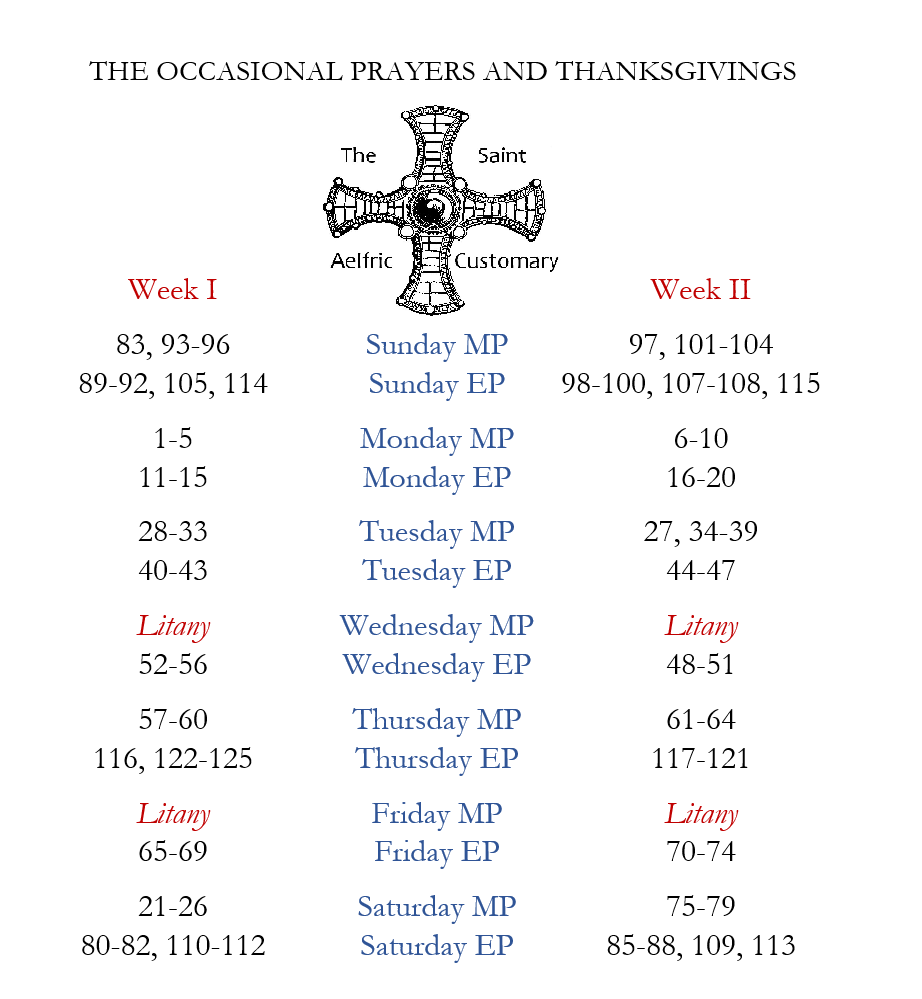
An Order for using the Occasional Prayers & Thanksgivings in the 2019 Prayer Book

The Daily Office of Morning and Evening Prayer have always provided for the allowance of additional prayers at the end.  The classic prayer books, in fact, provided a group of Additional Prayers immediately after (as well as within) the main text of the Daily Offices.  Modern books, like the 1979 and the 2019, have a much larger corpus of additional prayers located near the back of the book like an appendix.  This gives us the mixed blessing of having more quality prayers to draw from but the greater physical distance within the book such that they might more easily be ignored or forgotten.

To help remedy this, I’ve made available here in the past some orders for using the Occasional Prayers and Thanksgivings in the Daily Office.  Now the Saint Aelfric Customary is putting forth a third (and I think, final) version.


Occasional p+t

NOTE: All you have to do is download this picture, print it out, and use it as a bookmark in your prayer book!  If you want a document or spreadsheet with this information, please request one in the comments.

The previous versions were more jumpy, attempting to corral certain prayer topics to certain days.  After a few months of use I decided they could be streamlined to be easier to follow.  So here we are!  Let’s walk through how this works.

Two-Week Rotation

Because there are 125 prayers and thanksgivings, they are split into a two-week rotation so that an average of five are appointed for each Office.  You could combine them into a one-week cycle if you’ve got the attention span for it, I suppose.  Two prayers are omitted: #84 because it’s for meal times, not an office, and #106 because it’s better for the service of Antecommunion.

Wednesday and Friday Mornings are omitted because that is when the Litany is traditionally appointed to be said.  I assume that if you’re sufficiently “advanced” in your use of the Office to be making use of these prayers, you can (or should) be already praying the Litany.  Sunday morning is also an appointed time for the Litany, but in the scheme of this Customary, the Litany will actually be treated separately, between Morning Prayer and Holy Communion, and thus there is room for these prayers in Morning Prayer.

Monday

The twenty prayers for the Church are spread through the Offices on this day.

Tuesday

The prayers for the nation and most of the prayers for society are covered on Tuesday.  The morning in Week II has an inordinately large number of prayers appointed because there are included prayers specifically for Canada and for the USA, with the assumption that the individual will skip the national prayers that don’t apply.  #21-26, for Creation, were skipped and saved for Saturday.  #27 and #28 were separated into different groupings of prayer because they are very similar and would be a bit redundant prayed back to back.

Wednesday

The rest of the prayers for society are covered here, and the section of prayers for “those in need” is begun.

Thursday

The rest of the prayers for those in need are finished on Thursday mornings.  The evenings are for the thanksgivings, in keeping with the eucharistic theme accorded to Thursdays in some strands of liturgical tradition.

Friday

The evenings see the Family and Personal Life section begun.

Saturday

Week I holds the prayers for Creation, as Saturday is often a day off from work, and thus a day on which many people are likely to enjoy the outdoors.  More prayers for family and personal life are appointed here, as well as the beginning of the Personal Devotion section.  Most of the prayers for “Death, the Departed, and the Communion of Saints” also land on Saturday evening, matching the Good Friday to Holy Saturday to Easter Sunday pattern of spirituality.

Sunday

The last of the “Personal Devotion” section is covered on Sundays, as well as the last two “Death, the Departed, and the Communion Saints” section.  Most prominently, though, Sunday is when the “At Times of Prayer and Worship” section is used, splitting the preparatory prayers into the morning and the “after hours” prayers into the evening.


As a result, if you hold public Morning or Evening Prayer on Sundays, the occasional prayers here appointed will be particularly apt for the congregation’s interaction with the liturgy.

If you hold a public Office on a weekday, however, a pattern like this may not be beneficial.  The idea of this order is to provide the person(s) praying with the full scope of the Occasional Prayers’ contents, so if someone only experiences one weekday “slot”, then they’ll only experience one theme or category of occasional prayers.  In such a situation, it would be prudent to select occasional prayers from various groupings as is appropriate for the occasion, or as befits the lessons of the day.

Reinvent the Benedictine Monastic Offices with Family Prayer

wrw

Normally “Weird Rubric Wednesday” is about strange and silly things that you can do with (or to) the liturgy without technically breaking the rules in the 2019 Prayer Book.  Although today’s entry is a little strange, I’m taking a more serious and straight-forward tone.

You see, by my count (and I know different people are accounting it differently) we’re on day 31 of social distancing.  I’ve barely seen my church members, I’ve been home almost 24/7 with two children under six, and my usual musical and table-top gaming outlets have been seriously curtailed.  And now that a month of this has passed, the anxiety and depression is beginning to creep in.  But there is something that is (mostly) holding at bay that is absolutely share-worthy for Weird Rubric Wednesday: Reinvent the Benedictine Monastic Offices with Family Prayer.

First, some background

For those who don’t know, the Rule of St. Benedict is a short little book that undergirds virtually all of Western Christian Monasticism.  What’s more, the liturgical tradition it codified and perpetuated is the primary source for the Daily Offices of Morning and Evening Prayer in the Anglican Prayer Books.  An elaborate system of monastic prayer, seven times a day, plus at night, was whittled down to two offices so ordinary folks – both priests and people – could say them daily.

7-times[1]

Modern Prayer Books have “added” Midday Prayer and Compline, but with the Benedictine tradition in mind one would better say that modern Prayer Books have “restored” Midday Prayer and Compline.  But there are more “minor offices” throughout the day.

  • Matins & Lauds were the primary base for our Morning Prayer
  • Prime is the first hour (roughly 6am)
  • Terce is the third hour (roughly 9am)
  • Sext is the sixth hour (roughly noon), recovered as our Midday Prayer
  • None is the ninth hour (roughly 3pm)
  • Vespers is the evening office, together with Compline forming our Evening Prayer
  • Nocturns, well, I still don’t know much about it, other than that the Holy Week Nocturns are the source of the now-popular Tenebrae service.

Incidentally, this is why (in modern Prayer Books) Compline repeats a lot of material from Evening Prayer – the Prayer Book tradition had combined Vespers with Compline into Evening Prayer.

The “crazy” idea

I got a silly idea a while back – what if I re-purpose the four “Family Prayer” offices to fill in the gaps to cover the rest of the Benedictine system of minor offices?  It started as a theoretical idea, exploring things just for fun.  (Okay, yes, I have strange ideas of fun.  But if you follow this blog then I guess it has paid off, right?)  The “Family Prayer” offices in the 2019 Prayer Book are basically miniaturized versions of the regular Daily Offices; you can find them on pages 66-75.

As their opening introduction states, they “are particularly appropriate for families with young children.”  This is how I started using them: Family Prayer In The Morning is what I taught my 4-year-old (who is now 5).  We say the opening verse, we chant three verses of a psalm, I read him a Scripture lesson, explain it briefly and address questions if he brings anything up, we pray the Lord’s Prayer, usually the Collect provided, and end with the grace from 2 Corinthians 13:14.  A year before, I had devised a “Children’s Daily Lectionary”, providing short readings for every day of the year.  Here’s the link if you’re interested.

So that took care of Prime, the first hour; what about the rest?  Here’s what I ended up outlining:

  • Matins/Lauds = Morning Prayer
  • Prime = Family Prayer in the Morning
  • Terce (9am) = Family Prayer at Midday
  • Sext (12pm) = Midday Prayer
  • None (3pm) = Family Prayer in the Early Evening
  • Vespers = Evening Prayer
  • Nocturn (or extra vespers) = Family Prayer at the close of day
  • Compline (bedtime) = Compline

If you look at the rubrics on page 66, guiding what can be done with Family Prayer, you’ll find that you can change almost everything about them according to your particular needs.  One of the key sentences for my purposes is this one: “The Psalms and Readings may be replaced by…. some other manual of devotion which provides daily selections for the Church Year.”  That means, if there’s a daily devotional you happen to like, a good context for using it is in Family Prayer!  This is what got me started with the Children’s Daily Lectionary, and then I just kept going…

Terce.  For Family Prayer at midday I put together a plan of devotional readings intended to ground the reader in the historic Anglican tradition.   This means reading from the Apostolic Fathers in Epiphanytide and the early summer, other great Church Fathers during Lent, the 39 Articles during Eastertide, other Anglican Foundational Documents during Ascensiontide, and the ACNA catechism for the bulk of the summer and autumn.

None.  For Family Prayer in the evening I added no lectionary, but instead prayers.  It started on Saturdays, setting up our worship space at 3pm, when it made sense to pray for my flock when I was finished.  Now for none I have prayers for church, family, ministers, and non-believers, that I can cycle through over the course of the week.

Nocturn.  When I say Evening Prayer earlier, like at 5pm, there can be quite a gap if I stay up late, so having a mini office between Evening Prayer and Compline can be good, and that’s what I’ve tried out with Family Prayer at the close of day.  For this I appointed a mix: two days a week use Scripture readings from the 1662 Daily Office Lectionary and the other five days are from the Book of Homilies, an under-appreciated piece of Anglican tradition.

Ain’t nobody got time fo dat!

I think, during Holy Week, I actually said every one of these Offices every day.  But apart from that I always miss something.  And that’s okay – extra offices are extra, and should not be enforced unless you have good reason to put yourself through that.  Nevertheless, having all these extra offices available both encourage me to pray more often, as well as provide with a guide for doing so.

Now perhaps you’d rather just use an actual Benedictine Breviary and use versions of the actual monastic offices.  Perhaps you’d rather use a sourcebook of private devotions such as Saint Augustine’s Prayer Book.  Perhaps you’d prefer to offer spontaneous prayers without any liturgical framework at all.  Once you’ve got the Daily Offices down that our tradition expects (or even mandates) – Morning and Evening Prayer – you are free to expand your prayers however you see fit.  The flexibility of the Family Prayer offices just seemed to me ideal places to start.