The Readings at Compline

The Night Office, usually called Compline, is a pleasant little piece of liturgy that was just too beloved to die.  When the first Prayer Book was released, its adherents were criticized by Papists for having only two daily Offices – Morning/Mattins and Evening Prayer.  Although the Cranmerian genius was to streamline elements of the medieval monastic seven-fold office into two, popular devotional manuals quickly arose to provide people with orders for midday prayer and compline for their own private prayers.  John Cosin is one noteworthy contributor in this area, having re-created all the monastic canonical Hours in a Prayer Book friendly manner.

So in that regard it was no great surprise that eventually they would reappear in an actual Prayer Book.  Both the 1979 and the 2019 Books have Compline, and I think the Church is the richer for it, even though this office has many “redundancies” with Evening Prayer.

Our order for Compline is a bit different from its medieval forebear and its modern Roman counterpart.  Most of the ingredients are the same, but their arrangement has shuffled somewhat.  In particular, the diversity of Scripture readings now offered by Rome’s Liturgy of the Hours and the 2019 Prayer Book alike is something of an innovation on previous tradition.

To my knowledge, the primary reading for Compline, and possible the only one in monastic practice (we’d have to check) is 1 Peter 5:8-9 Be sober-minded, be watchful…  But now we have four choices printed in our Prayer Book:

  1. Jeremiah 14:9 You, O Lord, are in the midst of us…
  2. Matthew 11:28-30 Come to me, all who labor and are heavy laden…
  3. Hebrews 13:20-21 Now may the God of peace who brought again from the dead…
  4. 1 Peter 5:8-9 Be sober-minded; be watchful.  Your adversary the devil prowls…

To these the Additional Directions on page 65 add seven more possibilities:

  1. Isaiah 26:3-4  You keep him in perfect peace whose mind is stayed on you…
  2. Isaiah 30:15  Thus says the Lord, the Holy One of Israel, “In returning and rest…
  3. Matthew 6:31-34  Do not be anxious, saying “What shall we eat?…
  4. 2 Corinthians 4:6  For God, who said, “Let light shine out of darkness”…
  5. 1 Thessalonians 5:9-10  God has not destined us for wrath…
  6. 1 Thessalonians 5:23  Now may the God of peace himself sanctify you…
  7. Ephesians 4:26-27  Be angry and do not sin; do not let the sun go down…

The purpose for these additions is that if Compline is said every day, especially in a group setting, having more readings to draw from may be desired and beneficial.  But it lists these seven as additional options, not the sum total.  That means you can read whatever you want, actually.  But the best advice is this: stick to something very short, and don’t vary it up too much. Compline is meant to be a short devotional time, not a lengthy study of the Scriptures.  Morning and Evening Prayer is where we are primarily meant together around the Bible and listen.  Minor Offices like Compline are supposed to be more prayer-oriented and reflective.

So stick to a small rotation of readings, allowing you or your group to gain familiarity with these verses, and draw deeper from the well of Sacred Scripture during this quiet time of prayer.

If you want a guide to how you might rotate them, this is how I’ve ordered them for the Saint Aelfric Customary.

  • Sunday (Advent through Epiphanytide) – 2 Corinthians 4:6
  • Sunday (Pre-Lent and Lent) – Matthew 11:28-30
  • Sunday (Easter through Trinity) – Hebrews 13:20-21
  • Sunday (after Trinity through Proper 16) – Isaiah 26:3-4
  • Sunday (Proper 17-29) – Isaiah 30:15
  • Monday – 1 Thessalonians 5:9-10
  • Tuesday – 1 Peter 5:8-9
  • Wednesday – Ephesians 4:26-27
  • Thursday – 1 Thessalonians 5:23
  • Friday – Jeremiah 14:9
  • Saturday – Matthew 6:31-34

What I did was write the extra seven verses onto either side of a piece of paper roughly 4″x4″ and taped it gently onto page 61 so it’s like an extra page of Scripture readings along with the standard four.  That way I don’t need to grab a Bible for Compline, which would be particularly silly and bothersome for just a couple sentences to read, and when I’m angling to go to bed in a few minutes.

When you have to re-write the Burial Service

wrw

So you’re going through the 2019 Prayer Book, making sure you’ve got a handle on how this book operates and how it differs from its 1979 predecessor and how it relates to the classical 1928 Prayer Book and the editions before it, and you get to the Burial Service.  I mean, let’s face it, we’re living through an epidemic right now, and we may see a larger number of calls for the Burial Service than usual, depending upon your circumstances, region, and “luck”.  You’re reading through its initial directions on page 248 when you come to this weird rubric:

This Burial Office is intended for those who have been baptized and profess the Christian Faith.  Portions of this Office may be adapted for other circumstances.

In short, if you’ve been asked to hold a funeral for a non-Christian, you’re going to have to re-write the liturgy.

Is this a bug or a feature?  Why are there no further directions for how to handle this scenario?  How does this comport with our Anglican heritage?  Why can’t we just use the Burial Office as-is for someone outside the Church?

the Principle at work

Let us compare this with a rubric at the end of the Burial of the Dead in the 1928 Prayer Book, page 337.

It is to be noted that this Office is appropriate to be used only for the faithful departed in Christ, provided that in any other case the Minister may, at his discretion, use such part of this Office, or such devotions taken from other parts of this Book, as may be fitting.

This, in turn, is an adaption of a rubric at the beginning of the 1662’s Burial of the Dead, page 326.

Here is to be noted, that the Office ensuing is not to be used for any that die unbaptised, or excommunicate, or have laid violent hand upon themselves.

One can see a clear line of commonality through the tradition; the Burial Office is a Christian service, and its readings and prayers reflect that expectation.  This is how to bury a Christian.  When burying a non-Christian we obviously cannot speak of the hope of Christ within him or her, and therefore if for some reason the Church is sought for the dignified burial of one outside her fold, we have to adapt our language accordingly so that we don’t speak untruly either of the deceased or of God.

oddities

It is interesting to note that the reference to suicide was dropped by the 20th century.  In Roman theology, suicide is typically considered a “mortal sin” and therefore one who commits suicide (psychological impairment aside) dies in a state of condemnation.  I haven’t examined this subject deeply, but it appears that 17th century Anglicanism retained some sense of that view that we do not as explicitly hold ourselves to today.  We, after all, do not have an officially codified definition of mortal versus venial sin in our formularies.

The 1979 Prayer Book, meanwhile, is an anomaly in this area.  Its directions on page 490 are very similar to that of the 2019 Book except it omits the rubric about treating non-baptized or non-confessing persons’ burials differently!  Instead, on page 506 it offers An Order for Burial, “When, for pastoral considerations, neither of the burial rites in this Book is deemed appropriate”.  The implication is that the Order there presented is for those outside the church, but the inclusion of the possibility of a Communion (in step 8) rather undermines that and muddies the waters.  The 2019 Book has clearly removed us from that confusion and restored the traditional Anglican way.

how, then, to bury the non-Christian

We have always had to look to supplementary liturgical texts for guidance in burying the non-baptized or the non-confessing person.  The best example that I know about is in A Manual for Priests of the American Church, which was paired with the 1928 Prayer Book.  You can read about that manual here, if you like.  Citing the rubric on page 337 of the 1928 Book, this Manual sets out The Burial of Persons for whom the Prayer Book Service is Not Appropriate, and it cites the Occasional Offices of the Church of the Province of South Africa as what this order was adapted from.  I won’t copy the whole thing, but present it in outline.

  • Psalm 130 De profundis.
  • Lesson: John 5:24-30
  • Anthem: “Man that is born of a woman, hath but a short time to live…”
  • The Committal: “We commit the body of our dear brother to the grave…”
  • Kyrie & Lord’s Prayer
  • A prayer from the Litany: “Remember not, Lord, our offenses…”
  • Collect for Advent I: “Almighty God, give us grace that we may cast away the works of darkness…”
  • Collect: “Almighty God, the fountain of all wisdom, who knowest our necessities before we ask…”
  • Prayer from the Burial: “Almighty God, Father of mercies and giver of all comfort…”
  • “O Savior of the world, who by thy Cross and precious Blood hast redeemed us; Save us and help us, we humbly beseech thee, O Lord.”
  • The Grace (2 Corinthians 13:14)

Pretty much all of this can be found in the 2019 Prayer Book, and, given the additional possibilities for Scripture readings, we could flesh out this order to be something a bit longer and more substantial if we wanted.  But of course, one has to be very careful with handling the funeral of a non-believer.  When the Church speaks, we must proclaim the Gospel of Jesus Christ, but it can be rather unhelpful, to say the least, to announce the damnation of the departed!  And it would be irresponsible (and probably a lie) to claim a secret Christian faith in the name of the departed for which there was no verbal evidence in life.  So we must proclaim our faith in Jesus prudently, “in season and out of season” with all the wisdom and sensitivity and attentiveness to the context that we can muster.

An Order for using the Occasional Prayers & Thanksgivings in the 2019 Prayer Book

The Daily Office of Morning and Evening Prayer have always provided for the allowance of additional prayers at the end.  The classic prayer books, in fact, provided a group of Additional Prayers immediately after (as well as within) the main text of the Daily Offices.  Modern books, like the 1979 and the 2019, have a much larger corpus of additional prayers located near the back of the book like an appendix.  This gives us the mixed blessing of having more quality prayers to draw from but the greater physical distance within the book such that they might more easily be ignored or forgotten.

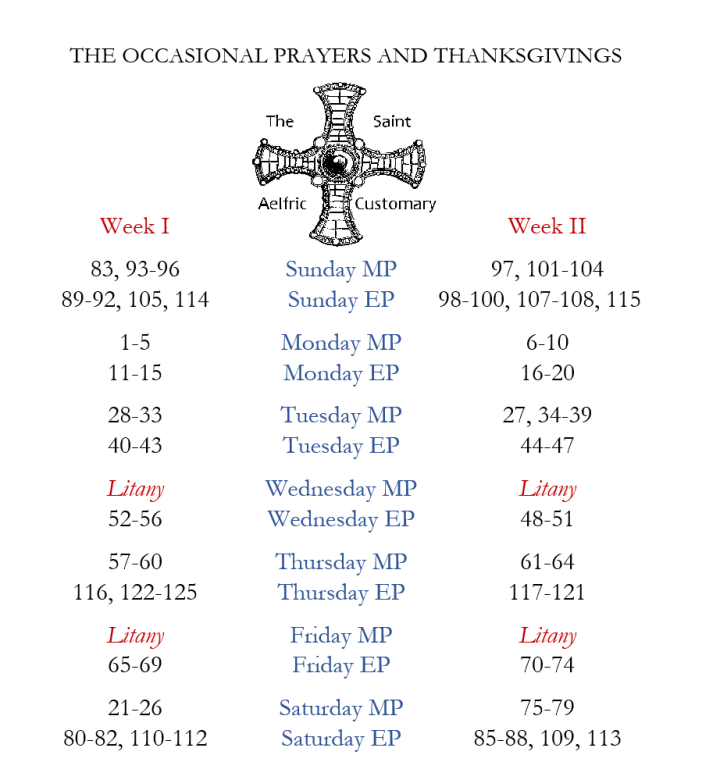
To help remedy this, I’ve made available here in the past some orders for using the Occasional Prayers and Thanksgivings in the Daily Office.  Now the Saint Aelfric Customary is putting forth a third (and I think, final) version.


Occasional p+t

NOTE: All you have to do is download this picture, print it out, and use it as a bookmark in your prayer book!  If you want a document or spreadsheet with this information, please request one in the comments.

The previous versions were more jumpy, attempting to corral certain prayer topics to certain days.  After a few months of use I decided they could be streamlined to be easier to follow.  So here we are!  Let’s walk through how this works.

Two-Week Rotation

Because there are 125 prayers and thanksgivings, they are split into a two-week rotation so that an average of five are appointed for each Office.  You could combine them into a one-week cycle if you’ve got the attention span for it, I suppose.  Two prayers are omitted: #84 because it’s for meal times, not an office, and #106 because it’s better for the service of Antecommunion.

Wednesday and Friday Mornings are omitted because that is when the Litany is traditionally appointed to be said.  I assume that if you’re sufficiently “advanced” in your use of the Office to be making use of these prayers, you can (or should) be already praying the Litany.  Sunday morning is also an appointed time for the Litany, but in the scheme of this Customary, the Litany will actually be treated separately, between Morning Prayer and Holy Communion, and thus there is room for these prayers in Morning Prayer.

Monday

The twenty prayers for the Church are spread through the Offices on this day.

Tuesday

The prayers for the nation and most of the prayers for society are covered on Tuesday.  The morning in Week II has an inordinately large number of prayers appointed because there are included prayers specifically for Canada and for the USA, with the assumption that the individual will skip the national prayers that don’t apply.  #21-26, for Creation, were skipped and saved for Saturday.  #27 and #28 were separated into different groupings of prayer because they are very similar and would be a bit redundant prayed back to back.

Wednesday

The rest of the prayers for society are covered here, and the section of prayers for “those in need” is begun.

Thursday

The rest of the prayers for those in need are finished on Thursday mornings.  The evenings are for the thanksgivings, in keeping with the eucharistic theme accorded to Thursdays in some strands of liturgical tradition.

Friday

The evenings see the Family and Personal Life section begun.

Saturday

Week I holds the prayers for Creation, as Saturday is often a day off from work, and thus a day on which many people are likely to enjoy the outdoors.  More prayers for family and personal life are appointed here, as well as the beginning of the Personal Devotion section.  Most of the prayers for “Death, the Departed, and the Communion of Saints” also land on Saturday evening, matching the Good Friday to Holy Saturday to Easter Sunday pattern of spirituality.

Sunday

The last of the “Personal Devotion” section is covered on Sundays, as well as the last two “Death, the Departed, and the Communion Saints” section.  Most prominently, though, Sunday is when the “At Times of Prayer and Worship” section is used, splitting the preparatory prayers into the morning and the “after hours” prayers into the evening.


As a result, if you hold public Morning or Evening Prayer on Sundays, the occasional prayers here appointed will be particularly apt for the congregation’s interaction with the liturgy.

If you hold a public Office on a weekday, however, a pattern like this may not be beneficial.  The idea of this order is to provide the person(s) praying with the full scope of the Occasional Prayers’ contents, so if someone only experiences one weekday “slot”, then they’ll only experience one theme or category of occasional prayers.  In such a situation, it would be prudent to select occasional prayers from various groupings as is appropriate for the occasion, or as befits the lessons of the day.

Reinvent the Benedictine Monastic Offices with Family Prayer

wrw

Normally “Weird Rubric Wednesday” is about strange and silly things that you can do with (or to) the liturgy without technically breaking the rules in the 2019 Prayer Book.  Although today’s entry is a little strange, I’m taking a more serious and straight-forward tone.

You see, by my count (and I know different people are accounting it differently) we’re on day 31 of social distancing.  I’ve barely seen my church members, I’ve been home almost 24/7 with two children under six, and my usual musical and table-top gaming outlets have been seriously curtailed.  And now that a month of this has passed, the anxiety and depression is beginning to creep in.  But there is something that is (mostly) holding at bay that is absolutely share-worthy for Weird Rubric Wednesday: Reinvent the Benedictine Monastic Offices with Family Prayer.

First, some background

For those who don’t know, the Rule of St. Benedict is a short little book that undergirds virtually all of Western Christian Monasticism.  What’s more, the liturgical tradition it codified and perpetuated is the primary source for the Daily Offices of Morning and Evening Prayer in the Anglican Prayer Books.  An elaborate system of monastic prayer, seven times a day, plus at night, was whittled down to two offices so ordinary folks – both priests and people – could say them daily.

7-times[1]

Modern Prayer Books have “added” Midday Prayer and Compline, but with the Benedictine tradition in mind one would better say that modern Prayer Books have “restored” Midday Prayer and Compline.  But there are more “minor offices” throughout the day.

  • Matins & Lauds were the primary base for our Morning Prayer
  • Prime is the first hour (roughly 6am)
  • Terce is the third hour (roughly 9am)
  • Sext is the sixth hour (roughly noon), recovered as our Midday Prayer
  • None is the ninth hour (roughly 3pm)
  • Vespers is the evening office, together with Compline forming our Evening Prayer
  • Nocturns, well, I still don’t know much about it, other than that the Holy Week Nocturns are the source of the now-popular Tenebrae service.

Incidentally, this is why (in modern Prayer Books) Compline repeats a lot of material from Evening Prayer – the Prayer Book tradition had combined Vespers with Compline into Evening Prayer.

The “crazy” idea

I got a silly idea a while back – what if I re-purpose the four “Family Prayer” offices to fill in the gaps to cover the rest of the Benedictine system of minor offices?  It started as a theoretical idea, exploring things just for fun.  (Okay, yes, I have strange ideas of fun.  But if you follow this blog then I guess it has paid off, right?)  The “Family Prayer” offices in the 2019 Prayer Book are basically miniaturized versions of the regular Daily Offices; you can find them on pages 66-75.

As their opening introduction states, they “are particularly appropriate for families with young children.”  This is how I started using them: Family Prayer In The Morning is what I taught my 4-year-old (who is now 5).  We say the opening verse, we chant three verses of a psalm, I read him a Scripture lesson, explain it briefly and address questions if he brings anything up, we pray the Lord’s Prayer, usually the Collect provided, and end with the grace from 2 Corinthians 13:14.  A year before, I had devised a “Children’s Daily Lectionary”, providing short readings for every day of the year.  Here’s the link if you’re interested.

So that took care of Prime, the first hour; what about the rest?  Here’s what I ended up outlining:

  • Matins/Lauds = Morning Prayer
  • Prime = Family Prayer in the Morning
  • Terce (9am) = Family Prayer at Midday
  • Sext (12pm) = Midday Prayer
  • None (3pm) = Family Prayer in the Early Evening
  • Vespers = Evening Prayer
  • Nocturn (or extra vespers) = Family Prayer at the close of day
  • Compline (bedtime) = Compline

If you look at the rubrics on page 66, guiding what can be done with Family Prayer, you’ll find that you can change almost everything about them according to your particular needs.  One of the key sentences for my purposes is this one: “The Psalms and Readings may be replaced by…. some other manual of devotion which provides daily selections for the Church Year.”  That means, if there’s a daily devotional you happen to like, a good context for using it is in Family Prayer!  This is what got me started with the Children’s Daily Lectionary, and then I just kept going…

Terce.  For Family Prayer at midday I put together a plan of devotional readings intended to ground the reader in the historic Anglican tradition.   This means reading from the Apostolic Fathers in Epiphanytide and the early summer, other great Church Fathers during Lent, the 39 Articles during Eastertide, other Anglican Foundational Documents during Ascensiontide, and the ACNA catechism for the bulk of the summer and autumn.

None.  For Family Prayer in the evening I added no lectionary, but instead prayers.  It started on Saturdays, setting up our worship space at 3pm, when it made sense to pray for my flock when I was finished.  Now for none I have prayers for church, family, ministers, and non-believers, that I can cycle through over the course of the week.

Nocturn.  When I say Evening Prayer earlier, like at 5pm, there can be quite a gap if I stay up late, so having a mini office between Evening Prayer and Compline can be good, and that’s what I’ve tried out with Family Prayer at the close of day.  For this I appointed a mix: two days a week use Scripture readings from the 1662 Daily Office Lectionary and the other five days are from the Book of Homilies, an under-appreciated piece of Anglican tradition.

Ain’t nobody got time fo dat!

I think, during Holy Week, I actually said every one of these Offices every day.  But apart from that I always miss something.  And that’s okay – extra offices are extra, and should not be enforced unless you have good reason to put yourself through that.  Nevertheless, having all these extra offices available both encourage me to pray more often, as well as provide with a guide for doing so.

Now perhaps you’d rather just use an actual Benedictine Breviary and use versions of the actual monastic offices.  Perhaps you’d rather use a sourcebook of private devotions such as Saint Augustine’s Prayer Book.  Perhaps you’d prefer to offer spontaneous prayers without any liturgical framework at all.  Once you’ve got the Daily Offices down that our tradition expects (or even mandates) – Morning and Evening Prayer – you are free to expand your prayers however you see fit.  The flexibility of the Family Prayer offices just seemed to me ideal places to start.

Learn how to pray the Daily Office

The Daily Offices of Morning and Evening Prayer (sometimes called Matins and Vespers) are staples of Anglican spirituality.  For most of the past five centuries, the typical Anglican was intimately familiar with these services – weekly Sunday Communion only having been achieved in the early-to-mid 20th century.  But now the tables have turned; comparatively few Anglicans are familiar with our Daily Offices, and know only the Communion Office.

There are many guides on the internet already explaining how to use the Prayer Book, how to find your way through the Daily Office, how to piece together the service, and give advice in getting use to it.  So I had no desire to replicate those resources.

Rather, I’ve put together a guide to learning the Daily Office from a different angle, for a different need: Sometimes the Prayer Book offices are too much for a newcomer to deal with.  Instead of diving all-in, some people need a gradual piece-by-piece introduction to this great tradition of prayer and devotion.  And, by approaching the Offices in this way, one learns the “heart” or “core” of the Office naturally, slowly growing and enfleshing it from the barest of ingredients to the fullness of prayer of beauty.

We’ve also gone through the twelve-step guide on this blog, but now I present it to you in a single document: Learn to pray the Office

Please share this with your friends, your parishioners, or anyone interested in learning to pray in a more robust, traditional, or biblically-grounded manner!

Learning the Daily Office – part 12 of 12

Well, you’re a regular at the Daily Office, now, that’s awesome.  You want to pray more?  Even more awesome!

Step One: Pray a Psalm followed by the Lord’s Prayer.
Step Two: Add a Scripture Reading
Step Three: Add more Psalms and Lessons
Step Four: Add the Apostles’ Creed
Step Five: Add Canticles
Step Six: Add the Confession
Step Seven: Add some Prayers
Step Eight: Add the Invitatory
Step Nine: Add the Collect of the Day
Step Ten: Add the Closing Prayers
Step Eleven: Supplement it with Occasional Prayers

Step Twelve: Supplement it with Hymnody

After reading the three Collects and Prayers, and before the closing sequence of prayers, there is a line where further prayers are invited.  It also notes that an anthem may be sung.  This is where you can begin to transform “the Daily Office” into “the Choral Service”, or Evening Prayer to “Evensong”!

Any Anglican Hymnal worth its salt has a section for Morning Hymns and a section for Evening Hymns, and those are the perfect places to start when it comes to adding music to the Daily Office.  Like the Collects for each day of the week, these hymns pay particular attention to the time of day, drawing beautiful connections between “natural time” and “sacred time”.  You may also find the hymns for each season of the church calendar to be nice points of connection between your recitation of the Office and the celebration of Holy Communion on Sundays.  If you want to think big, and look at how to sing the whole hymnal in a year, I’ve got you covered!

The simplest places to add hymnody to the Daily Office are three: the aforementioned Anthem towards the end of both Morning and Evening Prayer, and the Phos hilaron, which can be substituted for any hymn.  After that you could consider where to insert additional hymns – perhaps at the very beginning or end.  Technically even the Canticles can be substituted out for hymns, but that would be less desirable from a traditional standpoint.

Good Anglican hymnals also usually include a setting or two of “The Choral Service”, which sets some of the prayers of the Daily Office to chant.  If you are so inclined, you could pick up a hymnal or similar book, and do that too.

With music and additional prayers, the Daily Office can take up to half an hour.  This can be difficult to sustain in this busy world, but I love it when I have the time and discipline to make that happen!  Just remember that supplements are supplements, not requirements.  You may not always be able to make use of every option to expand the Daily Office, and sometimes will have to make use of the rubrics to reduce and truncate them instead.  The goal, as I’ve said throughout this series, is consistency.  Not every day will see you feeling or acting up to snuff, and that’s alright.  The point is that you have a stable life of prayer and worship such that, when things go awry for a little while, you’re not thrown completely off the spiritual track.  Along those lines, the Daily Office is unbeatable.  Godspeed!

Learning the Daily Office – part 11 of 12

Well, you’re a regular at the Daily Office, now, that’s awesome.  You want to pray more?  Even more awesome!

Step One: Pray a Psalm followed by the Lord’s Prayer.
Step Two: Add a Scripture Reading
Step Three: Add more Psalms and Lessons
Step Four: Add the Apostles’ Creed
Step Five: Add Canticles
Step Six: Add the Confession
Step Seven: Add some Prayers
Step Eight: Add the Invitatory
Step Nine: Add the Collect of the Day
Step Ten: Add the Closing Prayers

Step Eleven: Supplement it with Occasional Prayers

After reading the three Collects and Prayers, and before the closing sequence of prayers, there is a line where further prayers are invited.  You could add your own prayers, on the spot, if you so choose.  Perhaps you’ve already been doing that.  But you could also be drawing upon a larger collection of Occasional Prayers and Thanksgivings, that start on page 641.  There are 125 prayers in that list, which is a lot to take in.  Most of the classical prayer books provided a smaller list of extra prayers, tacked onto the end of Morning Prayer, but the list has grown so large that it’s been moved to a sort of appendix location where you can draw upon it regardless to the particular Office you may be saying at the time.

If you want to go about using the Occasional Prayers in an orderly manner, feel free to use the outline provided in a previous article.

Isolated Worship

So now that most of the country is under heavy restrictions of social distancing to slow the spread of this latest disease, churches everywhere are having to reinvent their approach to public worship.

As Anglicans, I cannot repeat this enough – we have a built-in feature of our tradition that SHOULD make this incredibly easy: the Daily Office.  The Offices of Morning and Evening Prayer don’t require a priest to lead them, they don’t require a sermon, they can be observed alone or in a group.  If we had bothered teaching our congregation the Office beforehand, they would be in excellent shape to keep up those disciplines on their own right now at home.  All we’d have to do is send them sermons, homilies, and reflections to aid their reading of the Scriptures in the meantime, and make the occasional plan for distributing communion, house to house.

Many of us have not taught them to pray the Office, however, partly because too many of us clergymen don’t pray the Office ourselves.  But thankfully, in this internet age, there are excellent resources to help people.

The best is “Daily Office 2019” which beautifully and accurately puts together the Morning and Evening Offices for you.  It even has the little Family Prayer devotions on a separate page.

The second-best options are the livestreams that many churches are offering now.  This approach is a two-edged sword.  On one hand, people get to see their (or another) church location, hear familiar music, and their favorite preacher(s).  But the downside is that it makes worship even more of a spectator sport than usual.  Our culture already has a problem with treating worship as a commodity, rather than an activity or discipline or offering in which each one participates, and livestreaming the liturgy (in part or in whole) will very easily play into that misconception and problem.

So, please, for the love of your congregation, or fellow laity, depending upon who you are reading this, teach others to pray the Daily Office so they can learn how to feed themselves.  Worship via livestream can be a great-tasting experience, but it’s mere spoonfeeding compared to what people can receive in praying the Offices alone or in small groups!

An Evening Hymn for Healing

Before church worship service cancellations were confirmed, I had a hymn in mind to bring to my congregation to sing this weekend.  It’s #249 in The Book of Common Praise 2017.  Although it’s in the Evening section, I was going to appoint it for Sunday morning because of its excellent treatment of a subject often under-represented in classic hymnody: healing.  Let’s check it out.

At even, when the sun was set,
The sick, O Lord, around thee lay.
O in what diverse pains they met;
O with what joy they went away!

It begins, you can see, with an acknowledgement of the many biblical stories of miraculous healing performed by our Lord Jesus.  It isn’t spiritualized into the healing of the sin-sick soul, but actually about physical healings, which is (I think) a rarity.

Once more ’tis eventide, and we,
Oppressed with various ills, draw near.
What if thy form we cannot see?
We know and feel that thou art here.

O Savior Christ, our woes dispel,
For some are sick, and some are sad,
And some have never loved thee well,
And some have lost the love they had.

The fact that it is now evening is pretty irrelevant to the prayer of the song, really.  It’s just there to maintain a poetic continuity between the first two stanzas.  What we’re tackling here, primarily, is the acknowledgement and offering of our various forms of sickness (physical, emotional, spiritual) and the prayer for Christ to dispel such woes from us.  The statement that we “know and feel” God’s nearness perhaps betrays the 19th century romanticism (compared to the more-subdued-emotions lyrics of the previous two centuries), but it’s not over the top by any stretch.

The next verse narrows in on our spiritual condition as fallen human beings:

And none, O Lord, have perfect rest,
For none are wholly free from sin;
And they who fain would love thee best
Are conscious most of wrong within.

This is a difficult truth to admit – those who most truly and earnestly love God are the most aware of their sinfulness and unworthiness before him.  It is, therefore, revealing of an imperfect (or even false) love when someone is apparently on fire for Jesus but has little sense of the gravity of his or her own sin.

The final two verses turn the focus away from us and onto Christ our Lord.

O Savior Christ, thou too art man;
Thou hast been troubled, tempted, tried;
Thy kind but searching glance can scan
The very wounds that shame would hide.

Thy touch has still its healing pow’r;
No word from thee can fruitless fall;
Hear, in this solemn evening hour,
And in thy mercy heal us all.  Amen.

Never put Jesus’ humanity in the past tense; his incarnation is not one-and-done, but a union that lasts into eternity.  That’s how he is our Great High Priest, as the epistle to the Hebrews explains in detail.  And yet, as God, he sees and knows all our wounds and sins.  He can still heal; his word never returns to him empty (cf. Isaiah 55:11).

This is, for sure, a very good song to bring to our attention during this COVID-19 pandemic.

Turn Antecommunion into a generic “prayer service”

wrwMany Anglicans have a love of importing liturgical and extra-liturgical devotions from other traditions into our own.  Anglo-Catholics brought in the liturgy of the palms and the Easter Vigil and the imposition of ashes before any Prayer Book (re-)authorized them.  Evangelical Anglicans have framed special worship services entirely around preaching.  And Charismatic Anglicans have brought in “prayer services.”  Today we’re looking at how such a prayer service could be licitly formed, based upon the rubrics of our own 2019 Prayer Book.

First of all, you need a day that isn’t Sunday.  That way you have freedom to pick the readings and collect practically at will.  Next, you need to use the Holy Communion service but turn it into Antecommunion (that is, omit everything after the Offertory).  Let’s walk through how this could work.

#1 Start with a music set, of course.

Lots of music is essential to charismatic worship.  Sure, sometimes it’s random, but normally there is a progression to the songs that are chosen:

  1. Start with something chill and average-sounding while people are still getting settled,
  2. follow with something loud and upbeat to help people get excited,
  3. maybe next have a slightly slower song with meatier lyrics to dig into,
  4. then crank it up to the “biggest” song of the set, forming a sort of climax to this part of the worship experience.
  5. After that, choose a slow or quiet song, or simply ad-lib for a few minutes, so people can bask in the glory of the Lord and offer their own praises and prayers spontaneously over the keyboard vamp.

I’ve written before that I do not generally approve of this approach to worship music.  But Weird Rubric Wednesday is a mix of satire and education, so let’s roll with it.

#2 The “liturgical” stuff

Following the letter of the law in the 2019 BCP, some sort of Acclamation, or “seasonal greeting” must be said, followed by the Collect for Purity.  Then follows the Summary of the Law (the Decalogue would be too long and perceived as too “formal” for a prayer & praise service) and the Kyrie.

#3 Praise the Lord

The Gloria in excelsis may be substituted with “some other song of praise”.  This is probably not the time for a full worship set, though you could put Step 1 here instead if you prefer.

#4 The Collect & Lessons

Away from Sundays and the Holy Days mandated in the Prayer Book calendar, the celebrant is free to choose just about any set of Propers desired.  For a prayer & praise service you probably want to choose one of the Various Occasions from page 733, such as “Of the Reign of Christ” or “For the Unity of the Church” or “For the Mission of the Church”.

Of course, there’s musical opportunity along the way here, too.  A common pattern I’ve observed is to split a song before and after the Gospel lesson.

#5 Preach

The sermon follows.

#6 Pray

The Creed can be skipped, if it’s neither a Sunday nor a Holy Day, so you can go straight to the Prayers of People.  And as we’ve explored before, technically anything is possible here.  This can be pastor-led or congregation-led, spontaneous or planned, spoken or sung.

#7 Confession & Absolution

I have yet to find any rubric that allows this to be omitted in the 2019 liturgy, so confess you must.  In my experience, charismatic Anglicans prefer the words of the “Renewed Ancient Text”, on page 130.

Alternatively, since this is basically the end of the liturgy, you might want to take advantage of the permissions of the Additional Directions and move the confession & absolution near the beginning of the service as a “Penitential Order”, so you can keep all the “liturgical” stuff in one place, and enjoy the pentecostal freedom of prayer & praise thereafter.

#8 The Peace & Dismissal

Antecommunion ends at this point.  Might as well have a closing song or two, and a spoken dismissal from the minister.

– – What did Fr. Brench just do? – –

I think it’s no secret that I’m not super positive about charismaticism being imported into the Anglican tradition.  I’ve seen some liturgical abuses result, and some sketchy theology and historical teachings promulgated as a result, much like how the Anglo-Papists skew our history to further their own ends, and the Anglo-Puritans provide their own slant regarding the establishment of Anglicanism.  Every modern “stream” is guilty of this.

So I wrote this partly as satire, but partly in realistic acknowledgement of what can actually be done in accord with the Prayer Book.  Both the 1979 and the 2019 afford a number of freedoms and points of technicality that open wide the doors to many different possibilities.  On one hand this is a bad thing – it makes the concept of “common prayer” nearly impossible to achieve when so many different interpretations of the same liturgy are possible and licit.  On the other hand, the flexibility of this book is a blessing – it provides a common ground where widely diverging traditions can share a basic common touchstone.  The charismatics will want to strip it down and add more music and prayer, the evangelicals will want to keep it simple and spend more time preaching, the anglo-catholics will want to ornament and ritualize it further.  But the basic texts remain in common.

Thus I outline this prayer & praise service not just to satirize but also to instruct and encourage.  If you are of a mind to hold a charismatic prayer & praise service in an Anglican church, don’t just make it up yourself!  Use the prayer book’s liturgy as the starting point.  I, myself, may not like the final product, but at least you’re using the book we have in common, and submitting to the authority that resides over us both.