Readings Review & Planning Propers 9/9

One of the things we’re doing on this blog on Mondays is look back and forth at the Daily Office readings (or lessons) so we can better process together what the Scriptures are saying.  The other thing we’re going to do on Mondays starting today is list the recommended Propers for the Communion or Antecommunion service for each day of the week.

Readings Review

Last week: 2 Samuel 19-24, 1 Chronicles 22, Ephesians 1-5:17, Jonah 3-4, Micah 1-5, Matthew 4-8:17
This week: 1 Kings 1-5, 1 Chronicles 28, Ephesians 5:18-6, Hebrews 1-6, Micah 6-7, Nahum, Habakkuk 1-2, Matthew 8:18-12:21
Special reading Saturday for Holy Cross Day: John 12:23-33

The main body of the Gospel according to St. Matthew (chapters 5-25) form a five-part cycle of Teachings & Activities.  It’s almost as if he was making a point of imitating the Torah (the five books of Moses) in the way that he compiled his gospel book.  This week’s coverage of Matthew sees us through most of the second block of the cycle: Jesus’ teachings on mission (or least relations with the world) in chapter 10, followed by feedback and opposition (from disciples and critics alike) in chapters 11 & 12.  At the end of the week we even get an example of Matthew’s signature move in citing an Old Testament prophet in the language of Jesus bringing “fulfillment” to the scriptures.

The epistle lessons in Morning Prayer also switch over the book of Hebrews this week, which is another book that leans heavily on Old Testament references.  If you’ve got a Bible with cross references in the margins or footer, this is a book where you should especially watch out, because unless you’re very familiar with the Old Testament already there are going to be a lot of strange-sounding references that you’ll need help clarifying.

Planning Propers

This is the week of Proper 18 (or 12th after Trinity in the traditional calendar), so keep in mind that the historic Prayer Book default is that a mid-week Eucharist will repeat the Collect & Lessons (the propers) for yesterday.  Otherwise, we recommend…

  • Monday 9/9 = Votive (of the Holy Spirit) or Constance & companions (marytrs)
  • Tuesday 9/10 = Votive (of the Holy Angels) *
  • Wednesday 9/11 = Votive (for Peace) **
  • Thursday 9/12 = Votive (of the Holy Eucharist)
  • Friday 9/13 = St. John Chrysostom (teacher of the faith)
  • Saturday 9/14 = HOLY CROSS DAY

* A Votive is a “Various Occasion” (page 733 in the BCP 2019) and label in parentheses are simply a traditional suggestion.

** This is not the traditional votive mass for a Wednesday, but seems an appropriate choice for the nation’s commemoration of September 11th.

Reading Pace, with video

Back in October I wrote a short piece about reading pace – how talking too quickly or slowly, either as a leader in the liturgy or concerning the congregation as a whole, can be the death knell of intelligible worship.  I decided it was time to re-visit that subject, not because I just had another bad experience with it, but because it was on my mind and I made a video.  The original post is repeated below.  Enjoy!

A major feature of any liturgy is reading.  Appointed readers read Scripture lessons, a Deacon (or Priest) reads a Gospel lesson at the Communion service, everyone reads prayers and Creeds together.  Sometimes it’s like a dialogue, going back and forth between the minister and the people; sometimes it’s a block reading, like everyone reading a Confession together.  One of the issues that can crop up is the pacing of these readings.

On his or her own, sometimes a reader gets nervous.  This is perfectly understandable, and experience and practice works wonders here.  But it must be cautioned that a nervous or inexperienced reader can rush through the words, tripping over or slurring them together.  Or sometimes the opposite – the gravity of reading the Word of God overwhelms them such that they end up reading it very slowly.  Public readings ought to be read at a natural pace, such that the commas, semicolons, and periods are all clear and distinct.  We want the reading to have some dramatic weight, but we don’t want to overdo it, William Shatner style:

B1iiw7BIgAArkQf[1]

The same applies to congregation readings.  Be it a Psalm, a Collect, Creed, or other prayer or reading, the people need to go at a natural pace.

If we read too fast together, the issues are many:

  • people could run out of breath
  • there’s no time to think about or process what you’re actually saying
  • it communicates a lack of care, value, or import to the words
  • visitors unfamiliar with the liturgy will feel swamped and overwhelmed

Similarly, reading too slowly can mask the overall coherence of the reading or prayer.

If your congregation has a pacing problem, it’s really upon the leaders to fix it.  The clergy or other ministers who lead the various services need to set the pace, even instruct the congregation to speed up or slow down.  Reading and praying together is a spiritual exercise requiring practice and intentionality.  Western culture sometimes makes this difficult for us – we don’t want to end up like the Borg from Star Trek, we don’t want to lose our individuality, we easily mistrust corporate liturgical action and prefer “personal” and “relational” things.  So for many people these acts of common prayer and common reading is a lost art that has to be re-learned.  Let’s not beat people over the head with this, but we do need to be aware that actual training, practice, and learning is involved!

Readings Review & Planning Propers 8/26/19

One of the things we’re going to do on this blog on Mondays is look back and forth at the Daily Office readings (or lessons) so we can better process together what the Scriptures are saying.  I’m not always going to touch on all four reading tracks, much less give a play-by-play review of the week past or preview of the week to come, but just look more generally at where we’ve been and where we’re going.  The other thing we’re going to do on Mondays starting today is list the recommended Propers for the Communion or Antecommunion service for each day of the week.

Readings Review

Last week: 2 Samuel 6-11, Philippians, Colossians 1:1-20, Joel 2-3, Amos 1-5, John 15:18-19:37
This week: 2 Samuel 12-18, Colossians, Philemon, Ephesians 1:1-14, Amos 6-9, Obadiah, Jonah 1-2, John 19-21:, Matthew 1-3

A nice feature of this late-August point in the daily lectionary is the concurrence of the end of St. John’s Gospel with the epistle to the Colossians.  Colossians is a book that leans heavily on the death and resurrection of Jesus, proclaiming his supremacy and sufficiency for all Christian life and spirituality.  We’ll look at this book further in another post this week, so suffice it to note here that we get to walk through the death and resurrection of Christ just as this epistle gets going.

You might ask why the epistles aren’t being read in canonical order.  After finishing Romans on August 17th we went to Philippians, now Colossians, and soon Philemon and Ephesians.  I’m not 100% sure, but I believe the general idea is to read these books chronologically.  Colossians and Philemon go together, at any rate (Philemon was from Colossae, and several greetings-names are found in both letters), so to read them in sequence can be beneficial for putting the larger picture together.  Having just finished Philippians and moving on to Ephesians after also keeps this group of “prison epistles” together – St. Paul likely wrote all four of these letters at roughly the same time during his imprisonment.

The Minor Prophets of the Old Testament, however, are being read in canonical order, even though that is not quite their chronological order.  Their chronology is a little more disputed, and the benefit gained from rearranging them is not as great.  We finish Amos this week and start into some of the shorter books, which will take us two-thirds of the way through September.  Take care not to skim these books – these are writings that Christian often and easily neglect, only pulling out the choice verse here and there around Christmas.  Let these prophets tell their stories, dole out their warnings, cry out for justice, and convict people of faithlessness.  There is much in there that points to Jesus, but there is also much in there that calls out sin – in any day and age!

Planning Propers

This is the week of Proper 16 (or Trinity 10 in the traditional calendar), so keep in mind that the historic Prayer Book default is that a mid-week Eucharist will repeat the Collect & Lessons (the propers) for yesterday.  Otherwise, we recommend…

  • Monday 8/26 = Votive (of the Holy Spirit) *
  • Tuesday 8/27 = St. Monica (saint) or Votive (of the Holy Angels)
  • Wednesday 8/28 = St. Augustine of Hippo (teacher of the faith)
  • Thursday 8/29 = Beheading of St. John the Baptist **
  • Friday 8/30 = Votive (of the Cross)
  • Saturday 8/31 = St. Aidan (missionary bishop)

* A Votive is a “Various Occasion” (page 733 in the BCP 2019) and label in parentheses are simply a traditional suggestion.

** You should use the Propers for a Martyr, but change the Gospel lesson to the actual story of the event, like Mark 6:17-29.

Remember to use different Collects today

Just a quick entry this Friday morning – remember to use a different Collect of the Day in Morning Prayer and Evening Prayer.

  1. In Morning Prayer today, we’re still using the Collect of the Day from Sunday (Proper 15 in the 2019 book).
  2. In Evening Prayer today it’s time to switch the Collect of the Day over to tomorrow’s feast day: St. Bartholomew.

As it says on page 687:

Following ancient Jewish tradition, the celebration of any Sunday begins at sundown on the Saturday that precedes it. Therefore at Evening Prayer on Saturdays (other than Holy Days), the Collect appointed for the ensuing Sunday is used.

Although this only refers to Sundays, the principle has traditionally been applied to major holy days, such as the “red-letter days” in Prayer Book tradition.  This quote does, however, speak to tomorrow’s Evening Prayer situation, noting that the Holy Day takes precedence over starting Sunday at sundown.

In short…

  • Friday Morning: still using the previous Sunday’s Collect
  • Friday Evening: begin using St. Bartholomew
  • Saturday Morning & Evening: still using St. Bartholomew
  • Sunday Morning: begin using that Sunday’s Collect

Happy praying!

Readings Review & Planning Propers 8/19

One of the things we’re going to do on this blog on Mondays is look back and forth at the Daily Office readings (or lessons) so we can better process together what the Scriptures are saying.  I’m not always going to touch on all four reading tracks, much less give a play-by-play review of the week past or preview of the week to come, but just look more generally at where we’ve been and where we’re going.  This plan was introduced at length last Monday.

The other thing we’re going to do on Mondays starting today is list the recommended Propers for the Communion or Antecommunion service for each day of the week.

Readings Review

Last week: 1 Samuel 30-2 Samuel 5, Romans 11-16, Hosea 9-14, Joel 1, John 11:45-15:17
This week: 2 Samuel 6-11, Philippians, Colossians 1:1-20, Joel 2-3, Amos 1-5, John 15:18-19:37
Special lesson for St. Bartholomew (24 Aug.)
= Luke 6:12-16

After spending half a month reading the Epistle to the Romans, the Morning New Testament lessons are going to start feeling a little more fast paced as we get through Philippians in six days, and will jump into a couple more short epistles until the end of the month.

The Old Testament lessons in Evening Prayer are also hopping through a short book right now in between two longer ones.  Joel in particular is going to feel like a throwback to Ash Wednesday, a day which prominently places readings from chapter 2 before us.  This time we’re reading it in its full context (Saturday through tonight), so we get to hear the full scope of the threat Joel foresaw and the repentance demanded by God through him, and the promise fulfilled at Pentecost, providing hope to God’s people.

Also in the Evening, our journey through the Gospel of John has made it to the Upper Room Discourse, in which Jesus gave extended teachings to the twelve at the Last Supper.  In the coming week we’ll finish those and make it to the death of Christ.  On Palm Sunday and Good Friday (and every day in between in the traditional lectionary) we typically hear these passion narratives at break-neck speed in lengthy readings in church, so enjoy the slightly slower pacing this time, and take in the story piece by piece.

Planning Propers

This is the week of Proper 15 (or Trinity 9 in the traditional calendar), so keep in mind that the historic Prayer Book default is that a mid-week Eucharist will repeat the Collect & Lessons (the propers) for yesterday.  Otherwise, we recommend…

Monday: Votive (of the Holy Spirit) *
Tuesday: St. Bernard of Clairvaux (monastic & teacher of the faith) or Votive (of the Holy Angels) *
Wednesday: Votive (of the Incarnation) * or Jonathan M. Daniels (martyr)
Thursday: Votive (of the Holy Eucharist) *
Friday: Votive (of the Holy Cross) *
Saturday: SAINT BARTHOLOMEW

* A Votive is a “Various Occasion” (page 733 in the BCP 2019) and label in parentheses are simply a traditional suggestion.

Book Review: Celebrating the Eucharist

Welcome to Saturday Book Review time!  On most of the Saturdays this year we’re looking at a liturgy-related book noting (as applicable) its accessibility, devotional usefulness, and reference value.  Or, how easy it is to read, the prayer life it engenders, and how much it can teach you.

Alongside Ceremonies of the Eucharist which we looked at last week, my seminary class on Anglican liturgy was also given a newer “practical ceremonial guide” entitled Celebrating the Eucharist, by Patrick Malloy.  The idea was that, together, they’d give us two slightly different approaches to the liturgy.  In retrospect, they aren’t all that different from one another.  Galley’s book was billed as the more specific and prescriptive (perhaps old-fashioned) writer in mindset, where this one by Malloy is more broad and theological, less interested in telling us how to do the liturgy, in favor of telling us how to think about the liturgy so we can make good decisions.

In our day of wide variation in local custom and architecture and circumstance, it would seem that Malloy’s approach here in Celebrating the Eucharist is the best way to go.  Unfortunately, the success of the endeavor is entirely reliant upon the principles of the writer, and Patrick Malloy is a 21st-century Episcopalian… this book was written in 2007.  So, apart from the problem shared with Ceremonies of the Eucharist and Elements of Offering (that these are all written for the 1979 Prayer Book with almost zero regard to prior tradition), Celebrating the Eucharist has the added problem that it literally comes from the very setting that we Anglicans are explicitly not a part of.  Many of you left TEC; I never joined them in the first place, so I don’t carry that experiential baggage myself, but on principle I know that there is little point on looking to their resources from recent times for good advice and perspective.

One example of what makes this book very much suspect is the author’s deconstruction approach to the liturgy.  Rather than dealing with the Eucharistic service as a cohesive whole, he looks at it from a utilitarian or practical perspective: “what are the most important parts?”  This American reductionism may be good for business and industry (though even that’s debatable) but it is terrible for liturgy.  A liturgical service is not a string of interchangeable ingredients like beads on a necklace, but more like a living body: yes bodies can look different from one another, but there’s a reason that every part is where it is.  To some extent Malloy knows this, and some of his liturgical principles spelled out in chapter 3 are spot on.  But in chapter 9 “The Greater and the Lesser” he succumbs to the temptation to deconstructing the liturgy into a set of “core essentials”, which don’t even line up with pre-1979 Prayer Book liturgies, giving away the game that he’s not espousing Anglican liturgical theology, but Modernist Episcopalian liturgical theology.

One brief example of this can be found on pages 163-164, where he talks about the Confession of Sin in the Eucharistic liturgy.  Oddly enough he sees this as one of the expendable parts of the service:

The Confession may be omitted “on occasion” (BCP 359).  The Council of Nicea (325) forbade kneeling during the entire Fifty Days of Easter, and so the Easter season could well be considered an appropriate time for omitting the Confession.  Other great feasts are similarly appropriate.

Such advice flies in the face of every Anglican Prayer Book before the 1979 book, and (I would argue) defies the spirit of the rubric in the 1979 book.  Every Sunday from Easter Day through Pentecost is not an “occasion.”

At risk of making you think that this book is total trash, I will point out that some of his advice is still useful.  After all, the external form of the 2019 Prayer Book liturgy is very similar to that of the 1979, so some of his more practical lines of advice remain applicable to our context.  Things like ordering a procession, the communion vessels on the Credence Table, the artistry (as opposed to “bill-board” effect or costume mentality) of vestments, advice against a “sequence hymn” intruding between the Gospel and the Sermon, and insight regarding the different styles of thuribles, are all worthy reminders for us.

The ratings in short:

Accessibility: 4/5
The book is well organized, and is written in a clear style.  Much of its contents are in essay, or prose, rather than step-by-step walk-throughs of the liturgy, so it takes a lot more reading than other customary or ceremonial books to find all the advice and direction you might be looking for.

Devotional Usefulness: N/A
The insights of this book are almost exclusively for the Communion service; the Daily Office is not in the purview of this book.

Reference Value: 2/5
As mentioned above, this was written specifically to explicate the 1979 Prayer Book.  Much of its procedure will translate well to the 2019 Prayer Book, but you have to be attentive to his principles at each step of the way, as both his liturgical and his theological perspective is suspect according to traditional Anglican standards.

Overall, it’s neat book to have, and to compare with other Episcopalian commentaries on liturgy, but it’s not one I’d recommend you go out and buy.

How to celebrate St. Mary today

Today is the feast of St. Mary the Virgin, Mother of our Lord, or in the language of the ecumenical councils, the Theotokos (God-bearer).  Sticking with the liturgy that we have, and not violating any rubrics, let’s look at some ways we can mark this holy day in the course of our formal worship today.

Morning Prayer

For the Opening Sentence, consider Habakkuk 2:20, from among the extended provision on page 28.  It’s from a lesson that tends to show up around Christmastime, albeit not in the spartan daily lectionary of our new prayer book.  Let all mortal flesh keep silence, an awesome hymn from an Eastern eucharistic liturgy, is also drawn from this verse, and in many protestant hymnals is considered a Christmas hymn.  Granted, the biblical appearances of Blessed Virgin Mary are not limited to the Christmas story, but it is her most prominent placement.

For the Venite (the invitatory psalm) use a seasonal antiphon.  There are two that work well for this holy day: the one on page 29 for the Presentation & Annunciation (which are both Marian feasts to some extent) and the one on page 30 for All Saints’ & Other Major Saints’ Days.  As the rubric on page 14, above the Venite, explains, an antiphon is used both before and after the psalm or canticle in question.  Time and time again I’ve seen people misuse antiphons… think of them as book-ends to start and finish the song.  Or if etymology is your thing, look at the word itself: anti-phon… opposing sound: use the antiphon on opposing sides of the psalm.

The Canticles should be the traditional two: the Te Deum and the Benedictus.  This makes the holy day feel the same as a Sunday, and has the added bonus that the Te Deum actually does mention Mary briefly (Christ “humbly chose the Virgin’s womb”).

The second lesson for Morning Prayer in the Daily Lectionary is Luke 1:26-38, which is the story of the Annunciation.  ‘Nuff said there, I think!

The Collect of the Day, starting at Evening Prayer last night, is on page 631.  As discussed previously it may be read in light of the traditional (but not official) doctrine of the Assumption if one is so inclined.

Evening Prayer

The Opening Sentence could be drawn from the extra one suggested for Christmas (on page 54) or perhaps one of the standard options – Psalm 26:8 – noting that St. Mary herself was a notable place where God’s “honor dwells”.

The Canticles should be the traditional two: the Magnificat and the Nunc dimittis.  This makes the holy day feel the same as a Sunday, and has the obvious bonus that the Magnificat is itself the Song of Mary.

The second lesson for Evening Prayer in the Daily Lectionary is John 14:1-14, which although simply part of the lectio continuo (continuous reading) of Scripture from day to day, proves fitting closure to this holy day in Jesus’ proclamation that he is the Way and the Truth and the Life.  The Blessed Virgin Mary, as do all saints of the Church, ultimately points us to Christ.

Holy Communion

Chances are that most of us don’t have the opportunity to host or attend a celebration of Holy Communion today, but you can always resort to Antecommunion.

The Opening Acclamation should be the last seasonal one on page 146 from the song of the saints in heaven (Revelation 4:11).

As this is a festal occasion, not penitential, the Summary of the Law with the Kyrie is a more appropriate choice than the full Decalogue.  The Gloria in excelsis should follow, as this is a major holy day.

The Collect of the Day has already been commented upon.  The Propers from Scripture are:

  • Isaiah 61:10-11 (typologically, Mary is the garden from which Christ springs)
  • Psalm 34 (“let us magnify the Lord” akin to Mary’s Song)
  • Galatians 4:4-7 (Christ’s birth points to our own adoption in Christ)
  • Luke 1:46-55 (the Magnificat itself)

The Creed should be said, as per the rubric on the bottom of page 108/126.

The Blessed Virgin Mary should be mentioned in the last “N.” in the last petition of the Prayers of the People on page 111.

If there’s an Offertory, consider Galatians 6:10 for the Offertory Sentence (on page 149), since a Saints’ Day (especially Mary!) is an excellent opportunity to reference “the household of faith“.

For the Proper Preface, I’ve seen some lovely Mary-specific ones out there, but since we’re trying to get used to our new prayer book let’s not introduce anything new yet.  The official Preface appointed for this day on page 631 is the one for Christmas (on page 152).

Other Resources & Opportunities

The fourth collect in Midday Prayer (on page 38) references Mary.

Occasional Prayer #125 on page 683, the Thanksgiving for the Saints and Faithful Departed, also lists Mary among its several commemorated holy ones.

This Customary’s Order for Daily Hymnody appoints hymn #178 God himself is with us for today (check the index to find its number if you don’t have this hymnal).  Surely there are other hymns for Christmas or the Annunciation (and so forth) that will also be appropriate to adorn this feast day.

Antecommunion: What, Why, and How?

Something we’ve touched upon here before is the subject of the service of Antecommunion. I figured it’s about time we revisit that idea with a more direct address of its identity, purpose, and execution.

What is ‘Antecommunion’?

The prefix ante- means ‘before’, so the service of Antecommunion is the Service of Holy Communion before, or leading up to and excluding, the actual celebration of Communion.  Basically from the Introit to the Offertory, this is the non-sacramental part of the Communion liturgy.  The only difference is that this is done on purpose, and ends with a few different prayers, making this specifically the Service of Antecommunion rather than the Service of Holy Communion Except We Stopped Short Just Before The Important Bit.

Why would anyone do this?

Antecommunion is a uniquely Anglican practice; I’m not sure if any other tradition has ever had a liturgy on the books like this.  In the Prayer Book tradition, provision was made for the celebration of Holy Communion every Sunday and major Holy Day of the year, but, people were not used to such frequent reception of Communion, and despite the Reformers’ best efforts, the average English believer still only came to the Holy Table once a month at best.  The priests, however, were still expected to fulfill the liturgical demands of the Prayer Book, and so provision had to be made for situations in which there was a Service of Holy Communion offered but no communicants prepared to receive Holy Communion.

The 1662 Prayer Book has, at the end of the Communion liturgy, a handful of collects, and a rubric or two, for that very situation.  I’m not aware what, if any, subsequent Prayer Books contained similar instructions for that situation.

Now that Anglicans almost the world over are accustomed to weekly Communion, this “need” for Antecommunion is no longer common.  If your parish priest is unexpectedly sick on a Sunday morning, then a Deacon or Lay Minister could lead an Antecommunion service instead, since it’s almost identical to the regular Communion service.  This leads us to two possible scenarios in which the Antecommunion service may still be relevant for our needs and interests:

  1. A group of people, lacking a priest, want to participate in the eucharistic liturgy as much as they’re able.
  2. A priest, lacking a congregation, wants to participate in the eucharistic liturgy as much as he’s able.

The former situation is rare – normally when people want to worship together they should be saying the Daily Office.  Antecommunion should always and only be an addition to the Office, not a substitute.

The latter situation is perhaps more common, especially among those clergymen with high church sensibilities.  Roman priests, for example, were (if not still are) bound to celebrate Mass daily, much like how Anglican priests were (if not still are) bound to say the Office daily.  If you’re a priest and you feel like you “ought to be” celebrating Holy Communion daily, or at least ought to be celebrating it more frequently than just Sunday mornings, then Antecommunion is the compromise.  It is extremely rare to find, among Anglicans, anyone who approves of a priest saying Mass entirely alone – Prayer Book tradition requires at least two other people gathered with the celebrant, so only the most Romanized clergymen would ever opt for a ‘private’ mass.  So if you are alone, Antecommunion is the closest you can get to the devotion of the so-called private mass.

How does the service of Antecommunion work?

The whole point of this liturgy is that it’s a stand-in for the full Communion service, so it’s essentially identical from the start until the Confession.  After that, you say the Lord’s Prayer, and a few additional prayers, and then you’re done.  For a bookmark-style guide using the 2019 Prayer Book, download this Antecommunion leaflet.  Plus, if you want, you can check out this walk-through video.

As a bonus, I even provided a quick summary of how to do this with the 1928 Prayer Book, since I know some of you are users of that book, rather than the 2019.

Singing of Saint Anne

Here’s another holy day that we noted ahead of time: “The Parents of Saint Mary.”  Tradition remembers them by the names of Joachim and Anne, and Anne in particular has been the recipient of some devotion in certain parts of Europe – to this day it’s not unusual to find a Catholic church named St. Anne’s.

Because the couple celebrated on this day are closely related to Jesus (in this case literally his grandparents) this is one of the few “black-letter days” appointed in the 2019 Prayer Book’s calendar that this Customary acknowledges with a hymn appointed for the day.  In this case it’s #188 (in the 2017 hymnal), “Faith of our fathers“, a well-known classic.  As the title itself suggests, it is a celebration of the continuity of faith from the past through the present into the future.  It is in the All Saints section of this hymnal, though in other sections in previous hymnals, if I recall.

If you’re curious, even skeptical, why this commemoration should be so elevated when the people commemorated are barely (or not at all) known in Scripture, consider the implications of their identity.  As I wrote for my 4-year-old today:

Jesus had a grandma
they say her name was Anne.
So although Christ is God,
he’s also fully man!

I also took the opportunity to include this commemoration in a sermon a few years ago, which you’re welcome to check out.  In that sermon I mentioned a hymn that we’d sung.  It was a traditional hymn that someone translated from Latin, and I re-tuned to the melody of a contemporary praise song: “Lamb of God” by Twila Paris.

Nocti succedit Lucifer, trans. c. 2009 Kathleen Pluth.

Verse
The morning star is on the rise
And soon the dawn will fill the skies,
Foretelling of the coming Sun
Whose light will shine on everyone.

Verse
The Sun of justice, Christ, true Light,
And Mary, grace’s dawning bright,
And Anna, reddening the sky,
Have caused the night of Law to fly.

Refrain
O mother Anna, fruitful root,
From you came your salvation’s shoot,
For you brought forth the flow’ring rod
That bore for us the Christ of God.

Verse
Christ’s mother’s mother, by the grace
Your daughter’s birth brought to our race,
And by her merits and her prayer
May we her favors come to share.

Refrain
O Jesus, Virgin-born, to You
All glory is forever due.
To Father and the Spirit, praise
Be sung through everlasting days.

Note in verse 3 (the first refrain the way this is arranged) how Anne (Anna) is addressed: “faithful root, flowering rod” – these are some biblical images in the Old Testament used to point to the Messiah.  The family tree leading to Jesus is often described in root-tree-branch-flower imagery, and is especially appropriate for St. Anne and the Virgin Mary.

However you choose to spruce up your worship of God today, may it be a blessed time!

Singing Simplified Anglican Chant

Ideally, both according to Prayer Book tradition as well as the general history Christian worship, the Psalms are most appropriate sung, not simply read aloud.  And when people talk about singing, that universally means chanting (until, say, the 14th century when modern European music began to emerge out of the Greco-Roman chant tradition).  Among the early Anglican Reformers, chant did get a new lease on life in the English language thanks to composers like John Merbecke, but for the most part among Anglicans the chant tradition went into hibernation in the 17th and 18th centuries, finally to re-emerge in 19th century as “Anglican Chant.”

Anglican Chant is distinct from plainchant or Gregorian chant in that it has contemporary harmonizations – a choir or congregation can chant together in four-part harmony.  Thus it utilizes the melodic simplicity of plainchant and the harmonic beauty of English hymnody.  Anglican Chant also stands distinct from ancient plainchant in that it has very little over-arching regulation on matching tunes to texts.  So there is much more room for freedom of expression, new chant tunes and combinations, and even in pointing the text (meaning, lining up the text with the notes).

Why Anglican Chant?  The singing of “metric psalms” enjoyed pride of place for those couple centuries when chant was in remission.  Metric psalms are perhaps easier for us to sing because they use familiar tunes and styles.  The downside of metric psalms, however, is that the Psalms are not written in English poetic rhythms or rhyme schemes, necessitating an entirely new translation.  This means neglect of the beautiful Psalter in our Prayer Books, less standardization of the actual translation (so the formation value is less prominent), and a much looser translation overall in order to force thousands-of-years-old poems into modern poetic styles.  If you use plainchant, or Anglican chant, you don’t have to re-translate the Psalms, but sing the text as it stands.  And to those of us who care deeply about the Word of God, that should be a very important consideration indeed!

There are videos on YouTube such as this one which can help you learn Anglican Chant.  There are also books and hymnals that have detailed written explanations.  But what I’d like to introduce you to here is Simplified Anglican Chant.  As the name suggests, this is a simpler version of the Anglican Chant you’ll hear and see in the videos and books above.

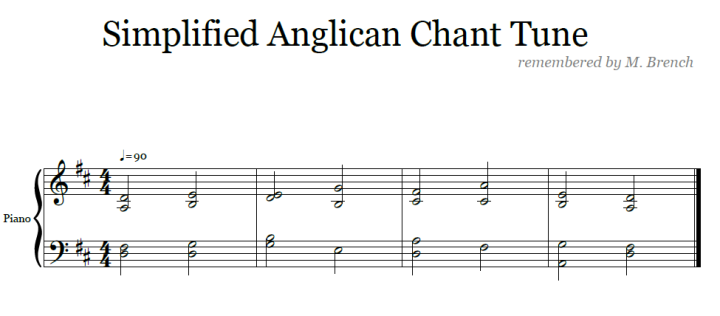
Simplified Anglican Chant is notated as four measures of music with two sets of notes each.  Each measure equals one half-verse of Psalm text.  Thus one full line of Simplified Anglican Chant equals two verses in the text of the Psalm.*  The majority of the half-verse is sung on the first note; the last ‘strong’ syllable is where you switch to the second note.

If you have the Book of Common Praise 2017, you’ll find an excellent explanation of this, complete with pictures, at “hymn” #738a.  Hymns #739-750 are twelve different Simplified Anglican Chant tunes.

Whether you have that book or not, however, you can take a look at this video I put together a little while ago.  In it, I go over some of the basics described above, and then demonstrate a few verses of Psalm 96 (which is among this morning’s appointed psalms, by the way).

The sample tune I used is not one of the twelve in the hymnal; it’s just one I vaguely remembered from when I was in a church choir nearly nine years ago.

simplified anglican chant

* From the 2017 hymnal: “But what if a psalm contains an odd number of verses rather than an even number?  Rather than finish the chant formula halfway through, which would be musically unfulfilling, the congregation can repeat the second half of the chant formula (measures 3 and 4) for the last verse of the psalm.