Let’s pray Morning Prayer together right now!

Okay, we’ve got a daily hymnody plan available, an order for using the Occasional Prayers, and some advice on the use of Canticles so far.  Let’s put it all together and see what Morning Prayer can be like. Listen and pray along!

Order of service (so you can get your books ready)…

  1. Opening Sentence (BCP 11)
  2. Morning Hymn (#229) *
  3. Invitatory with the Venite (BCP 13-14)
  4. Psalms 79, 80, 81 (BCP 373-377)
  5. 1 Samuel 7
  6. Canticle 8 Ecce Deus (BCP 85-86)
  7. 1 Corinthians 15:1-34
  8. The Benedictus (BCP 18-19)
  9. The Apostles’ Creed (BCP 20)
  10. The Prayers (BCP 21-24)
  11. The Anthem (Hymn #439)
  12. Occasional Prayers #25, 35-37
  13. The General Thanksgiving (BCP 25) **
  14. Closing Sentences (BCP 26)

* The first rubric on page 31 allows for the Confession and the Creed to to be omitted in one Office provided it is said in the other that day.  On my own I tend to say the Creed in the morning and the Confession in the evening.

** I tend not to pray the Prayer of St. John Chrysostom when alone, as the rubric on page 25 indicates it’s optional, and because its language of being gathered for corporate prayer is not exactly fulfilled in private.

Sing the Hymnal in a Year!

When it comes to liturgy, I’m a completionist, meaning I want to make use of all the legitimate options afforded in the Prayer Book in their proper times.  That means I want to say the Daily Offices and minor offices every day (not that my success rate is so high yet), and use each choice of prayer and canticle at appropriate opportunities.

I’m also a completionist when it comes to Bible-reading, and that includes the Ecclesiastical Books.  That’s why I made a supplementary lectionary (best used in Midday Prayer) to cover the various corners of the Bible that the Daily Office Lectionary had to leave out.  (I recently discovered that I’d neglected to fill in the missing chapters of Ezekiel, so I updated the file!)

And so, in this mindset I set out, a couple years ago, to figure out how I could accomplish a similar mission: sing all the hymns in the hymnal!  I made a rough year-long plan using the 1940 hymnal, which I can share if you really want it, though it is definitely quirky and personalized.  And when my congregation and I got our hands on the 2017 hymnal I began the slow process of starting all over again, aiming to make a cleaner, simpler, more logical plan for Daily Hymnody that could be used by anybody.  It took quite some time to “get it right” but now I’m happy to release:

DAILY HYMNODY
for the Book of Common Praise (2017) and the Book of Common Prayer (2019)
(formatted to be printed in “booklet” format if you’ve got a fancy printer)
(formatted to be printed as double-sided landscape that you can fold into a booklet)

Here are some explanatory notes of how this works.

Morning & Evening Hymns

The collection of Morning Hymns and Evening Hymns are treated separately.  They are placed on their own rotations (two-week and one-month, respectively), and thus will be sung several times in a given year.  Especially memorable or historical hymns are repeated more often in these cycles, to avoid awkward 17-day cycles or something silly like that.  Their frequent repetition also allows them to be replaced if there happens to be a large number of Daily Hymns in a given day.

How the Daily Hymns Work

The liturgical calendar has both fixed-date feasts (like Christmas) and moveable feasts (like Easter), which necessitates a daily hymnody plan that operates on both calendar styles in tandem.  This is managed by presenting hymns for fixed dates in either a parallel column or at the bottom of the page near the moveable-date hymns they’ll typically line up with.

As I mentioned in my review of the 2019 hymnal, there are more hymns in here that fit Advent and Lent compared to other books, making this project a lot easier than its 1940 hymnal version.  And, I think, more satisfying to use.  Here’s a quick commentary on how this order for Daily Hymnody uses the 2019 hymnal.

The Advent Hymns (#1-26) are spread throughout the Advent season, generally matched to the theme of the Collect each week.

The Christmas Hymns (#27-82) are sung through most of the 40 days from Christmas Eve until February 2nd (the feast of The Presentation).  Hymns that reference “today” or “this happy morn!” are placed earlier, in the actual twelve days of Christmas.  Hymns that pay particular attention to Mary are placed later, as a topical lead-up to the Presentation.

The Epiphany Hymns (#83-94) are sung January 6th through 11th.

The Lent Hymns (#95-104) are sung in the first week and a half of the season.  The Passiontide Hymns (#105-122) cover Holy Week, and also most of weeks 4 & 5.

The Easter Hymns (#123-146) are sung through Easter Week and the beginning of each subsequent week in Eastertide.  The Rogation Day Hymns (#147-8) are on the Tuesday and Wednesday before Ascension.

The Ascension Hymns (#149-161) cover the ten day of that period, and the Pentecost Hymns (#162-166) cover most of Pentecost Week.  The Trinity Sunday hymn is appointed on its Eve.

The various Saints Days hymns (#168-198) are appointed on their proper (or similar) days.  This includes a couple extra saints days and an All Saints’ Week November 1st-7th, using the Burial Hymns (#318-320) to add an “All Souls” flavor along the way.

The Thanksgiving Hymns (#199-209) are sung on November 21st-29th, ensuring that Thanksgiving Day will be enveloped in that spread of time.

The National Hymns (#210-218) are appointed for Memorial Day, July 1st-4th (covering both Canada Day and Independence Day), and November 8th-11th (giving a lead-up to Veteran’s/Remembrance Day).

The Baptism Hymns (#252-262) adorn the Sundays “Proper 8” through Proper 18 (basically all summer).  The Confirmation Hymns (#300-305) cover Propers 19-23 (and December 5th, because that’s my confirmation anniversary), and the Church Dedication Hymns (#313-317) finish the line on Proper Sundays 24-28.  The Sundays through this time of year also have General Hymn appointed, specially chosen to match its Collect of the Day.

The Communion Hymns (#263-299) are sung on nearly every Thursday from Maundy Thursday through Advent.

The Matrimony Hymns (#306-308) are appointed for the 5th of June and August, highlighting the popular “wedding season” in our culture today.  The Ordination Hymns (#309-312) are sung on the Wednesday of each set of Ember Days throughout the year.

The General Hymns, then, fill out the remaining gaps in the church year.

  • The Trinity section is mostly devoted to Trinity Sunday and the weekdays following.
  • Most of the “Praise to God” and “… God’s Works” section occupies Fridays & Saturdays from Proper 7-17.
  • Most of the “Jesus: Advent” section is sung in the days leading up to the First Sunday in Advent.
  • Most of the “Name…” and “Life & Ministry of Jesus” sections are sung in Epiphany 4-8 (Proper 3-7), with a few entries dotting the final days before Lent, a day in Eastertide, and a few in the week of Proper 8.
  • The “Mission” hymns cover Thursdays in Epiphany 4-7 or Proper 3-6.
  • The “Praise of Jesus” section mostly fills out Eastertide.
  • Most of the “Penitence” section is sung through the middle of Lent.
  • The “Jesus: Helper” section covers Mondays through Wednesdays in the weeks of Propers 9-13.  This is continued with the Holy Spirit, Holy Scripture, and Church sections, taking you to Proper 18.
  • Starting with the week of Proper 18, the split between MTW and FS ends.  The “Christian Vocation” section covers most of 18, “Christian Walk” is sung through Proper 22, continued by “Christian Warfare” and “Christian Duty” through Proper 25.
  • Propers 26-29 end the church year with the “Kingdom of God” and “Church Triumphant” sections.

Anyway, the two links above will get you booklets that give you these orderings in a neat and readable fashion.  I just offer this explanation as background for the curious.  Go, sing, worship, enjoy!

Pairing a Collect with a Hymn

One of my favorite things about the 2017 hymnal, “Book of Common Praise“, is that among its extensive indices it has a liturgical index that suggests hymns to match each Collect, OT lesson, Epistle lesson, and Gospel for each Sunday and holy day in the traditional calendar.  (Yes, traditional calendar, not the modern 3-year lectionary, because the REC made this book, and they still use the classic Anglican calendar.)  If you pay attention to the traditional Collects and find where they are in the modern (2019 Prayer Book) calendar, then you can profit from this liturgical index.

Take, for example, the Collect for Proper 9, which is this coming Sunday.  It corresponds with the 9th Sunday after Trinity (most of the post-Trinity collects numerically line up from the old to new calendars like this, which is handy).  The collect reads as follows:

Grant us, O Lord, we pray, the spirit to think and do always those things that are right, that we, who can do no good thing apart from you, may by you be enabled to live according to your will; through Jesus Christ our Lord…

The 2017 hymnal recommends the following hymns to match with this Collect:

Dear Lord…” right off the bat reveals its connection with this collect: “Forgive our foolish ways!  Reclothe us in our rightful mind, In purer lives thy service find…”  The recognition that we need God to enable us to good is clear throughout the hymn.

Breathe on me” is perhaps better known.  It’s not as “negative” about the sinful self, but its plea for reliance on God is just as sincere: “Fill me with life anew, That I may love what thou dost love, and do what thou wouldst do.”

O thou who camest” is a hymn for Confirmation in this hymnal.  It isn’t until verse 3 that this hymn’s connection to the Collect is clear: “Jesus, confirm my heart’s desire to work, and speak, and think for thee”.  Verse 4 also contributes: “Ready for all thy perfect will,
my acts of faith and love repeat”.  Its emphasis on doing the desire of one’s heart is revealed to be the godly intention of desiring what God desires, and thus plays into the main theme of the Collect.

Take my life, and let it be” may be cliche to some.  But the entire song can serve as a meditation on this Collect’s prayer for God’s spirit which alone enables us to do good.  Verse by verse this hymn hands to God our life, hands, lips, heart, voice, and finally our will:

Take my will, and make it thine;
It shall be no longer mine.

Take myself, and I will be
Ever, only, all for thee.  Amen.

If you want to make use of these hymns to reinforce the Collect of the Day on this coming Sunday, one of the best spots to do this is either between the Gloria in excelsis and the Collect.  The rubrics on pages 107 and 125 indicate that the Gloria may be substituted for a different song of praise, which my congregation traditionally stretches a little such that we say the Gloria and then sing a hymn.  I know of other congregations that take this idea even farther and put a whole “praise and worship set” after or in place of the Gloria… that strikes me as a stretch of the rubrics too far.  Whateverso, placing one of these hymns immediately before the Collect maximizes the potential for people to hear the thematic echo of the hymn in the Collect when the celebrant reads it.

If you place the related hymn elsewhere in the liturgy, it may be necessary for the preacher to identify that connection during the sermon.  And honestly, that’s not a bad idea either.  Include an explication of the Collect in the sermon, quote a piece of the hymn that connects to it, and then have the congregation sing that hymn during the Offertory or something.  That way the liturgy stands as a more coherent whole, and you the ministers are helping your flock see that, recognize that, and learn to make those connections on their own. For if we truly believe lex orandi lex credendi (the law of prayer is the law of belief) and vice versa, we should take care to see that our form of worship is just as coherent as our biblical preaching and doctrinal catechesis.


National & Patriotic Songs

The last Sunday in June and/or first Sunday in July is one of the several Sundays through the year when, in the US, many churches have to wrestle with the pressure to sing national or patriotic songs in the worship service.  Some embrace it whole-heartedly, happily singing the praises of our great nation.  Others forbid it full stop; save the love of country for civil and secular ceremonies, let the Church be the Church.  But if you and your congregation stand somewhere in between, you need a set of principles by which to decide what to allow, and what not.

We have to discern between hymns and spiritual songs on the one hand and national and patriotic songs on the other.  Church music is always sung to or about God.  They’re usually explicitly Christian, naming Jesus, or Christ, or the Trinity (if a song just says “Lord” or “God” that could be too generic, reduced to a theological least-common-denominator that could be sung just as happily by non-Christian religious adherents).  Patriotic music, similarly, is always sung to or about the country.  If you’re going to sing patriotic music in church, you have to make sure that it is still also church music, you have to find the overlap between church & patriotic music.

A number of hymnals have patriotic music, which may make this discernment process easier, depending upon how much confidence you place in the hymnal’s compilers.

Another approach, recognizing the fact that the Church spans all countries and ages, is to make a point of singing national songs that are neutral about what country they refer to, and therefore could be sung by any Christian in any country.  This thought also takes into account the possibility of visitors from other countries, and also accounts for the principle of common prayer and worship – that we should not pray or sing things that alienate one part of the Body of Christ from another part.  This stricter criterion would rule out songs like O Canada and America the beautiful and God save the Queen.

Now for a few specific examples to help you think through what you want or don’t want happening in your congregation.

My country, ’tis of thee

The last verse of this song is a prayer to God, recognizing him as the “Author of liberty,” which is a point in this song’s favor.  But everything else about it is open to potential trouble: expressing love for one’s country is not necessarily an idolatry, but its language of love is basically the same as how many psalms and songs address Jesus, which can suggest an idolatrous form nationalism (or support an idolatry already present).  The other big problem here is that “Great God our King” is so very generic.  Almost any monotheistic religion on the planet could sing this with integrity, there’s nothing specifically Christian about it.

The Star-spangled Banner

Like the previous, the last (second) verse mentions God, but in a cursory manner almost to the point of meaninglessness.  As this is the official national anthem in the US, this really belongs in civic ceremonies, not a worship service.  The Church is here to lift high the cross, not declare on behalf of America “then conquer we must, when our cause it is just” (verse 2).

O God of earth and altar

Although not usually printed in the “National Hymns” section of hymnals, this is a strong, even jarring, prayer for one’s country.  It doesn’t name its country, which makes it handy for whatever country you’re in.  The universal dominion of God makes it a good choice for national observances, though not everyone will necessarily appreciate its somewhat penitential tone.

God bless our native land

This is a good hymn for national days: it’s explicitly a prayer for the country, doesn’t name the country so it can be shared by all Christians, and still acknowledges the “one family The wide world o’er” (verse 3).  It’s set to the same tune as “My country ’tis of thee” and “God save the Queen,” so it feels patriotic, even though the words aren’t the popularly known lyrics.

O beautiful for spacious skies

I have vague memories of singing this song in elementary school and wondering what “beautiful forspacious skies” look like.  Childhood misunderstandings aside, this song is a little tricky to understand: “God shed his grace on thee” sounds like it’s past tense, and therefore a praise for the country which not all may see in the same way.  But if you finish the verse “and crown thy good with brotherhood…” you find that the verb form is not past/preterite but imperative: it’s a request, a prayer, that God would shed his grace and crown with good.  Verse two potentially runs into the danger of confounding national heroes with saints, and verse three can be a bit unclear distinguishing America from the heavenly Jerusalem, so those are some cautions before appointing or allowing this song in church.

Hymn for Ascensiontide: See the conqu’ror

One of the things I really like about the 2017 hymnal is that it’s got about twelve hymns about the ascension.  It’s nice to have choices, rather than appoint the same couple every year, even if they are really good.  Despite that, I figured I should just stick to “one of the greats” and walk us through a classic ascension hymn, See the conqu’ror mounts in triumph.  It’s as if each verse brings in a different theological layer to this momentous Gospel event.

See the Conqu’ror mounts in triumph;
See the King in royal state,
Riding on the clouds, his chariot,
To his heav’nly palace gate.
Hark! the choirs of angel voices
Joyful alleluias sing,
And the portals high are lifted
To receive their heav’nly King.

This is focused on the kingship of Christ Jesus.  He is a conqueror, his ascension is a victory march, the heavens are opened to welcome him in.  Verse two is similarly awe-filled, but quite different.

He who on the cross did suffer,
He who from the grave arose,
He has vanquished sin and Satan;
He by death has spoiled his foes.
While he lifts his hands in blessing,
He is parted from his friends,
While their eager eyes behold him,
He upon the clouds ascends.

This is about the humanity of Jesus.  The conqueror and savior is a man – the one who suffered and died, the one who had friends.  The context of his death and resurrection is perhaps the most obvious place to start approaching the ascension (and probably is the overriding context by which many people deal with the ascension at all), and although it is the most ‘simple’, it is by no means unimportant.

Verse three may be my personal favorite.

Now our heav’nly Aaron enters,
With his blood, within the veil;
Joshua is come to Canaan,
And the kings before him quail;
Now he plants the tribes of Israel
In their promised resting place;
Now our great Elijah offers
Double portion of his grace.

The Old Testament imagery is out in full force!  Jesus is like Aaron: a great high priest; his ascension is his entering into the true holy of holies.  Jesus is like Joshua, leading God’s armies to inevitable victory.  Jesus is like Elijah, ascending into heaven but leaving behind a spiritual legacy that will surpass the scope of his own earthly ministry.  The three offices of Priest, King, and Prophet, as applied to Jesus, make their offerings in this verse.  Personally, I think we need more celebration of Christ’s priesthood, Ascensiontide is well-suited to that, and this verse is a good step in the right direction.

The final verse also touches upon the priesthood of Christ, if obliquely.

Thou hast raised our human nature
On the clouds to God’s right hand;
There we sit in heav’nly places,
There with thee in glory stand.
Jesus reigns, adored by angels;
Man with God is on the throne;
Mighty Lord, in thine ascension,
We by faith behold our own.

If verse 2 can be said to be focusing the ascension upon the context of the death and resurrection of Jesus, verse 4 brings in the context of his incarnation.  Because Jesus is both God and man, and because Jesus has bodily ascended into the heavenly places at the right hand of the Father, we can say in no uncertain terms that humanity is enthroned with God!  He took on our flesh in order that there might be communion between the divine and humanity; it’s a two-way street.  He shares our sufferings, we share his glory.  He shares our death, we share his victory.  So we sing the great mystery of the ascension: we are seated with him on the throne!

This reinforces and echoes the Scripture lessons from Ascension Day, and the Collects from both Ascension Day and Sunday.  We’ll take a closer look at those tomorrow.

Book Review: The Bay Psalm Book

Welcome to Saturday Book Review time!  On most of the Saturdays this year we’re looking at a liturgy-related book noting (as applicable) its accessibility, devotional usefulness, and reference value.  Or, how easy it is to read, the prayer life it engenders, and how much it can teach you.

Today we’re stepping outside the Anglican tradition and looking at a gem of American history.  The first book ever published and printed in North America was The Bay Psalm Book in 1640, a mere twenty years after the pilgrims arrived in Massachusetts.  It has gone through many re-printings since then, and probably has some more legible successors in recent times, but I happened upon a facsimile print of the first edition, complete with blocky type and funny 17th century spelling.  On its own, it’s a cool historical curiosity.  But its actual contents have proven useful to me, and even found their way into my church’s worship from time to time.

The Bay Psalms Book is basically a psalter: all the psalms are re-translated such that they conform to common poetic meters in English such that they can be set to hymn tunes.  This book does not assign any tunes, it’s simply the text of the metric psalms.  What I have done, then, is take up some of a psalm from this book, fix up the spelling (and modernize the grammar a little if possible) and pick a tune that my congregation will know.

Psalm 67, for example (odd spelling and italics included), reads thus:

God gracious be to us & give
his blessing us unto,
let him upon us make to shine
his countenance alſo.*

That there may be the knowledg of
thy way the earth upon,
and alſo of thy ſaving health
in every nation. **

O God let thee the people prayſe,
let all people prayſe thee.
O let the nations** rejoyce,
and let them joyfull bee:

For thou ſhalt give judgement unto
the people righteouſly,
alſo the nations upon earth
thou ſhalt them lead ſafely.

O God let thee the people prayſe
let all people prayſe thee.
Her fruitfull increaſe by the earth
ſhall then forth yeilded bee:

God ev’n our owne God ſhall us bleſſe.
God I ſay bleſſe us ſhall,
and of the earth the utmoſt coaſts
they ſhall him reverence all.

* The “long s” – ſ – looks like an lowercase f, but if you look carefully it doesn’t have the horizontal line through the center.  There was a general rule when to use ſ or s, but it doesn’t seem to be strictly followed in this book.

** Twice in this psalm you have to pronounce “nations” with three syllables: na-ti-ons.  This kind of thing happens with similar words throughout the book, making it rather difficult for the modern reader to pick up on.

Now try singing that to the hymn tune AZMON (popular with the song “O for a thousand tongues to sing“).

Pretty cool, huh?  What you can do with a book like this is look up the Psalm for the Communion service on a given Sunday, check if its verses are readable and singable for your congregation, and then bring them into the worship service set to a tune they know… then they’ll both read/pray the Psalm and sing a paraphrase of it!

A note on Psalm-singing: in liturgical worship, Anglican or otherwise, the text of the liturgy is very important.  It matters what we say, and why we say it.  To mess around with the wording or translation, therefore, is not good practice.  So I would never recommend metric psalms as a replacement for the Psalmody in the Daily Office or Communion services.  Let the official psalter translation do its work.  Metric versions such as in The Bay Psalms Book can be refreshing and interesting and even beneficial at times, but should never replace the actual text of our liturgy.

The ratings in short…

Accessibility: 5/5
This book is nice and simple; there’s an explanatory introduction, the text of 150 psalms, and nothing else.  The header tells you what psalm(s) are on the page below, so you can thumb through the book quickly and easily as you search for the one your want.

Devotional Usefulness: 3/5
You have to supply the music.  You have to be able to read the imperfect print (if you get a facsimile edition) and ignore the funny spellings.  You have to figure out how to pronounce some of the words like a 17th century British colonist.  It can be done, and it can be beneficial, but much of this book just “won’t do it” for worshipers in the 21st century.  Whenever I’ve used it in my church, it’s always been limited in scope and edited for clarity of language.

Reference Value: 3/5
There are modern metric psalm translations out there, so you don’t really need to seek this one out.  This is great if you like colonial American history, or the history of bible/psalm translation, or the history of Christian worship.  The introduction provides a little insight into puritan theology of worship, too.

A Hymn for Rogationtide

Monday, Tuesday, and today are the Rogation Days – days devoted to prayer for the year’s crops.  We’ve mentioned ‘Rogationtide’ briefly recently and looked at the Collects for these days.  On this last day of the trio, let’s take a look at a rogation hymn.  The 2017 hymnal has two hymns for Rogationtide, and the 1940 hymnal has just one, so let’s look at that.  (Sing it to the tune KINGSFOLD.)

O Jesus, crowned with all renown,
Since thou the earth hast trod,
Thou reignest, and by thee come down
Henceforth the gifts of God.
Thine is the health and thine the wealth
That in our halls abound,
And thine the beauty and the joy
With which the years are crowned.

Lord, in their change, let frost and heat,
And winds and dews be giv’n;
All fost’ring power, all influence sweet,
Breathe from the bounteous heav’n.
Attemper fair with gentle air
The sunshine and the rain,
That kindly earth with timely birth
May yield her fruits again.

That we may feed the poor aright,
And, gath’ring round thy throne,
Here, in the holy angels’ sight,
Repay thee of thine own;
That we may praise thee all our days,
And with the Father’s Name,
And with the Holy Spirit’s gifts,
The Savior’s love proclaim.  Amen.

Just as the days, and the first Collect, enjoin us, this hymn expresses a prayer for a successful harvest, as well as attention to the purpose of a good harvest: to feed the poor, make offering to God, praise the Lord, and proclaim Christ’s love to the world.

As a child and teenager, that second stanza would have struck me as silly.  Who sings about the weather?  Plants just grow, crops are produced, if something goes wrong in one place you buy from another.  A child of the 20th century, I did not appreciate the significance of the natural order; many people today probably think this way their entire lives.  And to a large extent, much of the Developed World is able to live that way: if disaster strikes part of the country, certain food prices might increase a little as we import from other places, but on the whole we have the luxury of being unaffected by the weather.  Unless you’re the one whose livelihood just got destroyed, of course.

So singing a song like this is made all the more important in our day and age; it reminds us just how much is involved in the background of growing our food, and providing the many natural resources that go into various other products of commerce and industry.  Our lifestyles may only tangentially be impacted by the weather, even severe weather, but for others it’s critical.  The Rogation Days, and hymns like this one, can help us remember that.

Note: There are other layers to the Rogation Days which have not been explored, or even mentioned, in recent posts on this blog.  Perhaps next year we’ll hit upon some other aspects of Rogationtide, and how they can be observed in the course of private and congregational worship.

Book Review: Book of Common Praise 2017

Welcome to Saturday Book Review time! On most of the Saturdays this year we’re looking at a liturgy-related book noting (as applicable) its accessibility, devotional usefulness, and reference value. Or, how easy it is to read, the prayer life it engenders, and how much it can teach you.

Sadly, the ACNA has no province-wide plan for creating a new hymnal. This makes sense – different congregations have their favorite hymnals (often the 1940 or the 1982), and the growing preference for contemporary praise music is not especially conducive to printing in a book considering the majority of it is released as lead sheets (lyrics & chords) that only rarely include a written melodic line, let alone a written-out accompaniment.

However, one of the sub-jurisdictions of the ACNA, the Reformed Episcopal Church (REC), has has recently released an official hymnal for their churches: The Book of Common Praise 2017. It was brought to my attention in late 2017, soon after it was released, and my church and I got our hands on a box of copies the following summer. I intended to wait a few months to study this new hymnal on my own before switching over to it (in part in case I decided not to switch!) but my congregation seemed eager to use books that weren’t physically older than their Vicar, so we dove in pretty quickly.

Their immediate reactions were positive: the print is slightly larger and clearer than the 1940 hymnal.

My immediate reaction was mixed: I didn’t like font and typeface, it reminded me of a hymnal I didn’t particularly like from my congregationalist days. I also found that two hymns I really like were omitted from this book: Christ the fair glory of the holy angels (a fantastic song for Michaelmas) and Therefore we before him bending (a gloriously pious set of lyrics for Holy Communion, sometimes set as their own song and sometimes appended to the hymn Now my tongue the mystery telling).

But these losses were soon mostly balanced out by the inclusion of other songs missing from previous hymnals such as Amazing Grace! and of some newer songs I like such as In Christ alone my hope is found and Before the throne of God Above. (Technically Before the throne is a 19th century hymn but it was given a new melody in 1997 and thus repopularized amidst the Contemporary Christian Music crowd for a decade or so, which is the version found here.)

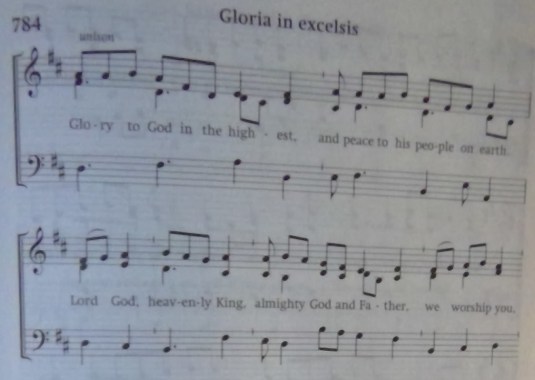
This hymnal puts the service music (including several settings of Anglican chant!) in back of the regular hymns, avoiding the formatting annoyance of the 1982 hymnal, which is an excellent decision. Its settings of various parts of the liturgy are still mostly keyed to the traditional-language forms, though there is one contemporary-language setting for the Communion service parts. I’ve tried the Gloria in excelsis with my congregation and it works fine.

WIN_20190517_14_11_02_Pro (2)

Another feature of this book, which I very much appreciate, is that they made a point of improving the balance of the number of hymns for each season of the church year. (You may recall the 1940 hymnal has an enormous glut of Christmas songs and a deplorable dearth of Advent and Lent songs!) Here’s the breakdown of the hymns in this 2017 book:

#1-198 The Church Year

  • Advent (26); Christmas (56); Epiphany (12); Lent (10); Passiontide (18); Easter (26); Ascension (13); Whitsunday [Pentecost] (5); Trinity Sunday (1); Saints’ Days and Holy Days (17); All Saints (10); Martyrs (4)
  • Hymns of Thanksgiving (11); National Hymns (9)

#219-251 The Daily Office: Morning (15); Evening (18)

#252-320 Sacraments and Other Rites

  • Baptism (5); Holy Communion (37); Confirmation (6); Matrimony (3)
  • Ordination and Ember Days (4); Consecration of a Church (5); Burial (3)

#321-639 General Hymns

  • The Holy Trinity, Praise to God, Jesus (Advent of, Life & Ministry, Name of, Help of, Praise to), Holy Spirit, Holy Scripture, Church, Mission, Christian Vocation, Christian Walk, Christian Warfare, Christian Duty, Penitence, Kingdom of God, The Lord’s Day, Church Triumphant

#640-800 Service Music

  • Index, Explanation of Anglican Chant
  • Daily Office Sung Responses, Canticles
  • Explanation of Simplified Anglican Chant, Simplified Anglican Chants (12)
  • Holy Communion: 5 Complete Services, plus Miscellaneous

Then follow 68 pages of Indices (indexes)!

There is so much in this book, it’s amazing. The liturgical index is excellent: it suggests hymns to match with the OT, Epistle, and Gospel lesson of each Sunday in the year as well as the Collect of the Day! Of course, this is for the REC Prayer Book, which uses the traditional one-year cycle of Collects & Lessons, so you really have to do your homework in order to “translate” that index into the modern ACNA 3-year lectionary cycle.

The season of Lent is still vastly underrepresented compared to the other seasons of the year, but that is compensated for the fact that the “Penitence” section of the General Hymns here include 21 hymns, which is a lot more than either of its predecessor books.

The Preface and introductory notes are also pleasantly specific about the process and goals that went into the creation of this book, reflecting a transparency similar to how the ACNA’s liturgical task force went about assembling the 2019 Prayer Book. Although, because this book was made by and for a relatively smaller group of people, the hands of its chief editor are a bit more visible than I would have expected – a number of new songs written or arranged by him have stood out to me in my exploration of this book over the past nine months.

The rating in short…

Accessibility: 4/5
The sections are well-labeled both in the Table of Contents and within the pages of the book so you can see where you are as you flip through. The collection of indexes are very comprehensive and hardly leave a stone unturned. If your church uses the traditional one-year lectionary, this is a 5/5, but for those of us (the majority) who don’t, the fact that it’s keyed to that different set of readings is a bit of a complication.

Devotional Usefulness: 5/5
The only thing it lacks, from my perspective, is more than a single option for modern-language Communion liturgy musical settings. There is so much devotional opportunity here, and it’s much better balanced than the 1940 or 1982 hymnals still in use today.

Reference Value: 5/5
Every index a music planner could need is in here. You can probably find some beloved hymns it lacks, but at 639 hymns (albeit doubling entries with an alternative melody choice) it’s got the larger portion of classic and recent Anglican hymnody.

In all it’s not quite a perfect hymnal, but it is absolutely the best one I’ve ever seen, held, or used. The ACNA does not have an official hymnal, but this is the book that I would heartily promote to fill that role.

Book Review: The 1982 Hymnal

Welcome to Saturday Book Review time!  On most of the Saturdays this year we’re looking at a liturgy-related book noting (as applicable) its accessibility, devotional usefulness, and reference value.  Or, how easy it is to read, the prayer life it engenders, and how much it can teach you.

Like many traditionalists, I don’t really like this hymnal.  So let’s make a point of starting with the positives.

+1 It matches the contemporary rites.  Made to pair with the 1979 Prayer Book, this hymnal is the first in the Episcopalian tradition to feature contemporary-language Service Music.  Carried into the ACNA, this remains a useful feature.  A few translation elements have changed since then (“And also with you” has returned to the properly historical and biblical “And with your spirit” for example), but for the most part those discrepancies are easily adapted from the 1979 liturgy to the 2019.

+2 It has a lot of options for service music.  In total there are 288 chant tunes and melodies for the various Office Canticles and Prayers, Mass parts, and other commonly-sung parts of the Office and Communion liturgies.  Add in the fact that it retains some traditional-language material alongside the contemporary, and you’ve got yourself a large collection of choices and resources built in to the hymnal.  This is very empowering for a choir or congregation, having so many possibilities accessible in one volume without having to purchase expensive choir music or whatever else.

+3 It brings in a few popular hymns that the previous hymnal lacked.  I commented last week that the 1940 hymnal doesn’t have Amazing grace! in it; this book does.  And, with a total of 720 hymns (compared to 600 in the 1940), this hymnal didn’t have to sacrifice a ton of songs in order to make room for new and imported ones.

But there are a number of shortcomings to this hymnal.  Depending upon your preferences and views, some of these might be minor or major to you; I’ll list what I consider to be the main offenders.

-1 The formatting is inconsistent.  Sometimes you get a fantastic four-part-harmony arrangement complete with the last verse’s descant on top, making for an excellent resource for congregation, choir, and keyboardist alike.  But sometimes you just get a melody line with no accompaniment.  If you want to play along on the piano or organ, too bad, you’ve got to purchase the giant TWO-VOLUME accompanist edition of the hymnal.  Ain’t nobody got time fo’ dat.  Plus, a lot of the hymns in this book are printed with uneven line or page jumps.  You can see the range of good and bad in this sample:

WIN_20190508_13_11_30_Pro

-2 A number of classic hymns have undergone changes to the lyrics.  To some extent, yes, there is a longstanding history of lyrics getting edited for reasons of theological preference or for clipping long songs into shorter versions.  But this hymnal goes a few steps too far, doing violence to the poetry of classic songs in the interest of gender-neutral language.  Perhaps the most prominent offender is Be thou my vision.  The second verse reads:

Be thou my wisdom, and thou my true word;
I ever with thee and thou with me, Lord;
thou my great Father; thine own may I be;
thou in me dwelling, and I one with thee.

compared to the original:

Be thou my wisdom, and thou my true word;
I ever with thee and thou with me, Lord;
thou my great Father, I thy true son;
thou in me dwelling, and I with thee one.

The theological implication (not to mention biblical language) of sonship is discarded.  The assurance of belonging in Christ (“thy true son”) is replaced with aspiration (“may I be”).  Plus, for the many, many people who already know the original version, this is a constant tripping point, stumbling over these awkwardly re-worded phrases.  Come thou fount of ev’ry blessing is also subject to some distracting word changes, and I’m sure there are other examples I haven’t found on my own.

-3 The ordering of the music is awkward.  Unlike the 1940 hymnal, the Service Music is printed in this book first.  If you’re in a choir, or the congregation uses the service music section a lot, that’s fine.  But if, like in many places, it’s primarily a book to pick up in order to sing hymns, this can be annoying (and downright confusing for newcomers), having to flip past S1 thorugh S288 before getting to hymn #1.

Furthermore, the hymns aren’t organized as logically as they could be.  Simplifying the Table of Contents…

  • #1-46 The Daily Office (Morning, Noon, Evening, Compline)
  • #47-293 The Church Year
  • #294-299 Holy Baptism
  • #300-347 Holy Eucharist
  • #348-361 Confirmation, Marriage, Burial, Ordination, Consecration
  • #362-634 General Hymns
  • #635-709 The Christian Life
  • #710-715 Rounds and Canons
  • #716-720 National Songs

Why Rounds and Canons need their own section, and why National Songs aren’t appended to the Church Year section, is beyond me.  The separation of The Christian Life from the related sub-sections of the General Hymns also seems strange to me.

Last of all, I should point out that the indexes are rather limited in this book compared to a number of others.  It has no liturgical index, recommending hymns for particular Sundays and Holy Days like in the 1940, but that is to be expected with the lengthy and complex 3-year lectionary cycle.  However, this hymnal also lacks a metrical index, which is admittedly probably only an issue for creative music ministers who want to look at alternative tune possibilities and make particularly detailed comparisons.

The rating in short…

Accessibility: 3/5
It’s well-labeled and has the basic Table of Contents and index that you need.  But you’ll probably need those resources more than you would with other Anglican hymnals.

Devotional Usefulness: 3/5
It has the positive usefulness of providing service music and additional hymns that older hymnals don’t or can’t provide.  But the liberal hand of editing has left its mark, which tampers with (and occasionally ruins) a number of hymns along the way.

Reference Value: 4/5
Compared to its predecessors, the extra-large collection of Service Music makes this hymnal rather handy to have around, especially for the contemporary-language worshiper.  And, with 720 hymns, it’s just plain got a lot of music in it too, lyrical tampering and format problems notwithstanding.

Ultimately, this hymnal is one I would recommend for two groups of people: choristers or congregations who routinely set many parts of the liturgy to music/chant, and music ministers who want to draw upon this book as a supplementary resource.  I would not recommend this hymnal as an ordinary hymnal for a church, especially considering the financial commitment for the accompanist who’ll need an extra $80 for that edition.
Hymn: At the lamb’s high feast

Easter is one of those holidays, like Christmas, that has some really famous, really well-loved, really satisfying hymns to sing.  Jesus Christ is ris’n today or its twin, Christ the Lord is ris’n today, are so classic I’m tempted to say “Easter just wouldn’t be Easter without singing that song!”  There are, of course, many other Easter hymns of lesser fame that are quite fantastic for the holiday, and one of my favorites in that middle category is At the lamb’s high feast we sing.  Set to the tune SALZBURG, it bears a grandeur both lyric and melodic that deserves higher praise than it usually seems to get.

At the lamb’s high feast we sing
Praise to our victorious King,
Who hath washed us in the tide
Flowing from his pierced side;
Praise we him, whose love divine
Gives his sacred blood for wine,
Gives his body for the feast,
Christ the victim Christ the priest.

That first stanza sets us firmly in the Easter celebration, makes a baptismal reference (as is traditional in the Easter celebrations), and then moves seamlessly to a eucharistic reference.  I especially appreciate how his sacrifice is described in the active sense: he gives his blood and body; he’s not just Christ the victim, but also Christ the priest!  This is, in my opinion, an emphasis that we often lack when discussing the atonement.

The second stanza continues:

Where the Psachal blood is poured,
Death’s dark angel sheathes his sword;
Israel’s hosts triumphant go
Thro’ the wave that drowns the foe.
Praise we Christ, whose blood was shed,
Paschal victim, Paschal bread;
With sincerity and love
Eat we manna from above.

The baptismal and eucharistic references remain, but are couched in more overtly Old Testament imagery, invoking the Passover and the Crossing of the Red Sea as the foreshadowings or prototypes of these two Sacraments of the Gospel.  It even manages (in the last two lines of this stanza) to reference the Easter Anthem (The Pascha Nostrum) and invoke the context of the teachings of 1 Corinthians 10, linking the Old Testament (particularly Exodus) waters and manna images to the New Covenant sacraments.

Mighty victim from the sky,
Hell’s fierce pow’rs beneath thee lie;
Thou hast conquered in the fight;
Thou hast brought us life and light;
Now no more can death appall,
Now no more the grave enthrall;
Thou hast opened paradise,
And in thee thy saints shall rise.

The brief Passover reference at the beginning of stanza 2 – the sheathing of the destroying angel’s sword – is explored here in full force.  The death and resurrection of our Lord Jesus Christ has brought about a great victory.  Jesus is a “mighty victim from the sky”, yet, “Hell’s fierce powers” lie beneath him.  He has conquered, he has brought us from death to life, and those evils can never reign over us again; the hope of our own resurrection to eternal life is sealed for sure.

This leads the hymn to a great doxological ending:

Easter triumph, Easter joy,
Sin alone can this destroy;
From sin’s pow’r do thou set free
Souls new-born, O Lord, in thee.
Hymns of glory, songs of praise,
Father unto thee we raise;
Risen Lord, all praise to thee
With the Spirit ever be.  Amen.

That second line always bugs me – “sin alone can this destroy“… It is obviously meant that sin is the object, not the subject, of the verb destroy: Easter triumph and joy alone can destroy sin.  But there’s just no decent way to get the word order sorted out with perfect clarity without destroying the rhyme scheme of the lyrics.  You just have to roll with the poetry, which we moderns and post-moderns are not generally very good at doing.  Getting over that shortcoming in ourselves, however, this is a logical and fitting apex for the hymn.  Christ’s victory is over sin itself, and in his Gospel we find freedom.  And thus we praise the triune God, Father, Risen Lord, and Spirit.

There’s still plenty of Easter Sundays left… get it into your congregation’s hands if you haven’t already!  It works as a communion hymn, offertory/doxology hymn, processional, recessional… nearly anywhere in the liturgy where singing can be found!