St. Joseph, a “New” Feast

When you go through the classical Prayer Book tradition, compared with modern Prayer Books such as ours in the ACNA, you’ll find that the list of Holy Days, or Major Feast Days, or Red-Letter Days, has grown rather noticeably.  A number of Anglo-Catholics were probably already “unofficially” adding some of these feasts to the Prayer Book calendar in practice, which perhaps helps to remind us that these are not truly “new” feasts in the modern Prayer Books, but simply old traditions that the early Prayer Books omitted and 20th century Anglicans have decided to bring back.  Saint Joseph’s Day, on March 19th, is one of those holidays.

The Collect and lessons look to be the same in our Prayer Book as in the 1979:

O GOD, who from the family of your servant David raised up Joseph
to be the guardian of your incarnate Son and the spouse of his virgin mother:
Give us grace to imitate his uprightness of life and his obedience to your commands;
through Jesus Christ our Lord, who lives and reigns with you and the Holy Spirit, one God, forever and ever.

2 Samuel 7:4,8-16; Psalm 89:1-4(5-18)19-29; Romans 4:13-18; Luke 2:41-52

There aren’t a lot of stories about Joseph in the Bible.  Most of his active presence therein is in Matthew 1 & 2, where he is visited by the Archangel Gabriel, and then leads the family to Bethlehem, Egypt, and Nazareth.  But our version of the Revised Common Lectionary covers most of those in Advent and Christmastide.  So instead we get the Gospel story in Luke 2 about the Finding of Jesus in the Temple.  In the historic calendar (before the 1970’s) that Gospel was appointed for the First Sunday after the Epiphany.  But the modern Epiphany season leaves that story out entirely, apparently giving it over to Saint Joseph’s Day instead.  It may not be the most interesting or even the most actively Joseph-centric Gospel story with Joseph, but that’s what we’ve ended up with.

Much more interesting, I daresay, are the other readings.  2 Samuel 7 and Psalm 89 together set up a wonderful emphasis on the covenant of eternal kingship God established with David and his descendants.  This is mentioned in the Collect as well, and expanded further in the Epistle, which adds the covenant with Abraham into the mix.  Joseph, therefore, is presented as the last step in that family succession (alongside Mary of course) from Abraham and David to Jesus.  The human parentage and family of Jesus is what legitimizes God’s fulfillment of all the previous covenants in Jesus – the faithful offspring of Abraham, the eternal King of Israel.

There’s more to be said about Joseph, of course, and the Collect hints at some of that.  Imitating Saint Joseph’s uprightness and obedience is a shout-out to the stories in Matthew 1 & 2, wherein Joseph gets the incredibly rare introduction as “a righteous man.”  Virtually every biblical hero character has reported flaws and sins; Joseph has scarcely a blemish recorded in sacred writ!  A role model he is, indeed.

So there are quite a number of directions one can go in observing St. Joseph’s Day today, and hopefully this is a helpful starting point.

St. Gregory the Great

Today is the commemoration of Saint Gregory the Great, who was the Bishop of Rome from 590 to 604.
To musicians he is remembered as the author (or perhaps just compiler) of a great deal of plainchant that came to bear his name: Gregorian Chant.
To Anglicans he is remembered as the one who sent St. Augustine and his team to England, where, based in Canterbury, the Anglo-Saxons were re-evangelized and the Church there reinvigorated.
To Roman Catholics he is remembered as one of the 36 ‘Doctors of the Church’.
To the Eastern Orthodox he is remembered as the author of the Dialogues, chronicling the lives and miracles of various early Saints, especially including Saint Benedict.
To many Bishops he is remembered as the author of the Liber regulae pastoralis – for centuries the definitive book on how a Bishop is to order his life.
To the Reformer John Calvin he is remembered as “the last good Pope.”

If we to commemorate him in a Communion service today, there are two main options for Collects and Lessons.

Of a Teacher of the Faith

Almighty God, you gave your servant Gregory the Great special gifts of grace to understand and teach the truth revealed in Christ Jesus: Grant that by this teaching we may know you, the one true God, and Jesus Christ whom you have sent; who lives and reigns with you and the Holy Spirit, one God, for ever and ever. Amen.

Proverbs 3:13-26; Psalm 119:89-106; 1 John 1:1-10; Matthew 13:47-52

Of a Pastor

O God, our heavenly Father, you raised up your faithful servant Gregory the Great, to be a bishop and pastor in your Church and to feed your flock: Give abundantly to all pastors the gifts of your Holy Spirit, that they may minister in your household as true servants of Christ and stewards of your divine mysteries; through Jesus Christ our Lord, who lives and reigns with you and the Holy Spirit, one God, for ever and ever. Amen.

Isaiah 6:1-8; Psalm 71:17-24; 1 Peter 5:1-11 or Acts 20:24-35; Matthew 24:42-50

What one would do is choose either of these sets, and stick with them wholesale; don’t mix and match between them.  Decide how you’re going to commemorate St. Gregory, identify what aspect of his legacy and sainthood you wish to highlight to the congregation, and choose the Propers (Collect & lessons) accordingly.

A further recommendation of this Customary, because this is an optional commemoration and not a Prayer Book “red letter day”, would be to use two readings (plus Psalm) instead of three.  Remember also that you can omit the Nicene Creed, which the rubrics require only for Sundays and Major Feast Days.

And, of course, there’s nothing stopping you from reading and praying an Antecommunion service on your own – that is, going through the Communion liturgy up to the Offertory and ending it there with the Lord’s Prayer!

Perpetua: a Cheerful Lenten Tale

March 7th is the commemoration of Saints Perpetua and Felicity, two martyrs of the Early Church, who died in Carthage in the year 203.  Something that makes their story very special in the memory of the Church is the fact that much of it was written autobiographically by Perpetua herself, making it one of the oldest surviving pieces of writing by a Christian woman.  (That is assuming the document is authentic… manuscript history isn’t always easy to nail down precisely, but the authenticity of this account is not widely disputed today.)

Feel free to take the time today to give it a read!

There’s something very appropriate to starting off the season of Lent with a martyrdom story like this.  We are endeavoring to grow in love and service to our Lord Jesus through this time, motivated by love and strengthened especially by the disciplines of prayer, fasting, and alms-giving, so it can be rather sobering to be reminded up front the sheer cost of discipleship and spiritual discipline for many of our forebears.  It’s one thing to give up chocolate for 40+ days in the name of Jesus; it’s quite another thing to give up your earthly life in the name of Jesus.

Last Sunday after Epiphany: liturgical colors

In a couple days it’ll be the last Sunday before Lent begins.  I have seen, and participated in, a couple different conversations about the liturgical color appropriate for that day, and so thought it prudent to compile the different perspectives and their major arguments

Before we begin, though, there’s a prologue question that should be addressed: “Who cares?”  Granted, the Prayer Book tradition has never mandated a particular scheme for liturgical colors, and granted, the Puritan party of Reformers held the day for a while in Anglican practice whereby liturgical colors were not used by the majority of ministers.  If that is the way you like it then there’s not a lot we can do for you here.  The use of liturgical colors is one of the church’s many and ancient practices for providing visual aids to worship and teaching.  As long as the colors are used in a consistent fashion, they can convey different postures and moods befitting different occasions.  Black for mourning, white for joy, purple for penitence, and so on.  But the key here is that these colors have to be used consistently with their use and meaning, otherwise they will only ever be fashion accessories and a frivolous game of ecclesiastical dress-up.  That’s why getting the colors right, if you’re using them in the first place, matters.

The Traditional Option

If you’re using the historic calendar and lectionary, this Sunday is “Quinqagesima” – the last Sunday before Lent – and Western tradition is unanimously clear: the liturgical color is purple.  The Pre-Lent season is nearing its end, Lent is almost here, the Alleluias have already been “buried”, there is no question: it’s purple.  Easy!  Done.

The Modern Calendar

Anglicanism has no history of its own when it comes to the liturgical color tradition; we’re just one of the several pieces of Western Catholicism in this matter.  Therefore, when Anglicans switched to the modern calendar developed in the Roman Catholic Church, the standard color practice was also imitated.  So if catholicity is your primary concern in choosing liturgical colors, or you’re just looking for the quick and easy answer, then do what the majority of Western tradition does in the modern calendar: it’s white.  Done.

But, but, but…

Not everyone’s happy with this idea, though.  Some argue for green, others for purple.  So let’s look at these arguments and compare with them with the reasons for using white.

The argument for green stems largely from a concern for the integrity of the Calendar as a whole and a rejection of the way the Last Sunday after Epiphany is treated.  This Sunday, wrapping up the modern Epiphany season, is always about the transfiguration of Jesus on the mountaintop.  But, Green Advocates point out, the Transfiguration is already a feast day in the calendar: August 6th.  To read it in the Gospel lesson this Sunday and wear white is basically to double that holy day in the calendar.  This is an inappropriate imbalance, they say, and this Sunday should be normalized to green along with the rest of Epiphanytide.

The argument for purple is a sort of hybrid approach to the modern calendar, drawing in some of the mindset of the old. Instead of looking at it as the Last Sunday after Epiphany it’s the Last Sunday before Lent, and the very observance of Christ’s Transfiguration as a prelude to Christ’s Passion supports this case.  This Sunday is basically the Pre-Lent Sunday of the modern calendar, and thus, in line with pre-1970’s liturgical practice, this Sunday is best characterized by purple.

So why does the Roman order (and all standard Protestant recommendations) appoint white for this day?  Part of the answer is a liturgical symmetry: both of the green seasons (after Epiphany, after Trinity) begin and end with a white Sunday (1st after Epiphany, Last after Epiphany, Trinity Sunday, Christ the King Sunday).  This may be rebutted by some: Christ the King Sunday shouldn’t be white either, and like the transfiguration is best left to its “proper” place in the calendar (Transfiguration to its feast on August 6th, Christ the King to its mini-season with Ascension Day and Sunday after).  But, I would point out, these arguments to take white away from these Last Sundays at the end of the green seasons, especially to replace them with green, are also arguments against the very nature of those Sundays in the modern calendar.  In short, a color scheme revision isn’t enough, these objections cut all the way to the lectionary, and will not be solved unless or until the lessons for “transfiguration” and “christ the king” Sundays are also changed.

Even the appeal for purple runs into trouble along similar lines.  The argument for purple has the advantage of befitting the readings – especially now in Year C where the Epistle lesson happens also to be the traditional Epistle for Quinqagesima! – but still requires a slight re-write of the calendar.  We have the Last Sunday after or of Epiphany, but purple requires the name to be Last Last Sunday before Lent.  It is natural, in the liturgical context of the modern calendar, to reconsider this Sunday as a Pre-Lent purple sort of day, but you have to change its name in the Prayer Book in order to justify it fully.

The Saint Aelfric Customary’s Recommendation

I sympathize with all these arguments.  It’s ecumenical to stick with the Roman order and wear white; it’s annoying to double a feast day like the Transfiguration; it would be nice to bring back some of the historic Pre-Lent purple.

The arguments for green, I think, run into too many counter-arguments that create even more tension within the calendar, and ultimately lead in a direction of a complete overhaul.  I’m not opposed to a complete overhaul; for the most part I’d like to see the calendar restored to the way it was before the radical revisions of the 1960’s and 70’s.  But changing this one Sunday from white to green isn’t really going to help us get there.

The idea of using purple in the modern calendar may primarily be my own imagination; I don’t remember if I’ve actually heard anyone else suggest it before.  It’s less disruptive to the calendar’s color scheme as a whole than choosing green, but it’s still clearly against the spirit of the modern calendar.

So, honestly, I still think white is the way to go.  It may not be the best solution, but at least let’s think of it this way: this is our last hurrah before Lent, let’s do our best to enjoy it and sing Alleluia before we bury it for six and half weeks.

George Herbert, the Country Parson

George Herbert (1593-1633) lived a short but saintly life, remembered for being a caring pastor in the English church, and as one of the great metaphysical poets of the day.  If you are a student of literature, especially poetry, Herbert is (or ought to be) a familiar name to you already.

But in the memory of the Church, his commemoration in our calendar, and especially to a liturgy blog such as this, George Herbert’s greatest gift to posterity is his short book A Priest to the Temple or, the Countrey Parson.  It went through multiple publications including well after his death, and was a classic manual for pastors for centuries.  I made a point of reading this book annually for four or five years, and it has made its way into my own pastoral mindset, practice, and writing noting…

This lovely short book briefly walks through all sorts of subjects: the pastor’s lifestyle, education, study, and household, his prayer life, preaching, and handling of the church building and people, his teaching and ministering to the sick and his circuit of visitations, pastoral discipline, legal counsel, and medical aid, his leadership, library and love for others.

I’ll leave you with chapter 6 on the pastor’s prayer life and liturgical example (with modernized spelling).

The Country Parson, when he is to read divine services, composes himself to all possible reverence; lifting up his heart and hands, and eyes, and using all other gestures which may express a hearty, and unfeigned devotion. This he does, first, as being truly touched and amazed with the Majesty of God, before whom he then presents himself; yet not as himself alone, but as presenting with himself the whole Congregation, whose sins he then bears, and brings with his own to the heavenly altar to be bathed, and washed in the sacred Laver of Christs blood. Secondly, as this is the true reason of his inward fear, so he is content to express this outwardly to the utmost of his power; that being first affected himself, he may affect also his people, knowing that no Sermon moves them so much to a reverence, which they forget again, when they come to pray, as a devout behaviour in the very act of praying.

Accordingly his voice is humble, his words treatable, and slow; yet not so slow neither, to let the fervency of the supplicant hang and die between speaking, but with a grave liveliness, between fear and zeal, pausing yet pressing, he performs his duty.

Besides his example, he having often instructed his people how to carry themselves in divine service, exacts of them all possible reverence, by no means enduring either talking, or sleeping, or gazing, or leaning, or half-kneeling, or any undutiful behaviour in them, but causing them, when they sit, or stand, or kneel, to do all in a strait, and steady posture, as attending to what is done in the Church, and every one, man, and child, answering aloud both “Amen,” and all other answers, which are on the Clerks and peoples part to answer; which answers also are to be done not in a huddling, or slubbering fashion, gaping, or scratching the head, or spitting even in he midst of their answer, but gently and pausably, thinking what they say; so that while they answer, “As it was in the beginning, &c.” they meditate as they speak, that God hath ever had his people, that have glorified him as well as now, and that he shall have so for ever. And the like in other answers.

This is that which the Apostle calls a reasonable service, (Rom. 12:1). when we speak not as Parrots, without reason, or offer up such sacrifices as they did of old, which was of beasts devoid of reason; but when we use our reason, and apply our powers to the service of him, that gives them.

If there be any of the gentry or nobility of the Parish, who sometimes make it a piece of state not to come at the beginning of service with their poor neighbours, but at mid-prayers, both to their own loss, and of theirs also who gaze upon them when they come in, and neglect the present service of God, [the parson] by no means suffers it, but after diverse gentle admonitions, if they persevere, he causes them to be presented [chastised]: or if the poor Church-wardens be affrighted with their greatness, notwithstanding his instruction that they ought not to be so, but even to let the world sink, so they do their duty; he presents [chastises] them himself, only protesting to them, that not any ill will draws him to it, but the debt and obligation of his calling, being to obey God rather then men.

Happy Saints Cyril & Methodius Day?!

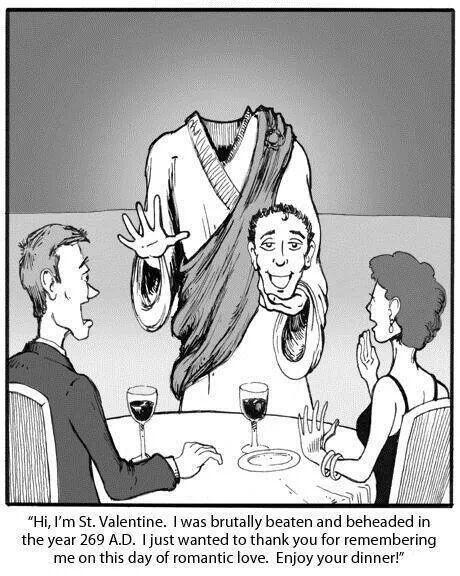
It’s February 14th, you know what that means…

valentine

Wait one sec… <checks calendar> …well we were all expecting St. Valentine’s Day, but no, it’s Sts. Cyril and Methodius.  Isn’t Valentine a Saint?  Yes, and he’s actually older – earlier – than Cyril and Methodius.  This probably only heightens the question, therefore: why do our calendars highlight those guys instead of Valentine?  I mean, Valentine was a martyr, and that usually puts one at the “top” of a list of Saints.  Insofar as one can rate “saintliness,” martyrdom is usually top-rate.

But there is one “category” of sainthood that tops a martyr: Apostles.  Obviously, Cyril and Methodius are not among the original twelve, or even among the first generation of Christians.  Rather, they were apostles of a later sort – what we might call missionary bishops.  They were sent to a new unreached people-group, the Slavs of Southeastern Europe, to preach the Gospel and establish the church among them.  They became bishops in time, and were thus the “Apostles to the Slavs.”

And their efforts, not without controversy at first, went beyond what we normally read about with historic apostolic missionary bishops.  Far from the imperialist mindset that frequently follows well-meaning missionaries, Cyril and Methodius actually learned the local language, began to invent an alphabet for them to write their language down, and began to celebrate the divine liturgy in their local language too.  This was in the 800’s, a point in which everything Christian was generally either in Greek or in Latin (the Coptic, Assyrian, and Armenian churches had departed by this point), so the adding of a third major liturgical language was viewed with some suspicion at first.  Nevertheless, the Cyrillic alphabet survives to this day, used by churches and nations that represent a massive portion of the world today.  Old Church Slavonic is also now considered an “ancient” standard in Eastern liturgy.

Now, obviously, all Saint are important.  Even further, all Christians, members of the Body of Christ, equally belong in Christ.  In that sense, there’s no comparing or ranking that can be done.  But liturgically speaking, you can only really have one commemoration per day.  Because Cyril and Methodius were brothers who worked together in the same mission, they get teamed up to share a holy day (14 February is understood to be Cyril’s death date).  And because their contribution to the global church makes a bigger splash than St. Valentine, who was executed on the same day of the year, they usually get liturgical priority over him.

So if you want to combine these commemorations today, perhaps you take someone out for a Valentine’s Day date, but write him or her a note in Russian or something 😉

Looking Ahead: St. Matthias Day

February 24th is the date our calendar holds for celebrating Saint Matthias.  One could say Matthias was the “second twelfth apostle.”  The Collect for his day makes this explicit:

Almighty God, who in the place of Judas chose your faithful servant Matthias to be numbered among the Twelve: Grant that your Church, being delivered from false apostles, may always be guided and governed by faithful and true pastors; through Jesus Christ our Lord, who lives and reigns with you, in the unity of the Holy Spirit, one God, now and forever. Amen.

Some modern calendars appoint his feast day for May 14th, landing him close to when Ascensiontide takes place.  That’s a modern change that actually makes some good sense: his only story in the Bible is in Acts 1 – he was elected and chosen by lot to replace Judas in the 10-day period of time between the Ascension of Christ and the descent of the Holy Spirit on the day of Pentecost.  But the ACNA’s calendar is holding onto his traditional date February 24th.

This year that puts his feast day on a Sunday, which (many people need to be reminded) is now explicitly permitted, if not also suggested, in our calendar that we can celebrate the feast day right then and there on that Sunday in place of the regular Sunday-after-Epiphany.  The relevant rubrics have been cited here before.

Now, if Lent started earlier, this wouldn’t be an option; Sundays in Lent cannot be overridden by major feast days.  If you are using the traditional calendar, this also would not be an option, as the three Pre-Lent Sundays cannot be overridden either.  But for the majority of us in the ACNA, using the modern calendar, it’s a regular Sunday which therefore can give way to an other prayer book major feast day such as St. Matthias.

So, despite what a lot of the popular Ordo Calendars and online daily office algorithms suggest, feel free to let loose this Saint’s Day on his proper day this month, Sunday February 24th!

Minor Feast Day: Cornelius the Centurion

Today’s commemoration in our calendar is Saint Cornelius the Centurion, whose story is recorded in Acts 10.  He was a devout believer in God, but a Gentile.  He kept regular “hours” of prayer, and during one of these he received an angelic vision affirming his devotion and almsgiving, that these have risen as “a memorial before God.”  As a Gentile, he was separated from God under the Old/Mosaic Covenant, but as he would soon find out, there is a New Covenant that was available to him.

He wasn’t the first Gentile to convert, but he was basically the first Gentile that an Apostle sought out, preached to, and baptized.  Acts 10 is sometimes nicknamed “the Gentile Pentecost,” as the Holy Spirit powerfully fell upon the household of Cornelius in the same way that he fell upon the Samaritans in chapter 8 and the Jews in chapter 2.

Like some of the other holy days we’ve noted in the past few weeks, Cornelius’ commemoration is particularly on-point for the Epiphany season.  Indeed, we need only look two days behind us, to Candlemas, to be reminded of the great Epiphany promise in Christ: to be a light to lighten the Gentiles, and the glory of [God’s] people Israel.  The light of the Gospel, through the angelic vision and the preaching St. Peter, shone in the household of Cornelius, and he and his family and servants – his entire household – were baptized into the Body of Christ.

If you, or someone you know, are typically skeptical of observing saints’ days, especially the longer list of optional commemorations, keep examples like this in mind.  It’s more than just about the man Cornelius.  It’s about the light of the Gospel advancing into new territory.  It’s about celebrating the fruit of faithful preaching and obedience to God.  It’s about affirming the honest search for God.  It’s about giving flesh and bones, real life stories, to the great theological topics and truths highlighted in the liturgical calendar year.

The Presentation / Purification / Candlemas

February 2nd is the Feast of the Presentation of our Lord in the Temple, also known as The Purification of Mary, or Candlemas for short.  I thought I’d take up some of the liturgical tid-bits that characterize the celebration of that day, and point out something of how they inform us of the Christian Faith, and biblical interpretation.

There are three primary worship services in Western liturgical tradition: Morning Prayer (or Mattins), the Mass (or Communion or Eucharist), and Evening Prayer (or Vespers).  Although they are normally held throughout the day in that order, the Communion service is the “principle” celebration of the day; that means that the scripture readings in that service are usually the most significant ones for the given holiday, and the readings in the Office are supplementary.  Also, what exactly the readings are, and how many of them exist, will vary between different specific traditions.  Older Anglican Prayer Books differ slightly from newer ones, and Roman Catholic and Eastern Orthodox liturgies also have slightly different choices in many cases, but over all the similarities tend to outweigh the differences.  With that in mind, let’s dive in!

The Collect

The “Collect of the Day” is a prayer that is meant to collect together the theme(s) of the day from the Scripture readings.  Looking at how this is done in a given Collect can reveal the theological, devotional, or practical emphases that the tradition is putting forth.  Here is one Collect for the feast of the Presentation:

Almighty and everlasting God, we humbly pray that, as your only-begotten Son was this day presented in the temple in the substance of our flesh, so we may be presented to you with pure and clean hearts by Jesus Christ our Lord; who lives and reigns with you and the Holy Spirit, one God, now and for ever.

This focuses on the historical event (Jesus’ presentation in the Temple) and draws a spiritual analogy to the end product of our salvation: the Day we are all made completely holy in Christ such that he may present us to the Father as adopted members of the household of God.  It also points out that Jesus was in “our flesh,” providing an emphasis on the incarnation and the exchange that takes place: God entered into our humanity so that we can enter into His divinity.

Morning Prayer readings

One Old Testament reading that some of the classic Prayer Books set forth for the Office of Morning Prayer is Exodus 13:1-16.  This makes for a great first reading on this holiday because it gives the Old Testament Law of Moses background for what’s going on with Jesus and his family.  In the wake of the Passover (Exodus 12), God instructs Moses that by destroying all the firstborn males in Egypt except for those households protected by the blood of the Passover Lamb, all firstborn males in Israel now belong to Him.  Therefore they must be redeemed (or bought back) after they are born.  It’s like a first-fruit offering, except because children are not to be sacrificed, they are to be paid for instead.  (Interestingly, it’s the same concept as an indulgence – a debt is owed, but another form of payment is accepted.)

This is what Mary and Joseph were doing in the Temple with 40-day-year-old Jesus; they were obeying this law going back to the time of the Exodus.

Holy Communion readings

Across the board, the Gospel reading for this holiday is Luke 2:22-40, as that is the account of the event on which this holiday is based.  There we find the story of Jesus’ family in the Temple, Simeon recognizing Jesus and singing his prophetic song (or Canticle), and Anna the prophetess recognizing Jesus and sharing the good news of His arrival as well.

The Old Testament reading often included here (including our 2019 Prayer Book) is Malachi 3:1-5.  Much of that passage provides material for the preaching of St. John the Baptist, which inevitably draws the participant in the liturgy back to the season of Advent.  For there we heard for one or two Sundays about John and his preaching, and the accompanying Advent theme of the future return of Christ for the final judgement echoes in this reading too.  But most importantly, the very first verse here says “suddenly the Lord you are seeking will come to his temple.”  Obviously this has multiple fulfillments, as Jesus visits the Temple many times in his life and significant things take place at several of those visits.  But this is his first arrival in the Temple, and there are two people there (Simeon and Anna) who had been seeking him there.

Other readings

An Epistle reading found in some Daily Office lectionaries is Galatians 4:1-7.  There we find a theme mentioned briefly in the Collect – our own becoming sons of God.  It also mentions the dynamic of moving from being bound to the Law to being adopted as sons.  Jesus himself, it says, was “born of a woman, born under law,” which this holiday describes.  So the sharing of Christ in our humanity leads to our sharing in his divinity, because “since you are a son, God has made you also an heir.”

One reading often used at the end of the day is Haggai 2:1-9.  This prophetic writing speaks of the newly-build second temple and its inferiority to the original built under King Solomon.  And yet, God promises that it will be greater in glory, for “in this place I will grant peace.”  This promise is empty and void throughout Old Testament history; it is not until Jesus arrives there that God’s presence actually ever even enters the Temple again!  As the Christian goes through Evening Prayer and sees this promise of peace at the end of the Old Testament lesson, he or she will be drawn back in memory to the Gospel reading earlier, specifically the words of Simeon: “Lord, now lettest thou thy servant depart in peace, according to thy word.”  Haggai’s words are directly answered by Simeon in Luke’s Gospel book!

The Canticle of Simeon

Let’s stick with Simeon’s song for a moment here.  It’s Luke 2:29-32, specifically, and is actually used throughout the entire year as a canticle (prayer-song) in the Daily Office.  Traditionally it’s a canticle appointed for Compline, the bedtime office of prayer.  In that context, it is read by Christians sort of in union with Simeon with our approaching bedtime as a picture of our eventual death (as Simeon had been promised that would not die until he’d seen the Savior).  In Anglican practice, the Canticle of Simeon is also used in Evening Prayer, but the end-of-day/end-of-life context and effect is the same.  My point is that a regular participant in the liturgy will be intimately familiar with the Canticle of Simeon.  As a result, hearing it in the liturgy for this particular holiday will have an interesting effect.

Two major promises stand out in the Canticle of Simeon: Christ will be a light to enlighten the Gentiles, and will be a light to be the glory of Israel.  The theme of light coming into the world is echoed throughout the seasons of Advent (Romans 13:12’s armor of light), Christmas (John 1:9’s light coming into the world), and Epiphany (Isaiah 60’s light shining upon the nations).  So as this holiday wraps up the Advent-Christmas-Epiphany cycle, the theme of light is brought to the foreground and celebrated quite visually.

f9cc7787ac1ab93f6e595a3d95d97e09

The Blessing of Candles

This holiday’s nickname is Candlemas, because of the tradition of blessing candles on this day.  All the candles to be used in the Church for the coming year are gathered up to be blessed for their sacred purpose.  Additionally, other candles are blessed and distributed to the people to carry in procession and to take home.  This is a physical enactment of what we learn from Simeon – Christ is the light of the world for all nations, including ourselves!  One can also find in the Gospel books the words of Christ, “you are the light of the world” (Matthew 5:14 and following).

Light does many things.  It drives out darkness and exposes what’s hidden.  Thus, the blessings spoken over the candles include both penitential aspects as God’s people repent of their sins, and apotropaic aspects as demonic spirits are to flee from the light of Christ.  The Scriptures do attest, after all, that the darkness has not overcome it (John 1:5).  So, by receiving candles and lighting them, we participants in the liturgy are given physical reinforcement to the words and teachings of Scripture that we are God’s adopted children, receiving Christ the light of the world promised in ages past by the Prophets.  And we receive this not just as some abstract teaching, but as historically linked to real events that actually happened.  Christ the Light of the World is not just a spiritual reality that occurs in our hearts, but is grounded in the real arrival of the real Christ child in the real (though now long-gone) Temple.  And with all that in place we are pointed to look ahead to the Day we each are presented in the heavenly temple to our heavenly Father by our adoptive brother, Christ Himself.

This post, apart some new edits, was originally published on my blog Leorningcnihtes boc, on 3 February 2016.
Last Christmas Hymn: From East to West

Tomorrow is the feast of the Presentation of Jesus in the Temple, or, the Purification of Mary, celebrating the events of Luke 2:22-40.  As I’ve suggested and explored here before, using these 40 days from Christmas Day until tomorrow is a great way to crawl through the massive collection of Christmas songs in our hymnals.  A good choice for the last of these hymns is From East to West, from shore to shore.

This is an ancient hymn, its text written in Latin by Coelius Sedulius around the year 450.  As often is the case with ancient hymns, its English translation has been set to several different tunes, so I’m not going to include a YouTube link this time; the lyrics will have to suffice.

From East to West is a good choice for the end of this extended run of Christmas hymns because its lyrics touch upon some thematic material that makes it fitting for this point in the calendar:

  1. The appeal for “every heart”, “from East to West, from shore to shore,” to awake and sing about the newborn Christ, is very Epiphany-appropriate.  The song starts immediately with that world-wide invitation to worship Jesus.
  2. The epiphany theme of revealing the divinity of Jesus is also prominent in this song, which identifies him with godly epithets such as “the everlasting King” and “the world’s Creator” and “the Lord most high.”
  3. Mary plays a relatively prominent role in these lyrics, anticipating her prominent role in the feast of the Presentation tomorrow.  Here she is celebrated, “a maiden in her lowly place,” who becomes “the chosen vessel of his grace.”  In the doxology, the final verse of the hymn, Jesus is named as the “Virgin-born.”

In all, this is a fantastic hymn that works for Epiphanytide almost as well as for Christmastide.  I wouldn’t be afraid to pull it out almost any time of year, come to think of it, if I knew I’d be preaching or teaching Christology.  It plays out the dual reality of Jesus’ humanity and divinity, his lowliness and his exaltation, marvelously.

Perhaps you can read or sing it at the Daily Office or other time of devotion today?

From east to west, from shore to shore Let ev’ry heart awake and sing
The holy child whom Mary bore, The Christ, the everlasting king.

Behold, the world’s creator wears The form and fashion of a slave;
Our very flesh our maker shares, His fallen creature, man, to save.

For this how wondrously He wrought!  A maiden, in her lowly place,
Became, in ways beyond all thought, The chosen vessel of His grace.

And while the angels in the sky Sang praise above the silent field,
To shepherds poor the Lord Most High, the one great Shepherd, was revealed.

All glory for this blessed morn To God the Father ever be;
All praise to You, O Virgin-born, And Holy Ghost, to thee.  Amen.