Readings Review & Planning Propers 11/4

What we’re doing on this blog on Mondays is looking back and forth at the Daily Office readings (or lessons) so we can better process together what the Scriptures are saying, and list the recommended Propers for the Communion or Antecommunion service for each day of the week.

Readings Review

Last week: 2 Kings 15-17, 2 Chronicles 28-29, Acts 5:12-9:31, Isaiah 9-15, Mark 8:11-11:26

This week: 2 Kings 18-22, 2 Chronicles 30-33, Acts 9:32-13:12, Isaiah 16-22, Mark 11-14

Both in Morning Prayer and Evening Prayer we are hurtling toward some major endings.  In Morning Prayer we are powering through the last century of the kingdom of Judah, recorded in 2 Kings and 2 Chronicles.  We’re in the reign of Hezekiah at the moment, who was one of the last great kings of Judah.  He’s featured heavily not only Kings and Chronicles but also in the middle of Isaiah, so we’ll hear some of his stories again from that book later this month.  We’ll then bounce through the lows and highs of Manasseh and Josiah over the coming week, and finally crash into the destruction of Jerusalem early next week.

In Evening Prayer we have been moving through Mark’s Gospel.  Last week we entered the second “half” of the book, where Jesus’ teachings and claims are increasingly tested.  Disagreements and questionings, even from St. Peter, characterize this half of the book, and things only continue to escalate this week.  We’ve just had the triumphal entry into Jerusalem, so now we’re in “holy week”, leading up to the crucifixion.  It’s an interesting experience reading through the Gospel books at this pace – you discover just how much attention is given to the death and resurrection of our Lord.  In this lectionary, for example, it takes about four weeks to read Mark, which means a quarter of the book is spent on Jesus’ final week in Jerusalem!  You’ll also note here (as in the other gospels) that the chapters dealing with the trial and crucifixion and death are the longest chapters in the book.

Many of us are used to thinking of the resurrection of our Lord as being “more important” than his suffering and death, so it’s thought-provoking to see the Gospels give more attention to the death than the resurrection.

Planning Propers

This is the week of Proper 26 (or 20th after Trinity in the traditional calendar), so keep in mind that the historic Prayer Book default is that a mid-week Eucharist will repeat the Collect & Lessons (the propers) for yesterday.  Especially this week a weekday communion service probably should use “Proper 26” if it was not used on Sunday!  Otherwise, we recommend…

  • Monday 11/4 = Votive *
  • Tuesday 11/5 = Elizabeth & Zechariah
  • Wednesday 11/6 = Votive
  • Thursday 11/7 = Votive or St. Willibrord
  • Friday 11/8 = Votive
  • Saturday 11/9 = Votive

* A Votive is a “Various Occasion” (page 733 in the BCP 2019).  The traditional appointments are Holy Trinity on Sunday, Holy Spirit on Monday, Holy Angels on Tuesday, of the Incarnation on Wednesdays, of the Holy Eucharist on Thursdays, the Holy Cross on Fridays, and of the Blessed Virgin Mary on Saturdays.

Will the real All Saints’ Day please stand up?

Happy All Saints’ Day!  Halloween or All Hallow’s Eve has brought us safely here at last.

Wait, Father Brench, my church is transferring All Saints’ Day to Sunday instead.

Actually that’s not quite how it works.  Our prayer book, on page 688, explains:

All Saints’ Day may also be observed on the Sunday following November 1, in addition to its observance on the fixed date.

Notice that this scheme gives us “two” All Saints’ Days.  What’s really going on here is the last vestige of the ancient “Octave of All Saints.”  We’ve discussed Octaves before, but it’s worth summarizing again: an octave is an eight-day period of time devoted to a special celebration.  All the highest feasts of the year had one: Easter Octave (Sunday to Sunday), Pentecost Octave (Day of Pentecost through Trinity Sunday), All Saints’ Day (November 1st-8th), and I believe a few other holidays here and there also here.  Modern prayer book tradition, with its allowance to celebrate All Saints’ Day on the Sunday within its octave, therefore preserves a piece of that ancient octave!

In short, if you’re celebrating All Saints’ Sunday, remember that today is still All Saints’ Day.  The Daily Office lectionary has a special reading for this feast day in both Morning and Evening Prayer, which is exceedingly rare in the 2019 lectionary.  So enjoy the holiday today, don’t fast, and sing For all the saints loudly on Sunday!

The Singing Schedule has changed

Did you know that The Saint Aelfric Customary offers a sing-the-hymnal-in-a-year plan, for the Book of Common Praise (2017) put out by the Reformed Episcopal Church – a subjurisdiction of the Anglican Church in North America?  It’s true, and you can read about it here.  Like the Bible, thanks to the daily office lectionary with its expansion, and like the options in the Prayer Book itself, the principle of completionism is at work here.  The idea of completionism is that if (or as) these books are fully authorized and endorsed by ecclesiastical authority, it is right and good for the Christian to (at least have a means to) read or make use of every page in its appropriate time.

Even if you’re not using this daily hymnody plan, at least skip to the last paragraph for a calendar insight.

With the hymnal, as we draw near the end of the liturgical year, the pace of the hymnody has changed.  From Trinity Sunday until this past Sunday (Proper 24) it has brought us two hymns almost every day of the week, working through the bulk of the General Hymns half of the book.  The “Christian Warfare” section has been running its course for the past week or so, some of it lining up neatly with the war stories of 1 & 2 Maccabees.  But now we’re down to one hymn a day, allowing more room for the Morning & Evening Hymns, and generally decreasing the time it takes to say the Office.  But there’s another practical reason also…

As the month of November approaches, the number of holy days increases.  The second half of October is unusually rich with major feast days but November starts off with All Saints’ Day, which is one of the seven principle feasts of the year, and includes Thanksgiving Day.  Both of these holidays have a substantial number of hymns associated with them, and therefore the regular progress through the hymnal is slowed at this to make room for the numerous special hymns of the season.  More than half of the days in November have at least one holiday hymn appointed for them.  So if you’re not normally a user of the hymnal in the rounds of daily worship, this time of year is a good one to consider picking one up and giving it a try on occasion.  Here are some of the hymns coming up, for your consideration:

  • 23 Oct. (St. James) – #195 Rise again, ye lion-hearted
  • 28 Oct. (Sts. Simon & Jude)- #169v20 From all the saints in warfare
  • 31 Oct. – #617 Day of wrath! O day of mourning!
  • 1 Nov. (All Saints’) – #186 For all the saints, #193 Lord, who shall come to thee
  • 2 Nov. (Commemoration of the faithful departed)
    – #187 Behold a host, arrayed in white, #319 O Lord, my God, I cry to thee
  • 3 Nov. (now filling out the All Saints/Souls Octave)
    – #191 Who are these like stars appearing
  • 4 Nov. – #192 I sing a song of the saints of God
  • 5 Nov. – #194  The saints of God! their conflict past
  • 6 Nov. – #318 Tempted and tried
  • 7 Nov. – #320 I fall asleep in Jesus’ wounds
  • 8 Nov. (now leading to Veteran’s/Remembrance Day)
    – #215 Thou by heav’nly hosts adored
  • 9 Nov. – #216 Rejoice, O land
  • 10 Nov. – #217 God bless our native land
  • 11 Nov. – #218 God of our fathers, whose almighty hand

Leading up to All Saints’ Day

There are three major feast days in October, in the modern calendar, and with All Saints’ Day on November 1st we get a pretty close succession of four holidays in close proximity.

This unusually “thick” part of the calendar actually make for an excellent introduction to why we have Saints Days at all in the Anglican tradition.  Even though it’s been a staple of the Prayer Book order since Day One, there are many life-long self-identifying Anglicans who know almost nothing about the purpose of these holidays, and are even uncomfortable with talking about “saints” at all.  This is a real shame!  The discipleship value, not to mention spirituality, is great, and to lose this part of our tradition leaves a gap that can only be filled with lesser things.  So if you need or want an introduction to why we celebrate saints days, or know someone else who needs such an explanation, here’s an article using the next four holy days as an example: https://leorningcniht.wordpress.com/2016/10/31/the-testimony-of-the-saints/

In the meantime, consider yourself reminded of the upcoming holy days:

  • Friday the 18th is St. Luke’s Day
  • Wednesday the 23rd is St. James of Jerusalem’s Day
  • Monday the 28th is Sts. Simon & Jude’s Day
  • Friday the 1st of November is All Saints’ Day, which the calendar permits may also be celebrated on the Sunday immediately following (see page 688 of the BCP 2019).  This is one of the last vestiges of an Octave – wherein the holy day continues its observance for a full week after its official date.

Your Own Commemorations

I recently read a reflection on the Church’s calendar, in which the author says: “The church year means that we don’t accidentally exclude a truth or event that is important for the life of our souls.”  What a clear and simple way to explain such a profound truth!

There are a number of truths and events that are important to our individual lives, too: birthdays, wedding anniversaries, baptism and confirmation anniversaries, graduations, new jobs, new homes, and so forth.  Dates and events like these form the skeleton of a Family Calendar that helps dictate the liturgy of your ordinary life.  It’s quite a neat comparison to how the Church Calendar sets up the framework for the liturgy of worship.

But there are a few spots where the Family Calendar and the Church Calendar might, and in a way should, intersect.  Just as there was once a tradition of a Family Bible with the names, birthdays, and death days and so forth, we can do the same with our Prayer Books.  Every Prayer Book has a calendar of commemorations, sometimes called “black-letter days”.  These calendars vary from book to book, and since they’re all technically optional, an implicit suggestion is that local churches can add to (or ignore) this calendar as is appropriate for their context.  The addition of St. Aelfric in this Customary is an example of that.

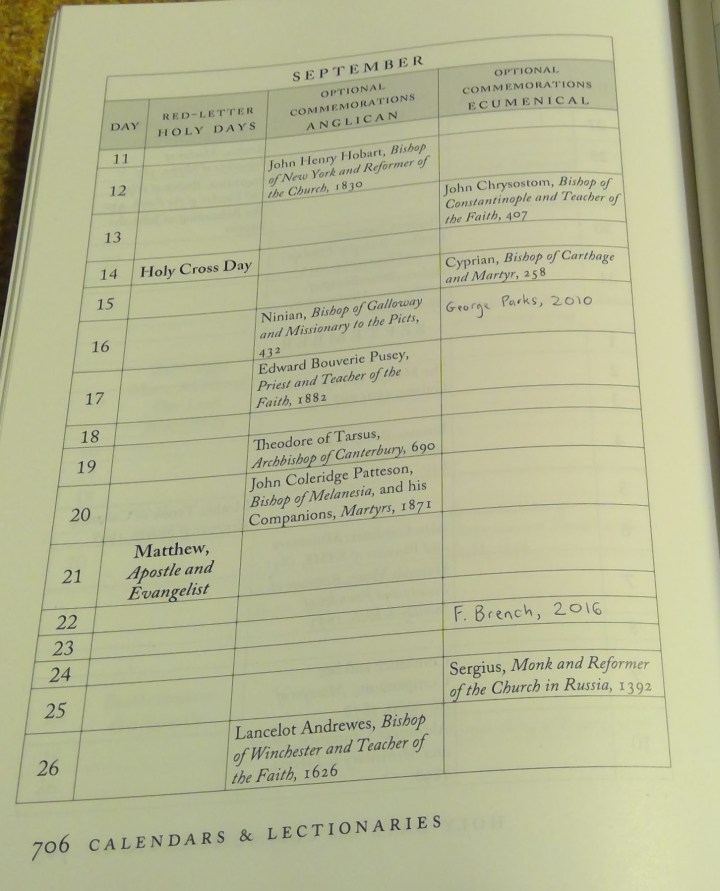
In that spirit, it can be a good idea for individuals to add in their own special commemorations in their own prayer books – not frivolous occasions, but ones that can and should be remembered in prayer somehow, such as deaths of family members and friends.  If you’re a parish priest, the death dates of members of your flock may be worth recording too.  It can help with the grieving process, it can help us remember the departed in an appropriate context, and even remind us to reach out to others who may be grieving more long-term.  I’ve already got seven names in my book, two of them are this month:

WIN_20190922_20_09_48_Pro

The distinction between Anglican and Ecumenical commemorations may be somewhat irrelevant for this purpose; this is more a third, “Personal”, category anyway.

Also keep in mind that the Prayers of the People in the Anglican Standard Text (on page 111) has a fill-in-the-blank spot in which the names of the departed may be remembered.  One tradition is to name the departed on or close to their death date (sometimes called their obit), and another tradition is to name all of them at the All Soul’s Day service (which for most of us Anglicans actually will probably be All Saints’ Sunday).  Whatever you do or don’t do, remember that your copy of the Prayer Book is your copy; invest your spiritual life into it!

What does “Proper 9” mean, anyway?

You have probably seen reference to this before, on this blog if nowhere else lately, that the previous two Sundays have been called “Proper 8” and “Proper 9”.  If you look inside our 2019 Prayer Book (as well as the old 1979) you’ll see these names in the Collects and Calendar sections.  There’s a further bit of explanation in the new book, which you might find handy – “PROPER 9 Week of the Sunday from July 3 to July 9” – but still doesn’t answer the question – what does “Proper” mean?

The term proper originally referred to parts of the Mass that changed from day to day or week to week: it was a feature of the Mass that was proper to a particular occasion or date.  Traditionally this included things like the Introit, Collect, Epistle, Gradual, Gospel, Offertory Sentence, Communion Sentence, and so on, but in the Prayer Book tradition the Propers were simplified to three things: Collect, Epistle, Gospel.  These three things are printed together, for each Sunday and Major Holy Day of the year, in the Prayer Book, such that you don’t actually need a Bible in hand to follow the entire Communion service.  The advent of the three-year lectionary, with its further addition of an Old Testament lesson and Psalm, has made such a feature much too large to fit in the Prayer book, so now our Communion lectionary is just a table of lessons, rather than the actual texts themselves.

With the radical revisions of the 1970’s came a revolutionary new liturgical calendar.  Pre-Lent was gone, Epiphanytide was almost completely revamped, and the season after Trinity Sunday was utterly rewritten.  You can read a little about how the historic Trinitytide season worked on this page.  The modern calendar, which our 2019 Prayer Book has inherited (this is my only significant complaint about the new book), does not build on “Sundays after Trinity” like the historic one, but instead has a set of “Propers” – that is, collects and lessons, tied to the secular calendar dates from late May until about four weeks before Christmas when Advent starts.  This means, given the shifting date of Easter from year to year, that although “Proper 29” will always be the last one before Advent, the first Proper Sunday will be different each year.  On average it starts around Proper 5 in roughly the second week of June.

One odd feature is the fact that Proper 1 is the week of the Sunday from May 8 to May 14, which is so early that neither it nor Proper 2 will ever be used on a Sunday!  They exist solely to provide for weekday Communion services of those weeks when Pentecost is that early, because the modern calendar has (again, sadly) one away with the Pentecost Octave.  Don’t worry, the Scripture lessons aren’t wasted, as they are duplicated with the corresponding Sundays in the latter weeks of the modern Epiphanytide.  Yes it’s complicated, but thankfully most people don’t have to worry about the mechanics of all this.  I only explain it here because someone out there is bound to be curious!

You can also look at the rubrics on page 614 for a few further notes about this portion (half) of the year.

To attempt to summarize this long answer into a short one… when you see “Proper 9”, don’t imagine it has any great special meaning.  It’s merely the 9th set of Propers (Collect & Lessons) in a line of Sundays spanning from May through November.  There are 29 in all, and we just jump right in to them after Trinity Sunday each summer.

Sanctoral Calendar

When you look at the liturgical calendar of the Roman Church, with all its various types, classes, or ranks of feast days, you will quickly appreciate the simplicity of the Prayer Book tradition.  It’s either a “red-letter day”, that is, a holy day mandated in the book, or it is a “black letter day”, a commemoration that you can celebrate if you want to, or ignore if you want.

But the priest may find, after considering how best to celebrate some of the names in our calendar, that not all commemorations ought to be treated equally.  Certainly, yes, all God’s children are equal in His sight, but as we look to the examples of those who have gone before us, there is a marked difference in the impact of Augustine of Hippo and, say, Samuel Shoemaker.  Pastorally, it’s worth helping our flocks identify who the ‘major players’ are in church history, who the great theologians and teachers are, who lived truly holy lives that we can strive to emulate.  And thus we stumble back into the Western tradition of feast days of different ranks.

The Saint Aelfric Customary sets forth a four-tired rank of saints days, and it’s very simple.

  1. The Major Feast Days (“red-letter days”) are the ones specifically named and mandated in the prayer book.  They each have their own set of Collect and lessons for Holy Communion that day, and usually impact the Daily Office Lectionary with at least one special reading.
  2. The Minor Saints Days are “black letter days” which are identified as the most prominent.  If you have a weekday communion service on one of these days, they ought to be celebrated, as if they were a major feast.  Unlike major feasts, though, these aren’t celebrated on Sundays, and don’t impact the Daily Office.
  3. The Commemorations are the “black letter days” entirely unchanged – they’re still optional, at the discretion of the celebrant to observe or not.
  4. The Memorials are the “black letter days” that are set aside as not for observance at Holy Communion.  This is born out of a respect for the liturgical tradition of not naming new Saints without either due process or clear consensus.  And since the Anglican tradition has no official process, we can only gain new saints by martyrdom or by clear consensus.  The names in our calendar that do not meet these terms are therefore categorized as Memorials.

You can download the Saint Aelfric Customary version of the Sanctoral Calendar here.

Note also that this calendar “elevates” three commemorations to Major Feast Day status:  Aelfric, Augustine of Canterbury, and King Charles I.  This is due to the fact that they are the three “patron saints” of this Customary, and therefore ought to be especially available to those who use this Customary.

Happy Birthday, John the Baptist!

This is one of the big feast days of the year, in some country’s traditions the most-celebrated of all Saints’ Days (especially in Scandinavia for some reason).  Rather than give you a single write-up about this feast day in Prayer Book tradition, we’re offering you a variety of angles to explore at your leisure.

#1 – the Natural Connection

https://leorningcniht.wordpress.com/2017/06/24/the-gospel-according-to-astronomy/

#2 – the Christmas Connection

nativity

#3 – the Calm Before the Storm

The Pentecost Octave, or, the Whitsun days

A day or two ago I saw a question pop up online, “Why does Pentecost only get one day to celebrate it?”  The questioner went on to insinuate that the liturgical tradition has a bias against the Holy Spirit in favor of the person of Jesus, where there’s Holy Week and Eastertide and Ascension, on top of Christmastide and Epiphany.  Apart from the obvious biblical and long-standing theological answer to why Christians give more overt attention to Jesus, let’s take a look today at the additional fact that Pentecost is not just one day, and never has been.

For well over a thousand years of Western liturgical tradition, most major holy days have what’s called an Octave: a period of eight days beginning on the holiday and running for a week after.  The only octave tradition that directly impacts most Anglicans today is the All Saints’ Day Octave, wherein although All Saints’ Day is officially November 1st, the Sunday immediately following (within the Octave) is typically celebrated as All Saints’ Sunday.  But back in the day, Easter had an Octave (which Prayer Book tradition has always observed in one way or another), the patronal feast of an individual church or diocese would have an Octave, and, among others, Pentecost had an Octave – from Sunday to Sunday ending with the feast of the Holy Trinity.

In current Roman Catholic practice that Octave has been suppressed, though there is the half-joking plan of priests celebrating Votive Masses of the Holy Spirit on the weekdays following Pentecost in order to simulate an Octave.  In the Anglican Prayer Books we’ve never had instructions for a full Octave, but we have had special Collects and lessons for Sunday, Monday, and Tuesday.

Older prayer books call this holiday Whitsun or Whitsunday, modern prayer books call it Pentecost.  The reason for the peculiarly English name of Whitsun is a story for another time – I’ll just link you to Wikipedia on that for now.

Whitsunday, the Day of Pentecost

The traditional Collect of the Day (which is the second listed in the 2019 Prayer Book for this day) is:

GOD, who as at this time didst teach the hearts of thy faithful people, by the sending to them the light of thy Holy Spirit: Grant us by the same Spirit to have a right judgement in all things, and evermore to rejoice in his holy comfort; through the merits of Christ Jesus our Saviour, who liveth and reigneth with thee, in the unity of the same Spirit, one God, world without end.  Amen.

With this would be read Acts 2:1-11 and John 14:15-31 (omitting the last phrase “let us go hence.”).  In the modern lectionary plan, part of Psalm 104 is added, and the OT and Epistle options are Genesis 11:1-9 and 1 Corinthians 12:4-13.  It should be noted that, although the 2019 Prayer Book doesn’t specify this, the Acts reading ought to be read.  The OT and Epistle lessons are both offered so that we have a choice of where to place the Acts reading.  Precedent from Eastertide and the 1979 Prayer Book suggest that Acts 2 should be in the OT position, precedent from the next two days of the week suggest that Acts 2 should be in the Epistle position.  So this is a legitimate choice; perhaps swap places every year so people hear all the potential readings most often!

Like Ascension Day, the 1662 Prayer Book appointed special Psalms for the Daily Office on Whitsunday: 48 and 68 in the morning, and 104 and 145 in the evening.

Unfortunately, according to the new prayer book (on page 614), “The Easter Season includes and ends with the Day of Pentecost. …The Collects, lessons, and prefaces for the Day of Pentecost and Trinity Sunday are not used on the following weekdays.”  Previous drafts of our new prayer book included the traditional Monday and Tuesday of Pentecost, but they seem to have dropped away from the final edition.  So it seems, at least officially, we in the ACNA are stuck in the same boat as the Romans, having to resort to appointing the “Various Occasion” propers “Of the Holy Spirit” on page 733 to fill out the old Pentecost Octave a little.  Or you can just grab the following from classical Prayer Books:

Monday in Whitsun Week

The traditional readings were Acts 10:34-end and John 3:16-21; a proposed addition was Numbers 11:24-30 and Psalm 98.  The 1928 Prayer Book added a new Collect:

Send, we beseech thee, Almighty God, thy Holy Spirit into our hearts, that he may direct and rule us according to thy will, comfort us in all our afflictions, defend us from all error, and lead us into all truth; through Jesus Christ our Lord…

Together, this day gives us a collection of further teachings about the ministry of the Holy Spirit along with another “pentecost moment” from the book of Acts.

Tuesday in Whitsun Week

The traditional readings were Acts 8:14-17 and John 10:1-10; a proposed addition was Ezekiel 37:1-14 and Psalm 98.  The 1928 Prayer Book added a new Collect:

Grant, we beseech thee, merciful God, that thy Church, being gathered together in unity by thy Holy Spirit, may manifest thy power among all peoples, to the glory of thy Name; through Jesus Christ our Lord…

This day got a bit more specific about the work and power of the Spirit unite God’s people.

What about the rest of the week?

The Wednesday, Friday, and Saturday following Pentecost are Ember Days, which occur quarterly throughout the year, so they don’t get special Pentecost-featured propers.  Some proposed Prayer Books (like the 2011 book) provide different Scripture readings for each of the Ember Days throughout the year, and thus provide the Pentecost Ember Days with a particularly Pentecost-appropriate theme regarding Spirit-empowered ministry.  But sadly, no such option is available in the 2019 Prayer Book.

That leaves Thursday yet untouched.  There is a small tradition of using that day to commemorate the Promulgation of the First Prayer Book, as Whitsunday 1549 was when the first Prayer Book was mandated to begin use across England.  We’ll look at that some more on the day.

So yes, sadly, in a way Pentecost is kind of reduced to a single day in the modern calendar.  But there is precedent in previous Prayer Books, both official and proposed, for the continued celebration of this great feast in various ways throughout the week.
Planning Ahead: Trinity Sunday

Until the revisions of the 1970’s, Trinity Sunday was the hinge of the Church Year.  That was the day the first half of the cycle (Advent through Pentecost) reached its culmination and turning point.  All the revelation about God covered in those seasons find their apex in the doctrine of the Trinity: God is One and Three.  As the Collect of the Day begins:

ALMIGHTY and everlasting God, who has given unto us your servants grace, by the confession of a true faith, to acknowledge the glory of the eternal Trinity, and in the power of the Divine Majesty to worship the Unity…

But this day is also a turning point.  We have not only received this faith throughout the year to confess and worship God, but also:

We beseech thee, that this holy faith may evermore be our defence against all adversities; who livest and reignest, one God, world without end.  Amen.

That is what the season of Trinitytide used to do: unfold like a discipleship course in how this faith may be our defence against all adversities.

I beseech you, readers, if you have the slightest interest in Anglican Prayer Book spirituality and history, to take a look at this essay: http://www.lectionarycentral.com/trinity/Phillips.html  It brilliantly lays out how the season after Trinity served as a multi-layered course of dealing with our chief adversary: sin.  The life and doctrines of Jesus are presented with Epistle lessons that together work to demolish our pride, our lusts, all our vices.  There are, for sure, other ways to analyze the Trinity season, but the general agreement is that it’s an application of the teachings of the first half of the year to help us conform our lives thereto.

It’s popular now to say that the first half of the year is “the story of Jesus” and the second half is “the story of the Church.”  This is wrong.  The first half is the story (or better, doctrines) of God, and the second half is the application of the story/doctrines of God to us.  Trinity Sunday is the hinge: it sums up all the teaching about the Father, Son, and Spirit, and presents it to us to believe, worship, and follow.

Enough with the theory, now for some advice.

how to mark Trinity Sunday

A fairly long-standing tradition, now recommended or encouraged in the general rubrics at the end of the Communion service in the 2019 Prayer Book, is to say the Athanasian Creed in place of the Nicene at the Communion Service on Trinity Sunday.  It is uncomfortably long, for the average worshiper, but a paltry once a year won’t kill them.  Plus, it’s honestly the best teaching tool we have when it comes to spelling out the doctrine of the Trinity without falling into one of many accidental heresies.  The 1662 Prayer Book called for this Creed to be read at Morning Prayer about 13 times a year, so once a year on Trinity Sunday is really quite lenient in that light!

If you haven’t used the Great Litany with your congregation in a while, that’s another possibility to consider for this day.  Its strong beginning with a Trinitarian invocation is a standard staple of Christian prayer, and extemporanous prayer these days very easily falls into Trinitarian confusion – addressing Jesus yet ending with “in Jesus’ name we pray”, or mindlessly switching from “Father-God” to “Jesus” as if it’s the same Person.  The Great Litany, or indeed any collect or liturgical prayer, can be a helpful teaching example of how to pray in an orthodox manner, rightly praising the triune God without confusing the Persons or denying the Unity.

There are lots of hymns that address God as Trinity, verse by verse.  If you’ve got an Anglican hymnal then the “general hymns” section usually starts with such hymns.  (If you’ve got a generic Protestant hymnal, that could be a problem here.)  If you opt for contemporary praise music, take care to make sure the lyrics handle the doctrine of the Trinity rightly; it’s very easy to make theological mistakes here!

Last of all, for you preachers out there, for God’s sake (literally), preach the doctrine of the Trinity.  Yes it’s complicated; yes it’s difficult; yes it’s easily seen as boring, or even stilted and of minor importance.  But this is basic Christian dogma; the doctrine of who & what God is the foundation of all Christian teaching.  If we don’t get it right, our congregations definitely won’t get it right, and eventually the whole church will be the sicker for it.  Grab a hold of the many resources in the liturgy that you’ve got, use them to your fullest advantage, and disciple your flock!