Book Review: The Anglican Service Book

Welcome to Saturday Book Review time!  On most of the Saturdays this year we’re looking at a liturgy-related book noting (as applicable) its accessibility, devotional usefulness, and reference value.  Or, how easy it is to read, the prayer life it engenders, and how much it can teach you.

If you were an Anglo-Catholic, or other sort of tradition highchurchman, in the Episcopal Church, and not one of the 1928 hold-out parishes, The Anglican Service Book was the thing to have.  Originally printed in 1991, and going through at least three more printings over the following decade-and-a-half, the ASB is the go-to text for Episcopalians who love and prefer the traditional language style of our Prayer Book tradition.  In accordance with the rubrics of the 1979 prayer book, the ASB is a collection of re-writes of nearly everything the ’79 book back into traditional English, with a number of suggestions, resources, and rewrites of various rubrics along the way.

One of its immediate points of usefulness is the use of bold print to denote words spoken by the congregation, making an otherwise-difficult prayer book just a little more user-friendly.  Besides that, it cuts down on some of the options offered in the 1979 book and reformats some of the liturgies to reduce page-flipping, making this book a bit easier to use overall.

There is one significant omission from this book that makes it fall just short of being called an actual Common Prayer Book: it has no lectionaries.  This, I expect, was a strategic choice.  It was designed carefully such that it technically obeyed the rubrics of the 1979 Prayer Book so that anyone under the authority of that book could use this one without having to ask for special permission – half the point of this book was to enable a parish to be as close to a 1928-using parish as possible.  But, also perhaps being used as a supplement by 1928-using parishes, this book strategically omitted re-printing any lectionary so it wouldn’t step on anyone’s toes.  So if you want to use this book for your Daily Office or Communion service, you have to look elsewhere for the readings. Though it does have the full traditional psalter, which is quite nice.

As I said, this book was made primarily with high-church parishes in mind.  It provides a number of additional liturgical materials and resources which lean in that direction.  For example, here is the index of the Additional Devotions occupying the last 66 pages of this volume:

  • Antiphons on the Benedictus
  • Antiphons on the Magnificat
  • The Sarum (Gregorian) Canon
  • Canon of 1549
  • The Athanasian Creed
  • The Solemn Reception of a Bishop
  • Stations of the Cross
  • Benediction of the Blessed Sacrament
  • Tenebrae for Wednesday of Holy Week
  • Blessing of the Font
  • The Angelus and the Regina Coeli
  • The Marian Anthems
  • The Walsingham Blessing

Nearly all of these are obviously quite Anglo-Catholic in nature, and a similar emphasis on the (seven) Sacraments can be found throughout the rest of the book.  You don’t have to be a Anglo-Catholic, yourself, to appreciate the usefulness of much of this book, but there’s definitely a lot of material in here that quite a few Anglicans would find needless, inappropriate, or even blasphemous.

Now, of course, those of us in the Anglican Church in North America (ACNA) are not under the authority of the 1979 Prayer Book, and are about to receive our own 2019 book.  The obvious question may be what use we have for a traditionalist re-write of the 1979!  In terms of structure, and a fair bit of content, the 2019 is looking a lot like the 1979 book.  Looking at how the ASB “traditionalizes” the 1979 book is a helpful model for highlighting how we, too, can draw out a traditional emphasis from the 2019 book.  Indeed, the ASB is a similar sort of project to what the Saint Aelfric Customary is intended to become!

The ratings in short:

Accessibility: 3/5
While more user-friendly than the 1979, it’s still not quite as streamlined as traditional Prayer Books.  And the lack of lectionaries requires you to lift them from another source.

Devotional Usefulness: 4/5
Whether you appreciate or use the extra Anglo-Catholic features or ignore them, the liturgical formation offered by this book is excellent.  For a member of the ACNA, this book is still pretty close to matching our official liturgy, so if you like the traditional language then there’s little stopping you from appreciating this on its own.  (It should be noted that a sub-committee is in the process of making a traditional-language version of the 2019 Prayer Book, so depending upon how that turns out it may ‘replace’ this book’s usefulness to us.)

Reference Value: 3/5
Because it is primarily a re-write of the 1979 book, the ASB isn’t quite as valuable as for reference material.  Like Common Prayer 2011 it does have a number of section introductions that are valuable lessons in traditional liturgy (as long as you don’t mind the churchmanship showing through).  Plus, the way it re-presents the 1979 material to highlight its historical aspects can help one see the historical aspects of the 2019 by simple comparison.

All in all, this is a neat book to have around.  It was definitely more useful to me before the ACNA’s liturgical texts started coming together, and a bit less relevant now.  I’m also not sure if it went through another printing since 2007, so finding a physical copy of it today may be difficult and expensive.  But it can be found in its entirety as a pdf online, or in parts at the link I included at the beginning of this review, and honestly that’s all I’d recommend to my readers: unless your spirituality is particularly high-church and this really appeals to you, having it as a reference document on the computer is all you need from it.
The Pre-Lent Mini-Season

This coming Sunday, as some liturgical calendars indicate, is (or was) known as Septuagesima.  This is the beginning of a distinct mini-season in the traditional calendar.  Although the ACNA calendar no longer retains or authorizes these three Sundays, it can be beneficial to know about them.  They are part of the treasure of Church Tradition that reaches back well past a thousand years, and, rightly received, can be of great benefit to our spiritual formation as we work with the Church’s calendar to learn and grow in Christ.

The three Sundays before Ash Wednesday were known as “the -gesima Sundays.”  -gesima is a Latin partial word, from Septuagesima and Sexagesima and Quinquagesima and Quadragesima.  These mean 70 days, 60 days, 50 days, and 40 days, respectively, and they refer to the approximate amount of time remaining until Easter.  Quadragesima is a Latin name for Ash Wednesday, when Lent officially begins, but the three Sundays before it (with increasingly ‘rounded’ approximations of the Easter countdown) form a sort of Pre-Lent season.

These three weeks were a transitional period: the Lenten spiritual disciplines had not yet begun, but some of Lent’s liturgical features were put in place, like the “burial of the alleluia” and the wearing of purple vestments.  Those who practiced especially severe fasting during Lent would use these three weeks to begin the fast in stages, giving their bodies time to adjust safely to the austere self-denial that awaited.

The Gospel lesson on the first Sunday (Septuagesima) was the Gospel of the Landowner paying his workers the same, even to the 11th hour (Matt. 20).  This prepared the Church for the labor of Lenten disciplines.  The second Sunday (Sexagesima) proclaimed the Parable of the Four Soils (Luke 8).  This reminded us of right reception of the Word of God.  The third Sunday (Quinquagesima) recounted Jesus’ announcement that he was going to Jerusalem where he’d be arrested, killed, and rise again (Luke 18:31ff).  This was an apt sort of announcement that the penitential season of Lent was about to begin.

As it happens, our Collect for the “Eighth Sunday after the Epiphany” is essentially the same as the Collect for Sexagesima Sunday, so on the very rare occasion that we get to use that 8th Sunday, we’ll have the historic Pre-Lent Sunday Collect with us, even on the correct date in relation to the beginning of Lent.

Why have the Roman Catholics and most Anglicans abolished this part of the liturgical calendar?  Perhaps some people think it redundant with Lent.  Perhaps others wanted to lengthen the Epiphany season.  Perhaps its function in the larger scheme of the calendar was not properly appreciated by the revisionists.  Whateverso it is a tradition largely gone from the Church today, observed only in the Eastern Orthodox traditions and the relatively few Anglicans who continue to use traditional prayer books.

If you want my personal opinion, which I suppose you probably already tolerate since you’re reading this article, I hold the third theory above: I believe the demise of Pre-Lent was a poorly-considered decision.  Yes, it simplifies the calendar, but I don’t think such simplification was necessary.  Some localities (and even the whole province of the Church of England and those influenced by their liturgical revisions of the past couple decades) have developed a sort of pre-Advent season, sometimes called Kingdomtide.  Why Advent can get a new pre-season and Lent cannot is beyond me, apart from the slightly-cynical observation that modernists don’t like penitential material.

In my own congregation, I had the liberty to use the traditional calendar for three years before the ACNA calendar appeared and we conformed to it.  Some people asked me about the Pre-Lent Sundays: “isn’t it redundant?  If Lent is about preparation for Easter, doesn’t that make Septuagesima (et al) a preparation for the preparation?”  My answer to that is a rejection of the assertion that Lent is primarily about preparation.  It points and leads to Easter, yes, but it is a season in its own right.  Lent focuses on penitence, purification, sin and death.  Only in its final two weeks did it traditionally start sliding toward Easter.  Lent, therefore, understood on its own terms and in relation to the rest of the calendar, is perfectly entitled to a three-week lead-up.  And that practical consideration of having some “warning” before it starts actually helps, too.

Sadly, this probably doesn’t help much with the liturgical planning for your congregation.  But if you have a regular weekday worship service, perhaps there you can make use of the Pre-Lent Sundays.  Or you can always just pray an Antecommunion service with these traditional Sundays!  They may be gone from the general life of the church, but that doesn’t mean that can’t live on in our private devotions.


This article was adapted from “Learning from the Liturgy: The Pre-Lent Sundays” on leorningcnihtes boc, originally posted on 4 February 2018.

Happy Saints Cyril & Methodius Day?!

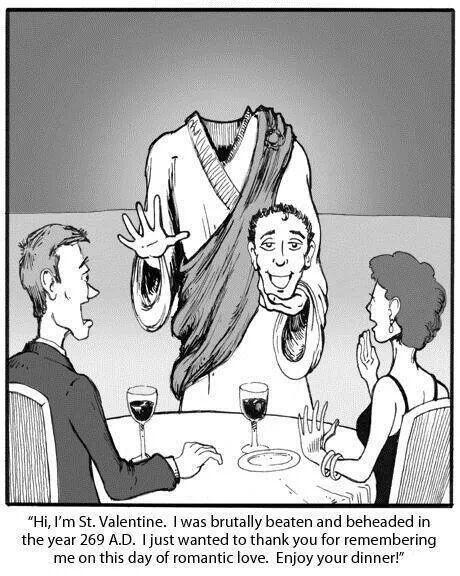
It’s February 14th, you know what that means…

valentine

Wait one sec… <checks calendar> …well we were all expecting St. Valentine’s Day, but no, it’s Sts. Cyril and Methodius.  Isn’t Valentine a Saint?  Yes, and he’s actually older – earlier – than Cyril and Methodius.  This probably only heightens the question, therefore: why do our calendars highlight those guys instead of Valentine?  I mean, Valentine was a martyr, and that usually puts one at the “top” of a list of Saints.  Insofar as one can rate “saintliness,” martyrdom is usually top-rate.

But there is one “category” of sainthood that tops a martyr: Apostles.  Obviously, Cyril and Methodius are not among the original twelve, or even among the first generation of Christians.  Rather, they were apostles of a later sort – what we might call missionary bishops.  They were sent to a new unreached people-group, the Slavs of Southeastern Europe, to preach the Gospel and establish the church among them.  They became bishops in time, and were thus the “Apostles to the Slavs.”

And their efforts, not without controversy at first, went beyond what we normally read about with historic apostolic missionary bishops.  Far from the imperialist mindset that frequently follows well-meaning missionaries, Cyril and Methodius actually learned the local language, began to invent an alphabet for them to write their language down, and began to celebrate the divine liturgy in their local language too.  This was in the 800’s, a point in which everything Christian was generally either in Greek or in Latin (the Coptic, Assyrian, and Armenian churches had departed by this point), so the adding of a third major liturgical language was viewed with some suspicion at first.  Nevertheless, the Cyrillic alphabet survives to this day, used by churches and nations that represent a massive portion of the world today.  Old Church Slavonic is also now considered an “ancient” standard in Eastern liturgy.

Now, obviously, all Saint are important.  Even further, all Christians, members of the Body of Christ, equally belong in Christ.  In that sense, there’s no comparing or ranking that can be done.  But liturgically speaking, you can only really have one commemoration per day.  Because Cyril and Methodius were brothers who worked together in the same mission, they get teamed up to share a holy day (14 February is understood to be Cyril’s death date).  And because their contribution to the global church makes a bigger splash than St. Valentine, who was executed on the same day of the year, they usually get liturgical priority over him.

So if you want to combine these commemorations today, perhaps you take someone out for a Valentine’s Day date, but write him or her a note in Russian or something 😉

The Collect(s) for Epiphany V

Sorry for the late post this time.  Nothing especially ground-breaking was planned for this post, mainly just some observations.  The “Collects for the Christian Year” document for our up-and-coming prayer book has undergone a few subtle changes here and there over the past three or four years, and to be honest this is the part of Texts for Common Prayer that I have monitored the least.  There’s only so much one pair of eyes can keep track of, I guess.

Still, I’ve noticed that this week’s Collect has undergone some interesting little edits over the years.  Here it is in its current form (at least, as of September 2018)…

O Lord, our heavenly Father, keep your household the Church continually in your true religion, that we who trust in the hope of your heavenly grace may always be defended by your mighty power; through Jesus Christ our Lord…

Compare that to how it appeared previously in 2016 and/or 2017:

O Lord, our Creator and Redeemer, we ask you to keep your household the Church continually in your true religion; so that we who trust in the hope of your heavenly grace may always be defended by your mighty power; through Jesus Christ our Lord…

The address to God has shifted from “Creator and Redeemer” to “our heavenly Father”.
The petition previously was “we ask you to keep” and is now more terse: “keep…”
The purpose clause had the word “so” but has since dropped it.

Before we can make too many inferences about the reasons for these changes, we should consider the original, traditional, collect for Epiphany V:

O LORD, we beseech thee to keep thy Church and household continually in thy true religion; that they who do lean only upon the hope of thy heavenly grace may evermore be defended by thy mighty power; through Jesus Christ our Lord.  Amen.

Notice that the address here is simply “O Lord”… the question of the modern version seems to be concerning how to expand that.  We can see that “we beseech thee to keep” was initially recast as “we ask you to keep”, and then apparently ruled too clunky for modern English.  Considering the Great Litany still uses the phrase “we beseech you to hear us, O Lord” I’m not sure why this simplification was ruled necessary.  There’s also a style difference – traditional English prayer language tends to use third person (them/those who do lean…) where modern tends to prefer first person (we who trust…).  This is, I’d argue, a good adaptation to current language use; one rarely refers to oneself in the third person anymore 😉

Sometimes it’s just fun to explore how things have developed over time, and discover the strengths and weaknesses of modern language and style.

Looking Ahead: St. Matthias Day

February 24th is the date our calendar holds for celebrating Saint Matthias.  One could say Matthias was the “second twelfth apostle.”  The Collect for his day makes this explicit:

Almighty God, who in the place of Judas chose your faithful servant Matthias to be numbered among the Twelve: Grant that your Church, being delivered from false apostles, may always be guided and governed by faithful and true pastors; through Jesus Christ our Lord, who lives and reigns with you, in the unity of the Holy Spirit, one God, now and forever. Amen.

Some modern calendars appoint his feast day for May 14th, landing him close to when Ascensiontide takes place.  That’s a modern change that actually makes some good sense: his only story in the Bible is in Acts 1 – he was elected and chosen by lot to replace Judas in the 10-day period of time between the Ascension of Christ and the descent of the Holy Spirit on the day of Pentecost.  But the ACNA’s calendar is holding onto his traditional date February 24th.

This year that puts his feast day on a Sunday, which (many people need to be reminded) is now explicitly permitted, if not also suggested, in our calendar that we can celebrate the feast day right then and there on that Sunday in place of the regular Sunday-after-Epiphany.  The relevant rubrics have been cited here before.

Now, if Lent started earlier, this wouldn’t be an option; Sundays in Lent cannot be overridden by major feast days.  If you are using the traditional calendar, this also would not be an option, as the three Pre-Lent Sundays cannot be overridden either.  But for the majority of us in the ACNA, using the modern calendar, it’s a regular Sunday which therefore can give way to an other prayer book major feast day such as St. Matthias.

So, despite what a lot of the popular Ordo Calendars and online daily office algorithms suggest, feel free to let loose this Saint’s Day on his proper day this month, Sunday February 24th!

Those wicked long readings…

Something great about the ACNA Daily Office Lectionary is that it has a return to the fantastically simple style of our 16th and 17th century lectionaries of reading one chapter at a time.  Back then, that reading pace typically applied both to the OT and NT daily readings, whereas for us it’s mostly just the OT readings that are thus treated.  It’s so much easier when you don’t have to fiddle about with “what verse to stop with” – just read one chapter at a time, and continue it tomorrow.  Simple!

The downside with this approach, of course, is that some chapters are longer than others.  When I tried a 1662-inspired lectionary, at first I found this irritating.  But eventually I came to appreciate the variety of length: sometimes you get a longer story, sometimes it’s short and sweet.  Nevertheless, some chapters are just really long compared to others.

This morning brings us to one such example: Genesis 41.  Clocking in at 57 verses, this chapter packs a punch with two lengthy pieces of the story of Joseph in Egypt.  The first 36 verses detail his interaction with the Pharaoh and interpreting his dreams about the coming bounty and famine; the last 21 verses detail Joseph’s rise to power through the implementation of his vision-based proposal.  It’d be nice to be able to break these up into two different readings, but there just isn’t enough space in the calendar to play with chapter divisions like this.

If you’re a completionist, using the lectionary to read as much of the Bible as possible each year, then you’ve just got to tough it up and read 57 verses in one go.  If, however, you’re praying the Office with a lighter devotional approach, and concerned more about getting the sense of the Scriptures without necessarily reading each word – or if for some reason you need to shorten the reading or have a time limit for the Office as a whole – there is another way.

The ACNA lectionary comes equipped with an “Optional abbreviation” for a number of the larger chapter readings throughout the year.  The entry in the lectionary table for this morning’s Old Testament reading is:

Gen 41 † 1-15,25-40

This means that if you want to shorten the chapter, simply read verses 1-15, then skip to 25 and read through verse 40.  In so doing, you cut out a fair bit of repetition (which is very common in Hebrew storytelling), and abbreviate the lengthy description of the honors Joseph went on to receive, as well as cut out the implementation of the plan that was already described and approved.

Here’s an interesting analogy: reading chapter 41 in its entirety is like reading a sermon, whereas reading the shortened version (vv 1-15,25-40) is like reading the blog post summary of the sermon.  The full version has a beginning, middle and end: “This is what we need to do, this is what we will do, this is what they did.”  A good sermon format is often similar: “This what I’m going to say, this is me saying, this is what I said.”  The blog post version is much more succinct: “Ain’t nobody got time for dis, so here’s the deal.”

Personally, I’m a big fan of reading the Bible in full throughout the year.  If we seriously believe it is the Word of God in literary form then we really ought to be poring through its pages diligently, consistently, and completely.  But as a stay-at-home parent with young children I have come to appreciate all the more how truly difficult it can be for many people to carve out that time for the longer Scripture readings.  So while I see the full-chapter readings in lectionaries like ours to be the ideal to reach for, I must assure you that there is no shame in opting for the shortened version as need arises.

Book Review: Common Prayer 2011

Welcome to Saturday Book Review time!  On most of the Saturdays this year we’re looking at a liturgy-related book noting (as applicable) its accessibility, devotional usefulness, and reference value.  Or, how easy it is to read, the prayer life it engenders, and how much it can teach you.

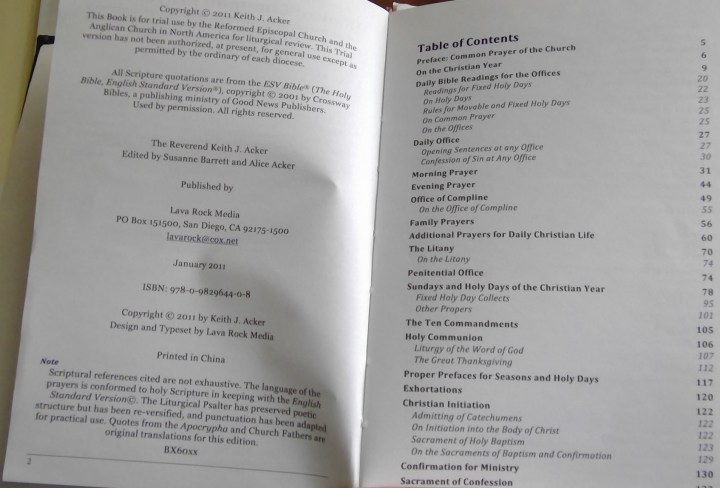
This weekend I’ve got something perhaps a bit more obscure for you: Book of Common Prayer 2011.  This book was self-published by the Rev. Keith J. Acker in 2011, and has stuck around for the past 8 years in (I assume) very limited circles, probably seeing more private use than congregational use.  It was (and perhaps still is) primarily one person’s effort to propose a modern-language Prayer Book that retains the historic content and order.  The Reformed Episcopal Church (in which he is a minister, and which is a subjurisdiction of the ACNA) already does have a modern-language version of their Prayer Book, so I’m not sure if the purpose of this book has any longevity at this point.

WIN_20190208_13_08_01_Pro (2)

Most of this Prayer Book is in line with the 1928 Prayer Book‘s order and content.  Its Daily Office is more in line with the English books (such as the 1662).  In accord with the spirit of the newer additions of 1979, though, this book also has a liturgy for Confession, a Healing Service, shorter Family Prayers, and special liturgies for Ash Wednesday, Palm Sunday, and Good Friday.  All of this is in modern English, even the Psalter is the ESV translation (with the verse numbers fixed to match the traditional Coverdale versification).  The “translation” style is a bit clunky for the modern reader, though careful use of punctuation can help one navigate the long compound sentences.  For example, the Prayer of Consecration begins this way:

ALL glory be to you, Almighty God, our heavenly Father, for you, of your tender mercy, gave your only Son Jesus Christ to suffer death on the cross for our redemption; Who made there (by his one oblation of himself once offered) a full, perfect, and sufficient sacrifice, oblation, and satisfaction for the sins of the whole world; And did institute, and in his holy Gospel command us to continue, a perpetual memory of his most precious death and sacrifice until his coming again.

So it is very traditional in its content, preferring faithful adherence to original words over contemporary readability.  Some will like this, some may not.

Another feature of this book that is common to modern Prayer Books is that it has explanatory notes at the beginning or end of most sections.  For example, between the liturgy for Admitting of Catechumens and the liturgy for Holy Baptism, there is this note:

On Initiation into the Body of Christ

We are initiated into a relationship with the Body of Christ by God’s grace in the Sacrament of Baptism.  God has supplied us with a fellowship of disciples, his Church, in which we are to live out that relationship with him.  The Church is God’s family and the household of Faith into which we are adopted, receiving the gift of being born anew and the indwelling of the Holy Spirit.

Converts are instructed in the Christian Faith.  Catechumens (Greek for instructed) are taught the need for repentance and faith in Jesus Christ and the practices of prayer, devotion, and fasting in preparation for Baptism.

In general, this book leans high church.  Confirmation, Confession, and Matrimony are referred to as Sacraments, the 1549 Prayer Book is expressly named as the primary foundation underlying this book, and (in line with REC polity) Holy Orders are explained as a male-only ministry.

Now, between the fact that it has only been authorized for use by one or two bishops in the ACNA, that its translation style is slightly different from what the 2019 Prayer Book is going to be, and that it doesn’t really supply anything that we don’t already have in the 2019 or 1928 Prayer Books, it has to be admitted that from a functional point of view this book isn’t really all that useful.  I will probably never use its Daily Office or its Communion liturgy, much less its pastoral services.  The fact that is retains the historic Communion lectionary is nice, and its suggested additional (usually Old Testament) reading to match the traditional Epistles & Gospels is excellent, but ultimately it’s a redundant book on my shelf.

However, it has something going for it that pays untold dividends in my understanding of the liturgy: it’s ANNOTATED!  Check it out:

WIN_20190208_13_38_41_Pro (2)

The rubrics are in red (as was traditional back in the day) and its annotations are in blue.  So you can look at a Collect or other prayer or exhortation in this book and see some of their origin from the Bible (or occasionally other sources).  This is immensely useful for a student of the liturgy.  It does make the book a little more complicated to use, because in the ordinary course of prayer your eyes have to ignore those blue reference notes.  It also makes the “Sundays and Holy Days of the Christian Year” a bit more complicated to navigate, as in the picture above – Matthew 4:1-2 is an annotated reference for the Collect for Lent I, but (in black text) Matthew 4:1-11 is the actual Gospel lesson for that Communion service.

Further, looking at this picture some more, there is a handy reference line under each Collect.  The first two blocks are the two traditional lessons for the Communion service on that day.  The second two blocks are the traditional Introit and Gradual (usually psalms) for that day, and the last block on the right is the recommended “third” lesson to add to the traditional two.

The ratings in short:

Accessibility: 3/5
It’s not really any more complicated to use than the 1662 or 1928 Prayer Books, which I rated as 4, but the visual formatting of this book (mainly due to the annotations) make it a little harder to follow.  There’s also the practical challenge of getting a physical copy.  Mine is from the first printing, which had notoriously horrible quality – I’ve barely used it and the front cover has almost torn off!  But there are nicer prints of it available now, apparently.  Its official page is here: http://www.bcp2011.com/node/1.

Devotional Usefulness: 5/5
If one can get past the issues of authorization, visual accessibility, and translation style, the spirituality of this book is almost perfect.  It pretty much fits the bill of my personal opinion of an ideal Prayer Book.  My only actual complaint about its content is that its Daily Office Lectionary seems a bit too scatter-brained.

Reference Value: 5/5
Even though very few people in the world use this, and it will probably be forgotten in a couple decades, the fact that it is similar in content to the 2019 Prayer Book makes it annotations extremely relevant for cross-comparison.  If you want to explore the Scriptural basis for part of our liturgy, you can look it up in this 2011 book and find out.  Unless someone makes an annotated 2019 book, this volume will be a precious asset to me for the rest of my life.

So, final recommendation… if you want to study the Prayer Book liturgy, and don’t have another annotated Prayer Book already, this is worth getting.


Retelling History in the Prophets

Okay, so, I can’t help it… let’s look at Jeremiah again.  This evening’s reading from that book continues through some more historical material culminating in the Fall of Jerusalem in tomorrow’s reading (chapter 39).  If you were to do a side-by-side comparison, you’ll find that this is lifted almost word for word from 2 Kings 25.  This will happen again towards the end of this month, as the last chapter or two of Jeremiah also reflect on the Fall of Jerusalem, bringing us back to 2 Kings 25.  So in the Daily Office lectionary you can trace lines of connection from February 9th and 22nd to November 12th.

The almost-perfect word match raises a lot of questions for biblical scholars, too.  Does this mean that Jeremiah wrote 2 Kings?  Did the writer of 2 Kings just copy Jeremiah’s writings?  Did an anonymous editor of Jeremiah add that excerpt from 2 Kings in order to add context to Jeremiah’s biographical material?  It’s one of the many mysteries of the Old Testament that will probably keep us guessing until we pass into the next life wherein we can finally ask the authors ourselves.

This happens in the book of Isaiah, too; chapter 37 extensively retells 2 Kings 19 and/or 2 Chronicles 32.  Again, who wrote what, who copied whom, who edited what and when, are unanswerable questions that remind us that the history of these writings are very long and very complicated.  That story will draw a line of connection from October 5th (Kings) to November 24th (Isaiah).

How does this help one to worship in the Daily Office and appreciate the Scripture readings therein?  Well, not a lot, honestly.  These observations are mostly background, context… more appropriate for study material.  But what we can notice and learn here is that some major events like the Fall of Jerusalem show up in multiple places in the Bible, and we will accordingly hear about them several times throughout the year as they come up.  This is obviously (and more frequently) true considering the great overlap between the four gospel books.  But for now, enjoy taking these stories in Jeremiah’s context.  Later this year we’ll hear some of them again in another setting.

Thirsty Thursday

It’s Thirsty Thursday, wooo!
No I’m not rewinding back to my university days… I wasn’t quite that wild anyway.  But we do have good reason, in the church, to think about wine on Thursdays.

Let’s think about the Christian conception of the week.  On one level we received the concept of the seven day week from pre-Christ Judaism.  The sabbath, or seventh, day was a day of rest to complete the week.  It set ordinary life into the context of creation: as God was described to have worked for six days and rested on a seventh, we were to work for six days and rest on the seventh (cf. Genesis 2, Exodus 20).  That sabbath was a day to replace the ordinary with the sacred, to gather with the community of the faithful and worship God.    That sabbath was also forward-looking, anticipating God’s promised “rest” for his people (cf. Psalm 95, Hebrews 3).

In light of the gospel of Jesus Christ, this theological accounting for the week got expanded.  The first day of the week was the day of Christ’s resurrection, and the apostles eventually dubbed it “the Lord’s Day” (cf. Acts 20:7, Revelation 1).  And although that resurrection day, Easter in English, quickly became an annual festival and holiday, it was also the theological raison d’etre of the first day of the week (or Sunday).  Some Christians also called it “the eighth day”, with a forward-looking anticipation of the new creation in Christ (cf. Justin Martyr’s First Apology ch. 67).  Thus every Sunday is a sort of mini-Easter.

Fridays, too, were drawn into this Gospel-centric scheme.  By the end of the first century Fridays were commonly considered a fast day (cf. Didache 8:1).  This tradition, of remembering Good Friday on most Fridays of the year, endures even into the Anglican Prayer Books, which we’ve noted here before.

What does this suggest to us about Thursdays?  Again, looking to the gospel narratives, we have Maundy Thursday, the day on which Christ instituted the Lord’s Supper, the Eucharist, or Holy Communion.  Our “Thirsty Thursday” is a weekly remembrance of the institution of the sacrament of the altar!  Now, to be fair, this particular tradition doesn’t have any echo that I’ve noticed in the classical Prayer Book tradition.  The closest we get, these days, is the Collect for the Presence of Christ recommended for Thursdays in the Evening Prayer liturgy:

Lord Jesus, stay with us, for evening is at hand and the day is past; be our companion in the way, kindle our hearts, and awaken hope, that we may know you as you are revealed in Scripture and the breaking of bread.  Grant this for the sake of your love.  Amen. 

Apart from that little shout-out, taking on a remembrance of the gift of Holy Communion on Thursdays is entirely up to the individual worshiper or worship planner.  You can keep it in heart and mind during the Office; you could read the Antecommunion service; you could choose Opening Sentences or Canticles that help you to reflect on the Sacrament in the midst of your daily worship.

How did this Maundy Thursday emphasis exist in the liturgical tradition before the Prayer Book?  It was part of the cycle of Daily Mass.  For centuries, every priest was expected or required to celebrate Mass every day.  In cathedrals or other churches with multiple priests available, this meant that there were more masses to be said than there were masses needed for the people to come to attend, and so while one or two priests would celebrate the “public” masses, the rest would have to celebrate a “private” mass – not meaning that nobody else could show up, but just that he would be using a side altar and probably serving the bread and wine to nobody but himself.  As the Western tradition flourished and grew more elaborate, more and more stipulations guided how this worked.  The “mass of the day” was the principle service, but could only be celebrated once or twice, depending upon the number of the congregations attending them.  For the rest of the priests, they’d be saying “votive masses”, that is, other topical devotions mostly divorced from the liturgical calendar.  And part of that tradition included a particular “votive mass” for each day of the week, and for Thursday it was – you guessed it – a mass giving thanks for the gift of Holy Communion, essentially repeating the theological themes of holy days like Maundy Thursday and (later) Corpus Christi.

Obviously, much of that tradition and mentality is incompatible with the Anglican Prayer Book tradition.  But the idea of taking on a different theological theme on different days of the week may well make its echo in our own private devotions, regardless of the potential excesses of medieval tradition.  So perhaps, tonight, you can raise a glass to our Lord Jesus, and give a toast to his saving health!

The Passions of Jeremiah & Jesus

Tonight at Evening Prayer, according to the ACNA daily lectionary, we will read Jeremiah 36 which begins a sequence of chapters of historical material depicting what might be termed ‘the Passion of Jeremiah.’  Although it does not lead to his death, he comes pretty close in chapters 38 and 39.  Meanwhile, in Morning Prayer, we’re getting into the Passion of Christ in John’s Gospel.

Because the Daily Office Lectionary is primarily a tool for reading the Bible sequentially, there is little to no intentionality to the combination of the lessons within a given day.  Nevertheless it is fortuitous to the reader that we should come to the sufferings of Jeremiah for the word of the Lord at the same time as we read of the sufferings of the Lord himself.  Notice the innocence they both have, before the face of the people.  Notice the innocent verdict afforded them by royal authority, and yet how they inspire the hatred of the populace at large.  One can even compare and contrast the way in which Jeremiah and Jesus respond to their accusations.

This is liturgy blog, not a Bible Study blog, but as Jeremiah is my favorite of the prophets I couldn’t let this slip by unmentioned.  Notice the pattern of the confessor or martyr that these two stories establish.  Even if the “official” authority figures find God’s people innocent of crime, that does not mean they will be safe from public ire for the message they bring.  It is the same for a confessor or martyr in any age – whether a government or individual ruler finds Christianity favorable or not, the unbelieving element in society will always be adversarial towards us.  Cozying up to King Zedekiah would have done Jeremiah no good, nor was Pilate able to save Jesus simply because he didn’t have a problem with him.  Likewise the Christian should take note that we do not derive our true public safety by means of law and government.  If the Gospel is offensive to a given culture, then members of that culture will not be kind to us no matter what those in charge may say.

May we strive to be as blameless and innocent as Jeremiah and Jesus.  May we recognize, as we considered yesterday, our frailty and need for the protection of our maker.

Keeping the liturgy faithfully according to the tradition of our forefathers is well and good.  But be sure you let it, especially through the words of sacred scripture, grow and transform you to reflect more and more the One whom the liturgy proclaims.