St. Gregory the Great

Today is the commemoration of Saint Gregory the Great, who was the Bishop of Rome from 590 to 604.
To musicians he is remembered as the author (or perhaps just compiler) of a great deal of plainchant that came to bear his name: Gregorian Chant.
To Anglicans he is remembered as the one who sent St. Augustine and his team to England, where, based in Canterbury, the Anglo-Saxons were re-evangelized and the Church there reinvigorated.
To Roman Catholics he is remembered as one of the 36 ‘Doctors of the Church’.
To the Eastern Orthodox he is remembered as the author of the Dialogues, chronicling the lives and miracles of various early Saints, especially including Saint Benedict.
To many Bishops he is remembered as the author of the Liber regulae pastoralis – for centuries the definitive book on how a Bishop is to order his life.
To the Reformer John Calvin he is remembered as “the last good Pope.”

If we to commemorate him in a Communion service today, there are two main options for Collects and Lessons.

Of a Teacher of the Faith

Almighty God, you gave your servant Gregory the Great special gifts of grace to understand and teach the truth revealed in Christ Jesus: Grant that by this teaching we may know you, the one true God, and Jesus Christ whom you have sent; who lives and reigns with you and the Holy Spirit, one God, for ever and ever. Amen.

Proverbs 3:13-26; Psalm 119:89-106; 1 John 1:1-10; Matthew 13:47-52

Of a Pastor

O God, our heavenly Father, you raised up your faithful servant Gregory the Great, to be a bishop and pastor in your Church and to feed your flock: Give abundantly to all pastors the gifts of your Holy Spirit, that they may minister in your household as true servants of Christ and stewards of your divine mysteries; through Jesus Christ our Lord, who lives and reigns with you and the Holy Spirit, one God, for ever and ever. Amen.

Isaiah 6:1-8; Psalm 71:17-24; 1 Peter 5:1-11 or Acts 20:24-35; Matthew 24:42-50

What one would do is choose either of these sets, and stick with them wholesale; don’t mix and match between them.  Decide how you’re going to commemorate St. Gregory, identify what aspect of his legacy and sainthood you wish to highlight to the congregation, and choose the Propers (Collect & lessons) accordingly.

A further recommendation of this Customary, because this is an optional commemoration and not a Prayer Book “red letter day”, would be to use two readings (plus Psalm) instead of three.  Remember also that you can omit the Nicene Creed, which the rubrics require only for Sundays and Major Feast Days.

And, of course, there’s nothing stopping you from reading and praying an Antecommunion service on your own – that is, going through the Communion liturgy up to the Offertory and ending it there with the Lord’s Prayer!

Know and Obey

When we looked at the logic of the season of Lent last week, as highlighted by the Collects and Gospels for each Sunday, I implied that our Collect for the First Sunday in Lent is the same as in the historic Prayer Books; this is not entirely true.  Our Collect functions the same way as the traditional Collect, and both make reference to the Gospel story of Jesus’ temptation in the wilderness, but how exactly that is applied to us has changed.  In the 2019 Prayer Book, the Collect is going to look rather like this:

Almighty God, whose blessed Son was led by the Spirit to be tempted by Satan: Come quickly to help us who are assaulted by many temptations, and, as you know the weaknesses of each of us, let each one find you mighty to save; through Jesus Christ…

The premise of the prayer is temptation of Jesus by the Devil, followed by the reality that we, too, are assaulted with demonic temptation.  God, in his mercy and perfect knowledge, knows our weaknesses and so we pray for experiential knowledge: that God is “mighty to save.”  The historic Collect goes in a very different direction:

O LORD, who for our sake didst fast forty days and forty nights: Give us grace to use such abstinence, that, our flesh being subdued to the Spirit, we may ever obey thy godly motions in righteousness and true holiness, to thy honour and glory, who livest and reignest…

The premise of this prayer is fasting of Jesus during those forty days, followed by a prayer that we would be enriched by our own fast during Lent.  Or rather, our abstinence.  Abstinence is a particular type of fast: to fast from something is to reduce its place in your life or your consumption or participation in something, while to abstain from something is to remove it from your life or to cease consuming or participating in something.  Eating smaller meals and cutting out snacking is fasting; giving up meat or chocolate or alcohol for Lent is abstinence.  Abstinence, in whatever specific form it takes, is one of our chief weapons in the subduing of the flesh to the Spirit, and this Collect prays that we would become more able to obey God’s commands “in righteousness and true holiness” (Ephesians 4:24).

Notice the modern Collect is focused more on experiential knowledge – knowing that God is our powerful Savior – while the traditional Collect is focused more on our obedience.  Surely both are necessary, and belong together, for a sincerely Christian life.  As such, I find I can’t make a personal judgment as to which one is “better” than the other.

The traditional Collect, by referencing the spiritual discipline, links back to Ash Wednesday more than the modern Collect does, so if you’re concerned about liturgical coherence from holy day to holy day then the old tradition preferable here.  But, on the other hand, perhaps one would prefer to see a balance: Ash Wednesday delivering the focus on our call to Lenten discipline and the First Sunday pointing us more to the example and power of Jesus rather than reiterating the disciplines we’re undertaking.

It’s all a matter of perspective and emphasis; certainly there is a place for both traditions.  And, as I said at the beginning, both function in the same way: they are making sure we are getting started into Lent on the right foot.

Book Review: TCP 2016

Welcome to Saturday Book Review time!  On most of the Saturdays this year we’re looking at a liturgy-related book noting (as applicable) its accessibility, devotional usefulness, and reference value.  Or, how easy it is to read, the prayer life it engenders, and how much it can teach you.

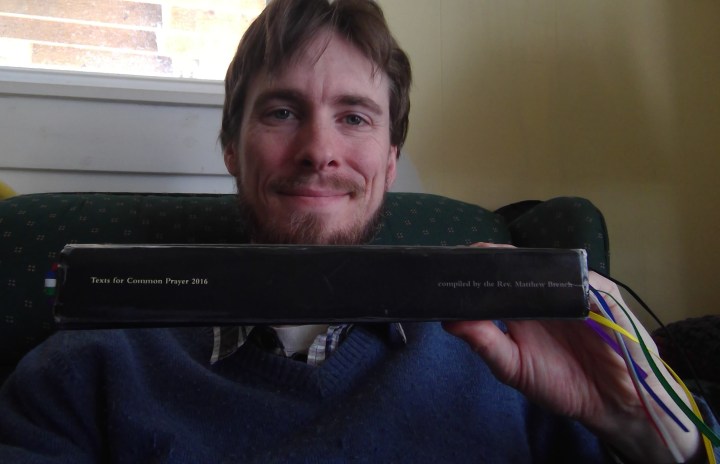
If you will permit a moment of self-indulgence, today we’re reviewing a provisional Prayer Book called Texts for Common Prayer 2016, compiled by the Rev. Matthew Brench… myself.  TCP2016 is sort of the parent of The Saint Aelfric Customary in terms of seeking a traditional arrangement of ACNA liturgical material, but is also the final edition of a succession of Prayer Book -like books that I assembled in the first few years of my priesthood.  The idea was that, once the ACNA had provisional liturgies for public trial use, I wanted to have myself and my congregation using them instead of the 1979 Prayer Book.  I wanted to wean myself and others off the Episcopalians’ book and back into traditional Anglicanism in a modern idiom as much as possible.  By 2016, enough liturgical material had been made available that two volumes were already being published by Anglican House Publishers.  What I did was collect those liturgies into a single volume, tidy up the formatting a little, and fill in the rest of the necessary Prayer Book material from other sources.  And thus, TCP2016 became the “official” prayer book for my house and my church for a couple years.  The near-final official ACNA releases in 2018 have dealt the final blow in rendering TCP2016 obselete.

WIN_20190308_11_34_13_Pro (2)

The contents of this prayer book were arranged in a classical fashion:

  • The Calendar of the Christian Year
  • The Daily Office: Daily Office Lectionary (Psalms & Lessons), Daily Morning Prayer, General Instructions for the Daily Office, Daily Evening Prayer, Supplemental Canticles for Worship, Supplemental Material for Worship
  • The Litany
  • Minor Offices: Concerning the Minor Offices, Family Prayer, Midday Prayer, Compline, Donning the Armor of God, Pastoral Office, Sanctoral Office, Penitential Office, Optional Lectionary of Devotional Readings, Optional Lectionary of Biblical Wisdom Literature
  • Propers for Sundays and Holy Days: Sundays, Red-Letter Days, General Instructions for Lesser Feasts and Fasts, The Calendar of Minor Feasts, The Common of Saints, Propers for Feria Days, Propers for Votive Masses
  • The Service of Holy Communion: Preparation for Mass, Holy Communion, Liturgy of the Word, Prayers of the People, Prayers of Consecration, Proper Prefaces, Offertory Sentences, The Exhortation, The Decalogue, General Instructions, Prayers after Worship
  • Other Sacramental Services: Holy Baptism, Holy Matrimony, Reconciliation of a Penitent, Ministration to the Sick, Ministration at the Time of Death, The Burial of the Dead
  • The Psalms of David
  • Appendix I: Blessings: General Rubrics, Blessing of Water, Various other blessings
  • Appendix II: Occasional Services: The Ash Wednesday Service, Liturgy of the Palms, Renewal of Baptismal Vows, The Litany of the Saints, Thanksgiving & Memorials in place of Communion
  • Appendix III: Confirmation, Reception, and Reaffirmation
  • Appendix IV: Particular Prayers
  • Appendix V: A Guide to Liturgical Colors
  • Appendix VI: The Thirty-Nine Articles of Religion
  • Appendix VII: References

Unlike my private projects beforehand, this book was designed to be usable by people besides just myself, so it came complete with rubrics and explanatory notes.  Whenever possible, this book draws upon liturgical sources that pre-date the 1979 Prayer Book, or at least stand on more classical tradition.  Some vestiges of my own experimentation survive, however, mainly in the handful of “Minor Offices” offered for structured private devotions and the way the calendar of commemorations and feria days are set out.

Overall, this book is noticeably piecemeal, combining the 2016 editions of various ACNA liturgies with 1979-style Ministrations to the Sick and Dying and the classical Commination adapted into modern language and a compact formatted version of the Coverdale Psalter and various prayers and devotions (often from traditional Anglo-Catholic sources) gently (and at times awkwardly) adapted into contemporary English.  But in that piecemeal regard, this book is also probably a realistic representation of how many ACNA churches have handled their liturgy over the past several years: trying to keep up with what our Task Force has provided, and cobbling together various other books and traditions to fill in the blanks.  The idea of this book was to codify how I do that, and model for others how we can do so as consistently and faithfully as possible given the authority promulgating the new liturgies and the tradition behind the old.

The ratings in short:

Accessibility: 3/5
If you account for the fact this book never went completely for public sale, then the rating should be about zero.  But if you’ve got a copy of this book in your hands, then you’ll find it easier to use than the ’79, though still a bit more complex than the historic prayer books.  When page-flipping is necessary, “go to page(s) ###” notes are usually there to help.

Devotional Usefulness: 5/5
Everything you “need” is in here: the Daily Office, a lectionary, the Communion, its lectionary, supplementary materials for weekday services (basically the essentials of the Episcopalian “Lesser Feasts and Fasts” book), the Litany, private devotions, the Psalms, Articles of Religion, and the other Sacramental Rites or Pastoral Offices.  Its style may not be perfectly consistent, but its contents are sound.

Reference Value: 1/5
In 2018, new liturgy drafts rendered large chunks of this book obsolete.  At that point I decided to refrain from giving copies of this book out anymore, knowing that it would only confuse people if they try to keep up with what the ACNA is putting out.  And with the 2019 deadline fast approaching, making a revised copy of TCP2016 was simply not feasible for me.  On its own, this book is only useful now in that it captures an ‘historical’ snapshot of the development of the 2019 Prayer Book, and assembles together a few additional resources from several other books.

If you want a digital copy of Texts for Common Prayer 2016 just contact me and I’ll be happy to email you a copy.  But ultimately the legacy of this book is not in its own endurance (it was never intended to last more than three years anyway) but in this Customary.  The assembly of resources and ideas in this temporary book have paved the way for the development of a Customary that will be able to work alongside the official Prayer Book that we will finally get to see later this year.

The Logic of Lent

The season of Lent is one of the more topically scripted seasons of the year, due in part to its relative brevity and narrow focus.  As is often the case, the traditional calendar is clearer than the modern calendar in terms of the ebb and flow of the season, the modern calendar losing some of its coherence due to the 3-year cycle of readings.  Nevertheless, a basic contour can still be discerned.  Rather than looking at traditional and modern Lent separately as we did for Epiphanytide, we can consider the tradition both old and new together.

The First Sunday of Lent is about the temptation of Jesus.  This has always been the case, and has not changed in modern practice.  Year B of the modern calendar almost drops the ball on this due to the fact that Mark’s Gospel only mentions the temptation in one sentence, rather than relating the whole story like Matthew and Luke.  The Collect, too, is the same in both traditions, seeking to imitate Christ’s abstinence that we may move towards holiness.  This is a strong “best foot forward” experience for the first Sunday of the season, making sure we’re on the right path with our spiritual disciplines that began on Ash Wednesday, with the right godly goals in mind.

The Second Sunday of Lent is a mixed bag in the modern lectionary.  The three years yield the Gospel sayings of Jesus ranging from “you must be born again,” “take up your cross and follow me”, and his lament over Jerusalem.  The latter two suggest a theme of looking ahead toward the liturgical culmination of Lent in the Passion of Jesus, while the former hangs back with another sort of starting place for the season.  Traditionally, the Gospel lesson was about the Syro-Phoenician (or Canaanite) Woman’s great faith over which Jesus marveled.  The Collect built off that, praying that God would keep us defended in body and soul because we’re defenseless (like that woman).  Although that Collect remains in our Prayer Book, it does not seem to have a strong connection with the modern Gospel readings.

The Third Sunday of Lent traditionally was very similar to the second, pairing another Collect asking God to look upon us and keep us defended with another healing story from the Gospel, this time an exorcism with subsequent teaching about demons.  Our Prayer Book supplies an expanded version of that Collect (first introduced in the 1979 Prayer Book) and pairs with the Gospel stories of the woman at the well, the cleansing the temple, and Jesus’ call to repent followed by the parable of the barren fig tree.  The traditional pairing makes this Sunday much like the previous, while the modern Collect and lessons lean more heavily on our “restless hearts” and “heartfelt desires” that need to be rightened, healed, or cleansed.

The Fourth Sunday of Lent is interesting in that one of the three years in the modern lectionary lines up with the traditional Gospel: the Feeding of the 5,000.  The traditional application of this, in the Collect, was a prayer for relief instead of punishment, marking this Sunday as the lighter and more hope-filled Sunday in the Lenten sequence, visually marked by the wearing of rose vestments instead of violet.  Our modern calendar, however, puts in a Collect about Jesus being our true bread from heaven, emphasizing the original Gospel story but setting it in a different context, especially in years A and C when the Gospel lesson is about the man born blind or the parable of the prodigal son.  In that light, there isn’t as much reason to retain the “Rose Sunday” tradition in the modern Lent.

The Fifth Sunday of Lent, nicknamed Passion Sunday, is an anticipation of Palm Sunday.  A noteworthy feature of the traditional lectionary was that major Sunday commemorations tended to have a follow-up Sunday to further explicate its meaning, but in the case of Palm Sunday, that follow-up had to be a preview Sunday instead.  Originally, the Gospel was Jesus’ speech about “before Abraham was, I am” – asserting his divinity.  This was paired with a lesson from Hebrews about his priestly sacrifice, so the theological import of his death on the Cross would be better appreciated on the following Sunday.  The modern calendar carries out a similar function using the Gospel stories of the resurrection of Lazarus, Jesus’ saying that “the son of man must be lifted up,” and the parable of the wicked tenants.  The traditional Collect was similar to those for the 2nd and 3rd Sundays, with a thematic similarity to the Collect for Good Friday, making it serve as another “preview” of the Passion to come.  The modern Collect, however, is a transfer from what was originally an Eastertide Collect, asking God to fix our hearts where true joy is to be found, despite our unruly wills and affections.  As far as I can see (thus far), this somewhat weakens the traditional Passion Sunday function.

The Sixth Sunday of Lent is usually called Palm Sunday, and it is the day we hear the great Passion Narrative as the Gospel.  The Collect is the same, old and new, drawing upon the Epistle (Philippians 2:5-11, also unchanged) to apply Christ’s passion to us; the only difference is that the historic lectionary sticks with Matthew’s Passion and the modern cycles between Matthew, Mark, and Luke.  We’ll look at this in greater detail when Holy Week draws nigh.


Perpetua: a Cheerful Lenten Tale

March 7th is the commemoration of Saints Perpetua and Felicity, two martyrs of the Early Church, who died in Carthage in the year 203.  Something that makes their story very special in the memory of the Church is the fact that much of it was written autobiographically by Perpetua herself, making it one of the oldest surviving pieces of writing by a Christian woman.  (That is assuming the document is authentic… manuscript history isn’t always easy to nail down precisely, but the authenticity of this account is not widely disputed today.)

Feel free to take the time today to give it a read!

There’s something very appropriate to starting off the season of Lent with a martyrdom story like this.  We are endeavoring to grow in love and service to our Lord Jesus through this time, motivated by love and strengthened especially by the disciplines of prayer, fasting, and alms-giving, so it can be rather sobering to be reminded up front the sheer cost of discipleship and spiritual discipline for many of our forebears.  It’s one thing to give up chocolate for 40+ days in the name of Jesus; it’s quite another thing to give up your earthly life in the name of Jesus.

Ash Wednesday

Dear People of God: The first Christians observed with great devotion the days of our Lord’s passion and resurrection, and it became the custom of the Church to prepare for them by a season of penitence and fasting. This season of Lent provided a time in which converts to the faith were prepared for Holy Baptism. It was also a time when those who, because of notorious sins, had been separated from the body of the faithful, were reconciled by penitence and forgiveness, and restored to the fellowship of the Church. In this manner, the whole congregation was put in mind of the message of pardon and absolution set forth in the Gospel of our Savior, and of the need that all Christians continually have to renew our repentance and faith.

I invite you, therefore, in the name of the Church, to the observance of a holy Lent: by self-examination and repentance; by prayer, fasting, and alms-giving; and by reading and meditating on God’s holy Word.

15

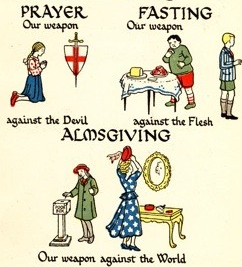
For a modern prayer book service, we still have very deep roots in some old traditions.  In calling the church to prayer, fasting, and alms-giving, we’re standing on a thousand years or more of Christian spirituality, asceticism, and even theological anthropology.  These are not arbitrary spiritual disciplines that happened to be popular at key times in history.  Rather, they are disciplines especially picked to combat our three-fold enemy: the world, the flesh, and the devil.  Prayer is our weapon against the Devil – spiritual enemies can only be fought in spiritual activity.  Fasting is our weapon against the flesh – denying our apparently-natural desires is how we learn to resist such passions.  Alms-giving is our weapon against the world, especially in a consumerist age such as ours where we’re told to spend, spend, spend (on ourselves of course!).

And the liturgy follows this up with the traditional Gospel lesson for Ash Wednesday: Matthew 6:1-6,16-18(19-21).  Technically, the traditional Gospel is just verses 16-21, so we recommend you include the verses that the ACNA lectionary considers as optional.  That way, the full reading is basically our Lord’s quick “how-to” guide for Lent.  “When you pray… When you fast… Lay up for yourselves treasures in heaven…”  So really, the Ash Wednesday liturgy starts with a call to spiritual disciplines, and then in the Scripture lessons explain how we are to pursue them.  It’s all quite neat, really!

Ash Wednesday without ashes?

Did you know that the Book of Common Prayer historically has not authorized the imposition of ashes on Ash Wednesday?  If you grew up with the 1979 Prayer Book, you’ve probably assumed that we’ve always kept the ashes in Ash Wednesday.

But no, until 1979, we had “the Commination” (this link is the 1662 version, but feel free to look at it in the 1928 book or another if you prefer).  It was a service of serious remonstration and repentance.  Elements of it, such as the congregational praying of Psalm 51, survive in the modern Ash Wednesday service, but on the whole its accusatory character has been lost.  Perhaps modern (or modernist) liturgical revisionists found it too dour and depressing for the contemporary worshiper.  But in these times of blatant and rampant sin in the church, it may be worth drawing upon the old Commination once again.  Check it out!

On Private Confession

So with Lent around the corner, let’s talk about the sacramental rite of Confession and Absolution.  In the upcoming 2019 Prayer Book, this is a simple matter: go to the “Rites of Healing” section and use that brief liturgy with your priest.  A traditional practice is to make a confession on Shrove Tuesday in preparation for Ash Wednesday.  This is part of the genius of Pre-Lent; having three and a half weeks to prepare for Lent meant you had time to prepare your Confession, which you could make on the day before Ash Wednesday, and then Lent would be the season of penitence in light of the confession you already made. Rather than 40 days of self-examination, it was 40 days of spiritual warfare to grow in grace after that confession.

Shrove

Now, one of the big objections raised against confession to a priest is that it’s a “Catholic” practice, and we’re “Protestants.”  While I could quibble with the terminology, I think it’ll be easier simply to argue in favor of the practice of Private Confession – that it is, and always has been, an option in classical Anglicanism.

Consideration #1 – the Exhoration

The Exhortation(s) in the Communion service invite those who are penitent to come to the priest for absolution and counsel. This is a public announcement to a private invitation. Reading this as a public confession is completely against the context, as the public confession follows shortly thereafter. That invitation is meant to eradicate “any scruples or doubt” in the individual conscience.  Even now, that invitation still exists in the Exhortation:

If you have come here today with a troubled conscience, and you need help and counsel, come to me, or to some other priest, and confess your sins; that you may receive godly counsel, direction, and absolution. To do so will both satisfy your conscience and remove any scruples or doubt.

Consideration #2 – Theological Consistency

The theology of priestly absolution is supported in the explicit wording of the Absolution in the Daily Office and in the Words of Ordination in the “Ordering of Priests” liturgy at the very moment of laying-on of hands.  The wording hasn’t really changed since 1662:

Receive the Holy Spirit for the Office and Work of a Priest in the Church of God, now committed to you by the Imposition of our Hands. If you forgive the sins of anyone, they are forgiven. If you withhold forgiveness from anyone, it is withheld. Be a faithful minister of God’s holy Word and Sacraments; in the Name of the Father, and of the Son, and of the Holy Spirit.

The authority of the priest to absolve is further supported in the text of the Daily Office’s words of absolution, again substantially unchanged since the originals:

Almighty God, the Father of our Lord Jesus Christ, desires not the death of sinners, but that they may turn from their wickedness and live. He has empowered and commanded his ministers to pronounce to his people, being penitent, the absolution and remission of their sins…

Consideration #3 – a classical prayer book example

Until 1979 the Prayer Books did not provide a liturgy for private confessions, but they did provide a model for how it could be done.  The practical example of this invitation to private confession is modeled in the Ministration of the Sick, in which the sick person is invited to confess to the priest (using very similar phraseology to the Exhortation).  You can see the whole liturgy here, but the specific words are as follows.

Here shall the sick perſon be moved to make a special Confession of his sins, if he feel his conscience troubled with any weighty matter.  After which Confession, the Prieſt shall absolve him (if he humbly and heartily desire it) after this sort:

OUR Lord Jesus Christ, who hath left power to his Church to absolve all sinners who truly repent and believe in him, of his great mercy forgive thee thine offences: And by his authority committed to me, I absolve thee from all thy sins, In the Name of the Father, and of the Son, and of the Holy Ghost. Amen.

The 1662 Prayer Book is anything but a Papist document; it should be noted that the Lutherans also generally maintained a sacramental (or almost-sacramental) status for absolution by a pastor in their theological tradition.

Consideration #4 – why Private Confession was absent from the old Prayer Books

One might question why the old prayer books, if my arguments are correct, didn’t simply provide a liturgy for private confession.  The answer is simple: a private confession is by definition not “common prayer” and therefore didn’t need to be in the Prayer Book itself.  The only part of a private confession that needs (or ought) to be scripted is the priestly absolution, and the minister already has three statements of absolution in the Prayer Book to choose from (Daily Office, Communion, Visitation of the Sick); there need not be any further liturgical form to the saying of a private confession.

That being said, it’s nice to have a brief summary of private confession to a priest in the modern prayer books.  Even though it’s not strictly necessary, having set forms and structure for the confessee can help him or her feel more comfortable in the moment, and cut down on the awkward of feelings of “am I doing this right?”  The only thing that matters is honest contrition about the sins being confessed, so having a liturgical form can help reduce the awkwardness of knowing “how” to say it.

Book Review: the 1979 BCP

Welcome to Saturday Book Review time!  On most of the Saturdays this year we’re looking at a liturgy-related book noting (as applicable) its accessibility, devotional usefulness, and reference value.  Or, how easy it is to read, the prayer life it engenders, and how much it can teach you.

In 1979, after several years of experimentation and trial-use liturgies, the Episcopal Church (USA) promulgated a revolutionary new Prayer Book.  It was a massive tome, compared to its predecessors, with all sorts of exciting new features.  The Daily Office and Communion services were offered in both traditional and contemporary English.  Multiple rites (especially prayers of consecration) for the Communion service were provided.  The minor offices of Noonday Prayer and Compline were added.  The Imposition of Ashes, the Liturgy of the Palms, a Good Friday liturgy, instructions for a traditional approach to Holy Saturday, and an Easter Vigil liturgy all brought catholic tradition into the Prayer Book (where high church parishes previously had to rely upon supplementary material if they wanted to hold such traditions).  The liturgies for Ministration to the Sick and the Dying were expanded.  A new translation of the Psalter was made.  The additional prayers for the Daily Office turned into a massive compilation of over 100 prayers and thanksgivings, neatly ordered and numbered for ease of use.  New lectionaries were made.  There’s a new (longer) catechism.  Additional “historical documents” were appended to the volume, along with The 39 Articles of Religion.

Pretty much all of these were firsts for the Prayer Book tradition.  It is hard to speak ill of that, especially when much of the expanded content was already in use by many traditionalists, and its inclusion in the Prayer Book enabled further standardization and propagation of said practices, even breaking the highchurch / lowchurch barrier.

But there are a number of issues that have been raised with this book.

The changes in style, order, and content to the primary liturgies (Daily Office and Communion) are major departures from all previous Prayer Books.  Many of the changes to the Roman Rite in the wake of their 2nd Vatican Council were imitated in our changes to the Anglican liturgies, especially in the calendars and the order of the Communion service. Some would describe the 1979 book’s results as a bland and generic western catholicism that is neither Roman nor Anglican.

The Baptism liturgy contains perhaps the most criticized feature of the 1979 book: the “baptismal covenant.”  It takes the biblical and traditional idea of the baptized person(s) committing him/herself to Christ, and expands it into a whole contract – or covenant – by which the individual is united to Christ.  Internet articles abound in picking apart just how poorly this innovation to the Baptism liturgy was devised.  On a related note, some also point out that the way this book emphasizes (and arguably redefines) Holy Baptism, the rite of Confirmation ends up being pushed aside as extraneous – a concern that is further highlighted by the fact that Confirmation was no longer the requirement for entry to Holy Communion.  The liturgies for Holy Matrimony and Ordination have also been somewhat liberalized from previous books.

There is also the question of the contemporary language itself.  This was very strongly desired by many Episcopalians at the time, and very strongly opposed by others.  While that controversy and argument still exists today, I think there is a little more peaceful coexistence between the two views now.  But the quality and precision of the contemporary English is still somewhat up for grabs.  As we’ve seen in the process of creating our 2019 Prayer Book, the delicate interplay between faithfulness to the wording of the Bible, consistency with the wording of previous Prayer Books, and accessibility of style and vocabulary to the modern reader is a difficult game to play.  Our recent examination of the Daily Office “lesser litany” illustrates this well.  Or, more bluntly, a quick reading of the 1979 book’s Eucharistic Prayer C makes it immediately obvious that some of this book is too much a product of its generation and lacks that ‘timeless’ quality that will appeal to the next generation(s) thereafter.  (That prayer is nicknamed the “Star Wars” or “Star Trek” Prayer.)

For better and for worse, this has been the standard Prayer Book for the majority of Anglicans in this country for a few decades now.  It was my first Prayer Book, too, and I used it faithfully and happily for about four years before I began to see just how different it was from the 1662 book.  At that point I started weaning myself off of it, using the new ACNA materials available and drawing from more traditional material to “fill in the gaps” for the time being.  I learned that the Prayer Book tradition’s roots look quite different from the 1979 book… but that isn’t the case for a lot of people; to many this book is the Prayer Book, and (if they’re in the ACNA) the 2019 will be the next Prayer Book.  In a way, I think that perspective is more damaging.  The 1979 book, for all its innovation, still does have a strong “Prayer Book” origin to it, and if you familiarize yourself with classical prayer book tradition then you can find that traditional core to the ’79 pretty easily and use it fruitfully.  But without that second foot in Anglican history, one’s use of the ’79 is going to be rather blind and untethered, tossed on the sea of alternate liturgies and options that transformed a 600-page book into 1,000.

The ratings in short:

Accessibility: 2/5
Due to the multiple versions and options of the primary liturgies, and the fact that most of the pastoral and episcopal liturgies are typically intended to be part of a Communion service, the page-flipping required to hold one worship service directly from this book is terribly excessive.  If you’re a liturgy nerd, or very patient, or have a cheat-sheet-style bookmark with all the page numbers for the service, then you can do it.  But this book doesn’t make it easy.  Also due to the page-flipping required, it’s easy to miss the rubrics at the end of sections which sometimes point to even more options.  Judicious use of “go to page ___” instructions would have mitigated some of these challenges, and I think the 2019 book looks like it’s learning that particular lesson.

Devotional Usefulness: 3/5
If you can get past the accessibility issues, there are plenty of good things in this book to feed the Christian soul.  Despite the changes, the Daily Office and Communion services still contain good, godly, biblical, and even Anglican prayers.  There is a fair bit of chaff to omit here and there, but it’s usually not too intrusive.  The prayers at time of death and anointing of the sick are also handy references for pastoral emergencies.  Though I’m happy to never have to use its baptism, confirmation, matrimony, or ordination services.

Reference Value: 1/5
Honestly, because the 2019 book is looking to be very similar to the 1979 in terms of general content, there’s basically no reason to pull this book off the shelf anymore.  We can trace the historical changes from 1928 to 1979 to 2019, but that’s largely of academic interest, and of little use to the average church-goer or minister.  Furthermore, because most of the changes from the 1979 to the 2019 are “roll-backs” toward classical Anglican content, the 1979 book represents a sort of liturgical dead end: the tradition went too far in one direction, and now we’ve reeled it in somewhat.

So we’re at a point now where I no longer give out copies of the 1979 Prayer Book to anyone.  I’m not an Episcopalian, it’s #notmyprayerbook, and I’d much rather point people to the corrected, more traditional and biblical 2019 material.  That being said, I’m not a hater.  The 1979 is where I first delved into the Anglican tradition, and my extensive study of that book gave me a leg-up in understanding what’s going on with the 2019 book.  The 1979 BCP has served its purpose, done its time, and is now ready to enjoy a (very) quiet retirement.

Last Sunday after Epiphany: liturgical colors

In a couple days it’ll be the last Sunday before Lent begins.  I have seen, and participated in, a couple different conversations about the liturgical color appropriate for that day, and so thought it prudent to compile the different perspectives and their major arguments

Before we begin, though, there’s a prologue question that should be addressed: “Who cares?”  Granted, the Prayer Book tradition has never mandated a particular scheme for liturgical colors, and granted, the Puritan party of Reformers held the day for a while in Anglican practice whereby liturgical colors were not used by the majority of ministers.  If that is the way you like it then there’s not a lot we can do for you here.  The use of liturgical colors is one of the church’s many and ancient practices for providing visual aids to worship and teaching.  As long as the colors are used in a consistent fashion, they can convey different postures and moods befitting different occasions.  Black for mourning, white for joy, purple for penitence, and so on.  But the key here is that these colors have to be used consistently with their use and meaning, otherwise they will only ever be fashion accessories and a frivolous game of ecclesiastical dress-up.  That’s why getting the colors right, if you’re using them in the first place, matters.

The Traditional Option

If you’re using the historic calendar and lectionary, this Sunday is “Quinqagesima” – the last Sunday before Lent – and Western tradition is unanimously clear: the liturgical color is purple.  The Pre-Lent season is nearing its end, Lent is almost here, the Alleluias have already been “buried”, there is no question: it’s purple.  Easy!  Done.

The Modern Calendar

Anglicanism has no history of its own when it comes to the liturgical color tradition; we’re just one of the several pieces of Western Catholicism in this matter.  Therefore, when Anglicans switched to the modern calendar developed in the Roman Catholic Church, the standard color practice was also imitated.  So if catholicity is your primary concern in choosing liturgical colors, or you’re just looking for the quick and easy answer, then do what the majority of Western tradition does in the modern calendar: it’s white.  Done.

But, but, but…

Not everyone’s happy with this idea, though.  Some argue for green, others for purple.  So let’s look at these arguments and compare with them with the reasons for using white.

The argument for green stems largely from a concern for the integrity of the Calendar as a whole and a rejection of the way the Last Sunday after Epiphany is treated.  This Sunday, wrapping up the modern Epiphany season, is always about the transfiguration of Jesus on the mountaintop.  But, Green Advocates point out, the Transfiguration is already a feast day in the calendar: August 6th.  To read it in the Gospel lesson this Sunday and wear white is basically to double that holy day in the calendar.  This is an inappropriate imbalance, they say, and this Sunday should be normalized to green along with the rest of Epiphanytide.

The argument for purple is a sort of hybrid approach to the modern calendar, drawing in some of the mindset of the old. Instead of looking at it as the Last Sunday after Epiphany it’s the Last Sunday before Lent, and the very observance of Christ’s Transfiguration as a prelude to Christ’s Passion supports this case.  This Sunday is basically the Pre-Lent Sunday of the modern calendar, and thus, in line with pre-1970’s liturgical practice, this Sunday is best characterized by purple.

So why does the Roman order (and all standard Protestant recommendations) appoint white for this day?  Part of the answer is a liturgical symmetry: both of the green seasons (after Epiphany, after Trinity) begin and end with a white Sunday (1st after Epiphany, Last after Epiphany, Trinity Sunday, Christ the King Sunday).  This may be rebutted by some: Christ the King Sunday shouldn’t be white either, and like the transfiguration is best left to its “proper” place in the calendar (Transfiguration to its feast on August 6th, Christ the King to its mini-season with Ascension Day and Sunday after).  But, I would point out, these arguments to take white away from these Last Sundays at the end of the green seasons, especially to replace them with green, are also arguments against the very nature of those Sundays in the modern calendar.  In short, a color scheme revision isn’t enough, these objections cut all the way to the lectionary, and will not be solved unless or until the lessons for “transfiguration” and “christ the king” Sundays are also changed.

Even the appeal for purple runs into trouble along similar lines.  The argument for purple has the advantage of befitting the readings – especially now in Year C where the Epistle lesson happens also to be the traditional Epistle for Quinqagesima! – but still requires a slight re-write of the calendar.  We have the Last Sunday after or of Epiphany, but purple requires the name to be Last Last Sunday before Lent.  It is natural, in the liturgical context of the modern calendar, to reconsider this Sunday as a Pre-Lent purple sort of day, but you have to change its name in the Prayer Book in order to justify it fully.

The Saint Aelfric Customary’s Recommendation

I sympathize with all these arguments.  It’s ecumenical to stick with the Roman order and wear white; it’s annoying to double a feast day like the Transfiguration; it would be nice to bring back some of the historic Pre-Lent purple.

The arguments for green, I think, run into too many counter-arguments that create even more tension within the calendar, and ultimately lead in a direction of a complete overhaul.  I’m not opposed to a complete overhaul; for the most part I’d like to see the calendar restored to the way it was before the radical revisions of the 1960’s and 70’s.  But changing this one Sunday from white to green isn’t really going to help us get there.

The idea of using purple in the modern calendar may primarily be my own imagination; I don’t remember if I’ve actually heard anyone else suggest it before.  It’s less disruptive to the calendar’s color scheme as a whole than choosing green, but it’s still clearly against the spirit of the modern calendar.

So, honestly, I still think white is the way to go.  It may not be the best solution, but at least let’s think of it this way: this is our last hurrah before Lent, let’s do our best to enjoy it and sing Alleluia before we bury it for six and half weeks.