Planning Prayers & Readings Review

Although the full text hasn’t been finalized yet, I do have plans for how the Saint Aelfric Customary will recommend the implementation of most of the features in the 2019 Prayer Book.  In short, I can’t tell you why these suggestions are here yet, but if you want to order your prayers accordingly, here is the weekly guide!

Planning Prayers

Sunday 12/15

  • Morning Prayer Canticles: Te Deum laudamus and Benedictus
  • Holy Communion: Third Sunday of Advent (Year A)
  • Evening Prayer Canticles: Magnificat and Nunc dimittis

Monday 12/16

  • Morning Prayer Canticles: #1 Magna et mirabilia and Benedictus
  • Holy Communion: Third Sunday of Advent (with the traditional readings)
  • Evening Prayer Canticles: Magnificat and #4 Quaerite Dominum

Tuesday 12/17

  • Morning Prayer Canticles: #1 Magna et mirabilia and Benedictus
  • Holy Communion: Votive: of the Blessed Virgin Mary (The Visitation)
  • Evening Prayer Canticles: Magnificat and #4 Quaerite Dominum

Wednesday 12/18

  • Morning Prayer Canticles: #1 Magna et mirabilia and Benedictus
  • Holy Communion: Ember Day I
  • Evening Prayer Canticles: Magnificat and #4 Quaerite Dominum

Thursday 12/19

  • Morning Prayer Canticles: #1 Magna et mirabilia and Benedictus
  • Holy Communion: Votive*
  • Evening Prayer Canticles: Magnificat and #4 Quaerite Dominum

Friday 12/20

  • Morning Prayer Canticles: #1 Magna et mirabilia and Benedictus
  • Holy Communion: Ember Day II
  • Evening Prayer Canticles: Magnificat and Nunc dimittis, Collect for St. Thomas

Saturday 12/21

  • Morning Prayer Canticles: Te Deum and Benedictus
  • Holy Communion: SAINT THOMAS
  • Evening Prayer: Magnificat and Nunc dimittis

Sunday 12/22

  • Morning Prayer Canticles: Te Deum laudamus and Benedictus
  • Holy Communion: Fourth Sunday of Advent (Year A)
  • Evening Prayer Canticles: Magnificat and Nunc dimittis

* A Votive is a “Various Occasion” (page 733 in the BCP 2019).  The traditional appointments are Holy Trinity on Sunday, Holy Spirit on Monday, Holy Angels on Tuesday, of the Incarnation on Wednesdays, of the Holy Eucharist on Thursdays, the Holy Cross on Fridays, and of the Blessed Virgin Mary on Saturdays.

Readings Review

Last week: Ecclus. (Sirach) 44-50, Revelation 1-6, Isaiah 51-57, Luke 12-16
This week: Wisdom 1-5, Revelation 7-13, Isaiah 58-64, Luke 17-20:26

Special reading for St. Thomas’ Day on Saturday morning: John 14:1-7

With Sirach finished yesterday we begin now on the book The Wisdom of Solomon.  Like Ecclesiastes and much of the book of Proverbs, this book’s authorship is attributed to King Solomon, and written in his voice.  But, also like those books, the ascription to Solomon here is primarily honorific.  They are all written in the tradition of Solomon; we have little way of knowing how much of any of this truly came from his own pen (or stylus?).  And ultimately that’s not the point; the point is that these various wisdom writings are in the great wisdom tradition that Solomon began, or popularized, or codified, or brought into the mainstream.

The opening three chapters of Wisdom, particularly, are arguably its best-known parts.  Their descriptions of the righteous and the unrighteous, and the interaction between the two, find themselves powerful readings when read with a christo-centric eye: the way the unrighteous resolve to “test” the righteous sounds very much like the pharisees’ account of the crucifixion of Jesus.  And chapter 3’s dealing with the security of the godly soul in the hands of God, even in death, makes for excellent reading, not only for comfort in time of grieving, but also clear indication of pre-Christian belief in the afterlife (which scholars sometimes like to quibble about when dealing with the Old Testament).

The Servant Songs of Isaiah have finished, though some powerful chapters are still hitting us this week.  Chapters 58 & 59 deal with fasting, prayer, and alms-giving, earning them prominent places in a few lectionaries on Ash Wednesday.  Chapters 60 & 61 deal with Gentiles and the heavenly Jerusalem, earning them prominent places in Epiphany and Advent alike.

In Luke, the “Kingdom of God” teachings are beginning to increase now.  They’re not quite as thick and heavy as Matthew’s Gospel presents them at this stage of the game, but they’re still quite prominent themes, and at the end of the week we’ll make it to the Triumphal Entry.  As noted a week or two ago, keep the Cross in mind as you read these chapters.
Sirach’s Wisdom anticipates Jesus

We don’t typically have entries on this blog on Sundays; most of the readership is busy on Sunday morning and I don’t want to distract you on the Lord’s Day (or distract myself promoting a post on Facebook or whatnot).  So today we’re looking at something that’s show up in one of tomorrow’s lessons.

At Morning Prayer on December 15th we read Ecclesiasticus (Sirach) 51, the final chapter of that long book.  The last chapter and a half, like the prologue, make for great reading because we get to see the author step out from behind the shadows and talk briefly about himself and his work, giving us an unusual amount of insight into the purpose and making of this book – very few biblical writings provide us with such opportunities, the opening verses of Luke and Acts being shorter examples.

Specifically, the very end of chapter 51 has a lovely little wrap-up:

Draw near to me, you who are untaught, and lodge in the house of instruction.
Why do you say you are lacking in these things, and why are your souls very thirsty?

I opened my mouth and said: Get these things for yourselves without money.
Put your neck under the yoke and let your souls receive instruction; it is to be found close by.
See with your eyes that I have labored little and found for myself much rest.
Get instruction with a large sum of silver, and you will gain by it much gold.
May your soul rejoice in his mercy; and my you not be put to shame when you praise him.
Do your works before the appointed time, and in God’s time he will give you your reward.

Ecclesiasticus (Sirach) 51:22-30

A host of references to other parts of the Bible can be found here.  The first three verses echo Proverbs 1:20-33 and Proverbs 8, in which Wisdom is personified, calling out on the streets to the simple who would come and learn from her.  Ben-Sirach does not depict Wisdom as a woman in this closing poem, but puts himself forth as a sage, one who teaches wisdom to others, but he is clearly well-schooled in Hebrew wisdom given his fluent use of the language of the proverbs in issuing his invitation to learn from the great tradition through him.

He then speaks of learning in terms of a “yoke” and “little” labor.  A little study in wisdom goes a long way!  Our Lord Jesus himself would take up this language from Ben-Sirach when he said “Come to me, all who labor and are heavy laden, and I will give you rest.  Take my yoke upon you, and learn from me, for I am gentle and lowly in heart, and you will find rest for your souls.  For my yoke is easy, and my burden is light” (Matthew 11:28-30).  The similarities are remarkable; it’s likely that either this set of images was commonplace in Hebrew teaching language, or Jesus was simply paraphrasing Sirach.

Even the line about paying silver to gain instruction and “much gold” lays the foundation for some of Jesus’ parables about the Kingdom of God – the buried treasure, the pearl of great price – the idea that what we have to gain is far greater than what we could ever spend to gain it.

Of course, there is a difference between the wisdom and teaching of Ben-Sirach in his book called Ecclesiasticus, and the teaching of our Lord Jesus Christ.  The former was a brilliant compiler of the Hebrew wisdom tradition and well-schooled in the grand sweet of the Hebrew Bible, able to write of the great heroes of the faith from Enoch in the mists of the past all the way to Simon the High Priest who saw the consummation of the Maccabean rebellion.  If there was no New Testament, this book could almost be treated as the capstone for the entire Hebrew Bible.  But we do have a New Testament, and we do have Jesus the awaited Messiah, or Christ.  As effective a teacher as Ben-Sirach was, he was not God-in-the-flesh.  As Christians, we turn to Jesus to show us the perfect way to understand the Old Testament.

In the meantime, it’s great to see moments like this, in chapter 51, where Ben-Sirach’s stand so clearly and brightly between the Old Testament and the New.  (This is why this book, with the other Ecclesiastical Books, belongs between the Testaments in print, unlike its strange placement in the new one from Anglican Liturgy Press.)

We’re well into Advent…

You know we’re well into Advent when O Sapientia is approaching!  Our calendar notes its beginning on December 16th, and it runs each evening through the 23rd.  For those unaware, O Sapientia is the first several “O antiphons” leading up to Christmas Eve – that is, antiphons that start with the word “O”.

An antiphon is a repeated phrase that is used both at the beginning and end of a Psalm or Canticle.  The 2019 Prayer Book only appoints antiphons for one thing: the Venite (Psalm 95) at Morning Prayer.  The classical prayer book tradition hasn’t appointed any antiphons for anything.  But in general Western tradition, you can find antiphons for everything – every psalm, every canticle, and also most introits and many graduals are constructed with antiphons.  The idea is that the psalm or canticle is book-ended with this antiphon to give it a seasonal or occasional context that may perhaps bring out a different aspect or theme or idea in the central text that you might not otherwise notice.

The O Antiphons are used with the Magnificat in Evening Prayer, and the first seven of them address Jesus by different prophetic names: Wisdom, Key of David, Root of Jesse, and so forth.  You can read more about them here.

These Antiphons begin on Monday, and count us down the final eight days until Christmas Eve.

Personally, I’ve long wished for a set of Mass Propers (Collects & lessons for a Communion service) for each of these days, but there are just too many interruptions to make it worthwhile: St. Thomas’ Day is always December 21st, the winter Ember Days land in the midst of this week, and at least one Sunday also butts in.  It’s a busy time of year, liturgically, not just culturally!

Anyway, if you want to pray the Evening Office with the O Antiphons, this Daily Office website provides for it. Have fun!

Dismissals

The very last act of worship in the Prayer Book’s Communion service (unless you have a hymn or other music after this, as the rubrics permit) is the Dismissal on page 122 and 138.  This is an import from the Roman Rite (and the 1979 Prayer Book); the classical Prayer Book tradition didn’t include a dismissal, but ended with the Blessing.  That being said, most (if not all) of the 1928 Prayer Book parishes that I’ve visited have tacked on a Dismissal to the end of the liturgy anyway!  I guess it really helps for the celebrant, or deacon, to tell people that the liturgy is over.

The rubrics state “The Deacon, or the Priest, may dismiss the People with these words“.  This indicates three things:

  1. If there is a deacon serving, he is the one should say this.  The priest only says it in the absence of a deacon.
  2. The Dismissal is optional, and may be left off, according to the historic Prayer Book pattern.
  3. The Dismissals provided are the complete list of approved dismissals; we’re not technically supposed to re-word them or make up different ones.  (Not that this is a massively critical piece of the worship service that will undermine the entire Christian Faith if we mess it up, but at the very least it avoids confusion if we don’t go “off-script” too far.)

The four dismissals all have the same response by the congregation: “Thanks be to God.” though “Alleluia, alleluia” is indicated to be added from the Easter Vigil through the Day of Pentecost.  “It may be added at other times, except during Lent and on other penitential occasions.”  This is a concession to popular practice, I suspect; traditionally, additional Alleluia’s are only found in that Easter-Ascension-Pentecost block of time.

Identifying the choices and when to use them

The four dismissals provided are not accompanied with any suggestions about times of year for use, allowing a parish or deacon to stick to one favorite all the time, use whichever one catches the deacon’s fancy at the time, or make a choice according to liturgical mood or tone.

Let us go forth in the Name of Christ.

This is perhaps the most straight-forward dismissal, and the one I find myself using the most often.  The word “Name” is capitalized here, as it often is in liturgical texts, because “the Name of Christ” or of God is of particular theological significance.  The Name, in ancient understanding, is representative of the power, authority, even presence, of the one named.  Regarding both the Tabernacle (or Tent of Meeting) and the Temple in Jerusalem, God said he would make his Name dwell there.  So when we depart in the Name of Christ, the implication is that we carry Christ with us, out from the church gathering and into the ordinary world around us.

Go in peace to love and serve the Lord.

The second dismissal is more like a “mission statement reminder”, giving the people particular instructions on their way out.  The call to love and service may make this dismissal particularly appropriate in penitential seasons, when there are concrete spiritual disciplines being preached from the pulpit, or otherwise commended in the lessons.

Let us go forth into the world, rejoicing in the power of the Holy Spirit.

This is the longest and most specific dismissal.  It points us out into the world, like the first two, but, rather than emphasizing good works like the second, it suggests a continued life of worship like the first.  Rather than centering us on Christ, though, this dismissal centers us on the Holy Spirit.  This perhaps makes it particularly appropriate for the Day of Pentecost and other occasions that share that emphasis.  And, lest one misconstrue a Pentecostal excess, “Nevertheless, do not rejoice in this, that the spirits are subject to you, but rejoice that your names are written in heaven” (Luke 10:20).

Let us bless the Lord.

The appearance of this stark and brief dismissal in some of the Holy Week services in the 1979 Prayer Book suggested that this is an appropriate dismissal for that time of year, but I haven’t found it there in our new prayer book, which frees this dismissal to an “any time” status.  As it is found at the end of the Daily Offices too, this simplest of dismissals may find their natural home in brief weekday Communion services or the ordinary Sundays of Trinitytide.

The Dismissal historically

The most common nickname for the service of Holy Communion among the Papists is “the Mass”.  That name comes from the usual traditional Latin dismissal “ite, missa est.”  I have often heard it said that the word missa indicates “mission”, that we’re being sent into the world bring the Gospel to all nations.  While this is a fine sentiment, and perhaps even an implication of the idea of the dismissal, that’s not what the word really is.  There is some linguistic discussion on its precise etymology and origin, which you can read about on the Wikipedia page linked above, but basically the missa here refers either to the congregation which is being sent, or to the dismissal being said.  Mission is a fine and proper implication, but not the direct meaning of that dismissal.

This background insight translates pretty well into our four dismissals, in that some of ours indicate a “missional” character and others don’t.  Both are valid interpretations of the purpose and message of the dismissal.  In your own ministry context, be sure you don’t pigeon-hole the dismissal into an overly-narrow field of meaning.

About that Magnificat…

One of the ancient staples of Christian prayer is the Song of Mary, the Magnificat, found in Luke 1, after Mary and Elizabeth have their encounter with their respective unborn sons recognizing one another in utero.  It has been associated with Vespers, or Evening Prayer, for many centuries, and the Anglican Prayer Book tradition is no exception.  The 1662 Prayer Book appoints it for Evening Prayer every day, all year, only replacing it with a Psalm when its text will appear in a lesson that day.  Subsequent Prayer Books, including ours, do not make that rule explicit, and so we technically do have more leeway with replacing the Magnificat with another Canticle, but in the spirit of the prayer book tradition, we should not.

And with good reason – the Magnificat is a fantastic song-prayer.  And its words are… startling.  The first half of it celebrates what God has done with, in, and through Mary herself, and the second half of it celebrates what God has done for the whole world.  “He has brought down the mighty from their thrones, and has exalted the humble and meek.  He has filled the hungry with good things, and the rich he sent empty away.”  Taken in a (very) anachronistic context, this could be an anthem for class warfare!  But this is prophetic language – a survey of the Old Testament prophets will yield multiple hits of phrases like these.  The work of God, however spiritualized and gospel-centric you describe it, still yields real-work effects.  Sometimes such in-breaking of the Kingdom of God can resemble all sorts of political and economic and social theories without actually confining itself to any one of them.  So while one can not read the Magnificat as a socialist manifesto, one can see elements of a socialist ideal drawn from the Magnificat.  Sure, Marx was an anti-religious nut who didn’t always know what he was criticizing, but that didn’t stop him from absorbing select elements of the Gospel.

The Kingdom of God is like that… it gets everywhere and changes the world in all sorts of ways, whether every individual accepts it wholesale or not.

Meanwhile, regarding the first half of the Magnificat, we can learn a startling amount about the Blessed Virgin Mary herself.  Since we’re in the the midst of Advent now, and that’s basically the only time of year most Protestants dare breathe the name of Mary out loud, let’s talk about her.  What do Anglicans believe about the Virgin Mary?

Subject Index:
* 00:00 Yes Mary did know! (see this for more)
* 02:05 Lessons from the Magnificat (Luke 1:46-55)
* 07:25 Lessons from the Early Church (the Mother of God / theotokos)
* 08:51 An Anglican take on approaching Mariology
* 12:37 Lessons from the Anglican Prayer Book (a “pure Virgin”)
* 19:22 Summary wrap-up which is a bit scatterbrained because I had a headcold at the time, sorry

Understanding the Revelation

As promised yesterday, we’re taking a look now at that strange book at the end of the Bible: Revelation.  The Revelation of Jesus Christ to Saint John, or the “Apocalypse”, for short, is a unique book in the Bible, especially compared to the rest of the New Testament.  Only brief half-chapter snippets of the first three Gospels come close to the style and tone that is found throughout this book.  Revelation is often the centerpiece in popular end-times debates and theories, and people sometimes take their own interpretation and perspective for granted, assuming that “if you just read the book, you’ll see what I mean.”

Since we will be spending most of the rest of December reading this book, I’m inviting you to take thirty minutes out of your day to refresh your familiarity with the style, content, and purpose of this book, with a nod to the major interpretive approaches that are taken up.

Of course, now I realize that I’ve doubled this entry.  I wrote this up last week already.  Oh well, sorry.  Now you get a second shot at it if you missed it last week.

For further reading:
Subject Index:
00:00 Revelation/Apocalypse
02:46 Signs, Metaphors, and the Literal Sense
07:17 Examples: seven lamps, lamb that was slain, city dressed as a bride
12:58 Interpretive Approaches: preterist, historicist, futurist, spiritualist
20:18 The 1,000 Years: pre-millennial, post-millennial, amillennial
30:30 Concluding Summary

Planning Prayers & Readings Review 12/9

Planning Prayers

Although the full text hasn’t been finalized yet, I do have plans for how the Saint Aelfric Customary will recommend the implementation of most of the features in the 2019 Prayer Book.  In short, I can’t tell you why these suggestions are here yet, but if you want to order your prayers accordingly, here is the weekly guide!

Sunday 12/8

  • Morning Prayer Canticles: Te Deum laudamus and Benedictus
  • Holy Communion: Second Sunday of Advent (Year A)
  • Evening Prayer Canticles: Magnificat and Nunc dimittis

Monday 12/9

  • Morning Prayer Canticles: #1 Magna et mirabilia and Benedictus
  • Holy Communion: Second Sunday of Advent (with the traditional readings)
  • Evening Prayer Canticles: Magnificat and #4 Quaerite Dominum

Tuesday 12/10

  • Morning Prayer Canticles: #1 Magna et mirabilia and Benedictus
  • Holy Communion: Votive: of the Blessed Virgin Mary (The Annunciation)
  • Evening Prayer Canticles: Magnificat and #4 Quaerite Dominum

Wednesday 12/11

  • Morning Prayer Canticles: #1 Magna et mirabilia and Benedictus
  • Holy Communion: Votive*
  • Evening Prayer Canticles: Magnificat and #4 Quaerite Dominum

Thursday 12/12

  • Morning Prayer Canticles: #1 Magna et mirabilia and Benedictus
  • Holy Communion: Votive
  • Evening Prayer Canticles: Magnificat and #4 Quaerite Dominum

Friday 12/13

  • Morning Prayer Canticles: #1 Magna et mirabilia and Benedictus
  • Holy Communion: St. Lucy (martyror Votive
  • Evening Prayer Canticles: Magnificat and #4 Quaerite Dominum

Saturday 12/14

  • Morning Prayer Canticles: #1 Magna et mirabilia and Benedictus
  • Holy Communion: Votive
  • Evening Prayer: Magnificat and Nunc dimittis, Collect for Advent 2

Sunday 12/15

  • Morning Prayer Canticles: Te Deum laudamus and Benedictus
  • Holy Communion: Third Sunday of Advent (Year A)
  • Evening Prayer Canticles: Magnificat and Nunc dimittis

* A Votive is a “Various Occasion” (page 733 in the BCP 2019).  The traditional appointments are Holy Trinity on Sunday, Holy Spirit on Monday, Holy Angels on Tuesday, of the Incarnation on Wednesdays, of the Holy Eucharist on Thursdays, the Holy Cross on Fridays, and of the Blessed Virgin Mary on Saturdays.

Readings Review

Last week: Ecclus. (Sirach) 14,17,18,21,34,38-39, Acts 24-28, Isaiah 44-50, Luke 9:18-12:34
This week: Ecclus. (Sirach) 44-50, Revelation 1-6, Isaiah 51-57, Luke 12-16

We are now getting into one of the more intensely familiar sections of the book of Isaiah.  As mentioned a couple weeks ago this is where pretty much every chapter will have something familiar to the regular church-goer, especially in a liturgical tradition like ours.  The “Servant Songs” populate a few of these chapters, officially identified in 42:1-4 (two weeks ago), 49:1-6 and 50:4-7 (this past week), and the long one 52:13-53:12 (coming up this week).  Few of the messianic prophecies detail the reality of Jesus as a suffering servant as clearly as this one; it’s easy to read this now as a Christian and look back to how it’s fulfilled in Christ, but for the people of Judea and Galilee at the time this text was not high on their list of expectations regarding the coming Savior.  But of course once the gospel events took place and the apostles started committing their teachings to writing, the connection between Isaiah’s “Suffering Servant” and Christ Jesus was made abundantly clear – particularly in 1 Peter.

Meanwhile, in Morning Prayer, the skipping through Ecclesiasticus (Sirach) has ended, and now we’re going to walk through the final eight chapters in sequence, covering the great “Hall of Faith” – like in Hebrews 11 except longer.  Whatever your personal opinions of the canonical status of this book, these chapters are an insightful read, reflecting on the whole of Old Testament history, and highlighting a pre-Christian perspective on what was particularly important about these great men of old.

And, of course, let us not forget the book of Revelation.  This book is appropriate saved for the end of the year, not only because it’s at the end of the Bible, but especially because of its strong Advent themes concerning the return of Christ.  More on that later this week…!

Book Review: The Holy Bible 1611 Fascimile Edition

Welcome to Saturday Book Review time!  On most of the Saturdays this year we’ve been looking at a liturgy-related book noting (as applicable) its accessibility, devotional usefulness, and reference value.  Or, how easy it is to read, the prayer life it engenders, and how much it can teach you.

Today we’re going a bit weird and looking at a Bible.  Not just any Bible, but the King James Version.  And not just any KJV Bible, but the 400th anniversary 1611 facsimile edition.  There are a few of these around, so the one I’m specifically dealing with here is the one from Hendrickson Publishers.  You can find others, like from Zondervan, which omit the Apocrypha/Deuterocanon, but that’s lame.  We’re Anglicans, and have all the books!

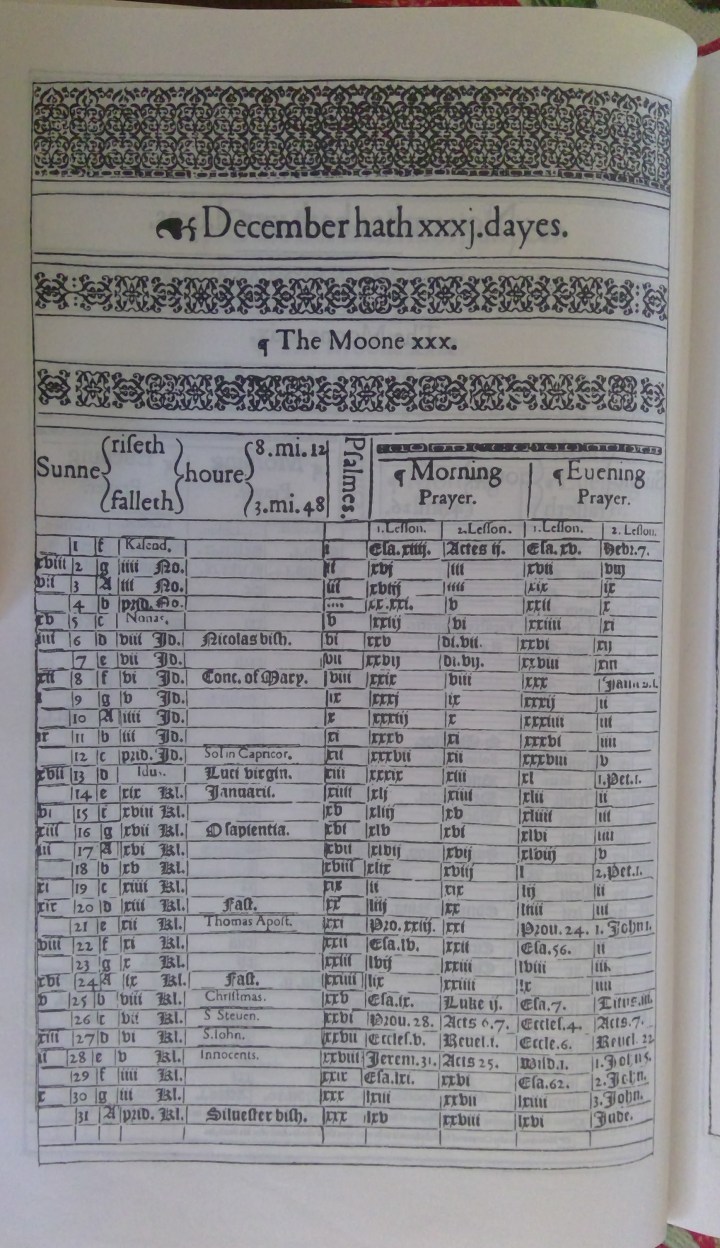
And, more importantly for the purposes of this review, this facsimile edition has the Daily Office Lectionary in it, as conformed to the then-current 1559 Prayer Book.  Looking through this lectionary is a massive education for the modern Anglican, as the history of daily lectionaries has wandered quite a bit over the centuries since.  Here’s a sample:

December

A quick run-down of what we’re looking at here…

  • The far-left column, I must admit, I haven’t figured out.
  • The second-left column is the day of the month (1-31 in this case).
  • The next column has the letters A-g in repetition, allowing you identify the day-of-the-week throughout the month without having to be year-specific.
  • The next column, labeled Kalend. at the top is the older Roman/medieval dating system.
  • The large column notes feasts and fasts: Nicholas Bish[op] on the 6th, Conc[eption] of Mary on the 8th, O Sapientia on the 16th, Fast on the 24th, Christmas on the 25th, etc.
  • The “Psalms” column tells you which day of the month’s psalms to use each day… for the majority of the year it’s identical to the actual day of the month, but there is one exception.
  • The last four columns give you the OT and NT lessons for Morning and Evening Prayer.  Here are a few samples, to help you with the typography:
    • December 1st: Esa. xiiij (Isaiah 14), Actes ii (Acts 2), Esa. xv (Isaiah 15), Hebr.7 (Hebrews 7).
    • December 21st: Pro.xxiij (Proverbs 23), xxi (Acts 21), Prou.24 (Proverbs 24), 1.John1. (1 John 1).
    • December 27th: Eccleſ.v (Ecclesiastes 5), Reuel.i. (Revelation 1), Eccle.6. (Ecclesiastes 6), Reuel.22 (Revelation 22)

As you may be able to see, here, the space-and-ink-saving pattern was not to repeat the name of the current book being read when it’s in continuity with the day above.  Christmas Day reprints Isaiah for the OT lessons because, although Isaiah was already the book being read at the time, the chapters to be read are different from the daily sequence.

You’ll also note that whole chapters were read at once.  The versification we’re used to today was invented in 1557 and first printed in 1560, which means they did not exist when the first prayer books were printed in 1549 and 1552.  The lectionary from those, continued here in 1611, therefore, could not rely on verse numbers to delineate Scripture readings!  There are a couple footnotes in this lectionary to adjust the readings’ start and end points, using phrases rather than verse numbers.

There are, of course, some typographical distinctions that make this book difficult to read at first.  The “long s”, ſ, is only used in the lectionary tables and in titles, never in the regular text of the scripture.  (And, to dispel anachronistic use, never at the end of a word.)  The letters u and v are treated as the same letter, u being in the middle of a word and v at the end of a word.  So, the phrase “leave us not” is instead printed “leaue vs not“.  You can also find the occasional typographical error, in which a u or an n is turned upside down – they’re the same “letter” from the printer’s perspective, just a matter of which-way-up-it’s placed on the printing block.

Anyway, I share this here because it’s a fantastic resource that modern Bibles sadly lack.  As American Anglicans we barely even have a functioning Bible to support our lectionaries, much less a Bible that reprints the lectionary in the front to aid our devotions with the Offices.  Considering how much arm-twisting it took just to get an ESV Bible with the additional books we need, chances are we’ll never have an ESV Bible with the full Anglican resources available.  So it’s all the more important we learn about these resources of old.

On a fun sidenote, this KJV edition is also a handy thing to have when dealing with those who insist on the KJV Bible being the only legitimate Bible, because the original KJV has the books “called apocrypha” which they dread, plus a number of footnotes to supplement the primary translation, not to mention the lectionary tying it explicitly to the Common Prayer Book tradition which such fundamentalists would also despise.  Knowing our own history, unsurprisingly, can help inoculate us against various errors of the present day.

The ratings in short:

Accessibility: 2/5
This isn’t a particularly easy edition to find; there are other similar editions out there which omit all the things that make this a genuine Anglican book.  It also takes some getting used to in terms of reading it; though it’s not as difficult as some people make it out to be.  This is, after all, Early Modern English.

Devotional Usefulness: 4/5 if Applicable
Obviously this is just a Bible with the lectionary.  You can’t pray the Office with this, or follow the Eucharistic lessons.  But as Bible-reading-plans go, this one is very simple and very strong.  It does omit significant portions of a few books, like Leviticus, Numbers, Ezekiel, and Revelation, though when you understand that the goal of a daily lectionary is common prayer, those omissions begin to make a lot more sense.

Reference Value: 4/5
Although this is a very specific snapshot of a very specific piece of Anglican liturgical history, this Bible and lectionary are very informative.  If all you’ve ever seen are the 1928 and/or 1979 Prayer Book lectionaries, you’ll look at the 2019 book’s daily lectionary and wonder what on Earth our committee was up to.  But if you look a this, the original daily lectionary, you’ll find that the 2019’s lectionary is incredibly more in step with historic Anglicanism  Indeed, the daily lectionary is one of the worst features of both the 1928 and 1979 Prayer Books due to their complicated and convoluted reading order and their decreasing coverage of scripture.

Honestly, this is a book I think most Anglicans ought to have, clergymen especially.  Try a year on this lectionary sometime, maybe even in this translation, too.  It’s honestly hard to beat.

An Ancient Advent Hymn

There’s an Advent Hymn that I’ve wanted to point out to people for a while, and I figured I’d pull it up for you all at this blog.  It’s called Hark! a thrilling voice is sounding, and the reason why I’ve had it in mind is because it quotes the Collect for the First Sunday of Advent in its first verse.

… except, as I suddenly realized as I sat down to write about it, this hymn was written in around the 6th century.  So it’s probably not quoting the Collect as we know it.  But it’s making the same Romans 13 reference as the Collect, which means that the way we collect Scripture together to develop the themes of Advent is the way the Church has done it for over 1,500 years.  Let’s check it out.

Hark! a thrilling voice is sounding;
“Christ is nigh,” it seems to say;
“Cast away the works of darkness,
O ye children of the day.”

There it is, our “cast away the works of darkness” reference from Romans 13.  Christ is near, we are children of the day, so put on the armor of light.

Waken’d by the solemn warning;
Let the earth-bound soul arise;
Christ, her sun, all sloth dispelling,
Shines upon the morning skies.

The theme of waking up, or staying awake, is also a prominent refrain in Advent hymnody and Scripture.  Christ as the morning star, or the sun at dawn, is also a common Advent image, depicting his Return as the beginning of a new and eternal day.

Lo! the Lamb, so long-expected,
Comes with pardon down from heav’n;
Let us haste, with tears of sorrow,
One and all to be forgiv’n.

Now we’ve got an echo of “Come thou long expected Jesus” (another Advent hymn).  And this third verse also highlights something that tends to get downplayed by a number of people today: Advent is a penitential season.

So when next he comes with glory,
And the world is wrapped in fear,
May he with his mercy shield us,
And with words of love draw near.

Honor, glory, might, and blessing
To the Father and the Son,
With the everlasting Spirit,
While unending ages run.

I think it’s nice to see the same conflicting emotions from the 500’s that we have today when it comes to the subject of eternity and judgment: fear, mercy, and love.

The Trinitarian doxology in the final verse, by the way, is characteristic of ancient hymns.  It’s impressive how many subtly different ways people find to praise the Father, Son, and Holy Spirit in the same 8.7.8.7 meter.

Another great thing about this hymn is that it fits anytime during Advent.  The reference to the first Sunday’s Collect makes it especially good for the first Sunday (in modern prayer book tradition, which no longer repeats that Collect throughout the season).  It also appeals well to the Collect for the 4th Sunday, so the end of the season works as well for this song as the beginning.  But apart from that, the wide sweep of classic Advent themes make this hymn great for any time in the season.

The Blessing at Communion

The last part of the Communion service in the classical prayer books is the Blessing.  Specifically, this one (albeit with the 2019 wording)…

The peace of God, which passes all understanding, keep your hearts and minds in the knowledge and love of God, and of his Son Jesus Christ our Lord; and the blessing of God Almighty, the Father, the Son, and the Holy Spirit, be among you, and remain with you always.  Amen.

Once this blessing is pronounced, people can get up and go.

Except, in the modern order, we now have an extra Dismissal that follows, and usually music as well.  But until the 1970’s (or perhaps the arrival of something like the Anglican Missal?) the Blessing marked the end of the liturgy.

I have heard it argued that the priest offering a Blessing at this point is redundant – what greater blessing could be conferred than receiving the Body and Blood of our Lord?  But there are a couple different answers.

First of all, ending a worship service with a blessing is biblical.  It is the Old Testament pattern – even though the sacrifice of animals and their oblation in the Temple and the eating of the meat was the “high point” of the Old Covenant liturgy, the priest was still to bless the people after.  It is the New Testament pattern too, in a way: St. Paul ended each of his epistles with a blessing of some sort.  It is a little ironic, though, that the blessing we use is not explicitly used as a blessing by St. Paul (cf. Philippians 4:7 – it was actually the Epistle reading a couple Sundays ago).

Secondly, the specific content of this blessing is appropriate.  In a general sense, the argument against a blessing after receiving Holy Communion does sound logical, but this objection is undermined by what this blessing calls for: that the people would be kept in the knowledge and love of God.  It is a blessing of perseverance – may the people, who have just celebrated their unity with and in Christ, always remain so.

Third, and finally, it is analogous to the Prayer of Humble Access.  If you reduce the meaning of this blessing to some sort of generic blessing, then yeah it’s lame.  Same deal with the Prayer of Humble Access: if you reduce the meaning of that prayer to some sort of generic confession, then it’s redundant and silly too.  But both of these prayers, although bearing similarities to other prayers and “functions” within the service, bring new and different lights to the table (or, from the Table in this instance).

Now, all that having been said… the 2019 Prayer Book states that

The Bishop, when present, or the Priest, gives this or an alternative blessing

But what is an “alternative blessing”?  None is supplied.  In the classical prayer books this choice didn’t exist: that blessing was the blessing.  But there is another blessing in the old prayer book tradition – the Burial Office ends with a different blessing, also found at the end of the Committal in the 2019 Prayer Book:

The God of peace, who brought again the from the dead our Lord Jesus Christ, the great Shepherd of the sheep, by the blood of the eternal covenant, make you perfect in every good work to do his will, working in you that which is well-pleasing in his sight…

Notice in both blessings that these are not (strictly-speaking) prayers.  “May God ___” is a prayer, but these are more like statements (or perhaps subjunctive verbs, if I remember my grammar correctly): “God… make you perfect” and “the peace of God… keep your hearts and minds.”  Blessings are “speech-acts”, like when a minister declares a man and a woman husband and wife, or baptizes somebody.  However sacerdotal you may or may not choose to view these “sacramental rites”, the reality is that these are special acts of the Church through her ordained ministers.  Pentecostalism, especially in its Prosperity Gospel extreme versions, has yielded an unhealthy practice that is creeping into evangelicalism: “declarations” in the name of Jesus for one or another sort of blessing.  This practice is essentially usurping the special role of the ordained clergy, popularizing it for all Christians, and reducing its gravity and import often to crass hopes and dreams for health and wealth.  Be very careful what you do, or permit, along these lines in your ministry context.

One last note about the option for different blessings at the end of the Communion service.  I strongly suspect that the main reason the 2019 rubric permits an “alternative blessing” is to authorize the Seasonal Blessings that have been provided in supplemental books such as Book of Occasional Services and Common Prayer (2000).  If you are so inclined, you can peruse those materials for a variety of blessings – probably finding a unique one for every Sunday of the year.  Although modern liturgy trends seem to prefer such variety, classic Prayer Book wisdom does not support this, so I would advise priests not to deviate from the standard Prayer Book blessing very often.  Maybe grab a “solemn blessing” for Christmas Day and Easter Day; maybe use another blessing from the Bible or pre-existing tradition on other special and rare occasions; otherwise, be sure to use the standard historic blessing virtually all year.

If it’s always changing, it’ll never stick in the people’s minds, and go in one ear and out the other.  And, given the fact that the standard blessing is for our hearts and minds to kept, that would be sadly ironic indeed.