Book Review: Liturgies of the Western Church

Welcome to Saturday Book Review time!  On most of the Saturdays this year we’re looking at a liturgy-related book noting (as applicable) its accessibility, devotional usefulness, and reference value.  Or, how easy it is to read, the prayer life it engenders, and how much it can teach you.

Today we’re looking at Liturgies of the Western Church, selected and introduced by Bard Thompson.  This is a reference book that every student of liturgy should have on the shelf.
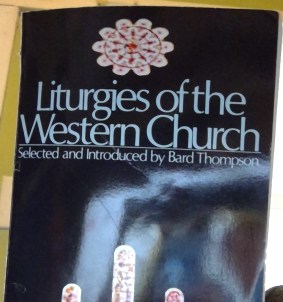
WIN_20191011_12_37_14_Pro

After a short introduction and bibliography (from the perspective of 1961), this book is occupied with introducing and setting out thirteen different liturgies from across Western Christian history (though the first two are not exclusively Western liturgies).

#1 – The First Apology of Justin Martyr (155)

This does not contain a liturgy, exactly, but we find here chapters 65-67 of his Apology, wherein he describes the order of service for the Communion liturgy he knew.  Although it is a brief outline, the basic sequence is clearly discernible, and it is consistent with the liturgical tradition to this day.

#2 – The Apostolic Tradition of Hippolytus (200)

This is an important entry in the annals of history not because of its long-standing influence, but because of its sudden sharp revival in the mid-20th century.  This is the rite from which most of the Rite II Communion Prayers in the 1979 Prayer Book were drawn, as well as the Renewed Ancient Text in the 2019 Prayer Book.  Reading what it actually says, though, allows one to see just what the adaptations are that modern liturgies have made in its name.  I’ll leave it to the reader’s judgment if the term “renewed ancient” is justified or not.

#3 – The Mass in Latin and English (Roman Rite)

The introductory text for this one is particularly lengthy, as befits the long history of the Roman Rite.  What is given in this book was the then-current form of the Roman Rite (as of 1959), making this the Tridentine form Mass just before the reforms of Vatican II kicked in.  The Tridentine Mass is what traditional (Roman) Catholics today really love and yearn for, and what the baby boomer generation stereotypically despises.  This is a useful resource, of course, as it gives insight into one end of Roman Catholic piety.  But its downside is that this is not the form of the Mass that was in use during, or prior to, the Reformation.  So if you want compare & contrast the Prayer Book liturgy with its medieval forebear, this book doesn’t quite provide that.  You’ll have to, instead, rely on Tyndale’s translation of the Mass provided in the Anglican Service Book.  Still, the Latin-English parallels are handy, and the historical introduction gives you a sense of the gradual milieu of change over the centuries.

#4 – Martin Luther’s Masses (1523, 1526)

This is an interesting entry.  The Formula Missa (1523) was in Latin, and Martin Luther intended for it to be used on occasion for educational purposes.  Most of the time, though, the German Mass (1526) was appointed.  Every educated person, after all, learned Latin, and since instructing the laity in the reading of Scripture and promoting education was a Reformation principle, it made sense to hold worship in Latin periodically, so people could connect the familiar vernacular text to the Latin.  The liturgy provided in this book, however, is not a full text of the whole service; it’s a mix of text, rubric, and commentary, so you end up learning more about the German liturgy than digging into its precise text.

#5 – the Zurich Liturgy (1525)

This is the work of Ulrych Zwingli, whose communion theology was, shall we say, problematically radical.  Because he had such a “low view” of Communion, his liturgy is similarly empty when it comes to the Holy Table.  No sacrament, no consecration, just remembering and partaking.

#6 – The Strassburg Liturgy (1539)

This is the work of Martin Bucer, who was a theologian standing somewhere between Luther and Zwingli.  He was respected by John Calvin and finished his life and ministry in England, where he had a particular lasting impact.  His liturgy contains a number of very long prayers (a pattern we’ll see copied later on) but when it comes to celebration of Holy Communion it is suddenly (like Zwingli) quite brief.

#7 – The Form of Church Prayers, Strassburg (1545), and Geneva (1542)

It is John Calvin’s turn, now.  These are two liturgies that are nearly identical, and thus printed in the book with their occasional differences noted in parallel columns.  Again, long prayers precede and follow the Confession, and lead up to the Sermon.  The Communion prayers are also lengthy, quoting 1 Corinthians 11 at length, and exhorting the people to lift their “spirits and hearts on high where Jesus Christ is in the glory of his Father”.  There are further sets of prayers that provide another liturgy that begin to resemble the Prayer Book pattern around the celebration of Holy Communion, but still focused heavily on the words of institution and giving thanks.

#8 – the First and Second Prayer Books of King Edward VI (1549, 1552)

Now at last we reach the English Reformation.  The 1549 liturgy is the most conservative protestant liturgy in this book; you can follow its similarity to the Roman Rite more easily than any other entry.  Its order of prayers around the consecration of the Eucharist are fairly closely followed in the Scottish and American Prayer Book traditions, all the way down to the 1928 Prayer Book and the Anglican Standard Text in the 2019.  The 1552 liturgy does the re-arranging and clipping of the Communion Prayers that sets the stage more clearly for what would standardize in the 1662 Prayer Book.

#9 – the Form of Prayers, Geneva (1556)

John Knox is now the man of the hour.  This liturgy represents one of the primary influences on the English Reformation party in exile during the reign of Catholic Queen “bloody” Mary Tudor.  It seems a bit of a hybrid between the previous Genevan liturgy and the Prayer Book liturgy, but contains some sharp polemic directed against the Papist doctrine of Transubstantiation, revealing its historical context a little too much!

#10 – The Middleburg Liturgy of the English Puritans (1586)

Now we’re getting into the world of Prebyterianism.  The Church of England had restored a Prayer Book similar to where it had left off before Mary’s reign, but the Puritan party was increasingly unhappy with it, and thus this liturgy was born.  The Calvinist, or Puritan, or “Reformed” desire was to simplify, reduce repetitions, and focus more on preaching and quoting Scripture.  This doesn’t mean short though… one prayer for After a Sermon goes on for several pages.  The Communion prayers, of course, are very short, and consciously different from the Prayer Book pattern.  There are also several instances where a rubric directs what the minister is to pray without giving an actual text.  Extemporaneous prayer was another major bullet point on the Reformed agenda.

#11 – The Westminster Directory of the Publique Worship of God (1644)

After the English Civil War, the Puritans had won: the Church of England as previously known was abolished, and Presbyterianism held sway over the country.  Within a couple years, this liturgy was put forth as the new standard.  It’s almost more of a guide than a liturgical text, however, as it mostly tells the order of what is to be done and only provides examples of what the minister is to pray.  Its hostility to the “excesses” of the Prayer Book tradition is clear in its preface.

#12 – The Savoy Liturgy (1661)

When the Interregnum ended and King Charles II returned to the throne of England, the Church of England with its bishops and prayer book also came back out of hiding.  The Puritan party was on the fence about conforming to the Anglican norm, and Richard Baxter, at the Savoy Conference, advocated a more Reformed liturgy in the (vain) hopes that the upcoming 1662 Prayer Book wouldn’t be like its predecessors.  The liturgy found here is an expanded version of what can be seen in the various Calvinist liturgies above, but with more full-text prayers provided, rather than mere examples.  It still falls short of Prayer Book standards, though, providing (for example) no absolution.  Interestingly, its prayers of consecration are the most Anglican of the Calvinist rites so far seen, including this line: “This bread and wine, being set apart, and consecrated to this holy use by God’s appointment, are now no common bread and wine, but sacramentally the body and blood of Christ.”  This indicates a distinction of Calvinist doctrine over again Zwinglian.  Ultimately this barely made a dent in the formation of the 1662 Prayer Book.

#13 – The Sunday Service of the Methodists in North America (1784)

Finally, we come to a liturgy left to the American Methodists by John Welsey.  Seeing little or no ordained Anglican clergymen in the fledgling United States, he felt at liberty to jumpstart a new church movement without episcopal authority or assistance.  Despite that rogue element in his work, what he gave to the American Methodist Church was almost an exact replica of the 1662 Prayer Book.  The Morning Prayer and Communion services are printed in this book, and you’ll see they are almost identical.

The ratings in short:

Accessibility: 4/5
The fact that the various liturgies present themselves in a few different ways makes a quick compare/contrast difficult to make.  But on the whole this is a readable book, not overly technical.

Devotional Usefulness: N/A
This is not a devotional book.  Though if it does it’s job, you’ll want to go grab a Prayer Book and worship!

Reference Value: 4/5
Put this next to your copy of the 1662 Prayer Book and you’ll have a fantastic history of liturgy on your shelf.  Or, because it’s not 1961 anymore, you can just go online and probably find each of these texts freely available.  Still, the introductions and footnotes in this book are useful.
How not to use music in church

Don’t worry, this is not going to be a style-bashing article.  Although we have looked almost exclusively at traditional hymnody on this blog, I have always maintained that there is a place for contemporary songs and styles in the liturgy.  There is more work involved when it comes to discerning the value and use of a new song, if at least because no previous generations have already done that work for us, but I don’t proclaim an “inherent value” of one style over another.  Chant is precious, hymnody is precious, and the various culture-specific expressions of worship music are precious too, at least in their home cultural contexts.

Rather, when I come up with a title “How not to use music in church“, I am concerned with the function of music in the liturgy.  The basic worship-related axiom for us as Anglicans must always be this: the Prayer Book is our liturgy.  Everything else, including music, is brought in to support the frame and plan of worship set out therein.  An opening song is not to “get people in the mood,” but to open the door between heaven and earth; an offertory song is not to “fill time during the collection”, but to reflect on the sermon, or the theme of offering, or begin meditation on the Communion; a closing song is not to “go out with a bang”, but to wrap up the themes heard that morning and/or send the people out into the world to do all the good works the Lord has prepared for them to walk in.  We take our cues from the Book of Common Prayer; it shows us how to worship, and keeps the Scriptures at the forefront, provided we don’t drown it in excessive music (or excessive incense, or excessive spontaneous prayer, or anything else).

To this end, I encourage you to read this article that came up earlier this week: https://www.patheos.com/blogs/ponderanew/2018/04/20/a-call-to-reject-the-orgasmic-worship-experience-and-return-to-liturgy/

I know not everyone will read it, so I’ll give a brief summary.  The author is critiquing the methodology of popular megachurch-inspired “worship”, which uses music in very powerful ways.  He uses the analogy of a sexual experience, where a standard set of five songs works like this:

  1. Set the mood (while people are still settling into the service)
  2. Musical foreplay (building momentum)
  3. Experience ecstasy (the song that goes big and all-out)
  4. Bask in the afterglow (a quiet, restful, meditative song in which to “linger”)
  5. Get up and make breakfast (last song starting gentle but ends with a bang)

Some call this emotional manipulation.  I’ve called it “addict spirituality.”  Whatever you call it, the problem is this: music is used as a substitute not only for liturgy, but for biblical reflection and intellectual participation.  This is worship according to the doctrine of “Sola Feels” as some, snarkier than I, have put it.

Where the article I linked to above falls short, I think, is setting out the clear corrective to the obvious abuse-with-music problem.  The Prayer Book liturgy does have emotional ups and downs, a rise and relax, high points and lows.  The steps of Collect of the Day, Old Testament reading, Psalm, Epistle, Gradual/Sequence music, and Gospel, form an upward movement leading us closer and closer to Jesus, until we plateau at the Sermon and Creed (in whichever order).  Similarly, the Prayers, Confession, and Great Thanksgiving form another upward movement toward the high point of walking up the aisle and receiving Holy Communion.

These can be emotionally-experienced too, but we needn’t force that like megachurch liturgy does with its music sets.  It can be oh-so-tempting for some evangelical Anglicans to mimic the worship forms of their former church homes, or of the large “successful” church down the street.  But we have to remember that this model of worship they put forth is manipulative, sexualized, and encourages addiction rather than devotion.  We would not do well to try to import such practices into our own.  The liturgy already has ups and downs, highs and lows, variations of intensity, which are much more time-tested, much more biblical in pattern, and contain far more Scripture in its prayers and dialogues than a megachurch music set can ever hope to achieve.

Can some of their individual pieces of music find a home in our liturgy?  Absolutely!  But, just as with traditional hymns, the music minister or priest has to use wisdom and discernment to apply the right pieces of music to the right parts of the worship service such that the liturgy is reinforced, not shaken apart.

Here a Proper Preface is normally sung or said.

Following on the heels of the Sursum Corda, the celebrant comes to the Proper Preface.  Together, this whole sequence forms the “Great Thanksgiving” or prefatory prayers of the Eucharistic Canon.  Make sure you read about the Sursum Corda before reading this, so you have the context settled.

The “Preface” is essentially a single-sentence addition to the Great Thanksgiving.  It specifies a particular reason why it is “right, our duty and our joy always and everywhere to give thanks” to God.  It is called a “Proper” Preface because it is proper to a particular occasion or season.

The 1662 Prayer Book offers five Proper Prefaces:

  1. upon Christmas Day, and seven days after
  2. upon Easter Day, and seven days after
  3. upon Ascension Day, and seven days after
  4. upon Whitsunday, and six days after [that’s Pentecost Week]
  5. upon the Feast of Trinity only

Because there were just five, these were provided directly in the liturgy itself, rather than in an appendix after the main text.  This state of affairs continued until the 1979 Prayer Book brought in a larger number of Proper Prefaces to cover every season of the church year.  I’m assuming these are, for the most part, imported from general Western Catholic practice, and not entirely made up by 1970’s Episcopalian revisionists, though I haven’t personally investigated their history.  Feel free to comment if you know!

Remarkably, the 2019 Prayer Book did not roll back this expansion, but actually added to them.  A few from the 1979 book’s list have been removed, but several more have been added, such that we have 34 Proper Prefaces to choose from!  Before the traditionalists chime in with renewed accusations of choose-your-own-adventure liturgies, however, it should be noted that these are not all “choices”, but Proper to particular occasions.  You can read them in full at this link; here I will just list them:

  1. The Lord’s Day (that is, any Sunday between Trinity and Advent)
  2. At Any Time (these two are for your weekday services not celebrating a saint)
  3. At Any Time
  4. Advent (throughout the season)
  5. Christmas (throughout the season, unless it’s one of the major saints’ days)
  6. Epiphany
  7. Presentation, Annunciation, and Transfiguration (some books nickname this Preface “Theophany”)
  8. Lent
  9. Holy Week
  10. Maundy Thursday
  11. Easter
  12. Ascension (all ten days!)
  13. Pentecost
  14. Trinity Sunday
  15. All Saints’
  16. Christ the King
  17. Apostles and Ordinations (including Ember Days)
  18. Dedication of a Church
  19. Baptism
  20. Holy Matrimony
  21. Burial or Commemoration of the Faithful Departed
  22. Penitential Occasions (because of the reference to the temptation of Jesus, this is a good one to use on the First Sunday of Lent!)
  23. Rogation Days or Thanksgiving Day
  24. Canada Day or Independence Day
  25. Remembrance Day or Memorial Day
  26. Common of a Martyr
  27. Common of a Missionary or Evangelist
  28. Common of a Pastor
  29. Common of a Teacher of the Faith
  30. Common of a Monastic or Religious
  31. Common of an Ecumenist
  32. Common of a Renewer of Society
  33. Common of a Reformer of the Church
  34. Common of Any Commemoration

Those last ones, #26-34, line up with the “Commons of Saints” Collects and lessons.

Now for a big question: How do I know which one to use?

The answer is usually simple: look at the Collect for the Day on pages 598-640.  Underneath each one, it will tell you which Preface to use.  Propers 1 through 28 do not note any Preface, which indicates three things:

  1. You can go with the classical prayer book pattern and not use a Preface at all.
  2. You can use the Lord’s Day Preface if it’s a Sunday.
  3. You can use the “At Any Time” Preface if it’s a weekday.

There, simple, all decided.

Perhaps, on very rare occasions, you may find it appropriate to use a Preface that is not normally appointed.  If the congregation (or greater social context) is experiencing a major crisis or a major celebration, perhaps a more penitential or thankful Preface, respectively, will be appropriate.  But on the whole, the Prefaces are not things to play mix-and-match with; they are Propers, just like the Collects and the Lessons, and are to be used as appointed.  They reinforce the liturgy as it stands; to meddle with them on your own is to seize control of the liturgy beyond your pay-grade, O priest!

And, a word of advice to those who publish service programs or bulletins… don’t make it a habit of including the full text of the Preface.  It’s just one sentence, let the people listen to their priest for ten seconds.  Besides, at certain times of year it changes fairly rapidly, and unless you’re really on top of the liturgy yourself you might make an error with it.  Best leave it in the hands of the celebrant and let him take the blame if something goes wrong! 😉

If you peruse other liturgical books, like the ASB, you will find some more beautiful Prefaces that are not included in the 2019 Prayer Book.  The jury is still out if The Saint Aelfric Customary will recommend any such extra Prefaces.

What happened after Malachi?

It’s a classic Sunday School question in evangelical churches when learning about the books of the Bible – “what happened after Malachi?”  Nearly four centuries pass between the last regular prophet, Malachi, and the forerunner of the Christ, St. John the Baptist.  What happened during that time?  Why is the Bible silent about it?

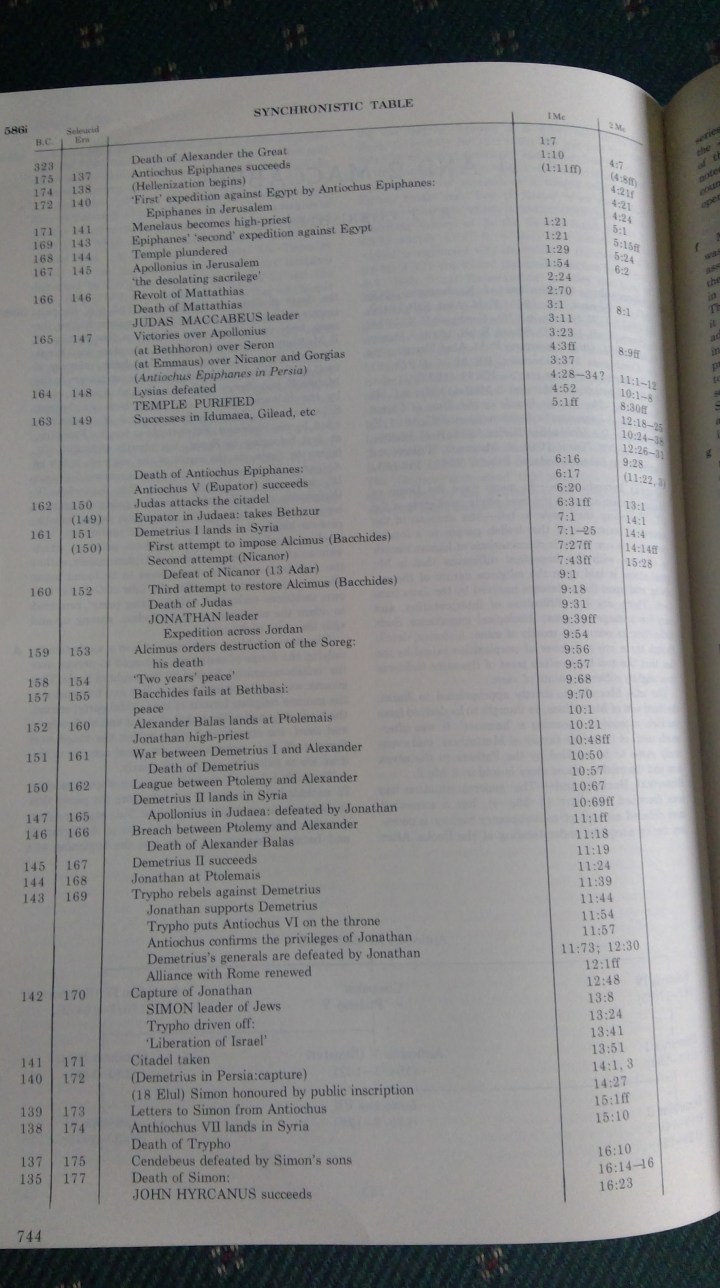
Well, the Bible isn’t entirely silent.  The Church has always had at least two books specifically devoted to relating some of the key historical events between Malachi and the Gospels: 1 and 2 Maccabees.  They cover only a specific 50-year stretch (roughly 175-135 B.C.) but relate some critical goings-on that provide the social, cultural, historical, and even political set-up for making sense of what’s going on in Judea in the 1st century.  Only in the past couple centuries have these books fallen out of Protestant attentions – the King James Bible (like Luther’s German Bible, and probably others) included these books as an appendix between the Old and New Testaments.  For economic reasons, many publishers started omitting those middle books once mass printing picked up speed in the 18th century, such that by the 20th and 21st centuries now, hardly any Protestant Christian is aware of them, let alone familiar with their contents.

If you want to learn more about those books, I have an introductory video and links to a few written articles here.  For now let’s just focus on 1 & 2 Maccabees, which our lectionary is about to start sampling in Evening Prayer.  1 Maccabees was originally written in Hebrew, but survives primarily in Greek, and gives us a lengthy 50-year history of the struggles between the Hellenistic kingdom and the Jews.  2 Maccabees was originally written in Greek, meant to summarize another source (probably working off of something much like 1 Maccabees), and gives us a closer look at the events surrounding the desecration and purification of the Temple.

In a general sense, 1 Maccabees is more historically-minded, giving more information, covering more years, providing less religious commentary.  2 Maccabees is more religious in nature, summarizing events with an eye to exhortation to faithfulness to God.  They work together not unlike how 2 Samuel – 2 Kings play off 1 & 2 Chronicles: a lot of overlap providing different emphases.  The following table shows how the two books line up.

maccabees parallel

Our lectionary does not walk through the entirety of either book, but steps through a few highlights.  (To read them in full would be a significantly more lengthy process, and, for many readers, a great deal more tedious.)  From October 9th through 18th we cover:

  • 1 Macc. 1 = the rise of Antiochus Epiphanes and his profaning of the Temple (the “abomination of desolation”)
  • 1 Macc. 2 = the uprising of Mattathias and his sons
  • 2 Macc. 6 = the violent suppression of Judaism
  • 2 Macc. 7 = a specific story of martyrdom at the hands of the Greeks
  • 2 Macc. 8 = Judas Maccabeus takes his father’s place and continues the good fight
  • 2 Macc. 10 = the purification of the Temple (origin of Hanukkah)
  • 1 Macc. 7 = the next round of Greek invasion and suppression of Judaism
  • 1 Macc. 9 = the death of Judas Maccabeus and succession of Jonathan
  • 1 Macc. 13 = the death of Jonathan and succession of Simon
  • 1 Macc. 14 = the final peace established by treaty under Simon’s leadership

If you have time, it’s worth exploring these books in full, to get the whole story.  There are a lot of new names and places to keep track of (from the perspective of one unused to this period of history), but the benefits can be great.  The entanglements between Jewish authorities and Rome, for example, find their beginning here.  When you realize that the Romans helped save the Jews from the Greeks, and supported Judean independence, it sheds new rays of light on the relationship between the Sanhedrin and Pontius Pilate in the Gospels!

Historical Accuracy in the Bible

This evening we reach Matthew 26, including the Last Supper.  This is a very familiar part of the Gospel for many readers, and yet it can also be one of the most frustrating stories to get straight.

When it comes to identifying the betrayer, according to St. Matthew, the disciples ask “is it I?” and Jesus answers to Judas “yes.”  According to St. Mark, the disciples ask “is it I?” and Jesus says it’s someone who’s eating bread from the dish like he is.  St. Luke doesn’t specify Jesus’ answer to the question.  According to St. John, John and Peter ask who the traitor is, Jesus indicates by giving a piece of bread to Judas, who then leaves, but the other disciples don’t know why.  How do you reconcile this? It’s pretty complicated.

There are several places in the Bible where the level of detail and precision leave the modernist’s desire for strict chronology not a little frustrated.  The underlying reality is that, even when a part of the Bible is labeled “historical”, its purpose is not to relate history, but to reveal God, specifically the person of Jesus Christ, to us.  We preach the Gospel, not history lessons; the unfailing authority of the Bible is not based upon what it has to say about science or about history, but about God and mankind.  Some people get overly hung up over this sort of issue, and we have to assure them that even in those little corners where the Scriptures don’t seem to add up historically or archaeologically or whatever, there is no cause for alarm.

If you want to share a whole video on the subject, feel free:

Readings Review & Planning Propers

What we’re doing on this blog on Mondays is looking back and forth at the Daily Office readings (or lessons) so we can better process together what the Scriptures are saying, and list the recommended Propers for the Communion or Antecommunion service for each day of the week.

Readings Review

Last week: 1 Chronicles 16, 1 Kings 15-19, James 3-5, 1 Peter 1-4:6, Zechariah 9-15, Malachi 1, Matthew 21-24

This week: 1 Kings 20-22, 2 Kings 1-3, 2 Chronicles 20, 1 Peter 4-5, 2 Peter, Jude, 1 John 1:1-2:6, Malachi 2-4, 1 Maccabees 1-2, 2 Maccabees 6-7, Matthew 25-27:56

There’s something appropriate about the convergence of St. Matthew’s Passion this week alongside the reading of selections from 1 & 2 Maccabees.  The suffering of God’s people at the hands of hostile non-believers – that is, martyrdom – is always best understood juxtaposed against the Cross.

You’ll also notice that although Kings & Chronicles are still swapping back and forth from time to time, but less often for the first half of October.  The reason for this is that at the end of 1 Kings and for the first half of 2 Kings there are a lot of stories about the Prophets, rather than of the Kings.  The result of this is that there are more chapters to read from 2 Kings before getting to a period of history where 2 Chronicles has anything to add in.  Of course, if you’re using our Supplemental Midday Lectionary then there are still plenty of “duplicate chapters” in 2 Chronicles to read along the way this month.

Planning Propers

This is the week of Proper 21 (or 15th after Trinity in the traditional calendar), so keep in mind that the historic Prayer Book default is that a mid-week Eucharist will repeat the Collect & Lessons (the propers) for yesterday.  Otherwise, we recommend…

  • Monday 10/7 = Votive *
  • Tuesday 10/8 = Votive
  • Wednesday 10/9 = St. Robert Grosseteste or Votive
  • Thursday 10/10 = St. Palinus or Votive
  • Friday 10/11 = St. Philip the Deacon
  • Saturday 10/12 = Votive

* A Votive is a “Various Occasion” (page 733 in the BCP 2019).  The traditional appointments are Holy Trinity on Sunday, Holy Spirit on Monday, Holy Angels on Tuesday, of the Incarnation on Wednesdays, of the Holy Eucharist on Thursdays, the Holy Cross on Fridays, and of the Blessed Virgin Mary on Saturdays.

Book Review: The Lutheran Service Book

Welcome to Saturday Book Review time!  On most of the Saturdays this year we’re looking at a liturgy-related book noting (as applicable) its accessibility, devotional usefulness, and reference value.  Or, how easy it is to read, the prayer life it engenders, and how much it can teach you.

It’s been a couple weeks but we left off with a couple non-Anglican liturgical books, and today we’re picking that trend back up again with The Lutheran Service Book (2006), which is basically the official liturgical text for the Lutheran Church – Missouri Synod (LCMS).

This book is basically a Prayer Book and Hymnal in one, which is super handy.  What’s strange about it, from an Anglican perspective, is the ordering of its contents.

Introductory Contents:
Church Year, Sunday & Holy Day lectionaries, Dates of Easter, Glossary, instructions for chanting psalms

Most of this makes sense to us, the only oddity is that the Sunday / Holy Day lectionaries are placed up front with the calendar – historically that’s where we would have the Daily Office Lectionary, though the 2019 BCP has all its lectionaries toward the back instead.

Interestingly, this book includes two choices for the Calendar and Sunday lectionary: one is their version of the 3-year Revised Common Lectionary (essentially the same as ours, only minor differences), and the other is the traditional one-year calendar and lectionary (essentially the same as in the classical Prayer Books).  Although I’m not surprised the 2019 Prayer Book didn’t provide both calendar & lectionary options, I kind of wish it had.

The chanting instructions make sense here because the first primary section of this book is:

The Psalms

Yes, all 150 are here, and they’re even pointed for chant!  For example, from Psalm 15:

O Lord, who shall sojourn | in your tent? *
Who shall dwell on your | holy hill?

He who walks blamelessly and does | what is right *
and speaks truth | in his heart.

So that’s pretty useful.  The chant style is very similar to Simplified Anglican Chant, which is great.  Functionally it’s strange that the psalter should be put first like this: this means that you “have to know” where the right worship service starts in the book, increasing the necessary page-flipping.  But in another sense, giving the Psalms place of preference is a theological statement: this is where our worship begins.  Virtually every worship service in the liturgical tradition utilizes the psalms, and biblically they are our greatest model for faithful prayer.

The Divine Service

The next nearly-60 pages are taken up with five “Settings” of the Divine Service, or Holy Communion.  “They have five different eucharistic texts!?” you ask.  Yes.  But they are all extremely similar to one another.

The primary difference between the order of service here and in the 2019 Prayer Book is that this starts with a confession and absolution, rather than placing it after the Prayers of the People.  Setting One’s confession prayer in particular is clearly based upon our confession in the Daily Office.  For the Creed, both the Nicene and Apostles’ are offered.  Two sequences of Communion Prayers are typically offered, one placing the Words of Institution before the Lord’s Prayer, and the other after.  In general, the style and wording of the prayers – particularly the Communion prayers – progress from traditional to contemporary as you look through from Setting One to Setting Five; the last of which sounds the most like the 1979 Prayer Book.

Another fascinating, and consistent, feature of the Lutheran liturgy is the use of the Canticle Nunc dimittis as a Post-Communion praise, just like how the classical Prayer Books employed the Gloria in excelsis.  This has prompted and encouraged me to explore different Canticle options after the administration of Holy Communion in my own church’s worship services, rather than always simply employing a Communion Hymn.

Another curiosity, perhaps marking the most obvious distinction between the five Settings, is the music.  Settings One through Four each have a particular collection of Service Music printed right into them.  This is useful for those who desire to use them, though a bit odd from my observing perspective, as it ties you to particular combinations of musical settings with the variations of prayers.  I assume it’s permissible for them to mix and match text and music, but it just seems an odd way of printing it.  Whateverso, the range of styles are interesting: different forms of chant (some like plainchant, some like Anglican Chant, including the Old Scottish Chant of the Gloria in Setting Three).  Setting Five has no music printed in it, though, preferring the simplicity of spoken liturgy, and indicating a few hymns to sing in place of the standard Kyrie and GloriaSanctus and Agnus Dei.

The Daily Offices

Where the Daily Offices hold pride of place in Anglican Prayer Books, the Lutheran Service Book starts them on page 219, after the Communion settings.  These, too, include musical settings of various Canticles and Psalms right in the text, as well as other chanted parts for the dialogues and blessings and whatnot.  Five Offices are provided: Matins, Vespers, Morning Prayer, Evening Payer, and Compline.  Again this is a “huh?” moment for Anglicans, as Matins & Vespers are the Morning & Evening Offices.

As it turns out, Matins and Morning Prayer are very similar in this book, containing largely the same elements.  Like the Communion Settings, the music and chant is the most obvious difference between the two,   Matins is the most like the Prayer Books’ Morning Prayer; the Morning Prayer in this book lacks the Te Deum and rearranges the prayers after the Canticle.

None of these offices include Confessions or the Apostles’ Creed, which is another difference between this book and our tradition.

Vespers and Evening Prayer are similar to one another, but start markedly different: Vespers more resembling the Prayer Book tradition, and Evening Prayer starting off with that curious “Service of Lights” thing in the 1979 Prayer Book.

Compline is very similar to as it is found in modern Anglican Prayer Books.  I assume, since it was not taken up in most Protestant liturgical books during the Reformation, that it saw the least amount of editing and change in unofficial use, such that when it started to reappear in the late 20th century it had undergone the least amount of denominational divergence.

Other Services and Resources

From here the book includes a collection of other liturgies that a Prayer Book would be expected to have: Holy Baptism, Confirmation, Holy Matrimony, Funeral Service, Responsive Prayers, a Litany, Corporate and Private Confessions & Absolution, Daily Prayer for Families, a Daily Lectionary, table of Psalms for the Offices (though not covering the whole psalter or the whole year), Occasional Prayers, the Athanasian Creed, and Luther’s Small Catechism.  All this is comparable to what one would expect in an Anglican Prayer Book, and much of its contents are recognizably similar to our own.

The first “Other Service”, however, does not have an Anglican counterpart (unless you delve into England’s controversial Common Worship).  It’s called Service of Prayer and Preaching, and it seems to be a what-to-do-on-a-Sunday-morning-when-the-ordained-minister-is-away sort of service.  Opening Verses, an Old Testament Canticle (known to us as #8 Ecce Deus), Scripture readings, dialogued responses, a congregational reading from part of the catechism, Sermon or Catechetical Instruction, (Offertory) Hymn, several Prayers, a New Testament Canticle (known to us as the Pascha Nostrum), and a closing Blessing.

The Hymns

636 hymns follow, arranged by Church Season, Person & Work of Christ, the Christian Church, the Christian Life, other Times and Seasons, additional Service Music, and National Songs.  Naturally there are quite a lot more German Chorales here than in a typical Anglican hymnal (though the 2017 hymnal has quite a few!), and several hymns well-known to us with different arrangements – occasionally entirely different tune settings.  For example Here, O my Lord, I see Thee face to face is set to FARLEY CASTLE instead of PENITENTIA, and At the Lamb’s high feast we sing is set to SONNE DER GERECHTIGKEIT instead of SALZBURG (ALLE MENSCHEN).

The ratings in short:

Accessibility: 3/5
Page-flipping within a particular worship service (especially the Sunday Communion) is minimal.  The main challenge is making sure you know what service you’re actually doing (five Communion rites, remember).  If you’re trying to use this for the Daily Office then things are rather more complex as you have to hunt for the lectionary and psalms with rather more vigor than a typical Anglican Prayer Book.

Devotional Usefulness: 3/5
This book is not the sum total the LCMS expression of Lutheran worship, but all the basics are here.  As Anglicans we could use this book and find a faithful approximation of our own liturgical tradition.  The Communion Prayers are all significantly shorter than ours (even shorter than what’s in the 1662 Prayer Book), but on the whole theologically compatible with ours.  The lack of clarity regarding daily psalmody would be a loss, however.  This book also has a nice collection of hymns that could supplement our own hymnals.  And to be fair, if I was a Lutheran, I’d rate this as either a or a 5, depending upon what I’d thereby know of the historic liturgies before this book.

Reference Value: 2/5
It’s hard to rate this score.  For most of us, we have no reason to pick up the liturgical text of a different tradition, even one so closely-related as the Lutherans.  The similarities of English-language Lutheran worship with Prayer Book worship also makes it clear that they have taken several queues from us.  As such, this Lutheran Service Book is probably best understood as an expression of historic Lutheran worship using the Anglican Prayer Book as a useful filter from time to time.  If you really want to explore historic Lutheran liturgy, you probably have to pick up the Book of Concord or something to that effect.  But I haven’t done that yet.

The Sursum Corda

When it’s time to begin the Communion Prayers, our liturgy begins with a dialogue usually called The Sursum Corda, which is Latin for “Lift up your hearts,” since that’s the first line of the dialogue.

Except it isn’t anymore, is it?

Celebrant: The Lord be with you.
People: And with your spirit.

Yeah, we actually preface the preface dialogue with this salutation.  It’s interesting to note that this is not how it’s always been.  The classical Prayer Books barely ever use that exchange; the preface of the Communion prayers is not one of those places.  It is there in the Roman Rite, and that’s one reason why it’s in our modern liturgies too: a move to return toward general Western liturgical practice.

Another reason for bringing back that salutary exchange is a functional issue: the modern liturgy has a lot of starting and stopping leading up to this point, and a new “start” is needed.  The confession and absolution ended with the Peace, which is often a huge interruption to the liturgy.  Announcements often take place there, which is an interruption to the liturgy.  The offertory is often drawn out with music and the presentation of the elements and all that… the interaction between priest & people in a worship-minded context is all but lost.  “The Lord be with you…” is practically needed to “restart” the worship service at this point.

Classically, the offering would be taken, then the Prayers of the People, Confession, and Absolution followed.  Then the Comfortable Words were read, after which the Priest shall proceed saying, Lift up your hearts.  There was a direct link from the comfort of divine forgiveness to the Communion: “You are fully pardoned and forgiven and Christ, so lift up your hearts and let us give thanks…!”  That context is lost in the modern arrangement of the liturgy.

Celebrant: Lift up your hearts.
People: We lift them up to the Lord.

This, the actual sursum corda, is where the eucharist, or Great Thanksgiving, begins.  We lift our hearts to God, pursuing a sort of ascent from earthly to heavenly matters.  The ministry of the Word has done its work and the ministry of the Altar, or Table, is setting in.

Celebrant: Let us give thanks to the Lord our God.
People: It is right to give him thanks and praise.

Initially, I was heartbroken when the final BCP text was released, and this was the last response from the people.  Clasically that line read “It is meet and right so to do” and our draft liturgies for most of the past few years read “It is just and right so to do“, which I thought was an excellent modernization of the traditional text.  Why did this matter to me?

It is just and right so to do. / It is right to give him thanks and praise.

The message is the same but the emphasis is reversed.  The old way emphasized the properness, fittingness, rightness, that we ought to give thanks to God.  The new way emphasizes the thanks and praise we are to offer.  Look at what the priest says next:

It is right, our duty, and our joy, always and everywhere to give thanks to you, Father Almighty, Creator and heaven and earth…

There we see the rightness of giving thanks to God spelled out clearly.  So between the priest’s two lines (let us give thanks and it is right) the whole message is present.  What falls to the people is to repeat and reinforce one or other part of that whole; the old way emphasized what the priest was about to say next; the new way emphasizes what the priest just said.  In that light, my initial sense of indignation over the last-minute change has been somewhat ameliorated.  In the 1979 Prayer Book, the whole section almost completely lost the “rightness” aspect of giving thanks to God, leaving only joy and love – which is still biblical, but incomplete, as worship is not just invited but commanded in the Scriptures.

Anyway, all this is just the beginning, what follows next is the Proper Preface, which is basically a sentence of purpose – a reason why we should give thanks to God.  The classical Prayer Book tradition had just a few Prefaces for certain holidays, and most of the year would skip it, but modern liturgies have promulgated ever-larger collections of Prefaces that may be used.  We’ll look at those next week, but I mention them now because they complete the thought that is begun here.

Leading up to All Saints’ Day

There are three major feast days in October, in the modern calendar, and with All Saints’ Day on November 1st we get a pretty close succession of four holidays in close proximity.

This unusually “thick” part of the calendar actually make for an excellent introduction to why we have Saints Days at all in the Anglican tradition.  Even though it’s been a staple of the Prayer Book order since Day One, there are many life-long self-identifying Anglicans who know almost nothing about the purpose of these holidays, and are even uncomfortable with talking about “saints” at all.  This is a real shame!  The discipleship value, not to mention spirituality, is great, and to lose this part of our tradition leaves a gap that can only be filled with lesser things.  So if you need or want an introduction to why we celebrate saints days, or know someone else who needs such an explanation, here’s an article using the next four holy days as an example: https://leorningcniht.wordpress.com/2016/10/31/the-testimony-of-the-saints/

In the meantime, consider yourself reminded of the upcoming holy days:

  • Friday the 18th is St. Luke’s Day
  • Wednesday the 23rd is St. James of Jerusalem’s Day
  • Monday the 28th is Sts. Simon & Jude’s Day
  • Friday the 1st of November is All Saints’ Day, which the calendar permits may also be celebrated on the Sunday immediately following (see page 688 of the BCP 2019).  This is one of the last vestiges of an Octave – wherein the holy day continues its observance for a full week after its official date.

The Offertory Sentences

One of the stranger experiences for someone accustomed to the 1979 Prayer Book (or similar resources), going into the 2019 book, might be the Offertory.  It’s handled pretty much the same in this book as the 1979: the prayer over the offering is hard-wired into the main text of the liturgy, which is a minor change, and probably not too jarring to adapt to.  But when you flip the pages over to the list of Offertory Sentences, that’s where things might get weird.

You see, the 1979 Prayer Book has a reputation for being absolutely drowned in choices.  Several Eucharistic Rites, contemporary and traditional language versions of the Offices and Collects, countless “_ or _” prayers, you name it, the 1979 book is full of options.  And its list of 8 Offertory Sentences and 1 “bidding” to choose from for the Celebrant to read at the beginning of the Offertory seemed like plenty of choices (page 376-7 of that book).  But turn to page 149 in the 2019 Prayer Book and you find twenty Offertory Sentences to choose from, spanning three pages!  What gives, 2019?  We thought the liturgy was getting more streamlined and simple, why so many choices?  And why for such a paltry moment in the liturgy?

As usual, the answer can be found with quick consultation with the classical prayer books.  Take up the 1662 Prayer Book, flip to the appropriate portion of the Communion liturgy (page 241 in my Cambridge Press copy, I don’t know how standardized they are), and you find that the Communion Sentences are printed right into the primary text of the service, not in an appendix after.  And there are twenty of them!  (Interestingly, not quite the same twenty.)  The 1662 rubric for their use is as follows:

Then shall the Priest return to the Lord’s Table, and begin the Offertory, saying one or more of these sentences following, as he thinketh most convenient in his discretion.

This sounds rather like the handling of the Opening Sentences in the Daily Office, which also have undergone a radical re-purposing since at least 1928.

The 2019 Prayer Book, meanwhile, calls for only “one of the provided sentences of Scripture.

Chances are that most celebrants will continue saying one of the three or four that they’d memorized from the 1979 Prayer Book’s shorter list, and not give this any more thought.  And that’s okay.  But it’s worth exploring this renewed list of Offertory Sentences.  Like the Comfortable Words they may feel redundant in function, but when taken seriously they can provide an excellent “bible study” on giving, generosity, and charity.  Our rubrics technically don’t permit us to read more than one, not that I can imagine any bishop telling us off for violating that, so perhaps the best way to go about exploring these with the congregation is using them on a rotation, week by week.  These sentences exist in our liturgy, after all, not just to “kill time” or warn people that the money plate is coming, but actually to teach them about the spiritual discipline of charity, alms-giving, or tithing.

Just for kicks, let’s make a text-based Venn Diagram comparing the 1662 and 2019 lists:

1662 only: Psalm 41:1, Proverbs 19:17, Tobit 4:7b, Luke 19:8, 1 Corinthians 9:7, 1 Corinthians 9:11, 1 Corinthians 9:13-14, Galatians 6:6-7, 1 Timothy 6:6-7, 1 Timothy 6:17-19.

1662 & 2019: Tobit 4:8-9, Matthew 5:16, Matthew 6:19-21, Matthew 7:21, 2 Corinthians 9:6-7, Galatians 6:10, Hebrews 6:10, Hebrews 13:16*.

2019 only: Deuteronomy 16:16-17, Psalm 50:14*, Psalm 96:8*, Matthew 25:40, Luke 10:2, Acts 20:35, Romans 10:14-15, Romans 12:1*, 2 Corinthians 8:9, Ephesians 5:2*, 1 Peter 2:9, 1 John 3:17.

The 1928 Prayer Book has sixteen Sentences, not simply a reduction from the 1662 list, but supplying new verses – some of which are preserved in subsequent books, and two which are unique to it but are now found in our post-Offertory prayer: 1 Chronicles 29:11* & 14.

* These are the eight listed in the 1979 book, in addition to the following: Matthew 5:23-24, Revelation 4:11.  Interesting that that book had only one Sentence in common with the 1662 list.

If at all possible, take up a copy of the 1662 Prayer Book, though, and read through its Offertory Sentences in its printed order.  It’s not just a list thrown together (which I think is likely the case with ours), but the progression from one to the next is logical, ideas building from one to the next.  With only a little finesse, you can make the whole “list” into a coherent Exhortation!