The Rogationtide Collects

Yesterday, today, and tomorrow are the Rogation Days – days devoted to prayer for the year’s crops.  We’ve mentioned ‘Rogationtide’ briefly recently.  Now that they’re here, let’s narrow in on the liturgical feature of these days that is the most natural to into our daily rounds of prayer: the Collects of the Day.  (We can, and probably ought to, use these as the Collect of the Day in Morning and Evening Prayer on these three days.)

Almighty God, Lord of heaven and earth: We humbly pray that your gracious providence may give and preserve to our use the harvests of the land and of the seas, and may prosper all who labor to gather them, that we, who are constantly receiving good things from your hand, may always give you thanks; through Jesus Christ our Lord, who lives and reigns with you and the Holy Spirit, one God, for ever and ever. Amen.

This Collect reflects the more historical form of the Rogation Days.  It is not the same as the Collect in the 1928 Prayer Book, but takes a rather more expansive view in its petition, now praying for the harvest of land and sea, God’s gift and preservation of both, the prospering of those who labor in those harvests, and for our own sense of thankfulness.

But nowadays the majority of our population aren’t farmers or fishermen, so we’ve got a second Collect for other forms of employment:

Almighty God, whose Son Jesus Christ in his earthly life shared our toil and hallowed our labor: Be present with your people where they work; make those who carry on the industries and commerce of this land responsive to your will; and give us all a right satisfaction in what we do, and a just return for our labor; through Jesus Christ our Lord, who lives and reigns with you, in the unity of the Holy Spirit, one God, now and for ever.  Amen.

This Collect is a good expression of a biblical theology of work.  We recognize Jesus’ sharing in our labor (implying his decades as a carpenter with St. Joseph), the need to be responsive to God’s will in the workplace (that is, being a faithful worker, judging by several parables of Jesus), a healthy satisfaction in our labor (understanding we were made for work), and a just return (the biblical injunctions concerning paying workers properly).  On their own, any of these four elements of the prayer could be twisted – the first to insubstantial piety, the second to undirected zeal, the third to idolatry, and the fourth to un-tethered social justice championship.  But collected together they form a healthier balance of biblical teaching concerning work and labor and employment.

So make sure you make use of these prayers today and tomorrow! Perhaps one in the morning and one in the evening?  Or both each time?  If you’re a teacher/preacher, that second Collect can also make excellent Bible Study material, especially if you bring up the Scripture readings it’s paired with: Ecclesiasticus 38:27-32, Psalm 107:1-9, 1 Corinthians 3:10-14, and Matthew 6:19-24.
Eastertide: 40 days or 50?

The length of the Easter season is one of those subjects that can start internet fights.  Some say it’s 50 days long, beginning on Easter Day and ending on the Day of Pentecost.  Others retort that it’s 40 days, beginning on Easter Day and ending with the Ascension.  Meanwhile, perhaps the majority of church-goers look on in bewilderment or bemusement.  Why does it matter?  What’s the big deal?  Surely there are bigger fish to fry.

Let’s explore this debate in chronological order, so we can see how this disagreement came about, and why it matters to those who argue about it.

The Classical Prayer-Book Tradition

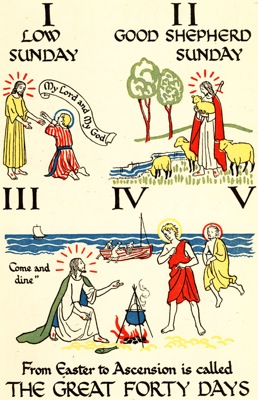
The changing of the seasons were not marked out quite so overtly in the old prayers books as they are in the new.  The Sunday Collects and Lessons were not typically marked out into season-based sections like they are in the 2019 book, so you had to rely upon the specific “name” of each Sunday, and the short list of Proper Prefaces early in the Communion prayers.  In both cases, Easter and Ascension are treated separately.  This sets out a demarcation: Eastertide ends when Ascension Day kicks in.  Thus we get images like this from Enid Chadwick’s beloved bookMy Book of the Church’s Year:

19

Note, “THE GREAT FORTY DAYS”… that’s Eastertide.

The emphasis this takes is on the gospel narrative of events: Jesus was raised from the dead, met with his disciples at various times, and ascended to the right hand of the Father 40 days later.  This also lines up the calendar with the Apostles’ Creed: “the third day he rose again; he ascended into heaven, and is seated at the right hand…”  In the ascension we see Jesus as Priest, making intercession for us, and Jesus as King, seated at the right hand of God.  It is a festal season, and closely related to Easter, but it takes on a theological emphasis that is distinct from Easter before it and Pentecost after it.

The Modern (or modernist?) Prayer-Book Tradition

The 1979 Prayer Book (and probably others like it) changed this up quite dramatically.  First of all, the name “Sunday after the Ascension” was changed to “the 7th Sunday of Easter”.  Ascensiontide still got its own Proper Preface, but a new feature of the liturgy – the opening acclamation – was provided for various seasons of the year, and the Easter acclamation (Alleluia, Christ is risen / The Lord is risen indeed, alleluia!) was appointed for the entire stretch from Easter to Pentecost.  Ascension Day and Ascensiontide were not removed from the calendar, but they were rolled into the Easter season, turning “the great forty days” into “the great fifty days.”

Now, there is a biblical precedent for this perspective: two of the primary Old Testament feasts (Passover and Tabernacles) are fifty days apart, and became the Christian Easter and Pentecost.  By emphasizing the fifty days, instead of the forty plus ten, the new calendar system highlights the Old Testament precedent for the Gospel.

The 2019 Prayer-Book Tradition

What we receive in the 2019 Prayer Book is something of a mixed bag when it comes to the length of Easter.  As usual, Ascension still has its own Preface.  Like the 1979 book, Ascensiontide has no acclamation of its own; it still gets the Easter call-and-response.  But the name of the Sunday in this season is back to “The Sunday after Ascension,” so there’s room for debate if it counts as Easter or not.  Room for debate, that is, until you read the calendar rubrics on page 689.  When discussing days of discipline, denial, and special prayer, it says:

The weekdays of Lent and every Friday of the year (outside the 12 Days of Christmas and the 50 days of Eastertide) are encouraged as days of fasting. Ember Days and Rogation Days may also be kept in this way.

This rather seals the deal: the 2019 Prayer Book sets forth a 50-day Eastertide.

HOWEVER,

Unlike the 1979 Prayer Book, there is a nuance, or a balance: the 7th Sunday of Easter is not “the seventh Sunday of Easter,” but the “Sunday after the Ascension.”  So although the “season” is still “Eastertide” in one sense, it has entered into a different phase: new Sunday nomenclature, new Proper Preface.

So if you’re a “50 days of Easter” kind of person, pay this balance (not to mention our historical tradition!) more careful attention.  We are apparently encouraged to use the 50-day language, according to our calendar rubrics.  But the Sunday after the Ascension is informed more by Ascension Day than by Easter Day.  Whether you call that ten day period the last part of Eastertide or Ascensiontide, be sure to afford it the distinct theological and Gospel-narrative emphasis it was meant to communicate.  On that Sunday, tell people “Christ is risen!” is no longer just about his resurrection, but about his rising bodily into heaven.  Make sure the Easter songs and hymns give way to songs and hymns about the ascension of Christ.  Crown him with many crowns and Hail the day that sees him rise are perhaps the two most famous examples.

If you want to read more about Ascension Day and its mini-season (or subset of Easter, if you insist), click here!  In my experience this is one of the most under-rated parts of the church year, and it has much to offer.

Next week: Rogation Days

Today’s entry is just a reminder: the Rogations Days are next week, on Monday, Tuesday, and Wednesday.  This coming Sunday is nicknamed Rogation Sunday, as a result.  If you look at a church calendar (or at least, a traditional one) the Rogation Days stand out like a sore thumb – three purple days in a sea of white.

What’s rogation?  Well, rogare is Latin for ask, so a rogation day in the church is a day of prayer.  The rogation days, specifically, are days of prayer and fasting for the year’s crops.  The major time for the sewing and planting of crops is already done, in many climes of the Northern Hemisphere, so this is a point when farmers have done most of what they can, as the Scriptures say “one plants, another waters, but God gives the growth.”  So we stop and pray that God will protect and prosper the crops.

In recent centuries, as Western Christendom has moved out of agriculture-dominated economy and culture, the Rogation Days have taken on additional layers of prayer to cover other forms of business and industry.

Unless your church has a weekday communion service on Monday, Tuesday, or Wednesday, it’s pretty easy for these days to slip by year by year, invisible to the vast majority of Christians.  One of the easiest ways to keep the spirit of Rogationtide is to grab a hymn appointed for Rogation and sing it on the 6th Sunday of (or 5th Sunday after) Easter.

Commemorating the Martyrs of Sudan

May 16th is noted, in our calendar of commemorations, not for a particular saint, but for a whole group: the Martyrs of Sudan.

Originally, this date was chosen to commemorate this group of martyrs because on this day in 1983 the Anglican leaders in Sudan made a public stand for the faith, knowing that under Sharia Law they were destined for execution.  And in the two decades of civil war that followed, millions lost their lives for Christ.  A further wave of attacks against Christians swept the country in 2011, soon before South Sudan was separated as a new (and Christian-friendly) country.

Many of the Sudanese bishops who survived the wars lived in exile; most of the clergy ministered without pay.  Hardly a church building was left standing.  To this day, rebuilding destroyed communities and healing broken families and lives is a massive effort.  The Sudanese diaspora across the world, including in the United States, also need prayer, ministry, healing, and new life rebuilding.

But the blood of the martyrs has been fruitfully sown: the population of South Sudan has gone from 10% Christian in the 1990’s to 60% Christian in 2012, the majority of whom are Roman Catholics and Anglicans.

As this is a mere commemoration in our calendars, there are no major changes to our daily round of worship, unless you hold a Communion or Antecommunion service for this day.  But we can add a Collect to the additional prayers at the end of the daily office, like this one:

Almighty God, you gave your servants in Sudan boldness to confess the Name of our Savior Jesus Christ before the rulers of this world, and courage to die for this faith: Grant that we may always be ready to give a reason for the hope that is in us, and to suffer gladly for the sake of our Lord Jesus Christ; who lives and reigns with you and the Holy Spirit, one God, for ever and ever. Amen.

We could also make a point of praying the Great Litany today with the Sudanese church and diaspora in mind.

Sources:

http://www.satucket.com/lectionary/Sudan.htm

http://50days.org/2013/05/the-martyrs-of-sudan-yesterday-today-tomorrow/

https://en.wikipedia.org/wiki/Christianity_in_Sudan#Persecution_of_Christians_in_Sudan

Pray for others’ dioceses

The Anglican Diocese in New England just held their annual clergy conference a few days ago.  The Diocese of CANA East is holding the annual synod in the coming week or so.  The ACNA provincial assembly is about a month away.  It strikes me as likely that other dioceses are having significant events around this time of year also.

Hearing about these events can (or should!) help spur us on to further prayer for one another.  It may be “too late” for me to pray for my diocesan events, but I can always pray for others.  We’ve got some lovely and thoughtful prayers in our Prayer Book that probably lie fallow much longer than they ought.  Think about what others are up to, and lift up these prayers for them!

  1. FOR A PROVINCE OR DIOCESE

O God, by your grace you have called us in this Diocese to be a good and godly fellowship of faith. Bless our Bishop(s) N., and other clergy, and all our people. Grant that your Word may be truly preached and truly heard, your Sacraments faithfully administered and faithfully received. By your Spirit, fashion our lives according to the example of your Son, and grant that we may show the power of your love to all among whom we live; through Jesus Christ our Lord. Amen.

  1. FOR A PROVINCIAL OR DIOCESAN CONVENTION OR SYNOD

Almighty and everlasting God, by your Holy Spirit you presided in the council of the blessed Apostles, and you promised, through your Son Jesus Christ, to be with your Church to the end of the world: Be with the council of your Church assembled [here] in your Name and presence. Save us from all error, ignorance, prejudice, and pride; and of your great mercy direct, sanctify, and govern us in our work, by the mighty power of the Holy Spirit; that the order and discipline of your Church may be maintained, and that the Gospel of Christ may be truly preached, truly received, and truly followed in all places, breaking down the kingdom of sin, Satan, and death; till all your scattered sheep, being gathered into one fold, become partakers of everlasting life; through the merits and death of Jesus Christ our Savior. Amen.

  1. FOR A PROVINCIAL OR DIOCESAN CONVENTION OR SYNOD

Gracious and everliving Father, you have given the Holy Spirit to abide with us for ever: Bless, we pray, with the Holy Spirit’s grace and presence, the Bishop(s), Priests, Deacons, and all the Laity who assemble in your Name; that your Church, being preserved in true faith and godly discipline, may fulfill the will of him who loved her and gave himself for her, your Son Jesus Christ our Savior; who now lives and reigns with you and the same Spirit, one God, now and for ever. Amen.

  1. FOR VESTRY AND CHURCH MEETINGS

Almighty and everliving God, source of all wisdom and understanding, be present with those who take counsel [in ______] for the renewal and mission of your Church. Teach us in all things to seek first your honor and glory. Guide us to perceive what is right, and grant us both the courage to pursue it and the grace to accomplish it; through Jesus Christ our Lord.  Amen.

  1. FOR THE SELECTION OF A BISHOP OR OTHER MINISTER

Almighty God, giver of every good gift: Look graciously on your Church, and so guide the minds of those who shall choose a Bishop for this Diocese that we may receive a faithful pastor who will preach the Gospel, care for your people, equip us for ministry, and lead us forth in fulfillment of the Great Commission; through Jesus Christ our Lord. Amen.

Praying with St. Julian of Norwich

Today’s entry in the calendar of commemorations is St. Julian of Norwich.  Two quick clarifications are in order.  First, Julian is (in this case) a woman’s name.  Second, the W in Norwich is silent, so pronounce it ‘norrich’.  (Sorry, I had an history professor in college who heavily pronounced the W all the time, and it was ridiculously embarrassing.)

Saint Julian of Norwich was an ordinary medieval woman of some social status and means.  She was born in England around 1342, and had a severe illness at thirty in which she received last rites and had a series of sixteen visions of Christ.  She wrote about her visions, Revelations of Divine Love, shortly afterward, and near the end of the century wrote a longer treatise explaining them in greater detail.

For most of her life, after her near-death experience, she lived as an anchoress.  An anchorite (male) or anchoress (female) is sort of a cross between a monastic and a hermit.  As the name suggests, one is anchored to the spot, living in a small cell block attached to a church.  As an anchoress, therefore, she lived simply, singly, on the charity of others.  She had a window into the church building through which she could hear Mass and receive Communion, and a window to the outside through which she could speak with visitors and offer spiritual wisdom and advice.  Near the end of her life she was visited by another medieval woman who came to be remembered as a Saint, Margery Kempe.

You can read more of about her life here.

Apart from her name appearing in our calendar, St. Julian shows up in one other place in our Prayer Book: the Occasional Prayers section.  There, prayer #92 on page 673 reads:

O God, of your goodness, give me yourself, for you are enough for me. I can ask for nothing less that is completely to your honor, and if I do ask anything less, I shall always be in want. Only in you I have all. Amen.

In this Customary’s recommended rotation of praying these Occasional Prayers every two weeks, I came across this prayer on the day after Ash Wednesday, and immediately took a liking to it.  In my own emotional and spiritual life at that point, I badly needed to refresh a sense of satisfaction in Christ alone.  Words like “for you are enough for me” and “Only in you I have all” are expressions of faith and trust and reliance that I needed to meditate upon, and so this little prayer became a quiet theme for me throughout Lent.  It wasn’t seasonally appropriate one way or the other, it had no connection to the liturgy as such, it was simply a piece of my private devotions for a few weeks.  This is legitimate and good; the classical three-fold rule of worship identifies private devotions as necessary to the Christian life alongside the daily office and the sacraments.

And yet, common prayer, or at least a Prayer Book, can aid us in our private devotions.  The 123 Occasional Prayers offered near the back of our Prayer Book include over 20 labelled as being for Personal Life or Devotion.  This means that 1, they aren’t meant for common worship as such, and 2, some will befit your prayer life better than others.  There are some in there that I actually rather dislike.  But my opinions will change with my mood and spiritual condition over time, I’m sure, and St. Julian’s prayer may not minister to me as profoundly in another year.

So I encourage you to explore these prayers for your own prayer life, and explore the people commemorated in our calendar.  You never know who and what the Holy Spirit will use to minister to you both within and apart from the liturgy!

Hymn: At the lamb’s high feast

Easter is one of those holidays, like Christmas, that has some really famous, really well-loved, really satisfying hymns to sing.  Jesus Christ is ris’n today or its twin, Christ the Lord is ris’n today, are so classic I’m tempted to say “Easter just wouldn’t be Easter without singing that song!”  There are, of course, many other Easter hymns of lesser fame that are quite fantastic for the holiday, and one of my favorites in that middle category is At the lamb’s high feast we sing.  Set to the tune SALZBURG, it bears a grandeur both lyric and melodic that deserves higher praise than it usually seems to get.

At the lamb’s high feast we sing
Praise to our victorious King,
Who hath washed us in the tide
Flowing from his pierced side;
Praise we him, whose love divine
Gives his sacred blood for wine,
Gives his body for the feast,
Christ the victim Christ the priest.

That first stanza sets us firmly in the Easter celebration, makes a baptismal reference (as is traditional in the Easter celebrations), and then moves seamlessly to a eucharistic reference.  I especially appreciate how his sacrifice is described in the active sense: he gives his blood and body; he’s not just Christ the victim, but also Christ the priest!  This is, in my opinion, an emphasis that we often lack when discussing the atonement.

The second stanza continues:

Where the Psachal blood is poured,
Death’s dark angel sheathes his sword;
Israel’s hosts triumphant go
Thro’ the wave that drowns the foe.
Praise we Christ, whose blood was shed,
Paschal victim, Paschal bread;
With sincerity and love
Eat we manna from above.

The baptismal and eucharistic references remain, but are couched in more overtly Old Testament imagery, invoking the Passover and the Crossing of the Red Sea as the foreshadowings or prototypes of these two Sacraments of the Gospel.  It even manages (in the last two lines of this stanza) to reference the Easter Anthem (The Pascha Nostrum) and invoke the context of the teachings of 1 Corinthians 10, linking the Old Testament (particularly Exodus) waters and manna images to the New Covenant sacraments.

Mighty victim from the sky,
Hell’s fierce pow’rs beneath thee lie;
Thou hast conquered in the fight;
Thou hast brought us life and light;
Now no more can death appall,
Now no more the grave enthrall;
Thou hast opened paradise,
And in thee thy saints shall rise.

The brief Passover reference at the beginning of stanza 2 – the sheathing of the destroying angel’s sword – is explored here in full force.  The death and resurrection of our Lord Jesus Christ has brought about a great victory.  Jesus is a “mighty victim from the sky”, yet, “Hell’s fierce powers” lie beneath him.  He has conquered, he has brought us from death to life, and those evils can never reign over us again; the hope of our own resurrection to eternal life is sealed for sure.

This leads the hymn to a great doxological ending:

Easter triumph, Easter joy,
Sin alone can this destroy;
From sin’s pow’r do thou set free
Souls new-born, O Lord, in thee.
Hymns of glory, songs of praise,
Father unto thee we raise;
Risen Lord, all praise to thee
With the Spirit ever be.  Amen.

That second line always bugs me – “sin alone can this destroy“… It is obviously meant that sin is the object, not the subject, of the verb destroy: Easter triumph and joy alone can destroy sin.  But there’s just no decent way to get the word order sorted out with perfect clarity without destroying the rhyme scheme of the lyrics.  You just have to roll with the poetry, which we moderns and post-moderns are not generally very good at doing.  Getting over that shortcoming in ourselves, however, this is a logical and fitting apex for the hymn.  Christ’s victory is over sin itself, and in his Gospel we find freedom.  And thus we praise the triune God, Father, Risen Lord, and Spirit.

There’s still plenty of Easter Sundays left… get it into your congregation’s hands if you haven’t already!  It works as a communion hymn, offertory/doxology hymn, processional, recessional… nearly anywhere in the liturgy where singing can be found!

The Prayer Book (2019) is Online

Have you heard the news?  BCP 2019 in its final form, page numbers and all, was put online and officially announced during Holy Week.  I would have mentioned it here that day, but Notre Dame Cathedral’s roof was burning, and amidst all the other goings-on both in world events and in liturgical matters, there just wasn’t a good opportunity to say here “oh by the way, habemus librem!”  (Pardon the Papist joke.)

Anyway… the official website is here: http://bcp2019.anglicanchurch.net/

The Home tab doesn’t have much to say; just a couple quotes and a button to the text/download page.

The Text tab is where you can download the whole book as a pdf, or any of its twelve parts as either a pdf or a Word document.

The Purchase tab doesn’t contain any links for ordering books yet; that won’t be available until June.  But it does show the two options that are in the works – a standard pew edition and a leather covered edition with four ribbons.

The History tab provides a brief outline of Anglican history, particularly noting the Prayer Book tradition leading to where we are today.

The Resources tab, finally, has a couple articles and a video about the new version of the liturgies of the church, as well as buttons to other pages that provide bulletin leaflets for the Communion service throughout the three-year cycle, and another button to “miscellaneous” resources.  These include a bunch of bits and pieces that the old Texts for Common Prayer page housed, such as translations into other languages, supplementary liturgical resources, study notes and reports from the liturgical task force, and some other reference articles that explain some of the features of the liturgies that might raise questions in some quarters.

If you find yourself critical of something in the 2019 BCP, or even just unsure and curious, be sure to peruse that Resources page in case your issue is already addressed there!

Easter Week, Old & New

It’s a little unfair to run a comparison between Easter Week in the traditional Prayer Books and the modern ones; the major difference is that before the great revision of the 1970’s Easter Week only contained two special weekdays – Monday and Tuesday – while the new books have special a Communion service for each day through Saturday.

I can’t help but wonder how many Anglican (or Episcopalian) churches actually take advantage of all six weekdays between the first two Sundays of Eastertide.  After all, the prevailing opinion after the rigors of Holy Week and Easter Day seems to be along these lines:

Facebook-Proposed-addition-to-the-Book-of-c071c1[1]
this makes the rounds on the internet every year; this copy is from https://me.me/i/mondays-facebook-proposed-addition-to-the-book-of-146408
Whateverso, whether it’s two days or six, we have a Prayer-Book-authorized tradition of continued celebration after Easter Day.

The traditional Easter Monday’s Collect is as follows:

O God, whose blessed Son did manifest himself to his disciplines in the breaking of bread; Open, we pray thee, the eyes of our faith, that we may behold thee in all thy works; through the same thy Son Jesus Christ our Lord.  Amen.

It was paired with a reading from Acts 10:34-43 and Luke 24:13-35.  In the modern calendar the same Collect and Gospel show up on Easter Thursday, which I assume is due to its eucharistic theme – providing an echo of Maundy Thursday a week later.  Instead of Acts 10, however, Acts 3:11-26 is paired with with the Gospel & Collect, replacing Saint Peter’s teaching to Cornelius with his sermon about the fulfillment of the prophets in Jesus Christ, which still matches up with Jesus’ teaching in the Gospel reading – perhaps even more succinctly.

The traditional Easter Tuesday has the same Collect as the modern Easter Monday – that we who celebrate the Paschal feast may be found worthy to attain to everlasting joys.  The readings are completely different, however.  The traditional appointment is Acts 13:26-41 and Luke 24:36-48 (Paul’s preaching and Jesus’ second appearance, to all the eleven on Easter evening).

The logic of the traditional calendar is an interesting mix of continual build-up and topical array.  The Gospel readings are both from Luke 24, following the course of the afternoon and evening of the first Easter Day.  The readings from Acts chime in with apostolic preaching that spells out the singularity of salvation in Christ.

The modern Easter Week, however, looks like this:

Monday: Acts  2:14,22-32 (Peter’s first sermon of OT background for Christ)
Matthew 28:9-15 (Jesus sends the women to the disciples, soldiers are given hush money)

Tuesday: Acts 2:14,36-41 (Peter’s first sermon, calling for repentance and baptism)
John 20:11-18 (Jesus speaks with Mary Magdalene in the garden)

Wednesday: Acts 3:1-10 (Peter & John heal a lame beggar)
Luke 24:13-35 (Jesus with two disciplines on the road to Emmaus)

Thursday: Acts 3:11-26 (Peter’s second sermon, identifying Jesus as the greatest prophet)
Luke 24:36-49 (Jesus with the disciples on that first evening)

Friday: 1 Peter 1:3-9 (Peter’s greeting of joy in Christ despite trials)
John 21:1-14 (Jesus visits seven disciples going fishing)

Saturday: Acts 4:1-22 (Peter and John defend their faith in Jesus before a Jewish council)
Mark 16:9-20 (St. Mark’s quick summary of post-resurrection events)

The emphasis, for both readings, is on continuity of story.  The Gospel readings follow closely (though not quite exhaustively) the narrative of the rest of Jesus’ resurrection day, and then moves on through most of his post-resurrection appearances.  A couple major omissions can be identified, such as the story of Thomas’ denial, but those are generally covered on the following two Sundays (as well as a bit of overlap with the Gospels read in this week).  The first lesson focuses on the beginning of Acts, especially the earliest examples of apostolic preaching.  There is a tradition that the modern lectionary takes very seriously of reading the book of Acts through the Easter season.  I cannot account for the reason behind this, exactly (why not start this at Pentecost, for example?) but it is a prominent feature of the Eastertide lectionary entries.

A cynic might accuse the modern Easter Week of destroying the Prayer Book tradition’s take on Easter Monday and Tuesday.  A more charitable take on the modern form, however, would be that the traditional approach of tracing the post-resurrection stories of Jesus and the apostolic preaching in Acts has simply been expanded from two days to six.  The topic coherence is lessened (especially the old Eucharistic focus on Easter Monday), but the scriptural coverage is widened.

And, of course, a real question to ask before even trying to get into a debate between old and new here is who’s actually going to church during Easter week?  Does all our planning go into Holy Week such that Easter week days are neglected?  Are we so burned out by the end of the Easter Vigil that we don’t have any energy left to keep up the celebration of the resurrection for another two or six days?  Interesting things to think about.

Before the Vigil

These days, Easter Vigils are super cool and popular.  A lot of churches that hold them end up drawing visitors from other Christian denominations who don’t practice this piece of liturgical tradition.  And hey, who can blame anyone, nowhere else can one find such a broad sweep of Scripture readings proclaiming so much of the Gospel history in the Bible in just one worship service.  Add in the fire and the candles and the dark-and-light drama and the baptisms and the sudden burst of joyful Alleluias, and you’ve got a memorable liturgical experience almost without trying.

I think it’s safe to say that the great majority of Anglicans in this country are happy to have the Easter Vigil authorized and (to some extent) directed in modern Prayer Books.

HOWEVER, this wonderful recuperation of pre-reformation tradition has come with a price: Holy Saturday.  Known as “Easter Even” in the classical prayer books, this was – and technically still is – the official liturgy of Holy Saturday.  In anticipation of the Great Vigil of Easter, many people forget about Holy Saturday, to the point where more and more churches are labeling The Triduum as Maundy Thursday, Good Friday, and the Easter Vigil.  This is incorrect!  The Triduum, as we saw in fair detail a couple days ago here, ends with the Holy Saturday liturgy.  The Vigil is not part of the Triduum.  It’s not even part of Holy Week or Lent, it’s the beginning of Easter.

If you’re excited about attending an Easter Vigil tonight, please do what you can to attend, or pray on your own, the Holy Saturday liturgy first.  You can do it in like five minutes.  Actually, here, I’ll copy the liturgy right here so you can pray it right now!

H O L Y  S A T U R D A Y

There is no celebration of the Eucharist on this day.

The Officiant says: Let us pray.

O God, Creator of heaven and earth: Grant that, as the crucified body of your dear Son was laid in the tomb and rested on this holy Sabbath, so we may await with him the coming of the third day, and rise with him to newness of life; through Jesus Christ our Lord. Amen.

or this

O God of the living, on this day your Son our Savior descended to the place of the dead: Look with kindness on all of us who wait in hope for liberation from the corruption of sin and death, and give us a share in the glory of the children of God; through Jesus Christ your Son our Lord. Amen.

T H E  L E S S O N S

JOB 14:1-14
PSALM 130
1 PETER 4:1-8
MATTHEW 27:57-66

After the Gospel, a homily may follow.

My homily is this: Note that the traditional Collect & Lessons are slightly different from the modern.  The main emphasis difference between traditional and modern Holy Saturday is the baptismal material, which we now have emphasized in the Easter Vigil instead.

The following is then sung or said.

T H E  A N T H E M

Man born of woman has but a short time to live, and is full of misery.
He springs up, and is cut down like a flower; he flees like a shadow,
and never continues the same.

In the midst of life we are in death: of whom do we seek strength, but you, O Lord,
who for our sins are justly displeased?

Yet, O Lord God most holy,
O Lord most mighty,
O holy and most merciful Savior,
deliver us not into the pains of eternal death.

You know, O Lord, the secrets of our hearts; shut not your ears to our prayer;
but spare us, Lord most holy,
O God most mighty,
O holy and merciful Savior,
most worthy Judge eternal,
do not let us, in this our final hour,
through the pain of death, fall away from you.

The Officiant and People together pray the Lord’s Prayer. The concluding doxology is customarily omitted.

The Officiant concludes: The grace of our Lord Jesus Christ, and the love of God, and the fellowship of the Holy Spirit, be with us all evermore.  Amen.