Planning Ahead: Trinity Sunday

Until the revisions of the 1970’s, Trinity Sunday was the hinge of the Church Year.  That was the day the first half of the cycle (Advent through Pentecost) reached its culmination and turning point.  All the revelation about God covered in those seasons find their apex in the doctrine of the Trinity: God is One and Three.  As the Collect of the Day begins:

ALMIGHTY and everlasting God, who has given unto us your servants grace, by the confession of a true faith, to acknowledge the glory of the eternal Trinity, and in the power of the Divine Majesty to worship the Unity…

But this day is also a turning point.  We have not only received this faith throughout the year to confess and worship God, but also:

We beseech thee, that this holy faith may evermore be our defence against all adversities; who livest and reignest, one God, world without end.  Amen.

That is what the season of Trinitytide used to do: unfold like a discipleship course in how this faith may be our defence against all adversities.

I beseech you, readers, if you have the slightest interest in Anglican Prayer Book spirituality and history, to take a look at this essay: http://www.lectionarycentral.com/trinity/Phillips.html  It brilliantly lays out how the season after Trinity served as a multi-layered course of dealing with our chief adversary: sin.  The life and doctrines of Jesus are presented with Epistle lessons that together work to demolish our pride, our lusts, all our vices.  There are, for sure, other ways to analyze the Trinity season, but the general agreement is that it’s an application of the teachings of the first half of the year to help us conform our lives thereto.

It’s popular now to say that the first half of the year is “the story of Jesus” and the second half is “the story of the Church.”  This is wrong.  The first half is the story (or better, doctrines) of God, and the second half is the application of the story/doctrines of God to us.  Trinity Sunday is the hinge: it sums up all the teaching about the Father, Son, and Spirit, and presents it to us to believe, worship, and follow.

Enough with the theory, now for some advice.

how to mark Trinity Sunday

A fairly long-standing tradition, now recommended or encouraged in the general rubrics at the end of the Communion service in the 2019 Prayer Book, is to say the Athanasian Creed in place of the Nicene at the Communion Service on Trinity Sunday.  It is uncomfortably long, for the average worshiper, but a paltry once a year won’t kill them.  Plus, it’s honestly the best teaching tool we have when it comes to spelling out the doctrine of the Trinity without falling into one of many accidental heresies.  The 1662 Prayer Book called for this Creed to be read at Morning Prayer about 13 times a year, so once a year on Trinity Sunday is really quite lenient in that light!

If you haven’t used the Great Litany with your congregation in a while, that’s another possibility to consider for this day.  Its strong beginning with a Trinitarian invocation is a standard staple of Christian prayer, and extemporanous prayer these days very easily falls into Trinitarian confusion – addressing Jesus yet ending with “in Jesus’ name we pray”, or mindlessly switching from “Father-God” to “Jesus” as if it’s the same Person.  The Great Litany, or indeed any collect or liturgical prayer, can be a helpful teaching example of how to pray in an orthodox manner, rightly praising the triune God without confusing the Persons or denying the Unity.

There are lots of hymns that address God as Trinity, verse by verse.  If you’ve got an Anglican hymnal then the “general hymns” section usually starts with such hymns.  (If you’ve got a generic Protestant hymnal, that could be a problem here.)  If you opt for contemporary praise music, take care to make sure the lyrics handle the doctrine of the Trinity rightly; it’s very easy to make theological mistakes here!

Last of all, for you preachers out there, for God’s sake (literally), preach the doctrine of the Trinity.  Yes it’s complicated; yes it’s difficult; yes it’s easily seen as boring, or even stilted and of minor importance.  But this is basic Christian dogma; the doctrine of who & what God is the foundation of all Christian teaching.  If we don’t get it right, our congregations definitely won’t get it right, and eventually the whole church will be the sicker for it.  Grab a hold of the many resources in the liturgy that you’ve got, use them to your fullest advantage, and disciple your flock!

Hymn for Ascensiontide: See the conqu’ror

One of the things I really like about the 2017 hymnal is that it’s got about twelve hymns about the ascension.  It’s nice to have choices, rather than appoint the same couple every year, even if they are really good.  Despite that, I figured I should just stick to “one of the greats” and walk us through a classic ascension hymn, See the conqu’ror mounts in triumph.  It’s as if each verse brings in a different theological layer to this momentous Gospel event.

See the Conqu’ror mounts in triumph;
See the King in royal state,
Riding on the clouds, his chariot,
To his heav’nly palace gate.
Hark! the choirs of angel voices
Joyful alleluias sing,
And the portals high are lifted
To receive their heav’nly King.

This is focused on the kingship of Christ Jesus.  He is a conqueror, his ascension is a victory march, the heavens are opened to welcome him in.  Verse two is similarly awe-filled, but quite different.

He who on the cross did suffer,
He who from the grave arose,
He has vanquished sin and Satan;
He by death has spoiled his foes.
While he lifts his hands in blessing,
He is parted from his friends,
While their eager eyes behold him,
He upon the clouds ascends.

This is about the humanity of Jesus.  The conqueror and savior is a man – the one who suffered and died, the one who had friends.  The context of his death and resurrection is perhaps the most obvious place to start approaching the ascension (and probably is the overriding context by which many people deal with the ascension at all), and although it is the most ‘simple’, it is by no means unimportant.

Verse three may be my personal favorite.

Now our heav’nly Aaron enters,
With his blood, within the veil;
Joshua is come to Canaan,
And the kings before him quail;
Now he plants the tribes of Israel
In their promised resting place;
Now our great Elijah offers
Double portion of his grace.

The Old Testament imagery is out in full force!  Jesus is like Aaron: a great high priest; his ascension is his entering into the true holy of holies.  Jesus is like Joshua, leading God’s armies to inevitable victory.  Jesus is like Elijah, ascending into heaven but leaving behind a spiritual legacy that will surpass the scope of his own earthly ministry.  The three offices of Priest, King, and Prophet, as applied to Jesus, make their offerings in this verse.  Personally, I think we need more celebration of Christ’s priesthood, Ascensiontide is well-suited to that, and this verse is a good step in the right direction.

The final verse also touches upon the priesthood of Christ, if obliquely.

Thou hast raised our human nature
On the clouds to God’s right hand;
There we sit in heav’nly places,
There with thee in glory stand.
Jesus reigns, adored by angels;
Man with God is on the throne;
Mighty Lord, in thine ascension,
We by faith behold our own.

If verse 2 can be said to be focusing the ascension upon the context of the death and resurrection of Jesus, verse 4 brings in the context of his incarnation.  Because Jesus is both God and man, and because Jesus has bodily ascended into the heavenly places at the right hand of the Father, we can say in no uncertain terms that humanity is enthroned with God!  He took on our flesh in order that there might be communion between the divine and humanity; it’s a two-way street.  He shares our sufferings, we share his glory.  He shares our death, we share his victory.  So we sing the great mystery of the ascension: we are seated with him on the throne!

This reinforces and echoes the Scripture lessons from Ascension Day, and the Collects from both Ascension Day and Sunday.  We’ll take a closer look at those tomorrow.

Planning for Pentecost

Chances are by now that most of the big decisions for the worship service on Pentecost have already been made by now.  Nevertheless, let’s take a moment here to consider ways to celebrate this great holy day.

The Languages Thing

Obviously one of the big features of the story of that first Day of Pentecost is the preaching of the Gospel in a dozen or so different languages.  If you have a multi-lingual congregation, this is an opportunity to celebrate that: invite readers to read one of the Scripture lessons in their own language, immediately before or after it’s read in English.  Take the Latin text of the Gloria in excelsis Deo and have it read or sung before or after (or instead of!) the English version.  If you use printed bulletins, perhaps you could put the Hebrew and Greek text for some of the readings in parallel with the English.

Obviously, you don’t want to go so far into this that you lose or confuse your congregation.  Keep it simple, keep it “easy to translate”, make it a feature yet not a burden.

The First Prayer Book

Jumping off the languages point, Pentecost in 1549 was the day the first English Prayer Book was mandated to begin its use across England.  So Pentecost is an anniversary for us Anglicans and there are ways we can honor and celebrate that too.  You could make use of the rubrics in the 2019 Prayer Book to re-order the Communion service according to the 1662 Prayer Book’s liturgy.  You could make it a traditional-language service (if you don’t normally have one).  The clergy could even make a point of vesting in historic English fashion – cassock, surplice, hood and preaching scarf (if they don’t normally).

The Old Covenant Echo

One of the Jewish Pentecost commemorations was/is the giving of the Law to Moses on the mountain.  While the glory of that gift is vastly surpassed by the gift of the Holy Spirit, there is still merit to observing the first giving of the Torah – have the Decalogue read at the beginning of the liturgy instead of the Summary of the Law!  (This coincides with the 1662 Order suggestion, by the way.)

Baptism

Although less prominent than the Easter Vigil, the Day of Pentecost is another fine opportunity to hold baptisms or renew baptismal vows.  The topic move from the Holy Spirit to Creation to the New Creation to Holy Baptism is very easy and natural to make; I’ve enjoyed it before.  It’s also a great opportunity for confirmations, but unless you’re a bishop you don’t have much say over that.

This is not when the disciples were scared

We’re sort of cheating today… this isn’t liturgical advice so much as it is Bible-teaching and preaching advice.  Now that we’re in Ascensiontide and Pentecost is approaching, you need to make sure you don’t mess this up for your congregations: this is not when the disciples were hiding and scared.  I see this error on the internet almost every year, and it’s even in my sons’ otherwise-pretty-good children’s Bible.  After Jesus ascended into heaven the disciples were not hiding behind locked doors in fear, wondering what was to happen next.  The biblical account we have of these ten days is Acts 1.  There we read of the ascension of Jesus following his final instructions:

to wait for the promise of the Father, which, he said, “you heard from me; for John baptized with water, but you will be baptized with the Holy Spirit not many days from now.”

So while yes, the disciples were waiting for the Holy Spirit to descend, they were not hiding away and frightened.  Furthermore, there were not waiting passively either, but actively preparing for that gift from on high.  In particular:

All these with one accord were devoting themselves to prayer, together with the women and Mary the mother of Jesus, and his brothers.

In those days Peter stood up among the brothers (the company of persons was in all about 120) and said, “Brothers, the Scripture had to be fulfilled, which the Holy Spirit spoke beforehand by the mouth of David concerning Judas, who became a guide to those who arrested Jesus. For he was numbered among us and was allotted his share in this ministry.… So one of the men who have accompanied us during all the time that the Lord Jesus went in and out among us,beginning from the baptism of John until the day when he was taken up from us—one of these men must become with us a witness to his resurrection.”

They then proceeded to identify who the new twelfth apostle would be, chose Matthias, and ordained him so.  (Some modern calendars place St. Matthias Day on May 14th, which generally lands around this time of year, making a stronger link between his story and its situation in the time between the Ascension and Pentecost.  Our calendar, however, keeps him in a more traditional date, February 24th.)  So, far from scared and hiding, the apostles were active during these days between Ascension and Pentecost; make sure you don’t misrepresent them in your Pentecost sermon!

Additionally this is worth noting because the “activity” and “mission” that is frequently brought up regarding Pentecost is often presented at the expense of the quiet prayer, preparation, and planning that went on in the days before.  We must be sure we present a healthy spirituality; one that not only pushes out “outwards” towards ministry and mission, but also equally draws us “inward” to worship and prayer.  That is one of the purposes of a Customary like this one, after all, to help the church order her prayers in a healthy manner so to under-gird a fruitful Christian life for all her members.

Book Review: The Bay Psalm Book

Welcome to Saturday Book Review time!  On most of the Saturdays this year we’re looking at a liturgy-related book noting (as applicable) its accessibility, devotional usefulness, and reference value.  Or, how easy it is to read, the prayer life it engenders, and how much it can teach you.

Today we’re stepping outside the Anglican tradition and looking at a gem of American history.  The first book ever published and printed in North America was The Bay Psalm Book in 1640, a mere twenty years after the pilgrims arrived in Massachusetts.  It has gone through many re-printings since then, and probably has some more legible successors in recent times, but I happened upon a facsimile print of the first edition, complete with blocky type and funny 17th century spelling.  On its own, it’s a cool historical curiosity.  But its actual contents have proven useful to me, and even found their way into my church’s worship from time to time.

The Bay Psalms Book is basically a psalter: all the psalms are re-translated such that they conform to common poetic meters in English such that they can be set to hymn tunes.  This book does not assign any tunes, it’s simply the text of the metric psalms.  What I have done, then, is take up some of a psalm from this book, fix up the spelling (and modernize the grammar a little if possible) and pick a tune that my congregation will know.

Psalm 67, for example (odd spelling and italics included), reads thus:

God gracious be to us & give
his blessing us unto,
let him upon us make to shine
his countenance alſo.*

That there may be the knowledg of
thy way the earth upon,
and alſo of thy ſaving health
in every nation. **

O God let thee the people prayſe,
let all people prayſe thee.
O let the nations** rejoyce,
and let them joyfull bee:

For thou ſhalt give judgement unto
the people righteouſly,
alſo the nations upon earth
thou ſhalt them lead ſafely.

O God let thee the people prayſe
let all people prayſe thee.
Her fruitfull increaſe by the earth
ſhall then forth yeilded bee:

God ev’n our owne God ſhall us bleſſe.
God I ſay bleſſe us ſhall,
and of the earth the utmoſt coaſts
they ſhall him reverence all.

* The “long s” – ſ – looks like an lowercase f, but if you look carefully it doesn’t have the horizontal line through the center.  There was a general rule when to use ſ or s, but it doesn’t seem to be strictly followed in this book.

** Twice in this psalm you have to pronounce “nations” with three syllables: na-ti-ons.  This kind of thing happens with similar words throughout the book, making it rather difficult for the modern reader to pick up on.

Now try singing that to the hymn tune AZMON (popular with the song “O for a thousand tongues to sing“).

Pretty cool, huh?  What you can do with a book like this is look up the Psalm for the Communion service on a given Sunday, check if its verses are readable and singable for your congregation, and then bring them into the worship service set to a tune they know… then they’ll both read/pray the Psalm and sing a paraphrase of it!

A note on Psalm-singing: in liturgical worship, Anglican or otherwise, the text of the liturgy is very important.  It matters what we say, and why we say it.  To mess around with the wording or translation, therefore, is not good practice.  So I would never recommend metric psalms as a replacement for the Psalmody in the Daily Office or Communion services.  Let the official psalter translation do its work.  Metric versions such as in The Bay Psalms Book can be refreshing and interesting and even beneficial at times, but should never replace the actual text of our liturgy.

The ratings in short…

Accessibility: 5/5
This book is nice and simple; there’s an explanatory introduction, the text of 150 psalms, and nothing else.  The header tells you what psalm(s) are on the page below, so you can thumb through the book quickly and easily as you search for the one your want.

Devotional Usefulness: 3/5
You have to supply the music.  You have to be able to read the imperfect print (if you get a facsimile edition) and ignore the funny spellings.  You have to figure out how to pronounce some of the words like a 17th century British colonist.  It can be done, and it can be beneficial, but much of this book just “won’t do it” for worshipers in the 21st century.  Whenever I’ve used it in my church, it’s always been limited in scope and edited for clarity of language.

Reference Value: 3/5
There are modern metric psalm translations out there, so you don’t really need to seek this one out.  This is great if you like colonial American history, or the history of bible/psalm translation, or the history of Christian worship.  The introduction provides a little insight into puritan theology of worship, too.

Book Review: Saint Dunstan’s Plainsong Psalter

Welcome to Saturday Book Review time!  On most of the Saturdays this year we’re looking at a liturgy-related book noting (as applicable) its accessibility, devotional usefulness, and reference value.  Or, how easy it is to read, the prayer life it engenders, and how much it can teach you.

One of the more unusual music volumes in my collection is Saint Dunstan’s Plainsong Psalter.  It was kindly bought for me as a Christmas gift by my parents-in-law a couple years ago, which was quite a surprise (though considering the vast length of my Amazon Wish Lists, it’s pretty easy for me to be surprised by gifts).  There was brief concern on my part, as I had just purchased stack of old books of chant, mass parts, choral services for the Daily Office, and so forth… would this book be redundant?

It turns out no, what this provides is a little different, and a lot more organized.  The title indicates that this book contains the Psalms marked for plainchant, but it has so much more inside.  It has some information and history of plainchant, including instructions on how to read and sing it.  It also provides chant settings (and text) for the entire Morning and Evening Office according to classical Prayer Book tradition!  With the resources in this single volume, you can chant the entire Morning Prayer (Matins) or Evening Prayer (Evensong) service, including the Scripture lessons.

It includes a walk-through of the ritual/ceremonial for a solemn chanted Office, and provides several chant tones for several Canticles that could be used at the Morning and Evening Office, even including the Athanasian Creed, and some Marian Anthems for those who want to high-church it up at the end of Evensong.  At the back, there’s a table of tones – an index of chant tunes, basically – which is a helpful study resource both for one who wants to learn to sing the chants regularly, and for one who wants to study this fascinating corner of music history.

It’s also worth noting that the plainchant tunes for the Psalms are not quite the same as in the traditional Roman Rite, but reflect the British variants that developed over the course of history.  So although this is a very “old-fashioned” traditional book, it is not crypto-Papist, but celebrates our Anglican heritage.

Of course, all the worship text is in traditional Prayer Book English.

WIN_20190524_10_46_38_Pro (2)

The ratings in short…

Accessibility: 3/5
With all the resources and explanations in this book, it is inevitably a bit tricky to navigate at first.  If you want to sing an Office, you need a bookmark in the Psalms section, in the Office liturgy section, and in the Canticles section.

Devotional Usefulness: 4/5
If you want to chant some or all of the Office, and don’t know how, this book will both teach you and provide everything you need for it.  All you need besides this is the Collect of the Day and Scripture readings appointed in your Prayer Book.  I give it a 4 instead of a 5 only because of all the explanatory text that makes the book a bit unwieldy… a more “professional” chorister or chanter would use a more streamlined book with fewer helps.

Reference Value: 5/5
If you don’t want to chant the Office, then this book is of purely academic value.  But its academic value is superb.  The history of chant, the application of chant in English practice, how to arrange and order a solemn Daily Office service, all make this book quite handy on your shelf even if you never intend to chant the Psalms in your church.

Saint Dunstan’s Plainsong Psalter is available from Lancelot Andrewes Press.

Next week: Rogation Days

Today’s entry is just a reminder: the Rogations Days are next week, on Monday, Tuesday, and Wednesday.  This coming Sunday is nicknamed Rogation Sunday, as a result.  If you look at a church calendar (or at least, a traditional one) the Rogation Days stand out like a sore thumb – three purple days in a sea of white.

What’s rogation?  Well, rogare is Latin for ask, so a rogation day in the church is a day of prayer.  The rogation days, specifically, are days of prayer and fasting for the year’s crops.  The major time for the sewing and planting of crops is already done, in many climes of the Northern Hemisphere, so this is a point when farmers have done most of what they can, as the Scriptures say “one plants, another waters, but God gives the growth.”  So we stop and pray that God will protect and prosper the crops.

In recent centuries, as Western Christendom has moved out of agriculture-dominated economy and culture, the Rogation Days have taken on additional layers of prayer to cover other forms of business and industry.

Unless your church has a weekday communion service on Monday, Tuesday, or Wednesday, it’s pretty easy for these days to slip by year by year, invisible to the vast majority of Christians.  One of the easiest ways to keep the spirit of Rogationtide is to grab a hymn appointed for Rogation and sing it on the 6th Sunday of (or 5th Sunday after) Easter.

Reading Acts at this time of year

We saw a few weeks ago how the book of Acts has a prominent place in the modern Communion lectionary through Easter week.  We’ve seen that the book of Acts may be read from in place of the Old Testament lesson through Easter season.  Now it’s time to look at why Acts shows up at this time of year, in the Communion lectionary, and at none other time.

The book of Acts holds a unique position in the canon of Scripture.  It is not an Epistle, nor is it a Gospel.  It’s like the Epistles in that it’s looking at the life of the Church after Jesus ascended; it’s like the Gospels in that it’s a collection of narratives.  Its very introduction makes it out to be a sort of sequel to the Gospel according to Saint Luke.  Ultimately its literary contribution to the Bible is much more like the historical books of the Old Testament – showing us the power and presence of God in the world through his people.  That likeness, perhaps, is why the book of Acts is almost always provided in place of the Old Testament lesson in the Communion lectionary.

As for the time of year… Acts has a particular focus on the life of the Church immediately after the Gospel work of Christ Jesus.  It re-tells the story of his ascension, it tells the story of the Day of Pentecost, and provides first-hand insight into the immediate history of a few of the apostles, as well as some of the missionary and church-planting ministry of St. Paul and others.  As the great feast of Easter (due in part to the ancient custom of holding baptisms at the Easter Vigil) has a particular liturgical emphasis on new life in Christ, it was only natural that the book of Acts came to be a go-to book in the season following.  Let’s take a look at how the book of Acts is read in the ACNA Sunday Communion lectionary:

Year A

Easter II – 2:14a, 22-32 – Peter preaching Christ from the Old Testament
Easter III – 2:14a, 36-47 – Peter preaching repentance unto faith in Christ
Easter IV – 6:1-9, 7:2a, 51-60 – diaconate established, Stephen martyred
Easter V – 17:1-15 – Paul is attacked for preaching the Gospel to Greeks as well as Jews
Easter VI – 17:22-34 – Paul preaches to the Gentiles
after Ascension – 1:1-14 – the ascension of Jesus

Year B

Easter II – 3:12a, 13-15, 17-26 – Peter preaching repentance unto faith in Christ
Easter III – 4:5-14 – Peter and John examined by the Jews for healing in the name of Jesus
Easter IV – 4:23-37 – the church rejoices and grows in generosity
Easter V – 8:26-40 – Philip preaches to and baptizes the Ethiopian eunuch
Easter VI – 11:19-30 – the church grows among Gentiles and is generous abroad
after Ascension – 1:15-26 – the replacement of Judas with Matthias

Year C

Easter II – 5:12, 17-22, 25-29 – the apostles are arrested for preaching Christ
Easter III – 9:1-19a – Saul (to be Paul) converts on the road to Damascus
Easter IV – 13:14b-16, 26-29 – Paul preaches Christ mostly from the Old Testament
Easter V – 13:44-52 – Paul is abused for his conviction to preach to the Gentiles
Easter VI – 14:8-18 – Paul and Barnabas heal a cripple
after Ascension – 16:16-34 – Paul exorcises a demon, is imprisoned, and preaches to his jailer

Noting the Patterns

If you just look at the chapter and verse numbers, it’s hard to see there’s any rhyme or reason to these tours through Acts.  But when you note what those readings contain, similar contours can be traced in each of the three years of the lectionary cycle.  The first three Sundays mostly follow a pattern of preachingresistancetriumph & growth.  Easter V and VI then deal with the spread of the Gospel among the Gentiles, typically to the chagrin and anger of the Jewish synagogue members.

The odd Sunday in this sequence is the Sunday after the Ascension.  In Year A it just repeats the Acts 1 lesson from Ascension Day; in Year B it (sensibly) deals with something that occurred between the ascension and Pentecost.  But in Year C it seems to be rolled into the Eastertide progression of readings from Acts, noting some of Paul’s ministry (and abuse) among the Gentiles.

Advice

When preparing for Eastertide and the Sunday after Ascension, the preacher(s) ought to make a decision: either commit to using the Acts readings each Sunday along the way, or commit to using none of them during this period.  These readings are not paired with the Gospel or Epistle, much less the Collect of the Day, but form a sequence of five or six Sundays exploring the spread of the Gospel from the apostles to the Jews to the Gentiles.  Whether they are the preaching focus or not, they form a sequence that ought to be carried through from start to finish, if they are to be used at all.

In my case, I was committed this year to preaching the “Epistle” texts from Revelation, so I opted not to use the Acts lessons, preferring to have OT lessons that would match the Gospels so there’d be more unity to the liturgy on a given day.

Whatever you decide is appropriate, be sure you stick with it through the season to maximize the liturgical benefit, one way or the other!

Book Review: Book of Common Praise 2017

Welcome to Saturday Book Review time! On most of the Saturdays this year we’re looking at a liturgy-related book noting (as applicable) its accessibility, devotional usefulness, and reference value. Or, how easy it is to read, the prayer life it engenders, and how much it can teach you.

Sadly, the ACNA has no province-wide plan for creating a new hymnal. This makes sense – different congregations have their favorite hymnals (often the 1940 or the 1982), and the growing preference for contemporary praise music is not especially conducive to printing in a book considering the majority of it is released as lead sheets (lyrics & chords) that only rarely include a written melodic line, let alone a written-out accompaniment.

However, one of the sub-jurisdictions of the ACNA, the Reformed Episcopal Church (REC), has has recently released an official hymnal for their churches: The Book of Common Praise 2017. It was brought to my attention in late 2017, soon after it was released, and my church and I got our hands on a box of copies the following summer. I intended to wait a few months to study this new hymnal on my own before switching over to it (in part in case I decided not to switch!) but my congregation seemed eager to use books that weren’t physically older than their Vicar, so we dove in pretty quickly.

Their immediate reactions were positive: the print is slightly larger and clearer than the 1940 hymnal.

My immediate reaction was mixed: I didn’t like font and typeface, it reminded me of a hymnal I didn’t particularly like from my congregationalist days. I also found that two hymns I really like were omitted from this book: Christ the fair glory of the holy angels (a fantastic song for Michaelmas) and Therefore we before him bending (a gloriously pious set of lyrics for Holy Communion, sometimes set as their own song and sometimes appended to the hymn Now my tongue the mystery telling).

But these losses were soon mostly balanced out by the inclusion of other songs missing from previous hymnals such as Amazing Grace! and of some newer songs I like such as In Christ alone my hope is found and Before the throne of God Above. (Technically Before the throne is a 19th century hymn but it was given a new melody in 1997 and thus repopularized amidst the Contemporary Christian Music crowd for a decade or so, which is the version found here.)

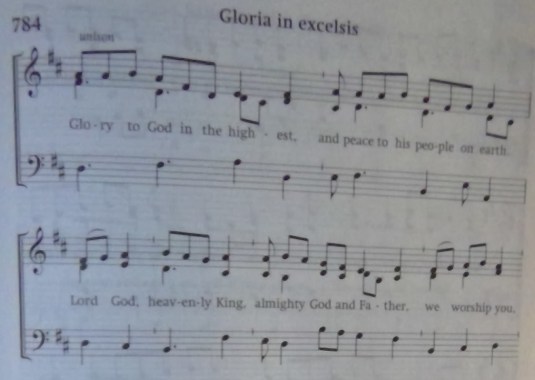
This hymnal puts the service music (including several settings of Anglican chant!) in back of the regular hymns, avoiding the formatting annoyance of the 1982 hymnal, which is an excellent decision. Its settings of various parts of the liturgy are still mostly keyed to the traditional-language forms, though there is one contemporary-language setting for the Communion service parts. I’ve tried the Gloria in excelsis with my congregation and it works fine.

WIN_20190517_14_11_02_Pro (2)

Another feature of this book, which I very much appreciate, is that they made a point of improving the balance of the number of hymns for each season of the church year. (You may recall the 1940 hymnal has an enormous glut of Christmas songs and a deplorable dearth of Advent and Lent songs!) Here’s the breakdown of the hymns in this 2017 book:

#1-198 The Church Year

  • Advent (26); Christmas (56); Epiphany (12); Lent (10); Passiontide (18); Easter (26); Ascension (13); Whitsunday [Pentecost] (5); Trinity Sunday (1); Saints’ Days and Holy Days (17); All Saints (10); Martyrs (4)
  • Hymns of Thanksgiving (11); National Hymns (9)

#219-251 The Daily Office: Morning (15); Evening (18)

#252-320 Sacraments and Other Rites

  • Baptism (5); Holy Communion (37); Confirmation (6); Matrimony (3)
  • Ordination and Ember Days (4); Consecration of a Church (5); Burial (3)

#321-639 General Hymns

  • The Holy Trinity, Praise to God, Jesus (Advent of, Life & Ministry, Name of, Help of, Praise to), Holy Spirit, Holy Scripture, Church, Mission, Christian Vocation, Christian Walk, Christian Warfare, Christian Duty, Penitence, Kingdom of God, The Lord’s Day, Church Triumphant

#640-800 Service Music

  • Index, Explanation of Anglican Chant
  • Daily Office Sung Responses, Canticles
  • Explanation of Simplified Anglican Chant, Simplified Anglican Chants (12)
  • Holy Communion: 5 Complete Services, plus Miscellaneous

Then follow 68 pages of Indices (indexes)!

There is so much in this book, it’s amazing. The liturgical index is excellent: it suggests hymns to match with the OT, Epistle, and Gospel lesson of each Sunday in the year as well as the Collect of the Day! Of course, this is for the REC Prayer Book, which uses the traditional one-year cycle of Collects & Lessons, so you really have to do your homework in order to “translate” that index into the modern ACNA 3-year lectionary cycle.

The season of Lent is still vastly underrepresented compared to the other seasons of the year, but that is compensated for the fact that the “Penitence” section of the General Hymns here include 21 hymns, which is a lot more than either of its predecessor books.

The Preface and introductory notes are also pleasantly specific about the process and goals that went into the creation of this book, reflecting a transparency similar to how the ACNA’s liturgical task force went about assembling the 2019 Prayer Book. Although, because this book was made by and for a relatively smaller group of people, the hands of its chief editor are a bit more visible than I would have expected – a number of new songs written or arranged by him have stood out to me in my exploration of this book over the past nine months.

The rating in short…

Accessibility: 4/5
The sections are well-labeled both in the Table of Contents and within the pages of the book so you can see where you are as you flip through. The collection of indexes are very comprehensive and hardly leave a stone unturned. If your church uses the traditional one-year lectionary, this is a 5/5, but for those of us (the majority) who don’t, the fact that it’s keyed to that different set of readings is a bit of a complication.

Devotional Usefulness: 5/5
The only thing it lacks, from my perspective, is more than a single option for modern-language Communion liturgy musical settings. There is so much devotional opportunity here, and it’s much better balanced than the 1940 or 1982 hymnals still in use today.

Reference Value: 5/5
Every index a music planner could need is in here. You can probably find some beloved hymns it lacks, but at 639 hymns (albeit doubling entries with an alternative melody choice) it’s got the larger portion of classic and recent Anglican hymnody.

In all it’s not quite a perfect hymnal, but it is absolutely the best one I’ve ever seen, held, or used. The ACNA does not have an official hymnal, but this is the book that I would heartily promote to fill that role.

A Canticle for Eastertide

We’ve already looked at the Pascha Nostrum, but there are other ways to distinguish the Easter season in the Daily Office!  Among our Supplemental Canticles provided at the end of the Daily Office section of the Prayer Book are four that are labeled as appropriate for the Easter season.

#1 Magna et mirabilia (Song of the Redeemed, Rev. 15)

The rubrics indicate this canticle is appropriate both for Advent and for Easter.  Since Advent has fewer options, this Customary recommends this canticle serve as the first canticle during Advent, rather than Easter.

#5 Cantemus Domino (Song of Moses, Ex. 15)

This canticle is a prime choice for the Easter Vigil as a response to the reading of the crossing of the Red Sea.  And it’s also great for the Daily Office – consider making use of it as an alternative to the Te Deum on weekdays throughout the season!

#6 Dignus es (Song to the Lamb, Rev. 4 & 5)

This canticle is indicated as being appropriate both for Eastertide and Ascensiontide.  This customary appoints Canticle 6 in place of the Te Deum in Morning Prayer for the weekdays starting on Ascension Day through Pentecost Week.

#7 Cantate domino (Sing unto the Lord, Ps. 98)

Historically, this canticle was appointed as the alternative for the Magnificat, presumably for the days on which that text, the Song of Mary, was appointed to be read in the New Testament lesson.  That is how this Customary recommends Canticle 7 continue to be used, and thus not have a particularly Easter-related role.