Eastertide: 40 days or 50?

The length of the Easter season is one of those subjects that can start internet fights.  Some say it’s 50 days long, beginning on Easter Day and ending on the Day of Pentecost.  Others retort that it’s 40 days, beginning on Easter Day and ending with the Ascension.  Meanwhile, perhaps the majority of church-goers look on in bewilderment or bemusement.  Why does it matter?  What’s the big deal?  Surely there are bigger fish to fry.

Let’s explore this debate in chronological order, so we can see how this disagreement came about, and why it matters to those who argue about it.

The Classical Prayer-Book Tradition

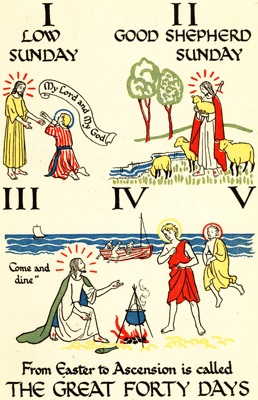
The changing of the seasons were not marked out quite so overtly in the old prayers books as they are in the new.  The Sunday Collects and Lessons were not typically marked out into season-based sections like they are in the 2019 book, so you had to rely upon the specific “name” of each Sunday, and the short list of Proper Prefaces early in the Communion prayers.  In both cases, Easter and Ascension are treated separately.  This sets out a demarcation: Eastertide ends when Ascension Day kicks in.  Thus we get images like this from Enid Chadwick’s beloved book, My Book of the Church’s Year:
19

Note, “THE GREAT FORTY DAYS”… that’s Eastertide.

The emphasis this takes is on the gospel narrative of events: Jesus was raised from the dead, met with his disciples at various times, and ascended to the right hand of the Father 40 days later.  This also lines up the calendar with the Apostles’ Creed: “the third day he rose again; he ascended into heaven, and is seated at the right hand…”  In the ascension we see Jesus as Priest, making intercession for us, and Jesus as King, seated at the right hand of God.  It is a festal season, and closely related to Easter, but it takes on a theological emphasis that is distinct from Easter before it and Pentecost after it.

The Modern (or modernist?) Prayer-Book Tradition

The 1979 Prayer Book (and probably others like it) changed this up quite dramatically.  First of all, the name “Sunday after the Ascension” was changed to “the 7th Sunday of Easter”.  Ascensiontide still got its own Proper Preface, but a new feature of the liturgy – the opening acclamation – was provided for various seasons of the year, and the Easter acclamation (Alleluia, Christ is risen / The Lord is risen indeed, alleluia!) was appointed for the entire stretch from Easter to Pentecost.  Ascension Day and Ascensiontide were not removed from the calendar, but they were rolled into the Easter season, turning “the great forty days” into “the great fifty days.”

Now, there is a biblical precedent for this perspective: two of the primary Old Testament feasts (Passover and Tabernacles) are fifty days apart, and became the Christian Easter and Pentecost.  By emphasizing the fifty days, instead of the forty plus ten, the new calendar system highlights the Old Testament precedent for the Gospel.

The 2019 Prayer-Book Tradition

What we receive in the 2019 Prayer Book is something of a mixed bag when it comes to the length of Easter.  As usual, Ascension still has its own Preface.  Like the 1979 book, Ascensiontide has no acclamation of its own; it still gets the Easter call-and-response.  But the name of the Sunday in this season is back to “The Sunday after Ascension,” so there’s room for debate if it counts as Easter or not.  Room for debate, that is, until you read the calendar rubrics on page 689.  When discussing days of discipline, denial, and special prayer, it says:

The weekdays of Lent and every Friday of the year (outside the 12 Days of Christmas and the 50 days of Eastertide) are encouraged as days of fasting. Ember Days and Rogation Days may also be kept in this way.

This rather seals the deal: the 2019 Prayer Book sets forth a 50-day Eastertide.

HOWEVER,

Unlike the 1979 Prayer Book, there is a nuance, or a balance: the 7th Sunday of Easter is not “the seventh Sunday of Easter,” but the “Sunday after the Ascension.”  So although the “season” is still “Eastertide” in one sense, it has entered into a different phase: new Sunday nomenclature, new Proper Preface.

So if you’re a “50 days of Easter” kind of person, pay this balance (not to mention our historical tradition!) more careful attention.  We are apparently encouraged to use the 50-day language, according to our calendar rubrics.  But the Sunday after the Ascension is informed more by Ascension Day than by Easter Day.  Whether you call that ten day period the last part of Eastertide or Ascensiontide, be sure to afford it the distinct theological and Gospel-narrative emphasis it was meant to communicate.  On that Sunday, tell people “Christ is risen!” is no longer just about his resurrection, but about his rising bodily into heaven.  Make sure the Easter songs and hymns give way to songs and hymns about the ascension of Christ.  Crown him with many crowns and Hail the day that sees him rise are perhaps the two most famous examples.

If you want to read more about Ascension Day and its mini-season (or subset of Easter, if you insist), click here!  In my experience this is one of the most under-rated parts of the church year, and it has much to offer.
Next week: Rogation Days

Today’s entry is just a reminder: the Rogations Days are next week, on Monday, Tuesday, and Wednesday.  This coming Sunday is nicknamed Rogation Sunday, as a result.  If you look at a church calendar (or at least, a traditional one) the Rogation Days stand out like a sore thumb – three purple days in a sea of white.

What’s rogation?  Well, rogare is Latin for ask, so a rogation day in the church is a day of prayer.  The rogation days, specifically, are days of prayer and fasting for the year’s crops.  The major time for the sewing and planting of crops is already done, in many climes of the Northern Hemisphere, so this is a point when farmers have done most of what they can, as the Scriptures say “one plants, another waters, but God gives the growth.”  So we stop and pray that God will protect and prosper the crops.

In recent centuries, as Western Christendom has moved out of agriculture-dominated economy and culture, the Rogation Days have taken on additional layers of prayer to cover other forms of business and industry.

Unless your church has a weekday communion service on Monday, Tuesday, or Wednesday, it’s pretty easy for these days to slip by year by year, invisible to the vast majority of Christians.  One of the easiest ways to keep the spirit of Rogationtide is to grab a hymn appointed for Rogation and sing it on the 6th Sunday of (or 5th Sunday after) Easter.

Why liturgy in the first place?

If you’re following this blog on Facebook, or directly, or via email subscription, chances are you’re already committed to the Anglican way of liturgical worship.  You may or may not have much to say about why you like or prefer liturgy over the free church tradition.  But you’ve probably been asked before by other Christians why you and/or your church worships the way it does.

Liturgy is not our “style”.  It is not our “flavor”.  It’s actually a part of who we are as Christians; it’s how we’re Christians.  Don’t fall into the trap of assuming or pretending that it’s a simple matter of preference.  No, it’s a principle.

For more on this, here’s a new video:

Subject Index:

  • 0:00 The challenge of understanding liturgy
  • 2:44 Why (and not why) we’re committed to liturgical worship
  • 6:15 Look at the whole, not the individual
  • 8:04 Many of us today struggle with liturgy

Reading Acts at this time of year

We saw a few weeks ago how the book of Acts has a prominent place in the modern Communion lectionary through Easter week.  We’ve seen that the book of Acts may be read from in place of the Old Testament lesson through Easter season.  Now it’s time to look at why Acts shows up at this time of year, in the Communion lectionary, and at none other time.

The book of Acts holds a unique position in the canon of Scripture.  It is not an Epistle, nor is it a Gospel.  It’s like the Epistles in that it’s looking at the life of the Church after Jesus ascended; it’s like the Gospels in that it’s a collection of narratives.  Its very introduction makes it out to be a sort of sequel to the Gospel according to Saint Luke.  Ultimately its literary contribution to the Bible is much more like the historical books of the Old Testament – showing us the power and presence of God in the world through his people.  That likeness, perhaps, is why the book of Acts is almost always provided in place of the Old Testament lesson in the Communion lectionary.

As for the time of year… Acts has a particular focus on the life of the Church immediately after the Gospel work of Christ Jesus.  It re-tells the story of his ascension, it tells the story of the Day of Pentecost, and provides first-hand insight into the immediate history of a few of the apostles, as well as some of the missionary and church-planting ministry of St. Paul and others.  As the great feast of Easter (due in part to the ancient custom of holding baptisms at the Easter Vigil) has a particular liturgical emphasis on new life in Christ, it was only natural that the book of Acts came to be a go-to book in the season following.  Let’s take a look at how the book of Acts is read in the ACNA Sunday Communion lectionary:

Year A

Easter II – 2:14a, 22-32 – Peter preaching Christ from the Old Testament
Easter III – 2:14a, 36-47 – Peter preaching repentance unto faith in Christ
Easter IV – 6:1-9, 7:2a, 51-60 – diaconate established, Stephen martyred
Easter V – 17:1-15 – Paul is attacked for preaching the Gospel to Greeks as well as Jews
Easter VI – 17:22-34 – Paul preaches to the Gentiles
after Ascension – 1:1-14 – the ascension of Jesus

Year B

Easter II – 3:12a, 13-15, 17-26 – Peter preaching repentance unto faith in Christ
Easter III – 4:5-14 – Peter and John examined by the Jews for healing in the name of Jesus
Easter IV – 4:23-37 – the church rejoices and grows in generosity
Easter V – 8:26-40 – Philip preaches to and baptizes the Ethiopian eunuch
Easter VI – 11:19-30 – the church grows among Gentiles and is generous abroad
after Ascension – 1:15-26 – the replacement of Judas with Matthias

Year C

Easter II – 5:12, 17-22, 25-29 – the apostles are arrested for preaching Christ
Easter III – 9:1-19a – Saul (to be Paul) converts on the road to Damascus
Easter IV – 13:14b-16, 26-29 – Paul preaches Christ mostly from the Old Testament
Easter V – 13:44-52 – Paul is abused for his conviction to preach to the Gentiles
Easter VI – 14:8-18 – Paul and Barnabas heal a cripple
after Ascension – 16:16-34 – Paul exorcises a demon, is imprisoned, and preaches to his jailer

Noting the Patterns

If you just look at the chapter and verse numbers, it’s hard to see there’s any rhyme or reason to these tours through Acts.  But when you note what those readings contain, similar contours can be traced in each of the three years of the lectionary cycle.  The first three Sundays mostly follow a pattern of preaching, resistance, triumph & growth.  Easter V and VI then deal with the spread of the Gospel among the Gentiles, typically to the chagrin and anger of the Jewish synagogue members.

The odd Sunday in this sequence is the Sunday after the Ascension.  In Year A it just repeats the Acts 1 lesson from Ascension Day; in Year B it (sensibly) deals with something that occurred between the ascension and Pentecost.  But in Year C it seems to be rolled into the Eastertide progression of readings from Acts, noting some of Paul’s ministry (and abuse) among the Gentiles.

Advice

When preparing for Eastertide and the Sunday after Ascension, the preacher(s) ought to make a decision: either commit to using the Acts readings each Sunday along the way, or commit to using none of them during this period.  These readings are not paired with the Gospel or Epistle, much less the Collect of the Day, but form a sequence of five or six Sundays exploring the spread of the Gospel from the apostles to the Jews to the Gentiles.  Whether they are the preaching focus or not, they form a sequence that ought to be carried through from start to finish, if they are to be used at all.

In my case, I was committed this year to preaching the “Epistle” texts from Revelation, so I opted not to use the Acts lessons, preferring to have OT lessons that would match the Gospels so there’d be more unity to the liturgy on a given day.

Whatever you decide is appropriate, be sure you stick with it through the season to maximize the liturgical benefit, one way or the other!

Book Review: Book of Common Praise 2017

Welcome to Saturday Book Review time! On most of the Saturdays this year we’re looking at a liturgy-related book noting (as applicable) its accessibility, devotional usefulness, and reference value. Or, how easy it is to read, the prayer life it engenders, and how much it can teach you.

Sadly, the ACNA has no province-wide plan for creating a new hymnal. This makes sense – different congregations have their favorite hymnals (often the 1940 or the 1982), and the growing preference for contemporary praise music is not especially conducive to printing in a book considering the majority of it is released as lead sheets (lyrics & chords) that only rarely include a written melodic line, let alone a written-out accompaniment.

However, one of the sub-jurisdictions of the ACNA, the Reformed Episcopal Church (REC), has has recently released an official hymnal for their churches: The Book of Common Praise 2017. It was brought to my attention in late 2017, soon after it was released, and my church and I got our hands on a box of copies the following summer. I intended to wait a few months to study this new hymnal on my own before switching over to it (in part in case I decided not to switch!) but my congregation seemed eager to use books that weren’t physically older than their Vicar, so we dove in pretty quickly.

Their immediate reactions were positive: the print is slightly larger and clearer than the 1940 hymnal.

My immediate reaction was mixed: I didn’t like font and typeface, it reminded me of a hymnal I didn’t particularly like from my congregationalist days. I also found that two hymns I really like were omitted from this book: Christ the fair glory of the holy angels (a fantastic song for Michaelmas) and Therefore we before him bending (a gloriously pious set of lyrics for Holy Communion, sometimes set as their own song and sometimes appended to the hymn Now my tongue the mystery telling).

But these losses were soon mostly balanced out by the inclusion of other songs missing from previous hymnals such as Amazing Grace! and of some newer songs I like such as In Christ alone my hope is found and Before the throne of God Above. (Technically Before the throne is a 19th century hymn but it was given a new melody in 1997 and thus repopularized amidst the Contemporary Christian Music crowd for a decade or so, which is the version found here.)

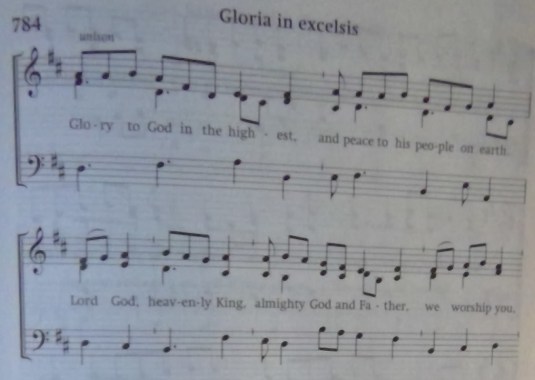
This hymnal puts the service music (including several settings of Anglican chant!) in back of the regular hymns, avoiding the formatting annoyance of the 1982 hymnal, which is an excellent decision. Its settings of various parts of the liturgy are still mostly keyed to the traditional-language forms, though there is one contemporary-language setting for the Communion service parts. I’ve tried the Gloria in excelsis with my congregation and it works fine.

WIN_20190517_14_11_02_Pro (2)

Another feature of this book, which I very much appreciate, is that they made a point of improving the balance of the number of hymns for each season of the church year. (You may recall the 1940 hymnal has an enormous glut of Christmas songs and a deplorable dearth of Advent and Lent songs!) Here’s the breakdown of the hymns in this 2017 book:

#1-198 The Church Year

  • Advent (26); Christmas (56); Epiphany (12); Lent (10); Passiontide (18); Easter (26); Ascension (13); Whitsunday [Pentecost] (5); Trinity Sunday (1); Saints’ Days and Holy Days (17); All Saints (10); Martyrs (4)
  • Hymns of Thanksgiving (11); National Hymns (9)

#219-251 The Daily Office: Morning (15); Evening (18)

#252-320 Sacraments and Other Rites

  • Baptism (5); Holy Communion (37); Confirmation (6); Matrimony (3)
  • Ordination and Ember Days (4); Consecration of a Church (5); Burial (3)

#321-639 General Hymns

  • The Holy Trinity, Praise to God, Jesus (Advent of, Life & Ministry, Name of, Help of, Praise to), Holy Spirit, Holy Scripture, Church, Mission, Christian Vocation, Christian Walk, Christian Warfare, Christian Duty, Penitence, Kingdom of God, The Lord’s Day, Church Triumphant

#640-800 Service Music

  • Index, Explanation of Anglican Chant
  • Daily Office Sung Responses, Canticles
  • Explanation of Simplified Anglican Chant, Simplified Anglican Chants (12)
  • Holy Communion: 5 Complete Services, plus Miscellaneous

Then follow 68 pages of Indices (indexes)!

There is so much in this book, it’s amazing. The liturgical index is excellent: it suggests hymns to match with the OT, Epistle, and Gospel lesson of each Sunday in the year as well as the Collect of the Day! Of course, this is for the REC Prayer Book, which uses the traditional one-year cycle of Collects & Lessons, so you really have to do your homework in order to “translate” that index into the modern ACNA 3-year lectionary cycle.

The season of Lent is still vastly underrepresented compared to the other seasons of the year, but that is compensated for the fact that the “Penitence” section of the General Hymns here include 21 hymns, which is a lot more than either of its predecessor books.

The Preface and introductory notes are also pleasantly specific about the process and goals that went into the creation of this book, reflecting a transparency similar to how the ACNA’s liturgical task force went about assembling the 2019 Prayer Book. Although, because this book was made by and for a relatively smaller group of people, the hands of its chief editor are a bit more visible than I would have expected – a number of new songs written or arranged by him have stood out to me in my exploration of this book over the past nine months.

The rating in short…

Accessibility: 4/5
The sections are well-labeled both in the Table of Contents and within the pages of the book so you can see where you are as you flip through. The collection of indexes are very comprehensive and hardly leave a stone unturned. If your church uses the traditional one-year lectionary, this is a 5/5, but for those of us (the majority) who don’t, the fact that it’s keyed to that different set of readings is a bit of a complication.

Devotional Usefulness: 5/5
The only thing it lacks, from my perspective, is more than a single option for modern-language Communion liturgy musical settings. There is so much devotional opportunity here, and it’s much better balanced than the 1940 or 1982 hymnals still in use today.

Reference Value: 5/5
Every index a music planner could need is in here. You can probably find some beloved hymns it lacks, but at 639 hymns (albeit doubling entries with an alternative melody choice) it’s got the larger portion of classic and recent Anglican hymnody.

In all it’s not quite a perfect hymnal, but it is absolutely the best one I’ve ever seen, held, or used. The ACNA does not have an official hymnal, but this is the book that I would heartily promote to fill that role.

A Canticle for Eastertide

We’ve already looked at the Pascha Nostrum, but there are other ways to distinguish the Easter season in the Daily Office!  Among our Supplemental Canticles provided at the end of the Daily Office section of the Prayer Book are four that are labeled as appropriate for the Easter season.

#1 Magna et mirabilia (Song of the Redeemed, Rev. 15)

The rubrics indicate this canticle is appropriate both for Advent and for Easter.  Since Advent has fewer options, this Customary recommends this canticle serve as the first canticle during Advent, rather than Easter.

#5 Cantemus Domino (Song of Moses, Ex. 15)

This canticle is a prime choice for the Easter Vigil as a response to the reading of the crossing of the Red Sea.  And it’s also great for the Daily Office – consider making use of it as an alternative to the Te Deum on weekdays throughout the season!

#6 Dignus es (Song to the Lamb, Rev. 4 & 5)

This canticle is indicated as being appropriate both for Eastertide and Ascensiontide.  This customary appoints Canticle 6 in place of the Te Deum in Morning Prayer for the weekdays starting on Ascension Day through Pentecost Week.

#7 Cantate domino (Sing unto the Lord, Ps. 98)

Historically, this canticle was appointed as the alternative for the Magnificat, presumably for the days on which that text, the Song of Mary, was appointed to be read in the New Testament lesson.  That is how this Customary recommends Canticle 7 continue to be used, and thus not have a particularly Easter-related role.

Commemorating the Martyrs of Sudan

May 16th is noted, in our calendar of commemorations, not for a particular saint, but for a whole group: the Martyrs of Sudan.

Originally, this date was chosen to commemorate this group of martyrs because on this day in 1983 the Anglican leaders in Sudan made a public stand for the faith, knowing that under Sharia Law they were destined for execution.  And in the two decades of civil war that followed, millions lost their lives for Christ.  A further wave of attacks against Christians swept the country in 2011, soon before South Sudan was separated as a new (and Christian-friendly) country.

Many of the Sudanese bishops who survived the wars lived in exile; most of the clergy ministered without pay.  Hardly a church building was left standing.  To this day, rebuilding destroyed communities and healing broken families and lives is a massive effort.  The Sudanese diaspora across the world, including in the United States, also need prayer, ministry, healing, and new life rebuilding.

But the blood of the martyrs has been fruitfully sown: the population of South Sudan has gone from 10% Christian in the 1990’s to 60% Christian in 2012, the majority of whom are Roman Catholics and Anglicans.

As this is a mere commemoration in our calendars, there are no major changes to our daily round of worship, unless you hold a Communion or Antecommunion service for this day.  But we can add a Collect to the additional prayers at the end of the daily office, like this one:

Almighty God, you gave your servants in Sudan boldness to confess the Name of our Savior Jesus Christ before the rulers of this world, and courage to die for this faith: Grant that we may always be ready to give a reason for the hope that is in us, and to suffer gladly for the sake of our Lord Jesus Christ; who lives and reigns with you and the Holy Spirit, one God, for ever and ever. Amen.

We could also make a point of praying the Great Litany today with the Sudanese church and diaspora in mind.

Sources:

http://www.satucket.com/lectionary/Sudan.htm

http://50days.org/2013/05/the-martyrs-of-sudan-yesterday-today-tomorrow/

https://en.wikipedia.org/wiki/Christianity_in_Sudan#Persecution_of_Christians_in_Sudan

Pray for others’ dioceses

The Anglican Diocese in New England just held their annual clergy conference a few days ago.  The Diocese of CANA East is holding the annual synod in the coming week or so.  The ACNA provincial assembly is about a month away.  It strikes me as likely that other dioceses are having significant events around this time of year also.

Hearing about these events can (or should!) help spur us on to further prayer for one another.  It may be “too late” for me to pray for my diocesan events, but I can always pray for others.  We’ve got some lovely and thoughtful prayers in our Prayer Book that probably lie fallow much longer than they ought.  Think about what others are up to, and lift up these prayers for them!

  1. FOR A PROVINCE OR DIOCESE

O God, by your grace you have called us in this Diocese to be a good and godly fellowship of faith. Bless our Bishop(s) N., and other clergy, and all our people. Grant that your Word may be truly preached and truly heard, your Sacraments faithfully administered and faithfully received. By your Spirit, fashion our lives according to the example of your Son, and grant that we may show the power of your love to all among whom we live; through Jesus Christ our Lord. Amen.

  1. FOR A PROVINCIAL OR DIOCESAN CONVENTION OR SYNOD

Almighty and everlasting God, by your Holy Spirit you presided in the council of the blessed Apostles, and you promised, through your Son Jesus Christ, to be with your Church to the end of the world: Be with the council of your Church assembled [here] in your Name and presence. Save us from all error, ignorance, prejudice, and pride; and of your great mercy direct, sanctify, and govern us in our work, by the mighty power of the Holy Spirit; that the order and discipline of your Church may be maintained, and that the Gospel of Christ may be truly preached, truly received, and truly followed in all places, breaking down the kingdom of sin, Satan, and death; till all your scattered sheep, being gathered into one fold, become partakers of everlasting life; through the merits and death of Jesus Christ our Savior. Amen.

  1. FOR A PROVINCIAL OR DIOCESAN CONVENTION OR SYNOD

Gracious and everliving Father, you have given the Holy Spirit to abide with us for ever: Bless, we pray, with the Holy Spirit’s grace and presence, the Bishop(s), Priests, Deacons, and all the Laity who assemble in your Name; that your Church, being preserved in true faith and godly discipline, may fulfill the will of him who loved her and gave himself for her, your Son Jesus Christ our Savior; who now lives and reigns with you and the same Spirit, one God, now and for ever. Amen.

  1. FOR VESTRY AND CHURCH MEETINGS

Almighty and everliving God, source of all wisdom and understanding, be present with those who take counsel [in ______] for the renewal and mission of your Church. Teach us in all things to seek first your honor and glory. Guide us to perceive what is right, and grant us both the courage to pursue it and the grace to accomplish it; through Jesus Christ our Lord.  Amen.

  1. FOR THE SELECTION OF A BISHOP OR OTHER MINISTER

Almighty God, giver of every good gift: Look graciously on your Church, and so guide the minds of those who shall choose a Bishop for this Diocese that we may receive a faithful pastor who will preach the Gospel, care for your people, equip us for ministry, and lead us forth in fulfillment of the Great Commission; through Jesus Christ our Lord. Amen.

Nunc Dimittis doing double duty

Most liturgical ingredients in the Prayer Book tradition are set into one particular function with little or no variance.  The Daily Office has its own opening and closing sentences, the Communion liturgy has its own acclamations and dismissals, each major liturgy has its own prayer of confession (though the rubrics now allow cross-pollination  to some extent), and every canticle has its particular home.

But the Nunc dimittis has two appointments in the Prayer Book, such that it’s even printed in the book twice.  It is the second canticle of Evening Prayer, and it is the anthem/canticle in Compline (the night office).  This is a particularly odd repetition, since Evening and Compline are both pretty similar in function and usually near one another in time (evening, bedtime).

The reason for this is that in the English Reformation when Archbishop Thomas Cranmer assembled the first Common Prayer Book he reduced the monastic offices from seven in the day and one at night down to two: Morning (Matins) and Evening (Vespers).  There are elements of three monastic morning offices wrapped up in Anglican Morning Prayer, and elements of Vespers & Compline wrapped up in Anglican Evening Prayer.

So what happens when you try to bring back in one of those “extra” monastic offices?  You get little hints of repetition with the Anglican Daily Office.  In the case of the Nunc dimittis its original home was the night office, Compline, which the Prayer Book tradition rolled into Evening Prayer.  Thus in modern books that bring Compline back to Anglican liturgy, we’ve got a situation where the Nunc dimittis has two homes.

If this doesn’t bother you, well and good.  But if you are someone who regularly prays both Evening Prayer and Compline, and desires to highlight separate identities for both offices, then there is something you can do about that: the 2019 Prayer Book has an appendix to the Daily Office section labeled Supplemental Canticles for Worship.  This is an expansion of what earlier Prayer Books (before 1979) did: offering usually two options of a Canticle for each slot (that is, position of response after each reading in the Morning & Evening offices).  Now, instead of 8 or 9 total Canticles with specific directions on which ones to use where, we have 15 Canticles, 10 of which provide minimal guidance as to their expected use.  If you want to make use of these and reduce the repetition of the Nunc dimittis between Evening Prayer and Compline, consider the following pattern of alternatives:

The Second Canticle, the Nunc dimittis, is to be recited on Saturdays and Sundays, and on other days throughout the year not superseded by the following.

Canticle 4, the Quaerite Dominum, is to be used in its place on the First Sunday of Advent and on weekdays throughout the season.

Canticle 3, the Kyrie Pantokrator, is to be used in its place on Ash Wednesday, the First Sunday of Lent, Palm Sunday, and every weekday throughout the season.

Canticle 9, the Deus misereatur, is to be used in its place on Monday through Friday during Epiphanytide and Trinitytide, and on the occasion that the text of the Nunc dimittis is part of the New Testament Lesson.

Reading 1 John in Eastertide

This evening we begin reading the epistle 1 John at Evening Prayer, and will go through it over the course of the whole week.  As I noted with 1 Peter a little while ago, this is an appropriate daily lectionary experience because it matches up with the Sunday Communion lectionary on one of the three years of its rotation.  It doesn’t match up perfectly in real time, of course, but the idea of reading 1 John in Eastertide is achieved both in Year B on Sundays and in the middle of May in daily Evening Prayer.

What makes 1 John an Easter-appropriate epistle such that it got assigned to this season in one year of the Communion lectionary?  In part, it’s an echo of the historic lectionary for Eastertide, which features 1 John and 1 Peter and James as the Epistle lessons through the season.  Digging deeper, the style of 1 John is very similar to the Gospel of St. John, which also gets heavy coverage in Eastertide and other major festal seasons and occasions throughout the year.  1 John has emphases on community, belonging, love, and release from sin, which all connect easily with the tradition of reading Acts in Eastertide, and the more general “result of the resurrection” frame of mind that this season is all about.

The opening prologue to 1 John also betray the unusual status of this book.  It is billed as an epistle of John but its writing style is much more like a homily or address.  Thus it makes for great reading and hearing but a far more difficult study than a more orderly epistle like those of St. Paul (at least in my opinion).  Despite the general challenge of making sense of how this book is structured and organized, the opening verses are one of my personal favorite passages of Scripture.

If you’d like a homily to accompany you in Evening Prayer today, here you go: