Encountering the Scriptures in Anglican Worship

One of the modern tag-lines used to describe the Book of Common Prayer is that it is “The Bible arranged for worship.” Much can and has been said about the sheer bulk of its pages being that of Scriptures, verbatim or referenced, most particularly the full Psalter. What I thought I’d describe today is the range of ways in which this descriptor is proven true. We Anglicans boast, quite rightly I daresay, that ours is the most biblical of liturgies the Church has ever had – let’s take a moment here to defend that claim and explore the major ways in which this is so.

In brief, the Scriptures are (1) heard spoken aloud, (2) they are preached, and (3) they are paraphrased or synthesized in prayer.

The Scriptures are heard spoken aloud.

There are three primary ways in which the Scriptures are encountered audibly in our worship: there are lessons, sentences, and prayers.

The LESSONS are distinct times of Bible-reading during a worship service. All churches that retain a liturgical tradition have Bible readings, though many in the “free church” tradition have sadly lost this crucial staple of worship, relegating the reading of a sermon text to within the sermon. Modern Anglican liturgies most typically have three lessons at Holy Communion: an Old Testament text, an Epistle text, and a Gospel text. The classical Prayer Book tradition typically had two: an Epistle and a Gospel. The Daily Offices of Morning and Evening Prayer also have two: typically one Old Testament and one New Testament. Exceptions to these patterns exist, but at a typical worship service that is what you can expect. In almost every case, though, these lessons are introduced with a citation of which book of the Bible they come from, and frequently which chapter, and even verses.

Sometimes simply one SENTENCE of Scripture is read, and it may or may not be introduced with a citation. This may be an “opening sentence” at the start of Morning or Evening Prayer, an Offertory Sentence before the collection, a Communion Sentence right after everyone has received the consecrated bread and wine, or a sort of mini-lesson in Midday Prayer or Compline. These are moments of devotional impact, not typically to be expounded further or given additional context or explanation. These are simply moments that are ornamented with the Word of God for beauty, for gravity, and for meaning.

And, of course, there are many ways in which we experience the Scriptures as PRAYERS. When we hear part of a Psalm at the Communion service – be it a traditional introit or gradual, or a responsory psalm after the Old Testament Lesson – we are praying that text. In the Daily Offices, often multiple Psalms are prayed in full! These are readings, but not lessons; we don’t sit back and listen, but we sit up (or even stand) and make those words our own in prayer. There are many traditions of chanting or singing the Psalms, also emphasizing this posture of prayer rather than only listening. Besides the Psalms there are other psalm-like texts which are also prayed. These are usually called Canticles, and various forms of the liturgical tradition call for different specific examples. There are a few from Isaiah and Exodus, and a couple from Revelation, but the three most significant canticles are from the Gospel of Luke: the Song of Zechariah, the Song of Mary, and the Song of Simeon.

The Scriptures are preached.

This is hardly unique to the Anglican tradition; all Christian churches include preaching in some manner in their worship services. But something that is relatively unique to the Prayer Book tradition is its collection of “exhortations” found in various liturgies. The famous “Dearly beloved…” speech at the start of the marriage ceremony is perhaps the most well-known example, which references several parts of Scripture and sets out a summary of the biblical doctrine of marriage – it is basically a two-minute sermon! There are a handful of such exhortations in the Prayer Book: some calling people to participate in Holy Communion, some shorter ones calling people to confess their sins before God, some outlining the duties of a bishop, or priest, or deacon at a service of Ordination. These are brief moments in which the minister is speaking to the congregation and expounding the Scriptures on one topic or another, providing biblical teaching to help them participate in the worship that is to follow.

The Scriptures are paraphrased or synthesized in prayer.

Like the several Exhortations in the Prayer Book, our tradition also bears a great many prayers that bring together biblical material to celebrate or proclaim various truths from the Word of God.

One of the greatest examples of this is the wealth of COLLECTS in the Prayer Book. Although not unique to the Anglican tradition, our liturgies do emphasize the use of these stylized prayers more than most other churches do. A collect is made up of an address to God which usually identifies something about his character or works, a petition which we ask, and a purpose undergirding that petition, often tying it back to the relevant thing about God’s character or works. Many of these collects quote or paraphrase Scripture, and all of them reflect on some biblical truth.

Besides the collects, many other prayers in the Book of Common Prayer contain biblical quotes, references, paraphrases, and allusions that together express a coherent theology built upon the Bible. The Prayers of the People make reference to some New Testament teachings on how the church should pray, and draw from biblical language in so doing. The Communion prayers include the Words of Institution (the words of Christ at the Last Supper) amidst a host of other biblical references. Other prayers at baptism, marriage, funerals, for the penitent, for the sick, prayers of thanksgiving, also bring together biblical material.

This is a double benefit.

For evangelicals who grew up with a heavy emphasis on Bible Study, discovering the traditional liturgy can be a great joy as they find a truly endless stream of biblical material in the prayers of the Church. This is a part of my own story. And it works the other way, too: those who grow up hearing the Prayer Book liturgy but received less instruction in the Bible find great joy in discovering the language of the liturgy in the Scriptures. As a priest and pastor I have seen folks in both positions experiencing the same joy of connecting biblical familiarity and liturgical familiarity. It is a joy and passion of mine to help people connect those dots.

I call this a double benefit because, rightly used, the Bible and the Liturgy reinforce one another in the lives of the worshipers. As we read the Bible and learn its words and teachings, and as we participate in the liturgy and learn from its content as well, we find that they reinforce one another. When the Church’s worship (or liturgy) is truly biblical, then it can be celebrated and enjoyed with confidence and joy, knowing that knowledge and study of the Bible will confirm its value. It also reminds us that worship and prayer are not arbitrary, disconnected from theology and Bible study. Rather, the doctrine and discipline of the Church is intertwined, synthesized, a coherent and unified whole. There should not be any competition or strife between the two, they are ultimately one and the same: the proclamation of the God who makes us, loves us, redeems us.

The Preachiest Wedding Ever.

It’s been a long time, but today I’m bringing back Weird Rubric Wednesday with another wacky idea that could be done, though probably shouldn’t.

We all want a God-honoring, biblical, Christian wedding, don’t we? The state of marriage in the West is pretty dismal, and it’s an uphill battle reeducating our fellow believers in the scriptural doctrine of holy matrimony. So let’s take a look at what the Prayer Book says about the wedding service.

THE LESSONS

One or more of the following passages is read.

Between the Lessons, a Psalm, hymn, or anthem may be sung or said. Appropriate Psalms are 45, 67, 127, or 128.

BCP 2019 page 204

Along with these rubrics are listed fifteen Scripture readings to choose from.

So if we’re looking at designing the Most Biblical Wedding Ever (TM) without violating the Prayer Book rubrics, let’s choose the best readings. Let’s choose the longest readings! Let’s choose ALL TEH READINGZ!!!1!one!

And, like good Anglicans informed by the regular recitation of the Daily Office, we’re going to follow each lesson with a Psalm, hymn, canticle, or anthem. Ready? Here goes…

  • Genesis 1:25-28 (Male and female he created them)
  • Psalm 67
  • Genesis 2:4-9, 15-24 (A man holds fast to his wife and they become one flesh)
  • Psalm 127
  • Song of Solomon 2:10-13; 8:6-7 (Many waters cannot quench love)
  • Psalm 45
  • Tobit 8:5b-8 (That she and I may grow old together)
  • Psalm 128
  • 1 Corinthians 13:1-13 (Love is patient and kind)
  • Hymn: Though angel tongues adorn my human voice (Magnify the Lord #590)
  • Ephesians 3:14-19 (The Father from whom every family is named)
  • Hymn: Lord of Glory, who hast bought us (Magnify the Lord #594)
  • Ephesians 5:1-2, 21-33 (Walk in love, as Christ loved us)
  • Pascha Nostrum (BCP 16)
  • Colossians 3:12-17 (Love which binds everything together in harmony)
  • Hymn: Blest be the tie that binds (Magnify the Lord #494)
  • 1 John 4:7-16 (Let us love one another, for love is of God)
  • Hymn: O perfect Love (Magnify the Lord #306/307)
  • Matthew 5:1-10 (The Beatitudes)
  • Te Deum (BCP 17)
  • Matthew 5:13-16 (You are the light… Let your light shine)
  • Nunc Dimittis (BCP 46)
  • Matthew 7:24-29 (Like a wise man who built his house on the rock)
  • Hymn: Seek ye first the kingdom of God (Magnify the Lord #625)
  • Mark 10:6-16 (They are no longer two but one)
  • Hymn: Love, fixed before the worlds were framed (Magnify the Lord #589)
  • John 2:1-11 (The wedding at Cana)
  • Hymn: O Father, all creating (Magnify the Lord #308)
  • John 15:9-12 (Love one another as I have loved you)

And of course a nice long sermon must follow, being sure to tie together this rich breadth of teaching on the nature and duties of Christian marriage.

In actual seriousness, this is obviously overkill for a normal wedding service. However, if you’re planning a wedding and need help lining up Scripture lessons with psalms or musical responses, much of this list is actually pretty thought-through; feel free to draw from it. Alternatively, if a special service of prayer is desired – perhaps for a special day of teaching or celebration or intercession on the subject of holy matrimony, this order can be a good resource for public worship and devotion.

Why is that missing from the Daily Office Lectionary?

From time to time, people who use a Prayer Book for daily prayers and Scripture reading notice that something has been skipped in the course of Bible-reading and wonder why. What have they missed? Why does the Prayer Book book omit whole chapters of sacred scripture? Is the Church trying to suppress or water down the truth?

I cannot answer that question for every Daily Office Lectionary in the world – some are more comprehensive than others, some have particular agendas or purposes, some were honestly just plain bad. But I can point you to two major principles that guide the formation of a given Bible-reading plan.

#1 The lectionary needs to be repeatable year by year

This is critical but easy to overlook. If the pace is too rigorous, only the most stalwart worshiper will get through it, and then it’ll be an exercise in elitism rather than a beneficial practice for the whole congregation. Similarly, this means that the lectionary has to be relatively simple to follow, and contain minimal changeable features from year to year. With only 365 days to work with, and this need for a reasonable pace (typically up to 4 chapters per day, one each of OT and NT in both Morning and Evening), something has to be cut.

The American lectionary of 1979, for example, defaults to a two-year cycle of reading which is easily sustainable but still manages to be lighter than ever in terms of biblical coverage (strangely not even covering the whole New Testament in that time). The American of lectionary of 1892 provided a special section of readings for the forty days of Lent, interrupting the usual continuous flow of reading – a complication that barely lasted thirty years!

#2 The lessons need to be suitable for public reading

It must be recalled that the Daily Office is not a private devotion, but a public office. It is, ideally, what is read in every church before all the worshipers present every day. This also means that these texts will be read without the benefit of a sermon following. Thus, when considering which passages of Scripture to include and which to leave out, this suitability for public reading is necessary. Some chapters of the Old Testament will be more suitable than others – a genealogy in 1 Chronicles or the land allotments in Joshua and Ezekiel will be inferior value and clarity than the riches of the historical accounts or the preaching of the prophets.

This is not a rejection of the God-breathed nature of all Scripture, of course. As St. Paul boldly asserted, all Scripture is breathed out by God and profitable for teaching, for reproof, for correction, and for training in righteousness (2 Timothy 3:16). Yet at the same time we are justified in evaluating the comparative value of different parts of Scripture. The four Gospels are of especial value, so we always read from one at every Communion service as the last (the apex) of the Scripture readings. The New Testament is of special significance as it proclaims Christ more directly than the Old; thus we read from it in equal measure as the Old, even though that means reading the NT more than once a year in the Daily Office Lectionary. And within the Old Testament, as I noted above, some readings will be more profitable to the hearer than others. We could go so far as to say that some passages of Scripture are sufficiently obscure that their most proper context for reading is in a study group or as a sermon text.

What’s missing in the 2019 Daily Office Lectionary?

There was a trend, for the past 100 years, of lectionaries getting shorter and shorter readings and getting more and more complex to follow. In the face of those trends, the 2019 lectionary stands against the tide, returning to the widest scope of biblical coverage since 1662 (in fact covering more of the Old and New Testaments than its original forebear, at the expense of the Books Called Apocrypha). Nevertheless, there are plenty of Old Testament chapters that are not included. Here’s a quick run-down on that.

Although more of the Book of Leviticus is read in this lectionary than in any previous Prayer Book, more than half of the book is still omitted. You can read more about that here. The same can be said for the Book of Numbers.

Nearly half of Joshua is omitted (notes on that here), and a couple chapters of Judges are also missing.

One of the most noteworthy omissions from the oldest Prayer Book lectionaries are the books of 1 & 2 Chronicles. In more recent times, select chapters of the Chronicles have been interspersed with 1 & 2 Kings, which is what the 2019 lectionary also does. You can read about that here.

Ezekiel, too, is a book that has been largely skimmed through in the past but now sees a bit more coverage. I’ve written on that here.

It’s also worth noting that the earliest Prayer Books omitted all but two chapters of Revelation. Recent books have restored it to full inclusion, and I’ve written a little about that history here, in case you’re interested.

The Ecclesiastical Books (more commonly known as the Apocrypha) have suffered the most chopping and omission in the 2019 lectionary. Where in the past the full books of Tobit, Judith, Wisdom of Solomon, and Ecclesiasticus (Sirach) were read in their entireties, plus most or all of Baruch, they are now given only summary treatment. And among these remnants is also added a crash summary of 1 & 2 Maccabees.

What if I *really* want to read everything?

Some people are completionists, or at least aspire to be completionists in Scripture-reading. If you have such a burning desire, and the time to give to extra reading of the “harder” or more obscure texts of sacred writ, I have put together a Midday Lectionary that supplements the 2019 Daily Lectionary with all the Old Testament chapters and Ecclesiastical Books omitted from Morning & Evening Prayer. You can find that here.

Some Modern Issues in Early Forms

I have a back-and-forth relationship with liturgical revisionism. Some changes are good, some changes are bad, and some changes are indifferently suitable to particular times and cultures.

The worship of the Church doesn’t need to be a total and complete time capsule (and indeed in many cases where antiquity of form is most loudly proclaimed, great anachronisms betray the claim). But neither does the Church benefit her members with total and complete innovation into the untested waters of a given rector’s flight of fancy. Good liturgical revision, in my estimation anyway, acknowledges the validity, power, and truthfulness of previous rites and forms, merely presenting “a new spin on an old classic.” If what we celebrate today rejects the forms of antiquity, then we have not reformed the Church’s faith & practice, but replaced it.

I don’t say this to disparage any particular Prayer Book, but to remind myself and others to be honest about the trends of revision and amendment for the past full century. It is all too fashionable to oversimplify our assessments of one or another product along the course of history. For example, we orthodox Anglicans in North America often vilify the Episcopalian Prayer Book of 1979. And it is a deeply flawed book that is extremely revolutionary, rather than reforming of previous liturgical forms. That said, however, several strands of “revolutionizing” ideology can be seen in the promulgation of the 1928 Prayer Book (often beloved among traditional Anglicans).

Many American Anglicans look fondly upon the 1928 Prayer Book as the last edition (and bastion) of historic Anglican liturgy. However, not all of its editors would agree with that assessment. Rather, there was a fair amount of language regarding it as a positively radical correction and improvement upon the old ways. Consider this excerpt from a 1929 booklet:

The revision of the 1892 Book is far-reaching, and in some instances radical. It extends not only to language, but also to theological statement. All passages of Holy Scripture are now taken from the Revised Version and in some cases the marginal rendering has been adopted. There is an entirely new translation of the Psalter correcting many obvious errors. In Psalm XIV these verses are deleted:

5 Their throat is an open sepulchre; with their tongues have they deceived: the poison of asps is under their lips.
6 Their mouth is full of cursing and bitterness: their feet are swift to shed blood.
7 Destruction and unhappiness is in their ways, and the way of peace have they not known: there is no fear of God before their eyes.

In the judgment of the best Hebrew scholars these verses are a late interpolation and are foreign to the thought of the Psalm. The relaxation of the requirement to read the Psalter for the day obviates the necessity of reciting in the public services those Psalms or parts of Psalms which call down the curses of heaven upon enemies–the “imprecatory” Psalms. No longer will a congregation of Christian people be compelled to say of a fellow man:–

Let his children be fatherless, and his wife a widow.
Let his children be vagabonds, and beg their bread….
Let there be no man to pity him, nor to have compassion upon his fatherless children.
Let his posterity be destroyed; and in the next generation let his name be clean put out.

Note the desire for a “liturgical adventure,” a “living liturgy” free of archaisms and medieval theology… this is the exact same trend that yielded the far-more-controversial 1979 Prayer Book!

The Prayer Book of 1892 lasted thirty-six years. It was never satisfactory. The Convention which adopted it was not only conservative, but timid. It hesitated to embark on a liturgical adventure. Revision was reduced to a minimum. Archaic expressions were retained and much of its theology savored of the middle ages. For the most part the painstaking labor of twelve long years was embalmed in the “Book Annexed” which remains a melancholy movement of what might have been done to make a living Liturgy. The consequence was the Church outgrew her own Prayer Book.

Many modern worshipers are accustomed to the Ten Commandments being read in an abbreviated form at the beginning of the Communion service (if they’re read at all anymore). This shortening begins with the 1928 Prayer Book. Was it save time? No, it was because revisionists didn’t want it in there at all!

The growing conviction that the Ten Commandments have no proper place in the service of Holy Communion finds expressions in a significant permission to modify their recital by the omission of the reasons for their observance; reasons which have lost their point and force in modern times.

As for the doctrine of original sin, many of the 1928 revisers wanted no part in it:

The opening sentence of the exhortation in the Office of Baptism, reading, “forasmuch as all men are conceived and born in sin,” has long been deeply resented, so much so that many of the clergy refused to read it. It has happily been deleted in the new Book as having no warrant in Holy Scripture; the old prayer quoting the saving of Noah and the passage of Israel through the Red Sea as figuring Baptism is now omitted, as also the phrase that the infant may “be delivered from thy wrath.” The unhappy prayer, “grant that the old Adam in this child may be so buried, that the new man may be raised up in him,” is changed to read, “grant that like as Christ died and rose again, so this child may die to sin and rise to newness of life.”

Old liturgy is gloomy, they said, and a liturgical revolution was necessary.

The Office for the Visitation of the Sick has been so changed as to be hardly recognizable in its new form. As it appeared in the old Prayer Book it was so gloomy, so medieval in its theology and so utterly lacking in any understanding of the psychological approach to sick persons, that it had almost ceased to be used in the church. Its basic assumption was that not only is all sickness sent by God, but it is sent as a just punishment for some wrong done. …In the new Book the whole tone of the service has been revolutionized.

What about all the gender issues in the post-modern church? Even those revisionist tendencies can be seen in 1928:

The most significant change [to the Solemnization of Holy Matrimony] is that the vows and promises of the man and the woman are made exactly alike by the omission of the word “obey.” They both undertake precisely the same obligation. In the giving of the ring the bridegroom is no longer called upon to say, “with all my worldly goods I thee endow.”

Again, I’m not trying to cast shade on the American Book of 1928 – in fact there is a great deal of its material that I appreciate (even including some of its innovations). We’ve got to admit, though, that it is different from the books of 1789 & 1892, and of 1662. Distinct trends of revision and amendment can be seen each step of the way, and an honest assessment must admit that not every change, and reason for change, is wise. It is often popular and easy to fall into a “golden age” mentality, favoring one or another Prayer Book, or epoch of our history, as the Best of Days that we need to return to. Even if we have favorites, though, we need to be able to identify and reckon with the dangerous forces that were present in those days, lest we narrow the scope of our vision, oversimplify the matter, and entrap ourselves in curious quarrels over liturgical matters that will easily miss the point of both past and present needs.

(And again, the source of these quotes about the then-new 1928 Prayer Book is here: http://anglicanhistory.org/bcp/chorley1929/07.html)

Book Reintroduction: The Brench Breviary

Early in 2022 I released the “Brench Breviary”, which is a companion to the Book of Common Prayer (2019), but after a year of use I found ways to improve it. I am now happy to announce The Brench Breviary, revised & corrected, available once again from Lulu.

The Minor Offices of the 2019 Prayer Book are implemented here into what can be a very rich Rule of private prayer, self-examination, instruction, and devotion. Included are: Personal Morning Devotions, Family Prayer: In the Morning with a Children’s Lectionary, Mid-Morning Office with a Catechetical Lectionary, Midday Prayer with a Supplemental Lectionary, Mid-Afternoon Office with a Pastoral Litany or a Litany for the Church and a Sapiential Lectionary, Mid-Evening Office with Homiletic Lectionary and examinations of conscience, and Compline.

https://www.lulu.com/shop/matthew-brench/the-brench-breviary/paperback/product-nejkjd.html

TABLE OF CONTENTS

  • Personal Morning Devotions                                  1
  • Family Prayer: In the Morning                               12
  • Additions to the Daily Office of Morning Prayer     16
  • Mid-Morning Office                                             36
  • Midday Prayer                                                      40
  • Mid-Afternoon Office                                           44
  • Family Prayer: In the Evening                                58
  • Additions to the Daily Office of Evening Prayer     61
  • Mid-Evening Office                                              82
  • Compline                                                             94
  • Night Vigil                                                          102
  • Select Psalms                                                       110
  • The Calendar & Lectionary                                   187
  • Appendix I: Anglican Prayer Beads                       213
  • Appendix II: On Meditation                                 219
  • A Note from the Editor                                       220                                                      

The main feature and purpose of this volume is to emphasize private or small group prayer apart from the regular and official prayers of the Church. Personal holiness, catechesis, constant prayer – these are the goals that this book puts before the worshiper.

Personal Holiness

For this revision of The Brench Breviary a number of prayers and offices of private devotion by Jeremy Taylor in his classic book Holy Living have been supplied for the Morning Devotions, Mid-Afternoon and Mid-Evening Offices. These lend the worshiper extra doses of repentance and humility before God, as well as prayers of adoration and self-oblation. Most of these prayers are preserved in their original (“traditional English”) language style, such as the following Prayer for Grace to Spend Our Time Well.

Catechesis

Another angle of use in which this book excels is the concern for robust catechesis. Where the standard liturgy of the Anglican tradition always include the basics (the Creed, the Ten Commandments, and the Lord’s Prayer) in the regular life of worship, private devotions such as these set forth reading plans for other key documents and writings that build upon the sure foundation of the Prayer Book’s explication of the Bible. This is accomplished via several different lectionaries.

The first and primary of these is the Catechetical Lectionary. It is attached to the Mid-Morning Office in this book (though the individual may of course use it whenever and however else works best), and covers the primary Apostolic Fathers (such as Sts. Clement of Rome, Ignatius of Antioch, Justin Martyr, and Athenagorus), excerpts from the writings of Sts. Athanasius, Augustine, Chrysostom and Cyril, some of the classic English metaphysical poets (such as George Herbert and Thomas Traherne), as well as the ACNA Catechism To Be A Christian, the Thirty-Nine Articles of Religion, and the other official statements and prose in the Prayer Book.

The secondary catechetical feature in this breviary is the reading of the Books of Homilies, appointed in the Mid-Evening Office. All 33 homilies are listed in a rough seasonally-appropriate order. Unlike most reading plans, however, these are listed only a weekly basis rather than on a daily scale.

Besides these are three other special lectionaries.

  1. The Supplemental Midday Lectionary is supplied for Midday Prayer and covers the entirety of the Scriptures omitted in the 2019 Daily Office Lectionary. This includes the Ecclesiastical Books (or apocrypha) that “the church doth read,” listed in the Articles of Religion.
  2. The Sapiential Lectionary walks through the biblical wisdom literature, now including the 4 Maccabees which is a wisdom sermon based on a story in 2 Maccabees 7. Jeremy Taylor commended meditation particularly on the wisdom books for the purposes of prayerfully nurturing a holy life, so this lectionary is now attached to the Mid-Afternoon Office.
  3. In the Mid-Evening Office special Scripture readings from the 1662 Prayer Book’s daily lectionary, delivering the Sunday sequence of Old Testament lessons into the modern worshiper’s hands.

Constant Prayer

“Pray without ceasing” St. Paul exhorts us. The Apostles, the Desert Fathers, and subsequent Monastic traditions have fulfilled this command in many ways. And although the goal, in part, is to transform all actions of life into acts of piety and prayerfulness, regular occasions of intentional concerted prayer are necessary, and this book continues in that tradition. A maximalist use of The Brench Breviary could look as follows:

In addition to these, a Night Vigil is supplied, allowing for sessions of prayer of varying length in the middle of the night.

Compatibility with Future Releases

An omnibus Altar Book is also in the finalizing stages right now, containing all the material in The Brench Breviary combined with the Daily Offices, the full Psalter, as well as the Communion liturgies. That will be a full 8.5″x11″ in size and spiralbound, making it ideal for use on a bookstand or podium. The content of each of these books will match one another, such that these offices and devotions can be done formally in church settings as well as at home, or alone.

So pop over to the book store and order your copy now!

The Hymn Board

Something you’ll see in many older church buildings in the US is a hymn board hanging up on the wall near the front of the worship space. Before projector screens and the printing-out of worship service bulletins or pamphlets, this was how the songs of the day were announced. I’ve seen several churches that still use these, thankfully, though I am aware that many others sit unused due to the growing ubiquity of projector screens and contemporary music that isn’t put into hymn books anymore.

I could wax eloquent on the downside of reliance on projectors in liturgy, but that isn’t the goal of this blog post. Rather, this is part of our Visual Tour through my church’s little chapel. I kind of wanted a hymn board in our new space, and my wife (who has been the chief decorator of both chapel and home) agreed. It turns out that hymn boards cost over a thousand dollars in many cases because they’re handmade from quality wood by loving experts. We weren’t prepared for that sort of investment, so we got one that was much less expensive and can be ordered from a number of different church supply companies.

At the time of taking this photograph, the board is set up to be ready for Evening Prayer, where I often appoint two hymns (one in place of the Phos Hilaron, near the start of the service right before the Psalms, and one as an anthem amidst the sequence of prayers toward the end). On Sunday morning, this board is typically filled with 3 to 5 hymns plus a few pieces of service music (chants for the Kyrie or Ten Commandments, the Gloria in excelsis Deo, the Sanctus, and the Agnus Dei). I still announce the songs as we get to them, but it’s helpful for me and for the congregation to have the visual reminder up there on the wall so we don’t have to shuffle about with papers in order to check what we’re singing next.

When our church was started, and I became the music minister, we originally did both contemporary-style songs as well as hymns from the book. A few years later we got new hymnals which I really like, and the contemporary music phased out. Part of the reason for that was that I, as the priest, didn’t have as much time to devote to practicing and leading or teaching contemporary songs (which is considerably more work than hymns from a book because the congregation has no music to read to help them learn it). Another part of the reason was simple demographics – the folks in our church had little familiarity with contemporary style songs, and while some were open to learning them, others simply struggled and weren’t edified. It was the more natural solution to let them go and invest in the tradition of rich and beautiful hymnody we’ve inherited. I wouldn’t say I’m a hymn snob, but I do very much prefer such congregational songs over the great majority of pop-influenced contemporary music which is often much more difficult for a group of people to sing together without a lot of guidance.

And so, here we are, with this lovely hymn board in the front-left corner of the chapel. There’s something oddly satisfying about the hands-on work of changing the numbers on it in preparation for worship. It makes the whole thing feel less virtual, more embodied. And let’s face it, in this Internet Age, we need to reclaim all the embodied experiences that we can.

Prayer Card: St. Charles the Martyr

Continuing our Visual Tour of the St. Aelfric Chapel here, we’re looking at one of the prayer cards atop the shelf that’s next to the entrance. At this shelf-top people pick up the bulletin for the worship service and grab their books from the shelves below. But there are also a few prayer cards and other things there, picturing a sort of “company of heaven” atop the instruments of our praise, and one of these is of St. Charles the Martyr-King.

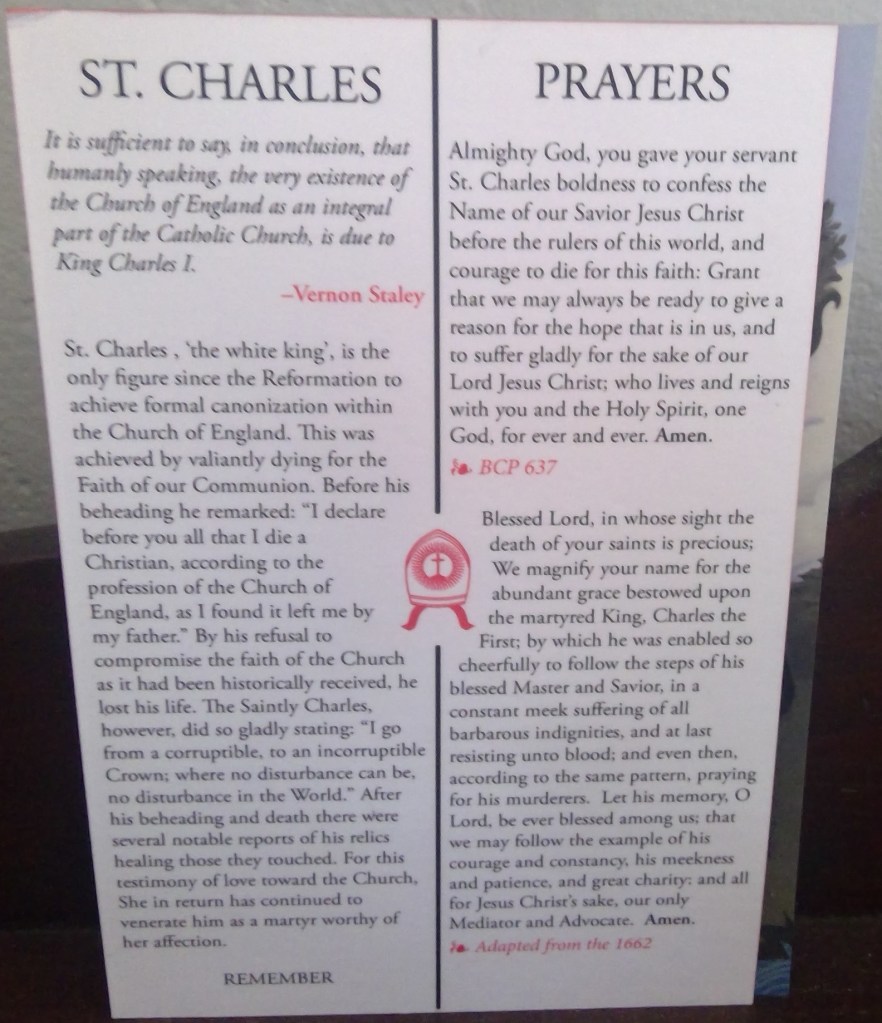
King Charles I is remembered with some controversy among some segments of the population, but to the English (Anglican) Church his memory is honorable; indeed, the 1662 Prayer Book contained a special service of mourning to be held every January 30th in recognition of his unjust execution at the order of the illegal Rump Parliament at the end of the English Civil War in 1649. An excerpt of his last words is included on one side of the card:

The Collect on the bottom-right is one of the prayers appointed in the 1662 Prayer Book for his commemoration, and is put forth by the Saint Aelfric Customary as the Collect of the Day on January 30th also. If you want your own copy of this prayer card, it can be purchased from the Seabury Society here:

What’s on the Altar Table?

The most prominent element in a liturgical church’s worship space is the Holy Table or Altar, where the prayers are read and the Communion is celebrated. The nomenclature and its ornamentation has a history of some controversy, though most of those arguments are very much muted today.

The Prayer Book consistently refers to the Table or Holy Table, rather than an Altar. This was to appease those who found the term Altar objectionable, cautious as many were to distance themselves from the Roman view of the sacrifice of the mass. For others it was a matter of emphasis: better to speak of God’s Board or Table (where we feast) than of the Altar (where we make a sacrifice). Nevertheless, the altar terminology never entirely left Protestant discourse; we have always recognized the sacrificial aspect of the Holy Communion, and thus you typically will hear people today using the terms synonymously.

Another controversy in the days of the Reformation was what to put on this table or altar. There was a period of time when even candles were banned, for fear of symbolizing the Roman doctrine of transubstantiation. This was eventually conceded to be excessive – the use of candles (and indeed nearly all Christian liturgical ornamentation and beauty) long precedes any late medieval abuses thereof. Thus even in “low church” settings it is not unusual to see a pair of candles and a cross on an altar table. After all, many ancient traditions have practical origins: candles on the altar helps the person(s) there to read the books!

The only ornament that remained a requirement in Anglican practice is the “fair linen cloth” to be draped over the holy table. This was in part a continuation of ancient practice, in part a symbol of cleanliness and holiness, in part an act of beauty and decency and decorum. Like the white robes worn by the saints in the Book of the Revelation, and the white pall draped over a coffin at a funeral, the fair linen cloth hides the tabletop (be it expensive and beautiful, or inexpensive and plain), emphasizing the holiness with which Christ clothes us, creating an equality and common ground that we would not otherwise have. One altar may be very ornately carved and another holy table may be a plastic fold-up (spoiler alert, that’s what we’ve got, still!), but the white cloth covers that up and says “whatever’s underneath here doesn’t really matter; what matters is that Christ is served here.”

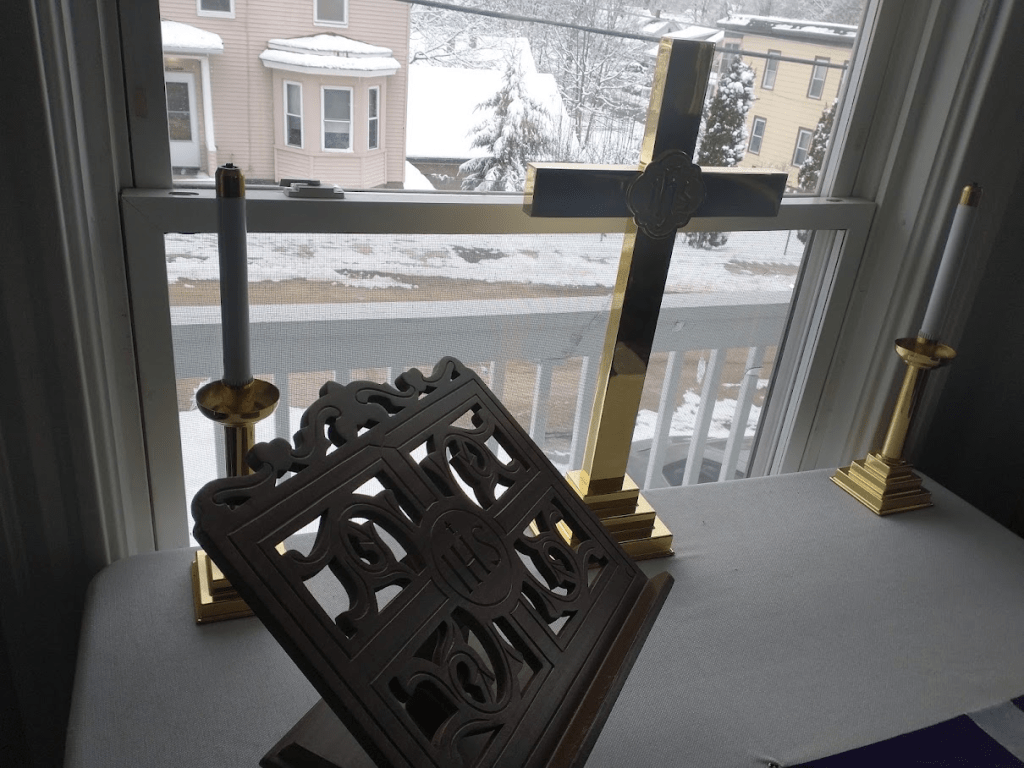
Grace Anglican Church has had this altar cloth, cross, candle set, and bookstand for most of its history. The cross comes with kind of a funny story. When it was first purchased and arrived, a parishioner set it on the table. The cross being nearly two feet tall and the celebrant being on the shorter side of average, it stood squarely in his face, a strange barrier between him and the congregation. So during that morning’s setup he said “Here’s how we solve this!” – he pushed the table up against the wall and celebrated ad orientem instead of versus populum. Many of my readers know these terms, but some of you may not.

Worship ad orientem means “toward the East” – that is, the priest & people all face East together: toward the altar. Worship versus populum (or is it populorum? I decline to remember which, if you’ll pardon my Latin pun) means “against the people” – that is, the priest and the people are facing one another. Most traditional altars are built against the wall (either literally East or just symbolically East), such that when the celebrant prays here he is facing in the same direction as everyone else. In the 20th century some liturgical reformers decided it was not very hospitable to have the priest’s back turned to the people, so a different ancient arrangement was dredged up from the history books – versus populum – which necessitates a freestanding altar or table that the priest stands behind such that when he is praying, the people can see his face as well as everything on the table.

The Prayer Book tradition has a hybrid setup often called North Facing, as the priest is directed to stand at the “North end” (congregation’s left) side of the holy table to celebrate communion. This has been implemented in a couple different ways, and I’m not really well-versed in this practice, so I’ll not wade any further into this subject lest I teach something incorrect.

All that to say, Grace Anglican Church has been an ad orientem worshiping community for about 10 years simply because of the furnishings! And frankly, I found it a much more comfortable posture for the prayers than facing the congregation – I’m not praying to them and they aren’t praying to me! We’re all praying together, to one Lord.

The bookstand is another common tool found on most altar tables – it elevates and angles the Prayer Book, Bible, binder, or other form of text, so that the celebrant can see it and turn pages more easily. Ours, you’ll see in the picture, has the letters IHS in the center. (So does our cross.) This is often thought to stand for “In His Service” (at least that’s what I thought when I saw those letters as a child), but it’s actually the first three letters of the name of Jesus in Greek: ΙΗΣΟΥΣ, or Ιησους.

There are other things to be said about the altar furnishings, and other ornaments around it, but that’s all we’ll address for today. Stay tuned for one more bonus article in this Visual Tour before next Wednesday!

The Saint Aelfric Window

This is how I intended to begin my “visual tour” of our chapel – with the image of the man himself, Saint Aelfric. There aren’t a lot of images of Aelfric out there, unfortunately, but this rather fetching stained-glass picture is from the church in Eynsham, the town where he was an abbot for many years.

The quote below the picture is from one of his Easter Homilies. It reads “This mystery [of the Holy Communion] is a pledge and symbol; Christ’s body is truth. This pledge we hold mystically until we come to the truth, and then will this pledge be ended. But it is, as we before said, Christ’s body and his blood, not bodily but spiritually. Ye are not to inquire how it is done, but to hold in your belief that it is so done.” Nearly 500 years before the Protestant Reformation began, Aelfric is a witness to the ancient Christian faith that confidently spoke of the real presence of Christ in the eucharist, yet without resorting to fanciful explanations that the medieval church would eventually fall into, particularly in the Roman doctrine of transubstantiation. His writings, therefore, as well as the earlier Church Fathers from whom he drew, were of great importance to the English Reformers as they sought to correct the recent Roman errors and restore the true teaching of the Catholic Church.

But why is Saint Aelfric the namesake, or patron, of my ministry, this blog, and this chapel? Well first of all Saint Aelfric himself is a difficult historical figure to identify. Historically he was understood to be the Abbot of Eynsham who wrote many biblical commentaries, sermons, and hagiographies in Old English, and the 28th Archbishop of Canterbury. In modern times “Aelfric of Eynsham” and “Aelfric of Abingdon, Archbishop” tend to be identified as two different men. Both lived in the late 900’s and died in the early 1000’s. Both of them are considered the namesake, or patron, of my ministry.

For one, the Aelfric who wrote all those treatises may also be responsible for some of the earliest Bible translation in the English language. Centuries before Wycliffe, significant parts of the Bible were translated into Anglo-Saxon, or Old English, of which the four Gospels, the Psalms, and other fragments survive to this day. Curiously, however, Aelfric was said to have been reluctant to do this; he apparently preferred the Latin Scriptures and liturgy, which were widely understood by all who learned to read and write, but he made his translation out of acquiescence to royal demand. My approach to liturgy and worship, and ministry in general, reflects that sense of caution, acquiescing to the authority of the Book of Common Prayer (2019) as set forth by the College of Bishops of the Anglican Church in North America (ACNA), yet looking back to the long-standing tradition of Anglican worship that was interrupted in the late 20th century. Rather than revert to the “only-ism” characteristic of many traditionalists, it is my aim to follow the present standards with our Great Tradition in mind whenever possible.

The split identity of Aelfric –the Abbot of Eynsham or the Abbot of Abingdon who became the Archbishop– also plays into the context of our church at large. As it stands, the ACNA has its own form of identity crisis: traditional hymnody versus contemporary praise songs, solemn liturgical standards versus charismatic leniency, disagreement over ordination, a wide range of interpretation regarding the wearing of clerical vestments… all making this province a colorful and confusing place. It is my aim to worship and minister in such a way that Christians of all stripes may benefit from the riches of our historic tradition without too much intrusion from the particular preferences of the milieu of today.

Thus the faithful spirit and example of St. Aelfric is a constant companion in my service to the Lord and his flock.

The Saint Peter Window

Today I’m beginning a new series of posts providing a Visual Tour of the Saint Aelfric Chapel, from which I serve and host my little parish, Grace Anglican Church. My intention was to begin a couple weeks ago, on the first Wednesday of the year, and to make this a weekly entry on each Wednesday following, so there are two I’ve missed which I’ll make up between now and next Wednesday.

In the years leading up to the purchase of my family’s first house and the establishment of our own chapel space therein, I had dreamed and hoped for the opportunity to collect and gather a lineup of saints whose images and relevant quotes could adorn one of the walls. The chapel we’ve ended up with has not made that a feasible wish, but I found an alternative: the windows.

Now, this is a sort of a multi-layered pun. First of all, we have a window on either side of the bay, where the altar is located, and during Holy Communion I place a picture of a saint on both of those window sills. One is a picture of Saint Aelfric, the namesake and patron of this blog, the chapel, and my ministry in general. The other is rotated out between several different saints and images throughout the year. Now, many of those images are printings of traditional icons, which (as the Eastern Christians say) are “windows into heaven”. So we have windows in the windows, but for most of the week these pictures, sitting in their picture frames, are up on the altar.

Currently Saint Peter is up:

Saint Peter, is, of course, commonly considered the leader of the original twelve apostles, and generally recognized as the first Bishop of Antioch and then of Rome. He is thus a hugely significant figure for the Roman Church, who claim him and his patronage and (errantly) his primacy over all other apostolic sees. But he’s also a hugely significant figure in the New Testament itself, being the most active character in the Gospel books save for our Lord himself, as well as the author of two epistles.

As for me, St. Peter took on a special significance while I was attending seminary. In part, it was because one of my exegesis classes was on 1 Peter, and so I got to know him through his writing better than I did any other author. But also something that resonated with me was one of his last encounters with the risen Christ. The story is quoted on the picture (or “window”) above, and it’s from John 21:18-22. In that encounter, Jesus foretells the sort of death that Peter would eventually die. Peter, a relatable human to the core, looks over at John and asks “what about him?” as if he’s once again trying to compare himself to others. And Jesus gently retorts “what is that to you? You follow me.” As a human, it’s tempting to compare myself to others to evaluate my worth and my success. As a pastor and priest, it’s all the more tempting to compare myself to other ministers to measure my success and my worth. Jesus reminds Peter, and all pastors, that the fate of other pastors is not important – we all must follow him.

So Saint Peter’s window is up in the chapel for most of the month of January, in which we celebrate his marvelous confession of faith (today in fact) recorded in Matthew 16. As one of the most significant of the Church’s Saints, he’ll also cycle back in a second time for the month of June, in which we commemorate his martyrdom (alongside the martyrdom of Saint Paul, in our calendar).