Who was St. Cyprian of Carthage?

There are several names that refer to early Christian Saints – John, Augustine, Clement, Theodore, Gregory, Basil, to name a few – so we generally have to give them suffixes to their names in order to distinguish them. Today’s commemoration in the calendar is one such example: St. Cyprian, from Carthage.

In many ways, Cyprian is the Augustine before Augustine. He was a Berber, a Roman African, born to a wealthy Pagan family, and he converted to Christianity at age 35. After his conversion he was ordained quickly, becoming the Bishop of Carthage roughly four years later. This was, perhaps understandably, a little controversial, but his actions in the ministry soon proved his sanctity-in-Christ. A wave of government oppression of the Church, called the Decian Persecution, swept through in the early 250’s, and Cyprian saw a lot of his flock cave in to the Roman demands to offer sacrifices to the pagan gods. Cyprian himself rode out much of that persecution in exile, believing it God’s will that he survive to shepherd his flock from a temporary distance, and be present to pick up the pieces when it was over, much like how the Apostles fled Jerusalem after the death of St. James, and how many Christians fled Jerusalem during the Roman-Jewish War culminating in the sack of 70 AD.

Needless to say, there was a controversy waiting for Cyprian when the dust settled: what do you do with the lapsi – the lapsed, who burned sacrifices to other gods? Cyprian’s initial demand was that they undergo public penance before being readmitted to Holy Communion, but a number of his earlier opponents thought this was too strict, and many priests took it upon themselves to invite people back under much more liberal conditions. As this controversy was brought to a local council, another party cropped up: a stricter group who argued that the lapsed could not repent and rejoin the church at all! The council stood with Cyprian, in between the too-liberal Novatus of Carthage and the too-strict Novatian of Rome.

As a pastoral and liturgical aside, this is insightful for us today, because we, too, see many lapsed Christians coming in and out of our churches these days. Do we admit them to Holy Communion without question? Or should we, as St. Cyprian ruled, call for public repentance of their wanderings from the Gospel before reinstating their place at the Holy Table? This is worth considering carefully, and we have resources in our Prayer Book to help us.

  • The Ash Wednesday exhortation explicitly mentions the ancient practice of public repentance.
  • The Exhortation in the Communion service warns us against unworthy reception of the Sacrament.
  • The Confirmation liturgy includes a variant for “Reaffirmation”, particularly for those who were previously confirmed, fell away, and have since returned.

It may well be that we have become too lax in our ministration of the Sacrament of Holy Communion, and need to re-learn, from the likes of St. Cyprian, what good Eucharistic discipline looks like.

This wrestling with the implications of the Gospel for those who fall away under persecution would return for St. Augustine of Hippo and the Donatists nearly 150 years later, though then it would be about the purported need for re-ordination, rather than readmission to Holy Communion. Cyprian was like an early Augustine in other ways too: his Latin writings were influential and beloved, his handling of controversy and good accord with other bishops was laudable. And they both saw disaster at the end of their lives. For Augustine, of course, it was the news of the sack of Rome and the arrival of barbarians at the gate of his own city. For Cyprian it was another round of government persecution, leading to his execution on 14 September 258.

The date of his commemoration isn’t so straight-forward, because 14 September has been taken by Holy Cross Day, forcing the Church calendar to shift St. Cyprian of Carthage to another day. Most Anglican calendars place him on an adjacent day – the 13th or 15th. The Roman Church has another observance (Our Lady of Sorrows) on the 15th, so they celebrate Cyprian on the 16th, and some other traditions follow suit.

Why Holy Cross Day in September?

Happy Holy Cross Day! Is that what we’re supposed to say? I mean, yeah, the Cross is where Jesus died a horrible painful death, that’s not super-happy is it… wait a minute, how is Holy Cross Day any different from Good Friday? Why do we have an extra Good Friday in September?

Perhaps we need a little history to make sense of this. To borrow from Wikipedia,

According to Christian tradition, the True Cross was discovered in 326 by Saint Helena, the mother of the Roman Emperor Constantine the Great, during a pilgrimage she made to Jerusalem. The Church of the Holy Sepulchre was then built at the site of the discovery, by order of Helena and Constantine. The church was dedicated nine years later, with a portion of the cross.

https://en.wikipedia.org/wiki/Feast_of_the_Cross

September 14th, then, is the day that the Church of the Holy Sepulchre was consecrated. Although, in the West, this day also commemorates St. Helena’s discovery of the Cross beforehand, as well as the restoration of the relics to Jerusalem in the 7th century after a brief Sasanid Persian invasion.

For Anglicans and Lutherans, however, who generally prefer their liturgy reformed around the primacy of Scripture, this feast has been focused less on the tradition of the True Cross (which may or may not be entirely historically accurate) and more on the significance of the Cross itself. There is, after all, quite a history of devotion (or veneration veneratio, which is of a lesser degree than worship latria) to the Cross and its relics; the Cross is the instrument by which Christ redeemed the world. He didn’t “just die”, he was nailed to a real physical piece of wood. Some have found this an opportunity to meditate upon the inclusion of nature itself in the Gospel, such as in the great Old English poem Dream of the Rood. Similarly, when the author of the Wisdom of Solomon was reflecting back on Noah’s ark, he also foreshadowed the Cross when he wrote:

It is your will that works of your wisdom should not be without effect;
therefore men trust their lives even to the smallest piece of wood,
and passing through the billows on a raft they come safely to land.
For even in the beginning, when arrogant giants were perishing,
the hope of the world took refuge on a raft,
and guided by your hand left to the world the seed of a new generation.
For blessed is the wood by which righteousness comes.

Wisdom 14:5-7

And so, in harmony both with this ancient spirituality and a renewed focus on the Scriptures, we have Holy Cross Day in our calendar. It is like a repeat of Good Friday, but instead of looking at the pain and suffering of Christ, as such, we are looking at the glorious work of God in the world. Instead of a day of fasting, mourning, and penitence, this is a feast day. We celebrate with awe the wonder of the Gospel, and the tactile reality of the Cross, a “tree” as St. Peter once described it, literally grounds this remarkable theological event in natural reality.

With that in mind, let’s conclude with a brief comparison of the Scripture readings for Good Friday and Holy Cross Day.

Good Friday, in the Holy Day lectionary, gives us:

  • Genesis 22:1-18 or Isaiah 52:13-53:12, which are a typology and prophecy, respectively, of Jesus’ death
  • Psalm 22:1-11(12-21) or 40:1-16 or 69:1-22, which are songs of suffering and lament
  • Hebrews 10:1-25, which deals with the high priestly sacrifice of Jesus
  • John 19:1-37, which is the Passion of the Christ

Holy Cross Day, however, gives us these readings at the Communion service:

  • Isaiah 45:21-25, which is a universal call to turn to Christ for salvation
  • Psalm 98, one of the joyful celebrations of God’s salvation and praiseworthiness
  • Philippians 2:5-11, an exhortation to imitate Christ in his humility even unto death on the Cross
  • John 12:31-36a, where Christ speaks of his glorification and drawing all men unto himself when he is lifted up on the Cross

So you can see that Holy Cross Day has a focus on glory and celebration that Good Friday lacks. They share a call to “behold”, to gaze upon the crucified one, and the Cross itself as his instrument, and they also share a call to follow Christ – Philippians 2:5-11 in particular is also the Epistle for Palm Sunday, which falls into the same pattern as these. But ultimately this is not a day to mourn the death of Christ but a day to celebrate the victory of Christ. The crucifixion, after all, is a deeply rich event, worthy of observance in many different ways from many different angles. Good Friday is particularly concerned with his suffering and our sins that drove him there; Holy Cross Day is particularly concerned with the triumphal glory and power of God displayed in that same death.

Almighty God, whose Son our Savior Jesus Christ was lifted high upon the Cross
that he might draw the whole world to himself:
Mercifully grant that we, who glory in the mystery of our redemption,
may have grace to take up our cross and follow him;
who lives and reigns with you and the Holy Spirit, one God, in glory everlasting Amen.

Customary update: Family Prayer

I’ve got a new update to the Saint Aelfric Customary online now: it’s some extra materials to help you customize Family Prayer for your own needs!

In a way, this seems like a silly idea; the whole point of liturgy, or common worship, or common prayer, is that we speak with one voice and one mind, as the Scriptures exhort us. So to customize a liturgy is to defeat the purpose, right? Yes, BUT…. family prayer is explicitly not common prayer in the congregational sense; it’s only common prayer within the context of a local household.  There are some devotions and practices that a family might want or need which they’ll best implement in a different way than others.  One example is children: my five year old is still developing his attention span; reading a whole chapter from the Old Testament, as in the Daily Office lectionary, is a bit too much for him to take in right now.  But if I stick with the mini-readings in Family Prayer, he’ll never be stretched to listen to longer readings, so we need something in between.  Thus, one of the resources to be provided in this Customary is a Children’s Lectionary.

Because formatting is difficult to translate onto a webpage (on top of WordPress radically changing its Post Editor into a new system that hate with an alarming hatred), I’m not putting all the actual lectionary-like resources on the page; they’ll wait for the book.  But you can comment on the Family Prayer Customary page to request a copy if you want.

Behold: Customary: Family Prayer

A brief history of the Te Deum

This great hymn of the Church is said to have been written by Saints Ambrose and Augustine together, though it has also been attributed to Bishop Niceta of Dacia; in either case its origins are in the late 4th or early 5th centuries. By the 6th century it had found its home in the Daily Office, in Matins (Benedictine) or Prime (Mozaribic). A set of suffrages were affixed to the Te Deum in medieval practice, which Archbishop Cranmer retained in the first Prayer Books.

The Prayer Book tradition has consistently appointed this canticle as the one following the Old Testament Lesson at Morning Prayer, usually with seasonal exceptions. Its precise translation has varied in most editions of the Prayer Book, making for a number of useful comparative-study opportunities for exploring its meaning more deeply.

In 1979 the medieval suffrages were removed from the Te Deum and placed elsewhere in the Morning Prayer liturgy, but the 2019 Book has placed them back in the traditional Prayer Book position, albeit rendering them optional.

A brief devotion on the Te Deum

One of the mainstays of the Prayer Book tradition are its canticles, the first of which is the Te Deum, appointed in Morning Prayer.  Although it is sometimes (even often) substituted for other shorter canticles, it stands as one of the most majestic hymns in all of Christian history.  Here’s a quick devotional examination of that canticle.

The Te Deum as we have it is a three-part hymn of praise.  The first part focuses on the Trinity, drawing from texts such as the “holy, holy, holy” in Isaiah 6 and Revelation 4, and language of the three Persons reminiscent of John 1:14, 5:20, and 14:26. Not only is the fullness of God described, but also the fullness of creation: angels, the powers of heaven, cherubim and seraphim, apostles, prophets, martyrs, the holy Church. Familiarity with the Te Deum will reward the worshiper at Holy Communion during the Sanctus, as the majestic language of this hymn echo in the mind of the worshiper during those brief moments in the Communion liturgy.

The second part of the Te Deum is a celebration of the Son of God: his incarnation, death, ascension, and promised return to be our judge. His atonement was to “set us free”, “open the kingdom of heaven to all believers,” and help us who were “bought with the price of your own blood” such that we can be brought “to glory everlasting.” The inclusion of the words “We believe” give this ancient hymn a creedal character to it, giving us an example of just how seamless the line can and should be between theology and worship, doctrine and doxology.

The third part of the Te Deum may not be as ancient as the first first two, and thus is rendered optional in this Prayer Book. The tone changes somewhat also, moving from praise to petition. Like the Suffrages that follow in the Daily Office, this final portion of the Te Deum is drawn from a series of Psalm references (28:10, 145:2, 123:4, 33:21, 31:1). Although these verses are from disparate sources, they are woven together seamlessly: each couplet leads to the next. “Now and always” is matched in “Day by day”, everlasting praise is matched with a request to be kept from all sin, the Kyrie is repeated (or in a way, clarified) with “show us your love and mercy”, and the placing of trust in God is matched with “In you, Lord is our hope.” This pattern of linking the end of a verse to the beginning of the next is also a feature of classical Prayer Book liturgy, where, particularly in the Communion prayers, paragraphs often repeat material used just before. Thus is formed a solid chain of continuity and purpose as the worshipers proceed through the worship service.

Customary update for Compline

The service of Compline in the 2019 Prayer Book has a small number of options to navigate: four Psalms, four readings (plus another seven in the Additional Directions), and a handful of collects to choose from among the prayers.

Although the saying of Compline is usually a private devotion, and thus highly subject to personal preference, familiarity, or brevity, I’ve got a Customary entry for Compline, too, by which you can order your use of the options in this brief service of prayer and meditation.

You can find it here: Customary: Compline

When to skip the Nicene Creed!?

Happy September!  I am finally easing out of a writing hiatus, now that my family’s move is more or less completed and the school year has more or less begun.  We won’t quite be jumping straight into five posts per week, but, as I announced a few months ago, the focus on quality over quantity will continue.

Today we’re tossing another “Weird Rubric Wednesday” into the collection.

wrw

So you’re going along through the Communion service in the 2019 Prayer Book, and you get to page 108 or 126 and you come to this rubric:

On Sundays, other Major Feast Days, and other times as appointed, all stand to recite the Nicene Creed…

So this is curious.  Most of you are probably used to the Nicene Creed being a static part of the Communion service – always there, unchanged, unchanging.  Indeed that was the pattern set out in 1662: And the Gospel ended, shall be sung or said the Creed following, the people still standing as before.  By that point it was assumed that Holy Communion was being celebrated, at most, on Sundays and Holy Days.  The Roman tradition of Daily Mass was pretty much gone from English practice.  So practically every Communion was a Sunday or Holy Day, and there was no need to mess around with options.  After the Gospel, just say the Creed.  (Yeah, the sermon used to be after the Creed.)

But eventually things got a bit more loose.  The 1928 Prayer Book, usually upheld as the last bastion of traditional Anglican liturgy in America, actually has quite a strange rubric about the Creed – I daresay more worthy of “Weird Rubric Wednesday” than its 2019 counterpart.  This is what it says:

Then shall be said the Creed commonly called the Nicene, or else the Apostles’ Creed; but the Creed may be omitted, if it hath been said immediately before in Morning Prayer; Provided, That the Nicene Creed shall be said on Christmas Day, Easter Day, Ascension Day, Whitsunday, and Trinity Sunday.

You see, in the 1928 Book, people have the option of saying either the Apostles’ or the Nicene Creed in Morning Prayer, and the same choices at the Communion too.  The “defaults” were still Apostles’ in the Office and Nicene in the Communion, but the expansion of options was such that one could choose either at any time, with only five exceptions.  Omitting the Creed entirely was also an option if Morning Prayer had just been said!

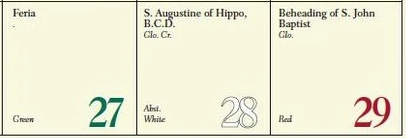
But this isn’t simply wild and crazy liberalism and choose-your-own-adventure liturgy building.  I mean, that could happen, but that’s not the intention.  Rather, this option to omit the Nicene Creed is in line with a retrieval of pre-Reformation tradition that was going on at the time in the growing Anglo-Catholic movement.  In the Roman calendar there are several “classes” or “ranks” of feast days, and they are celebrated with different levels of liturgical complexity.  Among those levels include the saying/omitting of the Gloria, and also of the Nicene Creed.  These options have been codified among traditional Anglo-Catholics, as demonstrated by this Ordo Kalendar put out by a group of the Continuing Churches:

aug-sample

In this picture you can see August 27th-29th, with notes for the daily mass.  St. Augustine of Hippo’s feast day merits both the Gloria and the Creed, whereas the Beheading of St. John the Baptist omits the Creed.  The Feria (or empty) day before them omits both.  So, coming back to the 2019 Prayer Book, when we read On Sundays, other Major Feast Days, and other times as appointed, this is an opportunity for those who want to follow some sort of “ranking” of feast days to make distinctions in how we celebrate Communion in honor of different saints’ days.

Livestream amidst hiatus

Hello again, the hiatus continues.  Moving house is a slow process of settling in.  But next week I’ll have one child in preschool and we will be just about finished with the last bits of moving, so hopefully next week is when I’ll resume writing here again!  It probably won’t be five posts a week immediately, though.

In the meantime, though, I have been experimenting with livestream Evening Prayer services.  Sunday and Monday evening of this week I held them, and plan another one tonight: Wednesday 19 August at 8pm EST.  It will be streamed via YouTube, though the link will also be shared on this Customary’s Facebook Page about an hour in advance.

Until then!

Some History of the Daily Office Lectionary

With the sole exception of the 1979 Prayer Book, the Prayer Book pattern has always been two lessons.  With perhaps one additional exception these two lessons have always been Old Testament and New Testament.  The original Daily Office Lectionary of the 16th–19th centuries appointed one chapter per reading (the 1549 Book actually preceding the current English Bible versification), with one exception for Luke 1.  Its Old Testament lessons were continuous between Morning and Evening Prayer, starting with Genesis in January and proceeding in canonical order, albeit leaving Isaiah for the end of the year.  The Gospels and Acts were read three times through in Morning Prayer and the Epistles were read three times through in Evening Prayer.  The books of 1 & 2 Chronicles and Revelation were omitted, as well as substantial portions of Exodus, Leviticus, Numbers, and Ezekiel.  Among the Books Called Apocrypha, Tobit, Judith, Wisdom, and Ecclesiasticus (Sirach) were read in full.  Besides this pattern, there were appointed Old Testament lessons for each Sunday morning and evening in the year, providing a yearly highlight of Old Testament content for the benefit of those who did not attend the Office daily; this started Genesis on Septuagesima Sunday, in accord with pre-reformation practice.

In the 20th century, many Prayer Book Daily Lectionaries switched to being built on the liturgical calendar instead of the secular calendar, a pattern uniquely broken by the 2019 Prayer Book.  The trend had been one of increasing complexity and attention to liturgical time and holy days, to the loss of continuous reading and wide coverage of the Bible.  Thus this Book returns to the simplicity of the first English lectionary, with due consideration for current needs and practice.  In line with evangelical concern for the distinction between the Books Called Apocrypha and the Hebrew Old Testament, the 2019 Daily Lectionary has the smallest coverage of those additional books than any previous Prayer Book.

The dialogue “This is the word of the Lord. / Thanks be to God.” was first introduced into the Prayer Book in 1979, having been imported from the Roman Rite of the Mass.

Brief Hiatus

As the future King, David, is running around finding new places to hide in the later chapters of 1 Samuel (which we’ve been reading lately in morning prayer), so now have my family and I just moved a few miles to a new home too. It’s wonderful to have space for the kids to play outside without having to watch out for cars, and (soon) set up a home office where I can write for you all from a proper workspace rather than the couch or the kitchen table.

This means, however, that I will not be able to keep up these posts for a few days, until our internet is connected and the boxes are a little more unpacked.

Back soon!