Paedocommunion: a feature or a bug?

There are a couple inconsistencies in the 2019 Prayer Book that I would like to address, gently, carefully, and with respect. Both involve doctrine and practice that were changed in the 20th century and are accepted by some otherwise-conservative Anglicans today without even batting an eye, yet grumpily condemned by the more traditionalist brethren. And the 2019 Prayer Book, perhaps predictably, has ended up awkwardly with a foot in each camp, so to speak. Is this a feature or a bug?

The issue that I’m going to address here is paedocommunion, the practice of serving Holy Communion to infants and small children, requiring only that they first be baptized. From what I have seen, this practice has been found among some of the more strictly traditional Anglican provinces, not just the ACNA, but there are still people in our midst who are hesitant or outright opposed to this practice. Historically, the Prayer Book tradition has required that one be Confirmed, or at least “desirous to be confirmed” in order to receive the Sacrament of Holy Communion. That loophole exception proved useful in the early years of the Episcopal Church in the USA when bishops were scarce, but that temporary situation soon went away and regular discipline was eventually resumed, as far as I know. Other Protestant (as well as Roman) traditions were all on the same page: receiving Communion requires a confession of faith, repentance of sin, and the desire to commune with Christ. Basically, if you just read 1 Corinthians 11:27-32 at face value, you get the rule that all of Western Christianity observed for over a thousand years.

But there are rumblings concerning the varied practices in the Early Church, and there is the ongoing witness of Eastern Orthodox practice wherein a child is baptized and “confirmed” (properly, chrismated) all at once, and then go on to receive Communion before what Westerners would call the Age of Reason. But we’re not confirming our infants, like they are, so what changed in Western Christian thought that has led so many Anglicans (and certain other traditions) to make such a radical change in practice?

The answer is largely found in the doctrine of Holy Baptism. It is no secret that the 1979 Prayer Book contains a severe shift in baptismal theology compared to the Prayer Book tradition previously. It became less about cleansing from sin and the beginning of the new life in Christ and more about joining the family of God and belonging to the mission of the Church. The Preface to the 2019 Prayer Book, on page 4, even calls this out:

Baptismal theology, especially in North America, was affected by radical revisions to the received Christian understanding, and came perilously close to proclaiming a gospel of individual affirmation rather than of personal transformation and sanctification.

The poster child for this was “The Baptismal Covenant”, which took some traditional elements of the examination of the candidates and set them in a context that shifts the emphasis from Baptism being a gracious gift of God toward Baptism being a commitment that we make as individuals.

All that being said, the question now arises: what does the 2019 Prayer Book do about all this? The Preface expresses clear concerns about the previous baptismal liturgy, and the 2019 Baptism service does a good job of bringing back several elements of historic prayers. There is still a thread of emphasis on “welcome to the family of God”, but that’s fine because it is (first of all) correct, and (secondly) not a theme original to 1979 but already cropping up in 1962 and 1928 alongside the historic liturgical forms. One might quibble over the quality of the balance between “welcome to the family” and “this child is now regenerate”, but it can safely be said that our baptismal liturgy is once again within the bounds of Anglican orthodoxy.

And yet, nearly the entire ACNA communes its not-yet-Confirmed members. And so do some of the Continuing churches who never even adopted the 1979 Prayer Book in the first place. So when you look at the 2019 Prayer Book and observe the utter lack of direction over whether not-yet-Confirmed children may receive Holy Communion or not, one has to conclude that this is a feature and not a bug as such. It is an inconsistency, yes, because we’ve called out the baptismal errors of the Episcopalians since the 70’s and yet we often retain their practice of communing our children on the basis of their Baptism alone. But it’s an inconsistency that we share with others, and therefore one that we cannot simply “solve” in our new Prayer Book alone.

If you or members of your congregation are uncertain about the practice of paedocommunion, I highly recommend you avoid it. If there are scruples or doubts about doing something, then it would be done in fear and not in faith, and therefore should not be done (Romans 14:23).

If this is a subject you’ve never thought about before, then please go read 1 Corinthians 11 and the Exhortation to Holy Communion in our Prayer Book. I have a doctrinal walk-through of it here for you, and an historical summary of it here.

Whatever you decide on this, make sure that you are able to do so in the confidence of the Holy Scriptures and the directions of your Church.
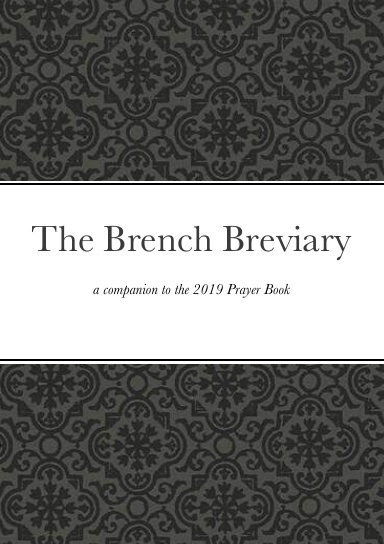
Book Introduction: The Brench Breviary 2022

THE BRENCH BREVIARY 2022 is the product of several years of liturgical tinkering, experimentation, subsequent conformity to the new Book of Common Prayer (2019), interest in Benedictine spirituality, attempts to organize private study and devotion, and a pastoral attention to the spiritual and catechetical needs of others.  It is my strong contention that the average Christian today desperately needs two things: a robust life of ordered prayer and Scripture-reading, and the development of an authentically Christian instruction and spirituality.  The former is amply supplied in the Book of Common Prayer, if any dare to “take up and read.”  The latter can at least be begun with a book such as this.

The Brench Breviary 2022

Honestly, if you poke around this blog site, especially the Customary pages, you’ll find most of the special additional material that makes this book a unique companion to the Book of Common Prayer. But what you get for your money, with this real-life physical book, is clear, neat, organized, and purposeful access to some of the best resources that I’ve produced and put online here – plus a couple things I haven’t!

As for the name, this is the Brench Breviary because it reflects the particular orders, ideals, or devotional practices that I (Fr. Brench) have aspired to, in part or in whole. There may someday be a Saint Aelfric Breviary, but the biggest issue there is how much Prayer Book material would be re-printed. It it more likely, economical, and in line with my educational intentions that a set of bookmarks or leaflets outlining this Customary’s implementation of the 2019 Prayer Book. And don’t worry, the 2022 doesn’t mean I’m going to replace this every year. Like the Prayer Book, this is a book that is intended to be supplemented, edited, and updated on a gentle and rare basis.

The Offices and orders in this book are presented in one idealized form, but individuals are encouraged to make these their own according to need and ability.  A maximalist use of this Breviary would look something like this:

For those looking to develop a prayer life with children, the Children’s Lectionary attached to the Family Prayer In the Morning can be used with any of the four “Family Prayer” offices in the Prayer Book.

For those looking to develop their grounding in historic Christianity, the Catechetical Lectionary and the reading of the Homilies can be attached to the Daily Offices themselves.

For those concerned about personal holiness, desiring to take up arms in the work of spiritual warfare, the Personal Devotions at the start and end of the day (which are drawn from the American Prayer Book of 1928) contain valuable prayers to that end, especially with the Examinations of Conscience added therein.

The Catechetical Lectionary, it must be noted, includes two compilations of writings that are not fully listed in this Breviary.  The first is Advent With Anglican Poetry, also published by Brench Publications. The second is Lent Readings from The Fathers, published by Oxford, John Henry Parker, in 1852. A reprint of the latter should be forthcoming within the next couple years.

It is my prayer that, however you choose to use this, with family members or a small group or alone, it may be a blessing that enriches your walk with God, your engagement with his Word, and your love for his Church.

The Rites of Holy Baptism compared

My slow and careful study through the Prayer Book has brought me to the Baptism service. In general, followers of this blog may have noticed a lot of entries about the Daily Office in 2020 and the Communion service in 2021. I did have a nice “plan” to work through the Baptismal material in December, Confirmation material in January, and continue on through the majority of the rest of the Prayer Book rites over the course of 2022, but I’m already “behind schedule.” Be that as it may, wherever I am in this process, I’m still sharing snippets of information – insight, encouragement, and advice – online here as I go, so we can all learn together.

Before we get into any specifics of the Baptism service, it’s helpful to take a big-picture view of where this liturgy has been in the past. Sometimes trends over the centuries can shed light on the peculiarities of the present (or any previous) day. Five Prayer Books are standing in parallel here: the English Prayer Books of 1549 and 1662, the American 1928, the Canadian 1962, and the 2019 Book of the Anglican Church in North America.

We begin with the context. One of the stand-out differences here is that the modern tradition is to place the Baptism amidst a Communion service. This was introduced in 1979, and reflects the practical reality that Communion is now the standard Sunday service in the vast majority of Anglican churches. It’s interesting to see, though, that the recommended “home” of the Baptism service has changed before. The 1662 Prayer Book does not make any direct suggestion about the timing of the service, other than that it’d best be on a Sunday or Holy Day so the maximum number of people will be present to witness it. The American and Canadian Prayer Books took their cues from the original: embed the Baptism within Morning Prayer or Evening Prayer!

So, just as the Wedding service begins with the immortal words “Dearly beloved…” so too does the Baptismal liturgy begin. There are several exhortations in the Prayer Book that begin this way, actually. In any case, this short opening speech or exhortation provides a brief outline of the purpose and necessity of Holy Baptism, and why we’re here to celebrate it. The 2019 version is a bit longer than its predecessors, as it’s combining elements from past versions of the liturgy that are not maintained later on.

The Flood Prayer follows in the English Prayer Books, which I’ve written a little about before. It was dropped in North America, but the 2019 Book has actually restored it, just later in the service.

This part of the comparison chart may be the most jarring. The 2019 Prayer Book continues with the Scriptures and Sermon, following a usual Communion liturgy, where the classical Prayer Books provided a special reading and set of preparatory prayers. Some elements here, I think, would be of use to us if we reclaim them in the 2019 BCP context. The short “Explanation of infant baptism” that follows the Scripture lesson in the English and Canadian Books, for example, would make a great starting point for the Sermon. The Prayers, too, are rich resources that the preacher could use, quote, or even teach on.

In defense of the 2019’s changes and losses at this juncture, however, it should be pointed out that the 21st century West is a Post-Christian society. The baptism of adult converts should become increasingly common, and the gearing of the Baptism liturgy toward small children and infants is not especially helpful to that end. It might be more helpful, at this section of the liturgy, to compare the 2019 order to the 1662’s Baptism of Those of Riper Years. Personally I haven’t looked closely at that yet, that’s just an observation that I think would be helpful to look into for those who are concerned about the details.

This is where the 2019 Prayer Book shines more brightly compared to the previous section. The Flood Prayer is brought back to North America, the classical Exhortation & Examination includes the full three-fold renunciation unheard since 1549, and also follows up on those renunciations with an Exorcism, also unseen since 1549 (albeit that Book placed the exorcism earlier in the service). The prayers for the baptismal candidates are thus longer and more robust, and the Flood Prayer serves double duty as a transition from prayers for the candidate(s) toward the actual baptismal act itself.

Last of all, the Baptism itself is where Prayer Books have changed the most over the years. This is where it really pays off to include the Canadian Prayer Book because it more smoothly connects the liturgy to the Daily Office in which it is recommended to abide.

In a strange twist of irony, the so-called “catholic traditionalist” 1549 Prayer Book does not include an explicit blessing of the water, while the “fully reformed protestant” 1662 Book does. (Hence why stereotypical labels like these are unhelpful!) It is interesting to see, however, that the 1549 Book explicitly orders a triple Baptism (right, left, then face-first into the font), where its successors haven’t been so specific. And for those who are squeamish about babies in water, there have always been provisions for the pouring of water instead (which was also normative for adults who can only lean their heads over a typical baptismal font). Another unique change from 1549 is the naming of the child – I think enough ministers complained that they couldn’t remember the name three minutes later that the naming was moved to the baptismal act itself. (I jest! It’s probably mainly for theological reasons: in baptism we receive our Christian name. The 1662 catechism says as much.)

The sign of the Cross is made on the forehead of the newly-baptized, but the use of anointing oil was not mentioned after 1549 until 2019.

Again the 2019 Book has lost some of the traditional material, most notably the post-baptism statement: Seeing now, dearly beloved brethren, that this Child is regenerate and grafted into the body of Christ’s Church, let us give thanks unto Almighty God for these benefits, and with one accord make our prayers unto him, that this Child may lead the rest of his life according to this beginning. However, this is not as great a loss as some might make it out to be, for this statement is a call to prayer, and the actual prayers (labeled “Thanksgiving and Prayer”) that follow are strong equivalents across the board.

Another concern that has been raised about the 2019 Prayer Book is the lack of attention to the doctrine of Regeneration. Where the classical Prayer Books use that word frequently, ours uses it only once. It must be understood, however, that a significant part of this dynamic is conformity to Bible translation. Where older translations say regenerate newer translations say born again (or from above), and that phrase is found several times throughout the 2019 liturgy. The Additional Directions on BCP page 172 clearly assert the biblical and traditional precedent for the doctrine of regeneration, so there ought to be no contention or confusion on this point. Holy Baptism is “the washing of regeneration” (Titus 3:5).


One final note is that this comparative study has ignored the American baptismal rite of 1979. This is because that rite represents too significant a deviation from the historic content, and presents theological emphases too askew from the traditional Anglican position, to make it worth considering alongside the others. The 2019 Prayer Book’s theology of Baptism is to be understood in light of our solid common history, not from our recent errors. The Preface to the Prayer Book on page 4 specifically notes that “Baptismal theology… came perilously close to proclaiming a gospel of individual affirmation rather than of personal transformation and sanctification.” Fruitful comparative study of the 1979 Book may still be had, but it is my (and our Prayer Book’s) opinion that 1979 represents a liturgical-theological dead end from which we have turned back.