Happy Halloween or Reformation Day?

Perhaps the strangest thing I remember hearing in seminary was around this time of year when a classmate commented in class with great frustration that Halloween must be a satanic plot to obscure Reformation Day.  … yeah, he was actually serious.

Halloween, as most of you probably know, is a mash-up of the words “hallows’ eve”, referring to All Hallow’s Eve.  (Hallow means holy, just like in the traditional translations of the Lord’s Prayer.)  All Saints’ Day has been celebrated on November 1st for a great many centuries – I believe I read somewhere that it was previously at a different time of year, but 1,000-year-old liturgical detail is neither my forte nor the goal of this blog.  The noting of the Eve of this great feast day had been known for centuries before the Reformation began.  Furthermore, Reformation Day as a holiday is quite a recent introduction to the evangelical world.  German Lutherans have been observing it in some way for a long time, which makes sense.

Honestly, there’s something terribly strange about a church celebrating Luther’s Reformation when its own doctrines are violently at odds with Luther himself.  The fact that most evangelicals today refuse to baptize their babies and treat the sacrament of the altar as a bare symbol would be enough to earn them outright excommunication in Luther’s mind, not to mention the host of other theological disputes that would come up.  Although as Anglicans we are much closer to Lutheran theology than most other protestants out there, it still makes less sense for us to celebrate Reformation Day… we’re better off celebrating our own Reformation events – the promulgation of the first prayer book is a good example that I’ve advocated before.

Plus, the present Lutheran pattern of celebrating Reformation Sunday a week before All Saints Sunday is a liturgical faux pas.  The way the calendar works, “Proper 26” is usually overwritten by All Saints Sunday; occasionally Proper 27 is instead.  But with another holiday adjacent to All Saints Sunday, that means Proper 26 will never be observed at all, and Proper 25 will also rarely be observed.  So that’s a liturgical-logistic argument against Reformation Sunday, too.

Anyway, enjoy Halloween.  And here’s a halloween homily to go with Evening Prayer tonight:

People of the Books

The phrase “people of the book”, as far as I’m aware, originates in Islam, and is usually used referred to the three religions that respect the Torah: Judaism, Christianity and Islam.  Obviously the way in which we each “respect” the Torah is worlds apart, not to mention how we interpret it; the only thing we have in common is that really just the book.  Several Christian traditions have come to refer to themselves as “people of the book”, in reference to the Old and New Testaments together, and I’ve read that there are some Jews that refer to themselves along similar lines also.

And why not?  It makes sense: our respective religions are particularly focused on a central book that defines us.  Most of the rest of the major world religions have no single identifiable constitution or text that sets the precedent for or holds authority over its members like we do.

And so, at least in the sort of evangelical circles I grew up in, there is a culture of having a Bible for everywhere you go.  You have one at home, you have one under the bathroom sink, one in the car, one at the office at work, and so on.  You have one to study and take notes in and another to read to the kids.  Always gotta have a Bible nearby.  I suppose now that most people have smart phones, this trend may have lessened somewhat.

But you know what isn’t on a phone app (yet)…?  The Prayer Book.  As Anglicans we’re not just “people of the book”, we’re “people of the books.”  The Bible is our rule for doctrine, and the Prayer Book is our rule for worship.  There’s no comparing the two when it comes to ultimate authority, but on the level of practical use we are a two-book people.  (And if you want a singing congregation, add the hymnal as the third book!)

Imagine, especially if you’re a clergyman, making a point of having your prayer book (or an extra prayer book) virtually everywhere you go.  If you came from that evangelical culture that did this with Bibles, perhaps you can make the jump with the Prayer Book too?

Just a thought. 🙂

Prayers to Note

Teen suicide rates are on the rise in the US.  The economy and workplace situations are worsening, as many people are forced to work multiple jobs to make ends meet, causing in loss of stable schedules, often minimal benefits, health insurance, and vacation time.  Depression and anxiety is commonplace, and the pressures of 21st century life can be crushing when exacerbated with social media.  To these and similar challenges, our new Prayer Book presents a number of Occasional Prayers that can direct our attentions and affections, and possibly ease the weary soul.  There are three I want to point you to today, on pages 663-665.

#59 FOR THE DISCOURAGED AND DOWNCAST

O God, almighty and merciful, you heal the broken-hearted,
and turn the sadness of the sorrowful to joy,
Let your fatherly goodness be upon all whom you have made.
Remember in pity all those who are this day destitute,
homeless, elderly, infirm, or forgotten.
Bless the multitude of your poor. Lift up those who are cast down.
Mightily befriend innocent sufferers,
and sanctify to them the endurance of their wrongs.
Cheer with hope all who are discouraged and downcast,
and by your heavenly grace preserve from falling
those whose poverty tempts them to sin.
Though they be troubled on every side, suffer them not to be distressed;
though they are perplexed, save them from despair.
Grant this, O Lord, for the love of him who for our sakes became poor,
your Son our Savior Jesus Christ. Amen.

#62 FOR THOSE AFFLICTED WITH MENTAL SUFFERING

Almighty God, whose Son took upon himself the afflictions of your people:
Regard with your tender compassion those suffering from anxiety,
depression, or mental illness [especially _______];
bear their sorrows and their cares; supply all their needs;
help them to put their whole trust and confidence in you;
and restore them to strength of mind and cheerfulness of spirit;
through Jesus Christ our Lord. Amen.

#63 FOR THOSE IN BONDAGE TO ADDICTION

O blessed Lord, you ministered to all who came to you:
Look with compassion upon those who through addiction
have lost their health and freedom.
Restore to them the assurance of your unfailing mercy;
remove from them the fears that beset them;
strengthen them in the work of their recovery;
and to those who minister to them,
give patient understanding and persevering love;
through Jesus Christ our Lord. Amen.

Readings Review & Planning Propers 10/28

What we’re doing on this blog on Mondays is looking back and forth at the Daily Office readings (or lessons) so we can better process together what the Scriptures are saying, and list the recommended Propers for the Communion or Antecommunion service for each day of the week.

Readings Review

Last week: 2 Kings 10-14, 2 Chronicles 26, Acts 1-5:11, Isaiah 2-8, Mark 4-8:10

This week: 2 Kings 15-17, 2 Chronicles 28-29, Acts 5:12-9:31, Isaiah 9-15, Mark 8:11-11:26

Special reading for St. Simon & Jude’s Day on Monday: John 14:15-31
Special readings for All Saints’ Day on Friday: Hebrews 11:32-12:2 & Revelation 19:1-16

If you’ve got a moment, check out this quick devotional on Isaiah 9 & 10, straddling Sunday and Monday evening’s OT lessons:
https://leorningcniht.wordpress.com/2019/10/27/and-his-hand-is-stretched-out-still/

Planning Propers

This is the week of Proper 25 (or 19th after Trinity in the traditional calendar), so keep in mind that the historic Prayer Book default is that a mid-week Eucharist will repeat the Collect & Lessons (the propers) for yesterday.  Otherwise, we recommend…

  • Monday 10/28 = SAINTS SIMON AND JUDE
  • Tuesday 10/29 = Votive* or James Hannington (martyr)
  • Wednesday 10/30 = Votive
  • Thursday 10/31 = Votive
  • Friday 11/1 = ALL SAINTS’ DAY
  • Saturday 11/2 = Commemoration of the Faithful Departed

* A Votive is a “Various Occasion” (page 733 in the BCP 2019).  The traditional appointments are Holy Trinity on Sunday, Holy Spirit on Monday, Holy Angels on Tuesday, of the Incarnation on Wednesdays, of the Holy Eucharist on Thursdays, the Holy Cross on Fridays, and of the Blessed Virgin Mary on Saturdays.

Book Review: Praying Shapes Believing

It’s a day late, but here is your “Saturday” book review.  This time we’re looking at Praying Shapes Believing, by Leonel L. Mitchell.  Its subtitle is A Theological Commentary on the Book of Common Prayer, and it should be noted that this is specifically for the 1979 Prayer Book.  I know a lot of my readers are biased against the 1979 book, and I frequently advocate caution against making use of that book also.  But, for many Anglicans in America today the 1979 book was the formative book in our training, and this book by Mitchell is one of its foremost commentaries.  It is therefore an important book to look at.

Its format is an excellently straight-forward and clear succession of chapters:

  1. The Service of the Church
  2. The Calendar, Times, and Seasons
  3. The Daily Offices
  4. The Great Vigil of Easter
  5. Christian Initiation
  6. The Holy Eucharist
  7. The Pastoral Offices
  8. Ordination Rites
  9. The Theology of the Prayer Book

For the most part, these chapters follow the format of the 1979 Prayer Book, and most of their subsections walk through the contents of those parts of the prayer book.  The last, ninth, chapter, focuses on the catechism near the back of that prayer book.

As the title and subtitle suggest, this book provides a running theological commentary on the ’79 prayer book.  There are number of explanations for the historical and ecumenical sources of the prayer book also, which can be very helpful.  If you are used to the 1928 (or other classical) prayer book, and are wondering about a “new” feature in the 2019 book, chances are it was introduced in the 1979 book, and chances are that Praying Shapes Believing will explain where it came from.  Some of the stranger features of the 1979 book, like the infamous Eucharistic Prayer C, are also explained – in that case it was based on a draft by Howard Galley (one of the authors of the previous book reviewed here).

Its comments on the liturgical calendar are worth sharing.  Mitchell argues that is not “merely as a kind of high evangelical pedagogy” (a ritualistic teaching tool), nor is it “a psychological device” to make us reflect on the same parts of the gospel together, nor is it “a system of readings… to cause us to go more deeply… into the Word of God.”  He grants that these are functional truths about the liturgical calendar, but also goes further to assert that they serve a mystagogical or sacramental role – that there is “some real relationship between the celebration of Easter and the resurrection of Christ” (pages 13-16).  The calendar doesn’t just lead us to commemorate history, but to participate in it.

On the whole, this book is positively useful for us as it shows and explains the theology behind the 1979 Prayer Book.  We in the ACNA can benefit from this not only in understanding the echoes of the ’79 tradition in the 2019 book, but also in understanding why other elements of the ’79 tradition had to be let go.  There are two big examples that I’ve picked out to highlight how this book shows us a clear difference between current Episcopalian and orthodox Anglican theology.

Red Flag #1 – the doctrine of Scripture

This is going to be a problem with virtually everything from the pen of an Episcopalian since the mid-20th century.  When dealing with the doctrine of the inspiration of Scripture, Mitchell states that “the closest the liturgy comes to explaining biblical inspiration” is in the supplemental book Lesser Feasts and Fasts, wherein the Collect for St. Jerome says “we pray your Holy Spirit will overshadow us as we read the written Word, and that Christ, the living Word, will transform us according to your righteous will.”  He then goes on to say that the liturgy does not teach “Fundamentalism” and that it is the Church’s job to interpret Scripture.  These are technically true statements, but the way the term “fundamentalism” is often used, and the way the teaching authority of the Church is often abused are both serious red flags here.  Mitchell reveals that the Prayer Book is essentially a companion piece to the Bible, something that helps us interpret the Bible, which again is technically true, but without a clear statement of what biblical inspiration and authority actually mean this is a recipe for the church to take the lead in doctrinal development rather than allow the Bible to lead us.

Red Flag #2 – the authority of the Bishop

In a twisted and ironic sort of way, it is very appropriate the Episcopal Church (USA) is now called the Episcopal Church, because it is their view of the authority of the office of Bishop that is their most noteworthy feature compared to other denominations and traditions.  And their view of the episcopacy is not Anglican, either.  He notes that “we learn from [the Scriptures] the Good News of Jesus Christ and “all things necessary to salvation”” but then asserts that “The bishop, at ordination, is charged to interpret the Gospel.”  He cites the ordination liturgy on page 517 of the 1979 Prayer Book, where indeed that phrase “interpret the Gospel” is used:

A bishop in God’s holy Church is called to be one with the apostles in proclaiming Christ’s resurrection and interpreting the Gospel, and to testify to Christ’s sovereignty as Lord of lords and King of kings.

Yikes.  It is no wonder that the very first piece of liturgical work in the ACNA was to replace the 1979 Ordinal with something substantially faithful to the actual Anglican tradition.  The closest equivalent text in the 2019 book reads as follows:

Question   Do you believe that the Holy Scriptures contain all things necessary for salvation through faith in Jesus Christ? And are you determined out of the Holy Scriptures to instruct the people committed to your charge, and to teach or maintain nothing as necessary to eternal salvation but that which may be concluded and proved by the Scriptures?
Answer   I do so believe, and I am so determined, the Lord being my helper.

Question   Will you then faithfully study the Holy Scriptures, and call upon God by prayer for the true understanding of them, so that you may be able by them to teach and exhort with wholesome doctrine, and to withstand and convince those who contradict it?
Answer   I will, the Lord being my helper.

Question   Are you ready, with all faithful diligence, to banish and drive away from the Church all erroneous and strange doctrine contrary to God’s Word, and both privately and publicly to call upon others and encourage them to do the same?
Answer   I am ready, the Lord being my helper.

A comparison with the Ordinal attached to the 1662 Prayer Book will find that what we ask of our bishops is the same as all Anglicans before us.  The Episcopalian doctrine of bishops places them too high, too powerful.  Bishops must proclaim the gospel, not interpret it.  Granted, the Gospel and the Bible in general must be interpreted in the sense that people in every culture and age need to be able to understand it, but we must be very careful as to how we speak of such things lest we give bishops free reign over the faith to run amok, as has clearly taken place over the past few decades.

Anyway, these are primarily critiques of the 1979 Prayer Book, but it is Mitchell’s commentary, Praying Shapes Believing, that helps bring these issues to the fore, even if he himself didn’t believe these issues to be actual problems.  That’s why I think this book is useful even if you have no personal history with the 1979 prayer book – it is a good and attentive analysis of the bullet we are dislodging from our ecclesiastical body.  If we know and understand what went wrong in the past, we will be better prepared not only to prevent ourselves from repeating those mistakes, but also to heal from the wounds already sustained.

The ratings in short:

Accessibility: 4/5
This books is readable, organized, and has a nice handy index, making everything easy to find and easy to understand.

Devotional Usefulness: N/A
This isn’t a devotional book, it’s a commentary.  But it is a tool that can help you rate the ups and downs of the 1979 prayer book’s devotional usefulness!

Reference Value: 3/5
If you’re trying to study Anglican liturgy starting with the basics, don’t grab this book.  Save it for later when you’re already grounded in good historic liturgy, and want to start branching out to the variety of modern variations on the prayer book tradition.  If and when you want to study what’s good and bad about the 1979 Prayer Book, then this will be an excellent reference.
Friday Devotions

Hey, everyone, it’s Friday again.

It’s all well and good to enjoy the appropriate Cross-related prayers that modern prayer book tradition has given us.  But there are even more traditional options that should be considered for our praying of the Office on Fridays.

#1 – Read the whole Venite.  The American Prayer Book tradition, I think from the very first in this country, has shortened the Venite (Psalm 95) and provided either additional options or alternative endings for it.  Our new prayer book represents an almost-complete-return to the English order on this point, except the “wrathful” second half of the Venite is optional.  The rubrics direct it to be added during Lent and other penitential occasions.  Consider every Friday (with a couple seasonal exceptions) a penitential occasion.  Read the whole Venite this morning.

#2 – Pray the Great Litany.  As discussed some time in the past, the Litany was originally appointed for the end of Morning Prayer on every Sunday, Wednesday, and Friday, plus any other occasion deemed appropriate.  The 2019 Prayer Book is not so specific in its direction for the Litany, but absent of any other plan for regular use, we’re best off simply continuing what the classical tradition appoints.  Say the Litany today.

#3 – Oh, and don’t forget to fast.  It’s not a “Roman thing”, it’s a “catholic thing”, and the Reformers (especially English reformers) saw themselves as the true catholics over against the Papists who had deviated from the catholic tradition.  Fasting on Fridays is thoroughly Anglican; only in recent times have prayer books gotten lazy about that.  The easiest way to fast is to have a small breakfast and eat nothing else until dinner.  This gives you lunchtime, at least, to spend in prayer and rest before God where one might normally be attending to one’s bodily hungers.

The Fraction: when to break the bread

On the night that he was betrayed, our Lord Jesus Christ took bread; and when he had given thanks, he broke it*…

And so when we celebrate Holy Communion, to this day, the celebrant breaks the bread.  The question we’re looking at in this entry in the walk-through of the Communion liturgy is when to break the bread.  The rubrics in the 2019 BCP, immediately above the words of institution in the prayer of consecration (pages 116 and 133) read thus:

At the following words concerning the bread, the Celebrant is to hold it, or lay a hand upon it, and here* may break the bread; and at the words concerning the cup, to hold or place a hand upon the cup and any other vessel containing the wine to be consecrated.

This is very nearly the only rubric in the prayer book tradition that tells the priest or bishop what to do with his hands during the prayers.  The Roman Rite is very specific – when to elevate, how many signs of the cross to make – but ours is very simple and free.  But the celebrant must touch the bread or the paten, and each vessel with wine to be consecrated.  This is as far as we go (at least officially) regarding the idea of “sacramental intent” – the notion that the priest only consecrates what he intends to consecrate, and nothing by mistake.  Physically indicating that which is to be consecrated for the Holy Communion is thus both an imitation of our Lord’s “taking” before blessing and breaking, as well as an act of verification regarding exactly what is about to be consecrated.

I have seen Anglican celebrations even by bishop where these rubrics have been ignored… please be sure you heed them!

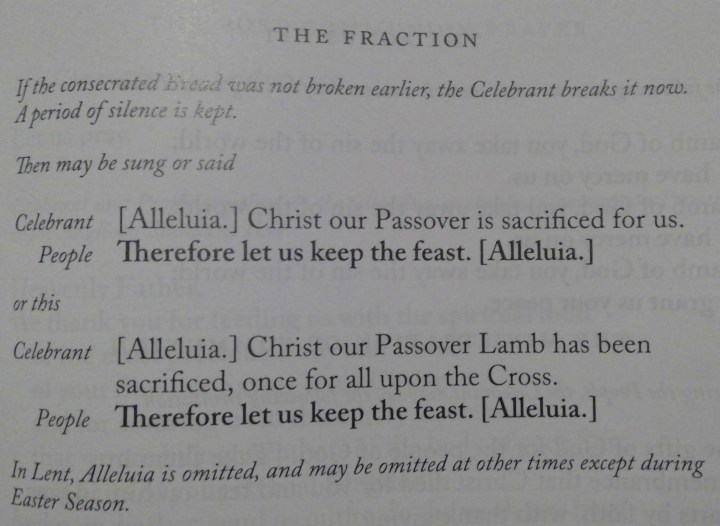
But what’s interesting here for the 2019 Prayer Book is that it says the bread may be broken during the words of institution.  Those who are used to the 1979 Prayer Book’s liturgy may be surprised – there is a distinct “Fraction” or “Breaking of the Bread” soon after the prayer of consecration.  But the classical Anglican pattern is actually to break the bread during the words of institution.  In our new prayer book we have the choice of doing the fraction at this point or as a special act after the prayers of consecration and Lord’s Prayer.  This is what it looks like:

fraction

This is much like what is found in the 1979 Prayer Book and the modern Roman Rite, with the one difference being that instead of the traditional wording of the Pascha nostrum (“[Christ] our passover”) the celebrant can say another version of it.  Why two versions?

  • “… is sacrificed for us” indicates an immediacy to the Sacrifice of Christ.  Some will take this as an acceptably high theology of the sacrament, others may deem it too close to the Roman notion of the sacrifice of the Mass.
  • “… has been sacrificed for us, once for all upon the Cross” puts more scripture verses together to emphasize the Cross and ensure that the people are directed backwards thither in time.

That both are presented as acceptable options here indicate that insofar a present sacrifice can be inferred in the celebration of Holy Communion, it is one that is communicative of the one sacrifice of Christ on the Cross, and not a repeat or addition thereto.  As Anglicans we can speak of a participation in the Holy Communion with Christ’s once-for-all sacrifice, even those of the “lower” Reformed stripe.

If your practice is to make the Fraction at this point, and use these two dialogues, consider using the first one most of the year and the second one during Lent and other occasions where the centrality of the Cross is made more explicit.

Anyway, back to the big question of the day: when should we break the bread?  And why do we have choices?

Option 1: Break the Bread during the Prayers

This is the theological preference of the Calvinists and (I presume) Zwinglians.  By breaking the bread at this point it emphasizes our remembrance of the Last Supper and de-emphasizes any notion of eucharistic sacrifice or offering.  Because most Anglicans-in-exile under Queen Mary’s reign spent their time with French Calvinists, the Elizabethan settlement saw the fraction enshrined in the same place in the liturgy.  So we have this as the standard pattern for every Book of Common Prayer with the probable exception of the original (1549) which doesn’t seem to specify.  Anglican precedent, therefore, pushes us firmly in this direction.  However…

Option 2: Break the Bread after the Prayers

That nice ritual breaking of the bread after the prayers is more historic, being the universal order before the Reformation.  The Lutherans retained it, too, likely due to their higher sacramentology compared to the Calvinists, et al.  And they rejected the Roman notion of eucharistic sacrifice as much as the rest of us, so that ought to assuage those who fear this form of the fraction is too “papist.”  To break the bread at this point, then, is to realign our liturgy with the greater ecumenical and historic consensus.  This is also in the “biblical” order.  Notice what we read: Jesus “took bread; and when he had given thanks, he broke it.”  The sequence is taking, praying, and breaking.  So why should we not let the priest finish “giving thanks” before breaking the bread?

Please Not Option 3: a bit of both

One practice I’ve come across (which seems quite common in my experience, though I haven’t traveled much) is for the celebrant to “snap” the bread during the words of institution without actually breaking it.  This, ideally, adds a dramatic effect in the midst of the prayers.  On my first celebration of the eucharist as a newly-ordained priest, I had perfect beginner’s luck and did this perfectly without breaking the bread on my first Sunday.  It took weeks to replicate that success.  But after a couple years I learned more about the theological reasons for the two different placements of the Fraction.  And so I took the advice given me: choose one point or the other.  People know what breaking bread is, means, and sounds like – you don’t have to pretend to demonstrate it for them, it doesn’t make things more dramatic or meaningful.

St. James of Jerusalem Day

October 23rd is the feast of St. James of Jerusalem in modern calendars.  The traditional calendar didn’t give him a separate day of his own because for a large chunk of history he was identified as one of the twelve apostles, commemorated along with Philip on May 1st.  Recent trends of interpretation have preferred to see this James as a separate person, not one of the twelve.  You can read a little bit more about that in last year’s entry.  I suppose it’s better accidentally to commemorate one person twice a year than to forget to commemorate someone because we confused him with someone else.  We’ve got that same problem with St. Aelfric, too, to be fair.

Anyway, let’s move on and look at the Collect of this Day.

Grant, O God, that following the example of your apostle James the Just, kinsman of our Lord, your Church may give itself continually to prayer and to the reconciliation of all who are at variance and enmity; through Jesus Christ our Lord…

It’s interesting to come across this just as a public strife has arisen between fans of John MacArthur and Beth Moore surrounding recent comments of the former against the latter.  There is, indeed, something of a theological gap between the two of them, and, further, a theological gap between both of them and the Anglican tradition from which we could stand aloof to their quarrel – or at least the quarrels of their respective fandoms and supporters.  “I follow Johnny Mac!” and “I follow Beth!” are voraciously-defended causes right now.

St. James of Jerusalem presided at a church council in Jerusalem around the year 50.  The primary issue was responding to Judaizers – people who insisted that Gentiles had to become practicing Jews in order to be proper Christians.  Circumcision, the keeping of the Law of Moses, the Saturday Sabbath, dietary regulations, and the like, were the prominent visible aspects of their cause.  The apostles, including Sts. Peter and Paul, had already been teaching against the Judaizers’ cause, though the former had paid lip service to them in the recent past, much to St. Paul’s consternation.  But a case had been made against St. Paul and his company, and it was time to settle the matter formally.  The full story can be read in Acts 15, and I put together a walk-through of that text a few years ago if you care to read it.

The short of it is that James, acting as what we would now call the diocesan bishop of Jerusalem, heard the case, made a ruling, saw it confirmed by the assembly, and released an official statement to make their decision public.  Enmity and strife was resolved with a little bit of comprise, but primarily a restatement of gospel truth.  Remember, godly compromise is only possible when both sides are essentially correct and only peripherally in disagreement… many of the judaizers were outright heretics (cf. the epistle to the Galatians), so there was very little room for compromise anyway.

What makes this episode particularly noteworthy is that St. James was supposed to be a “safe” choice for the judaizer cause.  He had been a faithful Jew, like most of the first disciples and apostles, and he was known continually as a devout Jewish man even after his conversion to Christ.  Simply the fact that he continued to live, minister, and lead the church in Jerusalem when all the other apostles had fled due to persecution by Jewish authorities (cf. Acts 12) is a significant clue to how Jewish James must have appeared.  If the judaizers were going to get a bishop on their side, James would be their man.  But, of course, he wasn’t.  He had a strong personal affinity for the Jewish religion and culture, and he was among the least willing to give up the formal trappings of the Old Covenant, but despite that he understood that this was a voluntary choice and not a Gospel mandate.

Only with the Gospel mandate, or creedal orthodoxy, or however you care to summarize it, can “reconciliation of all who are at variance and enmity” be achieved.  This speaks volumes to the MacArthur versus Moore conflict; this speaks to the ordination of women conflict within the ACNA; this speaks to the substantial disagreements between parties within the Anglican tradition, not to mention the many denominations beyond the confines of the Anglican Way.  Some compromises are possible, but ultimately one truth will prevail over the other(s) if unity is to be achieved.  Let us pray for leaders akin to the spirit and wisdom of St. James of Jerusalem – bishops who can discern biblical truth from personal preference and piety – through whom Christ can bring true reconciliation to his people in variance and enmity.

The Singing Schedule has changed

Did you know that The Saint Aelfric Customary offers a sing-the-hymnal-in-a-year plan, for the Book of Common Praise (2017) put out by the Reformed Episcopal Church – a subjurisdiction of the Anglican Church in North America?  It’s true, and you can read about it here.  Like the Bible, thanks to the daily office lectionary with its expansion, and like the options in the Prayer Book itself, the principle of completionism is at work here.  The idea of completionism is that if (or as) these books are fully authorized and endorsed by ecclesiastical authority, it is right and good for the Christian to (at least have a means to) read or make use of every page in its appropriate time.

Even if you’re not using this daily hymnody plan, at least skip to the last paragraph for a calendar insight.

With the hymnal, as we draw near the end of the liturgical year, the pace of the hymnody has changed.  From Trinity Sunday until this past Sunday (Proper 24) it has brought us two hymns almost every day of the week, working through the bulk of the General Hymns half of the book.  The “Christian Warfare” section has been running its course for the past week or so, some of it lining up neatly with the war stories of 1 & 2 Maccabees.  But now we’re down to one hymn a day, allowing more room for the Morning & Evening Hymns, and generally decreasing the time it takes to say the Office.  But there’s another practical reason also…

As the month of November approaches, the number of holy days increases.  The second half of October is unusually rich with major feast days but November starts off with All Saints’ Day, which is one of the seven principle feasts of the year, and includes Thanksgiving Day.  Both of these holidays have a substantial number of hymns associated with them, and therefore the regular progress through the hymnal is slowed at this to make room for the numerous special hymns of the season.  More than half of the days in November have at least one holiday hymn appointed for them.  So if you’re not normally a user of the hymnal in the rounds of daily worship, this time of year is a good one to consider picking one up and giving it a try on occasion.  Here are some of the hymns coming up, for your consideration:

  • 23 Oct. (St. James) – #195 Rise again, ye lion-hearted
  • 28 Oct. (Sts. Simon & Jude)- #169v20 From all the saints in warfare
  • 31 Oct. – #617 Day of wrath! O day of mourning!
  • 1 Nov. (All Saints’) – #186 For all the saints, #193 Lord, who shall come to thee
  • 2 Nov. (Commemoration of the faithful departed)
    – #187 Behold a host, arrayed in white, #319 O Lord, my God, I cry to thee
  • 3 Nov. (now filling out the All Saints/Souls Octave)
    – #191 Who are these like stars appearing
  • 4 Nov. – #192 I sing a song of the saints of God
  • 5 Nov. – #194  The saints of God! their conflict past
  • 6 Nov. – #318 Tempted and tried
  • 7 Nov. – #320 I fall asleep in Jesus’ wounds
  • 8 Nov. (now leading to Veteran’s/Remembrance Day)
    – #215 Thou by heav’nly hosts adored
  • 9 Nov. – #216 Rejoice, O land
  • 10 Nov. – #217 God bless our native land
  • 11 Nov. – #218 God of our fathers, whose almighty hand

Readings Review & Planning Propers 10/21

What we’re doing on this blog on Mondays is looking back and forth at the Daily Office readings (or lessons) so we can better process together what the Scriptures are saying, and list the recommended Propers for the Communion or Antecommunion service for each day of the week.

Readings Review

Last week: 2 Kings 4-9, 1 John – 3 John, 2 Maccabees 8,10, 1 Maccabees 7,9,13,14, Isaiah 1, Matthew 28, Mark 1-3

This week: 2 Kings 10-14, 2 Chronicles 26, Acts 1-5:11, Isaiah 2-8, Mark 4-8:10

Special reading for St. James of Jerusalem’s Day on Wednesday: James 1

As is often the case with biblical authors, the Morning Prayer readings includes the opening section of the saint-of-the-day’s book.  We saw this with St. Luke last week, and St. James this week.  There is some unresolved debate regarding exactly who the various people named James are, in the New Testament, but we can say, regardless of the possible confusions of identity, that the James who became bishop of Jerusalem, whose authority we see in action in Acts 15, is most definitely the author of the Epistle bearing James’ name.

As for the Gospel according to St. Mark, there are a few different ways that this book can be outlined.  One of the simpler theories is that, after a 15-verse introduction, the book is in roughly two “halves”: the demonstration of Jesus’ authority, and the testing of Jesus’ authority (especially his persecution and suffering).  The change from the first half to the second takes place in the latter part of chapter 8, putting our readings this week solely in the first half of the book, and leaving us ready to transition over next week to the push-back, resistance, and persecution that would lead to the death of our Lord.  So for now, consider the Gospel lessons to be various stories that show us the divinity of Jesus in his ministry.  Next week, we’ll see that claim put to the test…

Planning Propers

This is the week of Proper 24 (or 18th after Trinity in the traditional calendar), so keep in mind that the historic Prayer Book default is that a mid-week Eucharist will repeat the Collect & Lessons (the propers) for yesterday.  Otherwise, we recommend…

  • Monday 10/21 = Votive *
  • Tuesday 10/22 = Votive
  • Wednesday 10/23 = SAINT JAMES OF JERUSALEM
  • Thursday 10/24 = Votive
  • Friday 10/25 = Votive
  • Saturday 10/26 = St. Alfred the Great

* A Votive is a “Various Occasion” (page 733 in the BCP 2019).  The traditional appointments are Holy Trinity on Sunday, Holy Spirit on Monday, Holy Angels on Tuesday, of the Incarnation on Wednesdays, of the Holy Eucharist on Thursdays, the Holy Cross on Fridays, and of the Blessed Virgin Mary on Saturdays.