Happy Michaelmas!

On this special occasion of celebrating the feast of St. Michael and All Angels with the whole congregation on a Sunday morning, I thought it would be fun to share our liturgy here.  The Communion rite we’re using is the Anglican Standard Text, as usual.

OPENING HYMN: Christ the fair glory of the holy angels

ACCLAMATION: Worthy is the Lord our God: / To receive glory and honor and power.

COLLECT FOR PURITY, SUMMARY OF THE LAW, KYRIE,

GLORIA IN EXCELSIS sung to the setting #784 in the Book of Common Praise 2017

CHILDREN’S MINISTRY MOMENT

  • Revelation 12:7-12, followed by a 1-minute Children’s sermon
  • explanation: my church has two children, ages 2 and 4, so they spend most of the liturgy playing in a separate room.  I’m a big believer in including young children in the liturgy, but sometimes they need space to move around, and our context is so small that it wouldn’t work so well at the moment.  Soon the older will be able to sit/draw/play/read quietly in the worship space with the adults, and this addition to the liturgy will be removed.
    Normally, this ministry moment includes a few-verse Bible reading followed by a one-minute teaching, but on this occasion the short reading is actually the same as the Epistle Lesson, so it’s just being moved up here wholesale.  Yes it’s a strange way to tinker with the liturgy, and no I’m not crazy about it, but I’ve got to minister to everyone I can with the very limited resources and manpower available.

HYMN: Ye holy angels bright

COLLECT OF THE DAY, OLD TESTAMENT LESSON: Genesis 28:10-17

PSALM: 103, SEQUENCE HYMN: Life and strength of all thy servants

GOSPEL LESSON: John 1:47-51

THE SERMON, THE NICENE CREED, THE PRAYERS OF THE PEOPLE

THE CONFESSION AND ABSOLUTION OF SIN, THE PEACE

OFFERTORY HYMN: Bread of heav’n on thee we feed

THE SURSUM CORDA, leading to the Preface for Trinity Sunday

THE SANCTUS, THE PRAYER OF CONSECRATION, THE LORD’S PRAYER

THE FRACTION, THE PRAYER OF HUMBLE ACCESS, THE AGNUS DEI

THE MINISTRATION OF COMMUNION

POST-COMMUNION CANTICLE: #6 Dignus es (from page 84)

THE POST-COMMUNION PRAYER, THE BLESSING

CLOSING HYMN: Ye watchers and ye holy ones

THE DISMISSAL

Singing Psalm 121

We all know that the Psalms were originally meant to be sung.  There is, wonderfully, a new movement these days, mostly grassroots, to put music to the Psalms and put them into the hands of the congregations.  I’ve jumped on that bandwagon a little, providing an explanation of Simplified Anglican Chant, and I know others others on YouTube and even in the ACNA have made resources to encourage and enable to chant the psalms.

The wonderful thing about chant is that it provides you with some very simple music that you can then apply to any set of lyrics.  You don’t have to “learn a whole song”, just memorize a few notes and get a feel for where in each half-verse to move from note to note, and you’re good to go.  What makes Anglican Chant different from historic Plainchant is that 1, the chant tunes are written in more recent times and are rarely “tied down” to any particular Psalm or Canticle, and 2, ours come with classical four-part harmonies allowing a choir (or at least a keyboardist) to beautify the music.

What I thought would be fun to try today is providing a set of examples of how one short Psalm can be done in different styles of chant.  This will, I think, help clarify how the more “complicated” forms of chant work, by working our way up to them through some simpler forms.

Here’s the text as used:

1 I will lift up my eyes un|to the | hills; *
from | whence | comes my | help?
2 My help comes | from the | Lord, *
who | has made | heaven and | earth.
3 He will not let your | foot be | moved, *
and he who | keeps you | will not | sleep.
4 Behold, he who keeps | Israel *
shall | neither | slumber nor | sleep.
5 The Lord himself | is your | keeper; *
The Lord is your defense | upon | your right | hand,
6 So that the sun shall not burn |you by | day, *
nei|ther the | moon by | night.
7 The Lord shall preserve you| from all | evil; *
indeed, it is he | who shall | keep your | soul.
8 The Lord shall preserve your going out and your | coming | in, *
from this time | forth for|ever|more.

– Sample 1 –

Omitting the usual Gloria Patri at the end of the Psalm, here it simply read aloud with the musical rhythm of the ending of each verse in mind.  Always make sure you can read the Psalm comfortably before you sing or chant it!


– Sample 2 –

Now let’s use Fr. Ben Jeffries’ Simplified Plainchant.


– Sample 3 –

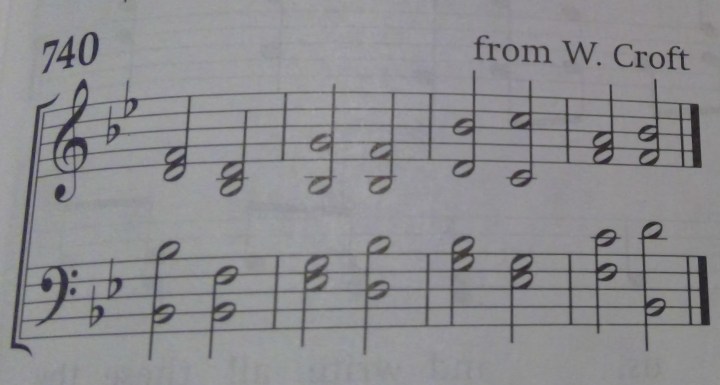
Next let’s move up to Simplified Anglican Chant. This and the following images are from the hymnal, Book of Common Praise 2017.

simplifiedchant740


– Sample 4 –

Now we’re ready for a fully-fledged Anglican Chant.  First let’s go for a Single Chant, which means each verse gets the same tune.

singlechant653


– Sample 5 –

Last of all, here’s a Double Chant, meaning the repeated tune spans two verses.

doublechant660

An Ember Day Hymn

If you’re following this Customary’s plan for Daily Hymnody from The Book of Common Praise 2017, then you’ll find that the hymn appointed for this Ember Day is “Come, Holy Ghost, our souls inspire.”  In the 2017 hymnal this is set to the Sarum Plainsong tune VENI CREATOR SPIRITUS, which is a bummer for me because I’m used to it being sung to COME HOLY GHOST.  And the way the lyrics are matched to the notes in the 2017 hymnal is different from how it’s done in the 1940 hymnal, so that’s just confusing to me as a musician who has paid attention to that in the past.

Tune-related issues, aside, the text of this hymn is very significant.  It is appointed in the Ordinal to be sung or said at the ordination of a priest and bishop!  This is true for the 1662 as well as the 2019 book, so it’s pretty standard Anglican fare.  And it’s a 9th century text, so it’s a piece of our Western/Latin heritage as well! Let’s take a look at these words.

COME, Holy Ghost, our souls inspire,
And lighten with celestial fire.
Thou the anointing Spirit art,
Who dost thy sevenfold gifts impart.
Thy blessed unction from above,
Is comfort, life, and fire of love.

Prayers addressed to the Holy Spirit are rare in the liturgical tradition.  Confirmations and Ordinations are among the few times we actually do this.  The seven-fold gift of the Spirit is a long-standing image in Church literature, stemming from the New Testament itself, and includes an Old Testament precedent that is not often in favor with Protestant interpretation.  You can read more about that here if this is unfamiliar to you.

Enable with perpetual light
The dulness of our blinded sight.
Anoint and cheer our soiled face
With the abundance of thy grace.
Keep far our foes, give peace at home;
Where thou art guide, no ill can come.

These are the primary specific petitions of this hymn.  Open our eyes, cheer us, grant us peace… if you think back to one of the titles our Lord gave for the Holy Spirit – The Comforter – these all make perfect sense.  Christ has won the victory, Christ has redeemed us; it falls to the Holy Spirit to apply these truths to our hearts and minds, to point us back to Jesus.  Such sight, cheering, and peace are all thereby ministries of comfort and help.

Teach us to know the Father, Son,
And thee, of both, to be but One;
That, through the ages all along,
This may be our endless song:
Praise to thy eternal merit,
Father, Son, and Holy Spirit.

Finally our plea is that we would know God the Trinity, Father, Son, and Holy Spirit, and that in this knowledge we would be able to worship and praise him forever.  Knowledge and worship, doctrine and doxology, teaching and liturgy, these are pairs that should never be separated.

Interesting that this hymn doesn’t actually mention anyone getting ordained, huh?  Yes, its function in the ordination liturgy makes it into a prayer especially for the candidate for ordination, but but textually it need not be so limited.  By all means, sing this and pray for your clergy.  But you can pray this for yourself, for all the Church, just as easily and honestly.  In the context of ordination, it makes sense that we should pray for clarity, for sight, for knowledge – not just for the candidate but for the whole congregation.  Calling a new minister of the Gospel, in any Order, is a “big deal” – one that will impact many lives for many years to come.  The Church needs to be in her right mind when placing the collar of recognizable authority upon another servant.

So on these Ember Days, be sure to pray for your Bishop and his clergymen, as well as for those individuals considering or seeking Holy Orders and the congregations in discernment with them.  The process is useless if the aspirant is surrounded by “Yes Men” whose eagerness to support blinds them from asking any hard questions about his true calling.  So pray this hymn with them and for them.

I don’t like this hymn

One of the big challenges of praying, reading the Bible, and worshiping alone is the tendency towards doing what we like and skipping what we don’t.  Left to my own devices, I’d probably just chant psalms and read the Old Testament, Ecclesiastical Books, and sometimes also the Gospels and Revelation.  Maybe the Canticles and the Lord’s Prayer and a collect or two would survive.  But the liturgical tradition, particularly the Prayer Book tradition, keeps steering me (and all who heed it) on a healthier track for more wholesome worship that keeps the individual and the congregation rightly balanced.

It is along those lines that I’ve been developing the Saint Aelfric Customary the way I have: taking on trust that the Prayer Book is a reliable book, we’re seeking to explore its options, with classical Anglican tradition in mind, and build a Customary – a style and plan of execution of liturgy – that makes full and proper use of the options at hand.

The hymnal has received similar treatment, and you can read about the Hymnal-in-a-Year recommendation here.  As I’ve observed before, the 2017 hymnal put out by the Reformed Episcopal Church is an excellent blend of old and new; I was glad to see a few contemporary songs – the cream of the crop – make it into its pages.  That said, there are still some tunes in this book that I’m not really that crazy about.  When it comes to music, my passion is mostly in the British folk tradition, and my training is primarily renaissance, baroque, and classical.  When it comes to Christian singing, this leaves a couple massive gap in my experience: African-American spirituals or gospel songs, and the American revivalist hymn style that came under its influence.

Enter Marie Ferguson’s Joys are flowing like a river, to a tune written by W. Marshall, both in 1897, “BLESSED QUIETNESS”.  This is one of the hymns in the 2017 hymnal appointed for today, Tuesday in the week of Proper 14.  The arrangement in our hymnal is not quite the same as what I’m finding on YouTube, but you can get the idea.  It’s just one of those awful schmalty tunes with to many flats in the key signature, with lyrics just dripping with sentimentality.  As my congregation’s music minister I will never appoint this hymn to be sung because I can’t play that style properly, and as my congregation’s priest I will never appoint this hymn because we do so little music as it is that I want to make sure that no song is wasted.  But today I’m trying to sing it on my own, because it’s in the hymnal, and some people who are more knowledgeable and experienced than I am decided it’s worth being one of 639.

Joys are flowing like a river,
Since the Comforter has come;
He abides with us forever,
Makes the trusting heart his home.

Blessed quietness, Holy quietness,
What assurance in my soul!

On the stormy sea, Jesus speaks to me,
And the billows cease to roll.

It’s a Holy Spirit themed hymn, of which Anglican hymnody tends to be rather scarce, left to its own devices (though this is true also of Catholic and classical Protestant hymnody too – the Church has always sung more about Jesus than about the Spirit), so it’s no surprise that we’re dipping into other traditions to bulk up this part of the book.

There is a collect in the prayer book that I didn’t understand at first until I found its biblical source (Isaiah 30:15), which sounds very much like the refrain of this hymn:

O God of peace, who hast taught us that in returning and rest we shall be saved, in quietness and in confidence shall be our strength: By the might of thy Spirit lift us, we pray thee, to thy presence, where we may be still and know that thou art God; through Jesus Christ our Lord. Amen.

This “blessed quietness”, this place of “returning and rest”, is a good place to be.  In that spiritual calm of “waiting upon the Lord” and spiritual peace, one can know and feel the presence and power of God.  So although this hymn comes across as super sentimental, it is still filled with biblical imagery and truth.  Let’s see the other verses (omitting the repeated refrain).

Bringing life, and health, and gladness
All around, this heav’nly Guest
Conquered unbelief and sadness,
Changed our weariness to rest.

Like the rain that falls from heaven,
Like the sunlight from the sky,
So the Holy Spirit’s given,
Coming on us from on high.

See, a fruitful field is growing,
Blessed fruit of righteousness;
And the streams of life are flowing
In the lonely wilderness.

What a wonderful salvation,
When we always see his face,
What a perfect habitation,
What a quiet resting place!

So yes, this is very much an emotion-driven song, which can make it both very effective (if you’re in the “right mood” for it) or quite maddening (it you aren’t), and yet in its emotionalism it continually latches on to biblical images in a way that shows decent theological reflection.  The Holy Spirit’s role as Comforter could be said to be the underlying premise of these lyrics, and explicated in both emotional and spiritual terms.  And if you’re less set-in-your-musical-ways than I am, you may even enjoy the tune!

So I have to admit, I still don’t like really like this hymn.  But I can also say it’s a good hymn, and I’ll try to sing it with you today, if I can the hang of the rhythms.
A Hymn for Holy Matrimony

It is a curious thing that for all our culture’s love of weddings, our hymnals stand remarkably short on hymns for this blessed occasion.  Perhaps people had a tendency to choose other favorite hymns; perhaps weddings were not frequently celebrated with hymnody back in the great hymn-writing centuries; perhaps weddings have long been too secularized (at least in popular mindset) for enough people to dare consider singing a wedding hymn from a hymnal.  Blessed be the ties that bind is the only hymn I can think of that’s even marginally popular for weddings, and some hymnals don’t even put it in that category!  It’s appropriate, for sure, but it’s not specifically (or exclusively) about holy matrimony.

So let’s take a look at a hymn that is specifically about marriage: O Father, all creatingYou may notice that it’s also explicitly trinitarian, verse by verse.

O Father, all creating, Whose wisdom, love, and pow’r
First bound two lives together In Eden’s primal hour,
Today to these thy children Thine earliest gifts renew:
A home by thee made happy, A love by thee kept true.

O Savior, guest most bounteous Of old in Galilee,
Vouchsafe today thy presence With these who call on thee;
Their store of earthly gladness Transform to heav’nly wine,
And teach them in the tasting, To know the gift is thine.

O Spirit of the Father, Breathe on them from above,
So mighty in thy pureness, So tender in thy love;
That, guarded by thy presence, From sin and strife kept free,
Their lives may own thy guidance, Their hearts be ruled by thee.

Each Person of the Holy Trinity is called upon to bless and sanctify the marriage.  As each has been revealed in Scriptures to relate to and interact with us in particular ways, so this hymn prays for their respective forms of presence and guidance upon the married couple.

It is perhaps a “no-brainer” to most of you who follow this blog that a marriage needs the guarding and guidance of God to survive in a holy state and bear spiritual fruit, but it should be observed that the way many weddings are celebrated, even among Christians, often tends to focus upon the marvellous love the couple holds for one another.  This is all too often exaggerated to the point where the binding force and strength of marriage seems to be their mutual love; God is hardly more than a formal afterthought, a patron to invoke for the sake of custom and respect.  I wouldn’t go so far as to say this hymn (or similar songs) should be required at every wedding we officiate, but the prayer and sentiment it puts forth is definitely and sorely needed, not only in the ears of our congregations and wedding-goers, but on their lips as well.

Let’s see how the last verse ends it:

Except thou build it, Father, The house is built in vain;
Except thou, Savior, bless it, The joy will turn to pain;
But nought can break the marriage Of hearts in thee made one,
And love thy Spirit hallows Is endless love begun.  Amen.

Drawing from the language of Psalm 127, this stanza narrows in on the complete dependence of man upon God.  Note particularly that last line, “and love thy Spirit hallows is endless love begun.”  Divine-inspired love between husband and wife is not perfect love, nor love fulfilled, but still only love begun.  The world will not be saved by spousal fidelity, no matter what some false teachers say.  Rather, a holy marriage is only the beginning of a picture of salvation.  When God makes two hearts into one, a glimpse of his divine love is introduced, not consummated.  Only continual reliance upon that strength and foundation will survive the course there begun.  As St. Paul wrote, “Having begun by the Spirit, are you now being perfected by the flesh?” (Galatians 3:3).

Most of my friends’ and family members’ wedding anniversaries seem to be either in June or August, which is why this Customary appoints the two Matrimony Hymns in the 2017 hymnal in early June and early August.  Feel free to move them around in your own use of this order for daily hymnody, as songs like the one we’ve looked at here are great prayers for your own marriage, or those of your friends and family!

A Hymn Old & New

If you follow this Customary’s “Daily Hymnody” plan, using the REC 2017 hymnal, one of the songs you’ll come to today (probably this evening) is #453, Before the throne of God above.  This is a song that I really quite like a lot, and it’s got an interesting history behind it.

It is best known as a contemporary worship song; the music was written (as far as I’m aware) by Vicki Cook in 1997, and it became relatively popular in the CCM world in the 2000’s.  As a music minister in the early 2010’s, it was on my shortlist of contemporary songs that I wanted to use along with the hymnal my church used at the time.  It was one of the only songs I was sad to lose when we went hymnal-only.  (That was mainly for practical and logistical reasons, by the way, not because of any serious push against CCM.)  But the 2017 hymnal has this song in it, so I’m quite happy to have it back again!

Despite its current popular tune only just passing 20 years old, its lyrics go back to the American Civil War period, 1863.  It never seemed to have universally settled on any one tune – perhaps the curse of the Long Meter Double metric is that there were too many possibilities.  Whatever the case, this song remained somewhat obscure until Cook gave it a unique melody, and it has thrived ever since.

A big reason I like this hymn so much is because it explores a critical theological aspect of Jesus that doesn’t get a lot of attention elsewhere: his priesthood.  I’ve addressed its lack of attention before, arguing for a greater place of prominence for it in understanding the atonement, our salvation, and the sacraments.  Let’s take a look:

Before the throne of God above
I have a strong and perfect plea,
A great high priest whose name is Love,
Who ever lives and pleads for me.
My name is graven on his hands,
My name is written on his heart.
I know that while in heav’n he stands,
No tongue can bed me thence depart.

(The modern tune has the last line of this and the following stanzas repeat.)

This is essentially an exposition of Hebrews 7:25 – “[Christ] is able to save to the uttermost those who draw near to God through him, since he always lives to make intercession for them” – and its context in chapters 7 through 10.  The second stanza addresses the self:

When Satan tempts me to despair,
And tells me of the guilt within,
Upward I look and see him there
Who made an end to all my sin.
Because the sinless Savior died,
My sinful soul is counted free.
For God the just is satisfied
To look on him and pardon me.

This is classic reformational soteriology – Jesus paid the price, cancelled the debt, for all sin.  Even in the midst of theological precision, the poetry is striking: “the sinless Savior died / my sinful soul is counted free.”  The final stanza does what the second stanza recommends, it looks “upward” to “see him there.”

Behold him there! the risen Lamb,
My perfect, spotless, Righteousness,
The great unchangeable I AM,
The King of glory and of grace!
One with himself, I cannot die;
My soul is purchased by his blood;
My life is hid with Christ on high,
With Christ my Savior and my God.

If you are in a hymnal-only church, or just are personally critical of CCM (contemporary christian music), I recommend this hymn as a tasteful example of modern music-writing, and an example that modern settings of classic lyrics is indeed possible!

If you’re a contemporary music kind of person and aren’t usually into hymns, this song is an asset to you, too.  It shows how classic lyrics can still come alive on modern lips, without drastic reworking of lyrics and the addition of bridges and choruses.  If people can enjoy these words, perhaps there are more old hymns that can find their way back into the modern crowd also without doctoring!

Singing of Saint Anne

Here’s another holy day that we noted ahead of time: “The Parents of Saint Mary.”  Tradition remembers them by the names of Joachim and Anne, and Anne in particular has been the recipient of some devotion in certain parts of Europe – to this day it’s not unusual to find a Catholic church named St. Anne’s.

Because the couple celebrated on this day are closely related to Jesus (in this case literally his grandparents) this is one of the few “black-letter days” appointed in the 2019 Prayer Book’s calendar that this Customary acknowledges with a hymn appointed for the day.  In this case it’s #188 (in the 2017 hymnal), “Faith of our fathers“, a well-known classic.  As the title itself suggests, it is a celebration of the continuity of faith from the past through the present into the future.  It is in the All Saints section of this hymnal, though in other sections in previous hymnals, if I recall.

If you’re curious, even skeptical, why this commemoration should be so elevated when the people commemorated are barely (or not at all) known in Scripture, consider the implications of their identity.  As I wrote for my 4-year-old today:

Jesus had a grandma
they say her name was Anne.
So although Christ is God,
he’s also fully man!

I also took the opportunity to include this commemoration in a sermon a few years ago, which you’re welcome to check out.  In that sermon I mentioned a hymn that we’d sung.  It was a traditional hymn that someone translated from Latin, and I re-tuned to the melody of a contemporary praise song: “Lamb of God” by Twila Paris.

Nocti succedit Lucifer, trans. c. 2009 Kathleen Pluth.

Verse
The morning star is on the rise
And soon the dawn will fill the skies,
Foretelling of the coming Sun
Whose light will shine on everyone.

Verse
The Sun of justice, Christ, true Light,
And Mary, grace’s dawning bright,
And Anna, reddening the sky,
Have caused the night of Law to fly.

Refrain
O mother Anna, fruitful root,
From you came your salvation’s shoot,
For you brought forth the flow’ring rod
That bore for us the Christ of God.

Verse
Christ’s mother’s mother, by the grace
Your daughter’s birth brought to our race,
And by her merits and her prayer
May we her favors come to share.

Refrain
O Jesus, Virgin-born, to You
All glory is forever due.
To Father and the Spirit, praise
Be sung through everlasting days.

Note in verse 3 (the first refrain the way this is arranged) how Anne (Anna) is addressed: “faithful root, flowering rod” – these are some biblical images in the Old Testament used to point to the Messiah.  The family tree leading to Jesus is often described in root-tree-branch-flower imagery, and is especially appropriate for St. Anne and the Virgin Mary.

However you choose to spruce up your worship of God today, may it be a blessed time!

Let’s pray Evening Prayer together!

We’ve got a daily hymnody plan available, an order for using the Occasional Prayers, and some insight on how to sing Simplified Anglican Chant.  Let’s put it all together and see what Evening Prayer can be like. We did this with Morning Prayer last week, but now let’s add some chanting to spruce up this feast day commemorating St. Mary Magdalene.  I should warn you that there are a couple of stumblings, hesitations, and even mistakes as I read, pray, and sing.  That’s life, that’s reality.  I’m not here to perform for anyone, and I just want to encourage you to pray and sing, yourself, too.  Anyway, grab your 2019 Prayer Book, ESV Bible, and 2017 Hymnal, and listen and pray along!


Order of service (so you can get your books ready)…

  1. Opening Sentence (BCP 41)
  2. Confession *
  3. Invitatory Dialogue with Hymn #444 instead of the Phos hilaron **
  4. Psalms 108 (tune #748) and 109 (tunes #747 & 746)
  5. Old Testament: Ezra 10
  6. Magnificat (tune #743)
  7. New Testament: John 1:1-28
  8. Nunc dimittis (tune #750)
  9. The Apostles’ Creed
  10. The Prayers
  11. The Anthem (Hymn #175)
  12. Brief homiletic reflection
  13. Occasional Prayers #11-15
  14. The General Thanksgiving ***
  15. Closing Sentences

* I don’t read either absolution after the general confession when I’m praying the Office alone because there’s no “you” for me to speak to, so I take on the words of the laity in the prayer for forgiveness instead.

** The rubric at the top of page 44 allows for a hymn to replace the Phos hilaron.  Since the Phos hilaron is not a feature of classic prayer books I typically prefer to replace it with an Evening Hymn (or other hymn as in this case).

*** I tend not to pray the Prayer of St. John Chrysostom when alone, as the rubric indicates it’s optional, and because its language of being gathered for corporate prayer is not exactly fulfilled in private.

Singing Simplified Anglican Chant

Ideally, both according to Prayer Book tradition as well as the general history Christian worship, the Psalms are most appropriate sung, not simply read aloud.  And when people talk about singing, that universally means chanting (until, say, the 14th century when modern European music began to emerge out of the Greco-Roman chant tradition).  Among the early Anglican Reformers, chant did get a new lease on life in the English language thanks to composers like John Merbecke, but for the most part among Anglicans the chant tradition went into hibernation in the 17th and 18th centuries, finally to re-emerge in 19th century as “Anglican Chant.”

Anglican Chant is distinct from plainchant or Gregorian chant in that it has contemporary harmonizations – a choir or congregation can chant together in four-part harmony.  Thus it utilizes the melodic simplicity of plainchant and the harmonic beauty of English hymnody.  Anglican Chant also stands distinct from ancient plainchant in that it has very little over-arching regulation on matching tunes to texts.  So there is much more room for freedom of expression, new chant tunes and combinations, and even in pointing the text (meaning, lining up the text with the notes).

Why Anglican Chant?  The singing of “metric psalms” enjoyed pride of place for those couple centuries when chant was in remission.  Metric psalms are perhaps easier for us to sing because they use familiar tunes and styles.  The downside of metric psalms, however, is that the Psalms are not written in English poetic rhythms or rhyme schemes, necessitating an entirely new translation.  This means neglect of the beautiful Psalter in our Prayer Books, less standardization of the actual translation (so the formation value is less prominent), and a much looser translation overall in order to force thousands-of-years-old poems into modern poetic styles.  If you use plainchant, or Anglican chant, you don’t have to re-translate the Psalms, but sing the text as it stands.  And to those of us who care deeply about the Word of God, that should be a very important consideration indeed!

There are videos on YouTube such as this one which can help you learn Anglican Chant.  There are also books and hymnals that have detailed written explanations.  But what I’d like to introduce you to here is Simplified Anglican Chant.  As the name suggests, this is a simpler version of the Anglican Chant you’ll hear and see in the videos and books above.

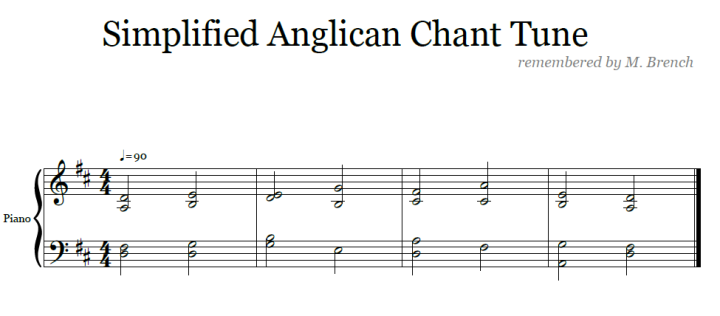
Simplified Anglican Chant is notated as four measures of music with two sets of notes each.  Each measure equals one half-verse of Psalm text.  Thus one full line of Simplified Anglican Chant equals two verses in the text of the Psalm.*  The majority of the half-verse is sung on the first note; the last ‘strong’ syllable is where you switch to the second note.

If you have the Book of Common Praise 2017, you’ll find an excellent explanation of this, complete with pictures, at “hymn” #738a.  Hymns #739-750 are twelve different Simplified Anglican Chant tunes.

Whether you have that book or not, however, you can take a look at this video I put together a little while ago.  In it, I go over some of the basics described above, and then demonstrate a few verses of Psalm 96 (which is among this morning’s appointed psalms, by the way).

The sample tune I used is not one of the twelve in the hymnal; it’s just one I vaguely remembered from when I was in a church choir nearly nine years ago.

simplified anglican chant

* From the 2017 hymnal: “But what if a psalm contains an odd number of verses rather than an even number?  Rather than finish the chant formula halfway through, which would be musically unfulfilling, the congregation can repeat the second half of the chant formula (measures 3 and 4) for the last verse of the psalm.

When to sing the “Gloria in excelsis”

After the penitential rite at the beginning of the Communion service follows this rubric:

The Gloria or some other song of praise may be sung or said, all standing.  It is appropriate to omit the song of praise during penitential seasons and days appointed for fasting.

Placement of the Gloria…

For those who grew up accustomed to the Roman Rite or the 1979 Prayer Book, this is expected – the Gloria is the standard historic hymn of praise following the Kyrie, signalling the movement from penitence to absolution, from abjection to joy, from unworthiness in God’s sight to worthiness, from fear to perfect love.  What many don’t realize is the peculiar tradition of the classical Anglican Prayer Books in placing the Gloria after the Communion and Post-Communion Prayer!

Thus, when we read in the rubric on page 107 & 125 that the Gloria “may be sung or said”, what we ought to see here is the permission to save it for its traditional placement near the end of the liturgy.  The reason for saving the Gloria for that point in the liturgy is that there it functions as an expression of unadulterated praise to God in light of his saving work on the Cross that we have just memorialized in prayer and received in the Sacrament.  So the flow of penitence-to-praise at the beginning of the service doesn’t really apply, but the celebration post-communion is certainly much grander.  It’s also interesting to note that in Lutheran tradition they tend to keep the Gloria in its traditional (Roman) position near the beginning after the Kyrie but also have a special post-communion canticle like the Prayer Book tradition, though in their case the Nunc dimittis.  Now that’s a much more sober (or sobering) way to reflect upon the reception of the consecrated elements!

Instead of the Gloria…

I know lots of congregations that have a contemporary “praise and worship set” in place of the Gloria.  Although this provokes the ire of hymns-only traditionalists, this can rightly capture the spirit of the modern prayer book (and traditional Roman) rite, as the Gloria is a song of pure praise.  Indeed, in my own church, we long had a hymn or contemporary song of praise in addition to the Gloria.  As long as you find lyrics that are very God-centered, they’ll fulfill the same function as the Gloria.  But keep in mind, how many times does the Gloria mention “us” or “me”?  If you’re appointing songs in its place, try to make sure that they live up to that standard of pure and undistracted adoration.

During Advent and Lent, though, it is customary to omit the Gloria, whether you’ve got it near the beginning or the end of the liturgy.  The 1940 hymnal even has, in its liturgical index, suggestions for which hymns could replace the Gloria during those seasons.  This is an excellent place to use a season-specific hymn, as they typically capture the tone and mood of the season in a very appropriate manner, and thus support the shift of emphasis that the liturgical calendar is meant to convey to us.

Singing the Gloria…

Last of all, it’s worth noting that the rubric states “sung or said“, as if to imply that it’s more appropriate to sing the Gloria than to read it.  This is where the otherwise-bloated 1982 hymnal can be a valuable resource, as it provides a number of musical settings for the contemporary translation of the Gloria that our new Prayer Book continues to use.  The Book of Common Praise 2017 has only one setting in the contemporary language, which is original to that edition, I believe, and has worked pretty well with my own congregation.  But sometimes it’s nice to have options.

You could even take a page out of medieval tradition and change the musical setting of the Gloria for different times of year or occasions!  For example, my congregation sings it on major feasts and high Sundays, but just says it on ‘normal’ Sundays.