Perhaps one of the most noticeable things, when one walks into our chapel, is the little organ sitting against a wall. This is a pump organ – you work the bellows with your feet while your hands play the manuals (keyboard). It has two stops underneath the keyboard (not quite in sight in the picture below) that you can work with your knees: the one on the left is an octave link, rendering the highest and lowest thirds of the keyboard louder and more majestic; the one on the right is damper board, muffling the sound coming out if you want to have a more dramatic difference in dynamics (volume). From what I understand of these 100-year-old pump organs, they were typically employed in small churches and homes, and it certainly fulfills that role excellently for us!
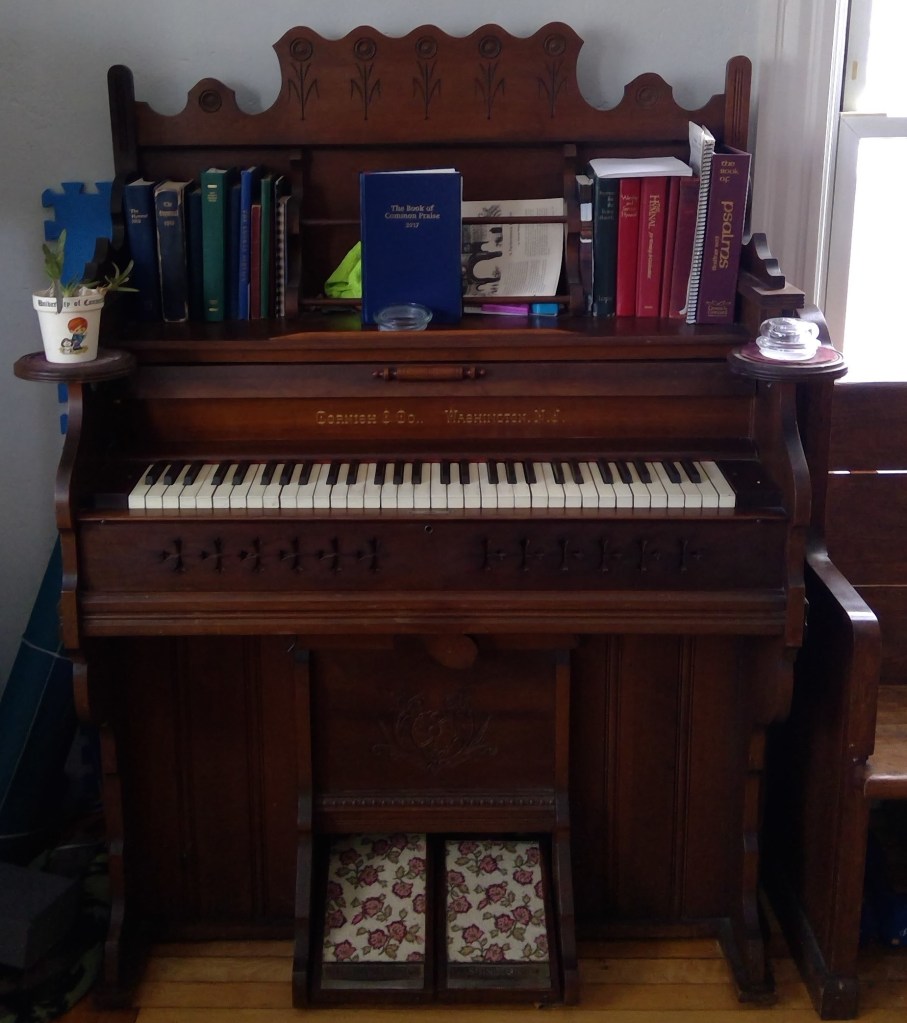
Apart from a nice built-in stand for holding up music in front of the player, this organ also has some handy shelf space where I can keep accessible the most useful church music. I need very little of it in my church, as we rarely deviate from the one hymnal we use, and I don’t prepare special preludes or postludes. That would be nice, but as I function as both priest and organist, there’s only so much back-and-forth that I can handle.
So what are the books that we’ve got on hand here?
In the center is the Book of Common Praise, the hymnal that we’ve been using for the past several years, now. It’s a great book, and I’m glad we switched to it.
On the left-hand side there are actually twelve books (half of them are very thin).
- The Hymnal 1982 – this was the standard hymnal of the Episcopal church, still used by a number of contemporary-language Anglican churches as well.
- The Hymnal 1940 – our church received a large box of these as a donation when we started meeting (before even I joined!), so this is what we used for the first several years.
- The American Psalter – published in 1930, this book contains all the Psalms and Canticles (in the 1928 prayer book) set to Anglican Chant tunes.
- Saint Dunstan’s Plainsong Psalter – this is a newer book for traditional-language worshiping churches. It’s a beautiful resource and we’ve used one or two of its hymns before.
- The Plainsong Psalter – from 1932 and renewed in 1960, this book contains only the Psalms, set to ancient plainchant. It’s largely redundant in light of the previous book, but an extra copy isn’t a bad thing!
- The Choral Service – this Manual for Clergy and Organists from 1927 has instructions and music for setting the majority of the Prayer Book services to chant, with a good bit of historical information included along the way.
- The Plainchant Evening Psalter and Canticles – from 1916 and revised in 1920, this book only contains the psalms and canticles for Evening Prayer.
- The Kyrial (St. Dunstan Edition) – This book contains a whole bunch of different ancient plainchants for the various “mass parts” (primarily the Kyrie, Sanctus, Agnus Dei, and Gloria in Excelsis) set to the English language.
- The English Gradual (Part 1 – The Ordinary) – Using modern notation rather than historic chant notation, this book provides a number of chants useful for clergy and choirs (again in the traditional Prayer Book language) for various parts of the Communion service.
- The English Gradual (Part 2 – Supplement) – I think this is a homemade photocopy edition, bearing only about 40 pages of additional music. It’s mostly for Anglo-Catholic commemorations (like some of the Roman devotional masses in honor of the Blessed Virgin) but it also supplies chants for a few holy days that are now standard such as the Transfiguration and St. Joseph Day.
- The English Gradual (Part 2 – The Proper) – this is the real sequel to book 9 above. For the most part this book supplies the “proper” parts of a mass, that is, the chants that are unique to a given day or commemoration, namely the Introit, Gradual, Alleluia or Sequence, Offertory, and Communion sentences.
- The English Gradual (Part 2 – The Proper, Supplement) – like book 10, this tiny booklet provides additional Proper chants for those extra feasts and commemorations mentioned above.
On the right-hand side we just have eight music books.
- Grace Anglican Church – Supplemental Music Collection – I printed our own supplement to the hymnal we normally use, after several years of drawing particular songs and hymns from other sources.
- Hymns for the Living Church – printed in 1986 by Hope Publishing Company, this is a fairly standard evangelical hymnal.
- Worship and Service Hymnal – also printed by Hope, this 1957 hymnal (reprinted in 1999) was the book I grew up using in my childhood congregational church.
- The Hymnal for Worship & Celebration – Word Music published this hymnal in 1986, and my congregational church switched to it sometime when I was a teenager. It’s got a few responsive readings and “services” (combinations of songs) built in, making it an interesting liturgical resource for a church that has no official liturgy.
- The Saint Dunstan Hymnal – in 1968, this book was put together as a supplement to to the 1940 Hymnal, providing a number of chant-based hymns (mostly ancient) that bring some of the treasures of the monastic tradition to the table.
- Hymns of Worship & Service – in 1905, this hymnal was produced to be an ecumenical resource (perhaps one of the first hymnals of this kind), based on then-current usage in various church traditions. Interestingly it has a few canticles and liturgical bits towards the end, utilizing both plainchant and Anglican Chant!
- Psalms, Hymns and Spiritual Songs – this book was a smaller project put together by a seminary professor and a professional church organist, and contains a lovely collection of songs that they wrote. Much of these songs use well-known melodies, making them very easy to pick up, and I’ve drawn from this book quite a bit over the years.
- The Book of Psalms for singing – My wife got this giant three-ring-binder book of metrical psalms before we were married. Metrical psalms are psalms that have been re-translated so that they conform to the metre of English poetry and thus can be sung as hymns. The result of this is that you get some interesting paraphrases of the Psalms, but they’re often easier for a congregation to sing than the chant forms.

 The Saint Aelfric Customary