Michaelmas throughout the Scriptures

September 29th is the feast of Holy Michael the Archangel, and most calendars today extend this feast to the celebration of All Angels alongside him. As I’ve done a few times before here, I’d like to reverse-engineer this holy day by walking through several texts of Scripture that have been used over the years to celebrate this great feast.

Prologue: Daniel 10 & Revelation 5

We begin with a pair of great visions, one by the Prophet Daniel and one by Saint John. Daniel ch. 10 is the vision in which an angel comes to speak to Daniel, and he is terrified, as is the usual response to angel visitations. But the angel strengthens him with a touch on the mouth and words of his own, particularly mentioning two different times that the Archangel Michael helped him fight against the “prince of” (read: demon behind) Persia so that he could get to Daniel to deliver this message. Michael is further described as “your prince”, that is, a guardian angel in defense of all God’s people. In Christian religious language, that’d be rendered as Michael being the Patron of the Church. This is of great comfort to Daniel, and it should also be of great comfort to us – that we have such a terrifyingly powerful being fighting on our behalf against the spiritual powers behind or within this dark world of sin.

The vision in Revelation 5 takes this even further up the heavenly ladder: there is a scroll that nobody in heaven seems worthy to open: not even these mighty angels! But there is one who is worthy: the seven-horned lamb standing on a throne as if slain. That’s a terrifying appearance too, perhaps even more than the angel who visited Daniel. Yet we know that this lamb is actually a depiction of the Lord Jesus, who is exalted above all heavenly beings, being God himself. So we enter into this holy day celebrating the angelic hosts and their great Captain, Michael, with a reminder both of their mighty power and of their Lord and ours: Jesus the Son of God.

In the Morning: Psalm 82, Daniel 12, and Revelation 8

Us modern and post-modern folks have a frequently-recurring problem with the supernatural. We tend either toward denial or dualism: denial being that atheistic or de-mythologizing tendency to ignore the existence of spiritual things (or at least downplay their reality), and dualism being the attitude that matter and spirit are utterly separate, and the human soul’s ultimate goal is to escape this mortal flesh and become pure spirit like God. This Psalm and these two lessons smash these false teachings to bits like they’re nothing, and rightly so!

In Psalm 82 God addresses “you princes” and “you gods”. From other examples of Old Testament language (like Daniel 10, above), a prince can refer not only to a powerful human ruler but also to a powerful spirit – a high-ranking angel or a demon. As God sits in judgment in and over the council of princes we hear his calling to defend the poor, deliver the outcast, save the weak from the hand of the ungodly. He acknowledges that these “princes” are “gods” but that they shall die like mortals. Whether it’s an angel or a human, both alike stand before God as subjects. All nations – earthly and heavenly – shall be taken by God as his own inheritance.

This is further promised in Daniel 12, where the angel tells Daniel that Michael the Archangel will arise and commence a great deliverance of God’s people in their time of greatest need. Daniel doesn’t fully understand, but is assured that God has a timetable, the days of suffering are numbered (not endless), and that Daniel himself will have his place to stand (that is, to be vindicated in judgment) on the Last Day.

Revelation 8 also depicts that time of judgement: the Lamb has opened the last seal of the scroll mentioned earlier (in chapter 5, above) and this unleashes a round of judgment upon the earth. And, just like how Psalm 82 blurs the distinction between angelic princes and human princes, Revelation 8 details the offering of the “prayers of the saints” as incense from the hand of an angel: in short, heavenly worship and earthly worship, angelic worship and human worship, is all one, intertwined and inseparable. Thus when we celebrate Holy Michael and All Angels, we do celebrate an order of beings that is quite distinct from us, yet we do so acknowledging that they are also a sort of kin to us; we are one with the angels in service to Christ!

At the modern Eucharist:
Genesis 28:10-17, Psalm 103, Revelation 12:7-12, and John 1:47-51

At the principle worship service of the day, we hear a smattering of texts that further depict this link between earth and heaven. Genesis 28 contains the story of Jacob’s Ladder, in which that ancient patriarch has a dream and sees angels climbing up and down a ladder between heaven and earth. This has forever since served as one of the primary images of the Christian life: aided upwards by angels and discouraged downwards by demons, we are ascending from one world to another. The reading from John 1 is the main New Testament acknowledgement of this image: Jesus tells Nathaniel (Bartholomew) that he will see angels ascending and descending upon the Son of Man. Thus Jesus makes himself out to be Jacob’s Ladder, the very Way to heaven!

Psalm 103 contributes a separate word of connection between earth and heaven. In the same vein as Revelation 8 (above) we here call upon the angels and heavenly hosts to bless the Lord along with us.

And in Revelation 12 we read of the epic battle between Michael (the Archangel) and the dragon (Satan), which represents a cosmic or supernatural or spiritual perspective of the Gospel of Jesus Christ. Whether you look at “the war in heaven” or at the Cross of Christ, you see the same result: “Now the salvation and the power and the kingdom of our God and the authority of his Christ have come“.

At a traditional Eucharist: Isaiah 14:12-17, Psalm 148:1-3, Matthew 18:1-10

Instead of (or in addition to) those readings, a traditional eucharistic service might also present us with readings such as these.

Isaiah 14 contains the great contrast to Holy Michael by addressing the dragon, his opponent, the false “Day Star”, Satan. This was once a great and holy being but he chose to “ascend to heaven above the stars of God” without climbing the ladder that is Christ. He sought to make himself “like the Most High” but instead is brought down to Sheol, the place of the dead.

Psalm 148 begins like Psalm 103 ends: with a call to the angels to praise the Lord alongside us and all creation. Again, this emphasizes the unity of heaven and earth, of angel and human, giving us a common identity and calling in the unending worship of God.

And Matthew 18, finally, returns us to the concept of a guardian angel (cf. Daniel 10, above). Here, Jesus warns us not cause “little ones” (that is, children either in age or in spiritual maturity) to sin, for “their angels always see the face of my Father who is in heaven.” In other words, there are angelic beings watching over the weak, and if we mistreat or mislead them, we shall be held accountable. Thus the angels remain very much attentive to human affairs.

In the Evening: Genesis 32 & Acts 12:1-11

The celebration of this holy day wraps up with two last images: Jacob’s wrestling with the Angel of the Lord, and Peter’s angelic breakout from prison. In the former case, the “Angel of the Lord” is so closely associated with God himself that this angel is often understood to be Jesus, before he was incarnate (or made man). This is evidenced in the Angel’s refusal to tell Jacob his name (as a couple other angels were happy to disclose their names to people); for the holy name of Jesus was not yet given. Meanwhile in Acts 12, an angel breaks St. Peter out of prison and leads him to safety.

In both of these cases, the spiritual realms are interposed upon the material world, the heavenly invades the earthly. The Angel of the Lord comes to strengthen and bless Jacob in his night of anguish and fear, and an angel comes to rescue Peter from a possible death sentence before his time. After all those cosmic, large-scale pictures of the union of heaven of earth and the cooperation of angels and men, it helps to conclude with these two, more personal stories. For it sends us away from this holiday thinking not just about the grand idea of angels, but also of specific tangible personal examples of angelic assistance. It’s one thing to say “Do not neglect to show hospitality to strangers, for thereby some have entertained angels unawares” (Hebrews 13:2), but it’s all the more real to us when we are reminded of these one-on-one encounters.

May Holy Michael and the angelic hosts of the Lord Jesus be not only an inspiration to you, but a true and powerful help in times of trouble.
The Many Texts of Pentecost

Although less popularized than Christmas and Easter, the feast of Pentecost is liturgically just as exalted, and is equally rich with seemingly endless appropriate Scripture readings to aid our celebration, edification, and instruction. As I treated the feast of the Visitation a week and a half ago, I’d like to list and identify a number of scripture readings that you can pull up to enrich your experience of the great feast of Pentecost.

For, at least traditionally, Pentecost is not just one day. In ancient times it had a full octave – eight days of liturgical commemoration starting on Sunday (yesterday) and culminating on the following Sunday, which became known as Trinity Sunday. In the Prayer Book tradition this was simplified to Sunday, Monday, and Tuesday, with Trinity Sunday being the theologically-oriented follow-up. Sadly, the modern calendar and lectionary has done away even with that, leaving us with only a single day, officially. Of course, that doesn’t mean we can’t continue the celebration despite the lack of rubrical direction! So let’s get to it.

The Main Event

Without a doubt, the primary text for the Christian holiday of Pentecost is Acts 2:1-11. There we read of the descent of the Holy Spirit in power, enabling the disciples to preach the Gospel in many languages to the multi-national crowd that was in Jerusalem at the time. Thousands came to believe in Jesus within days! For all intents and purposes, the New Covenant Church completed its secret gestation and was born into this world.

Although it doesn’t normally show up in the traditional lectionaries, the rest of Acts 2 is good reading also. It continues the story, chronicling the preaching of Saint Peter and the largely-positive response of the crowds who heard.

One of the key texts that he cites in the course of his preaching, however, is one of the commonly-appointed readings for Pentecost: Joel 2:28-32. God promises through the ancient prophet that he will pour out his Spirit upon all flesh, all his people will receive him, and Peter is pointing out that the events of his day were seeing this promise fulfilled.

The Old Testament Foundation

Pentecost, of course, was already a major Jewish holiday. In fact, it was one of the top three holy days where the Law of Moses required all men to come to the appointed place (Jerusalem) to offer sacrifice. Thus we find another traditional scripture reading: Deuteronomy 16:9-12, which could be extended to cover verses 1-17 if you want to read about the other two top feasts of the Old Covenant sacred calendar. Here Pentecost is called the Feast of Weeks, so named because of its placement seven weeks after the Passover, which remains true in the New Covenant sacred calendar: Pentecost is seven weeks after Easter. And the name “Pentecost” by the way is just the Greek-language version of this, noting the fifty days distance from Easter/Passover.

The Gospel of our Lord Jesus

The Gospel texts appointed for the feast of Pentecost are, unusually, a little sparse, since its primary text is in Acts instead. The historic liturgical appointment for the Gospel lesson on the day of Pentecost is John 14:15-31a, and in the modern lectionaries it’s John 14:8-17, so there’s a bit of overlap there. Both readings include these words of Christ:

 “If you love me, you will keep my commandments.  And I will ask the Father, and he will give you another Helper, to be with you forever, even the Spirit of truth, whom the world cannot receive, because it neither sees him nor knows him. You know him, for he dwells with you and will be in you.”

The older emphasis went on to read the continuing explanation of the Holy Spirit as the Helper who is to come, while the new order is to read of the unity between the Father and the Son, making the giving and indwelling of the Spirit to be the climax of the lesson.

On the subsequent days, the Prayer Book appointed Gospels are John 3:16-21 and John 10:1-10. The former is the famous text about God loving the world in such a way that he sent his only-begotten Son to give life to the dead. The latter is the beginning of Jesus’ Good Shepherd Discourse, in which he says much the same thing: “If anyone enters by me, he will be saved…” While neither of these readings speak directly of the Holy Spirit, their placement on Pentecost Monday and Tuesday invites us to recognize the realities that Jesus describes as things that are brought about in us because of the Holy Spirit’s work within us.

There’s also John 16:1-15 which pops up in the 2019 Prayer Book. Like much of the Upper Room Discourse of chapters 14-17, it is likely to have been read already on one of the previous Sundays. Here, the Spirit is again named as the Helper, but also as the Spirit of Truth who teaches and guides God’s people.

Subsequent Echoes of Pentecost

The Day of Pentecost in the book of Acts is a pivotal event, and like most pivotal events it has echoes where things kind of repeat themselves in new settings. St. Luke was clever in the way he wrote this book, for while he started with the thoroughly Jewish Pentecost in Jerusalem, he then went on to write about a similar event taking place in Samaria in Acts 8:14-17 and again among Gentiles in Acts 10:34-48. Both of these (albeit in reverse order) are the traditionally appointed readings on Pentecost Monday and Tuesday, keeping the theme and our attentions firmly anchored on the powerful gift of the Holy Spirit.

Another interesting event takes place in Acts 18:24-19:7. While this is less flashy than the previous readings, it does bring the experience down to earth a bit more, and it provides some important teaching along the way. Here, we find two brief scenarios where devoted believers in Jesus have not heard about Christian Baptism, having known only the baptism of John (the Forerunner of Christ). These short encounters provide us with the further teaching that Christian Baptism is also our primary reception of the Holy Spirit into our lives, and that without it we are severely lacking.

As it happens, the New Testament’s most prolific author, Saint Paul, missed almost all these. For most of that time he was raging against this “new sect” and trying to put Christians to death. And so his experience of the giving and the ongoing ministry of the Holy Spirit was a little bit different. Rather than focusing on specific moments in history which are descriptive, he gives us some straight-forward teaching which is prescriptive.

Romans 8:12-39 is one standout example. Through the Spirit, he writes, we receive adoption as sons of God. Indeed, the Holy Spirit serves as a sort of midwife not only for us but for all of creation, groaning for new life. And only for the start of our Christian life, the Holy Spirit continues to be our Helper through every stage of growth, all the way to the promise of eternal glory. Therefore we can live with confidence, as “more than conquerors“, knowing that the presence of the Holy Spirit within us makes us inseparable from the Father and the Son.

For a longer discourse on the gifts and empowerment of the Holy Spirit, we can also turn to 1 Corinthians 12, 13, and 14. There we read of the unity of the Body of Christ, the Spirit giving both diversity of gifts and ministries as well as unity of purpose and mutual interdependence as one Church. And although he does list a number “gifts of the Spirit,” he goes on to highlight the most important of them is love. With that in mind, he is then able to go on to write more about some of the different gifts of the Spirit like tongues and prophecy, and then wrap it up with exhortations to conducting sound worship in which everything is intelligible, decent, and in order. The Spirit is not a spirit “of confusion, but of peace.”

Saint Peter also chimes in on the primacy of love as characteristic of a Spirit-filled Christian in another scripture lesson appointed for Pentecost Tuesday in one or two Prayer Books: 1 Peter 1:17-23. There he exhorts our love as a result of our new birth from “imperishable seed“, indicating also thereby that the gift of the Spirit is not just any new life, but eternal life.

Other Old Testament Types and Shadows

Besides the establishment of the original Jewish Pentecost in the books of the Law, and the prophecy of Joel, there are countless other Old Testament texts which point forward to the feast of Pentecost in some way. At this point we’ll finish our scriptural tour in canonical order, rather than tracing any more specific topics or themes.

Genesis 11:1-9 is the story of the Tower of Babel. Its connection to Pentecost is that, here, the manifestation of multiple languages was used to divide the people, whereas on the Day of Pentecost in Acts 2 the gift of tongues was used to unite people around the Gospel of Jesus Christ.

Numbers 11, or especially verses 24-30, tells the story of God sharing “the spirit upon Moses” with seventy other elders of Israel. When the Spirit comes upon them they prophecy, and Moses famously quips “Would that all the Lord’s people were prophets, that the Lord would put his Spirit on them!” This, too, has been fulfilled in the gift of Pentecost.

The story of the plague and the bronze serpent in Numbers 21:4-9 is normally associated with John 12 and the crucifixion of Christ. But it can also serve here as a backup to the preaching of St. Peter throughout the first half of the book of Acts. It also provides a handy illustration of living by faith: look up to Jesus and rely on God’s strength rather than grumbling about in your sins. Life in the Spirit changes us and redirects our attentions.

Psalm 48 is a celebration of the heavenly Jerusalem, or Zion, from where God reigns, and beneath which we wait, watch, and worship. The blowing of the East Wind and the loving-kindness of God in the midst of his Temple also can evoke pictures of the Holy Spirit’s power and presence among us his people.

Much of Psalm 68 is associated with the Ascension of Jesus, but specifically verses 1-10 also has a place among the Pentecost psalms because these verses focus a lot on the benefits that God’s people enjoy as a result of his “arising.” Pentecost is very much the promised result of Christ’s ascension, so it is sensible to continue some ascension-themed material to its fulfillment now.

Psalm 104 is a celebration of God’s work of creation. In particular, verses 24-35 summarize the psalm’s theme in identifying God’s wisdom in creating all creatures, and that it is the giving of his breath, or Spirit, that all things are made and given life.

Although a more generic psalm of praise, Psalm 116:1-4 and 12-16 show up in ancient liturgical appointments for Pentecost Tuesday. While not directly mentioning the Spirit of God, it does direct us to respond to his grace, his deliverance, all his benefits, with vows and praises and sacrifices. The gift of the Holy Spirit not only enables us, but compels us to worship him.

The last of the traditionally appointed psalms is Psalm 145, which praises God for his everlasting goodness and his unending kingdom. Its language of God giving “food in due season” and preserving “those who love him” is reminiscent of the themes in Psalm 104.

Ezekiel 36:22-28 is one of the great prophecies of the giving of the New Covenant, and this one, specifically, is the one that uses the language of removing our heart of stone and giving us a heart of flesh. This promise is flanked by two important details: “I will sprinkle clean water on you” and “I will put my Spirit within you,” thus giving us a picture of Holy Baptism and its benefits.

Ezekiel 37:1-14 follows the above prophecy with the Vision of the Valley of Dry Bones. Just as a heart of stone indicates a person who is dead inside, so too do dry bones indicate a body that is thoroughly deceased. And while the word of prophecy can reassemble and enflesh the dead, it is the breath of the Spirit of God that animates them, bringing new life. Once again, this is a major role of the Spirit in creation, and in the new creation.

Having explored the law and the prophets, we now turn to the writings. In Wisdom 7:15-8:1 we read of the role of divine wisdom, personified as a women (as found also throughout the book of Proverbs). Now, the church has traditionally found the most appropriate interpretation of Lady Wisdom to be a type of Jesus, God the Son (hence the final verse of this reading giving us the lyrics “O come Thou wisdom from on high” in the song O come O come Emmanuel). Nevertheless, as the Holy Spirit is our Helper and Guide and Teacher, and even more importantly the one who unites us with Christ, this text still reminds us of one of the great benefits of the post-Pentecostal reality of being indwelt with the Holy Spirit.

Wisdom 9:1-6, finally, is a prayer for wisdom written as if by King Solomon. The entire chapter is the full prayer, but the first six verses give us the gist of it, especially in the final line: “without the wisdom that comes from [God] he will be regarded as nothing.” Again, life without the Holy Spirit, is no life at all.

Thanks be to God for this, his greatest of gifts to his people.

Celebrating the Visitation of the Virgin Mary with Scripture

One of my hobbies of late, in this long period of quietness online, has been gathering the appointed readings from various Prayer Books for the holy days in the Church year and lining them up as additional readings for the Daily Office for a deeper dive into these commemorations. In the case of today’s holiday, the Visitation of Mary to Elizabeth, most of the Prayer Book tradition did not appoint or observe this feast, so there aren’t as many different sources to pull from. But there are still enough readings to run with.

Preparation Readings

Isaiah 11:1-10 = One of Isaiah’s prophecies of the shoot (or branch) from the stump of Jesse, this is where we read the traditional sevenfold gifts of the Holy Spirit often associated with Confirmation, and pictures of nature at peace with itself because of the perfect reign of the Righteous Branch (Jesus). The inspiration of the Holy Spirit at the presence of the pre-natal Jesus is going to feature prominently in this holiday’s main story.

Hebrews 2:11-18 = Jesus is not afraid to call us (humanity) brothers, because he became incarnate, true man. His compassion and aid are thereby assured in his incarnation, which we are about to celebrate today.

Beginning the Feast

1 Samuel 1:1-20 = A barren woman receives a miraculous pregnancy! Hannah serves as a sort of type (or picture) both of Mary and of Elizabeth, who also experienced miraculous pregnancies from God. Hannah promises to dedicate her child (before he’s even born) to the Lord, just like with Mary and Elizabeth’s sons (Jesus and John).

Hebrews 3:1-6 = Christ is faithful over God’s house as a Son and heir. Again, his incarnation brings about a new layer of relationship with his people that confirms his greatness (even above Moses) as well as his faithfulness and effectiveness.

The Main Event

Luke 1:39-56 = This is the holiday’s commemoration. Here we read of the Virgin Mary visiting her relative Elizabeth, both pregnant, and the pre-natal John leaps for joy at the presence of the pre-natal Christ! Elizabeth blesses Mary for it, and Mary delivers her Magnificat, that great song (or canticle) of praise that serves as part of the Church’s daily prayers to this day.

Zephaniah 3:14-18 = Sing aloud, O daughter of Zion, the prophet writes, in anticipation of Mary’s words in the approaching Gospel. The prophet’s words of restoration and hope also set the stage for what Mary herself proclaimed.

Psalm 113 = He gives the barren woman a home, making her the joyous mother of children, this Psalm proclaims among the various blessings of our benevolent Lord. With the memory of the story Hannah echoing in our minds from earlier, this psalm is thus a popular choice for holidays that have to do with the Blessed Virgin Mary.

Colossians 3:12-17 = Let the word of Christ dwell in you richly, as he once did in Mary, and sing psalms and hymns and spiritual songs such as hers as well.

The Wrap-Up

Zechariah 2:10-13 = Sing and rejoice, O daughter of Zion, for God will dwell in your midst! Mary is the Daughter of Zion par excellance, and indeed she delivered quite the song in response to God dwelling within her. We all are now admonished to keep our flesh silent in worshipful adoration before the arising of Christ from his holy dwelling of the womb of Mary.

John 3:25-30 = Years later, John made this great statement about Jesus: “He must increase, but I must decrease.” John the Baptizer never ceased jumping for joy at the presence of his Savior, and his final recorded command is for us to join him in following Christ. May it ever be so.

Almighty God, by whose grace Elizabeth rejoiced with the Blessed Virgin Mary and greeted her as the mother of the Lord: Look with favor on your lowly servants, that, with Mary, we may magnify your holy Name and rejoice to acclaim her Son as our Savior; who lives and reigns with you, in the unity of the Holy Spirit, one God, now and for ever. Amen.

Telling the Story of Ash Wednesday: A Scriptural Tour

While there are a great many church traditions and history lessons that can be explored and explained, oftentimes the best way to understand “Why we do what we do” on various holy days throughout the year is to look at the use of Scripture on and around those days.

Ash Wednesday is rich with scriptural material to explain its purpose and position in the church calendar.

By far the best place to start is the traditional first reading at the mass, or service of Holy Communion. Normally this would be an Epistle but Ash Wednesday is one of the extremely rare occasions that called for an Old Testament lesson instead: Joel 2:12-17. (Modern Prayer Books often appoint verses 1 & 2 as well.) This is one of the iconic calls to corporate fasting in the writings of the Prophets, and even on its own stands as a remarkably clear introduction to the season of Lent. Reading this text aloud almost feels like issuing a public announcement in and to the Church. We now call a solemn assembly to consecrate a fast with weeping and mourning, to rend our hearts and not our garments, for all of us old and young have sinned against the Lord and are called to repent.

This is followed by the traditional Gospel, Matthew 6:16-21 (again, with modern lectionaries often adding verses 1-4 for further context). Here, Jesus is teaching us us how to go about fasting, as if in response to Joel’s proclamation to begin a communal time of fasting. “When” (not if!) “you fast, do not look gloomy… [but] anoint your head and wash your face so that your fasting may not be seen by others.” As if Joel wasn’t clear enough about the sincerity of repentance to which we’re called, the Gospel of Jesus Christ sets the record straight: this is not a performative spiritual discipline, but one we are to undertake wholeheartedly with sincerity.

The next text of Scripture which is iconic for use on Ash Wednesday is Psalm 51. This is the Penitential Psalm par excellance, the most famous and the most heartfelt of all the penitential psalms in the Bible. The praying or chanting of this psalm is a typical component of the Ash Wednesday penitential service, and even in churches outside the liturgical tradition there are echoes of this psalm throughout other traditions of worship and lament. If you are not in the habit of praying the Psalms, Psalm 51 on Ash Wednesday is a perfect place to start.

Other psalms often associated with worship services on the first day of Lent include Psalms 6, 32, 38, 57, 102, 103, 130, and 143.

Modern liturgies tend to favor three readings of Scripture at services of Holy Communion, so to Joel 2 and Matthew 6 is now added an Epistle lesson. There are three main possibilities, depending upon the particular tradition you dip into. One is Hebrews 12:1-14, where we are exhorted to pick ourselves up despite the discipline of the Lord, and to receive his chastisement of evidence of his loving desire to see us grow unto perfection. Another is 2 Corinthians 5:20b-6:10 (starting with “We implore you on behalf of Christ…”). “Now is the favorable time… now is the day of salvation”, St. Paul declares, as he recounts his many sufferings which commend his legitimacy as a true Apostle of Christ and encourages us likewise not to receive the grace of Christ in vain. The third is James 4:1-10 which speaks of God’s desire for us and the call to humble ourselves before him so that the devil may flee from us and that God may exalt us.

To these core Scripture lessons we can add a number of additional readings, drawn from various Prayer Books over the centuries, to give us further context and instruction. Let us consider them in canonical (rather than logical) order…

Isaiah 58 – This is a classic text on the nature of true fasting, noting (like Jesus did) that a true fast is one that inwardly kept, not merely outwardly performed. Here the other traditional Lenten disciplines of alms-giving and prayer are introduced alongside fasting, making the three a composite whole of godly spirituality.

Isaiah 59 – More in the vein of Joel 2, this chapter decries the sinfulness of God’s people and the lack of justice in their midst and the justice that God promises to bring (either for or against them) in the end. This is should help us further our meditations on our own sinfulness.

Jonah 3 (& 4) – The story of Jonah preaching repentance to Nineveh (and his subsequent anger at the fact that they actually did repent and were spared by the Lord) is another effective entrance into the Lenten season. We should follow the example of the wicked Ninevites who actually repented in sackcloth and ashes, rather than the example of Jonah who just wanted to see them all dead.

Luke 15 – The parables of the lost sheep, the lost coin, and the prodigal son are beautiful pictures of God’s compassion toward sinners and his desire to see us repent. In a way this reading can be seen as an extension of the lesson of James 4, mentioned above.

Luke 18:9-14 – The Parable of the Pharisee and the Tax Collector gives us a further illustration of the teachings of Isaiah 58 and Matthew 6. Only the tax collector returns home justified because his prayer came from a truly contrite heart, as opposed to the pharisee’s prayer of prideful access.

1 Corinthians 9:24-27 – This epistle text is the same as that traditionally appointed on Septuagesima Sunday, nearly three weeks before Lent begins. Here we read of the call to self-discipline as a spiritual exercise, as in running a race. This invites us to enter the Lenten fast with vigor and intent.

Hebrews 3:12-4:13 – The discourse in the early chapters of Hebrews deals with the promised “Rest”, the ultimate Sabbath, to which God’s people are called, and how neither Moses nor Joshua ultimately brought anyone to the true spiritual land of rest. This gives another layer of vision to our conception of Lent: our spiritual disciplines at this time comprise our “striving to enter that rest” to which we look forward.

2 Peter 3 – Finally, this chapter gives Lent a slightly eschatological flavor to it, which is more typical of Advent. Nevertheless, this period of discipline pointing toward the ultimate hope of glory does have an “endtimes” sort of vibe to it, and the call to holy living issued here by St. Peter neatly ties together the themes of spiritual discipline, holy living, and preparation for the glory of the eternal life to come.

All of these readings and themes can be said to be collected up in this prayer:

Almighty and everlasting God, who hatest nothing that thou hast made,
and dost forgive the sins of all them that are penitent:
Create and make in us new and contrite hearts,
that we, worthily lamenting our sins, and acknowledging our wretchedness,
may obtain of thee, the God of all mercy, perfect remission and forgiveness;
through Jesus Christ our Lord.  Amen.

Days of Special Private Devotion

One of the great strengths of the liturgical tradition which I don’t often write about here is the fact that we can draw from common worship – from the shared practices of the Church – in our own private prayers and devotions.

It may be that you want to study, read, or otherwise spend time with the Scriptures beyond the 4ish chapters of readings per day supplied by Morning and Evening Prayer. You could spend extra time on your own reading more of the Bible, perhaps drawing from other lectionaries or from the resources for a holy day. It may be that you want to keep praying more psalms besides the Office’s allotment, perhaps engaging in a weekly plan for praying the Psalms or at some other pace.

An idea that I wanted to describe today is the idea of observing special days for private devotion. The Church makes a big deal of Easter, Christmas, of the Epiphany and Pentecost, and a host of other holy days not to mention the Lord’s Day in general. You may well have family celebrations for some of these days too. But there may be other occasions that are relative minor in the Church’s grand scheme of things which are special or significant to you, and on your own (apart from the formal liturgy) you may want to spend a little extra time in worship.

For example, in my own private devotions there are a handful of commemorations that are significant to me for various reasons, and there are a couple devotional practices that are of special importance to me, so I like to put these together and match them up a bit.

First of all, there’s the praying of the psalms. I have come to cherish this ancient practice, and sometimes I just sit down with a psalter and read, pray, or even sing some psalms apart from the liturgy. So I figured why not, in the course of picking out a handful of days of special personal devotion, assign the Psalter across those occasions?

I also love reading the Bible in general have a particular affinity for the Old Testament. So how about grabbing some parts of the Bible to read on some of these special occasions too?

Now, for identifying some of those days for myself.

  1. King Charles the Martyr (30 January) is a significant figure both in my study of history as well as my appreciation for the Anglican identity. His martyrdom was commemorated in the 1662 Prayer Book, so there’s already precedent for such a holy day. How about around that day I pray the first seventh the psalter (1-25) and read a book like Lamentations or Ecclesiastes?
  2. Augustine of Canterbury (27 May) was the first Archbishop of Canterbury and one of the key renewers of Christianity in Britain. For that commemoration, I might want to go through the next seventh of the psalter (26-41) and read the pastoral epistles (1 & 2 Timothy, Titus) to reflect on my own ministry.
  3. Saint Bernard of Clairvaux (20 August) is an important figure to a group of priests I’m in fellowship with. That’s a good opportunity to pray some psalms of desire (42-72) and read the Song of Songs, a book that was immensely special to Bernard. He also wrote a long hymn in love to Jesus which I might attempt to sing through.
  4. The Nativity of Mary (8 September) is my ordination anniversary, so I have a fondness for that commemoration. That’s a good time to read the fourth seventh of the psalms (73-89) and read a book of the Bible that’s reflective of both Mary’s love and Mary’s knowledge of Jesus, like 1 John.
  5. The Consecration of Samuel Seabury (14 November) and
  6. Saint Aelfric (16 November) are right on each other’s doorsteps, so that’s a good opportunity to take a longer book and split it in half between them, such as The Wisdom of Solomon, chapters 1-9 for one day and 10-19 for the other. Psalms 90-106 and 107-119 would also be good matchups for those days, respectively.
  7. Finally, the season of Advent one of my favorite times of year, including the subtle lead-up to it in the month of November. As the first Sunday in Advent finally arrives, that’s a good time to finish both the Psalter and the Bible, symbolically speaking, with psalms 120-150 and the book of Revelation.

There are other practices you might want to consider for highlighting your own special days of devotion. Times of silence, songs to sing, places to go, people to visit, even giving alms, showing hospitality, or providing service and aid to another… there are many ways that we can mark special days. Perhaps the anniversary of the death of a loved one will see you visiting his or her grave, or reaching out to a surviving relative. Perhaps for your baptismal birthday you may want to go to a weekday worship service at church. Perhaps you want to take up a special Lent devotional book or a pious Advent calendar to highlight a special time of the year. Perhaps on a day of sorrowful memory you might give yourself to fasting.

Sometimes it’s particularly meaningful to an individual to make personal days of memory, interest, or inspiration. Explore with possibilities – this is where we can make our own traditions!

an All Hallows Eve liturgy

As most of my readership probably knows already, October 31st is the eve of All Saints’ Day, from which the name Halloween (or more old-school, Hallowe’en) derives. So, as this blog is inclined to explore, how might a church observe this night in anticipation of the great feast of All Saints?

Ask and ye shall receive! Provided here is a simple liturgy of Antecommunion – that is, the Communion service before (ante) the actual celebration of Holy Communion. You can just do a regular Communion service, for sure, but you may not be a priest, or you may be a priest with no congregation present. Why not just Evening Prayer, you might ask? Well, please, yes, say Evening Prayer too; that’s supposed to be said every day. This is something additional, extra, most appropriately said after Evening Prayer, and probably after the rounds of trick-or-treating are complete as well.

Three things distinguish it from a normal worship service.

First is the sequence of Old Testament lessons. This is like a light version of the Easter Vigil, wherein as many as twelve OT readings (with Psalms or canticles) are provided. Here we walk through the call of Abram followed by a number of stories of suffering, martyrdom, and perseverance. This is also an excellent opportunity for people to discover the close connection between Ecclesiasticus (Sirach) 44 and Hebrews 11, the former being one of the lessons in the lectionary for All Saints’ Day.

The second distinction is the provision of additional prayers that reference the saints and the departed. As the Prayers of the People in our prayer book end with a petition which acknowledges them, these work either as a replacement for that line or as an extension to it.

Lastly, the ending dialogue is taken from the Prayers for a Vigil that the Prayer Book provides for when someone has died.

Because this is not a sacramental service, full vestments are not appropriate; the minister would only need a surplice and preaching scarf (tippet). But if Communion were to follow, purple/violet vestments would be appropriate, as this liturgy is largely a vigil preceding the feast rather than an early observation of the feast itself. October 31st should also be considered a fast day, as it is a day preceding a major holy day, though good luck telling your kids that as they collect candy!

Entering Hallowtide

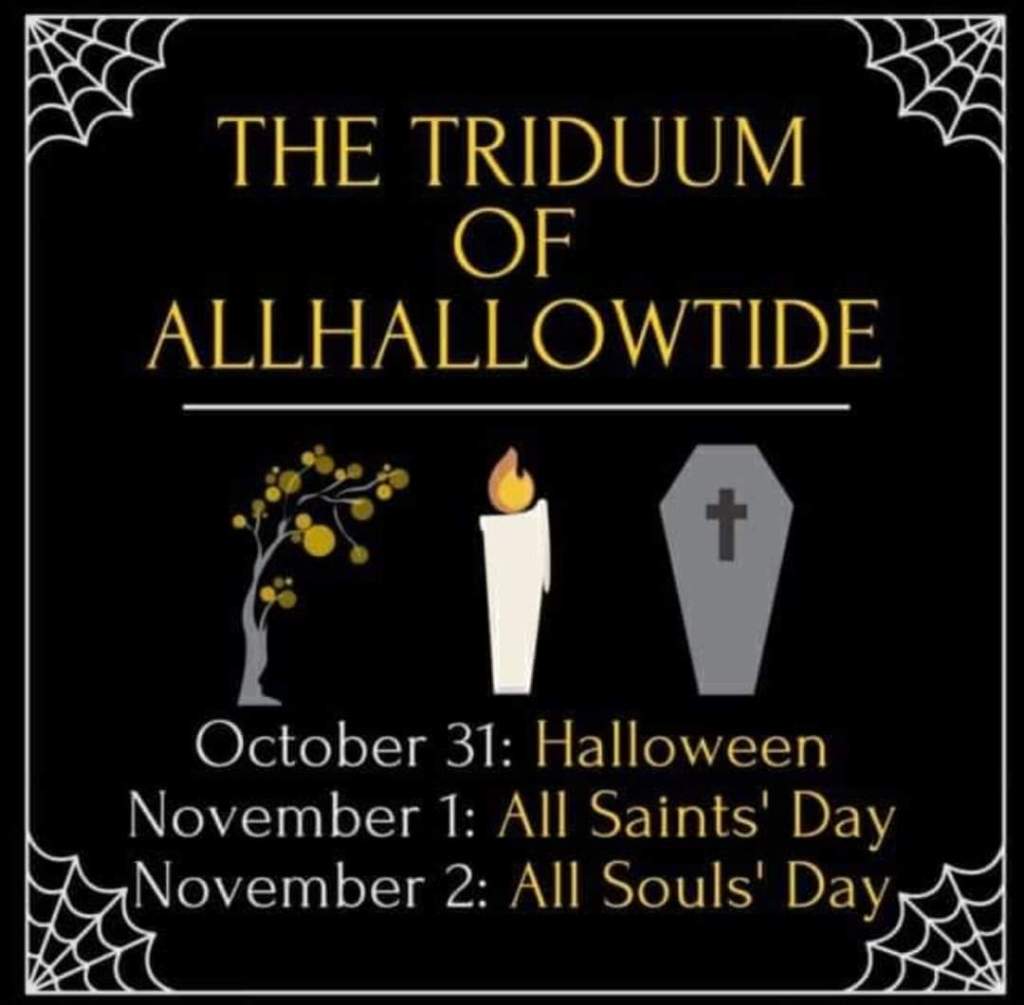
October 31st begins a stretch of time known informally as Hallowtide – an Old English word for “Saints Season”. One way to understand this holy moment in the Church Calendar is call it a Triduum, a three-day period.

Image pulled from Facebook

October 31st, Halloween, is the opening celebration in which we acknowledge the thinning of the barrier between the living and the dead. Some say this derives from the language of Celtic Christianity, but it’s very difficult to discern fact from fad when it comes to referencing the belief in practice of the early Church in the British isles, so let’s not take that too seriously. In any case, this evening, All hallows eve, is the liturgical start of All Saints Day itself, and the party begins.

All Saints Day, November 1st, is when we particularly celebrate the church triumphant – that victory over sin and death itself that God’s people have in Christ and even now enjoy in paradise, even though they have not yet tasted of the general Resurrection of the Body.

All Souls Day, November 2nd is when the Roman Church remembers those who are still in purgatory, and have not yet attained to the beatific vision of the Saints in heaven. This is not an Anglican take on the holy day, obviously, and so the optional commemoration on this day in our prayer books now typically turn it the commemoration of the faithful departed. So rather than talking about those in heaven and those in purgatory, as the Romans erroneously do, we celebrate two different aspects or realities that the Saints departed presently experience. November 1st is the day of joy in triumph, we give thanks to God for their victory in him, and we are stirred up to follow their good examples that we might share in that eternal inheritance with them. November 2nd is the day of rest and mourning, where we lament the ongoing present reality of death, acknowledge the pain of losing people to that death even temporarily, and are comforted in the knowledge that they are at rest with the Lord.

Beyond this triduum one could also identify hallowtide as an octave. An octave is a stretch of eight days, which is represented in our prayer book by the fact that when All Saints Day is not on a Sunday we are allowed to celebrate it on the first Sunday in November. This results in a span of 7 days (November 1st through 7th) in addition to the evening of October 31st bringing us to a total of eight different days in which we could be celebrating the hallowed ones continuously!

One way this can be observed is by singing. This customary has proposed the following recommendations for observing the All Saints / All Souls dynamic throughout the octave:

  • 31st: Day of wrath! O day of mourning!
  • 1st: For all the saints, and, Lord who shall come to thee
  • 2nd: Behold a host arrayed in white, and, O Lord my God I cry to thee
  • 3rd: Who are these like stars appearing
  • 4th: I sing a song of the saints of God
  • 5th: The saints of God! their conflicts past
  • 6th: Tempted and tried, we’re oft made to wonder
  • 7th: I fall asleep in Jesus’ wounds

Vigil fast today!

In the 1662 prayer book there are several fasts appointed on the eve, or vigil, or day before several of the holy days in the church year. Curiously, not all of the holy days in that prayer book get their own fast day beforehand; perhaps about 75% do and the rest do not.

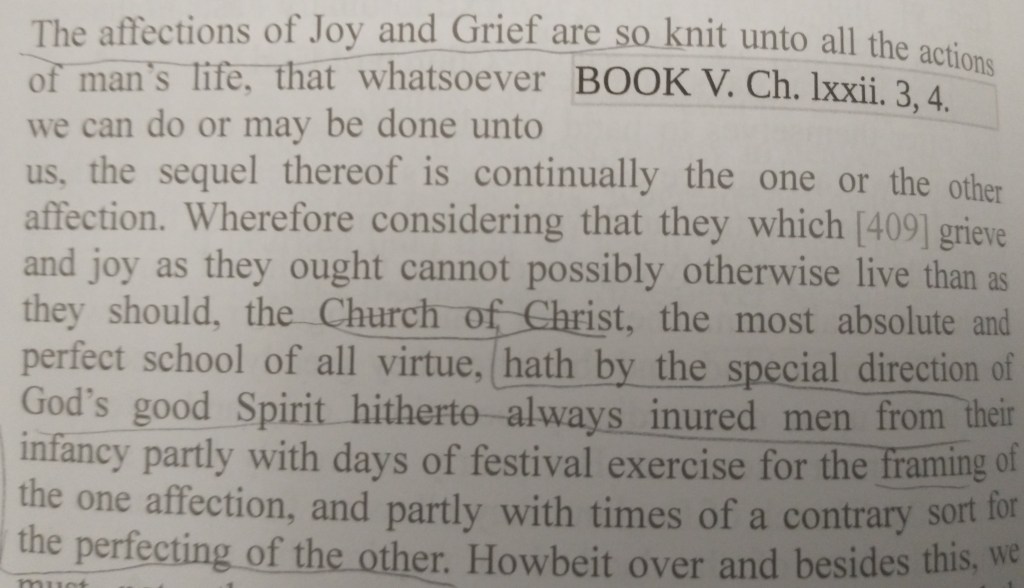
Today is one such vigil fast, preparing us for the feast of the nativity of Saint John the Baptist tomorrow! This pairing of fasts and feasts is both an ancient and a sound practice:

Here, the great Anglican theologian, Richard Hooker, points out that grief and joy are two states of heart and mind which excellently summarize human life, and in her fast and feast days the church uses grief and joy to help Christians grow in virtue and holiness.

So if you are not normally one who observes days of fasting consider adopting the prayer book tradition of vigil fasts today!

Faithfully Stay the Course

February 24th is Saint Matthias Day in the traditional liturgical calendar. Some churches and provinces have moved him over to May 14, closer to Ascension Day and Pentecost, where his story in Acts 1 fits right in from a biblical-narrative perspective. But we’ve still got him in late February, usually in Lent. It’s always nice to have a feast day in Lent – we get a little break from the penitential tone! – but there’s also something appropriate about observing this Saint during Lent: Matthias is only one of the twelve Apostles because he was selected to replace Judas, the traitor.

There are two lessons that I’d like to draw from this liturgical observance (and from Acts 1:12-26).

  1. Apostolic authority is a critical point for the unity of the Church.
  2. Every Christian must faithfully stay the course of the faith.

On the point of apostolic authority, this is something I like to try to mention during Ascensiontide but often don’t have time – (there is a lot of fantastic theology and lessons about Jesus and his ministry to us to tease out in that brief mini-season, and I seldom have opportunity to write or preach about ecclesiology then) – the eleven considered it vitally important that they replace Judas and restore their number to twelve apostles. Jesus had just told them that while it was not for them to know “the times or seasons” concerning the Kingdom of God, but that they would “receive power” when the Holy Spirit would descend upon them. And this wasn’t entirely in the future; Jesus had already “breathed on them the Holy Spirit” giving them authority to forgive and retain sins. In that authority they’d already been entrusted with, they took it upon them to select and ordain a new twelfth man – Matthias. St. Peter even quotes Psalm 109 to acknowledge the necessity of this act: “Let another take his office.” And in the Greek, the word translated “office” is the source for the word “episcopate” – the office of an overseer, or bishop.

They knew that when the Holy Spirit would descend upon the whole church (on the day of Pentecost) the leadership had to be ready. Ancient Israel was founded with Twelve Tribes, and the New Israel was to be re-founded with Twelve Apostles – this was a very self-conscious and -aware decision, they knew the significance of what they were doing.

And, although the nature of the authority of those first Apostles is different from the authority that has been passed down among the Bishops ever since, the apostolic role of the bishops assembled is still critical for the church today. On their own, bishops might be little more than super-priests, pastors of megachurches, or of multi-site churches. That’s where cynicism from tired or burned church-goers (or skepticism from presbyterians and congregationalists) thrives. The real power, or authority, of the bishop is not so much in the individual as in the episcopacy as an institution and a group. One bishop can go astray about as easily as one priest or pastor, honestly. But a group, or college, of bishops, is another matter. Yes, a group can be corrupted too – we consider the entire Roman Church to be in error for example. But a church is at its best when its bishops speak together with one voice, in accord with the Church global and temporal.

An example of this was just demonstrated last month when the College of Bishops of the Anglican Church in North America concluded a year of deliberations concerning the issues of ministering to people with same-sex attraction. It’s one of the greatest ministry challenges of our time, and must be met with careful biblical attention and loving attention to the situation of people today. Their excellent statement can be read online here.

But of course, there are always people who want to add their own nuances, pick at words, and even twist or re-cast what has been said. No small online furor has followed, muddying the waters and making some people wonder what the exodus from the Episcopal Church was all about if we’re just going to re-tread the same ground all over again. One of the angles of corrective response is an article in which a respected Anglican examines for us the nature of the teaching authority of bishops as a unified body. I commend that reading to you also!

But this also leads us to the second point about the election of Matthias to be the new 12th Apostle – he was “one of the men who have accompanied us during all the time that the Lord Jesus went in and out among us, beginning from the baptism of John until the day when he was taken up from us“. And, critically unlike Judas Iscariot, Matthias faithfully stayed the course. He did not falter from the way of Christ; he remained constant like the other eleven.

Other Scriptures read on this day attest to this also: Psalm 15 asks the hard-yet-important question of who can dwell on God’s holy hill; Philippians 3 gives us the example of “press[ing] on toward the goal for the prize of the upward call of God in Christ Jesus“. Simply put, there is a way that leads to life, and a way that leads to death. Judas chose the latter for himself; we must choose the former. Yes, salvation is not simply about what you choose – the real work of salvation is Jesus’ death on the Cross for the sins of the world, but if you reject his sacrifice on your behalf then you’ll have to find another way to pay for your sins… and there isn’t one.

The story of St. Matthias taking Judas’ office, or episcopacy, is a sobering reminder. Please, faithfully stay the course of the faith. In Christ alone is salvation wrought, and only his Body (the Church) offers him to us.

A Series of Related Commemorations

The calendar of commemorations in our new Prayer Book today lists three women: Lydia, Dorcus, and Phoebe. Normally, as you may be aware, only one commemoration per day is the norm. Sometimes if a group of people were martyred together they’ll share a date, and sometimes (even more rarely) a few people with similar legacies are remembered together. This “affinity group commemoration” phenomenon is mostly a feature of the Episcopalian calendar since 1979, though some rare examples of these entries have carried over into our calendar and/or can be found in other traditions also.

Just for one example, Lydia has been commemorated as a Saint in many traditions over the years, but her feast day varies widely. The Romans remember her on August 3rd, various Eastern churches commemorate her on March 27th, May 20th, or June 25th. Some Lutherans celebrate her on October 25th. We, with some other Lutherans and the Episcopalians, have her down for January 27th.

What is particularly interesting about this date for commemorating Lydia and Dorcus and Phoebe (since we don’t have clear traditions of when they died, which would be the normal date for a Saint’s Day) is that they are on Day Three of a three-day series of commemorations. January 25th is the Conversion of Saint Paul, January 26th is for Saints Timothy and Titus, and January 27th is for Lydia, Dorcas, and Phoebe. This string of remembrances is a real “Book of Acts Party”, I once joked, and makes a lot of sense. Together these six people form a sequence both historical and missiological:

  1. God calls Saul (eventually to be known as Paul) to faith in Christ
  2. Paul ordains ministers (Timothy and Titus) to continue his work
  3. More people convert (Lydia, Dorcus, Phoebe) and continue the advance of the kingdom

Thus this trio of celebrations is worth pointing out to our fellow church-goers as a biblical and liturgical reminder of the call of the Church to make disciples and grow. The different roles are important to note, because sometimes we assume that “mission” and “evangelism” is best done by professionals – or least by particular individuals with special zeal and drive. Saint Paul was an extraordinary individual, Timothy and Titus were bishops, they can be most inspiring but also very difficult to relate to. This is where the three women may come in helpful.

Lydia was a wealthy woman, who lived in Thyatira, in Roman Macedonia. She was essentially the first European convert to Christianity. She was already a “worshiper of God”, which means she was probably familiar with basic Jewish teachings and believed in the God of Israel, but (most importantly) “the Lord opened her heart to pay attention to what was said by Paul” and she and her household were subsequently baptized. She heeded the Gospel, brought her family along, and then supported the ministry of Paul and his companions with her considerable means. Believing in the mission of the Gospel and supporting it with hospitality and finances is no small thing!

Dorcas, also named Tabitha, was a devout woman faithful in Christ and abundant in good works. Her ministry of providing for the poor and needy made her most beloved in her community and when she died many people showed St. Peter the clothing she had made for them, beseeching him to pray for her and raise her from the dead, which he did. Her resuscitation “became known throughout all Joppa, and many believed in the Lord.” Thus even though she did directly participate in “evangelistic outreach” as we might call it, her good deeds gave her a positive reputation that, when recognized by the Church, brought many to share the faith she proclaimed. The light of her good deeds was seen, and many others came to the Light as a result.

Phoebe, finally, is a person of some controversy in modern Christian circles. She is described as a “διάκονον” from which we have the word Deacon. Some argue she was a Deacon in the formal ordained sense, like the men in Acts 6. Some argue she was a Deaconess in the context of the Early Church’s practice: a non-ordained minister who assisted with the baptism of women and works of mercy in the community. Others take the word in its general sense – a “servant of the Church”. Whatever the precise interpretation of this word, we know that Phoebe was an active member of the Church at Cenchrae (probably a village near Corinth) who traveled to Rome, perhaps along with the letter that St. Paul had written to them. She was to be received “worth of the saints” and to be helped in whatever she might need, because she was a “patron of many” as well as of Paul himself. A patron indicates she probably was rich, like Lydia, and provided financial and/or hospitable support for the traveling apostles and the local church. As a woman of means, perhaps she was able to be active in other ways – supplying the church and the ministers, caring for the sick, bringing alms to the poor, or any number of other services for the cause of the Gospel.

So we remember today the great contribution of these three women; their service to the Gospel and the Church was incalculable and their names endure forever through the Scriptures and the liturgical calendar. It is helpful for us to commemorate people who made a great difference through seemingly “ordinary” means… maybe just maybe we can be inspired to spend and be spent for the cause of Christ, ourselves.