Readings Review & Planning Propers 9/9

One of the things we’re doing on this blog on Mondays is look back and forth at the Daily Office readings (or lessons) so we can better process together what the Scriptures are saying.  The other thing we’re going to do on Mondays starting today is list the recommended Propers for the Communion or Antecommunion service for each day of the week.

Readings Review

Last week: 2 Samuel 19-24, 1 Chronicles 22, Ephesians 1-5:17, Jonah 3-4, Micah 1-5, Matthew 4-8:17
This week: 1 Kings 1-5, 1 Chronicles 28, Ephesians 5:18-6, Hebrews 1-6, Micah 6-7, Nahum, Habakkuk 1-2, Matthew 8:18-12:21
Special reading Saturday for Holy Cross Day: John 12:23-33

The main body of the Gospel according to St. Matthew (chapters 5-25) form a five-part cycle of Teachings & Activities.  It’s almost as if he was making a point of imitating the Torah (the five books of Moses) in the way that he compiled his gospel book.  This week’s coverage of Matthew sees us through most of the second block of the cycle: Jesus’ teachings on mission (or least relations with the world) in chapter 10, followed by feedback and opposition (from disciples and critics alike) in chapters 11 & 12.  At the end of the week we even get an example of Matthew’s signature move in citing an Old Testament prophet in the language of Jesus bringing “fulfillment” to the scriptures.

The epistle lessons in Morning Prayer also switch over the book of Hebrews this week, which is another book that leans heavily on Old Testament references.  If you’ve got a Bible with cross references in the margins or footer, this is a book where you should especially watch out, because unless you’re very familiar with the Old Testament already there are going to be a lot of strange-sounding references that you’ll need help clarifying.

Planning Propers

This is the week of Proper 18 (or 12th after Trinity in the traditional calendar), so keep in mind that the historic Prayer Book default is that a mid-week Eucharist will repeat the Collect & Lessons (the propers) for yesterday.  Otherwise, we recommend…

  • Monday 9/9 = Votive (of the Holy Spirit) or Constance & companions (marytrs)
  • Tuesday 9/10 = Votive (of the Holy Angels) *
  • Wednesday 9/11 = Votive (for Peace) **
  • Thursday 9/12 = Votive (of the Holy Eucharist)
  • Friday 9/13 = St. John Chrysostom (teacher of the faith)
  • Saturday 9/14 = HOLY CROSS DAY

* A Votive is a “Various Occasion” (page 733 in the BCP 2019) and label in parentheses are simply a traditional suggestion.

** This is not the traditional votive mass for a Wednesday, but seems an appropriate choice for the nation’s commemoration of September 11th.

The celebrant may then say the Exhortation.

When was the last time you heard the Exhortation read in your church?  Or if you’re a priest, when was the last time you read the Exhortation to your flock?  Or when was the last time you read the Exhortation at all?  Do you even know what the Exhortation is?  I’ve resisted the urge to give this entry a click-bait title, but I have a sinking feeling that a lot of people are grossly unfamiliar with this uniquely Anglican feature of the Communion liturgy.

The main reason the Exhortation is almost completely gone from the modern Anglican landscape is because the 1928 Prayer Book (and other books since) almost completely buried the Exhortation.  It’s still there, and there are rubrics to direct its location within the liturgy, but the primary text of the liturgy itself makes no mention of it.  It’s a dinosaur, a relic of ages past, preserved in the liturgical appendix to appease the grumpy old traditionalists.

In the 2019 Prayer Book however both our Communion rites have this rubric between the Prayers of the People and the Confession:

The celebrant may then say the Exhortation.

You then have to turn to pages 139-40 for its suggested uses: it can be part of a special “Penitential Order” at the beginning of the Communion liturgy (for those who want the service to be more Lutheran I guess) and that it “is traditionally read on the First Sunday of Advent, the First Sunday in Lent, and Trinity Sunday.”  This is an appeal to the precedent of (at least) the 1928 Prayer Book which requires the Exhortation to be said on those three Sundays at least (though again you have to find the Exhortation and its rubrics after the conclusion of the Communion liturgy).

So what is the Exhortation?

You can read it on pages 147-8 of the 2019 Prayer Book.  Originally there were three Exhortations: one for the Communion Service itself, one for the Antecommunion when the Communion is coming up (next week or so), and another one for the second setting with a particular emphasis on calling people to receive the Sacrament when they have been “negligent to come.”  Now that weekly Communion is almost universally normalized, the latter two aren’t really useful anymore; only first remains.

If you haven’t read it yet, please do so.  Like, literally, now.  Grab your prayer book, click the link, whatever.

Read it?

Seriously, don’t think you can fool me; I may technically still be a young priest but I’m that naive anymore.

Okay, great, let’s continue.

The Exhortation as found in the 2019 Prayer Book is pretty similar to its traditional form, though you will find that it incorporates elements of all three.  (The 1979 version was re-written to emphasize a fairly liberal agenda regarding the love of God and downplaying the judgment of God, so don’t bother digging that one up anymore.)  Rather than one giant block of text it is spaced into six more readable paragraphs.

The first paragraph gets you started on the right foot: if you intend to receive Communion today, make sure you follow the scriptural mandate to approach with penitence and faith.  The benefits and dangers are great, appealing to 1 Corinthians 11.  The second paragraph continues the same line of scriptural reference, honing in on the call to “judge yourselves lest you be judged by the Lord,” including full confession and restitution as much as is possible.  The third paragraph is drawn from the “Communion is next week, guys!” speech, and that shows because it’s kind of too late to make the invitation to private confession to the priest not five minutes before the celebration of Holy Communion begins.  Nevertheless, the offer is there, and in this day of cheap grace and faux-forgiveness I think our congregations need to know that private confession to a priest is a real ministry that is available to them.

The remaining three, shorter, paragraphs, take a more cheerful tack – “above all, each of us should give humble and hearty thanks to God…. Because of his exceedingly great love for us…”  The facts of the Gospel surrounding the death and resurrection of Jesus are summarized as a show of great love, which he desires to communicate to us in “these holy mysteries” of bread and wine.  We are called to love and to joy in submitting to Christ, and that is the last word before the call to confessing our sins.

If you are familiar with the eucharistic canon of the Anglican Standard Text, or any pre-1979 prayer book, you will find several echoes of language between the Exhortation and the Communion prayers.  Because of the close similarity in language, I would highly recommend using the “Anglican Standard” instead of the “Renewed Ancient Text” whenever giving the Exhortation.

As for the dates, our rubric only recommends Advent 1, Lent 1, and Trinity Sunday.  For the most part, I’ve adhered to that pattern in my church since Advent 2013.  The freedom afforded us in this rubric, though, should not be taken as a wholesale opt-out option, but rather, to choose different Sundays or more Sundays to read the Exhortation.  People need to know why we celebrate Communion, and how to prepare for it – especially those many who have come into Anglicanism from an evangelical background where the Sacraments hardly played a role in their spiritual life at all.  I find that Advent 1 is often a low-attendance week due to post-Thanksgiving-Day travel, so sometimes I save the Exhortation for Advent 2 when they’re all back.  Sometimes Trinity Sunday also has that beginning-of-summer slump, too, so I might move the Exhortation up to Pentecost instead.  Use your freedom on this part of the liturgy responsibly, not as an excuse to be lazy.

Is it wordy?  Yes.  Can it be boring?  Yes.  Is it difficult to read if you’re not used to it?  Yes.  But don’t let that stop you.  This is a valuable piece of liturgy, and the more you expose your congregation to it, the more of it will sink in.  Use it in Sunday School or Confirmation preparation when teaching on the Sacraments!  Maybe dedicate a Maundy Thursday sermon to exposit its text; it’s basically a sermon on 1 Corinthians 11 anyway.

If you’re a priest, learn to love the Exhortation.  It is a valuable tool, ally, and resource, and it’s right there in the liturgy.  You don’t have to go full 1662-style and use it every single service, but it’s too good to let it fall into obscurity forever.

Readings Review & Planning Propers 9/2/19

One of the things we’re doing on this blog on Mondays is look back and forth at the Daily Office readings (or lessons) so we can better process together what the Scriptures are saying.  The other thing we’re going to do on Mondays starting today is list the recommended Propers for the Communion or Antecommunion service for each day of the week.

Readings Review

Last week: 2 Samuel 12-18, Colossians, Philemon, Ephesians 1:1-14, Amos 6-9, Obadiah, Jonah 1-2, John 19-21:, Matthew 1-3

Next week: 2 Samuel 19-24, 1 Chronicles 22, Ephesians 1-5:17, Jonah 3-4, Micah 1-5, Matthew 4-8:17

Something that begins at the end of this week and will last into early November is the supplementing of readings from 1 & 2 Kings with readings from 1 & 2 Chronicles.  As you may be aware, the books of the Chronicles cover the same span of time from 2 Samuel 1 (David’s ascension to the throne of Israel) to the end of 2 Kings (the conquest and destruction of Jerusalem).  This means that there is a lot of repeat material in the Samuel-Kings books and the Chronicles, rather similar to the overlap between the four Gospel books.  There are a few “glitches” along the way – different numbers for the reigns of certain kings, or census results, and so forth – most of which can be explained by means of different cultural perspectives (namely, who counts in a census? does a king’s reign begin when his father dies or when he begins a co-regnancy during his father’s life? etc.).  There are also a few stories that are told in slightly different orders.  In general, the Samuel-Kings books are considered the more “historic” books, and Chronicles, having been written later, are more of a theological commentary on the history.

In the context of our daily lectionary, though, the role of 1 & 2 Chronicles is simply that of “filler.”  When those books supply a story that Samuel-Kings does not, the lectionary adds it in a the appropriate place.  It makes for a slightly unpredictable reading experience, because you’ll be going through one book and suddenly a chapter from another book will jut in, but narratively it works.  And, for what it’s worth, the original Anglican daily lectionary went for the simpler course and just omitted Chronicles completely, so rejoice in re-gained ground!

Planning Propers

This is the week of Proper 17 (or Trinity 11 in the traditional calendar), so keep in mind that the historic Prayer Book default is that a mid-week Eucharist will repeat the Collect & Lessons (the propers) for yesterday.  Otherwise, we recommend…

  • Monday 9/2 = Labor Day or Martyrs of Papua New Guinea
  • Tuesday 9/3 = Votive (of the Holy Angels) *
  • Wednesday 9/4 = St. Birinus (missionary bishop)
  • Thursday 9/5 = Votive or Mother Theresa (renewer of society)
  • Friday 9/6 = Votive (of the Holy Cross)
  • Saturday 9/7 = Votive (of Blessed Mary**

* A Votive is a “Various Occasion” (page 733 in the BCP 2019) and label in parentheses are simply a traditional suggestion.

** Choose between the Annunciation, the Visitation, or St. Mary’s Day.

Book Review: Saint Joseph Continuous Sunday Missal

Welcome to Saturday Book Review time!  On most of the Saturdays this year we’re looking at a liturgy-related book noting (as applicable) its accessibility, devotional usefulness, and reference value.  Or, how easy it is to read, the prayer life it engenders, and how much it can teach you.

The next few books we’re going to look at are from liturgical traditions other than our own.  Obviously it is important to well-grounded in who we are and what we believe and where we stand, but it is also important to understand that we don’t stand in a vacuum, but as a part of the greater whole of Western Catholicism, and further, universal Christianity.  So today we’re going to go with one of the more random entries on my liturgy shelf: the Saint Joseph Continuous Sunday Missal, from 1963.

As you probably know, the 1960’s was a hotbed of liturgical changes in the Roman Church, and the vast majority of the Protestant world was about to follow suit.  The council known as Vatican II ran from 1962 to 1965, and one of its earliest reforms was for the liturgy in the local vernacular.  This Sunday Missal from 1963 represents a brief slice of Roman liturgical reform where it’s all in English, but most of the “novus ordo” (new order) stuff hasn’t been introduced.  It’s a precious snapshot of the Tridentine liturgy in English, something that’s almost completely lost today.  Under Benedict XVI, Roman Catholics got their Latin Mass back, but I’m not sure they got back their historic liturgy in the English language.  Their situation is something like Anglicans having to choose between the 1662 Prayer Book with zero changes and the 1979 Prayer Book – super traditional to the point of liturgical fetishism, or super modern to the ire of traditionalists everywhere.

So, apart from historical reference, in a tradition not even our own, what use is this book to an Anglican today?  Well, if you’re one of those crypto-Papist versions of Anglo-Catholic, then I suppose this book is pretty close to your view of an ideal liturgy in English.  It may help inform how you use the Anglican Missal, or whatever other Prayer Book supplement you prefer.  But most of us, I hazard to say, are more interested in Anglican liturgy and spirituality; what does this Roman book have to offer?

When I spent three years with my church in the classical prayer book lectionary, I learned a lot about how the liturgy used to be structured.  Remember that the historic Sunday Eucharistic lectionary has just two readings: an Epistle (usually) and a Gospel.  The Prayer Book tradition appoints a Collect for each Sunday and Holy Day to go with those two readings, but that’s it.  But what I eventually discovered was that there are more “propers” to draw upon if one so chooses.  There’s also the Introit and the Gradual – short pieces, usually chanted, usually from the Psalms, that are said near the start of the liturgy and between the Epistle and Gospel, respectively.  But what are those texts, and how are they used?  That’s where this book came in handy for me: by spelling out the full text of the Roman Mass for each Sunday of the year, it showed me how they did the Introit and Gradual, giving me insight into how those two additional propers could be put into the our liturgy.

First you can see the Introit, between the “Foremass” confession and the Kyrie, functioning in essentially the same way as our Opening Acclamation today.
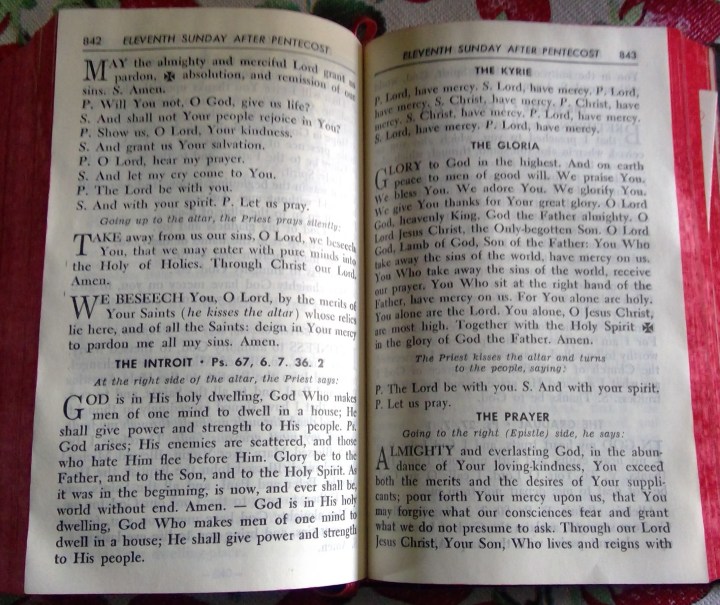
Introit

After the Kyrie and Gloria comes their Collect of the Day, and then we turn the page to find the Epistle, Gradual, and Gospel.  Notice how both the Introit and Gradual use an Antiphon-Verse-Antiphon pattern, though slightly differently.  The Gradual functions similarly to our (responsory) Psalm in modern liturgy.

gradual

Then we get through the Creed, Sermon, and arrive at the Offertory.  It’s interesting to note that they appointed particular Offertory Sentences to particular Sundays, whereas the Prayer Book tradition just throws a 2-3 page list at you to choose from.

offertory

And then finally, after 8 pages of Communion prayers, we get to an oft-overlooked piece of liturgy, the Communion Sentence.  As far as I’ve noticed, the Prayer Book tradition has always authorized this little piece of liturgy, but seldom (if ever) gave instructions on how to do it.  Notice here that it’s said after the sacrament has been distributed and the vessels cleaned.

communion

The Post-Communion Prayer follows the Communion Sentence – it’s almost as if that little Scripture verse is there to re-direct everyone’s attention to the reception of the Sacrament after the sometimes-lengthy process of communicating everyone, getting everyone back on track to pray the Post-Communion together.

I share this in detail partly because I think it’s interesting, but also because it sheds some slight on how certain elements of our own liturgy, old and new, work in similar tradition to our own.  For example, I’ve only ever heard a Communion Sentence uttered at one church I’ve visited, and only tried saying one myself at my church once or twice.  Perhaps old resources like this one can inspire us to look at our own liturgy with fresh eyes.

The ratings in short:

Accessibility: 5/5
If this book represented the way a church worships today, it would be incredibly useful.  It’s easy to follow, the whole Mass through.  It’s got a picture at the beginning of each Sunday Mass to give a visual sense of the day’s theme.  Everything is clearly labeled.  The book is long (over 1,000 pages) but not large.  It’s got explanations of the calendar and the parts of the Mass, with color pictures, at the beginning.  The whole point of this book was to help church-goers follow and understand the Roman Mass easily.

Devotional Usefulness: 1/5
As noted previously, this book represents a form of the liturgy that probably doesn’t exist anywhere anymore.  And it’s very Roman, so the theological content of its eucharistic prayers is not entirely agreeable with the Prayer Book tradition.  And although it does have some other prayer resources in the back, this book just isn’t really “for us”.

Reference Value: 3/5
If you’re interested in how various elements of traditional Western liturgy can/did/”should” look in English, this book, or another like it, is extremely handy.  Its usefulness is pretty narrow, though.

If you chance upon a book like this at a yard sale or an estate sale, like I did, it’s totally worth shelling $5 to save it from the rubbish heap.  It’s a book cool to explore, and it looks really pretty on your shelf, too!  There’s a lot to be said for elegant, simple, beauty.

Prayers of the People (Old & New)

One of the primary improvements found in the 2019 Prayer Book over its predecessor in 1979 is the restoration of a great of deal of classical prayer book content that was displaced, obscured, or even omitted in ’79.  The “Prayers of the People” in the Communion service was once of the hardest-hit features of classical liturgy in the ’79 which is substantially restored in the 2019’s Anglican Standard Text.

The classical approach was to read through all those prayers, straight through, and the 2019 puts in congregational responses – “Lord in your mercy / Hear our prayer” – which is hardly more than a cosmetic update to help people keep focused.  A few changes of wording have been made, and at least one new addition made (namely the petition for the advancement and spread of the Gospel), and one slightly-controversial line in the final petition pointing back toward the 1549 Prayer Book’s approach to handling prayers for the departed. A sober and attentive article on this subject can be found here, in case you’re curious or concerned.

What we’re going to look at today though is not so much the content of the prayers (I dare say the above paragraph and link are a sufficient headstart into your own comparison if you really want to do that), but instead the function of the prayers.  In modern liturgy, the Prayers of the People are a sort of thing unto itself.  The Sermon has been delivered and the Creed has been said, and now it’s time to pray for a little while.  When we’re done we move on to the Confession, absolution, and Offertory.  It all fits together into a logical progression: intercede, confess, receive absolution, and celebrate with offering.  It’s logical and sensible, but it’s not particularly profound; as far as I understand it thus far, this is primarily a functional progression of liturgy.

The classical prayer book order was more, for lack of a better term, mystical about the Prayers.  Until the 1979 book changed things up, the Sermon was followed by the Offertory, and the monetary gifts would be brought up front along with the bread and wine for Holy Communion, and then the “Prayer for the Whole State of Christ’s Church” began, read by the Celebrant (rather than a Deacon or lay reader).  These prayers included an optional line for God to “accept our alms and oblations”, referencing the Offertory gifts, and in a sense anticipating Holy Communion itself.

In a way, the “Prayers of the People” were like the preparation for Communion itself!  As the people got ready to approach the throne of grace, their intercessions were sent ahead, along with the very elements that God would provide to feed them.  These Prayers would then be followed by an Exhortation, the Confession & absolution, and then the Communion prayers would follow immediately.  This is probably the most-changed part of the liturgy from old to new in terms of “order of service.”

If you find this appeals to you, and you want to capture this sense of eucharistic anticipation in the Prayers of the People in the 2019 book’s liturgy, there are things you can do.  You can go all out and use the instructions in the Additional Directions to re-structure the entire liturgy to the “1662 Order.”  *SEE FOOTNOTE*  But if that’s too radical a change for your context (or you prefer the 1928-informed order of the eucharistic canon over the 1662 order), there are three things you should do to help tie the Prayers of the People more clearly to the celebration of Holy Communion:

  1. Do not hold announcements after the Peace.
  2. Always appoint a Communion Hymn at the Offertory.
  3. Have the bread and wine brought up to the altar at the same time as the monetary gifts.

In most cases, those are the two things that separate the Prayers of the People from the Communion.  The Peace already easily turns into a greet-everyone-in-the-room moment, and when it’s followed by the weekly parish announcements the flow of the liturgy is basically dead at that point, only to be revived with the Offertory – but almost as if a second worship service is starting.  If you want the Prayers of the People to reclaim any semblance of Eucharistic preparation, you’ve got to hold those announcements somewhere else (the old order called for them after the Creed and before the Sermon).  And then you have to follow that up with Communion-themed offertory music, lest that anthem also break the link.  The bread and wine, too, need to be involved in the Offertory (as was its traditional purpose anyway), so it’s clearer that the money is secondary and the sacrament is primary.

If none of this interests you, or strikes you as necessary, that’s fine.  The modern liturgical order clearly has a different logic to it, and it’s not always easy or reasonable to use one prayer book and pretend it’s a different one.  But, as always, it’s important to know and understand how classical Anglican liturgy worked, so we can at least be honest about when we’re following it and when we’re doing something new.  And the opportunities for teaching and spiritual formation in our congregations, too, can be greatly enriched by such perspective!


** UPDATE **
It turns out that we do in fact have the option to conform the liturgy of the Anglican Standard Text not only to the 1662 Order, but to any subsequent book.  This permission is spelled both on pages 7 and 104, and a member of the ACNA liturgy committee confirmed that this is the intention of those rubrics.

Readings Review & Planning Propers 8/26/19

One of the things we’re going to do on this blog on Mondays is look back and forth at the Daily Office readings (or lessons) so we can better process together what the Scriptures are saying.  I’m not always going to touch on all four reading tracks, much less give a play-by-play review of the week past or preview of the week to come, but just look more generally at where we’ve been and where we’re going.  The other thing we’re going to do on Mondays starting today is list the recommended Propers for the Communion or Antecommunion service for each day of the week.

Readings Review

Last week: 2 Samuel 6-11, Philippians, Colossians 1:1-20, Joel 2-3, Amos 1-5, John 15:18-19:37
This week: 2 Samuel 12-18, Colossians, Philemon, Ephesians 1:1-14, Amos 6-9, Obadiah, Jonah 1-2, John 19-21:, Matthew 1-3

A nice feature of this late-August point in the daily lectionary is the concurrence of the end of St. John’s Gospel with the epistle to the Colossians.  Colossians is a book that leans heavily on the death and resurrection of Jesus, proclaiming his supremacy and sufficiency for all Christian life and spirituality.  We’ll look at this book further in another post this week, so suffice it to note here that we get to walk through the death and resurrection of Christ just as this epistle gets going.

You might ask why the epistles aren’t being read in canonical order.  After finishing Romans on August 17th we went to Philippians, now Colossians, and soon Philemon and Ephesians.  I’m not 100% sure, but I believe the general idea is to read these books chronologically.  Colossians and Philemon go together, at any rate (Philemon was from Colossae, and several greetings-names are found in both letters), so to read them in sequence can be beneficial for putting the larger picture together.  Having just finished Philippians and moving on to Ephesians after also keeps this group of “prison epistles” together – St. Paul likely wrote all four of these letters at roughly the same time during his imprisonment.

The Minor Prophets of the Old Testament, however, are being read in canonical order, even though that is not quite their chronological order.  Their chronology is a little more disputed, and the benefit gained from rearranging them is not as great.  We finish Amos this week and start into some of the shorter books, which will take us two-thirds of the way through September.  Take care not to skim these books – these are writings that Christian often and easily neglect, only pulling out the choice verse here and there around Christmas.  Let these prophets tell their stories, dole out their warnings, cry out for justice, and convict people of faithlessness.  There is much in there that points to Jesus, but there is also much in there that calls out sin – in any day and age!

Planning Propers

This is the week of Proper 16 (or Trinity 10 in the traditional calendar), so keep in mind that the historic Prayer Book default is that a mid-week Eucharist will repeat the Collect & Lessons (the propers) for yesterday.  Otherwise, we recommend…

  • Monday 8/26 = Votive (of the Holy Spirit) *
  • Tuesday 8/27 = St. Monica (saint) or Votive (of the Holy Angels)
  • Wednesday 8/28 = St. Augustine of Hippo (teacher of the faith)
  • Thursday 8/29 = Beheading of St. John the Baptist **
  • Friday 8/30 = Votive (of the Cross)
  • Saturday 8/31 = St. Aidan (missionary bishop)

* A Votive is a “Various Occasion” (page 733 in the BCP 2019) and label in parentheses are simply a traditional suggestion.

** You should use the Propers for a Martyr, but change the Gospel lesson to the actual story of the event, like Mark 6:17-29.

Sermon, Creed, or Creed, Sermon…

When going through the Communion service, after the Collect & Lessons comes the Creed, and then the sermon.  Or is it the sermon, and then the Creed?  Most people take this for granted and tend to forget (or not even be aware at all) that there are two ways that this works.

In the 1979 and 2019 Prayer Books, in accordance with the Roman Rite, the sermon immediately follows the Gospel lesson, and the Nicene Creed comes after that.  Thanks to the liturgical ubiquity of Romanism in the West, and their impact on Anglican liturgy in the 1970’s and beyond, this is the order that the vast majority of Anglicans today are used to.

However, the Prayer Book tradition from 1549 until 1979 was unanimous: after the Gospel comes the Nicene Creed!  Then follows announcements of the week’s feasts and fasts, whatever other announcements and prayers need to be made, and then the sermon will follow.

These two different orders may not seem like a big deal, but there are some underlying matters of emphasis that are worth considering here.

One of the basic principles of liturgy is revelation and response.  God is revealed in some way, and the people respond.  The dialogue “The Word of the Lord / Thanks to be God” is perhaps the smallest and clearest example of this dynamic at play.  In the Daily Office a Scripture reading (revelation) is followed by a Canticle (response).  In the Communion liturgy the first lesson (revelation) is followed by a Psalm (response).  So, if the Gospel lesson is a revelation, what is the response?

Classical Anglicanism makes the Nicene Creed the response; the Roman Rite and modern Anglican liturgies makes the Sermon the response.  In the former, the Sermon then goes on to be like another “revelation” followed by the “response” of the Prayers and Confession.  In the latter, the Creed is perhaps the next revelation followed by the Prayers?  It’s hard to say, one can’t go too haywire with liturgical principles as if one concept will explain everything.

Nevertheless, the shape or feel of the liturgy comes across very differently if the Creed is the climax of the lessons, followed by a brief ‘break’ before the sermon begins, compared to if the sermon is the climax of the lessons, followed by the creed and the prayers.  In the old Prayer Books, your “announcement break” is relatively early (between the Creed and the Sermon) whereas in modern Prayer Books the “announcement break” is relatively late (after the Peace and before the Offertory).  I suppose it depends upon the typical length of a sermon to judge which tradition most nearly bisects the liturgy in half.

In previous drafts of the ACNA Communion liturgy, a rubric authorized the re-arranging of the Creed-Sermon order according to local custom and preference.  This would have allowed a more classical-prayer-book order to the liturgy within the 2019 BCP.  However, the book we have no longer offers that switch explicitly, but only as part of the “1662 Order” described on pages 142-143 which not only re-order the sermon & creed but also much of the rest of the liturgy following.  So, as it stands, we are not, strictly speaking, permitted to rearrange the 2019 liturgy to match the order found in the 1928 Prayer Book.  That said, if you ask your bishop for permission to do so, I doubt he’d say no.

Whether you want to go old-school or not, whether you’re allowed to go old-school or not, it’s helpful to be aware of how our liturgy has changed over time.  Cosmetically these may be subtle changes.  Theologically this may not be a major profound change.  But it is a change, and emphasis does carry meaning, however slight.  Even if you never experience or implement the “other order” (whichever one is native to your parish) it is fruitful to look across the fence at how else this aspect of liturgy is done, and what these little variances can show us about the significance and role and function of the Creed and the Sermon.

Let’s pray Antecommunion together!

Now that we’ve had an introduction to the Service of Antecommunion, let’s take 23 minutes to pray it together!  I’ve chosen the optional commemoration of St. Bernard of Clairvaux for today’s liturgy.  Grab your 2019 prayer book, ESV Bible, and 2017 hymnal, and let’s go…

Order of Service, so you can get your books ready:

  • Trinity Acclamation (BCP 105)
  • Collect for Purity, Summary of the Law, Kyrie, Gloria (BCP106-7)
  • Collect of the Day: of a Monastic (BCP 639)
  • Lessons: of a Monastic (BCP 732)
    • OT: Lamentations 3:22-33
    • Psalm 1 (Simplified Anglican Chant Tune #744)
    • for the Epistle: Acts 2:42-47
    • Gospel: Mark 10:23-31
  • Reflection on the life of St. Bernard
  • the Creed is omitted because it’s neither a Sunday nor a Major Holy Day
  • Prayers of the People (BCP 110)
  • Confession & modified absolution (BCP 112)
  • modified Peace (BCP 114)
  • The Lord’s Prayer (BCP 118)
  • Occasional Prayers #76, 98, 100, 108 (BCP 669-77)
  • Prayer #106 for Spiritual Communion (BCP 677)
  • Dismissal (BCP 122)

Readings Review & Planning Propers 8/19

One of the things we’re going to do on this blog on Mondays is look back and forth at the Daily Office readings (or lessons) so we can better process together what the Scriptures are saying.  I’m not always going to touch on all four reading tracks, much less give a play-by-play review of the week past or preview of the week to come, but just look more generally at where we’ve been and where we’re going.  This plan was introduced at length last Monday.

The other thing we’re going to do on Mondays starting today is list the recommended Propers for the Communion or Antecommunion service for each day of the week.

Readings Review

Last week: 1 Samuel 30-2 Samuel 5, Romans 11-16, Hosea 9-14, Joel 1, John 11:45-15:17
This week: 2 Samuel 6-11, Philippians, Colossians 1:1-20, Joel 2-3, Amos 1-5, John 15:18-19:37
Special lesson for St. Bartholomew (24 Aug.)
= Luke 6:12-16

After spending half a month reading the Epistle to the Romans, the Morning New Testament lessons are going to start feeling a little more fast paced as we get through Philippians in six days, and will jump into a couple more short epistles until the end of the month.

The Old Testament lessons in Evening Prayer are also hopping through a short book right now in between two longer ones.  Joel in particular is going to feel like a throwback to Ash Wednesday, a day which prominently places readings from chapter 2 before us.  This time we’re reading it in its full context (Saturday through tonight), so we get to hear the full scope of the threat Joel foresaw and the repentance demanded by God through him, and the promise fulfilled at Pentecost, providing hope to God’s people.

Also in the Evening, our journey through the Gospel of John has made it to the Upper Room Discourse, in which Jesus gave extended teachings to the twelve at the Last Supper.  In the coming week we’ll finish those and make it to the death of Christ.  On Palm Sunday and Good Friday (and every day in between in the traditional lectionary) we typically hear these passion narratives at break-neck speed in lengthy readings in church, so enjoy the slightly slower pacing this time, and take in the story piece by piece.

Planning Propers

This is the week of Proper 15 (or Trinity 9 in the traditional calendar), so keep in mind that the historic Prayer Book default is that a mid-week Eucharist will repeat the Collect & Lessons (the propers) for yesterday.  Otherwise, we recommend…

Monday: Votive (of the Holy Spirit) *
Tuesday: St. Bernard of Clairvaux (monastic & teacher of the faith) or Votive (of the Holy Angels) *
Wednesday: Votive (of the Incarnation) * or Jonathan M. Daniels (martyr)
Thursday: Votive (of the Holy Eucharist) *
Friday: Votive (of the Holy Cross) *
Saturday: SAINT BARTHOLOMEW

* A Votive is a “Various Occasion” (page 733 in the BCP 2019) and label in parentheses are simply a traditional suggestion.

Book Review: Celebrating the Eucharist

Welcome to Saturday Book Review time!  On most of the Saturdays this year we’re looking at a liturgy-related book noting (as applicable) its accessibility, devotional usefulness, and reference value.  Or, how easy it is to read, the prayer life it engenders, and how much it can teach you.

Alongside Ceremonies of the Eucharist which we looked at last week, my seminary class on Anglican liturgy was also given a newer “practical ceremonial guide” entitled Celebrating the Eucharist, by Patrick Malloy.  The idea was that, together, they’d give us two slightly different approaches to the liturgy.  In retrospect, they aren’t all that different from one another.  Galley’s book was billed as the more specific and prescriptive (perhaps old-fashioned) writer in mindset, where this one by Malloy is more broad and theological, less interested in telling us how to do the liturgy, in favor of telling us how to think about the liturgy so we can make good decisions.

In our day of wide variation in local custom and architecture and circumstance, it would seem that Malloy’s approach here in Celebrating the Eucharist is the best way to go.  Unfortunately, the success of the endeavor is entirely reliant upon the principles of the writer, and Patrick Malloy is a 21st-century Episcopalian… this book was written in 2007.  So, apart from the problem shared with Ceremonies of the Eucharist and Elements of Offering (that these are all written for the 1979 Prayer Book with almost zero regard to prior tradition), Celebrating the Eucharist has the added problem that it literally comes from the very setting that we Anglicans are explicitly not a part of.  Many of you left TEC; I never joined them in the first place, so I don’t carry that experiential baggage myself, but on principle I know that there is little point on looking to their resources from recent times for good advice and perspective.

One example of what makes this book very much suspect is the author’s deconstruction approach to the liturgy.  Rather than dealing with the Eucharistic service as a cohesive whole, he looks at it from a utilitarian or practical perspective: “what are the most important parts?”  This American reductionism may be good for business and industry (though even that’s debatable) but it is terrible for liturgy.  A liturgical service is not a string of interchangeable ingredients like beads on a necklace, but more like a living body: yes bodies can look different from one another, but there’s a reason that every part is where it is.  To some extent Malloy knows this, and some of his liturgical principles spelled out in chapter 3 are spot on.  But in chapter 9 “The Greater and the Lesser” he succumbs to the temptation to deconstructing the liturgy into a set of “core essentials”, which don’t even line up with pre-1979 Prayer Book liturgies, giving away the game that he’s not espousing Anglican liturgical theology, but Modernist Episcopalian liturgical theology.

One brief example of this can be found on pages 163-164, where he talks about the Confession of Sin in the Eucharistic liturgy.  Oddly enough he sees this as one of the expendable parts of the service:

The Confession may be omitted “on occasion” (BCP 359).  The Council of Nicea (325) forbade kneeling during the entire Fifty Days of Easter, and so the Easter season could well be considered an appropriate time for omitting the Confession.  Other great feasts are similarly appropriate.

Such advice flies in the face of every Anglican Prayer Book before the 1979 book, and (I would argue) defies the spirit of the rubric in the 1979 book.  Every Sunday from Easter Day through Pentecost is not an “occasion.”

At risk of making you think that this book is total trash, I will point out that some of his advice is still useful.  After all, the external form of the 2019 Prayer Book liturgy is very similar to that of the 1979, so some of his more practical lines of advice remain applicable to our context.  Things like ordering a procession, the communion vessels on the Credence Table, the artistry (as opposed to “bill-board” effect or costume mentality) of vestments, advice against a “sequence hymn” intruding between the Gospel and the Sermon, and insight regarding the different styles of thuribles, are all worthy reminders for us.

The ratings in short:

Accessibility: 4/5
The book is well organized, and is written in a clear style.  Much of its contents are in essay, or prose, rather than step-by-step walk-throughs of the liturgy, so it takes a lot more reading than other customary or ceremonial books to find all the advice and direction you might be looking for.

Devotional Usefulness: N/A
The insights of this book are almost exclusively for the Communion service; the Daily Office is not in the purview of this book.

Reference Value: 2/5
As mentioned above, this was written specifically to explicate the 1979 Prayer Book.  Much of its procedure will translate well to the 2019 Prayer Book, but you have to be attentive to his principles at each step of the way, as both his liturgical and his theological perspective is suspect according to traditional Anglican standards.

Overall, it’s neat book to have, and to compare with other Episcopalian commentaries on liturgy, but it’s not one I’d recommend you go out and buy.