Make the Daily Office Unrecognizable

wrw

One of the big concerns among traditionalists when it comes to modern Prayer Book revision and the proliferation of options and substitutions is that our liturgical heritage will get so muddled in “local preferences” that all semblance of Anglican heritage, or even any sense of common prayer, will be lost.  Personally, I think that overlooks the vast array of tweaks and changes that many priests and parishes have gotten away with even under the classically-minded 1928 Prayer Book in recent decades – in some cases drastically re-writing the Communion service so it looks more and more like the pre-Vatican-II Roman Mass and no longer actually an Anglican Prayer Book service.  But let’s not fight.  It’s Weird Rubric Wednesday!  So let’s humor those who complain about the 2019 Prayer Book and see just how far we can destroy the Daily Office without actually breaking the rubrics.

Ahead is Wednesday evening, and the parish is getting together for a special ‘Evening Prayer’ worship service.  But this is what happens:

  • The Officiant reads something short from the Bible.
  • The Invitatory dialogue (BCP 43) is exchanged.
  • The congregation sings a song like Nate Hale’s Psalm 13.
  • Another, slightly longer, reading from the Bible follows.
  • Someone comes up front and gives a brief testimony of faith, referring to his or her favorite Bible quote which is found in that previous reading.
  • A couple more songs are sung.
  • Now it’s prayer time (starting on BCP 47) – the Kyrie, the Lord’s Prayer, one of the sets of suffrages, a Collect commemorating someone in the calendar that day, and one of the Prayers for Mission (BCP 51).
  • The congregation then launches into a time of prayer and song lasting as long as the Spirit leads (so, about fifteen minutes).
  • The Officiant reads Ephesians 3:20-21 (BCP 53) to conclude the service.

If you know the Office pretty well, you can probably discern here what was done.  It’s actually not quite as mangled as I expected it to turn out; the “myriads of options” in the 2019 Prayer Book aren’t all-encompassing.  So here’s what happened:

  • The Opening Sentences can be anything “appropriate”.
  • The Confession may be omitted, once per day.
  • The Phos Hilaron is optional, and therefore skipped.
  • The Psalm(s) Appointed can be shortened “according to local circumstance” (BCP 734), so a sung version took its place.
  • Only one Scripture lesson is permitted (BCP 44).  Rubrics don’t seem to allow deviation from the lectionaries, though if you take the option of drawing the Communion readings into the Office then quite a few choices are possible.
  • A “sermon may be preached after the lessons” (BCP 56).
  • The Canticles can be replaced by other songs (BCP 45).
  • The Creed may be omitted, once per day.
  • The beginning of The Prayers are not optional, and the Collect of the Day is the only explicitly required Collect, but you can choose a black-letter-day commemoration to fulfill that role.  The Prayer for Mission is also required.
  • After that, there is technically free reign to pray and sing (BCP 51) although the rubric does technically indicate only one hymn or anthem.
  • The final prayers are optional, but the list of three closing sentences is not (BCP 52-53).

Yes, this is satire, I do not recommend this for healthy, proper, regular Anglican worship.

However, there are extraordinary circumstances in which such freedom may actually be advantageous.  Say you’re planning an ecumenical prayer service with another church… as the Anglican host you are bound to the authority of the Prayer Book as our rule of worship, but to be a gracious host you want to find room to incorporate elements of worship from your “guest church” also.  Perhaps you’re commemorating one of the ecumenical figures in the calendar together, or perhaps it’s Thanksgiving Day or some other holiday – in such cases you can draw Scripture lessons from the Communion Propers instead of the Daily Office Lectionary.  Perhaps they have their own prayers or canticles, or just particular translations thereof, that you can substitute in the place of our own.  The confession with full introductory exhortation may be a good idea to retain, as it puts forth a fantastic theology of worship, but perhaps circumstances would benefit from side-stepping that instead.  The flexibility of when the sermon is placed (BCP 56) also can be helpful in “shaping” the worship service in a manner appropriate to the occasion.

The good news, for those concerned about the integrity of Anglican tradition, is that the simplest by-the-book service of Evening Prayer with the least amount of page-flipping is going to be solidly traditional.  It takes more effort to deviate from the standard norm, and that alone is enough to steer most folks in the right direction.
On Psalmody in the Daily Office

The first and foremost distinction of the role of the Psalms, not only in the Daily Office, nor even in the Prayer Book generally, but in the entire history of Christian worship, is that the Psalms are to be sung or prayed.  They are distinct from the rest of the Bible in this regard; they are not provided for in the lectionaries; the Psalms are prayers, not lessons.  Indeed, just like the rest of the Scriptures the Psalms are useful for edification and instruction, but the manner in which they do so is not through proclamatory reading but through prayer.  As Dietrich Bonhoeffer famously put it, the Psalms are the Prayer Book of the Bible.  They are, therefore, naturally, the heart of the Prayer Book.  Those who are new to the liturgical tradition often find this one of the most fundamental shifts in their understanding both of the Psalms and of worship.

The Prayer Book pattern of praying the Psalms set out by Archbishop Cranmer since 1549 is a methodical advance, cover to cover, through all 150 Psalms in thirty days.  They are divided about as evenly as possible into Morning and Evening groupings for each of those thirty days, though every Psalm except the inordinately long 119th is kept intact.  Thus the monthly sequential praying of the Psalms mirrors the annual sequential reading of the Bible, in the course of the Lessons that follow.

Just as different readings of Scripture teach the hearer different things at different times, so too do the various Psalms lead the worshiper through different tones and moods and subjects – and all this regardless of the individual’s condition or circumstance.  This is one of the greatest roles of liturgy, calling individuals out of themselves and into a common worship and a common prayer.  And if only one portion of the Daily Office could be considered absolutely essential, it would be the praying of the Psalms.  From these 150, and the Lord’s Prayer, all Christian worship is extrapolated.

Our Prayer Book offers a sixty-day Psalter as an alternative to the Cranmerian pattern.  This is not new; the 1979 Prayer Book’s daily lectionary provides a roughly-seven-week pattern of Psalmody (though omitting a few), and the 1928 Prayer Book’s daily lectionary throughout the year offers highlights of the Psalter ranging from four to seven weeks in length.  These alternatives are best offered for the young and the beginner to praying the Psalms.

Customary Update: Morning Prayer

The Saint Aelfric Customary for the Daily Office of Morning Prayer has been completed.  You can read it all here: https://saint-aelfric-customary.org/customary-morning-prayer/

The idea behind this is provide guidance regarding when and how to use the various options in the Prayer Book in order to make reasonable use of the scope of resources in the 2019 Prayer Book while yet retaining a stable tether to the great well of Anglican tradition before all these modern forms came to the fore.

Some history on the Invitatory

The Invitatory

The invitatory dialogue contains four couplets: two verses of Scripture (Psalm 51:15 and Psalm 70:1) the Gloria Patri (glory be to the Father), and third verse (Psalm 135:1a). In the American Prayer Book tradition, the second couplet was omitted, until 1979 when the second couplet returned in place of the first in Evening Prayer. The final couplet was omitted only in the 1979 Book. Our Prayer Book restores the full English dialogue.

The Antiphons

In the American Prayer Book of 1928, nine antiphons were added for use with the Venite on particular occasions. In 1979 that collection was expanded to thirteen antiphons. Our Prayer Book preserves those thirteen antiphons but moves the ten appointed for specific seasons or holy days to an appendix after the Morning Prayer liturgy to keep the primary text less cluttered. Only the three for general use appear here on BCP 14. Furthermore, these antiphons remain optional.

Historically, in Anglican practice, antiphons have not been a feature. They are extremely common in historic Western liturgy, however – the Roman Rite at its height of complexity having multiple antiphons for every Psalm and Canticle according to season and occasion. At their best, they provide unique “book-ends” that color the worshiper’s experience of the Psalm or Canticle according to the occasion, and enrich the Church’s life of worship. The obvious challenge, of course, is the burdensome complexity that ensues which the Preface to the 1549 Prayer Book explicitly endeavors to remedy.

By providing some antiphons on page 14 and collecting the other 10 on pages 29-30, our Prayer Book endeavors to strike a healthier balance between historical Western complexity and Anglican simplicity.


The Venite

The use of Psalm 95 as the “invitatory”, the invitation or call to worship, dates back at least to the Rule of Saint Benedict: it was to be prayed every morning at Matins. This was preserved in Archbishop Cranmer’s Prayer Book of 1549 and thereafter: it was called to be said or sung at Morning Prayer daily except for the 19th day of the month when it would be read as part of the Psalms Appointed, and on Easter Day when the Easter Anthem, Pascha Nostrum, was appointed instead. Furthermore, in the English Prayer Books the Venite included the “Glory be” at the end.

The American Prayer Book tradition diverged from this pattern. The Venite was now Psalm 95:1-7 followed by Psalm 96 verses 9 and 13. Furthermore, the Gloria Patri was rendered optional here. Again, it wasn’t until 1979 that the entirety of Psalm 95 was authorized for the invitatory psalm, and until 2019 that the entirety of Psalm 95 was printed in this place in the liturgy, albeit with verses 8-11 still labelled as optional outside of the season of Lent.


The Jubilate

In the classical Prayer Book tradition, the Jubilate Deo, or Psalm 100, was a canticle offered in place of the Benedictus, until the 1979 Prayer Book when instead it was included as an alternative to the Venite as the invitatory psalm. It was offered without rubrical directions, though one already accustomed to the Prayer Book tradition might most naturally consider the Jubilate to be a substitute for the Venite on the 19th day of the month when the Venite was formerly appointed to be omitted from the invitatory. Our Prayer Book also provides no rubrical guidance on the matter, so the same historically-minded intention may still be assumed.


Pascha Nostrum

The Pascha Nostrum, as indicated in its Scripture reference text, is an amalgamation of three New Testament texts strung together. Although this is an example from early Church history, Anglican liturgical practice has yielded several examples of collating multiple biblical texts into an eclectic but coherent whole for the purpose of worship.

This Easter Anthem has always been a part of the Prayer Book tradition, but its location has changed in modern practice. Traditionally, it was placed among the Propers (the Collects and Lessons), for Easter Day; since the 1979 Book it has been placed here within the Morning Prayer liturgy.

Originally this anthem was appointed only for Easter Day. The American 1892 Prayer Book uniquely added the Gloria Patri to it. The 1928 Prayer Book authorized the option of using this anthem throughout the Easter Octave (that is, from Easter Day through the First Sunday after Easter). The 1979 Book expanded this further still, appointing it for every day in Easter Week and making it optional every day until the Day of Pentecost. This has not changed in the 2019 Prayer Book, though the wording of the rubric has been altered.

There is also a custom in some places of using the Pascha Nostrum in place of the Gloria in excelsis Deo near the beginning of the Communion service, under the modern rubrics that allow other hymns of praise to take its place. Especially in church cultures where the Daily Office is not publicly offered, this can be an effective way of introducing elements of the Office liturgies to the congregation. Such points of contact and familiarity will prove helpful when teaching people to pray the Office.

An Exegesis of the Invitatory

The Venite, Psalm 95, is the historic standard “invitatory”, or call to worship, and even a cursory glance through its text reveals its aptness for the role.  The opening words “O come,” are followed by three “let us” statements, each giving different angles toward defining worship: singing, rejoicing, thankfulness and gladness, approaching God, and particularly using psalms.  The next verses provide reasons for worshiping God: his greatness and kingship, his ownership of all creation by virtue of being its Creator.  The result is a return to the opening verse: “O come, let us worship and fall down, and kneel before the Lord our Maker.”  The emphasis on physical posture and gesture is not only symbolic of the disposition of the true worshiper’s heart but also instructive for the postures of right worship; indeed, one of the biblical terms for worship literally means “fall down before” or “prostrate.”

The tone of the second half of Psalm 95 turns suddenly to a dire warning against ignoring God’s voice and hardening against him.  The Exodus generation is invoked as an example of those who so spurned the Lord and received punishment for their rebellion.  These verses point back specifically to Exodus 17, and are in turn picked up for further explication in Hebrews 4 & 5.  The worshiper is reminded of the obligations of worship: praise is empty when not accompanied with (or followed by) obedience to the One who is praised.  Many Old Testament Prophets had strong condemnations for those who participated in divine worship but practiced unrighteousness, and Psalm 95 is our most prominent reminder within the liturgy of the Church that we, too, must practice in our lives the same faith we profess in the congregation.

 The Jubilate, Psalm 100, is a functional substitute for Psalm 95 but does not contain all the same elements.  A few similar phrases are found – 100:2 and 95:7 are almost identical – and the same invitation to worship the Lord is extended, but Psalm 100 lacks the “warning” verses, providing instead only the briefest hint in the words “it is he that has made us, and not we ourselves.”

The Pascha Nostrum, as indicated in its Scripture reference text, is an amalgamation of three New Testament texts strung together, the word Alleluia (or “praise the Lord”) interspersed as an antiphon (a repeated word or phrase) between each section of the canticle.  Like the invitatory psalms the Pascha Nostrum invites people to worship – “let us keep the feast” – but instead of grounding the reason for this invitation in God’s kingship or ownership of the world as its Creator, it instead points to the new creation inaugurated in the death and resurrection of Christ Jesus.  The “warning” text of Psalm 95 is similarly transposed here: rather than dwelling on the danger of apostasy this canticle draws the Gospel connection between Christ’s death and the Christian’s death to sin.  This warning is not the cold hammer of the Law, but the healing embrace of the Gospel.

Introducing the Creed of Saint Athanasius

One of the “Documentary Foundations”, on page 769 in the 2019 Prayer Book, is The Athanasian Creed.  It is offered there without comment, much like it is in the back of the 1979 Prayer Book, except this time in a normal font size so you don’t have to be especially young and spry in order to read it.

There is, however, a rubric in our Prayer Book that point to it.  On page 139, among the Additional Directions Concerning Holy Communion, we are told that the Athanasian Creed may be used in place of the Nicene Creed on Trinity Sunday and other occasions as appropriate.  This is probably the most widespread use of that Creed today.

In the classical Prayer Book tradition, however, it received a bit more use.  In the 1662 Prayer Book, for example, we find this rubric:

Upon these Feasts, Christmas-day, the Epiphany, St. Matthias, Easter-day, Ascension-day, Whitsunday, St. John Baptist, St. James, St. Bartholomew, St. Matthew, St. Simon and St.
Jude, St. Andrew, and upon Trinity-sunday, shall be sung or said at Morning Prayer, instead of the Apostles Creed, this Confession of our Christian Faith, commonly called the Creed of St. Athanasius, by the Minister and people standing.

That’s 13 times a year this Creed was ordered to be said.  If you’re curious about why those feasts were selected, and not others, the best I can offer is that the principle feasts of the year are covered (Christmas, Epiphany, Easter, Ascension, Pentecost, Trinity Sunday), and beyond that one feast per month is chosen, such that this Creed would be heard about once a month, usually near the end:

  • January: Epiphany (6th)
  • February: St. Matthias (29th)
  • March: Easter sometimes
  • April: Easter usually, Ascension sometimes
  • May: Ascension usually, Pentecost sometimes
  • June: Pentecost usually, Trinity, St. John Baptist (24th)
  • July: St. James (25th)
  • August: St. Bartholomew (24th)
  • September: St. Matthew (21st)
  • October: St. Simon and St. Jude (28th)
  • November: St. Andrew (30th)
  • December: Christmas (25th)

Anyway, let’s look at the Creed itself.  It’s called Of Athanasius because he is the traditionally-acclaimed author, though historical scholarship has indicated that it’s most likely a product of his school of thought, or his tradition so to speak, rather than of him himself.  Thus some like to refer to it by its first line in Latin: Quicunque vult.  But the appellation of Athanasius is appropriate nonetheless, as this does express his theology quite clearly.

In terms of contents, this Creed is by far the best and most robust resource in the Church’s arsenal when it comes to teaching the doctrine of the Trinity.  In the way it is formatted in our Prayer Book, most of page 769 deals with the Trinity, all of page 770 does, and the first “verse” of it on page 771 concludes the section on the Trinity.  The rest of the Creed (page 771) proceeds in a fashion very similar to the Nicene Creed, outlining the incarnation, life, death, and resurrection of Jesus.  But even this uses more developed language to expound the two natures of Christ (in close union with the 3rd and 4th Ecumenical Councils, again indicating a post-Athanasius origin).

Let’s be honest, this Creed can be a bit of a tongue-twister, and its repetitive phrases can make it difficult to understand without familiarity.  But if you read it slowly and carefully, its logic will be clear, as two things are being established very methodically: there are three Persons in the Trinity and there is one God in Unity.

Apart from its length, this Creed has other features that have contributed to its decline in popularity over the past 200 years: its vehement insistence on orthodoxy for salvation.  Note how it begins:

Whoever will be savedbefore all things it is necessary that he hold the Catholic Faith.
Which Faith except everyone do keep whole and undefiled, without doubt he shall perish everlastingly.

It ends with the same tone:

This is the Catholic Faith, which except a man believe faithfully, he cannot be saved.

The good news here is that it never says “understand”, only “hold” or “keep” or “believe”.  So if you or your child or your uneducated Christian friend don’t really understand what this Creed is saying, you or they are not damned.  We keep the faith, we hold and believe the faith, however well we understand and grasp its particulars in our minds.  The mystery of the Trinity is one of the greatest mysteries and paradoxes that can be found in the Scriptures, yet this Creed reminds us (and carefully explains) that no true Christian worships three Gods, or blends the Father, Son, and Spirit together into one person, neither do we blend the divinity and humanity of Jesus together into some sort of demigod half-breed.  We hold to the intellectually-difficult yet simple truths that the one God exists in three persons, and that Jesus is both fully God and fully man.

So that, I hope, puts to rest any fears that the anathemas (condemnatory statements) may rile up in the heart of the reader.

If you and your church did not say the Athanasian Creed on Trinity Sunday this year (and let’s face it, very few of us even had the chance to!) consider taking up the tradition of the classical Prayer Books and saying it at Morning Prayer on John the Baptist’s birthday tomorrow!  It’s not technically authorized in our Prayer Book, but to do so would be in accord with the spirit of the rubrics, if not the letter.

Evening Prayer on the Day of Pentecost

Here’s a little surprise, or bonus, for this evening: I’ve recorded the Daily Office of Evening Prayer for Pentecost evening!

Outline so you can have your books (2019 Prayer Book, ESV Bible, and a Hymnal) ready and follow along:

  • Opening Sentence (BCP 55)
  • Confession of Sin (BCP 41)
  • The Invitatory (BCP 43)
  • Abide with me (Hymnal)
  • Psalm 145 (BCP 461)
  • First Lesson: Acts 2
  • Canticle: Magnificat (BCP 45)
  • Second Lesson: Acts 10:34-end
  • Canticle: Nunc dimittis (BCP 46)
  • Apostles’ Creed (BCP 46)
  • The Prayers (BCP 47)
    • Collect for the Day of Pentecost #1 (BCP 614)
    • Collect for Resurrection Hope (BCP 49)
    • Prayer for Mission #1 (BCP 51)
  • Anthem: Hail thee, festival day (Hymnal)
  • One-minute Reflection
  • Additional Prayers (BCP 675-680)
    • #98 For the Acceptance of Prayer
    • #99 For the Acceptance of Prayer
    • #100 For the Answering of Prayer
    • #108 After Public Worship
    • #115 For the Coming of God’s Kingdom
  • The Great Thanksgiving (BCP 51)
  • Closing Prayers (BCP 52)

Psalms for the Daily Office on the 31st of the month are not clearly defined.

wrw

One of the more curious features of the 2019 Prayer Book’s handling of the Psalter in the Daily Office is this rubric on page 735:

If there is a 31st day of the month, psalms are chosen from among the Songs of Ascents (120 to 134).

If you want to know more about the Songs of Ascents, I wrote about them a couple weeks ago here.

But today we’re looking at this Weird Rubric.

The 31st day of the month has always been a monkey wrench in Thomas Cranmer’s arrangement of the Psalms, which is a 30-day rotation.  The solution in Prayer Books before ours was that the 31st day of the month would simply repeat the Psalms from the 30th day.  There was at first a more complicated exception to this rule to account for the shortened month of February, but that faded from the Prayer Book tradition.  But in the 2019 Book we now have this murky instruction to choose the Psalms from a particular range.  What this, in effect, does is make the 31st day a repeat of the 27th day or 28th morning.

Now there are two “outs” if you (like me) find this rubric a little too weird.  Your first alternative is to use the 60-day cycle of Psalms, which is printed along with the Daily Office Lectionary.  This has the advantage of begin easy to look up, and perhaps the shorter psalmody will be a welcome “break” if you struggle to keep up with the 30-day standard.  The other solution is to take advantage of this text on page 734:

For any day, the psalms appointed may be reduced in number according to local circumstance, provided that the entire Psalter is read regularly.

This could be interpreted as a “Lazy Clause”, authorizing practically anything.  For example, you could literally read one Psalm, or half a long Psalm, each Office, and take a quarter of a year to get through the whole psalter!  If you do that “regularly” then you’re obeying the rubric here.  And, hey, if you’re new to liturgical prayer and new to the psalms, or you’re helping a child learn to pray, that may be a good idea.  But a seasoned Christian should not use this rubric as license for simply being lazy.  However, the license afforded here does mean that on “any day”, such as the 31st day of the month, you can deviate from the chart on page 735, provided you are covering the entire Psalter regularly.  In short, this is your “out” for praying the Psalms the traditional way, repeating Day 30’s psalms on Day 31.

But if you want to turn Day 31 into a grab-bag of Psalmody, replicating Day 27 and the morning of 28 in some fashion or another, go for it!

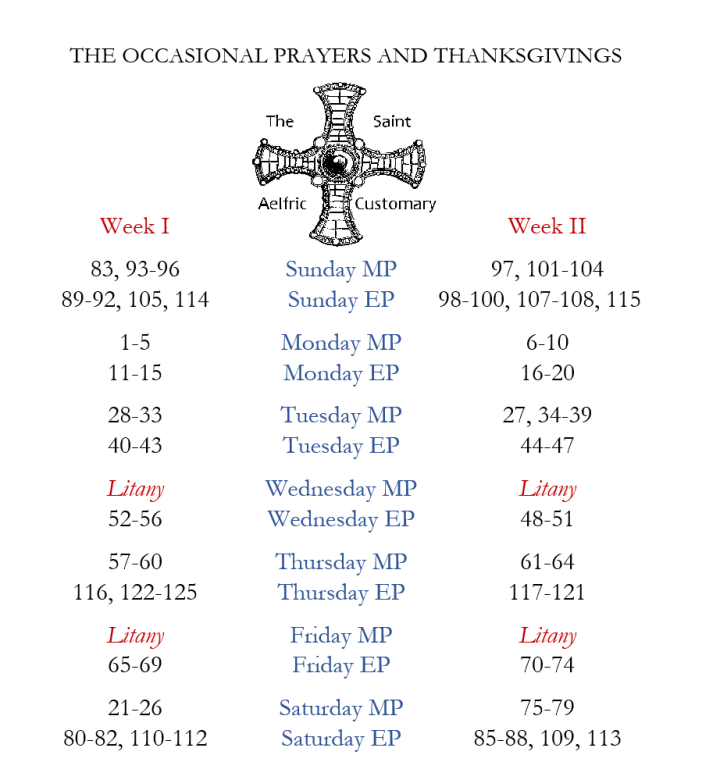
An Order for using the Occasional Prayers & Thanksgivings in the 2019 Prayer Book

The Daily Office of Morning and Evening Prayer have always provided for the allowance of additional prayers at the end.  The classic prayer books, in fact, provided a group of Additional Prayers immediately after (as well as within) the main text of the Daily Offices.  Modern books, like the 1979 and the 2019, have a much larger corpus of additional prayers located near the back of the book like an appendix.  This gives us the mixed blessing of having more quality prayers to draw from but the greater physical distance within the book such that they might more easily be ignored or forgotten.

To help remedy this, I’ve made available here in the past some orders for using the Occasional Prayers and Thanksgivings in the Daily Office.  Now the Saint Aelfric Customary is putting forth a third (and I think, final) version.


Occasional p+t

NOTE: All you have to do is download this picture, print it out, and use it as a bookmark in your prayer book!  If you want a document or spreadsheet with this information, please request one in the comments.

The previous versions were more jumpy, attempting to corral certain prayer topics to certain days.  After a few months of use I decided they could be streamlined to be easier to follow.  So here we are!  Let’s walk through how this works.

Two-Week Rotation

Because there are 125 prayers and thanksgivings, they are split into a two-week rotation so that an average of five are appointed for each Office.  You could combine them into a one-week cycle if you’ve got the attention span for it, I suppose.  Two prayers are omitted: #84 because it’s for meal times, not an office, and #106 because it’s better for the service of Antecommunion.

Wednesday and Friday Mornings are omitted because that is when the Litany is traditionally appointed to be said.  I assume that if you’re sufficiently “advanced” in your use of the Office to be making use of these prayers, you can (or should) be already praying the Litany.  Sunday morning is also an appointed time for the Litany, but in the scheme of this Customary, the Litany will actually be treated separately, between Morning Prayer and Holy Communion, and thus there is room for these prayers in Morning Prayer.

Monday

The twenty prayers for the Church are spread through the Offices on this day.

Tuesday

The prayers for the nation and most of the prayers for society are covered on Tuesday.  The morning in Week II has an inordinately large number of prayers appointed because there are included prayers specifically for Canada and for the USA, with the assumption that the individual will skip the national prayers that don’t apply.  #21-26, for Creation, were skipped and saved for Saturday.  #27 and #28 were separated into different groupings of prayer because they are very similar and would be a bit redundant prayed back to back.

Wednesday

The rest of the prayers for society are covered here, and the section of prayers for “those in need” is begun.

Thursday

The rest of the prayers for those in need are finished on Thursday mornings.  The evenings are for the thanksgivings, in keeping with the eucharistic theme accorded to Thursdays in some strands of liturgical tradition.

Friday

The evenings see the Family and Personal Life section begun.

Saturday

Week I holds the prayers for Creation, as Saturday is often a day off from work, and thus a day on which many people are likely to enjoy the outdoors.  More prayers for family and personal life are appointed here, as well as the beginning of the Personal Devotion section.  Most of the prayers for “Death, the Departed, and the Communion of Saints” also land on Saturday evening, matching the Good Friday to Holy Saturday to Easter Sunday pattern of spirituality.

Sunday

The last of the “Personal Devotion” section is covered on Sundays, as well as the last two “Death, the Departed, and the Communion Saints” section.  Most prominently, though, Sunday is when the “At Times of Prayer and Worship” section is used, splitting the preparatory prayers into the morning and the “after hours” prayers into the evening.


As a result, if you hold public Morning or Evening Prayer on Sundays, the occasional prayers here appointed will be particularly apt for the congregation’s interaction with the liturgy.

If you hold a public Office on a weekday, however, a pattern like this may not be beneficial.  The idea of this order is to provide the person(s) praying with the full scope of the Occasional Prayers’ contents, so if someone only experiences one weekday “slot”, then they’ll only experience one theme or category of occasional prayers.  In such a situation, it would be prudent to select occasional prayers from various groupings as is appropriate for the occasion, or as befits the lessons of the day.

Learn how to pray the Daily Office

The Daily Offices of Morning and Evening Prayer (sometimes called Matins and Vespers) are staples of Anglican spirituality.  For most of the past five centuries, the typical Anglican was intimately familiar with these services – weekly Sunday Communion only having been achieved in the early-to-mid 20th century.  But now the tables have turned; comparatively few Anglicans are familiar with our Daily Offices, and know only the Communion Office.

There are many guides on the internet already explaining how to use the Prayer Book, how to find your way through the Daily Office, how to piece together the service, and give advice in getting use to it.  So I had no desire to replicate those resources.

Rather, I’ve put together a guide to learning the Daily Office from a different angle, for a different need: Sometimes the Prayer Book offices are too much for a newcomer to deal with.  Instead of diving all-in, some people need a gradual piece-by-piece introduction to this great tradition of prayer and devotion.  And, by approaching the Offices in this way, one learns the “heart” or “core” of the Office naturally, slowly growing and enfleshing it from the barest of ingredients to the fullness of prayer of beauty.

We’ve also gone through the twelve-step guide on this blog, but now I present it to you in a single document: Learn to pray the Office

Please share this with your friends, your parishioners, or anyone interested in learning to pray in a more robust, traditional, or biblically-grounded manner!