Ascensiontide Old & New

The ten days between the Ascension of Christ and the Day of Pentecost form a mini-season or sub-season called Ascensiontide.  There is debate between modern and traditionalist views of the calendar over just how independent this season is from Eastertide, and you can read about that here.  What one finds upon closer inspection, however, is that whether Ascensiontide should be considered part of Easter or a season in its own right, it is very strongly linked, liturgically, both to Easter and to Pentecost, marking the transition from one to the other, not unlike the transitional Pre-Lent Sundays of the old calendar.

At a length of ten calendar days, Ascensiontide has two “days” in the Prayer Book: Ascension Day (the Thursday in the 6th week of Easter) and the Sunday after Ascension Day.

Ascension Day

This day has not substantially changed from the traditional calendar to the 2019 Prayer Book.  The Collect is the same, and the two original lessons are among the 2019 options: Acts 1:1-14 and Mark 16:14-20 both speak of the ascension of Jesus and his last words to his disciples.  The 2019 Prayer Book adds Psalm 47 (or 110:1-5) and Ephesians 1:15-23, and also supplies Luke 24:44-53 as an alternative to the traditional Gospel from Mark.

For the Daily Office, the 1662 Prayer Book identified Ascension Day as one of the six days of the year that merited a unique set of Psalms: 8, 15, and 21 at Morning Prayer, and 24, 47, and 108 at Evening Prayer.  Psalm 47 is perhaps the most obvious ascension-related Psalm (“God has gone up with a triumphant shout!“) and thus is offered as the psalm for the Communion service in the modern lectionary.

Ascension Sunday

In both traditional and modern lectionaries, the Sunday after the Ascension shows signs of influence from both Eastertide and Ascension Day.

The Collect (same in old and 2019 prayer books) is thematically built on the same foundation as that for Ascension Day, but adds the element of looking ahead to Pentecost: “Do not leave us comfortless, but send us your Holy Spirit” – a reference to the traditional Gospel for the day of Pentecost.  It’s lovely: we pray this prayer on one Sunday, as if with the original apostles-in-waiting, and then we hear it answered the following Sunday as the apostles experienced it too.

The lessons are rather more different.  The course of Epistle and Gospel lessons in the traditional Eastertide are continued on this day, ending in 1 Peter 4 and John 15.  The modern lessons also complete the modern Eastertide sequence: a different part of 1 Peter 4 or the end of 1 John 5 or Revelation 22; and a Gospel from John 17, which appropriately brings us Jesus’ prayer for Christian unity in preparation for the day of Pentecost.  Readings from the book of Acts continues as an Old Testament replacement option on this day: on two years of the cycle looking appropriately at Acts 1, and in Year C reading from chapter 16 to finish off the Eastertide sequence instead of addressing Ascensiontide.

Ascensiontide as a transition

Whether you choose to consider this period of time as the final of Easter’s 50 days or a distinct ten day season of their own, tradition both old and new connects this time fluidly to its predecessor (Easter) and its successor (Pentecost).  We move from the resurrection to the resurrection life to the ascension of Christ with our human nature to Jesus’parting blessing to us in the descent of the Holy Spirit, and this season marks the turning of the page between Easter and Pentecost.

As we observed the other day, this is a period of time that is ripe for quiet inward-focused prayer.  If your or your church doesn’t normally pray the Great Litany, this is an excellent time to make use of it.  This is a good time for special prayer meetings or vigils, for rest and discernment before the Lord.  Like the Apostles who spent this time in preparation and prayer before the explosive activity of Pentecost, it is good for us to seize times such as this for the same, preparation and prayer, before starting the next round of outward-focused activity that we normally like to think about at Pentecost.  This often lines up with the end of the academic school year, and may easily match the transition period for students between school work and summer jobs.  It may also be a good time to look inward at our Sunday School or Christian Education teachers and thank them for their labors and grant them some rest.

Learning from the Liturgy: Ascension Day

Happy Ascension Day, everyone!
Here’s what I wrote for my congregation last year about this holy day:

Fr. Brench's avatarLeorningcnihtes boc

Ascension Day is perhaps the most under-celebrated important holiday in the calendar.  Representing one of the lines of the Creeds (“he ascended into heaven and is seated at the right hand of the Father”), this holiday marks a significant turning point in the Gospel story and sets the stage for how the Christian’s relationship with God is defined.  We often think of it as an awkward point between the Resurrection of Jesus (Easter) and the Descent of the Holy Spirit (Pentecost), but even in itself the Ascension is a major event.  What I’m setting out to do in this post is draw from the various Scriptural and traditional resources of the Church’s liturgy to explore some of the basic teachings and implications of this great and underappreciated day in the year.

The Event of the Ascension

Christ’s ascension is described in three books: Mark, Luke, and Acts.

In Mark’s Gospel…

View original post 2,092 more words

Eastertide: 40 days or 50?

The length of the Easter season is one of those subjects that can start internet fights.  Some say it’s 50 days long, beginning on Easter Day and ending on the Day of Pentecost.  Others retort that it’s 40 days, beginning on Easter Day and ending with the Ascension.  Meanwhile, perhaps the majority of church-goers look on in bewilderment or bemusement.  Why does it matter?  What’s the big deal?  Surely there are bigger fish to fry.

Let’s explore this debate in chronological order, so we can see how this disagreement came about, and why it matters to those who argue about it.

The Classical Prayer-Book Tradition

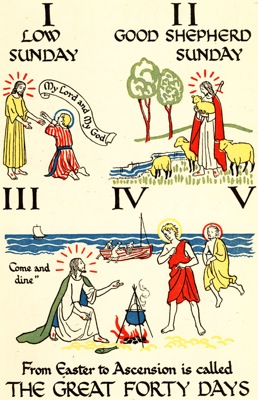
The changing of the seasons were not marked out quite so overtly in the old prayers books as they are in the new.  The Sunday Collects and Lessons were not typically marked out into season-based sections like they are in the 2019 book, so you had to rely upon the specific “name” of each Sunday, and the short list of Proper Prefaces early in the Communion prayers.  In both cases, Easter and Ascension are treated separately.  This sets out a demarcation: Eastertide ends when Ascension Day kicks in.  Thus we get images like this from Enid Chadwick’s beloved bookMy Book of the Church’s Year:

19

Note, “THE GREAT FORTY DAYS”… that’s Eastertide.

The emphasis this takes is on the gospel narrative of events: Jesus was raised from the dead, met with his disciples at various times, and ascended to the right hand of the Father 40 days later.  This also lines up the calendar with the Apostles’ Creed: “the third day he rose again; he ascended into heaven, and is seated at the right hand…”  In the ascension we see Jesus as Priest, making intercession for us, and Jesus as King, seated at the right hand of God.  It is a festal season, and closely related to Easter, but it takes on a theological emphasis that is distinct from Easter before it and Pentecost after it.

The Modern (or modernist?) Prayer-Book Tradition

The 1979 Prayer Book (and probably others like it) changed this up quite dramatically.  First of all, the name “Sunday after the Ascension” was changed to “the 7th Sunday of Easter”.  Ascensiontide still got its own Proper Preface, but a new feature of the liturgy – the opening acclamation – was provided for various seasons of the year, and the Easter acclamation (Alleluia, Christ is risen / The Lord is risen indeed, alleluia!) was appointed for the entire stretch from Easter to Pentecost.  Ascension Day and Ascensiontide were not removed from the calendar, but they were rolled into the Easter season, turning “the great forty days” into “the great fifty days.”

Now, there is a biblical precedent for this perspective: two of the primary Old Testament feasts (Passover and Tabernacles) are fifty days apart, and became the Christian Easter and Pentecost.  By emphasizing the fifty days, instead of the forty plus ten, the new calendar system highlights the Old Testament precedent for the Gospel.

The 2019 Prayer-Book Tradition

What we receive in the 2019 Prayer Book is something of a mixed bag when it comes to the length of Easter.  As usual, Ascension still has its own Preface.  Like the 1979 book, Ascensiontide has no acclamation of its own; it still gets the Easter call-and-response.  But the name of the Sunday in this season is back to “The Sunday after Ascension,” so there’s room for debate if it counts as Easter or not.  Room for debate, that is, until you read the calendar rubrics on page 689.  When discussing days of discipline, denial, and special prayer, it says:

The weekdays of Lent and every Friday of the year (outside the 12 Days of Christmas and the 50 days of Eastertide) are encouraged as days of fasting. Ember Days and Rogation Days may also be kept in this way.

This rather seals the deal: the 2019 Prayer Book sets forth a 50-day Eastertide.

HOWEVER,

Unlike the 1979 Prayer Book, there is a nuance, or a balance: the 7th Sunday of Easter is not “the seventh Sunday of Easter,” but the “Sunday after the Ascension.”  So although the “season” is still “Eastertide” in one sense, it has entered into a different phase: new Sunday nomenclature, new Proper Preface.

So if you’re a “50 days of Easter” kind of person, pay this balance (not to mention our historical tradition!) more careful attention.  We are apparently encouraged to use the 50-day language, according to our calendar rubrics.  But the Sunday after the Ascension is informed more by Ascension Day than by Easter Day.  Whether you call that ten day period the last part of Eastertide or Ascensiontide, be sure to afford it the distinct theological and Gospel-narrative emphasis it was meant to communicate.  On that Sunday, tell people “Christ is risen!” is no longer just about his resurrection, but about his rising bodily into heaven.  Make sure the Easter songs and hymns give way to songs and hymns about the ascension of Christ.  Crown him with many crowns and Hail the day that sees him rise are perhaps the two most famous examples.

If you want to read more about Ascension Day and its mini-season (or subset of Easter, if you insist), click here!  In my experience this is one of the most under-rated parts of the church year, and it has much to offer.

Happy Saint Mark’s Day!

If you’ve got a “Churchman’s Ordo Calendar” or other such liturgical resource hanging on your wall, you may see today is Saint Mark’s Day [transferred].  This may be puzzling to some people – why is it transferred, and what does that mean?

A certain calibre of holy day can be transferred in the event that it conflicts with another, higher ranking, holy day.  When you think of a “day” in liturgical time, imagine there is only room for one Communion service.  In the event that you get double-booked, a judgment call has to be made: which holy day will you celebrate, and will the other one just get skipped for the year, or get transferred to the next available day?

In the Prayer Book tradition, taking its cue from Western Catholic practice in general, we have Major Feast Days (“red-letter days” as provided in the Prayer Book) and we have commemorations (“black-letter days” listed in the Prayer Book calendar).  Commemorations are of a low rank; they get skipped if they coincide with a Sunday or other holy day.  The Major Feast Days, however, are generally required in the Prayer Book tradition, and therefore they will either replace the Sunday they land on (depending upon the season) or they will get bumped back to the next available date.

Saint Mark’s Day is supposed to be April 25th.  But this year, April 25th fell within Easter Week, wherein the Prayer Book tradition does not allow any non-Easter intrusions.  A few days ago I mistakenly stated that the old Prayer Books allowed holy days like this to be celebrated later in Easter Week, but closer inspection of the old calendar rules revealed that, even though Easter Week only provides two sets of Collects and Lessons, the whole week is still off-limits for other major feast days.  So whether you’re using an old or new prayer book, Saint Mark’s Day is still transferred to today.

If you take a look at both the major feast days and the commemorations throughout the year, you’ll notice that there’s a convenient gap through much of March and April where they get pretty sparse.  The average month has three major feast days in it, but March has just two, and April only one!  This is because of the overriding presence of Holy Week and Easter Week – every year, somewhere in this time of year, those two weeks in a row will blot out all the commemorations in its path, and cause any of those major feast days to be transferred.  So, the fewer saints days we schedule in these months, the less we have to deal with this situation.  Pretty smart, huh? 😉

The Logic of Eastertide (Modern)

A couple days ago we looked at the traditional calendar’s treatment of this season; now let’s look at how it has developed through the liturgical reforms of the 20th century into the lectionary of the 2019 BCP that we have today.

The same general contour still exists: the initial emphasis is on the resurrection and Christ’s post-resurrection appearances, then comes “Good Shepherd Sunday”, and the remaining Sundays deal with teachings about the Holy Spirit, transitioning toward Ascension and Pentecost.  The modern calendar, however, has one extra Sunday of post-resurrection appearance and one less Sunday of Holy Spirit teaching… so in a way modern Eastertide is more “eastery” if you like.

And, to repeat the warning from last time, the modern naming system is “The #th Sunday of Easter” starting with Easter Day, and the traditional system is “The #th Sunday after Easter”, starting with the modern Easter II.  So, here goes…

Easter Vigil & Day

There are now four sets of readings available for the course of Easter Day.  The Easter Vigil has up to twelve Old Testament readings, followed by the baptismal discourse in Romans 6 and Matthew 28:1-10.  The Easter Sunrise service is essentially the same, though allows only a choice of one of the vigil’s OT readings.  The Principle Eucharist has the shortened traditional Epistle (Colossians 3:1-4) with a reading from Acts 10 as an alternative, and the resurrection Gospel is from Matthew, Mark, or Luke, depending upon the year.  Because Matthew’s resurrection narrative is used at the Vigil and Sunrise service, John’s narrative is also permitted in Year A so Matthew’s gospel doesn’t have to get re-used so many times.  There is then an Easter Evening option featuring the Road to Emmaus story from Luke 24 (which is also covered during Easter Week).

The 2nd Sunday of Easter

As in the traditional calendar, the Sunday after Easter Day deals with the disciples gathered, being visited by Jesus, and receiving the Holy Spirit.  It is lengthened, however, to include the following week’s meal when Thomas is present, satisfies his unbelief, and makes his confession of faith.  The Epistle readings now diverge for the rest of the season: outlining 1 Peter in Year A, 1 John in Year B, and Revelation in Year C.  And, although the Old Testament lessons continue their usual function of matching with the Gospel lesson, there is also an alternative track for reading from the book of Acts.  Both of these patterns conclude with the Sunday after the Ascension.

The 3rd Sunday of Easter

Here a further post-resurrection appearance is dealt with: Luke 24’s road to Emmaus (in Year A), Luke 24’s gathering of the eleven (presumably minus Thomas) (Year B), or John 21’s miraculous catch of fish (Year C).

The 4th Sunday of Easter

A week late, compared to the traditional pattern, this is the modern calendar’s Good Shepherd Sunday.  The traditional Gospel was from John 10, and so all three years of the modern calendar include different excerpts from the same chapter, catching different parts of Jesus’ Good Shepherd Discourse.  The traditional Epistle (from 1 Peter 2) is retained in Year A, when that book is the recurring epistle for the season, but in Years B & C the progressive readings from 1 John and Revelation manage to chime in the Good Shepherd theme just a little.

The 5th & 6th Sundays of Easter

Traditionally the last three Sundays picked up non-sequential excerpts from John 16.  Now that there’s a three-year cycle of lessons, even more excerpts from the Upper Room Discourse can be covered.  The 5th Sunday now has John 14:1-14 (Year A) or 14:15-21 (Year B) or 13:31-35 (Year C); the 6th Sunday now has 15:1-11 (Year A) or 15:9-17 (Year B) or 14:21-29 (Year C).

In both the old and new traditions, this progression of Gospel readings continues into the next mini-season, Ascensiontide.

So, although the general content of the modern Easter season is similar to the traditional history behind it, the arrangement is rather different.  The modern lectionary favors sequential (or at least in-order) Bible reading and has largely abandoned the topical approach to dealing with Eastertide.  One of the major indicators that the underlying logic and purpose has shifted, despite keeping many of the readings within the season, is the fact that the Collects of the Day are mostly changed from the old books to the new.

The Logic of Eastertide (Traditional)

When looking at the Easter season in the old and new calendars, the most annoying challenge right off the bat is the fact the numbering system changed.  The modern system is “The #th Sunday in Easter” starting with Easter Day, and the traditional system is “The #th Sunday after Easter”, starting with the modern Easter II.  So if you just use numerical shorthands, the old and new calendars will be off by one.  I suppose the modern system was making a point of identifying Eastertide as a single unit, rather than a succession of days following the high point of Easter day itself.

Anyway, the traditional calendar with its one-year lectionary had a certain flow to it which is relatively well imitated in the modern calendar.  We’ll get to the modern one in a couple days; today we’re just looking at traditional Eastertide.

Easter Day

The resurrection of Jesus is clearly set forth, complete with multiple witnesses in the Gospel reading (John 20:1-10), today’s celebration aptly applies the resurrection to all God’s people. The Epistle (Colossians 3:1-11) chimes in with the reminder that we have died with Christ and been raised with Christ, by virtue of our union with him in Baptism. The Epistle then goes on to direct us toward heavenly Christ-like lifestyles and attitudes, which is also the prayer of the Collect.

The Octave Day – The First Sunday after Easter Day

The focus remains very close to Easter Day itself: examining the benefits of the resurrection of Christ for us. And they are many: the Collect notes the dual doctrines of justification and sanctification that flow from his death and resurrection, the Gospel (John 20:19-23) speaks of the gift of the Holy Spirit, and the Epistle (1 John 5:4-12) points us knowing this testimony from God.

The Second Sunday after Easter Day

Today the Easter focus on the resurrection is expanded to include how Jesus was also an example for us to follow. Specifically, we follow him as sheep follow their shepherd. The Collect and lessons each speak of God as our shepherd, gathering us, keeping us safe, and holding us close to him. Thus today is commonly nicknamed “Good Shepherd Sunday.” But it is the Epistle (1 Peter 2:19-25)) and the Collect that turns these beautiful descriptions into instructions: we are to follow and imitate Jesus, even if it means suffering for doing nothing wrong. Knowing of his resurrection gives us hope for ours, too.

The Third Sunday after Easter Day

This Sunday we are reminded of a consistent biblical pattern: suffering and pain is temporary, while joy is eternal. In the Gospel (John 16:16-22), Jesus pointed this out to his disciples concerning his approaching death and resurrection.  The Collect and Epistle (1 Peter 2:11-17), then, take this theme and apply it very practically: because we know that the pain and suffering of life this world is temporary and the joy of God’s kingdom is eternal, we ought to live in such a way that is consistent with that eternal life.

The Fourth Sunday after Easter Day

This Sunday, we are reminded that the resurrection life in Christ is one that is patterned after and ordered by God. The Epistle reading (James 1:17-21) describes this by asserting that we must listen to the word of God, because it saves us and renews us. Additionally, it mentions gifts from above, and the Gospel reading (John 16:5-15) gives an example of this: the Holy Spirit who leads us into all God’s truth. The Collect, finally, takes these themes of listening, and gifts, and disciplines them into one beautiful and coherent prayer.

The Fifth Sunday after Easter Day (Rogation Sunday)

For the past couple weeks, hints of a change of focus have arisen as the Gospel readings have focused more and more on the departing of Jesus and the arrival of the Holy Spirit.  Now, with the Ascension Day approaching, this focus begins to take center stage as all today’s propers deal with the idea of gifts and provision from God.  The Gospel (John 16:23-33) speaks of the coming gift of the Holy Spirit.  What the Epistle reading (James 1:22-27) does, and subsequently the Collect, is turn towards us and remind us of the responsibility that comes with such wonderful gifts: thinking and living according to the will and life of the Spirit given to us.

When you look at the course of the season, there are three major contours that can be traced.

  1. The Epistles move from the exalted “theological” writings of 1 John to the more balanced writings of 1 Peter to the bluntly practical writings of James.  This is something like descending a staircase from the lofty heights of Easter toward the more tangible earthly mission that will be given in Ascensiontide and Pentecost.
  2. The Gospel lessons are all from John.  In general, his gospel book tends to be treated as the “festal” book, containing the exalted texts for the high points of the Christian year such as this.
  3. Overall, these Sundays move from dealing with the resurrection of Jesus into his Upper Room Discourse where he speaks extensively of the Holy Spirit.  The Easter resurrection focus this transitions toward the topics of Pentecost.

One oddity resulting from these seasonal progressions is the fact that there are several readings from week to week that take you out of sequence, even backwards, through single passages.  This happens with 1 Peter 2 for two Sundays, and with John 16 in the last three Sundays.  Again it should be pointed out that in the classical prayer book tradition, continuous readings through Scripture was the function of the daily office lectionary; the Sunday Communion lectionary dealt with Gospel topics on a seasonal basis.

Anyway, that is the traditional set of Sundays in the Easter season.  If you’re more familiar with the revised common lectionary you will probably still recognize some of this shape.  But we’ll get into that, and the comparison between them, later this week.

Easter Week, Old & New

It’s a little unfair to run a comparison between Easter Week in the traditional Prayer Books and the modern ones; the major difference is that before the great revision of the 1970’s Easter Week only contained two special weekdays – Monday and Tuesday – while the new books have special a Communion service for each day through Saturday.

I can’t help but wonder how many Anglican (or Episcopalian) churches actually take advantage of all six weekdays between the first two Sundays of Eastertide.  After all, the prevailing opinion after the rigors of Holy Week and Easter Day seems to be along these lines:

Facebook-Proposed-addition-to-the-Book-of-c071c1[1]
this makes the rounds on the internet every year; this copy is from https://me.me/i/mondays-facebook-proposed-addition-to-the-book-of-146408
Whateverso, whether it’s two days or six, we have a Prayer-Book-authorized tradition of continued celebration after Easter Day.

The traditional Easter Monday’s Collect is as follows:

O God, whose blessed Son did manifest himself to his disciplines in the breaking of bread; Open, we pray thee, the eyes of our faith, that we may behold thee in all thy works; through the same thy Son Jesus Christ our Lord.  Amen.

It was paired with a reading from Acts 10:34-43 and Luke 24:13-35.  In the modern calendar the same Collect and Gospel show up on Easter Thursday, which I assume is due to its eucharistic theme – providing an echo of Maundy Thursday a week later.  Instead of Acts 10, however, Acts 3:11-26 is paired with with the Gospel & Collect, replacing Saint Peter’s teaching to Cornelius with his sermon about the fulfillment of the prophets in Jesus Christ, which still matches up with Jesus’ teaching in the Gospel reading – perhaps even more succinctly.

The traditional Easter Tuesday has the same Collect as the modern Easter Monday – that we who celebrate the Paschal feast may be found worthy to attain to everlasting joys.  The readings are completely different, however.  The traditional appointment is Acts 13:26-41 and Luke 24:36-48 (Paul’s preaching and Jesus’ second appearance, to all the eleven on Easter evening).

The logic of the traditional calendar is an interesting mix of continual build-up and topical array.  The Gospel readings are both from Luke 24, following the course of the afternoon and evening of the first Easter Day.  The readings from Acts chime in with apostolic preaching that spells out the singularity of salvation in Christ.

The modern Easter Week, however, looks like this:

Monday: Acts  2:14,22-32 (Peter’s first sermon of OT background for Christ)
Matthew 28:9-15 (Jesus sends the women to the disciples, soldiers are given hush money)

Tuesday: Acts 2:14,36-41 (Peter’s first sermon, calling for repentance and baptism)
John 20:11-18 (Jesus speaks with Mary Magdalene in the garden)

Wednesday: Acts 3:1-10 (Peter & John heal a lame beggar)
Luke 24:13-35 (Jesus with two disciplines on the road to Emmaus)

Thursday: Acts 3:11-26 (Peter’s second sermon, identifying Jesus as the greatest prophet)
Luke 24:36-49 (Jesus with the disciples on that first evening)

Friday: 1 Peter 1:3-9 (Peter’s greeting of joy in Christ despite trials)
John 21:1-14 (Jesus visits seven disciples going fishing)

Saturday: Acts 4:1-22 (Peter and John defend their faith in Jesus before a Jewish council)
Mark 16:9-20 (St. Mark’s quick summary of post-resurrection events)

The emphasis, for both readings, is on continuity of story.  The Gospel readings follow closely (though not quite exhaustively) the narrative of the rest of Jesus’ resurrection day, and then moves on through most of his post-resurrection appearances.  A couple major omissions can be identified, such as the story of Thomas’ denial, but those are generally covered on the following two Sundays (as well as a bit of overlap with the Gospels read in this week).  The first lesson focuses on the beginning of Acts, especially the earliest examples of apostolic preaching.  There is a tradition that the modern lectionary takes very seriously of reading the book of Acts through the Easter season.  I cannot account for the reason behind this, exactly (why not start this at Pentecost, for example?) but it is a prominent feature of the Eastertide lectionary entries.

A cynic might accuse the modern Easter Week of destroying the Prayer Book tradition’s take on Easter Monday and Tuesday.  A more charitable take on the modern form, however, would be that the traditional approach of tracing the post-resurrection stories of Jesus and the apostolic preaching in Acts has simply been expanded from two days to six.  The topic coherence is lessened (especially the old Eucharistic focus on Easter Monday), but the scriptural coverage is widened.

And, of course, a real question to ask before even trying to get into a debate between old and new here is who’s actually going to church during Easter week?  Does all our planning go into Holy Week such that Easter week days are neglected?  Are we so burned out by the end of the Easter Vigil that we don’t have any energy left to keep up the celebration of the resurrection for another two or six days?  Interesting things to think about.

Book Review: Common Worship Times and Seasons

Welcome to Saturday Book Review time!  On most of the Saturdays this year we’re looking at a liturgy-related book noting (as applicable) its accessibility, devotional usefulness, and reference value.  Or, how easy it is to read, the prayer life it engenders, and how much it can teach you.

The last official volume of Common Worship on my shelf is Times and Seasons.  It goes through the entire [modern] calendar of the Church of England highlighting special holy days and providing both occasional and seasonal material for all sorts of things – Opening Acclamations, calls to confession, prayers of confessions, absolutions, Canticles, Prayers of the People, Offertory Sentences, Eucharistic Prefaces, and various other special liturgical bits and bobs that can be used to spice up the Communion service for a special occasion.  In terms of historic Prayer Book tradition, none of this is necessary, and is largely unprecedented.  But this is what late 20th-century liturgical revolution was all about: exploring new ways to diversify the worship experience by emphasizing different occasions and seasons in certain ways to make them stand out from each other more noticeably.  And what you find in this volume, as is the case with most of the Common Worship materials, is a mix of pre-Reformation tradition, modern re-invention, and just plain innovation.

common worship

In terms of authorization, the extended rubrics of the 2019 Prayer Book indicate that the Prayers of the People may be rewritten, provided they cover certain specified items.  Thus, various Prayers from Common Worship: Times and Seasons could actually find a home in our ACNA liturgy.  The same applies to the Blessing at the end of the Communion Prayers – the rubrics permit alternate blessings without restriction.

However, unlike most of the supplementary volumes of Common WorshipTimes and Seasons provides for the liturgy of several “irregular” worship services (that is, neither the Daily Office nor the Holy Communion) such as Lessons and Carols for Advent or Christmas.  Indeed, this book’s greatest use outside of the Church of England is probably its extended treatment of various special-occasion services like those, or Remembrance Day (Nov. 11th) or Stations of the Cross or, the Maundy Thursday Chrism Mass, or the Easter Vigil.  Its insights into the seasons and festivals of the liturgical and agricultural years, too, make for decent reading for anyone interested in how the Church “sanctifies time” through her liturgy.  It is certainly a mix of old and new, so if you’re a traditionalist about liturgy there will be many opportunities for ire herein.

The ratings in short:

Accessibility: 4/5
In terms of use in the liturgy, this book cannot stand alone; it is a supplement to the primary volume of Common Worship.  However, for what it contains, it is very logically arranged and easy to navigate.  It is not overly technical or obscure, but explains its contents thoroughly and succinctly.

Devotional Usefulness: 2/5
As with much of the Common Worship series, we have little practical use for the contents of this book.  But the various prayers and devotions do highlight well the different themes of the liturgical seasons, and can greatly enrich one’s private devotions, and, to a limited extent, find a place in our actual liturgies.

Reference Value: 3/5
The liturgical calendar of the Church of England is set out rather differently than ours, but the basics are similar enough that a study through this book’s contents can help one understand not only how our respective calendar traditions diverged from the historic Prayer Book in different ways, but also provide us insight into the logic of liturgical calendars in general.  I could see this book being fruitfully referenced in the context of catechesis, or a small group study, helping people learn about and explore the Church Calendar.

In all, I think this may be the most useful and interesting volume of Common Worship that I’ve got.

Laetare Sunday coming up

The Fourth Sunday in Lent is known by two nicknames: Laetare Sunday and Mothering Sunday.

The first name, Laetare, comes from the Introit (the opening hymn, if you like) in Latin.

Lætare Jerusalem: et conventum facite omnes qui diligitis eam: gaudete cum lætitia, qui in tristitia fuistis: ut exsultetis, et satiemini ab uberibus consolationis vestræ.

Rejoice with Jerusalem, and be glad for her, all you who love her; rejoice with her in joy, all you who mourn over her; that you may suck and be satisfied with her consoling breasts.

These words are from Isaiah 66:10-11a, and serve as an antiphon to Psalm 122, Laetatus sum (“I was glad”).  This joy-filled antiphon, paired with a joy-filled Psalm, start off the 4th Sunday in Lent with a noticeably cheerful mood compared to the rest of the season.  This is, roughly, the midpoint of Lent, and thus serves as a sort of breather from the rigors of the season where the congregation can take their noses off the grindstone, so to speak, lift up their heads, and take a good look at the joy of Easter fast approaching.

This is traditionally matched with slightly “lightened up” vestments from violet to rose, and the historic Gospel is the feeding of the 5,000, adding to the theme of God strengthening us with provisions along the long hard road of the great penitential season.

The modern lectionary’s take on this Sunday, however, is not quite as noteworthy, and undercuts (or at least diffuses) the impact of “Laetare Sunday” compared to the historic lectionary.  It almost doesn’t make sense to retain the rose vestments for this day anymore, and indeed a great many churches, both Roman and Anglican, have not.

The other nickname for this Sunday is Mothering Sunday.  This largely stems from a tradition of masters giving their household servants this day off from their duties so they can go visit their own mothers.  I couldn’t say where this particular custom originates, though it’s probably not a coincidence that the traditional Epistle of this day begins in Galatians 4:21, discussing the allegory of Hagar the slave woman and Sarah the free woman.

Other traditions associated with this day also add to the enhanced cheerfulness of the occasion: the organ, normally silenced during Lent in pre-Reformation practice, was permitted to be used on this Sunday.  Flowers might be placed on the altar.  And weddings, traditionally disallowed during the penitential season of Lent, could be held on this one day of the season.

Given that many of those old Lenten traditions are not in place in many of our churches today, there aren’t many ways that we can “lighten up” the 4th Sunday of the season anymore.  Plus, given that our Lenten disciplines and modern lectionary and calendar are also a great less rigorous than the days of old, there is far less cause or need for such a day as this.  But sometimes knowing about how things used to work can help us reshape our modern practice, and rediscover some of the discipline and mentality that were nearly lost in the 20th century.

The Logic of Lent

The season of Lent is one of the more topically scripted seasons of the year, due in part to its relative brevity and narrow focus.  As is often the case, the traditional calendar is clearer than the modern calendar in terms of the ebb and flow of the season, the modern calendar losing some of its coherence due to the 3-year cycle of readings.  Nevertheless, a basic contour can still be discerned.  Rather than looking at traditional and modern Lent separately as we did for Epiphanytide, we can consider the tradition both old and new together.

The First Sunday of Lent is about the temptation of Jesus.  This has always been the case, and has not changed in modern practice.  Year B of the modern calendar almost drops the ball on this due to the fact that Mark’s Gospel only mentions the temptation in one sentence, rather than relating the whole story like Matthew and Luke.  The Collect, too, is the same in both traditions, seeking to imitate Christ’s abstinence that we may move towards holiness.  This is a strong “best foot forward” experience for the first Sunday of the season, making sure we’re on the right path with our spiritual disciplines that began on Ash Wednesday, with the right godly goals in mind.

The Second Sunday of Lent is a mixed bag in the modern lectionary.  The three years yield the Gospel sayings of Jesus ranging from “you must be born again,” “take up your cross and follow me”, and his lament over Jerusalem.  The latter two suggest a theme of looking ahead toward the liturgical culmination of Lent in the Passion of Jesus, while the former hangs back with another sort of starting place for the season.  Traditionally, the Gospel lesson was about the Syro-Phoenician (or Canaanite) Woman’s great faith over which Jesus marveled.  The Collect built off that, praying that God would keep us defended in body and soul because we’re defenseless (like that woman).  Although that Collect remains in our Prayer Book, it does not seem to have a strong connection with the modern Gospel readings.

The Third Sunday of Lent traditionally was very similar to the second, pairing another Collect asking God to look upon us and keep us defended with another healing story from the Gospel, this time an exorcism with subsequent teaching about demons.  Our Prayer Book supplies an expanded version of that Collect (first introduced in the 1979 Prayer Book) and pairs with the Gospel stories of the woman at the well, the cleansing the temple, and Jesus’ call to repent followed by the parable of the barren fig tree.  The traditional pairing makes this Sunday much like the previous, while the modern Collect and lessons lean more heavily on our “restless hearts” and “heartfelt desires” that need to be rightened, healed, or cleansed.

The Fourth Sunday of Lent is interesting in that one of the three years in the modern lectionary lines up with the traditional Gospel: the Feeding of the 5,000.  The traditional application of this, in the Collect, was a prayer for relief instead of punishment, marking this Sunday as the lighter and more hope-filled Sunday in the Lenten sequence, visually marked by the wearing of rose vestments instead of violet.  Our modern calendar, however, puts in a Collect about Jesus being our true bread from heaven, emphasizing the original Gospel story but setting it in a different context, especially in years A and C when the Gospel lesson is about the man born blind or the parable of the prodigal son.  In that light, there isn’t as much reason to retain the “Rose Sunday” tradition in the modern Lent.

The Fifth Sunday of Lent, nicknamed Passion Sunday, is an anticipation of Palm Sunday.  A noteworthy feature of the traditional lectionary was that major Sunday commemorations tended to have a follow-up Sunday to further explicate its meaning, but in the case of Palm Sunday, that follow-up had to be a preview Sunday instead.  Originally, the Gospel was Jesus’ speech about “before Abraham was, I am” – asserting his divinity.  This was paired with a lesson from Hebrews about his priestly sacrifice, so the theological import of his death on the Cross would be better appreciated on the following Sunday.  The modern calendar carries out a similar function using the Gospel stories of the resurrection of Lazarus, Jesus’ saying that “the son of man must be lifted up,” and the parable of the wicked tenants.  The traditional Collect was similar to those for the 2nd and 3rd Sundays, with a thematic similarity to the Collect for Good Friday, making it serve as another “preview” of the Passion to come.  The modern Collect, however, is a transfer from what was originally an Eastertide Collect, asking God to fix our hearts where true joy is to be found, despite our unruly wills and affections.  As far as I can see (thus far), this somewhat weakens the traditional Passion Sunday function.

The Sixth Sunday of Lent is usually called Palm Sunday, and it is the day we hear the great Passion Narrative as the Gospel.  The Collect is the same, old and new, drawing upon the Epistle (Philippians 2:5-11, also unchanged) to apply Christ’s passion to us; the only difference is that the historic lectionary sticks with Matthew’s Passion and the modern cycles between Matthew, Mark, and Luke.  We’ll look at this in greater detail when Holy Week draws nigh.