The Many Texts of Pentecost

Although less popularized than Christmas and Easter, the feast of Pentecost is liturgically just as exalted, and is equally rich with seemingly endless appropriate Scripture readings to aid our celebration, edification, and instruction. As I treated the feast of the Visitation a week and a half ago, I’d like to list and identify a number of scripture readings that you can pull up to enrich your experience of the great feast of Pentecost.

For, at least traditionally, Pentecost is not just one day. In ancient times it had a full octave – eight days of liturgical commemoration starting on Sunday (yesterday) and culminating on the following Sunday, which became known as Trinity Sunday. In the Prayer Book tradition this was simplified to Sunday, Monday, and Tuesday, with Trinity Sunday being the theologically-oriented follow-up. Sadly, the modern calendar and lectionary has done away even with that, leaving us with only a single day, officially. Of course, that doesn’t mean we can’t continue the celebration despite the lack of rubrical direction! So let’s get to it.

The Main Event

Without a doubt, the primary text for the Christian holiday of Pentecost is Acts 2:1-11. There we read of the descent of the Holy Spirit in power, enabling the disciples to preach the Gospel in many languages to the multi-national crowd that was in Jerusalem at the time. Thousands came to believe in Jesus within days! For all intents and purposes, the New Covenant Church completed its secret gestation and was born into this world.

Although it doesn’t normally show up in the traditional lectionaries, the rest of Acts 2 is good reading also. It continues the story, chronicling the preaching of Saint Peter and the largely-positive response of the crowds who heard.

One of the key texts that he cites in the course of his preaching, however, is one of the commonly-appointed readings for Pentecost: Joel 2:28-32. God promises through the ancient prophet that he will pour out his Spirit upon all flesh, all his people will receive him, and Peter is pointing out that the events of his day were seeing this promise fulfilled.

The Old Testament Foundation

Pentecost, of course, was already a major Jewish holiday. In fact, it was one of the top three holy days where the Law of Moses required all men to come to the appointed place (Jerusalem) to offer sacrifice. Thus we find another traditional scripture reading: Deuteronomy 16:9-12, which could be extended to cover verses 1-17 if you want to read about the other two top feasts of the Old Covenant sacred calendar. Here Pentecost is called the Feast of Weeks, so named because of its placement seven weeks after the Passover, which remains true in the New Covenant sacred calendar: Pentecost is seven weeks after Easter. And the name “Pentecost” by the way is just the Greek-language version of this, noting the fifty days distance from Easter/Passover.

The Gospel of our Lord Jesus

The Gospel texts appointed for the feast of Pentecost are, unusually, a little sparse, since its primary text is in Acts instead. The historic liturgical appointment for the Gospel lesson on the day of Pentecost is John 14:15-31a, and in the modern lectionaries it’s John 14:8-17, so there’s a bit of overlap there. Both readings include these words of Christ:

 “If you love me, you will keep my commandments.  And I will ask the Father, and he will give you another Helper, to be with you forever, even the Spirit of truth, whom the world cannot receive, because it neither sees him nor knows him. You know him, for he dwells with you and will be in you.”

The older emphasis went on to read the continuing explanation of the Holy Spirit as the Helper who is to come, while the new order is to read of the unity between the Father and the Son, making the giving and indwelling of the Spirit to be the climax of the lesson.

On the subsequent days, the Prayer Book appointed Gospels are John 3:16-21 and John 10:1-10. The former is the famous text about God loving the world in such a way that he sent his only-begotten Son to give life to the dead. The latter is the beginning of Jesus’ Good Shepherd Discourse, in which he says much the same thing: “If anyone enters by me, he will be saved…” While neither of these readings speak directly of the Holy Spirit, their placement on Pentecost Monday and Tuesday invites us to recognize the realities that Jesus describes as things that are brought about in us because of the Holy Spirit’s work within us.

There’s also John 16:1-15 which pops up in the 2019 Prayer Book. Like much of the Upper Room Discourse of chapters 14-17, it is likely to have been read already on one of the previous Sundays. Here, the Spirit is again named as the Helper, but also as the Spirit of Truth who teaches and guides God’s people.

Subsequent Echoes of Pentecost

The Day of Pentecost in the book of Acts is a pivotal event, and like most pivotal events it has echoes where things kind of repeat themselves in new settings. St. Luke was clever in the way he wrote this book, for while he started with the thoroughly Jewish Pentecost in Jerusalem, he then went on to write about a similar event taking place in Samaria in Acts 8:14-17 and again among Gentiles in Acts 10:34-48. Both of these (albeit in reverse order) are the traditionally appointed readings on Pentecost Monday and Tuesday, keeping the theme and our attentions firmly anchored on the powerful gift of the Holy Spirit.

Another interesting event takes place in Acts 18:24-19:7. While this is less flashy than the previous readings, it does bring the experience down to earth a bit more, and it provides some important teaching along the way. Here, we find two brief scenarios where devoted believers in Jesus have not heard about Christian Baptism, having known only the baptism of John (the Forerunner of Christ). These short encounters provide us with the further teaching that Christian Baptism is also our primary reception of the Holy Spirit into our lives, and that without it we are severely lacking.

As it happens, the New Testament’s most prolific author, Saint Paul, missed almost all these. For most of that time he was raging against this “new sect” and trying to put Christians to death. And so his experience of the giving and the ongoing ministry of the Holy Spirit was a little bit different. Rather than focusing on specific moments in history which are descriptive, he gives us some straight-forward teaching which is prescriptive.

Romans 8:12-39 is one standout example. Through the Spirit, he writes, we receive adoption as sons of God. Indeed, the Holy Spirit serves as a sort of midwife not only for us but for all of creation, groaning for new life. And only for the start of our Christian life, the Holy Spirit continues to be our Helper through every stage of growth, all the way to the promise of eternal glory. Therefore we can live with confidence, as “more than conquerors“, knowing that the presence of the Holy Spirit within us makes us inseparable from the Father and the Son.

For a longer discourse on the gifts and empowerment of the Holy Spirit, we can also turn to 1 Corinthians 12, 13, and 14. There we read of the unity of the Body of Christ, the Spirit giving both diversity of gifts and ministries as well as unity of purpose and mutual interdependence as one Church. And although he does list a number “gifts of the Spirit,” he goes on to highlight the most important of them is love. With that in mind, he is then able to go on to write more about some of the different gifts of the Spirit like tongues and prophecy, and then wrap it up with exhortations to conducting sound worship in which everything is intelligible, decent, and in order. The Spirit is not a spirit “of confusion, but of peace.”

Saint Peter also chimes in on the primacy of love as characteristic of a Spirit-filled Christian in another scripture lesson appointed for Pentecost Tuesday in one or two Prayer Books: 1 Peter 1:17-23. There he exhorts our love as a result of our new birth from “imperishable seed“, indicating also thereby that the gift of the Spirit is not just any new life, but eternal life.

Other Old Testament Types and Shadows

Besides the establishment of the original Jewish Pentecost in the books of the Law, and the prophecy of Joel, there are countless other Old Testament texts which point forward to the feast of Pentecost in some way. At this point we’ll finish our scriptural tour in canonical order, rather than tracing any more specific topics or themes.

Genesis 11:1-9 is the story of the Tower of Babel. Its connection to Pentecost is that, here, the manifestation of multiple languages was used to divide the people, whereas on the Day of Pentecost in Acts 2 the gift of tongues was used to unite people around the Gospel of Jesus Christ.

Numbers 11, or especially verses 24-30, tells the story of God sharing “the spirit upon Moses” with seventy other elders of Israel. When the Spirit comes upon them they prophecy, and Moses famously quips “Would that all the Lord’s people were prophets, that the Lord would put his Spirit on them!” This, too, has been fulfilled in the gift of Pentecost.

The story of the plague and the bronze serpent in Numbers 21:4-9 is normally associated with John 12 and the crucifixion of Christ. But it can also serve here as a backup to the preaching of St. Peter throughout the first half of the book of Acts. It also provides a handy illustration of living by faith: look up to Jesus and rely on God’s strength rather than grumbling about in your sins. Life in the Spirit changes us and redirects our attentions.

Psalm 48 is a celebration of the heavenly Jerusalem, or Zion, from where God reigns, and beneath which we wait, watch, and worship. The blowing of the East Wind and the loving-kindness of God in the midst of his Temple also can evoke pictures of the Holy Spirit’s power and presence among us his people.

Much of Psalm 68 is associated with the Ascension of Jesus, but specifically verses 1-10 also has a place among the Pentecost psalms because these verses focus a lot on the benefits that God’s people enjoy as a result of his “arising.” Pentecost is very much the promised result of Christ’s ascension, so it is sensible to continue some ascension-themed material to its fulfillment now.

Psalm 104 is a celebration of God’s work of creation. In particular, verses 24-35 summarize the psalm’s theme in identifying God’s wisdom in creating all creatures, and that it is the giving of his breath, or Spirit, that all things are made and given life.

Although a more generic psalm of praise, Psalm 116:1-4 and 12-16 show up in ancient liturgical appointments for Pentecost Tuesday. While not directly mentioning the Spirit of God, it does direct us to respond to his grace, his deliverance, all his benefits, with vows and praises and sacrifices. The gift of the Holy Spirit not only enables us, but compels us to worship him.

The last of the traditionally appointed psalms is Psalm 145, which praises God for his everlasting goodness and his unending kingdom. Its language of God giving “food in due season” and preserving “those who love him” is reminiscent of the themes in Psalm 104.

Ezekiel 36:22-28 is one of the great prophecies of the giving of the New Covenant, and this one, specifically, is the one that uses the language of removing our heart of stone and giving us a heart of flesh. This promise is flanked by two important details: “I will sprinkle clean water on you” and “I will put my Spirit within you,” thus giving us a picture of Holy Baptism and its benefits.

Ezekiel 37:1-14 follows the above prophecy with the Vision of the Valley of Dry Bones. Just as a heart of stone indicates a person who is dead inside, so too do dry bones indicate a body that is thoroughly deceased. And while the word of prophecy can reassemble and enflesh the dead, it is the breath of the Spirit of God that animates them, bringing new life. Once again, this is a major role of the Spirit in creation, and in the new creation.

Having explored the law and the prophets, we now turn to the writings. In Wisdom 7:15-8:1 we read of the role of divine wisdom, personified as a women (as found also throughout the book of Proverbs). Now, the church has traditionally found the most appropriate interpretation of Lady Wisdom to be a type of Jesus, God the Son (hence the final verse of this reading giving us the lyrics “O come Thou wisdom from on high” in the song O come O come Emmanuel). Nevertheless, as the Holy Spirit is our Helper and Guide and Teacher, and even more importantly the one who unites us with Christ, this text still reminds us of one of the great benefits of the post-Pentecostal reality of being indwelt with the Holy Spirit.

Wisdom 9:1-6, finally, is a prayer for wisdom written as if by King Solomon. The entire chapter is the full prayer, but the first six verses give us the gist of it, especially in the final line: “without the wisdom that comes from [God] he will be regarded as nothing.” Again, life without the Holy Spirit, is no life at all.

Thanks be to God for this, his greatest of gifts to his people.
Passion Week: anticipating Holy Week

Users of the 2019 Prayer Book may notice that yesterday (the 5th Sunday in Lent) is labeled “Passion Sunday”. This can be a little confusing for those unaccustomed to the classical Prayer Book tradition, or pre-modern Western Catholicism in general, because we’re used to thinking of Palm Sunday as the day when we observe the passion and death of our Lord and Savior Jesus Christ. Let’s briefly explain that.

Most major Sundays in the calendar have a follow-up Sunday to give it further explanation and context: Easter Sunday is followed by a Sunday that looks at the events of Easter evening; Pentecost is followed by Trinity Sunday to explain how this third person of the godhead still does not threaten monotheism; Christmas is followed by the Circumcision (before 1928 anyway; since then there’s been a 2nd Sunday in Christmas which fulfills the same role with different scripture readings). But Palm Sunday doesn’t have room for a follow-up Sunday, because the next Sunday after that is Easter Day. Granted, the entirety of Holy Week is a wonderfully slow-motion examination of the events of Palm Sunday, but in terms of having an actual Sunday dedicated to giving it further context you have to look backwards instead of forwards, and that gives us the 5th Sunday in Lent. So on this “Passion Sunday” we anticipate Palm Sunday by looking at the blood of the covenant. The traditional Epistle lesson is from Hebrews 9, examining the blood of Christ as the giving of the New and better Covenant, over against the Old Mosaic Covenant. On Passion Sunday we examine the sacrifice of Jesus as our Great High Priest, in preparation for examining the sacrifice of Jesus as the Spotless Victim on Palm Sunday.

With that traditional background in mind, I’d like to recommend a modern take on observing “Passion Week” in preparation for Holy Week. Specifically, as Holy Week walks through the events that surround our Lord’s crucifixion (Matthew 27, Mark 15, Luke 23, John 19), why not look at the ‘previous chapter’ throughout this week? Let’s pick up where Jesus and his disciples leave the Upper Room and head over to the Garden of Gethsemane.

#1: Peter’s Denial Foretold
Hebrews 3:12-19, Psalm 53, Matthew 26:30-35 or Mark 14:26-31

Saint Peter and the others express confidence that they will never fall away, despite Jesus’ warning. The reading from Hebrews continues that warning against falling away and points it toward us, and the Psalm hammers that home even further with the indictment: “The fool says in his heart, ‘there is no God’.

#2: Our Lord’s Prayer in the Garden
1 Samuel 3, Psalm 116:12-end, Matthew 26:36-46 or Mark 14:32-42 or Luke 22:39-46

As Samuel learned to pray and listen to God’s voice in the middle of the night, so Jesus shows the perfected art of nighttime vigil, pleading with the Father for mercy yet submitting his human will to the divine will. The Psalm allows us to join in with his prayer, lifting up the cup of salvation and recognizing the blessedness of the death the Holy One.

#3 (and #8): Our Lord’s Betrayal
Isaiah 33:1-10, Psalm 109:1-15, John 18:1-14

As Judas betrays his Lord, we are reminded in Psalm 109 of the curse that Peter would later identify against him for his treachery. Isaiah’s prophecy also speaks against the likes of Judas, promising destruction upon the destroyer.

#4: Our Lord’s Betrayal Arrest
Colossians 1:9-13, Psalm 107:10-18, Matt. 26:47-56 or Mark 14:43-52 or Luke 22:47-53

When Jesus is arrested we see the long-building of conflict between worldly darkness and divine light coming to a head. It is ironic that the crowd must carry torches to light the way through their own dark world in order capture and detain the Light of the World. The Epistle and the Psalm, therefore, direct us to reflect on our redemption from the domain of darkness.

#5 (or #9): Peter’s Denial Before the Cock Crows
Isaiah 22:1-4, Psalm 88:13-end, Luke 22:54-62 or Matt. 26:69-75 or Mark 14:66-72

Jesus is totally abandoned by his earthly companions. Isaiah’s prophecy call out the “leaders” for their flight, Psalm 88 expresses our Lord’s loneliness having lost all his friends from sight, and Saint Peter realizes his shame yet cannot now repent of his denials.

#6: Our Lord is Mocked and Beaten
Isaiah 65:1-7, Psalm 74:9-19, Luke 22:63-65

Isaiah speaks of a holy servant of God who stands silent before his mockers, and that is what we read here fulfilled in Luke’s account. “How long is the enemy to scoff?” we ask ourselves in the Psalm, and then go on to encourage ourselves with the truth of our Lord’s reign despite the appearances the moment.

#7: Our Lord’s Trial before the Jewish Council
Jeremiah 38:14-28, Psalm 110, Matthew 26:57-68 or Mark 14:53-65 or Luke 22:66-71

The Prophet Jeremiah was subjected to a stacked court, and was only saved at the last minute by the King. Jesus, too, is subjected to an unfair (and even illegal) trial, with false accusations being thrown at him. In both scenarios it is the Word of the God which they both speak which finally earns them a verdict of blasphemy. Psalm 110 stands as a testimony of God’s eternal promises to his Anointed One.

#8 (or #3 continued): The Unfaithfulness of Annas and Peter
Isaiah 33:1-10, Psalm 109:1-15, John 18:15-27

Peter begins to deny his association with Jesus while the senior priest Annas also demands Jesus’ respect and rejects his teachings. As before against Judas, Isaiah 33 and Psalm 109 speak against those who betray the Lord’s Christ.

#9 (or #5): Peter’s Denial Before the Cock Crows
Isaiah 22:1-4, Psalm 88:13-end, Matt. 26:69-75 or Mark 14:66-72 or Luke 22:54-62

Jesus is totally abandoned by his earthly companions. Isaiah’s prophecy call out the “leaders” for their flight, Psalm 88 expresses our Lord’s loneliness having lost all his friends from sight, and Saint Peter realizes his shame yet cannot now repent of his denials.

#10: Our Lord’s Trial before Pontius Pilate
Sirach 4:20-28, Psalm 45:1-9, John 18:28-40

The wisdom of Sirach cautions us never to speak against truth, even before rulers, even unto death, and that is precisely what Jesus does until Pilate finally scoff’s “What is truth?” Psalm 45, in turn, celebrates the true and beautiful lordship of Christ.

If you want to see a roadmap for how you can organize these devotions through all three of the modern lectionary years, here’s a handy table:

Year AYear BYear C
Monday
Hebrews 3:12-19
Psalm 53
Matthew 26:30-35
Monday
Hebrews 3:12-19
Psalm 53
Mark 14:26-31
 
Tuesday
1 Samuel 3
Psalm 116:12-end
Matthew 26:36-46
Tuesday
1 Samuel 3
Psalm 116:12-end
Mark 14:32-42
Monday
1 Samuel 3
Psalm 116:12-end
Luke 22:39-46
Wednesday
Isaiah 33:1-10
Psalm 109:1-15
John 18:1-14
  
Thursday
Colossians 1:9-13
Psalm 107:10-18
Matthew 26:47-56
Wednesday
Colossians 1:9-13
Psalm 107:10-18
Mark 14:43-52
Tuesday
Colossians 1:9-13
Psalm 107:10-18
Luke 22:47-53
  Wednesday
Isaiah 22:1-4
Psalm 88:13-end
Luke 22:54-62
  Thursday
Isaiah 65:1-7
Psalm 74:9-19
Luke 22:63-65
Friday
Jeremiah 38:14-28
Psalm 110
Matthew 26:57-68
Thursday
Jeremiah 38:14-28
Psalm 110
Mark 14:53-65
Friday
Jeremiah 38:14-28
Psalm 110
Luke 22:66-71
 Friday
Isaiah 33:1-10
Psalm 109:1-15
John 18:15-27
 
Saturday
Isaiah 22:1-4
Psalm 88:13-end
Matthew 26:69-75
Saturday
Isaiah 22:1-4
Psalm 88:13-end
Mark 14:66-72
 
  Saturday
Sirach 4:20-28
Psalm 45:1-9
John 18:28-40

Telling the Story of Ash Wednesday: A Scriptural Tour

While there are a great many church traditions and history lessons that can be explored and explained, oftentimes the best way to understand “Why we do what we do” on various holy days throughout the year is to look at the use of Scripture on and around those days.

Ash Wednesday is rich with scriptural material to explain its purpose and position in the church calendar.

By far the best place to start is the traditional first reading at the mass, or service of Holy Communion. Normally this would be an Epistle but Ash Wednesday is one of the extremely rare occasions that called for an Old Testament lesson instead: Joel 2:12-17. (Modern Prayer Books often appoint verses 1 & 2 as well.) This is one of the iconic calls to corporate fasting in the writings of the Prophets, and even on its own stands as a remarkably clear introduction to the season of Lent. Reading this text aloud almost feels like issuing a public announcement in and to the Church. We now call a solemn assembly to consecrate a fast with weeping and mourning, to rend our hearts and not our garments, for all of us old and young have sinned against the Lord and are called to repent.

This is followed by the traditional Gospel, Matthew 6:16-21 (again, with modern lectionaries often adding verses 1-4 for further context). Here, Jesus is teaching us us how to go about fasting, as if in response to Joel’s proclamation to begin a communal time of fasting. “When” (not if!) “you fast, do not look gloomy… [but] anoint your head and wash your face so that your fasting may not be seen by others.” As if Joel wasn’t clear enough about the sincerity of repentance to which we’re called, the Gospel of Jesus Christ sets the record straight: this is not a performative spiritual discipline, but one we are to undertake wholeheartedly with sincerity.

The next text of Scripture which is iconic for use on Ash Wednesday is Psalm 51. This is the Penitential Psalm par excellance, the most famous and the most heartfelt of all the penitential psalms in the Bible. The praying or chanting of this psalm is a typical component of the Ash Wednesday penitential service, and even in churches outside the liturgical tradition there are echoes of this psalm throughout other traditions of worship and lament. If you are not in the habit of praying the Psalms, Psalm 51 on Ash Wednesday is a perfect place to start.

Other psalms often associated with worship services on the first day of Lent include Psalms 6, 32, 38, 57, 102, 103, 130, and 143.

Modern liturgies tend to favor three readings of Scripture at services of Holy Communion, so to Joel 2 and Matthew 6 is now added an Epistle lesson. There are three main possibilities, depending upon the particular tradition you dip into. One is Hebrews 12:1-14, where we are exhorted to pick ourselves up despite the discipline of the Lord, and to receive his chastisement of evidence of his loving desire to see us grow unto perfection. Another is 2 Corinthians 5:20b-6:10 (starting with “We implore you on behalf of Christ…”). “Now is the favorable time… now is the day of salvation”, St. Paul declares, as he recounts his many sufferings which commend his legitimacy as a true Apostle of Christ and encourages us likewise not to receive the grace of Christ in vain. The third is James 4:1-10 which speaks of God’s desire for us and the call to humble ourselves before him so that the devil may flee from us and that God may exalt us.

To these core Scripture lessons we can add a number of additional readings, drawn from various Prayer Books over the centuries, to give us further context and instruction. Let us consider them in canonical (rather than logical) order…

Isaiah 58 – This is a classic text on the nature of true fasting, noting (like Jesus did) that a true fast is one that inwardly kept, not merely outwardly performed. Here the other traditional Lenten disciplines of alms-giving and prayer are introduced alongside fasting, making the three a composite whole of godly spirituality.

Isaiah 59 – More in the vein of Joel 2, this chapter decries the sinfulness of God’s people and the lack of justice in their midst and the justice that God promises to bring (either for or against them) in the end. This is should help us further our meditations on our own sinfulness.

Jonah 3 (& 4) – The story of Jonah preaching repentance to Nineveh (and his subsequent anger at the fact that they actually did repent and were spared by the Lord) is another effective entrance into the Lenten season. We should follow the example of the wicked Ninevites who actually repented in sackcloth and ashes, rather than the example of Jonah who just wanted to see them all dead.

Luke 15 – The parables of the lost sheep, the lost coin, and the prodigal son are beautiful pictures of God’s compassion toward sinners and his desire to see us repent. In a way this reading can be seen as an extension of the lesson of James 4, mentioned above.

Luke 18:9-14 – The Parable of the Pharisee and the Tax Collector gives us a further illustration of the teachings of Isaiah 58 and Matthew 6. Only the tax collector returns home justified because his prayer came from a truly contrite heart, as opposed to the pharisee’s prayer of prideful access.

1 Corinthians 9:24-27 – This epistle text is the same as that traditionally appointed on Septuagesima Sunday, nearly three weeks before Lent begins. Here we read of the call to self-discipline as a spiritual exercise, as in running a race. This invites us to enter the Lenten fast with vigor and intent.

Hebrews 3:12-4:13 – The discourse in the early chapters of Hebrews deals with the promised “Rest”, the ultimate Sabbath, to which God’s people are called, and how neither Moses nor Joshua ultimately brought anyone to the true spiritual land of rest. This gives another layer of vision to our conception of Lent: our spiritual disciplines at this time comprise our “striving to enter that rest” to which we look forward.

2 Peter 3 – Finally, this chapter gives Lent a slightly eschatological flavor to it, which is more typical of Advent. Nevertheless, this period of discipline pointing toward the ultimate hope of glory does have an “endtimes” sort of vibe to it, and the call to holy living issued here by St. Peter neatly ties together the themes of spiritual discipline, holy living, and preparation for the glory of the eternal life to come.

All of these readings and themes can be said to be collected up in this prayer:

Almighty and everlasting God, who hatest nothing that thou hast made,
and dost forgive the sins of all them that are penitent:
Create and make in us new and contrite hearts,
that we, worthily lamenting our sins, and acknowledging our wretchedness,
may obtain of thee, the God of all mercy, perfect remission and forgiveness;
through Jesus Christ our Lord.  Amen.

Seven Weeks of Advent?

Something that I and other preachers often observe throughout the month of November is how the Sunday Communion lectionary transitions so smoothly into Advent from the end of the Trinitytide season. Whether it’s the traditional calendar or the modern, the readings naturally anticipate many of the major Advent themes: eternity, Christ’s judgement & reign, the Kingdom of God, our glorification in Christ. In both cases Advent does not come out of nowhere, but is a natural “next step” in the calendar’s cyclical presentation of the whole Gospel of Christ throughout the year.

But Advent has some pretty tough opponents these days. It normally begins on the coattails of Thanksgiving in the USA, and the commercialization of Christmas tends to drown out the distinction of Advent from Christmas. The hustle and bustle of culture, school, and general “holiday prep” makes it all too easy for the Christian today to miss the season of Advent completely. What can be a beautiful, quiet, and deeply spiritual experience is frequently truncated to a cardboard box with 24 numbers on it and chocolates inside.

I know what we need, MORE ADVENT!

Some eleven years ago now, a group of Episcopalians and Methodists came up with the idea of extending Advent from four weeks to seven, and thus The Advent Project was born. Nothing much came of it, and it never left the confines of liberal Protestantism. Unlike most liturgical innovations from that crowd, however, this idea was based on some rather sound principles: (1) Advent was a 40-week fast in the Early Church, (2) the secularization of Advent & Christmas needs to be combated, and (3) this could be accomplished without substantially changing the lectionary as it stands.

It’s also worth noting that the modern calendar authorized in the Church of England actually sets forth a sequence of “Sundays before Advent” (sometimes nicknamed Kingdomtide) which deliberately explores some pre-Advent themes. The liturgical color of red is put forth there as an alternative to the more traditional green.

The Advent Project’s 7-week plan, however, makes a lot of sense. When the popular secular and church cultures alike have made a mess of something like the season of Advent, why not turn to the Early Church for help? And if we can do that without yet another change to the lectionary, doesn’t that sound like the perfect solution?

Actually this is a silly idea.

But every good idea has its downsides. If you extend Advent to seven weeks in length, that means it begins on the Sunday within November 6th through 12th, meaning that roughly two years out of seven there is going to be a conflict between All Saints Sunday and the First Sunday of Extended Advent. Celebrating All Saints’ on the first Sunday of November is actually a 20th-century innovation, but the sort of congregation that is likely to adopt the 7-week Advent is probably also the sort that observes All Saints’ on the first Sunday of November, and thus there will be this conundrum to face on a regular basis.

Furthermore, the idea that Advent is so special that it needs its own pre-season reveals a telling bias. The traditional calendar has three weeks of Pre-Lent, smoothing the transition beautifully from Epiphanytide to Lent; but the modern calendar has thrown them out, resulting in a jarring shift of gears from Epiphany/Ordinary Time to Lent with only one Sunday (unique to Anglicans and Episcopalians I think) to bridge the gap between them. (That Sunday does, admittedly, use the Transfiguration as a brilliant hinge to make that shift from Epiphany to Lent, but it’s still just one little day with Ash Wednesday following too soon for anyone to prepare themselves spiritually.) The fact that there is interest in restoring dignity to Advent while neglecting Lent indicates what might be considered an imbalanced set of spiritual and theological priorities.

Also, let’s be real, what are the odds that a proposal like this, which has been dead in the water since 2011, will ever catch on?

Let’s see how it works!

Having played devil’s advocate, I want to turn now to providing some positive suggestions on how the spirit of the extended Advent idea can be used fruitfully, particularly in my context, using the authorized 2019 Prayer Book of the Anglican Church in North America.

The Advent Project had a clever idea: take the seven O Antiphons and appoint each of them as the theme or motif for each of the seven Sundays of Extended Advent. If you present them in their traditional order (with just one pair switched) they line up with the modern lectionary quite nicely. The collects in the 2019 BCP are different from those in the 1979 BCP, so many of the original idea-matches from the Advent Project are not applicable. But there are different ways that the same idea can work. Let’s walk through them:

Proper 27 / Third Sunday before Advent / Superadvent I: O Sapientia

SUNG VERSE: O come, thou wisdom from on high, who ord’rest all things mightily…

COLLECT: As the song prays that we might follow in the ways of Wisdom, so too does the collect pray that we purify ourselves as Christ (our wisdom) is pure so that we will be like him upon his second advent.

GOSPELS: Matthew 25:1-13 Parable of the WISE and foolish virgins
Mark 12:38-44 The learned scribes are unwise in their conduct, the poor widow is wise in her generosity
Luke 20:27-38 God is God of the living, not the dead; the Sadducees were not wise to understand this

Proper 28 / Second Sunday before Advent / Superadvent II: O Adonai

SUNG VERSE: O come, thou Lord of might, who to thy tribes on Sinai’s height…

COLLECT: As the song remembers the giving the Law, the collect prays for an abundance of good works (which the Law directed but was powerless itself to bring about).

GOSPELS: Matthew 25:14-30 Parable of the talents, in which one servant fails to invest his talent
Mark 13:14-23 & Luke 21:5-19 Do not be deceived by false Lords (adonai’s)

Proper 29 (Christ the King) / Last Sunday before Advent / Superadvent III: O Rex gentium

SUNG VERSE: O come, Desire of nations, bind in one the hearts of all mankind…

COLLECT: The song and the collect both pray for the end of human division under the unifying reign of Christ the King.

GOSPELS: Matthew 25:31-46 The King will judge the sheep from the goats for his kingdom
John 18:33-37 Jesus admits to Pilate that he is a king
Luke 23:35-43 This is the King of the Jews

Advent I / Superadvent IV: O radix Jesse

SUNG VERSE: O come, thou Rod of Jesse’s stem, from ev’ry foe deliver them…

COLLECT: The song prays for deliverance and victory, matched in the collect’s reference to putting on the armor of light.

GOSPELS: Matthew 24:29-44 & Mark 13:24-37 At the coming of the Son of Man, his elect will be delivered
Luke 21:25-33 Keep watch and pray that you will escape all these things at the end of the age

Advent II / Superadvent V: O clavis David

SUNG VERSE: O come, thou Key of David, come, and open wide our heav’nly home…

COLLECT: The song prays for the path to misery be shut and the heavenly way opened, and the collect sets forth the Scriptures as a vehicle for blessed hope.

GOSPELS: Matthew 3:1-12 & Mark 1:1-8 & Luke 3:1-6 John the Baptist’s preaching points the way/highway/path to Christ

Advent III / Superadvent VI: O Oriens

SUNG VERSE O come, thou Day-spring from on high, and cheer us by thy drawing nigh…

COLLECT: The song’s language of dispelling darkness and night is matched in the collect’s prayer for repentance and cleansing upon hearing the prophets’ preaching.

GOSPELS: Matthew 11:2-19 Jesus affirms to John’s disciples that he is dispelling the darkness as promised
John 1:19-28 & Luke 3:7-20 John the Baptist proclaims that the Christ is drawing nigh

Advent IV / Superadvent VII: O Emmanuel

SUNG VERSE: O come, o come, Emmanuel, and ransom captive Israel…

COLLECT: The song bids us await the appearance of the Son of God, and the collect also prays for him to come among us.

GOSPELS: Matthew 1:18-25 They shall call his name Emmanuel
Luke 1:26-38 He will be called the Son of the Most High
Luke 1:39-56 Fetal John the Baptist recognizes the newly-conceived Jesus

A final personal note of recommendation.

Surely if you dig through the Epistles and Old Testament lessons of the modern lectionary you will find further connections to these themes. But it should be emphasizes that this schema is not how the lectionary was designed to be interpreted. Using these seven O Antiphons in this manner only gives coincidental lines of interpretation. They’re not bad lines of interpretation, but they don’t account for everything, nor do they even begin to exhaust the potential of these Sundays’ themes and lessons.

I have used this Extended Advent concept once, a few years ago, and plan to use it again in 2023. I did not, and will not, rename the Sundays before Advent as if to make an official Pre-Advent season; rather, I treated it like a sermon series, preaching on Jesus in the Old Testament images that those seven antiphons/verses portray. We also sang the corresponding verse of the hymn each week, needless to say. I do recommend other priests and pastors give this a try sometime, too. 2023 is a good opportunity for it because All Saints’ Sunday won’t conflict with the first day of this sequence!

That having been said, there are plenty of other ways to anticipate Advent in the final Sundays of the church year. As early as “Proper 24” (Oct. 16-22) the Collects of the Day give themes that summarize the course of Christian life and discipleship and anticipate eternity – bondage from sin (24), live among things that are passing away (26), and so on – not to mention the lectionary’s meanderings into the later Prophets, and 1 & 2 Thessalonians around the same time. (I suppose Year B is the weak one of the three, when it comes to explicit anticipation of Advent.) The seven-week Advent idea is a nifty one, and can be used gently to draw upon the wisdom and resources of the Early Church without having to tinker with the liturgy we’ve received by authority in our own day. But it’s one approach of many, and I pray that you and yours will be enriched with the blessed hope of eternal life that this time of year directs us toward!

an All Hallows Eve liturgy

As most of my readership probably knows already, October 31st is the eve of All Saints’ Day, from which the name Halloween (or more old-school, Hallowe’en) derives. So, as this blog is inclined to explore, how might a church observe this night in anticipation of the great feast of All Saints?

Ask and ye shall receive! Provided here is a simple liturgy of Antecommunion – that is, the Communion service before (ante) the actual celebration of Holy Communion. You can just do a regular Communion service, for sure, but you may not be a priest, or you may be a priest with no congregation present. Why not just Evening Prayer, you might ask? Well, please, yes, say Evening Prayer too; that’s supposed to be said every day. This is something additional, extra, most appropriately said after Evening Prayer, and probably after the rounds of trick-or-treating are complete as well.

Three things distinguish it from a normal worship service.

First is the sequence of Old Testament lessons. This is like a light version of the Easter Vigil, wherein as many as twelve OT readings (with Psalms or canticles) are provided. Here we walk through the call of Abram followed by a number of stories of suffering, martyrdom, and perseverance. This is also an excellent opportunity for people to discover the close connection between Ecclesiasticus (Sirach) 44 and Hebrews 11, the former being one of the lessons in the lectionary for All Saints’ Day.

The second distinction is the provision of additional prayers that reference the saints and the departed. As the Prayers of the People in our prayer book end with a petition which acknowledges them, these work either as a replacement for that line or as an extension to it.

Lastly, the ending dialogue is taken from the Prayers for a Vigil that the Prayer Book provides for when someone has died.

Because this is not a sacramental service, full vestments are not appropriate; the minister would only need a surplice and preaching scarf (tippet). But if Communion were to follow, purple/violet vestments would be appropriate, as this liturgy is largely a vigil preceding the feast rather than an early observation of the feast itself. October 31st should also be considered a fast day, as it is a day preceding a major holy day, though good luck telling your kids that as they collect candy!

Entering Hallowtide

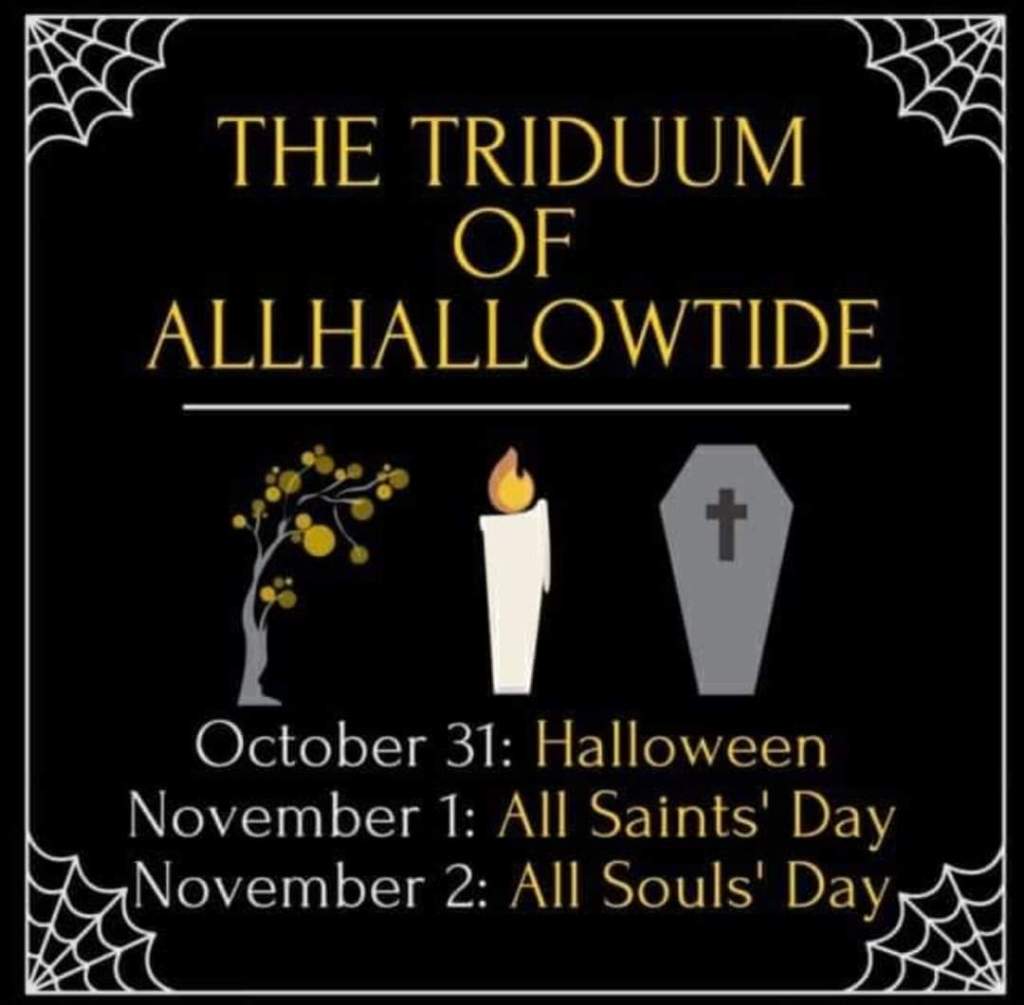
October 31st begins a stretch of time known informally as Hallowtide – an Old English word for “Saints Season”. One way to understand this holy moment in the Church Calendar is call it a Triduum, a three-day period.

Image pulled from Facebook

October 31st, Halloween, is the opening celebration in which we acknowledge the thinning of the barrier between the living and the dead. Some say this derives from the language of Celtic Christianity, but it’s very difficult to discern fact from fad when it comes to referencing the belief in practice of the early Church in the British isles, so let’s not take that too seriously. In any case, this evening, All hallows eve, is the liturgical start of All Saints Day itself, and the party begins.

All Saints Day, November 1st, is when we particularly celebrate the church triumphant – that victory over sin and death itself that God’s people have in Christ and even now enjoy in paradise, even though they have not yet tasted of the general Resurrection of the Body.

All Souls Day, November 2nd is when the Roman Church remembers those who are still in purgatory, and have not yet attained to the beatific vision of the Saints in heaven. This is not an Anglican take on the holy day, obviously, and so the optional commemoration on this day in our prayer books now typically turn it the commemoration of the faithful departed. So rather than talking about those in heaven and those in purgatory, as the Romans erroneously do, we celebrate two different aspects or realities that the Saints departed presently experience. November 1st is the day of joy in triumph, we give thanks to God for their victory in him, and we are stirred up to follow their good examples that we might share in that eternal inheritance with them. November 2nd is the day of rest and mourning, where we lament the ongoing present reality of death, acknowledge the pain of losing people to that death even temporarily, and are comforted in the knowledge that they are at rest with the Lord.

Beyond this triduum one could also identify hallowtide as an octave. An octave is a stretch of eight days, which is represented in our prayer book by the fact that when All Saints Day is not on a Sunday we are allowed to celebrate it on the first Sunday in November. This results in a span of 7 days (November 1st through 7th) in addition to the evening of October 31st bringing us to a total of eight different days in which we could be celebrating the hallowed ones continuously!

One way this can be observed is by singing. This customary has proposed the following recommendations for observing the All Saints / All Souls dynamic throughout the octave:

  • 31st: Day of wrath! O day of mourning!
  • 1st: For all the saints, and, Lord who shall come to thee
  • 2nd: Behold a host arrayed in white, and, O Lord my God I cry to thee
  • 3rd: Who are these like stars appearing
  • 4th: I sing a song of the saints of God
  • 5th: The saints of God! their conflicts past
  • 6th: Tempted and tried, we’re oft made to wonder
  • 7th: I fall asleep in Jesus’ wounds

Learning to sing or chant mass parts

I have always served a small church. And for all but one year of my pastoral ministry I have doubled as the musician, which is how I actually began my service for Grace Anglican Church. As a result (by necessity) the selection of music has been part and parcel of liturgical planning. This is sometimes a fair bit of extra work for me, but also can be pretty rewarding for all of us in that the songs we sing usually tie closely with the Scriptures and prayers of the day. In fact, I’ve even started working on a booklet to collect the “best practices” I’ve developed (and learned from others) which will be available for sale sometime in the coming months.

One thing which is common in many Anglican (and Episcopalian) churches which we’ve only dabbled in, however, is the singing or chanting of mass parts. “Mass parts” is a phrase that refers to the parts of the mass, or Communion service, that are traditionally sung or chanted by a choir and/or the congregation. Traditionally there are quite a few of these, but the main ones are:

  1. the Kyrie
  2. the Gloria in excelsis
  3. the Sanctus
  4. the Agnus Dei

In the classical Prayer Book tradition, there is no Kyrie but instead the Decalogue (Ten Commandments) which could have chanted/sung responses, and the Gloria is placed near the end of the liturgy instead of near the beginning. And most of the old Prayer Books had no place for the Agnus Dei, either, come to think of it. But contemporary Prayer Books (and contemporized versions of the classical Prayer Books) restore all four of these to the liturgy one way or another. Every Anglican hymnal these days worth its salt has at least one (if not a handful) of different musical settings for these parts of the liturgy.

The main reason my church never got into these is because we used the 1940 hymnal for years, and then switched to the 2017 hymnal. The former only has the traditional-language texts for the liturgy and the latter has only one setting for the contemporary language that we use 96% of the year. When we had a different music minister for a little while, he brought in a contemporary Gloria and Sanctus, which we appreciated, but I was not able to keep them up when he was gone. In fact, after his departure I quickly became a hymnal-only musician, no longer having the energy to learn and teach contemporary-style worship songs. The demographics of our congregation matched this preference anyway, so it was not an issue one way or the other.

But this past year, coming out of COVID-tide, I’ve started taking these mass parts seriously. It was time to start singing or chanting these parts of the liturgy again. I started at the Easter Vigil this year, introducing the Gloria in excelsis Deo. The contemporary-language set in our new hymnal is the New Plainsong set by David Hurd, first copyrighted in 1981 and featured in the 1980 Episcopal hymnal. It’s not an especially ground-breaking new and exciting set of music, nor is it a re-make of one of the old classics, but it is stately and singable. Since Easter, we’ve sung that Gloria on the major Sundays of the year, but not every Sunday… yet.

Shortly thereafter I introduced the Sanctus (Holy, holy, holy), which went over pretty well. We’ve been singing it ever since.

And now that we’re moving our worship indoors for the season I’m about to introduce the Agnus Dei which is nicely similar in sound and contour to the others. After about a month to get used to that, I’ll add the sung Kyrie (just threefold, not ninefold), and then we’ll have all four together for a solemn few Sundays before Advent.

In Advent it is traditional to omit the Gloria, so we will not sing or say it at all for those four weeks until it returns at Christmas. From there I will be free to use or omit some or all of these sung parts to emphasize the tone of the church calendar. We can sing everything on the most celebratory Sundays and other feast days, sing some of them on more ‘normal’ Sundays, or simply just speak them at penitential times. The solemnity of the liturgy style can become a tool in the celebration of the Gospel from week to week, and season to season.

As I was planning this, though, and preparing to type this up, I could just hear in my head the anti-traditionalists, as the ACNA is sometimes a bit infamous for, asking the question “and how will this help the mission of your church and its growth?” To which I will confidently reply that it will neither help nor hinder the missional character of Grace Anglican Church… at least directly. Instead, it will help teach us to worship with reverence, and perhaps to respect the Lord just that little bit more. And, with its periodic use and omission to accentuate the gospel that we proclaim over the course of the year, it may just help people grasp that gospel more nearly to their hearts. In which case, I dare say, we may become a people more apt for the missio Dei.

Vigil fast today!

In the 1662 prayer book there are several fasts appointed on the eve, or vigil, or day before several of the holy days in the church year. Curiously, not all of the holy days in that prayer book get their own fast day beforehand; perhaps about 75% do and the rest do not.

Today is one such vigil fast, preparing us for the feast of the nativity of Saint John the Baptist tomorrow! This pairing of fasts and feasts is both an ancient and a sound practice:

Here, the great Anglican theologian, Richard Hooker, points out that grief and joy are two states of heart and mind which excellently summarize human life, and in her fast and feast days the church uses grief and joy to help Christians grow in virtue and holiness.

So if you are not normally one who observes days of fasting consider adopting the prayer book tradition of vigil fasts today!

A Series of Related Commemorations

The calendar of commemorations in our new Prayer Book today lists three women: Lydia, Dorcus, and Phoebe. Normally, as you may be aware, only one commemoration per day is the norm. Sometimes if a group of people were martyred together they’ll share a date, and sometimes (even more rarely) a few people with similar legacies are remembered together. This “affinity group commemoration” phenomenon is mostly a feature of the Episcopalian calendar since 1979, though some rare examples of these entries have carried over into our calendar and/or can be found in other traditions also.

Just for one example, Lydia has been commemorated as a Saint in many traditions over the years, but her feast day varies widely. The Romans remember her on August 3rd, various Eastern churches commemorate her on March 27th, May 20th, or June 25th. Some Lutherans celebrate her on October 25th. We, with some other Lutherans and the Episcopalians, have her down for January 27th.

What is particularly interesting about this date for commemorating Lydia and Dorcus and Phoebe (since we don’t have clear traditions of when they died, which would be the normal date for a Saint’s Day) is that they are on Day Three of a three-day series of commemorations. January 25th is the Conversion of Saint Paul, January 26th is for Saints Timothy and Titus, and January 27th is for Lydia, Dorcas, and Phoebe. This string of remembrances is a real “Book of Acts Party”, I once joked, and makes a lot of sense. Together these six people form a sequence both historical and missiological:

  1. God calls Saul (eventually to be known as Paul) to faith in Christ
  2. Paul ordains ministers (Timothy and Titus) to continue his work
  3. More people convert (Lydia, Dorcus, Phoebe) and continue the advance of the kingdom

Thus this trio of celebrations is worth pointing out to our fellow church-goers as a biblical and liturgical reminder of the call of the Church to make disciples and grow. The different roles are important to note, because sometimes we assume that “mission” and “evangelism” is best done by professionals – or least by particular individuals with special zeal and drive. Saint Paul was an extraordinary individual, Timothy and Titus were bishops, they can be most inspiring but also very difficult to relate to. This is where the three women may come in helpful.

Lydia was a wealthy woman, who lived in Thyatira, in Roman Macedonia. She was essentially the first European convert to Christianity. She was already a “worshiper of God”, which means she was probably familiar with basic Jewish teachings and believed in the God of Israel, but (most importantly) “the Lord opened her heart to pay attention to what was said by Paul” and she and her household were subsequently baptized. She heeded the Gospel, brought her family along, and then supported the ministry of Paul and his companions with her considerable means. Believing in the mission of the Gospel and supporting it with hospitality and finances is no small thing!

Dorcas, also named Tabitha, was a devout woman faithful in Christ and abundant in good works. Her ministry of providing for the poor and needy made her most beloved in her community and when she died many people showed St. Peter the clothing she had made for them, beseeching him to pray for her and raise her from the dead, which he did. Her resuscitation “became known throughout all Joppa, and many believed in the Lord.” Thus even though she did directly participate in “evangelistic outreach” as we might call it, her good deeds gave her a positive reputation that, when recognized by the Church, brought many to share the faith she proclaimed. The light of her good deeds was seen, and many others came to the Light as a result.

Phoebe, finally, is a person of some controversy in modern Christian circles. She is described as a “διάκονον” from which we have the word Deacon. Some argue she was a Deacon in the formal ordained sense, like the men in Acts 6. Some argue she was a Deaconess in the context of the Early Church’s practice: a non-ordained minister who assisted with the baptism of women and works of mercy in the community. Others take the word in its general sense – a “servant of the Church”. Whatever the precise interpretation of this word, we know that Phoebe was an active member of the Church at Cenchrae (probably a village near Corinth) who traveled to Rome, perhaps along with the letter that St. Paul had written to them. She was to be received “worth of the saints” and to be helped in whatever she might need, because she was a “patron of many” as well as of Paul himself. A patron indicates she probably was rich, like Lydia, and provided financial and/or hospitable support for the traveling apostles and the local church. As a woman of means, perhaps she was able to be active in other ways – supplying the church and the ministers, caring for the sick, bringing alms to the poor, or any number of other services for the cause of the Gospel.

So we remember today the great contribution of these three women; their service to the Gospel and the Church was incalculable and their names endure forever through the Scriptures and the liturgical calendar. It is helpful for us to commemorate people who made a great difference through seemingly “ordinary” means… maybe just maybe we can be inspired to spend and be spent for the cause of Christ, ourselves.

Video: the Holy Days in the Prayer Book

The video series I started a year ago nears its conclusion. Here is a summary of how the Holy Days (commonly, the Major Feast Days) fit into the Christian Calendar.

Subject Index:

  • 00:00 Definition & Major Themes
  • 05:20 Historical Features
  • 10:13 Walk-through in the 2019 Prayer Book
  • 15:36 Daily Office & other features
  • 17:36 The Collect for All Saints’ Day

Links for further reading: