Dealing with Psalm 137

It’s day 28, Evening Prayer… almost finished with the month, we’re zipping through all these short Psalms near the end of the Psalter, and then suddenly BAM! you slam into Psalm 137.

Oh it starts normally enough.  The lament of the community in exile in Babylon over the loss of Jerusalem is a sad thing; this month it is especially timely with the book of Lamentations at the same time.  How can God be worshiped away from His (destroyed) House, in the midst of a heathen land?  What will become of us if (and when!) memory fades of that glorious Temple?  Translated into Christian experience today, we see a world around us steeped in sin and ask similar questions: how long until the music of worship fades in our own hearts?  How much will we succumb to the paganizing forces in natural human culture?  Will churches and denominations continue to decline into obscurity?

Blessed shall he be who takes your children * and throws them against the stones

Wait, what? Where did that come from?  I thought this was a sad psalm, but all of a sudden it takes such and angry and sadistic turn at the end.  And it just stops there, like that’s a perfectly okay last word to have.  What does a Christian do with this?  This angry and vengeful rebuke of the Edomites who were complicit in the destruction of Jerusalem as they basically cheered the Babylonians on feels a little too extreme.  As the popular meme goes, “that escalated quickly!”

As Anglicans, we pray through the Psalter every month at least, so we really need to know how to tackle with this, lest we have a crisis of faith and biblical fidelity every month.

Reminder #1 – Vengeance is the Lord’s

Prayers for vengeance can be found in many places throughout the Bible, especially the Old Testament.  This does not conflict with the also-biblical teaching that God is the one who avenges evil; indeed, such prayers reinforce the doctrine, putting our desire for revenge into the hands of the Just One.

In the New Testament, a new pattern emerges: prayers for mercy upon the evildoers, even as they kill the faithful.  Jesus prayed for those who arrested him and those who crucified him.  Saint Stephen prayed the same as he was stoned to death.  The readings for the Communion service on St. Stephen’s Day, by the way, highlight this interesting contrast between Old and New Testament tendencies regarding vengeance.  Regardless of whether the victim is praying for mercy or not, however, the New Testament upholds the doctrine that God will judge and avenge wrongdoing.

Reminder #2 – You can bring your anger to God

One of the frequent shortcomings in modern piety is the misunderstanding that you have to (or even just should) come to church happy.  Jesus is our lover and our joy, and therefore we must be happy in his presence.  Such an attitude can be very damaging for those who are hurting!  Thankfully there has been some popular movement toward recovering a sense of common lament before God, recognizing the pain and brokenness and drear of our lives.  But anger, I suspect, is probably not quite as readily accepted.  Wrath quickly turns to sin, as the Bible teaches, so perhaps it is understandable that we don’t have many examples of anger in the Psalms.  Psalm 109 is one of the angriest psalms besides this one.

So what about those babies dashed against the rocks?

Frankly, I hope this verse will always make you uncomfortable.  It takes a very deep and profound anger to wish such a curse on anyone.  The trauma the Judean exiles experienced – the trauma of many refugees to this day – is not an experience that most people have, and I hope you and I never do.  This verse is coming from that place of extreme pain.  It may not come from your own place of brokenness and hurt, but it does come from someone’s brokenness and hurt, and you and I are offering that pain to God with them.

Just as we pray the happy Psalms like 98, 99, and 100 whether we’re feeling joyful or not, just as we pray the penitential Psalm 51 whether we’re actually in a contrite mood or not, also do we pray Psalm 137’s profound anger regardless of the state of our own heart.
Ultimately, this psalm is one of the most helpful case studies in liturgical worship, as it puts into the mouth of the worshiping community words that likely none of us in a given church would ever say in our own extemporaneous prayers!  As rough ’round the edges as this psalm is, I thank God that it’s in the Bible.  It teaches us that we can pray even at our angriest.  It teaches how to pray with others at their angriest.  And it shows us anger that still faithfully conforms itself to the ultimate judgment of God.
George Herbert, the Country Parson

George Herbert (1593-1633) lived a short but saintly life, remembered for being a caring pastor in the English church, and as one of the great metaphysical poets of the day.  If you are a student of literature, especially poetry, Herbert is (or ought to be) a familiar name to you already.

But in the memory of the Church, his commemoration in our calendar, and especially to a liturgy blog such as this, George Herbert’s greatest gift to posterity is his short book A Priest to the Temple or, the Countrey Parson.  It went through multiple publications including well after his death, and was a classic manual for pastors for centuries.  I made a point of reading this book annually for four or five years, and it has made its way into my own pastoral mindset, practice, and writing noting…

This lovely short book briefly walks through all sorts of subjects: the pastor’s lifestyle, education, study, and household, his prayer life, preaching, and handling of the church building and people, his teaching and ministering to the sick and his circuit of visitations, pastoral discipline, legal counsel, and medical aid, his leadership, library and love for others.

I’ll leave you with chapter 6 on the pastor’s prayer life and liturgical example (with modernized spelling).

The Country Parson, when he is to read divine services, composes himself to all possible reverence; lifting up his heart and hands, and eyes, and using all other gestures which may express a hearty, and unfeigned devotion. This he does, first, as being truly touched and amazed with the Majesty of God, before whom he then presents himself; yet not as himself alone, but as presenting with himself the whole Congregation, whose sins he then bears, and brings with his own to the heavenly altar to be bathed, and washed in the sacred Laver of Christs blood. Secondly, as this is the true reason of his inward fear, so he is content to express this outwardly to the utmost of his power; that being first affected himself, he may affect also his people, knowing that no Sermon moves them so much to a reverence, which they forget again, when they come to pray, as a devout behaviour in the very act of praying.

Accordingly his voice is humble, his words treatable, and slow; yet not so slow neither, to let the fervency of the supplicant hang and die between speaking, but with a grave liveliness, between fear and zeal, pausing yet pressing, he performs his duty.

Besides his example, he having often instructed his people how to carry themselves in divine service, exacts of them all possible reverence, by no means enduring either talking, or sleeping, or gazing, or leaning, or half-kneeling, or any undutiful behaviour in them, but causing them, when they sit, or stand, or kneel, to do all in a strait, and steady posture, as attending to what is done in the Church, and every one, man, and child, answering aloud both “Amen,” and all other answers, which are on the Clerks and peoples part to answer; which answers also are to be done not in a huddling, or slubbering fashion, gaping, or scratching the head, or spitting even in he midst of their answer, but gently and pausably, thinking what they say; so that while they answer, “As it was in the beginning, &c.” they meditate as they speak, that God hath ever had his people, that have glorified him as well as now, and that he shall have so for ever. And the like in other answers.

This is that which the Apostle calls a reasonable service, (Rom. 12:1). when we speak not as Parrots, without reason, or offer up such sacrifices as they did of old, which was of beasts devoid of reason; but when we use our reason, and apply our powers to the service of him, that gives them.

If there be any of the gentry or nobility of the Parish, who sometimes make it a piece of state not to come at the beginning of service with their poor neighbours, but at mid-prayers, both to their own loss, and of theirs also who gaze upon them when they come in, and neglect the present service of God, [the parson] by no means suffers it, but after diverse gentle admonitions, if they persevere, he causes them to be presented [chastised]: or if the poor Church-wardens be affrighted with their greatness, notwithstanding his instruction that they ought not to be so, but even to let the world sink, so they do their duty; he presents [chastises] them himself, only protesting to them, that not any ill will draws him to it, but the debt and obligation of his calling, being to obey God rather then men.

Reading the Lamentations

Our Daily Office readings for the evening continues through the Jeremianic literature with the book of Lamentations.  We’ve worked our way through the book of Jeremiah itself already, and touched upon the book of his assistant, Baruch, and are now reading from Lamentations, which is traditionally attributed to Jeremiah’s hand.

An unusual amount of biographical information about Jeremiah himself is preserved in the middle of the book bearing his name; it relates his dicey interaction with the leadership of Jerusalem.  He prophesies doom and gloom for Jerusalem, and the leaders of the people generally see this as an act of treason – how can it possibly be God’s will to lead the Gentiles to victory and destroy His own temple?  The end of the book of Jeremiah is another historical note about the fall of Jerusalem largely repeating material in 2 Kings 24.

This rather depressing ending sets up for a sort of appendix, which we know as the Lamentations. This is a series of five Hebrew poems, alphabetic acrostics of varying length and elaborateness, each bewailing the destruction of Jerusalem from a different point of view, be it the third-person perspective of an observer, personifying the city itself, and others. Despite the mournful subject of all five laments, some very famous glimmers of hope shine through: “The steadfast love of the LORD never ceases, his mercies never come to an end; they are new every morning; great is thy faithfulness” (3:22-23).  You may be familiar with a famous hymn inspired by these verses.  Perhaps, after reading chapter 3, you may be so moved to sing that hymn as an Evening Prayer Canticle, or an Anthem after the Collects.

Structurally, the book of Lamentations is very simple.  Each chapter is its own poem.  Apart from the Hebrew acrostics, other elements show up from time to time: there are call-and-response elements pop up, as if some of these poems were used for a liturgical community lament around the wrecked Temple.  The varying of perspective, too, enables one to embody the experience of the city itself, or the Temple itself, looking at the destruction and devastation from several angles.

Spiritually, one of the simplest appropriations of this book in a Christ-centered manner is to connect the Old Testament Temple building to the New Testament Temple of Christ’s Body, which was destroyed on that first Good Friday and “rebuilt in three days” as Jesus promised (John 2:21).  Indeed, parts of this book will be read again during Holy Week, in which that bewailing of the destruction of all we hold dear is given an explicit Christocentric context.

This time around, perhaps it’s best to try to keep the historical setting of the Lamentations in mind for now; walk with Jeremiah and/or the Hebrew survivors of the Babylonian destruction of Jerusalem in 586BC, and mourn with them.  Come Holy Week, we’ll use some of these words again to mourn with the disciples (and all of faithful humanity) over the even more grievous destruction of the Temple that is Jesus himself.

Less-than-Occasional Prayers

In both Morning and Evening Prayer, after the three Collects, the rubrics in our liturgy states:

The Officiant may invite the People to offer intercessions and thanksgivings.

In older Prayer Books, a handful of suggested prayers and collects were printed in this place, indicating those certain prayers for the crown, state, society, and so on, were appropriate for that point in the Daily Office.  In the 1979 and 2019 Prayer Books, no such collection is provided immediately, but a larger collection of “additional” or “occasional” Prayers and Thanksgivings is provided in an appendix of sorts near the back of the book.  This is, basically, the modern equivalent of the earlier, traditional, collection.

UPDATE — This order has been revised: https://wordpress.com/post/saint-aelfric-customary.org/1898

On the ACNA page for Texts for Common Prayer, and thus what will probably show up in the 2019 Prayer Book, is a list of 123 prayers and collects.  A few of them are occasion-specific (like for a birthday, or for someone’s healing) but most of them are perfectly appropriate for general use.  To this end, it is the recommendation of this Customary to work through all (well, most) of these prayers on a regular basis towards the end of Morning and Evening Prayer.  This is a two-week rotation of prayers, averaging about 4 or 5 prayers per Office.

Week I                              Office                          Week II

95-96, 107-108             Sunday Morning          97, 99-102
98, 103, 106, 109-110   Sunday Evening           104-105, 111-113

1-5                               Monday Morning         6-10
11-15                           Monday Evening          16-19

26-31                           Tuesday Morning         25, 32-37
70-73                           Tuesday Evening         38-41

48-53                           Wednesday Evening     42-47

78-82                           Thursday Morning       90-94
114, 120-123                Thursday Evening        115-119

54-58                           Friday Evening             59-63

20-24                           Saturday Morning        64-69
85-89                           Saturday Evening            74-77, 84

Let’s look at why this scheme is recommended the way it is.

Sunday, being the principle day of worship for the church gathered, has the section of prayers labeled At Times of Prayer and Worship as well as the prayers on Death, the Departed, and the Communion of Saints, as that is when most of the saints on earth are gathered.  The assigned prayers skip around, numerically, in order to avoid prayers that are too similar from being read at the same Office.

On Monday the prayers start at the beginning of the list, covering the section For the Church.  In general, the prayers for the morning are more specific and the prayers for the evening are more general or topical.

Tuesday morning covers the next section, For the Nation, again arranging the prayers so that too-similar collects aren’t prayed on the same day.  Depending upon which country you hail from, certain prayers along the way will be appropriate to omit (mainly in the USA versus Canada distinction).  In the evening, one day dips into the Personal Devotions list and the other starts the For Society section.

Wednesday morning is omitted, because that’s a traditional time for saying the Great Litany.  The evening finishes the For Society section and begins the next section, Intercessions For Those in Need.

Thursday morning skips ahead to more of the Personal Life and Personal Devotions sections, while Thursday evening (in light of the day’s traditional Eucharistic theme) covers most of the Thanksgivings.

Friday morning (like Wednesday morning) is omitted so you focus on the Great Litany.  The evening covers the rest of the prayers For Those in Need where Wednesday left off.

Saturday covers the prayers about Creation and Family Life, as well as Personal Life and Devotion.  The creation theme matches the Morning Prayer Collect recommended for Saturdays (Collect for Sabbath Rest), and the family section is chosen to match the fact that Saturday is often a “day off with the family” for much of the working world.  The remaining personal devotions also serve as a sort of introspective preparation for corporate worship on the following morning.

For sake of simplicity, “Week I” should line up with odd-numbered weeks in the liturgical calendar, and “Week II” with even-numbered weeks.  For example, yesterday was (in modern reckoning) the 7th Sunday after the Epiphany, so this week could be considered an odd-numbered week.

Book Review: An Anglican Prayer Book

Welcome to Saturday Book Review time!  On most of the Saturdays this year we’re looking at a liturgy-related book noting (as applicable) its accessibility, devotional usefulness, and reference value.  Or, how easy it is to read, the prayer life it engenders, and how much it can teach you.

In 2008 the Anglican Mission in the Americas (then AMiA) published An Anglican Prayer Book to provide their congregations with historic Anglican liturgy in contemporary idiom.  The project was aided by the late Rev. Dr. Peter Toon, then President of the Prayer Book Society of the USA.  I don’t know how widely-used this book ended up being, given the colorful and complicated history of AMiA’s founding, leaving, and partially re-joining the ACNA, eventually splitting from its parent province Rwanda, and the complicated leadership debacle surrounding its founding Bishops.  Their Prayer Book, sometimes nicknamed “the blue book”, however popular or obscure, was a gem of a resource.  It contains an entire Prayer Book, omitting only a Psalter, and very closely preserves traditional Anglican liturgy in contemporary English.

Its language style is plain and simple, and strikes me as a little less awkward than that found in Common Prayer 2011.  It might even go in the other direction, feeling a bit calm and informal by comparison.  Also in contrast to CP2011, this book seems to produce more of a low-church feel to it.  Take, for example, this excerpt from the Absolution in the Daily Office:

He has commanded and authorized his Ministers to assure his people that they will receive absolution and forgiveness of their sins when they repent of their sins.

Compare this to the historic wording:

[He] hath given power, and commandment, to his Ministers, to declare and pronounce to his people, being penitent, the Absolution and Remission of their sins…

The language of the original may be understood to say that the Minister actually declares or enacts God’s pardon upon the penitent, whereas the language of An Anglican Prayer Book specifies that the Minister merely assures the penitent of God’s pardon.  Similar subtleties can be found throughout this book, especially in its contemporary version of the 39 Articles of Religion, where the minutiae of wording and grammar have sparked centuries of theological debate.  Thankfully, this book isn’t trying to re-write the Articles of Religion according to a particular agenda (in this case low-church evangelical), but admits up front that this translation is provided for ease of reading, and only the original text is authoritative.  Still, the nature and style of this book is clearly better-suited to the evangelical than the anglo-catholic.

One of the unique features of this book is that it combines Morning and Evening Prayer together into one liturgy, noting which Canticles and Collects belong to which time of day.  Because it sticks with the traditional material and adds nothing of what is supplied in the 1979-2019 tradition, this doesn’t take up a ton of space, and very much helps to shorten the length of the book overall.

Another interesting feature of this book is that it the Communion liturgy has three Prayers of Consecration: one based on the English 1662, one based on the American 1928, and one based on the Canadian 1962.  This allows for variation in churchmanship, local tradition and familiarity, and just plain variety.  The first half of the liturgy is the same, and the last section is presented one version at a time; you have to skip to the correct page in order to follow along.

Because of its simplicity, small size, and traditional brevity, you’d think that this book should be easy to use.  But it actually isn’t all that user-friendly.  Part of it is the typeface: the rubrics are in a lighter grey color, and not in italics, which often makes them harder to distinguish from the regular spoken text.  The page-flipping, while not as complex as in the 1979 Prayer Book, is more cumbersome than the historic Prayer Books, and there are no page number guides within the liturgy texts to tell you where to go.

The greatest triumphs of this book, however, are the lectionaries.  The Daily Lectionary (bafflingly stuck near the back of the book instead of the front near the actual Office liturgy) is very simple to use.  It is the 1871 version of the 1662 Prayer Book’s daily lectionary, which sticks close to the original one-chapter-per-read method, but breaks up the longer chapters in half so they’re less cumbersome for the average reader.  I haven’t studied it carefully (let alone used it before), but I think it may give the new ACNA daily lectionary a run for its money in terms of overall quality.

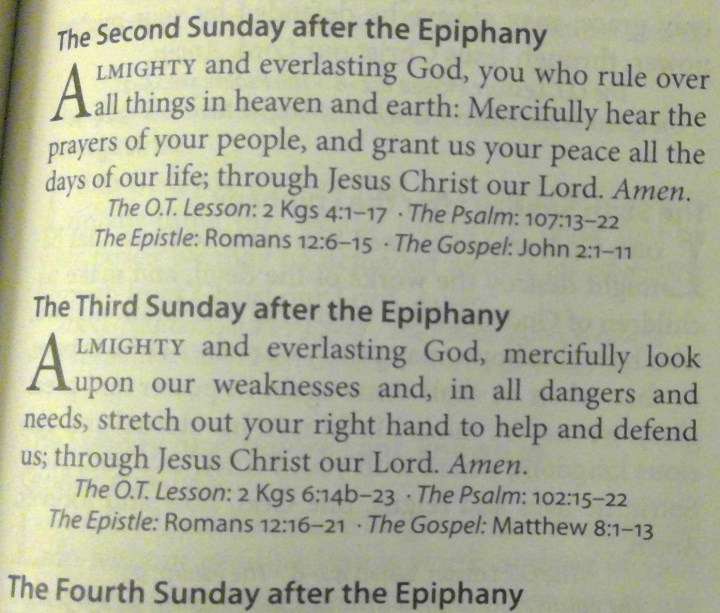
The Communion lectionary, too, is assembled in what I consider the best way possible: united with the Collects.  The traditional Prayer Books printed the Collect, Epistle, and Gospel each in full text together for every Sunday and Holy Day of the year.  This makes a book quite lengthy of course, so the space-saving option (and especially smart in this age of multiple options for Bible translations) is to print the Collect with the verse references for the lessons.  Behold:

win_20190222_19_21_08_pro.jpg

In my opinion, this is what the 2019 Prayer Book ought to do.  Granted, with a 3-year lectionary you’d need to specify “Year A: OT, Psalm, Epistle, Gospel“, but that wouldn’t take up a ton of space and would cut out an extra bit of page-flipping situation from having the Collects and Lectionary in two different places (like the 1979 book does).  I fear this is not a lesson our book will learn, though I did suggest it to them a couple times.

Also, this book is noteworthy for adding an Old Testament lesson & Psalm to the historic lectionary which featured only an Epistle & Gospel.  This, I believe, was the right way to contemporize the Communion lectionary, not rehash another version of the modern (or modernist!?) 3-year lectionary, as the 2019 book is doing.

The ratings in short:

Accessibility: 3/5
While not as simple as traditional Prayer Books, this book still has a relatively small learning curve.  As I noted above, its primary hindrances are due to presentation, not structure.

Devotional Usefulness: 4/5
Although some features in this book lean in the low-church direction, it still has everything you need for an Anglican devotional life.  The lectionaries are sound and the daily prayers are thorough.  It lacks all the bells and whistles of modern Prayer Books (such as special liturgies for Palm Sunday and similar days), but that’s not an issue for personal use.

Reference Value: 2/5
This book has had a relatively low impact in American Anglican liturgical development; I’ve never met anyone who uses (or used) it as their congregation’s primary prayer book.  I’ve known someone who used its daily lectionary, and I’ve known a church that uses its additions to the historic Communion lectionary, but never the book wholesale.  Really, apart from the added lessons to the Communion lectionary, this book has nothing to offer the liturgical world.  There are quite a few modern adaptations of the old liturgies out there, these days, making this book feel like one of the most redundant prayer books on my shelf.

At the end of the day, this isn’t a book I’d recommend adding your liturgy collection unless

  1. you really like collecting different prayer books, or
  2. your parish uses the historic lectionary and you want an OT & Psalm added, or
  3. you like studying different ways traditional language can be modernized.


Introduction to Baruch

One of the greatest blessings about the Bible’s contents is that it provides us with multiple accounts and perspectives on a large portion of the major events, stories, and people within.  There are four Gospel books, each telling the story of Jesus in a different way.  Echoes of several events recorded in the book of Acts can be found throughout the New Testament Epistles.  And in the Old Testament there are a number of books that overlap with one another in their historical coverage.  Sometimes this can be seen as a problem, for there are a number of instances that don’t seem to match.  The exact sequence of events at the last supper, at Paul’s life-changing encounter with Jesus on the road to Damascus, and the lifespans and reigns of several Israelite kings are difficult to reconstruct with the conflicting information found in different accounts throughout the Bible.  Many, if not most, of these issues can be harmonized with more careful study of the text, and an attentive eye to the writing style and emphasis of the particular authors.  But even as some of these challenges remain, it is a source of blessing for us.  It keeps us honest about the human element in the authorship of the Sacred Scriptures; it reminds us that the Bible exists to communicate Christ, and not to quibble over minor and inconsequential details like how long a particular Old Testament king lived in Jerusalem.

The book of Baruch, with appended Epistle of Jeremiah, is an offering of further perspective to the ministry and book of the Prophet Jeremiah.  The prophet Baruch is mentioned several times in the book of Jeremiah as his scribe and assistant (cf. chapters 32, 36, 43, 45).  For the most part this book serves as an answer to some of Jeremiah’s instructions to those who were going to Babylon in exile.  Chapters 1 and 2 in particular match up with Jeremiah 29, suggesting that some of the exiles were indeed beginning to live in faith and penitence, respecting their new masters in their temporary exile home.  The Epistle of Jeremiah, sometimes treated as chapter 6 of Baruch, is a further treatise against idolatry.

Those are what I tend to consider the major features of the book of Baruch, but oddly enough the ACNA Daily Lectionary only gives us two chapters of this short book to read, and it’s none of the above!  Instead we are to read chapters 4 and 5 which speak words of comfort to the Jewish exiles in Babylon.  As chapters 1 & 2 indicate, there were some among the exiles who did come to understand that the destruction of Jerusalem was God’s punishment for their idolatry, and they repented of their sins.  To such penitent believers, hope and comfort could be preached: God had a future for his faithful people.  These chapters are like the “Words of Comfort” in our Communion liturgy that follow the Confession and Absolution.

As you delve into these chapters this evening and tomorrow, think of this as the “light at the end of the tunnel” that Jeremiah yearned for in his long and painful prophetic ministry and his assistant finally gets to see.

A Pre-Lent Hymn: Come, labor on!

Although we don’t officially have the Pre-Lent season on the books, there’s no reason we can’t learn from that mindset and explore ways of incorporating the old wisdom of the church into modern practice.  For example, let’s consider a hymn that encapsulates something of the Pre-Lent spirit.

Come, labor on.
Who dares stand idle on the harvest plain
while all around him waves the golden grain?
And to each servant does the Master say,
“Go work today.”

Come, labor on.
The enemy is watching night and day,
To sow the tares, to snatch the seed away;
While we in sleep our duty have forgot,
He slumbered not.

Come, labor on.
Away with gloomy doubts and faithless fear!
No arm so weak but may do service here;
By feeble agents, may our God fulfill
His righteous will.

Come, labor on.
Claim the high calling angels cannot share;
to young and old the gospel gladness bear.
Redeem the time; its hours too swiftly fly.
The night draws nigh.

Come, labor on.
No time for rest, till glows the western sky,
till the long shadows o’er our pathway lie,
and a glad sound comes with the setting sun,
“Servants, well done!”

This song links to the Gospel both on Septuagesima Sunday (Matthew 20, the parable of the successively-hired laborers in the vineyard) and on Sexagesima (Luke 8, the parable of the sower and four types of soil).  The call to join in the Lord’s labor, to bear fruit, to put in our all for Christ, is excellent preparatory thematic material to rally the troops, as it were, before the spiritual disciplines of Lent begin.

It may already be too late to appoint this hymn for your Sunday morning worship services in the next two Sundays, but there’s nothing stopping you from using it on your own and recommending it to others as a great-ready-for-Lent sort of devotion!

The Suffrage in the Daily Office

One of the fun perks of watching the liturgical revision process carefully and attentively over the past 3 or 4 years is noticing what has been pretty consistent from the start, and where the pinball machines are located.  The Suffrage (also known as the Lesser Litany or the Preces & Responses) in the Daily Office is one such instance, having gone through a subtle edit or two almost every year.

Is a “subtle edit”, you may ask, really worth mentioning?  Sure, some changes are bigger than others, and there’s no major doctrinal conflict at stake in this Suffrage, but the fact that it’s part of the Daily Office – a service of prayer common to all Christians as opposed to the Prayers of Consecration only ever read aloud by priests and bishops – makes it a point of contact for real common prayer.  This is the sort of thing that people memorize after a while, so even the small and subtle changes can be jarring for regular pray-ers of the Daily Office (especially if you’ve sung these at Choral Evensong or something).

The starting point for these call-and-response prayers seemed to be the version found in the 1979 Prayer Book, and the constant question seemed to be how much further they should be rolled back towards the style and wording of the classical books.  Let’s take a look at how these have been translated and adapted.

It should be noted, further, that the ordering of these prayers is a little different in the 1979 book.  We’re following the order as found in our own 2019 prayer book, which matches the historic order with one addition.

The First Pair (Psalm 85:7)

1662: O Lord, show thy mercy upon us; And grant us thy salvation.
2018: O Lord, show your mercy upon us; And grant us your salvation.
2016: O Lord, show us your mercy; And grant us your salvation.
1979: Show us your mercy, O Lord; And grant us your salvation.

This one is subtle.  The difference between “show us your mercy” and “show your mercy upon us” is significant.  The former, as in the 1979 book and 2016 draft, is a general request that could be answered in any form.  The latter, as in the historic and probably-final draft of the new book, asks for such a show of divine mercy to be enacted upon us specifically.  It’s just like the translation of the Kyrie – “Lord have mercy” versus “Lord have mercy upon us.”

The Second Pair (Psalm 20:9)

1662: O Lord, save the King. And mercifully hear us, when we call upon thee.
2018: O Lord, guide those who govern us; And lead us in the way of justice and truth.
2016: O Lord, save our nations;  And guide us in the way of justice and truth.
1979: Lord, keep this nation under your care; And guide us in the way of justice and truth.

This is an inevitably tricky one, as the verse needs “translating” the moment it leaves England.  A traditional option was “O Lord, save the state”, but that’s actually quite divergent from the original – praying for a country or government rather than a specific person or leader.  And so you can see the sweep of thinking and re-thinking as this prayer is adapted into North American life while still seeking to be faithful to the original verse.

I don’t know why “and hear us when we call upon you” hasn’t been restored though, as that’s what our Revised Coverdale Psalter now reads.  Force of recent American habit, perhaps?

The Third Pair (Psalm 132:9)

1662: Endue thy Ministers with righteousness; And make thy chosen people joyful.
2016: Clothe your ministers with righteousness; And make your chosen people joyful.
2018: Clothe your ministers with righteousness; And let your people sing with joy.
1979: Clothe your ministers with righteousness; Let your people sing with joy.

Our Revised Coverdale Psalter translates the second half of this verse “And let your saints sing with joy.”  There’s an interesting balance in the 2018 version, as a result: we’re making closer use of our psalter’s translation of the verse, yet also retaining a rhythm (or syllable count) that matches the 1662 almost exactly.  This especially makes it easier for those who chant or sing these prayers to adapt to the new wording; though even just reading it with a similar cadence is a pleasant experience.

The Fourth Pair (Psalm 28:9)

1662: O Lord, save thy people; And bless thine inheritance.
2018: O Lord, save your people; And bless your inheritance.
2016: O Lord, save your people; And bless your inheritance.
1979: Let your way be known upon earth; Your saving health among all nations. (Psalm 67:2)

The 1979 Prayer Book omitted this one entirely and used a different verse instead.  It’s a fine prayer (it’s all Scripture), but we’re going back to the original.

The Fifth Pair (Leviticus 26:6)

1662: Give peace in our time, O Lord; Because there is none other that fighteth for us, but only thou, O God.
2018: Give peace in our time, O Lord; And defend us by your mighty power.
2016: Give peace in our time, O Lord; For only in you can we live in safety.
1979: Give peace, O Lord, in all the world; For only in you can we live in safety.

I secretly suspect that the double-length of this response is the bane of every modern liturgist, who I’m assuming wants every line to look close to the same length.  The question, of course, is how to shorten it faithfully.  That half is not directly in Leviticus 26:6, but is simply implied in the context (and throughout the Old Testament), so, unless there’s something I’m missing, we are at liberty to rephrase it without direct scriptural appeal.  I can see why the more radical end of the modernist revisionists wouldn’t want to talk about God “fighting” and prefer to emphasize our “safety” in him.  But it makes more sense to me, as with the 2018 probably-final version, to be a little more explicit about God defending us by his might power.

The Sixth Pair (Psalm 9:18)

1662: (This one wasn’t added until 1979 as far as I’m aware.)
2016: Let not the needy, O Lord, be forgotten; Nor the hope of the poor be taken away.
2018: Let not the needy, O Lord, be forgotten; Nor the hope of the poor be taken away.
1979: Let not the needy, O Lord, be forgotten; Nor the hope of the poor be taken away.

This one’s a bit of an anomaly.  The 1979 Prayer Book added this one in, for what I believe was the first time in Prayer Book history.  It’s a fine prayer, straight from the psalter in that book.  What amuses me is the fact that we haven’t updated its wording to match more closely our psalter, which reads:

For the poor shall not always be forgotten; * the patient hope of the meek shall not perish for ever.

It’s possible that the 2019 book will make some final edits here, but it’s probably more likely that the “inertia” of liturgy will result in this prayer remaining the same as in 1979.

The Seventh Pair (Psalm 51:11)

1662: O God, make clean our hearts within us; And take not thy Holy Spirit from us.
2018: Create in us clean hearts, O God; And take not your Holy Spirit from us.
2016: Create in us clean hearts, O God; And take not your Holy Spirit from us.
1979: Create in us clean hearts, O God; And sustain us with your Holy Spirit.

This verse is a classic point of argumentation among Christians; there are those who argue that such a concern/prayer is no longer applicable to us under the New Covenant.  The 1979 Prayer Book certainly cracked under that pressure and changed “take not from us” to “sustain us with”, completely sidestepping the issue and rewriting the Bible verse.  As I’ve said a few times before, it’s a fine prayer, but we’re sticking with the original.

Echoes of Lent in Epiphanytide

Traditionally this Sunday is/was Septuagesima, the third Sunday before Lent.  The modern calendar, however, continues the Epiphany season through these final weeks, all the way to Ash Wednesday.  What’s interesting is that some of the Collects for these final Sundays are lifted from the traditional Lent and Pre-Lent observances.  This week’s Collect, for example, Epiphany VI, is as follows:

Almighty God, look mercifully upon your people, that by your great goodness they may be governed and preserved evermore; through Jesus Christ our Lord, who lives and reigns with you and the Holy Spirit, now and for ever. Amen.

Traditionally this was the Collect appointed for Lent V, or Passion Sunday.  Compare this to the Good Friday Collect and you’ll see a very similar prayer: “behold this your people O Lord…”

This was no accident: Passion Sunday (Lent 5) was the beginning of Passiontide, the last two weeks of Lent, which direct our attentions to the suffering and death of Jesus.  Lent 5, being the Sunday immediately before Palm Sunday, provided something of a theological background to prepare the worshiper for Palm Sunday, by exploring the concept of sacrificial atonement such as found in Hebrews chapter 9.  Good Friday, being the intensification of Palm Sunday and Holy Week and Passiontide, naturally brings the some sort of prayerful approach as Lent 5.

But now we have that Collect here on the 6th Sunday after the Epiphany.  Although diminished in effect by being so much farther away from Good Friday, it can still be a signal for us that something different is coming.  Instead of hailing the beginning of Passiontide like it did at Lent 5, it now hails the approach of Lent, giving us a foretaste, an echo back in time, of the Good Friday subject: may God graciously look upon his people and govern and preserve us evermore.

Martin Luther & the Baptismal Liturgy

February 18th is the commemoration of Martin Luther, the first of the great Protestant Reformers.  He was born in 1483, ordained a priest in 1507 at about age 24, began his public protest of ecclesiastical abuses with his 95 Theses in 1517, and was excommunicated by the Pope in 1521, thus kicking off the Protestant Reformation.  He died on this day in 1546 at the respectable age of 62.

When examining the history of the English Reformation and the birth of Anglican tradition, more attention is usually paid to the influence of the Calvinist reformers of Geneva than to the German Lutherans.  So today let’s take a look at a significant Lutheran feature in Anglican liturgy: the “flood prayer” in the Baptismal service.  When Luther was revising the Roman liturgy for the German Protestant churches in the 1520’s he abbreviated the baptism service a couple different times, streamlining its attention upon the baptismal act and the grace of God therein.  But one thing he added to the liturgy was this “flood” prayer which carried over into the English Prayer Books a few decades later.

Let’s take a look at this prayer in three versions: the Lutheran Service Book as used by the Lutheran Church Missouri Synod (which I’m hoping is a close representative of the German original), the 1662 Prayer Book (the Anglican standard), and the most recent draft version I’ve got from the ACNA website.

Baptism - Flood Prayer

Perhaps the first thing you’ll notice is the modern love of brevity.  The long, eloquent, and often verbose prayers of the 16th and 17th centuries have been eroded through the 20th century for the modern ear.

The next obvious feature is that our new version is missing two sections with biblical references.  Before people start complain about the ACNA watering down the baptismal liturgy (if you’ll forgive the wonderful, wonderful pun), it should be pointed out that those omitted references to the crossing of the Red Sea and the Baptism of Jesus in the Jordan are found elsewhere in the modern liturgy.  Rather than hitting us with all of them at once in one glorious prayer, it’s spread out among a few medium- and short-length prayers.

It’s also interesting to note the theme of the judgment of the wicked – it’s present in each version of the Flood Prayer but ours seems to be less prominent than its Lutheran forebear.  We just get a shout-out to God’s wrath in the penultimate section, while the Lutheran version mentions those condemned in the Noahic Flood, hard-hearted Pharaoh, and the inherited sin of Adam.  This, perhaps, flies in the face of certain negative stereotypes regarding the Reformed theological camp.

Whateverso, despite its reduction in length, and its spreading out through different parts of our baptismal liturgy today, the Flood Prayer is a beautiful prayer, deeply expressive of our baptismal theology, and we have Martin Luther to thank for writing the original version!  If you want to read more about the origin of the Flood Prayer, this article is a nice place to start.