Praying Humbly

The Collect for Proper 12 (or, in classical prayer books, for the 12th Sunday after Trinity) is a truly humble prayer.  If you want to see an example of what it means to pray with a humble heart, look no further.

Almighty and everlasting God, you are always more ready to hear than we to pray, and to give more than we either desire or deserve: Pour upon us the abundance of your mercy, forgiving us those things of which our conscience is afraid, and giving us those good things for which we are not worthy to ask, except through the merits and mediation of Jesus Christ our Savior; who lives and reigns with you and the Holy Spirit, one God, for ever and ever. Amen.

This prayer acknowledges several things that takes our egos down a notch.

  1. God is more ready to hear than we are to pray.
  2. God gives us more than we desire or deserve.
  3. God forgives us the things of which we’re afraid to ask for forgiveness.
  4. God gives us god things that we’re not worthy even to ask for.
  5. We’re only worthy to ask God for things through the merits of another: Jesus Christ our Savior.

If you chase down some Scripture references this one prayer could be turned into a Bible Study, even a sermon!  And why not? let’s grab a few verses right now.

  • Before they call I will answer, while they are yet speaking I will hear. – Isa. 65:24
  • God said to him, “Because you have asked this, and have not asked for yourself long life or riches or the life of your enemies, but have asked for yourself understanding to discern what is right, behold, I now do according to your word. Behold, I give you a wise and discerning mind, so that none like you has been before you and none like you shall arise after you. – 1 Kings 3:11-12
  • I have said this to you, that in me you may have peace. In the world you have tribulation; but be of good cheer, I have overcome the world. – John 16:33

Sometimes in a conservative, confessional, liturgical, or otherwise traditional church setting, we might find ourselves downplaying the prodigal love of God toward us, preferring to take a more severe and sober attitude concerning our sinfulness or concupiscence, pushing back against the excesses of pop-evangelical culture, or worse, the prosperity gospel heretics who go on about bastardized versions of “God’s love” all the time.  It’s important, with prayers such as this one, to maintain that biblical balance between sober awareness of our sinfulness and joyful recognition of God’s loving-kindness.

So enjoy this prayer for the rest of the week, and revel in God’s love for you!  (But if you’re in a classical-prayer-book parish, then I guess you have to wait another month or so for your turn with this Collect!)

A Hymn Old & New

If you follow this Customary’s “Daily Hymnody” plan, using the REC 2017 hymnal, one of the songs you’ll come to today (probably this evening) is #453, Before the throne of God above.  This is a song that I really quite like a lot, and it’s got an interesting history behind it.

It is best known as a contemporary worship song; the music was written (as far as I’m aware) by Vicki Cook in 1997, and it became relatively popular in the CCM world in the 2000’s.  As a music minister in the early 2010’s, it was on my shortlist of contemporary songs that I wanted to use along with the hymnal my church used at the time.  It was one of the only songs I was sad to lose when we went hymnal-only.  (That was mainly for practical and logistical reasons, by the way, not because of any serious push against CCM.)  But the 2017 hymnal has this song in it, so I’m quite happy to have it back again!

Despite its current popular tune only just passing 20 years old, its lyrics go back to the American Civil War period, 1863.  It never seemed to have universally settled on any one tune – perhaps the curse of the Long Meter Double metric is that there were too many possibilities.  Whatever the case, this song remained somewhat obscure until Cook gave it a unique melody, and it has thrived ever since.

A big reason I like this hymn so much is because it explores a critical theological aspect of Jesus that doesn’t get a lot of attention elsewhere: his priesthood.  I’ve addressed its lack of attention before, arguing for a greater place of prominence for it in understanding the atonement, our salvation, and the sacraments.  Let’s take a look:

Before the throne of God above
I have a strong and perfect plea,
A great high priest whose name is Love,
Who ever lives and pleads for me.
My name is graven on his hands,
My name is written on his heart.
I know that while in heav’n he stands,
No tongue can bed me thence depart.

(The modern tune has the last line of this and the following stanzas repeat.)

This is essentially an exposition of Hebrews 7:25 – “[Christ] is able to save to the uttermost those who draw near to God through him, since he always lives to make intercession for them” – and its context in chapters 7 through 10.  The second stanza addresses the self:

When Satan tempts me to despair,
And tells me of the guilt within,
Upward I look and see him there
Who made an end to all my sin.
Because the sinless Savior died,
My sinful soul is counted free.
For God the just is satisfied
To look on him and pardon me.

This is classic reformational soteriology – Jesus paid the price, cancelled the debt, for all sin.  Even in the midst of theological precision, the poetry is striking: “the sinless Savior died / my sinful soul is counted free.”  The final stanza does what the second stanza recommends, it looks “upward” to “see him there.”

Behold him there! the risen Lamb,
My perfect, spotless, Righteousness,
The great unchangeable I AM,
The King of glory and of grace!
One with himself, I cannot die;
My soul is purchased by his blood;
My life is hid with Christ on high,
With Christ my Savior and my God.

If you are in a hymnal-only church, or just are personally critical of CCM (contemporary christian music), I recommend this hymn as a tasteful example of modern music-writing, and an example that modern settings of classic lyrics is indeed possible!

If you’re a contemporary music kind of person and aren’t usually into hymns, this song is an asset to you, too.  It shows how classic lyrics can still come alive on modern lips, without drastic reworking of lyrics and the addition of bridges and choruses.  If people can enjoy these words, perhaps there are more old hymns that can find their way back into the modern crowd also without doctoring!

Book Review: Ritual Notes (11th ed.)

Welcome to Saturday Book Review time!  On most of the Saturdays this year we’re looking at a liturgy-related book noting (as applicable) its accessibility, devotional usefulness, and reference value.  Or, how easy it is to read, the prayer life it engenders, and how much it can teach you.

Ever wondered when and how to make the sign of the cross during the Communion prayers, as the celebrant?  Or what the order of the procession and recession should be?  How do we know when to wear a cope, or which liturgical colors to use.  How do you cense an altar, and when is it appropriate to do so?  These are questions of ritual, and although the Anglican tradition has virtually no official ritual directions whatsoever, there is widespread custom insofar as such rituals are observed at all.  To learn these customs, we turn to books called customaries which attempt to put into words the ritual actions of church tradition.  Among the classical high church Anglican customaries is the book Ritual Notes, originally published in 1894 (available online), though there are a few other classics out there.  Ritual Notes underwent a total of eleven editions, the last being published in 1964.  Once the 1979 Prayer Book came out, the break with pre-established liturgical tradition was too great; either a new or hybridized approach to ritual and ceremony had to be devised, or a Ritual Notes -using parish would have to stay with with the 1928 Prayer Book.  And indeed, many did, including the churches of the Anglican Continuum, who are primarily responsible for the recent re-prints of Ritual Notes, especially its 11th and final edition.  That is the copy that someone gave to me, and thus the copy on which I am commenting.

Written theoretically for the 1662 Prayer Book, its expectations work better with the American 1928 Prayer Book, or better yet, with some sort of Anglican Missal that brings the language and practice of our worship more in line with that of Rome.  This book, therefore, is scorned by many lowchurchmen as a crypto-Papist abberation.  Such an accusation may not be applicable to its earlier editions, but in the 11th edition the Roman language and terminology is used throughout.  Low Mass, High Mass, Solemn Mass, requiem masses, the exposition and benediction of the blessed sacrament, supplemental Kalendar laws that flesh out the Prayer Book calendar with Roman observances, all this and more smacks of Romanism.

Despite appearances and language, however, this book does bring Roman elements into an Anglican context.  Although the Prayer Book is supplemented more than some would like, the Prayer Book remains the center of the ritual and liturgy that Ritual Notes constructs.  The aim is not to make Anglican more Roman, but to promote Western Catholicism in general.  In that spirit, there is quite a lot in this book that can be a useful resource to all Anglicans, regardless of liturgical and theological partisanship.  In that light, let’s take a look at the Table of Contents.

Part I: General Considerations

  • ch. 1 The Church’s Ornaments
  • ch. 2 Vestments
  • ch. 3 Liturgical Colours
  • ch. 4 Ceremonial Actions
  • ch. 5 Concerning the Church’s Worship

Part II: The Holy Mass

  • ch. 6 General Considerations Concerning the Mass
  • ch. 7 The Parts of the Mass
  • ch. 8 Low Mass
  • ch. 9 High Mass
  • ch. 10 Sung Mass
  • ch. 11 The Canons of Certain Provinces
  • ch. 12 Various Modern Adaptations of Ceremonial
  • ch. 13 Mass on Certain Special Occasions
  • ch. 14 Votive and Requiem Masses
  • ch. 15 Certain Ceremonies Associated with the Mass

Part III: The Divine Office

  • ch. 16 General Considerations Regarding the Office
  • ch. 17 The Parts of the Office
  • ch. 18 The Ceremonial of the Office
  • ch. 19 Other Matters Concerning the Office

Part IV: The Christian Year

  • ch. 20 The Kalendar
  • ch. 21 The Church’s Seasons
  • ch. 22 The Ceremonies of Certain Days of the Year

Part V: The Occasional Offices and Other Services

  • ch. 23 Holy Baptism
  • ch. 24 Holy Matrimony
  • ch. 25 Certain Pastoral Offices
  • ch. 26 The Offices of the Dead
  • ch. 27 Exposition and Benediction
  • ch. 28 Processions

Part VI: Pontifical Services

  • ch. 29 General Considerations
  • ch. 30 Certain Lesser Ceremonies of the Bishop
  • ch. 31 Common Pontifical Functions in Full Form
  • ch. 32 Simplified Episcopal Ceremony
  • ch. 33 Some Functions of the Pontifical

As you can see, there are sections that may be extremely useful to reference if you want to have a special solemn service, as well as sections that you and your parish might never touch with a ten foot pole.  I would particularly commend the chapters on Vestments and Liturgical Colours as useful reading for all clergymen.  Even if you end up holding to a different custom, it’s important to know one of (if not the) standard customs regarding these things.

A few pictures help illustrate elements of the service, and when appropriate there are multiple parallel columns to help the reader track through either different prayers of consecration or different groups of servers and assistants working in parallel during the liturgy.

The ratings in short:

Accessibility: 3/5
All the “catholic” liturgical terminology is used, but also defined and explained.  If you’re new to high ceremonial, this book will feel a bit overwhelming.  But it’s not overly-complicated, so it’s a great resource.

Devotional Usefulness: 4/5
This isn’t a book you pray with, so in a sense this is an N/A answer.  But if you aim to use high church ceremonial in a worship service, this book is invaluable.  Although some elements of it are “out-dated” according to the 2019 Prayer Book (such as the traditional calendar versus our modern one), other features of it which were less compatible with the 1979 book are actually more applicable to the 2019 liturgy once again.

Reference Value: 5/5
Even if you disagree vehemently with its Anglo-Catholic stance, what it provides is an excellent benchmark of Western Catholic ritual and ceremony.  You may find arguments among Anglo-Catholic priests today over which edition is the best (apparently usually between the 9th and 11th), but the failings of individuals aside, this book is a goldmine for learning about “traditionalist” worship.

Project Canterbury has the first edition available online for free; the link is provided near the beginning of this review.  A reprint of the 11th edition is made available for sale online.  I’m not sure I would say this is a book that absolutely every priest should have on his shelf, but instead perhaps every parish church should have in its library.  For some it’s the gold standard of public worship, but for the rest of us it’s still a marvelous reference.

Singing of Saint Anne

Here’s another holy day that we noted ahead of time: “The Parents of Saint Mary.”  Tradition remembers them by the names of Joachim and Anne, and Anne in particular has been the recipient of some devotion in certain parts of Europe – to this day it’s not unusual to find a Catholic church named St. Anne’s.

Because the couple celebrated on this day are closely related to Jesus (in this case literally his grandparents) this is one of the few “black-letter days” appointed in the 2019 Prayer Book’s calendar that this Customary acknowledges with a hymn appointed for the day.  In this case it’s #188 (in the 2017 hymnal), “Faith of our fathers“, a well-known classic.  As the title itself suggests, it is a celebration of the continuity of faith from the past through the present into the future.  It is in the All Saints section of this hymnal, though in other sections in previous hymnals, if I recall.

If you’re curious, even skeptical, why this commemoration should be so elevated when the people commemorated are barely (or not at all) known in Scripture, consider the implications of their identity.  As I wrote for my 4-year-old today:

Jesus had a grandma
they say her name was Anne.
So although Christ is God,
he’s also fully man!

I also took the opportunity to include this commemoration in a sermon a few years ago, which you’re welcome to check out.  In that sermon I mentioned a hymn that we’d sung.  It was a traditional hymn that someone translated from Latin, and I re-tuned to the melody of a contemporary praise song: “Lamb of God” by Twila Paris.

Nocti succedit Lucifer, trans. c. 2009 Kathleen Pluth.

Verse
The morning star is on the rise
And soon the dawn will fill the skies,
Foretelling of the coming Sun
Whose light will shine on everyone.

Verse
The Sun of justice, Christ, true Light,
And Mary, grace’s dawning bright,
And Anna, reddening the sky,
Have caused the night of Law to fly.

Refrain
O mother Anna, fruitful root,
From you came your salvation’s shoot,
For you brought forth the flow’ring rod
That bore for us the Christ of God.

Verse
Christ’s mother’s mother, by the grace
Your daughter’s birth brought to our race,
And by her merits and her prayer
May we her favors come to share.

Refrain
O Jesus, Virgin-born, to You
All glory is forever due.
To Father and the Spirit, praise
Be sung through everlasting days.

Note in verse 3 (the first refrain the way this is arranged) how Anne (Anna) is addressed: “faithful root, flowering rod” – these are some biblical images in the Old Testament used to point to the Messiah.  The family tree leading to Jesus is often described in root-tree-branch-flower imagery, and is especially appropriate for St. Anne and the Virgin Mary.

However you choose to spruce up your worship of God today, may it be a blessed time!

St. James’ Day

It’s July 25th, you know what that means!  No, no “Christmas In July”… it’s Saint James’ Day, I warned you this was coming!  One of the “inner three” of Christ’s apostles, James’ story comes to an abrupt end in Acts 12.  Let’s start with prayer though:

O gracious God, your servant and apostle James was first among the Twelve to suffer martyrdom for the Name of Jesus Christ: Pour upon the leaders of your Church that spirit of self-denying service, by which they may have true authority among your people; through Jesus Christ our Lord, who lives and reigns with you and the Holy Spirit, one God, now and for ever.  Amen.

Though he tends to get less press than a few of the other apostles, James is one of the ones we know the most about from the New Testament.  This is reflected in several of the Scripture readings appointed for today.  The special reading for this feast day in Morning Prayer is from Mark 1, where we see the call of James with his brother John, sons of Zebedee.  At the Communion today the Gospel (from Matthew 20) has Jesus’ subtle prediction of James’ death, and the reading from Acts 11 & 12 (in the place of the Epistle) accounts for James’ death directly.

If you chose to make use of the Midday Lectionary provided by this Customary, you’ll also read from 2 Kings 1 today – a curious story in which the prophet Elijah calls down fire from heaven upon multiple groups of soldiers until a group entreats him with the honor due his office as a Prophet.  This sets the Old Testament background and precedent for another story of James (and John) in Luke 9, wherein they ask Jesus if they should call fire down from heaven to destroy a Samaritan village that rejected Jesus’ teaching.  One can see that St. James was indeed a zealous disciple of our Lord!

So, as the Collect of the Day, how about taking a little time today to pray for pastors, deacons, priests, bishops, that they might be ready, like St. James, to lay down their life for you and those whom else they serve in the name of the Lord?

The Gospel lesson is in the evening now?

You may have noticed yesterday that the Gospel according to St. John started its second sequential read-through of the year in the evening, even though for most of the year so far the gospel lesson has been in the morning (and epistle in the evening).  You may be wondering why did it switch to the evening?

If you’re familiar with classical prayer books and their various daily lectionaries, this may be especially jarring.  The traditional pattern, with very few exceptions, is that the New Testament lessons in Morning Prayer are from the Gospels and from the Epistles in Evening Prayer.  If all you’ve know is the 1979, then maybe you’re still adapting from its weird daily lectionary and didn’t even notice that this little switch has taken place.

On one hand, the daily office lectionary in the 2019 prayer book represents a huge stride toward the style of the 1549/1552/1559/1662 daily lectionary.  But this treatment of the New Testament lessons is a surprising exception.  So let’s take a look at the logic behind this.  (I should be a good role model and cite my sources, but I don’t remember where I read all this, so you’ll just have to trust me on this.  Or look through the Prayer Book Q&A stuff yourself.)

How the original daily lectionary worked:

  • Most of the Old Testament and about half of the Ecclesiastical Books were read through, continuously, from Office to Office.  This meant you had to read Morning and Evening Prayer daily in order to keep up.
  • The Gospels and Acts were read through three full times in Morning Prayer.
  • The Epistles were read through three full times in Evening Prayer.  (Revelation was omitted.)

How the 2019 daily lectionary works:

  • Most of the books Genesis through Chronicles, plus extracts from three Ecclesiastical Books, is read through the year in Morning Prayer.
  • Most of the rest of the OT, and extracts from the Maccabees, is read through the year in Evening Prayer.
  • The New Testament is read once through the year in Morning Prayer.
  • Most of the New Testament is read once through the year in Evening Prayer.

The idea here is an accommodation to the reality that many individuals, not to mention churches, do not say the daily offices daily.  In the old lectionary, if you only say MP, or only EP, you’ll be reading every other chapter of the OT, and miss half of the NT entirely.  In the new one, basically the whole NT is covered in both offices, but in opposite orders (Gospels together, Epistles together).  That way if an individual or church has a pattern of only saying one office per day, the morning and evening “halves” of the lectionary can be turned into a two-year cycle to ensure that the most Bible coverage is attained.

The only downside to this plan, as far as I can tell, is that those who do read the whole lectionary in a year has to keep track of four continuous books at a time, instead of three.  But then again, if you’re spiritually disciplined enough and mature enough to be saying both offices every day (or almost every day), I guess you can probably handle tracking four books of the Bible in tandem.  I just hope you’ve got enough ribbons on your Bible! 😉

Praying Psalm 110 with Jesus

The first of this morning’s psalms, Psalm 110, is one of those psalms that confuses a lot of readers who don’t regularly pray the psalms.  Well heck, for all I know Psalm 110 might also confuse some of you, too.  I honestly don’t know the level of erudition among my readership here.  A bunch of you are clergymen, a bunch aren’t, but are astute readers of Scripture, so who knows.  If you already know this then pat yourself on your back and move on with your day happy in the knowledge that you Know The Thing!

Anyway, the Psalm begins with a bit of odd wordplay in the very first verse.

The Lord said unto my Lord, “Sit at my right hand, *
until I make your enemies your footstool.

Who is speaking?  Who are the two Lords?  Unless we figure that out, none of the rest of this will have any context, or make any sense.  I once asked a Bible Study group who those two lords are, and got some interesting tentative theories and guesses, but I don’t recall if anyone figured it out.  Perhaps one person did.  Honestly it is a tricky one on its own.  But if you read the Gospels, you’ll find the answer.  From the end of Matthew 22:

Now while the Pharisees were gathered together, Jesus asked them a question, saying, “What do you think about the Christ? Whose son is he?” They said to him, “The son of David.”  He said to them, “How is it then that David, in the Spirit, calls him Lord, saying, “‘The Lord said to my Lord, “Sit at my right hand, until I put your enemies under your feet”’?  If then David calls him Lord, how is he his son?”  And no one was able to answer him a word, nor from that day did anyone dare to ask him any more questions.

So, according to our Lord, Psalm 110 is prayed in the voice of King David, who begins by speaking of the Lord (God the Father) addressing the Lord (God the Son) to sit at his right hand until victory is complete.  Reading on through the Psalm, the Father invites the Son to “rule in the midst of your enemies” which is certainly seen in the persistence of the Church throughout the world and history.  The offerings described in verse 3 are the fruit of our lips, the sacrifice of praise and thanksgiving, and most especially the celebration of Holy Communion – our most great thanksgiving (hence ‘eucharist’).  In verse 4 God the Father confirms the priesthood of Jesus, which the epistle to the Hebrews expounds throughout its middle chapters.  Jesus, at the right hand of the Father, will also judge, smite kings, and slay the wicked, as the remaining verses describe.

Psalm 110, therefore, is a celebration of Jesus as priest and king.  Around him is gathered his royal priesthood, the Church, who join him in prayer, worship, suffering, and glory.  So when you take up your Prayer Book this morning and pray or chant this psalm, consider the journey with Christ it takes you on as you celebrate, with all prayer-book-users, our glorious Lord and Savior.

Let’s pray Evening Prayer together!

We’ve got a daily hymnody plan available, an order for using the Occasional Prayers, and some insight on how to sing Simplified Anglican Chant.  Let’s put it all together and see what Evening Prayer can be like. We did this with Morning Prayer last week, but now let’s add some chanting to spruce up this feast day commemorating St. Mary Magdalene.  I should warn you that there are a couple of stumblings, hesitations, and even mistakes as I read, pray, and sing.  That’s life, that’s reality.  I’m not here to perform for anyone, and I just want to encourage you to pray and sing, yourself, too.  Anyway, grab your 2019 Prayer Book, ESV Bible, and 2017 Hymnal, and listen and pray along!


Order of service (so you can get your books ready)…

  1. Opening Sentence (BCP 41)
  2. Confession *
  3. Invitatory Dialogue with Hymn #444 instead of the Phos hilaron **
  4. Psalms 108 (tune #748) and 109 (tunes #747 & 746)
  5. Old Testament: Ezra 10
  6. Magnificat (tune #743)
  7. New Testament: John 1:1-28
  8. Nunc dimittis (tune #750)
  9. The Apostles’ Creed
  10. The Prayers
  11. The Anthem (Hymn #175)
  12. Brief homiletic reflection
  13. Occasional Prayers #11-15
  14. The General Thanksgiving ***
  15. Closing Sentences

* I don’t read either absolution after the general confession when I’m praying the Office alone because there’s no “you” for me to speak to, so I take on the words of the laity in the prayer for forgiveness instead.

** The rubric at the top of page 44 allows for a hymn to replace the Phos hilaron.  Since the Phos hilaron is not a feature of classic prayer books I typically prefer to replace it with an Evening Hymn (or other hymn as in this case).

*** I tend not to pray the Prayer of St. John Chrysostom when alone, as the rubric indicates it’s optional, and because its language of being gathered for corporate prayer is not exactly fulfilled in private.

Book Review: The ‘Very Pure Word of God’

Welcome to Saturday Book Review time!  On most of the Saturdays this year we’re looking at a liturgy-related book noting (as applicable) its accessibility, devotional usefulness, and reference value.  Or, how easy it is to read, the prayer life it engenders, and how much it can teach you.

Does it feel like there’s been a bit more ‘Anglo-Catholic’ content here lately compared to other resources?  Maybe a larger proportion of them write about liturgy than the evangelicals, I don’t know.  But our book today is most definitely of an evangelical perspective.  As the title suggests, the book is about the biblical (and reformed) basis of the 1662 Prayer Book.  More specifically, the title is drawn from a phrase in the Preface to the 1549 Prayer Book:

It is more profitable, because here are left out many things, whereof some be untrue, some uncertain, same vain and superstitious: and is ordained nothing to be read, but the very pure word of God, the Holy Scriptures, or that which is evidently grounded upon the same; and that in such a language and order as is most easy and plain for the understanding, both of the readers and hearers.

as reproduced on page 796 in the 2019 BCP

The primary thrust of this book is a four-fold thesis.  Peter Adams argues that the 1662 BCP…

  1. is intentionally formed by Biblical truth, and focused on the gospel of Christ;
  2. is a guard and correction against un-Biblical and anti-Biblical doctrines and practices;
  3. puts forth the Bible as the chief instrument of ministry, to be read and preached intentionally and systematically;
  4. provides responses to God that express Bible truths and use Bible words.

With these points in mind, the author has two primary audiences in mind: those who use the Prayer Book but downplay its reformed protestant nature, and those who are reformed protestants that downplay the Prayer Book.  He, therefore has a few strong words for Anglo-Catholics, Charismatics, and self-professed Anglicans who don’t use the Prayer Book.  Whether you’re on the same specifically ‘Reformed’ page as he is or not, though, there are some good challenges and analyses in this little book.

I’ll get my negative feedback out of the way first.  There is a section, where he deals with the Sacraments of Baptism and Communion, in which he basically argues for the Regulative Principle of worship, yet acknowledges the Normative Principle for other liturgies of the Church.  Personally, I sharply disagree with the notion that the regulative principle has any real place in Anglicanism, and I believe our formularies say the same.  (If you’re unfamiliar with the regulative and normative principles debate, I’ve touched on the subject in a commentary on Article of Religion #20.)

On the whole, though, this 70-page booklet (rather more of a pamphlet or a tract, really) is a useful piece of literature.  It’s part of the ‘Anglican Foundations’ series put out by the Latimer Trust, a foundation devoted to promulgating conservative Evanglicalism in England.  It’s peppered with footnotes, yielding a very large bibliography, which is a useful resource in and of itself for the student of Anglican studies.  The book explores the historical context of the Prayer Book tradition (both religious and political), explores the biblical foundation of the Prayer Book, briefly comments on some key parts of the Prayer Book, and is meticulously broken down into clearly-titled sections making it very much like a Q&A catechism.  If you have a question about the Prayer Book, you can basically look at the Table of Contents, and find what you’re looking for.

Being 66 pages long, plus bibliography, though, means that it’s just a surface-level exploration.  That means that if you’ve got a Anglican seminary degree behind you already, you probably know most of the information in here.  This book is really more of a gateway to the subject of Prayer Book history, and primarily functions as an appeal for the reformed protestant faith as expressed in the BCP.

However, lest you get the impression that this is an annoyingly partisan book, and liturgically dogmatic, check out this excerpt:

peteradam

When you kick around Anglican- or Prayer-Book-related groups on Facebook for a while, you will see these tendencies at play: those who worship as if the BCP never existed, and those who slavishly proclaim the perfection of the 1662 or the 1928 or whichever… even if they themselves don’t actually use those books wholesale!  So I appreciate the honesty of the author here, where he’s able to uphold the 1662 BCP as the gold standard, and yet not require slavish adherence to its every letter without taking our contemporary context into account.

The ratings in short:

Accessibility: 5/5
This booklet is written with lots of short clearly-marked sections, making it very easy to read through or to peruse at will.  It’s not written for academics, and it assumes no prior knowledge.

Devotional Usefulness: N/A
This is not a devotional book.  Though if it does it’s job, you’ll want to go grab a Prayer Book and worship!

Reference Value: 3/5
The historical information is a handy introduction to Prayer Book history.  Some of his analysis, and his theological lens, will be questioned by those with different viewpoints; and because this is just short book there isn’t space devoted to counter-argumentation.  Though the bibliography is a great resource for those who want to study more.

All in all, even though I’m not 100% on board with all of his views and assertions, I would still probably loan this book to a parishioner interested in the Prayer Book tradition, especially one coming from a Protestant background who’d most immediately benefit from a protestant-heavy defense of the BCP.  If you’re in a parish with an Anglo-Catholic congregation, however, this may ruffle a few feathers.  Though it’s not bad to see why evangelical Anglicans (should) love the Prayer Book!  It is supposed to be the book that unites the churchmanship parties, after all.

Singing Simplified Anglican Chant

Ideally, both according to Prayer Book tradition as well as the general history Christian worship, the Psalms are most appropriate sung, not simply read aloud.  And when people talk about singing, that universally means chanting (until, say, the 14th century when modern European music began to emerge out of the Greco-Roman chant tradition).  Among the early Anglican Reformers, chant did get a new lease on life in the English language thanks to composers like John Merbecke, but for the most part among Anglicans the chant tradition went into hibernation in the 17th and 18th centuries, finally to re-emerge in 19th century as “Anglican Chant.”

Anglican Chant is distinct from plainchant or Gregorian chant in that it has contemporary harmonizations – a choir or congregation can chant together in four-part harmony.  Thus it utilizes the melodic simplicity of plainchant and the harmonic beauty of English hymnody.  Anglican Chant also stands distinct from ancient plainchant in that it has very little over-arching regulation on matching tunes to texts.  So there is much more room for freedom of expression, new chant tunes and combinations, and even in pointing the text (meaning, lining up the text with the notes).

Why Anglican Chant?  The singing of “metric psalms” enjoyed pride of place for those couple centuries when chant was in remission.  Metric psalms are perhaps easier for us to sing because they use familiar tunes and styles.  The downside of metric psalms, however, is that the Psalms are not written in English poetic rhythms or rhyme schemes, necessitating an entirely new translation.  This means neglect of the beautiful Psalter in our Prayer Books, less standardization of the actual translation (so the formation value is less prominent), and a much looser translation overall in order to force thousands-of-years-old poems into modern poetic styles.  If you use plainchant, or Anglican chant, you don’t have to re-translate the Psalms, but sing the text as it stands.  And to those of us who care deeply about the Word of God, that should be a very important consideration indeed!

There are videos on YouTube such as this one which can help you learn Anglican Chant.  There are also books and hymnals that have detailed written explanations.  But what I’d like to introduce you to here is Simplified Anglican Chant.  As the name suggests, this is a simpler version of the Anglican Chant you’ll hear and see in the videos and books above.

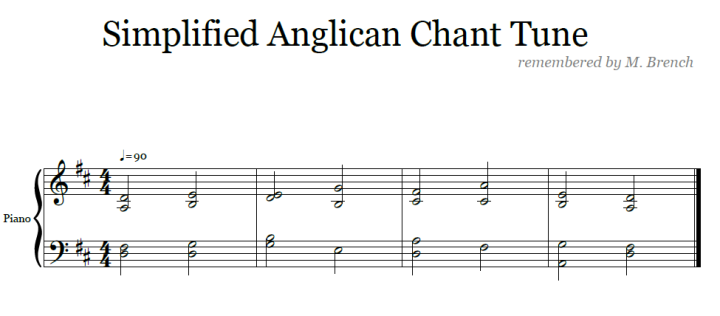
Simplified Anglican Chant is notated as four measures of music with two sets of notes each.  Each measure equals one half-verse of Psalm text.  Thus one full line of Simplified Anglican Chant equals two verses in the text of the Psalm.*  The majority of the half-verse is sung on the first note; the last ‘strong’ syllable is where you switch to the second note.

If you have the Book of Common Praise 2017, you’ll find an excellent explanation of this, complete with pictures, at “hymn” #738a.  Hymns #739-750 are twelve different Simplified Anglican Chant tunes.

Whether you have that book or not, however, you can take a look at this video I put together a little while ago.  In it, I go over some of the basics described above, and then demonstrate a few verses of Psalm 96 (which is among this morning’s appointed psalms, by the way).

The sample tune I used is not one of the twelve in the hymnal; it’s just one I vaguely remembered from when I was in a church choir nearly nine years ago.

simplified anglican chant

* From the 2017 hymnal: “But what if a psalm contains an odd number of verses rather than an even number?  Rather than finish the chant formula halfway through, which would be musically unfulfilling, the congregation can repeat the second half of the chant formula (measures 3 and 4) for the last verse of the psalm.