Praying Amidst an Impeachment Inquiry

I am not one known for being particularly #woke.  Following the news is (for me) a low-priority necessary evil.  There’s a lot of distraction out there, far too much commentary posing as facts, and let’s not even talk about the Comment Sections on news-related websites and social media.  Except this blog; comments here are pretty sparse and polite… thanks for that!  For the politeness I mean, I wouldn’t mind if they were less sparse.  Not that I’m begging.

Anyway, it did not escape my notice that a formal call to investigate the President of the United States of America and his conduct regarding foreign relations and electoral procedures, with an eye toward an impeachment inquiry, has been issued.  I had a few emotional knee-jerk reactions deep down inside, and I’m sure lots of people are going to have much stronger, and more public, reactions to this news also.  So I thought this would be a good thing to address in the realm of liturgy and prayer.

To a large extent, liturgical intercessory prayer is a matter of fill-in-the-blank.  We have a standard collection of prayers that we offer for the state, for society, and for leaders in particular.  On that level, our prayers for the nation do not change just because the word “impeachment” is officially on the table in Washington D.C.  We must not, on the one hand, devolve into that silly “sports fan” scenario of prayer, pray that we crush the Angry Orange Man of Doom.  Nor must we, on the other hand, devolve into that nationalism-over-faith sort of idolatry that we’ve seen from certain health-wealth and pentecostal extremes lately, and pray The Lord’s Anointed will be protected from such a demonic assault.  No, the President is still the President, and the inquiry is a perfectly legal procedure, whatever our personal opinions may be about either.  And so on one level we must continue to pray as we always pray:

We pray that you will lead the nations of the world in the way of righteousness; and so guide and direct their leaders, especially Donald Trump, our President, that your people may enjoy the blessings of freedom and peace.  Grant that our leaders may impartially administer justice, uphold integrity and truth, restrain wickedness and vice, and protect true religion and virtue.

2019 BCP, page 110

What does change is the context of our prayers, rather than the content.  With this new inquiry in mind, we must be sure we heartily pray for:

  1. impartially administer[ed] justice” – that these proceedings will go forward wisely, without assumption of guilt without evidence, and without scorn of evidence without analysis;
  2. uphold[ing] integrity and truth” – that all involved will proceed with due dignity and gravity of the task before them, without bombast or frivolity, and earnestly seeking the truth of the matter;
  3. restrain[ment of] wickedness and vice” – if the President is guilty of crimes that he will be held accountable for them; that the proceedings will not be sullied by ad hominem tactics, and our observation will not be an occasion for sin;
  4. and the “protect[ion of] true religion and virtue” – referencing James 1:27 as well as the general plea for clear heads and pure hearts to prevail.

These are four of the major purposes of earthly governments, as we understand the teaching in the Scriptures, and we ought to keep these in mind as we pray.  Whether you want to see Trump out of the White House for good, or whether you want him to remain there, in prayer we learn to set our political preferences aside and come before the Father with a more pure request: to fulfill his Word, to mete out judgement in his own time and on his own terms, and to deliver each of us from temptation and evil in the midst of all this.

We’ve also got Occasional Prayers #29, 30, 33, 37, 38, and 39 on pages 654-7 to help spell this out further.  Resist the temptation to go on internet rampages; take it to the Lord in prayer.
Readings Review & Planning Propers 9/24

Readings Review

Last week: 1 Kings 6-11, Hebrews 5-10, Habakkuk 3, Zephaniah, Haggai, Zechariah 1, Matthew 12:22-16:12
This week: 1 Kings 12-14, 2 Chronicles 12-15, Hebrews 11-13, James 1-2, Zechariah 2-8, Matthew 16-20
Special reading coming up on Sunday for St. Michael’s Day: Revelation 12:7-12

We touched on this a few weeks ago, but something we’ll see this week is the beginning of some regular jumping back and forth between Kings and Chronicles in the Morning Prayer Old Testament track.  This will occur regularly from this week into early November.  It may be annoying for your bookmark(s), but it will make for a fuller coverage of events going through that history.  In general, Chronicles emphasizes the positive things to say about various kings of Judah, such as Asa’s religious reforms this week, whereas Kings takes a number of ‘digressions’ to talk about the prophets instead of the kings.

In Evening Prayer, the Gospel readings have reached the “home stretch”, as it were.  With the Transfiguration reached last night, everything is geared toward Jerusalem, and the death and resurrection of our Lord.  The Gospel according to St. Matthew still has a lot of final parables and things to get through, but we should remember that their primary context is now “with his eyes on the Cross.” Keep that in mind as you read, this week and next.

Planning Propers

This is the week of Proper 20 (or 14th after Trinity in the traditional calendar), so keep in mind that the historic Prayer Book default is that a mid-week Eucharist will repeat the Collect & Lessons (the propers) for yesterday.  Otherwise, we recommend…

  • Tuesday 9/24 = Votive *
  • Wednesday 9/25 = Votive or St. Sergius
  • Thursday 9/26 = Votive
  • Friday 9/27 = Votive
  • Saturday 9/28 = Votive
  • and remember that Sunday is the feast of SAINT MICHAEL AND ALL ANGELS!

* A Votive is a “Various Occasion” (page 733 in the BCP 2019).

Your Own Commemorations

I recently read a reflection on the Church’s calendar, in which the author says: “The church year means that we don’t accidentally exclude a truth or event that is important for the life of our souls.”  What a clear and simple way to explain such a profound truth!

There are a number of truths and events that are important to our individual lives, too: birthdays, wedding anniversaries, baptism and confirmation anniversaries, graduations, new jobs, new homes, and so forth.  Dates and events like these form the skeleton of a Family Calendar that helps dictate the liturgy of your ordinary life.  It’s quite a neat comparison to how the Church Calendar sets up the framework for the liturgy of worship.

But there are a few spots where the Family Calendar and the Church Calendar might, and in a way should, intersect.  Just as there was once a tradition of a Family Bible with the names, birthdays, and death days and so forth, we can do the same with our Prayer Books.  Every Prayer Book has a calendar of commemorations, sometimes called “black-letter days”.  These calendars vary from book to book, and since they’re all technically optional, an implicit suggestion is that local churches can add to (or ignore) this calendar as is appropriate for their context.  The addition of St. Aelfric in this Customary is an example of that.

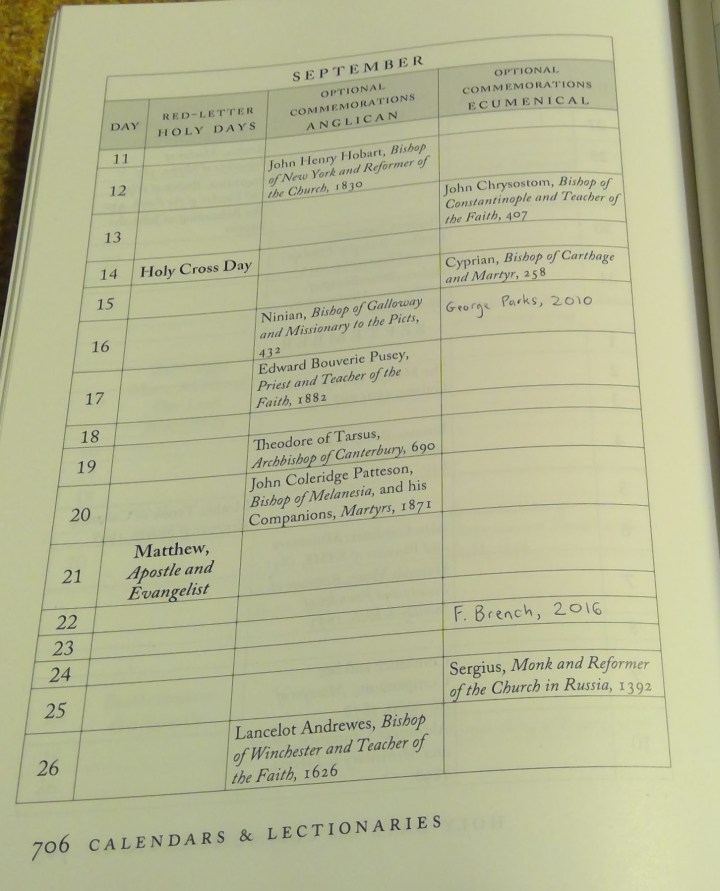
In that spirit, it can be a good idea for individuals to add in their own special commemorations in their own prayer books – not frivolous occasions, but ones that can and should be remembered in prayer somehow, such as deaths of family members and friends.  If you’re a parish priest, the death dates of members of your flock may be worth recording too.  It can help with the grieving process, it can help us remember the departed in an appropriate context, and even remind us to reach out to others who may be grieving more long-term.  I’ve already got seven names in my book, two of them are this month:

WIN_20190922_20_09_48_Pro

The distinction between Anglican and Ecumenical commemorations may be somewhat irrelevant for this purpose; this is more a third, “Personal”, category anyway.

Also keep in mind that the Prayers of the People in the Anglican Standard Text (on page 111) has a fill-in-the-blank spot in which the names of the departed may be remembered.  One tradition is to name the departed on or close to their death date (sometimes called their obit), and another tradition is to name all of them at the All Soul’s Day service (which for most of us Anglicans actually will probably be All Saints’ Sunday).  Whatever you do or don’t do, remember that your copy of the Prayer Book is your copy; invest your spiritual life into it!

Stewardship and St. Matthew’s

Today in the Offices and Eucharist we pray:

Lord Jesus, you called Matthew from collecting taxes to become your apostle and evangelist; grant us the grace to forsake all covetous desires and the pursuit of inordinate riches, so that we may follow you as he did and proclaim to the world around us the good news of your salvation; for with the Father and the Holy Spirit you live and reign, one God, now and forever. Amen.

Combined with his story from Matthew 9:9-13 and the other lessons from today’s Communion (Proverbs 3:1-12, 2 Timothy 3:1-17), we have a day that provides a solid groundwork for a “stewardship” sermon or devotion.  Perhaps that is an evangelical buzzword, I’m not sure if everyone uses it with the same connotation – this is an opportunity to talk to people about money and what they do with it.

St. Matthew was a corrupt lover of money before he followed Christ.  Although the Bible doesn’t give us any specifics of his life post-call, it stands to reason that he, like the others, lived a life radically dedicated to his Lord: his priorities changed from “covetous desires and the pursuit of inordinate riches” over to the proclamation of “the good news of… salvation.”  This is a transformation that is part and parcel of Christian living for everyone.  For some of us the love of money is manifest in the insane hoarding of wealth – buying that summer cottage and new yacht while neglecting the tithe and basic charity; for others it is the more subtle beast of “waiting for the next pay-raise” before finally trusting God with generous giving; for others the love of money is the miserly life in constant fear on the edge of poverty.  Money can rule the heart of rich, comfortable, and poor, alike.  All need the transformation of heart.

What makes this feast day particularly interesting in timing in Year C of the Sunday Communion lectionary is that (this year at least) we’ve been hearing about a lot of hospitality and wealth related lessons from Luke 14-16.  St. Matthew’s Day fits right in to this context, giving us a concrete example of a person who experienced this reformation of heart regarding money.  To make this clear, here are the Gospel lessons from September 1st, 8th, 15th, and 22nd in the 2019 Prayer Book:

  • Luke 14:7-14 = be hospitable to those who can’t repay you
  • Luke 14:25-33 = renounce all to be Christ’s disciple
  • Luke 15:1-10 = Jesus is hospitable with sinners in order to draw them to salvation
  • Luke 16:1-13 = parable of dishonest manager, you cannot serve two masters

Obviously it’s too late to go back and turn September into Stewardship Sermon Series Month.  But in your own devotions today may be a good time to glance back, put some of these pieces together, and reflect on your personal relationship with money versus your personal relationship with our Lord.  And if your reflections bear fruit in the form of an article or bulletin note or other communication for your congregation, all the better!

Blessings Despite Sin

Since we’re reading Haggai in Evening Prayer, let’s go for a sermon on part of chapter 2.

Index Outline:

  •  00:00 The story of Haggai 2:10-19
  •  05:13 Lesson #1 Grow in faith
  •  07:20 Lesson #2 Sin is contagious
  •  10:20 Lesson #3 Receive God’s holiness 
  •  12:20 Lesson #4 Recognize God’s blessings 
  •  15:15 Concluding thoughts & prayer

The short book of Haggai is one with which I’m particularly familiar, having preached through it a few years ago.  If you want to explore any part of this book in depth, feel free to check out these sermons and articles:

The Comfortable Words

After the Confession and Absolution in the Service of Holy Communion follow The Comfortable Words.  In my planning notes, this entry was to be entitled “The Comfortable Words (old & new)” which I can only assume was a joke to myself, as the comfortable words are always the same four quotes from Scripture.  Both their function and their content are the same in the classical Prayer Books and in the 2019 Prayer Book.  All that differs are what the rubrics say.  Also, for the many people who are used to the Roman Rite, or the 1979 book, or similar liturgical revisions, the Comfortable Words may be a “new” feature of the liturgy to them.

This lovely graphic explanation of the Comfortable Words made the rounds on Facebook last month, and it’s worth sharing here:

68883032_3436068519740484_8566763161833701376_n

I’ll let the commentary there stand for itself.  What we can explore from a liturgical perspective is the question of what these “words” do, and how we use them.

Classically, all four of these statements were read by the priest after the Absolution, and were introduced individually: “Hear what our Lord Jesus Christ saith… hear also what what St. Paul saith… hear also what St. John saith…”  But in the 2019 there is one introduction: “Hear the Word of God to all who truly turn to him.”  This is matched with a rubric that states The Celebrant may then say one or more of the following sentences.  Basically, this means that the rubrics allow us to skip any or all of these Words.

It is the recommendation of this Customary that you go all-or-nothing on this.  The Comfortable Words have always been the same group of four ever since Thomas Cranmer first appointed them in 1549, and the logical progression they form together makes the omission of one or more a loss to overall coherence.  Besides, if you just read one, then it runs the risk of just being a “random Scripture reading” floating out there, whereas if you read all four it makes a more bold and clear statement about the forgiveness of sins.  The liturgy will survive without them, so either embrace them as a whole or leave them be entirely.

Their function is to stand as a sort of reassurance of pardon.  Beyond the Anglicans and the Lutherans (the only two Protestant traditions that retain any sense of sacramentality of Absolution from a minister) an “assurance of pardon” is about all a minister can give, after a confession, and quoting the Bible is the best way to go about it.  For us, then, who do have an Absolution pronounced, the Comfortable Words serve as a sort of biblical seal upon the priest’s word of absolution.  This emphasizes that the ministry of the Church is grounded upon the authority of the Word of God written.

Priest, if your congregation already has a high view of Scripture, and a clear understanding that your ministry is derived therefrom, then the function of the Comfortable Words has been fulfilled whether you read them or not.  This does not make them extraneous, however.  The Word of God is living and active, arguably even more alive and active than you are.  Therefore we should not treat the Comfortable Words as “extra add-ons”, but words of great significance and comfort.  The rubrics permit us to skip them, but tradition and wisdom together exhort us to make regular use of them.

Anecdotally, I find myself using them throughout Advent, Lent, and Easter, and only occasionally reading them through the rest of the year.  Like many priests, I feel pressed for time: so-and-so wants to get home on time for the Patriots game, the kids only have so much attention span left, and wasn’t the sermon already long enough?  Perhaps there are good reasons for omitting the Comfortable Words from time to time.  But as a norm, we probably ought to be reading them far more often than we omit them.

An Ember Day Hymn

If you’re following this Customary’s plan for Daily Hymnody from The Book of Common Praise 2017, then you’ll find that the hymn appointed for this Ember Day is “Come, Holy Ghost, our souls inspire.”  In the 2017 hymnal this is set to the Sarum Plainsong tune VENI CREATOR SPIRITUS, which is a bummer for me because I’m used to it being sung to COME HOLY GHOST.  And the way the lyrics are matched to the notes in the 2017 hymnal is different from how it’s done in the 1940 hymnal, so that’s just confusing to me as a musician who has paid attention to that in the past.

Tune-related issues, aside, the text of this hymn is very significant.  It is appointed in the Ordinal to be sung or said at the ordination of a priest and bishop!  This is true for the 1662 as well as the 2019 book, so it’s pretty standard Anglican fare.  And it’s a 9th century text, so it’s a piece of our Western/Latin heritage as well! Let’s take a look at these words.

COME, Holy Ghost, our souls inspire,
And lighten with celestial fire.
Thou the anointing Spirit art,
Who dost thy sevenfold gifts impart.
Thy blessed unction from above,
Is comfort, life, and fire of love.

Prayers addressed to the Holy Spirit are rare in the liturgical tradition.  Confirmations and Ordinations are among the few times we actually do this.  The seven-fold gift of the Spirit is a long-standing image in Church literature, stemming from the New Testament itself, and includes an Old Testament precedent that is not often in favor with Protestant interpretation.  You can read more about that here if this is unfamiliar to you.

Enable with perpetual light
The dulness of our blinded sight.
Anoint and cheer our soiled face
With the abundance of thy grace.
Keep far our foes, give peace at home;
Where thou art guide, no ill can come.

These are the primary specific petitions of this hymn.  Open our eyes, cheer us, grant us peace… if you think back to one of the titles our Lord gave for the Holy Spirit – The Comforter – these all make perfect sense.  Christ has won the victory, Christ has redeemed us; it falls to the Holy Spirit to apply these truths to our hearts and minds, to point us back to Jesus.  Such sight, cheering, and peace are all thereby ministries of comfort and help.

Teach us to know the Father, Son,
And thee, of both, to be but One;
That, through the ages all along,
This may be our endless song:
Praise to thy eternal merit,
Father, Son, and Holy Spirit.

Finally our plea is that we would know God the Trinity, Father, Son, and Holy Spirit, and that in this knowledge we would be able to worship and praise him forever.  Knowledge and worship, doctrine and doxology, teaching and liturgy, these are pairs that should never be separated.

Interesting that this hymn doesn’t actually mention anyone getting ordained, huh?  Yes, its function in the ordination liturgy makes it into a prayer especially for the candidate for ordination, but but textually it need not be so limited.  By all means, sing this and pray for your clergy.  But you can pray this for yourself, for all the Church, just as easily and honestly.  In the context of ordination, it makes sense that we should pray for clarity, for sight, for knowledge – not just for the candidate but for the whole congregation.  Calling a new minister of the Gospel, in any Order, is a “big deal” – one that will impact many lives for many years to come.  The Church needs to be in her right mind when placing the collar of recognizable authority upon another servant.

So on these Ember Days, be sure to pray for your Bishop and his clergymen, as well as for those individuals considering or seeking Holy Orders and the congregations in discernment with them.  The process is useless if the aspirant is surrounded by “Yes Men” whose eagerness to support blinds them from asking any hard questions about his true calling.  So pray this hymn with them and for them.

Long Psalm 89

Evening Prayer today, the 17th day of the month, is occupied in its psalmody solely with Psalm 89.  This psalm is quite lengthy, and one of the big challenges with long psalms is keeping the attention span alive, and the comprehension alive, all the way through.

In short, Psalm 89 is a celebration and lament in a single package.  God has given a covenant to the house of David, promising the eternal kingship to his servants.  Yet God has allowed Israel, in their unfaithfulness, to fall into misfortune at the hands of their enemies.  Which mood wins out?  Let’s look at a little outline of its verses:

  • vv1-2 Introduction
  • vv3-4 Summary of the Davidic Covenant
  • v5-19 Hymn to God the Creator
  • 20-36 Celebrating the promise to David
  • 37-44 Lamentation for the fall of David
  • 45-50 Reproaches
  • v 51 Benediction

So there’s a logical, or even sort of chronological, order to the main body of the psalm: from verse 5 through 44 we have a movement from God’s lordship over creation, God’s covenant-making, and God’s withdrawal of the blessings of that covenant.  The “Reproaches” at the end are similar to the Lamentations, bewailing the loss Israel has suffered, beseeching God for mercy, and expressing glimmers of hope that His faithfulness will pull them through.

Plus, if you take the promises seriously in the celebratory part of the psalm, the language of “forever” is pretty strong – even if curse and calamity should befall God’s people, it must only be for a season – God’s covenant promises carry eternal weight.  This is especially true from the New Covenant perspective we have as Christians, since the Davidic Covenant is fulfilled in the kingship of Christ Jesus.  It is unsurprising, therefore, that Psalm 89 is featured on holy days like St. Joseph‘s and Christmas Day.  This reality transforms the lament and reproaches even more for us: now when we see the Church suffering on earth, we know all the more undeterred that our Lord and King stands firm, victorious even over death and the grave.

So, as usual, keep the gospel of our Lord Jesus Christ in mind as you’re praying through this long psalm.  Perhaps the verse groupings listed above can give you places to pause for breathe and recollect your attentions, too.

Readings Review & Planning Propers 9/16

What we’re doing on this blog on Mondays is looking back and forth at the Daily Office readings (or lessons) so we can better process together what the Scriptures are saying, and list the recommended Propers for the Communion or Antecommunion service for each day of the week.

Readings Review

Last week: 1 Kings 1-5, 1 Chronicles 28, Ephesians 5:18-6, Hebrews 1-5, Micah 6-7, Nahum, Habakkuk 1-2, Matthew 8:18-12:21
This week: 1 Kings 6-11, Hebrews 5-10, Habakkuk 3, Zephaniah, Haggai, Zechariah 1, Matthew 12:22-16:12
Special reading Saturday for St. Matthew’s Day: Matthew 9:9-13

The Old Testament lessons in Evening Prayer are still powering through the Minor Prophets (or slogging through, depending upon how you feel about them).  In the next few days we finish up the middle group of minor prophets, covering the “late kingdom era”, that is, the prophets who served at the royal court in the final century of Judah’s existence as a kingdom.  Later this week we’re starting into the last three (Haggai, Zechariah, and Malachi) who wrote during the Second Temple Era, that is, during the rebuilding of Jerusalem after the exile in Babylon was complete.  The short book of Haggai is one with which I’m particularly familiar, having preached through it a few years ago.  Click here to find eight articles and sermons about Haggai and his themes!

Meanwhile in Morning Prayer we started the Epistle to the Hebrews last week, and are now working our way through the thickest part of that book culminating in chapters 9 and 10.  The gist of Hebrews is basically “Jesus is better than __!” where the blank is just about anything important from the Old Testament religion.  The priesthood descended from Aaron is the particular focus of what Jesus fulfills and transforms in chapters 9 and 10, and have much to teach us about priestly sacrificial atonement.

Planning Propers

This is the week of Proper 19 (or 13th after Trinity in the traditional calendar), so keep in mind that the historic Prayer Book default is that a mid-week Eucharist will repeat the Collect & Lessons (the propers) for yesterday.  Otherwise, we recommend…

  • Monday 9/16 = Votive (of the Holy Spirit) * or St. Ninian
  • Tuesday 9/17 = Votive (of the Holy Angels)
  • Wednesday 9/18 = Ember Day I
  • Thursday 9/19 = Votive (of the Holy Eucharist) or St. Theodore of Tarsus
  • Friday 9/20 = Ember Day II
  • Saturday 9/21 = SAINT MATTHEW

* A Votive is a “Various Occasion” (page 733 in the BCP 2019) and label in parentheses are simply a traditional suggestion.

Holy Cross Day Round-up

Today is the feast of the Holy Cross, a red-letter day newly introduced into the Prayer Book tradition in the 20th century.  Historically, this holiday commemorates the date that Emperor Constantine’s mother, Helena, found the True Cross in a rubbish heap outside of Jerusalem, thus beginning the veneration (not worship) of the instrument whereby Christ redeemed the world.  In modern Prayer Book context, this holiday focuses on the glory of Christ on the Cross, thus instead of the Gospel lesson being about the crucifixion, it’s from John 12 wherein our Lord declares that when he will be lifted up the whole world will be drawn to him.

Here’s a round-up of different sorts of writings to help explore different facets of the Cross and this holy day.  (In general the first three links are shorter reads and the latter three are longer, in case you need to budget your time.)