Let us give thanks for God’s deliverance

In our recently-released order for praying the Occasional Prayers and Thanksgivings you will find Thursday evening is a time particularly dedicated to giving thanks.  Some of the thanksgiving prayers in the back of our Prayer Book are rather specific, and may not always resonate with the individual’s situation or experience.  But this one might be an interesting take right now:

  1. FOR DELIVERANCE FROM PERIL

Almighty God, our strong tower of defense in time of trouble: We offer you praise and heartfelt thanks for our deliverance from the dangers which lately surrounded us [and for your gracious gift of peace]. We confess that your goodness alone has preserved us; and we ask you still to continue your mercies toward us, that we may always know and acknowledge you as our Savior and mighty Deliverer; through Jesus Christ our Lord. Amen.

With hints of Psalm 46, this prayer celebrates in thanksgiving a deliverance that God has wrought among his people.  The bracketed phrase about his gracious gift of peace enables one to put this prayer into a post-war context, though it could easily serve many situations in a metaphorical sense too.

Some states and countries are beginning to “open up for business” now or in the near future.  Let’s not get into the debates of “too soon” or “too late”; our concern here is how we pray.  If you have come through this time healthy, housed, and fed, then you have much to give thanks for!  God’s goodness has preserved you from the dangers that lately surrounded you.  We are taught in holy scripture to give thanks even in the midst of our sufferings, though that is not one of the themes of this particular prayer.

But there is an important line in this prayer which we might not always remember to think or pray on our own: “we ask you still to continue your mercies toward us…”  It’s very easy to come out of peril with victorious mentality: I’ve overcome the challenge, we got through this, the fight is over, the battle won.  In reality, most perilous situations (be they wars, pandemics, family feuds, or whatnot) have after-effects and the threat of resurgence.  There is great concern that the second wave of COVID-19 will be worse than the first if it isn’t handled rightly at the onset.  So it is important that we don’t let down our guard and cease from prayer just because a problem looks like it’s going away.  This prayer directs us to keep up the petitions even in the midst of thanksgiving and deliverance.

Regardless of context, that’s an important lesson to take to heart, if one would become a mature Christian in prayer.

The Canticle of Zechariah

The seasoned Anglican, or other tradition of Christianity also steeped in liturgy, will have an interesting experience this morning: the Canticle of Zechariah is in the New Testament Lesson!  On a practical lesson that means you should replace that Canticle with a different one in Morning Prayer today; prior Prayer Book tradition recommends the Jubilate, Psalm 100, which can be found a couple pages earlier in the Morning Prayer service, on page 15 of the 2019 Book of Common Prayer.  Normally the Canticle of Zechariah, or Benedictus, should not be replaced, remaining a static ingredient in the Daily Office of Morning Prayer.

Experientially, though, this is where things get interesting.  If you pray the Daily Office with any regularity, you’ll be used to the translation of the Canticle of Zechariah in the liturgy (whichever one you happen to use), and thus will be reading the awkwardly-different wording for it in your regular Bible today.  But that’s a good thing.  Every now and then it’s helpful to try a different translation of the Bible, as it can give different insights into the breadth and depth of meaning of the text.  You might want to pursue the rabbit trail of the subject of Bible translation; here are two videos:

  1. what sort of translations are there
  2. how to choose among them

Anyway, with that in mind, let’s glance at a couple examples where the English Standard Version of the Bible (ESV) and the 2019 Prayer Book give us different takes on the Canticle of Zechariah, or Benedictus.

Blessed be the Lord God of Israel, for he has visited and redeemed his people
Blessed be the Lord, the God of Israel; he has come to his people and set them free.

The ESV uses the word “redeemed” where our Prayer Book renders it “set them free.”  Both of these terms are, of course, helpful.  “Redeem” is a key biblical term and it’s important to note it and retain it, as the Apostles did as they appropriated Old Testament language into their own writings.  But it’s also helpful to tease out the various meanings of redemption, and being set free is one of those aspects.  It sounds rather clinical, or even businesslike, to say God redeemed us.  To say he set us free carries a lot more emotional relatability.  So it’s quite appropriate that our formal Bible translation says “redeem” while our liturgy is more poetic.

to show the mercy promised to our fathers and to remember his holy covenant,
He promised to show mercy to our fathers and to remember his holy covenant.

One of the features of modern English compared to Early Modern English and many other languages (especially Koine Greek) is that we like short sentences today.  The ESV tries very hard to preserve the Greek run-on sentence, and that’s great – it helps the reader notice the connectedness of the front half of this canticle, even if it makes it harder to read at first.  But in the course of the liturgy, we want to be able to offer up this song-prayer with ease and beauty, so almost every verse is made into its own sentence.

to give knowledge of salvation to his people in the forgiveness of their sins,
To give his people knowledge of salvation, by the forgiveness of their sin.

In both cases, this verse is connected to the previous as part of a larger sentence; this is what Zechariah’s child, John the Baptist, would go on to do as the Prophet of the Most High.  The word order of these two translations is slightly different, but the main difference is in the preposition of the second half: “in” or “by” the forgiveness of their sin(s).  Prepositions like these can be very tricky.  Sometimes we use them loosely and think little of them.  Sometimes we make Really Big Deals about the little nuanced differences between them.  Seeing two different prepositions used here, therefore, helps clue us in to how we might best handle its meaning.  In the liturgical text, people are given knowledge of salvation BY the forgiveness of their sin; and the ESV translation says knowledge of salvation comes IN the forgiveness of sins.  So the act or reality of forgiveness is something of an instrument for bring about salvation… IN and BY the cross, for example, Jesus enacts the salvation of the world, the forgiveness of sins.

Anyway, this is just a fun opportunity to experience this text in a different translation than we’re probably used to.  Plus there’s also the dynamic of reading a canticle as a Scripture Lesson rather than as a Canticle on its own.  I’ve noted something of that dynamic in a previous entry you’re welcome to look back on, too.

An Order for using the Occasional Prayers & Thanksgivings in the 2019 Prayer Book

The Daily Office of Morning and Evening Prayer have always provided for the allowance of additional prayers at the end.  The classic prayer books, in fact, provided a group of Additional Prayers immediately after (as well as within) the main text of the Daily Offices.  Modern books, like the 1979 and the 2019, have a much larger corpus of additional prayers located near the back of the book like an appendix.  This gives us the mixed blessing of having more quality prayers to draw from but the greater physical distance within the book such that they might more easily be ignored or forgotten.

To help remedy this, I’ve made available here in the past some orders for using the Occasional Prayers and Thanksgivings in the Daily Office.  Now the Saint Aelfric Customary is putting forth a third (and I think, final) version.
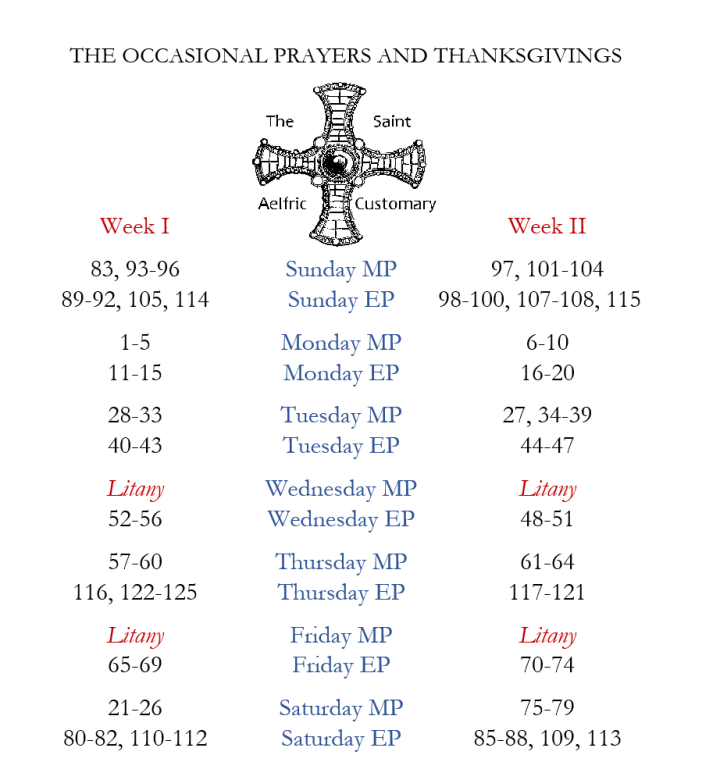
 

Occasional p+t

NOTE: All you have to do is download this picture, print it out, and use it as a bookmark in your prayer book!  If you want a document or spreadsheet with this information, please request one in the comments.

The previous versions were more jumpy, attempting to corral certain prayer topics to certain days.  After a few months of use I decided they could be streamlined to be easier to follow.  So here we are!  Let’s walk through how this works.

Two-Week Rotation

Because there are 125 prayers and thanksgivings, they are split into a two-week rotation so that an average of five are appointed for each Office.  You could combine them into a one-week cycle if you’ve got the attention span for it, I suppose.  Two prayers are omitted: #84 because it’s for meal times, not an office, and #106 because it’s better for the service of Antecommunion.

Wednesday and Friday Mornings are omitted because that is when the Litany is traditionally appointed to be said.  I assume that if you’re sufficiently “advanced” in your use of the Office to be making use of these prayers, you can (or should) be already praying the Litany.  Sunday morning is also an appointed time for the Litany, but in the scheme of this Customary, the Litany will actually be treated separately, between Morning Prayer and Holy Communion, and thus there is room for these prayers in Morning Prayer.

Monday

The twenty prayers for the Church are spread through the Offices on this day.

Tuesday

The prayers for the nation and most of the prayers for society are covered on Tuesday.  The morning in Week II has an inordinately large number of prayers appointed because there are included prayers specifically for Canada and for the USA, with the assumption that the individual will skip the national prayers that don’t apply.  #21-26, for Creation, were skipped and saved for Saturday.  #27 and #28 were separated into different groupings of prayer because they are very similar and would be a bit redundant prayed back to back.

Wednesday

The rest of the prayers for society are covered here, and the section of prayers for “those in need” is begun.

Thursday

The rest of the prayers for those in need are finished on Thursday mornings.  The evenings are for the thanksgivings, in keeping with the eucharistic theme accorded to Thursdays in some strands of liturgical tradition.

Friday

The evenings see the Family and Personal Life section begun.

Saturday

Week I holds the prayers for Creation, as Saturday is often a day off from work, and thus a day on which many people are likely to enjoy the outdoors.  More prayers for family and personal life are appointed here, as well as the beginning of the Personal Devotion section.  Most of the prayers for “Death, the Departed, and the Communion of Saints” also land on Saturday evening, matching the Good Friday to Holy Saturday to Easter Sunday pattern of spirituality.

Sunday

The last of the “Personal Devotion” section is covered on Sundays, as well as the last two “Death, the Departed, and the Communion Saints” section.  Most prominently, though, Sunday is when the “At Times of Prayer and Worship” section is used, splitting the preparatory prayers into the morning and the “after hours” prayers into the evening.


As a result, if you hold public Morning or Evening Prayer on Sundays, the occasional prayers here appointed will be particularly apt for the congregation’s interaction with the liturgy.

If you hold a public Office on a weekday, however, a pattern like this may not be beneficial.  The idea of this order is to provide the person(s) praying with the full scope of the Occasional Prayers’ contents, so if someone only experiences one weekday “slot”, then they’ll only experience one theme or category of occasional prayers.  In such a situation, it would be prudent to select occasional prayers from various groupings as is appropriate for the occasion, or as befits the lessons of the day.

The Psalms of Ascent

If you’re praying the Psalms in the Prayer Book, there is one little detail that you’re missing: the superscriptions, usually printed in italics, above verse 1.  Sometimes they are titles; sometimes they note the author or a situation relevant to the psalm’s origin; sometimes they say something about the music or the instruments.  Some Bible translations even make the superscription “verse 1” and start the text of the psalm on “verse 2”.

The usefulness of these superscriptions is… honestly rather poor.  When you compare the Greek and Hebrew Old Testaments, many of them are different.  When you compare different manuscript groups even within the same language, they still vary.  In short, it’s very difficult to tell how old a given superscription is, when they were added, by whom, and for what purpose.  Even if some of them are authentic they can still be misleading; to say a Psalm is “Of David” could mean both written by him or written in the tradition of David.  To say a Psalm is from “Asaph and his sons” could mean both written by him and his biological children or written by the school of Temple musicians that was first run by Asaph.

And so, quite rightly, liturgical texts such as the Prayer Book do not include the superscriptions for any psalm.  After all, when it’s time to pray, we don’t read titles and labels, we pray the prayers.

But there are some superscriptions that can be useful.  Psalms 120 through 134 are all labeled “A Song of Ascents.”  It is said that this label refers to their liturgical use among the faithful Judeans, who would sing or chant these psalms during their approach (or “ascent”) to Jerusalem for a high feast like Passover, or Pentecost.  This tells us nothing about their origin, but that doesn’t really matter; these are prayers to be prayed.  That they were especially used in a particular context can give us insight into how we might use them too.

And, lo and behold, there are two places in the 2019 Prayer Book where this group of Psalms shows up.  One is on page 735, where they are commended as appropriate psalms to be prayed on the 31st day of the month, when the 30-day cycle has ended but the next month has not yet begun.  This is kind of an “ascent”, approaching the beginning of a new month.  The other place they are mentioned is on page 39 where Psalms 120 through 133 are offered as suitable additional psalms for Midday Prayer.  (Psalm 134 is omitted in this reference because it’s already on the list for Compline.)  So there again, at midday, we have a sort of “ascent”, not quite at one of the major Offices of prayer for the day, but simply stopping along the way of the day’s journey to offer some brief prayers before continuing on in our labor.

In the Daily Office, the Psalms of Ascents are normally read on the 27th and 28th days of the month (today and tomorrow).  They are mostly pretty short, and they touch on all sorts of topics.  (This may be something of a relief after the epic-length Psalm 119 occupying three days of prayer!)  Most of them are pretty happy and cheerful, celebrating God’s deliverance and protection.  Several of them are sober, expressing trust in the Lord in the face of evil.  Though among them is also Psalm 130, “Out of the deep…” which is traditionally associated with death and grief.

One could say that they inspire and model for us the traditional practice of “keeping the hours”, or offering regular but very brief prayers at certain times of day.  They do this by being short, concise, and memorable.  On the ascent to Jerusalem, stop and offer these prayers, one by one, along the way.  On the way through your day, stop and pray these psalms, or other prayers, bit by bit, along the way.

Sihon & Og in Numbers 21

Let’s wrap up Friday with a video on this morning’s reading from the Book of Numbers.  Honestly, the only reason I know about Sihon and Og is because they show up in Psalms 135 and 136.  Regular prayer of the Psalms, as our Anglican tradition wisely provides for, can help us connect with some otherwise-obscure stories like this…

“If you forgive the sins of any, they are forgiven them”

At the Sunday Eucharist a few days ago we read or heard the following utterance from Christ:  Receive the Holy Spirit.  If you forgive the sins of any, they are forgiven them; if you withhold forgiveness from any, it is withheld”  (John 20:22-23).  This and its counterparts in the Gospel of Matthew can be rather contentious verses among Protestants today.

As jarring as this might be for modern evangelicals, Jesus meant exactly what he said.  He invested his apostles with the power of the Holy Spirit to forgive and withhold (or retain) sins.  In Matthew’s Gospel book this is expressed in the language of “binding” and “loosing” – people are bound to their sins or loosed from their sins by the power of the Holy Spirit.  This is called The Power of the Keys (after how Jesus introduces it in Matthew 16), and is a feature not only of Roman theology but of classical protestantism as well.

“But only God forgives sins!” scoffs the pharisees and evangelicals alike.  Naturally, this is a valid point, and the whole point of that objection in the Gospels is to highlight the true divinity of Jesus.  However, Jesus unapologetically tells his apostles to forgive and retain sins.  Saint James would go on to reflect on this in chapter of his epistle: “Let him call for the elders of the church, and let them pray over him, anointing him with oil in the name of the Lord.  And the prayer of faith will save the one who is sick, and the Lord will raise him up. And if he has committed sins, he will be forgiven.”  So there must be a way to connect the dots.

Thankfully, as Anglicans, we have hard-wired our theological answer to this conundrum into our liturgy.  In the Daily Offices of Morning and Evening Prayer the absolution read by the priest contains this sentence:

He has empowered and commanded his ministers to pronounce to his people, being penitent, the absolution and remission of their sins.

That is the wording in the 2019 Prayer Book, but it’s essentially the same in all historic Prayer Books.  The interpretation is clear: John 20:23 is a granting of authority to Christ’s ordained ministers.  But what it also does is link the minister’s words to the power and authority of Christ, who

pardons and absolves all who truly repent and genuinely believe his holy Gospel.

Thus the forgiveness of sins is not a special power of the priest so much as it is the promise of God to all faithful penitents; the priest or bishop is merely the mouthpiece for God in the congregation for that role.

In the Communion service the words of absolution are different.  But they are followed up with The Comfortable Words, which provide the Word of God as a more sure foundation of the absolution spoken by the priest.  In short, it is God, in Christ, through the power of the Holy Spirit working through an imperfect priest, who forgives sins.  The priest has a solemn and fearful duty and role in this, but has no magical or divine powers of his own.

World Mission Sunday: it doesn’t have to exist

wrw

You know how it goes, haters gonna hate, complainers gonna complain, the overly-picky will never be satisfied.  Actually, being excessively choosy in one’s tastes is a form of the sin of gluttony, so their reward will be in their bellies… or something like that.

Anyway, one of the more nit-picky criticisms of the Texts for Common Prayer and the resultant 2019 Prayer Book was the introduction of a new commemoration: World Mission Sunday.  It has been branded as the Second-to-Last Sunday of Epiphany since its first appearance, if I remember correctly, though the rubrics (such as on page 604) state that it may be observed on any Sunday in that season, except for the first and last Sundays.

This shows us two things:

  1. The first and last Sundays are noteworthy over against the Sundays in between.  This is perhaps why many modern Anglican calendars appoint white for them, and green for the Sundays in between.  It also stands in line with the tradition of being able to celebrate major saints days (or “red letter days”) on the “green” Sundays but not the first or last in Epiphanytide.
  2. World Mission Sunday itself is not fixed.  It’s the 2019 Prayer Book’s default for the penultimate Sunday before Lent, but it doesn’t have to be!

In fact, when you look at the numbered Sundays “of Epiphany” you’ll find that there still are eight, which means that you can live like 2015 never happened and World Mission Sunday doesn’t exist.

So there you go, if you don’t like it, fine, you’re not required to use it!

What if I’m not grumpy about it, one way or the other?

I’ll tell you a secret, since this is Weird Rubric Wednesday where I’ve given myself permission to be a bit silly-yet-sincere.  I have never observed World Mission Sunday with my congregation.  They probably don’t even know it exists.  And it’s not because I’m opposed to world missions, or think it’s not worth celebrating or preaching about.  I’m not even one of the aforementioned grumpy critics.  Though I have been grumpy and critical about things in the 2019 Prayer Book before… but this isn’t one of them.

Initially I had two reasons for ignoring World Mission Sunday in my tiny parish.

  1. It used the exact same Collect as the 3rd Sunday of Epiphany and all its Scripture lessons are already found elsewhere in the lectionary, so it added nothing really new to the calendar on its own.
  2. More importantly, I had decided to preach through as much of 1 Corinthians as possible through Epiphanytide in Years A through C, so WMS would have interrupted that series considerably.

Since then, World Mission Sunday has gotten its own unique Collect, which is great, though its scripture lessons are still generally duplicated elsewhere in the lectionary.  So if you’ve got a preaching series through the lectionary readings going on during Epiphanytide, you too may want to opt for giving WMS a miss.  But in general, it’s not a bad tradition to introduce, and the Epiphany season is probably the best part of the year to place it.  Epiphanytide is already one of the most-changed seasons when you compare the historic and modern calendars, so it’s not as though further tinkering is going to make it any more or less like its original form.

If you want to learn more about World Mission Sunday in the context of the Epiphany season, here are some links to check out:

A Prayer for Seeking God

April 21st is a minor feast day, or Optional Commemoration, honoring Saint Anselm.  He was an Archbishop of Canterbury, a monk and abbot, and a theologian of great repute to this very day.  I’ve written about him before, which you should feel free to peruse if you’re interested.  Here’s the link: https://leorningcniht.wordpress.com/2018/04/20/st-anselm-of-canterbury/

For our purposes, however, staying close to the subject of Anglican spirituality with the new Prayer Book, I would like to observe that one of the Occasional Prayers (#88, for Daily Growth) is drawn from the prayers of St. Anselm.  He wrote a whole treasure trove of prayers and devotions which are highly theological, both affective and intellectual, you could say.  And from among that material, translated into comfortable modern English, we get this:

Teach me to seek you, and as I seek you, show yourself to me;
for I cannot seek you unless you show me how,
and I will never find you unless you show yourself to me.
Let me seek you by desiring you, and desire you by seeking you;
let me find you by loving you, and love you in finding you.  Amen.

This is very affective (emotional) as well as intellectual.  A lot of people are more strongly one over the other.  I was raised in a non-denominational evangelical setting where affective spirituality was the rising star: true devotion to Jesus was expressed in terms of love and joy and excitement.  More and more, people were expected to raise their hands and their voices in song as a sign of their spirituality.  But that same church, in my childhood, was more intellectual: know the Scriptures, memorize key verses, study the basic points of doctrine and consider why you believe what you believe.  This story is not unique, by any means; almost everywhere you can find both crowds, sometimes coexisting peacefully and sometimes at odds with one another.  Anselm is great because he stands squarely in their overlap.

Intellectually, he writes of seeking God and God revealing himself to us because we can’t seek or find him on our own.  Affectively, he writes of seeking and finding God by desiring and loving him.  And all the way through its a “both/and” scenario: let us seek God by desiring God and desire God by seeking God.

So if you’re an emotion-driven person who worries about the intellectual credibility of your faith sometimes, latch on to this prayer: “let me seek you by desiring you… let me find you by loving you” because that’s what you already understand.  Or if you’re an intellectual person who worries about how much you actually love Christ, latch on to the other side of the prayer: “let me desire you by seeking you… let me love you in finding you.”  The act of seeking God is itself a sign of love and desire; the act of desiring God is itself a sign of seeking and searching.

What an encouraging little prayer.  Thank you, Archbishop!

Reflection – The Fish – John 21:1-14

After a month of the quarantine lifestyle I’ve gotten a bit tired and find it difficult to keep up with daily blogging, so I apologize for the lack of entry yesterday.  Today I’m simply sharing a little video reflection on the Gospel for today’s Communion service.

God bless!