The Fraction & its Anthems

The Fraction, or breaking of the bread, is permitted to take place either at the Words of Institution or after the Consecration and Lord’s Prayer.  While the Reformed tradition, with most classical Prayer Books, has preferred the breaking of the bread at the Words of Christ, the summary in the biblical narrative commends a later fraction: taking bread, blessing it, breaking it, and then giving it (Matthew 26:26, Mark 14:22, Luke 22:19).  Thus the Fraction is permitted to take place after the Prayer of Consecration and the Lord’s Prayer, as is the case with the Roman Rite and the 1549 Prayer Book.

In the former case, the breaking of the bread during the Words emphasizes the narrative of the Last Supper, and points the worshiper toward that ancient Passover celebration in which the New Covenant was brokered.  In the latter, the breaking of the bread as its own ceremonial moment in the liturgy emphasizes the sacrifice of Christ upon the Cross, to which this entire liturgy directs us.  It is best when the celebrant chooses one pattern or the other, rather than snapping the bread during the Words of Institution and then actually breaking it at this point in the liturgy.

The Fraction Anthem, too, is drawn from the 1549 liturgy, which reads “Christ our Paschal lamb is offered up for us, once for all, when he bare our sins on his body upon the cross, for he is the very lamb of God, that taketh away the sins of the world: wherefore let us keep a joyful and holy feast with the Lord.”  This anthem, drawing largely from 1 Corinthians 5:7 and John 1:29, is parsed out into two options.  The first option, using the present tense, highlights the role of Holy Communion in communicating the Sacrifice of Christ to us.  The second option uses the past tense, rendering a version of the 1549 text in accord with how 1 Corinthians 5:7 is translated today.

The two versions of the anthem also represent slightly different emphases on the eucharistic sacrifice, often in line with high- and low-church perspectives.  The first declares the timeless nature of Christ’s sacrifice by using the present tense – this holy feast makes present to us now the atoning death of Christ.  The second uses the past tense to point us back in time, emphasizing the historicity of Christ’s sacrifice.  The worshiping community may benefit from using both of these anthems, perhaps appointing the former during seasons of joy and the latter during seasons of penitence.

The Lord’s Prayer at the Holy Communion

As the name implies, this prayer was authored by our Lord Jesus Christ.  The doxology “For thine is the kingdom…” is found in certain manuscripts but is largely understood to be a liturgical addition to the original prayer.  Exactly as with the Daily Office, the classical Prayer Book tradition appoints the Lord’s Prayer twice in the Communion service: once at the beginning (said by the priest alone), and again toward the end (said by all).  Which iterations of the Lord’s Prayer includes or excludes the doxology has varied from one Prayer Book to another, resulting in its near-universal inclusion in the present volume, for sake of simplicity and familiarity.

The English Prayer Book of 1549, with the Scottish and American Prayer Books, placed the Lord’s Prayer immediately after the Oblations, soon before the reception of the Sacrament.  The English Books thereafter, and of most other provinces, appoint the Lord’s Prayer immediately after the ministration and reception of the Sacrament.

The celebrant announces the Lord’s Prayer as one “we are bold to pray.”  This is not an historical commentary, referring to the people praying in their own tongue against medieval Roman malpractice, but a spiritual commentary: although we are unworthy sinners, boldly we approach the throne of grace, by faith (cf. Hebrews 4:16).

The Lord’s Prayer, being composed, taught, and commended by Jesus himself, is an integral component of any liturgy; no official service of the Church omits it.  Its specific placement at this point, however, does have significance.  The Prayers of Consecration have been completed, the holy food is on the holy table, and God’s family is gathered.  The first (and classically, only) thing the congregation says aloud in this holy moment is the prayer that their Lord taught them.  And, in the context of Holy Communion, many lines of this prayer take on particular meanings and tones.  God “in heaven” doesn’t feel quite so distant for a moment.  That his will be done “on earth as it is in heaven” is actually about to take place in our hands, mouths, bodies, and souls, momentarily.  “Our daily bread” is already before us in Word and Sacrament.  The promise of forgiveness and call to forgive others has already been addressed in the liturgy.  The lofty ideals and hopes of this Prayer are, in this glorious moment, nearer than they normally seem.

Consecrationism, Receptionism, and the Epiclesis

There are long-standing debates, especially within the classical Protestant churches, over the “when” and “how” of the consecration of the bread and wine.  On one side there is consecrationism, championed by Martin Luther and his early followers.  This view asserts that the Words of Institution, being the very words of Christ, are the moment in the liturgy when the bread and wine are properly consecrated to be the Body and Blood of Christ.  In competition with this rose a view called receptionism, championed by 17th-century Lutheran scholastics and John Calvin’s Reformed tradition, which asserts that the bread and wine are the Body and Blood of Christ only in the reception, or even only the faithful reception, of the communicants.  The Articles of Religion and the Prayer Book were written early enough that both views are encompassed within our prayers, thus allowing the debate to survive within the Anglican Church throughout these five centuries.

Differences both practical and devotional result from these competing views.  A consecrationist will consider the Words of Institution the most central, necessary, and holy part of the eucharistic canon, where a receptionist will emphasize prayers that speak of the worshipers’ faith and participation in Christ.  Furthermore, the consecrationist will consider bread and wine left over from the liturgy still consecrated and holy, where the receptionist will consider them ordinary bread and wine.  Most Prayer Books have included rubrics mandating the consumption of leftover bread and wine immediately after the liturgy, thus appeasing (though not directly affirming) the consecrationist view.

In the course of the 20th century, through increased contact with Eastern and Early Church liturgies, the epiclesis rose in prominence, especially among pentecostal or charismatic-minded Anglicans who naturally emphasize the work of the Holy Spirit.  Although this emphasis was largely absent from Western Christianity beforehand, a variant of consecrationism has arisen which asserts that it is the epiclesis, the invocation of the Holy Spirit, that consecrates the bread and wine.  The impact of this theology is reflected in the Additional Directions of the 1979 and 2019 Prayer Books, in which an Epiclesis is included with the Words of Institution in the rubrics for consecrated additional bread and wine during the Ministration of Holy Communion.

Entering Hallowtide

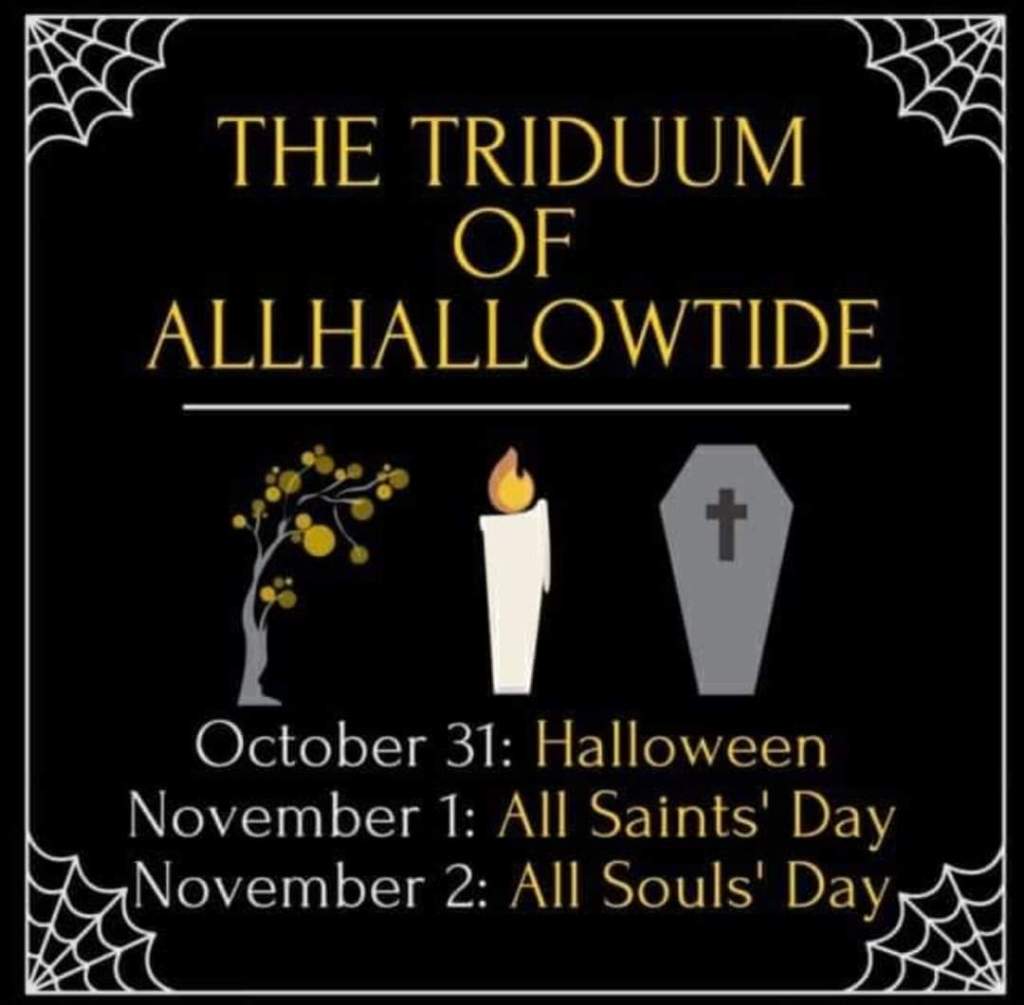
October 31st begins a stretch of time known informally as Hallowtide – an Old English word for “Saints Season”. One way to understand this holy moment in the Church Calendar is call it a Triduum, a three-day period.

Image pulled from Facebook

October 31st, Halloween, is the opening celebration in which we acknowledge the thinning of the barrier between the living and the dead. Some say this derives from the language of Celtic Christianity, but it’s very difficult to discern fact from fad when it comes to referencing the belief in practice of the early Church in the British isles, so let’s not take that too seriously. In any case, this evening, All hallows eve, is the liturgical start of All Saints Day itself, and the party begins.

All Saints Day, November 1st, is when we particularly celebrate the church triumphant – that victory over sin and death itself that God’s people have in Christ and even now enjoy in paradise, even though they have not yet tasted of the general Resurrection of the Body.

All Souls Day, November 2nd is when the Roman Church remembers those who are still in purgatory, and have not yet attained to the beatific vision of the Saints in heaven. This is not an Anglican take on the holy day, obviously, and so the optional commemoration on this day in our prayer books now typically turn it the commemoration of the faithful departed. So rather than talking about those in heaven and those in purgatory, as the Romans erroneously do, we celebrate two different aspects or realities that the Saints departed presently experience. November 1st is the day of joy in triumph, we give thanks to God for their victory in him, and we are stirred up to follow their good examples that we might share in that eternal inheritance with them. November 2nd is the day of rest and mourning, where we lament the ongoing present reality of death, acknowledge the pain of losing people to that death even temporarily, and are comforted in the knowledge that they are at rest with the Lord.

Beyond this triduum one could also identify hallowtide as an octave. An octave is a stretch of eight days, which is represented in our prayer book by the fact that when All Saints Day is not on a Sunday we are allowed to celebrate it on the first Sunday in November. This results in a span of 7 days (November 1st through 7th) in addition to the evening of October 31st bringing us to a total of eight different days in which we could be celebrating the hallowed ones continuously!

One way this can be observed is by singing. This customary has proposed the following recommendations for observing the All Saints / All Souls dynamic throughout the octave:

  • 31st: Day of wrath! O day of mourning!
  • 1st: For all the saints, and, Lord who shall come to thee
  • 2nd: Behold a host arrayed in white, and, O Lord my God I cry to thee
  • 3rd: Who are these like stars appearing
  • 4th: I sing a song of the saints of God
  • 5th: The saints of God! their conflicts past
  • 6th: Tempted and tried, we’re oft made to wonder
  • 7th: I fall asleep in Jesus’ wounds

The Great Thanksgiving

The Great Thanksgiving is a modern (or arguably a renewed ancient) label for the opening section of the Eucharistic Canon. Although the specific “prayers of consecration” that follow have varied over the centuries, and even seen some shuffling within the Anglican Prayer Book tradition, the first section has remained remarkably stable for well over a thousand years. Its pieces are the Sursum Corda, the Preface, the Sanctus, and the Benedictus. Let’s take a look at these prayers, primarily as presented in the 2019 Prayer Book.

SURSUM CORDA

Classically, the Sursum Corda followed the Words of Comfort, the assurance of pardon leading directly to the lifting up of our hearts to give thanks.  The Liturgical Renewal Movement of the 20th century, however, led to a re-ordering of the liturgy (sometimes termed novus ordo – new order) and the addition of the dialogue “The Lord be with you.” “And with your spirit.” which was used only sparingly in the classical Prayer Books.  This dialogue is also present in the Roman Rite; contemporary Anglican liturgies like this signal a move toward general Western liturgical practice.

The Sursum Corda has also been entitled the Great Thanksgiving.  The worshipers lift their hearts to God, pursuing a sort of ascent from earthly to heavenly matters, and do this with an explicit call to “give thanks to the Lord our God.”  The final response, classically, was “it is meet and right so to do,” and the initial drafts for this Prayer Book drew a closer rendition in the phrase “it is just and right so to do,” but it did not survive the final revision. The celebrant’s next phrase, “It is right, our duty, and our joy…” is, by contrast, a return to classical phraseology, where the 1979 Prayer Book had set aside the language of duty by phrasing this “It is right, and a good and joyful thing…”

The ordering of the modern liturgy has a lot of starting and stopping, and a new “start” is needed at this point.  The Confession and Absolution ended with the Peace, which is often a huge interruption to the liturgy.  Announcements often take place there, which is an interruption to the liturgy.  The Offertory is often drawn out with music and the presentation of the elements – in short, the interaction between the celebrant and the people in a worship-minded context can easily be all but lost.  “The Lord be with you…” is a practical addition in order to restart the worship service at this point.  Classically, the offering would be taken, then the Prayers of the People, Confession, and Absolution followed.  Then the Comfortable Words were read, after which the Priest shall proceed saying, Lift up your hearts.  There was a direct link from the comfort of divine forgiveness to the Communion: “You are fully pardoned and forgiven and Christ, so lift up your hearts and let us give thanks…!”  That context is easily obscured in the modern arrangement of the liturgy.

After being bidden to give thanks, the people respond “it is right to give him thanks and praise”, rather than the classical “it is meet and right so to do.”  The message is the same but the emphasis is reversed.  The classical phrase emphasizes the properness, fittingness, rightness, that we ought to give thanks to God.  The modern phrase emphasizes the thanks and praise which we are to offer.

That loss is balanced with the restoration of the celebrant’s next phrase, “It is right, our duty, and our joy…”  There we see the rightness of giving thanks to God spelled out clearly.  So, between the priest’s two lines the whole message is present.  What falls to the people is to repeat and reinforce one or other part of that whole; the classical phrase emphasized what the priest was about to say next; the modern phrase emphasizes what the priest previously said.

All this is just the beginning; what follows is the Proper Preface, which provides a sentence of purpose – a reason why we should give thanks to God.

THE PROPER PREFACE

Then may follow a Preface.  The 1979 Prayer Book uniquely required one on every Sunday, when classically only five to seven Prefaces were appointed, for a few specific days or weeks in the year.  This edition has embraced both classical practice (by making the Preface optional) and contemporary liturgical development (by adding to the number of prefaces for special occasions).  This variation mirrors early liturgical history: the Leonine Sacramentary appointed a specific Preface for each Sunday and Holy Day, the Galasian Sacramentary contained about fifty Prefaces, the Gregorian Sacramentary reduced the list near to twelve, and the Sarum Missal contained ten.  The early Prayer Books reduced this to five (Christmas, Easter, Ascension, Whitsunday, and Trinity), and by 1928 the Epiphany and the Purification/Annunciation/Transfiguration were added to make seven.  The 1979 Prayer Book brought the total to 22, and the present edition has 34, although most of these are for special occasions not typically observed on Sundays.

The Preface is essentially a single-sentence addition to the Great Thanksgiving.  It specifies a particular reason why it is “right, our duty and our joy always and everywhere to give thanks” to God.  It is called a “Proper” Preface because it is proper to a particular occasion or season.  Many of these Prefaces are similar to collects in that they both identify something about God and a benefit that we enjoy as a result; our particular thanksgiving is typically for the benefit in light of God’s character, word, or acts.

Therefore we praise you…

After a specific reason for thanksgiving has been elucidated in the Preface, the celebrant continues by aligning the Church’s praise with the worship taking place in the heavenly places.  This is one of the clearest expressions of the Communion of Saints in all of Christian liturgy: we explicitly call upon the angels, archangels, and saints in heaven as fellow-worshipers of God.  With one heart and voice we sing…

SANCTUS

Holy, Holy, Holy

As far as we know, this hymn was composed by angels.  Both the Prophet Isaiah and the Apostle St. John witnessed the angelic hosts singing this in their respective visions of heaven, and duly recorded it for the faithful on Earth to join in (Isaiah 6:3, Revelation 4:8).  The liturgical form of the Sanctus has gently grown over time.  The Gregorian Sacramentary provides the biblical text “Sanctus sanctus sanctus Dominus Deus Sabaoth.”  By the 16th century this had been expanded, as the classical Prayer Book rendition attests: “Holy, holy, holy, Lord God of hosts, heaven and earth are full of thy glory: Glory be to thee, O Lord, most high.  Amen.”  Before the Reformation, the Sanctus was often sung by a choir, but the English Prayer Books reserved the reading or singing of this hymn to the priest.  The first American Prayer Book contained a rubric that implied that the priest and people were to sing or say the Sanctus and its lead-in text together, but subsequent revisions have clarified that the Sanctus only is said by the congregation with the celebrant.  The present text of the Sanctus (most noteably changing “God of hosts” to “God of power and might”) was first adopted in the 1979 Prayer Book, matching the translation of the Roman Rite into English.

Certain musical settings in recent times have obscured the proper phraseology of this hymn.  It should be read and understood:

            Holy, holy, holy,
            Lord God of power and might,
            heaven and earth are full of your glory.
            Hosanna in the highest.

The thrice-repeated “holy” proclaims the Triune God – Father, Son, and Holy Spirit. By “power and might” we proclaim not just the idea of divine strength but the “powers” of the universe, namely the mighty ones, the spiritual beings, with whom we sing this hymn.  And, as heaven and earth are united in the singular worship of their common Creator, so too are heaven and earth filled with his glory.

Blessed is he…

The variable text of the Preface here concludes with a fixed text, which, together with the Sursum Corda and the Sanctus has been standard in Western liturgy since at least the 9th century, developing from Early Church liturgies.  The English translation of the Latin text was changed in modern Prayer Books.  The 1662 Prayer Book here reads “Therefore with Angels and Archangels, and with all the company of heaven, we laud and magnify thy glorious Name; evermore praising thee, and saying:”

The anthems “Benedictus qui venit in Nomine Domini” and “osanna in excelsis” were suffixed to the Sanctus over the course of the time in the medieval era.  The 1549 Prayer Book initially retained this – “Blessed is he that cometh in the name of the Lord: Glory to thee, O Lord in the highest.” – but it was soon dropped from the Prayer Book tradition, not to return until its retrieval in the modern Prayer Books (1979 on).

The addition of this “Benedictus”, taken from the praises of the people of Jerusalem when Christ the Lord entered the city to its initial celebration and joy, evokes the sense of Christ’s entrance into the worship gathering in a new way.  (This phrase is occasionally misunderstood: Jesus is the one “who comes in the name of the Lord.”)  He has been present in the reading and preaching of his Word, he has been the object and mediator of our prayers, he has been our comfort in the absolution of our sins, and now he enters into the midst of a people prepared for himself.  The worshiper is reminded of the sacramental presence of Christ that will soon be received in the forms of bread and wine.

Autumn Approaching Advent

It’s the most wonderful time of the year!
For me, anyway, that’s autumn. I love the cooling temperature, the return of sweater weather, the comfort of drinking tea at any time of day without feeling overly warm, and of course the unbeatable vista of the New England countryside turning all sorts of colors.

But things are happening liturgically, too. Both the traditional lectionary and the modern lectionary feature an escalation in the Scripture lessons as Advent draws near. The traditional Trinitytide propers point us toward our coming perfection-in-Christ as we grow in holiness (that growth and sanctification being the theme gradually worked out throughout a 20-week span) and the modern lectionaries get near the end of the Gospel Book of the Year where Jesus’ teachings get more intense and the accompanying Old Testament lessons start favoring the prophets, speaking more and more of Christ’s death and his judgment and reign over us.

So now that’s mid-October a number of things are coming together, especially in my church’s context. First of all, our bishop is coming for a midweek Confirmation service next week. This was initially disappointing – small churches like ours always get low priorities for episcopal visitations, so we didn’t get a Sunday morning. Nevertheless, the timing works out pretty well: he’s coming on the evening of October 27th which is the Eve of Saints Simon & Jude Day. Lining up a confirmation service with a holy day, especially a saints day, is pretty excellent as the liturgy provides a built-in example of what it looks like to follow Christ. Furthermore, on the Sunday immediately before that the 2019 Prayer Book’s version of the Revised Common Lectionary gives us a reading from Hebrews 5&6 which actually references the Laying On of Hands in the context of Christian maturity. While one cannot necessarily prove that this is a reference to an apostolic form of Confirmation as we know it today, it is still applicable, and will make for a fantastic opportunity for a final “Serious Call” sermon to prepare everyone for what the Confirmation service itself will mean and proclaim. I’m definitely going to appoint a portion of the Great Litany for this Sunday’s prayers, too.

Then on October 31st it will be the Eve of All Saints’ Day. That does not mean churches should celebrate All Saints’ Day then – the calendar works forwards not backwards. Save All Saints’ Sunday for November 7th. Instead, October 31st is regular ole’ “Proper 26” in the modern calendar, which is often missed due to All Saints. It’s a good opportunity to throw in Occasional Collect #3 in acknowledgement of the Lutheran commemoration “Reformation Day”. And we’re going to sing For all the Saints at the end of that service just to anticipate All Saints’ Day!

All Saints’ Sunday, on Nov. 7th, will be a great celebration opportunity. We’ll have more songs in the liturgy than usual, to make it more special and stand out. Where the Prayers of the People have fill-in-the-blank opportunities to commemorate saints and remember the departed, we will read the names of several Saints as well as our church’s departed members. Again, we’re a small church, so we’ll remember the whole list of now-dead parishioners rather than just the past year’s list.

November 14th is the Consecration of Samuel Seabury, who was the first bishop in the Protestant Episcopal Church of the United States of America, famously consecrated in Scotland because the English Ordinal was no longer appropriate for an American clergyman. On its own, this is not a commemoration that is to be elevated to Sunday status, but I am a member of the Seabury Society, and the Saint Aelfric Customary appoints this as one of the few optional commemorations that are elevated to Holy Day status. Here are the Collect and Lessons we’ll be using that Sunday:

We give you thanks, O Lord our God, for your goodness in bestowing upon this Church the gift of the episcopate, which we celebrate in this remembrance of the consecration of Samuel Seabury; and we pray that, joined together in unity with our bishops, and nourished by your holy Sacraments, we may proclaim the Gospel of redemption with apostolic zeal; through Jesus Christ our Lord, who lives and reigns with you and the Holy Spirit, one God, now and for ever. Amen.

Acts 20:28-32; Psalm 133; 1 Timothy 3:1-7; Matthew 9:35-38

This commemoration is a neat follow-up to All Saints’ Sunday also in that it provides a more specific context for us. The celebration of All Saints’ is the entire family of God, past and present and future, American and African and European and Asian and everywhere else, Old Testament and New Testament, militant and triumphant. It’s big! But the 14th gives us a day to celebrate our particular heritage as American Anglicans. So, where the 7th will see a 2019 Prayer Book liturgy filled with music, and commemorations in the prayers, the 14th will see the liturgy re-ordered according to the classical American Prayer Book order. It might even be an opportunity for traditional-language worship as well; I haven’t decided yet.

After that is Christ the King Sunday which (in the modern calendar/lectionary) is functionally doubled with the traditional Last Sunday before Advent. This, presaged in the “Serious Call” tone of this coming Sunday and the other commemorations into November, gives five consecutive Sundays a sort of Pre-Advent feel to them. Advent is such a powerful and rich season, juggling the Return of Christ and the Judgment on the Last Day and the prophetic ministry of St. John the Baptist and the faithful posture of the Blessed Virgin Mary approaching the birth of the Savior – four Sundays just isn’t enough time to give full consideration to all these elements! So allowing some of that to bleed over earlier into November and October is helpful, I think.

I write this summary of what’s coming up in my church’s worship schedule in the hopes that it helps you think about your own congregation’s life of worship on the “seasonal” scale also. Slavish adherence to the lectionary only on a punctiliar (or day by day) basis without awareness and understanding of the larger movements and patterns at play in the calendar and the lectionary can be a real loss to the sense of seasonal “flow”, especially for those who only think about Church on Sundays and are not also grounded in the Daily rhythms of prayer and worship.

Hopefully I’ll write more about some of these days as the next few weeks unfold, to give you more ideas and examples of how the liturgy on paper can really pop into life.

The Exchanging of the Peace

The Peace is a staple of modern (or Novus Ordo) liturgy, but the traditional Anglican (or most other traditions for that matter) may scoff at this ancient tradition seemingly-haphazardly thrusted into our liturgies. Let’s take a quick look at where it came from, how it ended up in our Prayer Book, and what it means.

The Peace in some form has been found throughout the history of Christian worship.  The New Testament contains several references to a “kiss of peace” or “a holy kiss”, and instructions to “greet one another” during what are presumed to be formal gatherings of the local faithful.  The specific act of the kiss gradually fell from common use as the Christian community became larger over the centuries, instead being reserved for more particular circumstances such as priests greeting one another or Eastern Christians kissing an icon of Christ.  Nevertheless, even in Late Medieval England the custom of kissing a pax-board was not unknown, and in some cases provided a substitute for the frequent reception of Holy Communion.

The Peace is absent from the classical Prayer Book tradition with the exception of the 1549 Prayer Book, wherein these words are exchanged between the priest and the people after the Prayer of Consecration and Lord’s Prayer, roughly where the Roman Rite places it today.  No physical action or exchange of peace among the members of the congregation was appointed, however, and when the Communion liturgy was further reordered in 1552 the Peace disappeared until its revival in the mid-20th century.

The function of the Peace is twofold.  First, it is an expression of Christian brotherhood wherein we acknowledge the family-like nature of our fellowship.  We embrace one another in love as an expression of unity and peace.  In this sense, the Peace could be appropriately placed elsewhere in the liturgy, such as after the breaking of the bread as in the modern Roman Rite.  The second function of the peace, which seals its location after the Confession and Absolution of Sin and the Comfortable Words, is its expression of reconciliation – a liturgical expression of Matthew 5:23-24 wherein we reconcile with our brethren before offering our gifts at the altar.

With these two purposes of the Peace rightly understood, the worshiper may find one’s priorities changed regarding how to “greet one another in the Name of the Lord.”  Far from a “say hello to everyone nearby” moment, as some church traditions have interpreted the Peace, this is a moment either to offer a symbolic sign of peace to one’s immediate neighbor, or to make good and true restitution with another member of the congregation before proceeding to the Holy Table.  To aid such a corrected understanding of the Peace the celebrant may add to the provided dialogue, “[In light of such peace with God,] let us extend that peace to one another.

The Absolution and Comfortable Words

Almighty God, our heavenly Father,
who in his great mercy has promised forgiveness of sins
to all those who sincerely repent and with true faith turn to him,
have mercy upon you, pardon and deliver you from all your sins,
confirm and strengthen you in all goodness,
and bring you to everlasting life; through Jesus Christ our Lord. Amen.

The priest’s word of absolution in the Communion service has remain essentially unchanged since 1549, with the sole exception of the absolution of 1979.  In that version, all three persons of the Trinity are invoked, referencing their typical scriptural roles with regards to our salvation:

Almighty God have mercy upon you,
forgive you all your sins through our Lord Jesus Christ,
strengthen you in all goodness,
and by the power of the Holy Spirit keep you in eternal life. Amen.

But the opening line about the Father’s merciful promise to forgive sins is omitted, and the stipulation that the people “sincerely repent and with true faith turn to him” was also omitted, drastically truncating the biblical doctrine of the forgiveness of sins and sharply clericalizing the sacramental act of absolution.  Thus, the 1979 absolution was not retained for the Renewed Ancient Text, as other elements of that book were.

Far from a perfunctory word from the priest or bishop, this absolution is a solid piece of biblical theology that fully embraces catholic history and protestant reformed doctrine.  It is formatted similar to a collect: it begins with the identification of God and certain attributes relevant to what follows, and then proceeds to the main statement.  However, the absolution is not a prayer, but a statement – or as some might term it, a “speech-act” – in which the priest addresses the people.  It differs from a prayer for forgiveness in that the words of mercy, pardon, deliverance, confirmation, strengthening, and bringing to everlasting life are subjunctive (similar to imperative/command) verbs.  The speaking of these words conveys the actions they describe.  Thus we see the promise of Christ (in Matthew 16:19 and John 20:23) at work: whomever God’s ministers forgive, they are forgiven.  See also the absolution in the Daily Office.

But these are not unconditional benefits infallibly bestowed by the power of the ordained priesthood.  Unlike contemporary Roman absolutions, the Prayer Book absolution makes sure to describe the character or properties of God that pertain to such forgiveness: he has “great mercy” and “has promised forgiveness of sins.”  Specifically, though, such forgiveness is for the sincere penitent who turns to him in “true faith.”  Thus the power of absolution is tempered.  The priest cannot simply issue absolutions and expect infallible results; the grace of this ministry must be received by faith.

The worshiper is therefore reminded, in this moment of absolution, to continue in faith and to make good the repentance voiced in the prayer of confession.

The words of comfort, following, were introduced in the first Prayer Book and remained a mainstay of the Communion liturgy until they were removed in 1979.  They return in the 2019 Book as optional, and without the intervening texts “Hear also what Saint Paul saith” and “Hear also what Saint John saith.”

The words of comfort stand as a sort of reassurance of pardon.  They serve as a sort of biblical seal upon the priest’s word of absolution.  This emphasizes that the ministry of the Church is grounded upon the authority of the Word of God written. Furthermore, these are not casually-arranged memory verses to encourage the penitent; rather, they form a logical sequence that carry the message of the Gospel in a subtle but heartfelt way.

Come to me, all who labor and are heavy laden, and I will give you rest. Matthew 11:28 begins with the condition and desire of the weary sinner for rest, or refreshment, in Christ. 

God so loved the world, that he gave his only-begotten Son, that whoever believes in him should not perish but have eternal life. John 3:16 follows this with God’s desire to give life to such a weary sinner, opening a reciprocating relationship. 

The saying is trustworthy and deserving of full acceptance, that Christ Jesus came into the world to save sinners. 1 Timothy 1:15 then shows us what God has done to address our need: sending his son Jesus. 

If anyone sins, we have an advocate with the Father, Jesus Christ the righteous. He is the propitiation for our sins, and not for ours only, but also for the sins of the whole world. Finally, then, 1 John 2:1-2 gives us the closing action of the Gospel with Christ as our advocate before God.

This is the Gospel of the God who condescended to rescue us from sin, repeated and summarized here for our comfort and our joy.  In the classical Prayer Books, this would be followed immediately with “Lift up your hearts” – eucharistic thanksgiving being the logical response to such good news and comfort.

Learning to sing or chant mass parts

I have always served a small church. And for all but one year of my pastoral ministry I have doubled as the musician, which is how I actually began my service for Grace Anglican Church. As a result (by necessity) the selection of music has been part and parcel of liturgical planning. This is sometimes a fair bit of extra work for me, but also can be pretty rewarding for all of us in that the songs we sing usually tie closely with the Scriptures and prayers of the day. In fact, I’ve even started working on a booklet to collect the “best practices” I’ve developed (and learned from others) which will be available for sale sometime in the coming months.

One thing which is common in many Anglican (and Episcopalian) churches which we’ve only dabbled in, however, is the singing or chanting of mass parts. “Mass parts” is a phrase that refers to the parts of the mass, or Communion service, that are traditionally sung or chanted by a choir and/or the congregation. Traditionally there are quite a few of these, but the main ones are:

  1. the Kyrie
  2. the Gloria in excelsis
  3. the Sanctus
  4. the Agnus Dei

In the classical Prayer Book tradition, there is no Kyrie but instead the Decalogue (Ten Commandments) which could have chanted/sung responses, and the Gloria is placed near the end of the liturgy instead of near the beginning. And most of the old Prayer Books had no place for the Agnus Dei, either, come to think of it. But contemporary Prayer Books (and contemporized versions of the classical Prayer Books) restore all four of these to the liturgy one way or another. Every Anglican hymnal these days worth its salt has at least one (if not a handful) of different musical settings for these parts of the liturgy.

The main reason my church never got into these is because we used the 1940 hymnal for years, and then switched to the 2017 hymnal. The former only has the traditional-language texts for the liturgy and the latter has only one setting for the contemporary language that we use 96% of the year. When we had a different music minister for a little while, he brought in a contemporary Gloria and Sanctus, which we appreciated, but I was not able to keep them up when he was gone. In fact, after his departure I quickly became a hymnal-only musician, no longer having the energy to learn and teach contemporary-style worship songs. The demographics of our congregation matched this preference anyway, so it was not an issue one way or the other.

But this past year, coming out of COVID-tide, I’ve started taking these mass parts seriously. It was time to start singing or chanting these parts of the liturgy again. I started at the Easter Vigil this year, introducing the Gloria in excelsis Deo. The contemporary-language set in our new hymnal is the New Plainsong set by David Hurd, first copyrighted in 1981 and featured in the 1980 Episcopal hymnal. It’s not an especially ground-breaking new and exciting set of music, nor is it a re-make of one of the old classics, but it is stately and singable. Since Easter, we’ve sung that Gloria on the major Sundays of the year, but not every Sunday… yet.

Shortly thereafter I introduced the Sanctus (Holy, holy, holy), which went over pretty well. We’ve been singing it ever since.

And now that we’re moving our worship indoors for the season I’m about to introduce the Agnus Dei which is nicely similar in sound and contour to the others. After about a month to get used to that, I’ll add the sung Kyrie (just threefold, not ninefold), and then we’ll have all four together for a solemn few Sundays before Advent.

In Advent it is traditional to omit the Gloria, so we will not sing or say it at all for those four weeks until it returns at Christmas. From there I will be free to use or omit some or all of these sung parts to emphasize the tone of the church calendar. We can sing everything on the most celebratory Sundays and other feast days, sing some of them on more ‘normal’ Sundays, or simply just speak them at penitential times. The solemnity of the liturgy style can become a tool in the celebration of the Gospel from week to week, and season to season.

As I was planning this, though, and preparing to type this up, I could just hear in my head the anti-traditionalists, as the ACNA is sometimes a bit infamous for, asking the question “and how will this help the mission of your church and its growth?” To which I will confidently reply that it will neither help nor hinder the missional character of Grace Anglican Church… at least directly. Instead, it will help teach us to worship with reverence, and perhaps to respect the Lord just that little bit more. And, with its periodic use and omission to accentuate the gospel that we proclaim over the course of the year, it may just help people grasp that gospel more nearly to their hearts. In which case, I dare say, we may become a people more apt for the missio Dei.

A Collect for the Cessation of Rain

I have often joked with people that we, in the Anglican tradition, only have a collect for rain, not a collect for not-rain. So in the midst of flood situations we’re kinda outta luck. Here in New England where I live, anyway, it rained nearly every day in July. We weren’t in any serious danger of flooding as far as I know, but there certainly have been farms that struggled to keep their crops healthy with all the constant water and the lack of sunshine. My family’s splitting a crop share this year, and the farmers were apologizing for the weather’s adverse impact on the veggies – last year was too hot and dry, this year has been too rainy.

So I guess it was about time to set about writing that collect for no-more-rain-please.

I’m billing this as Weird Rubric Wednesday because this idea came from conversations that were flippant and silly, even though the resulting prayer is actually legit.

You see, the challenge is that the primary concern in the Lord’s heart is that his people pray with humility, penitence, honesty, and faith. We don’t have to concoct the Perfect Prayer to make our supplications satisfactory in His sight. Eloquence is not a requirement for efficacy. The child-like cry for help is really all he wants from his children. Yet at the same time, when we come together to worship with one voice and one heart, it is right and good that we present to the Lord something not only of our hearts and desires but also of our intellect and efforts. We are taught to worship in spirit and truth, and in the corporate assembly it is especially important that we model truth in our prayers and utterances.

Thus, while on your own it may be perfectly appropriate to cry out “Please God stop all this rain!” it behooves a congregation to clothe that honest and faith-filled prayer with a layer of biblical truth and assurance.

So here is what I came up with:

O Lord Jesus Christ, who stills the storm and calms the waves of the sea: Deliver us, we beseech you, from excess of rain and save us from flood; that the fruit of the earth may yield its increase, and at the harvest we all may enjoy its bounty, even as we await your great Harvest on the Last Day, with the Father and the Holy Spirit in one eternal glory. Amen.

A Collect for the Cessation of Rain, composed by the Rev. M. Brench

The classic Collect Formula is executed quite regularly:

The Address is to Jesus, rather than the Father, which is a little rare but regular enough. This is most appropriate because it is in the person of Jesus Christ that we see (in the Gospels) both weather and wave commanded and calmed. So we open with that reference, proclaiming God’s power over the forces of nature.

The Petition is, simply, for deliverance from excess of rain and salvation from flood. I almost added a third phrase about the restoration of sunlight, but couldn’t figure out how to fit it in without making the prayer too crowded. And, as it would turn out, the next section of the prayer is where the majority of the focus ends up anyway. As it happens, the petition is often the simplest and shortest part of a prayer anyway. That is the “simple cry of the heart” at the center of a collect, which the liturgy clothes with dignity and clarity in the Address and the Purpose.

The Purpose is where things get more specific. We don’t ask for God’s intervention in the weather for frivolous or selfish reasons. Our children may prefer to play in a dry playground and someone may want to go to the beach and get a tan, but one of the greater concerns about excessive rain is the ecosystem. Too much rain means too many mosquitos, and flooded crop fields, and hardship for those who labor outdoors. Again, there is more than can be crammed comfortably into one short prayer, so I honed in on the concern for agriculture. The language of “the fruit of the earth” and “all enjoying its bounty” is borrowed from Occasional Prayers in the Prayer Book (2019) on page 653 For the Harvest of Lands and Waters, For Rain, and In Time of Scarcity and Famine, where this collect thematically fits right in.

The prayer transitions into its Doxology which I’ve made trinitarian – not a requirement for a collect, but a common feature. (The doxologies of the modern collects for Sundays & Holy Days are all standardized to be Trinitarian, but that was not historically the case.) The transition is smoothed over by linking the awaited earthly harvest with the eschatological harvest when Christ returns, which is a theme that is also picked up on Thanksgiving Day and especially one of my favorite Thanksgiving Hymns. Thus as we pray for such earthly concerns as the weather and its impact upon our lives, our hearts and minds are still lifted to spiritual things, matters of eternity. This is precisely what the parables of Jesus and indeed much of biblical teaching does – use ordinary images and concepts to point us heavenward.

So while praying for no-more-rain can seem like a weird prayer request, it can have its place in the church’s treasury of worship.