Ash Wednesday without ashes?

Did you know that the Book of Common Prayer historically has not authorized the imposition of ashes on Ash Wednesday?  If you grew up with the 1979 Prayer Book, you’ve probably assumed that we’ve always kept the ashes in Ash Wednesday.

But no, until 1979, we had “the Commination” (this link is the 1662 version, but feel free to look at it in the 1928 book or another if you prefer).  It was a service of serious remonstration and repentance.  Elements of it, such as the congregational praying of Psalm 51, survive in the modern Ash Wednesday service, but on the whole its accusatory character has been lost.  Perhaps modern (or modernist) liturgical revisionists found it too dour and depressing for the contemporary worshiper.  But in these times of blatant and rampant sin in the church, it may be worth drawing upon the old Commination once again.  Check it out!

On Private Confession

So with Lent around the corner, let’s talk about the sacramental rite of Confession and Absolution.  In the upcoming 2019 Prayer Book, this is a simple matter: go to the “Rites of Healing” section and use that brief liturgy with your priest.  A traditional practice is to make a confession on Shrove Tuesday in preparation for Ash Wednesday.  This is part of the genius of Pre-Lent; having three and a half weeks to prepare for Lent meant you had time to prepare your Confession, which you could make on the day before Ash Wednesday, and then Lent would be the season of penitence in light of the confession you already made. Rather than 40 days of self-examination, it was 40 days of spiritual warfare to grow in grace after that confession.

Shrove

Now, one of the big objections raised against confession to a priest is that it’s a “Catholic” practice, and we’re “Protestants.”  While I could quibble with the terminology, I think it’ll be easier simply to argue in favor of the practice of Private Confession – that it is, and always has been, an option in classical Anglicanism.

Consideration #1 – the Exhoration

The Exhortation(s) in the Communion service invite those who are penitent to come to the priest for absolution and counsel. This is a public announcement to a private invitation. Reading this as a public confession is completely against the context, as the public confession follows shortly thereafter. That invitation is meant to eradicate “any scruples or doubt” in the individual conscience.  Even now, that invitation still exists in the Exhortation:

If you have come here today with a troubled conscience, and you need help and counsel, come to me, or to some other priest, and confess your sins; that you may receive godly counsel, direction, and absolution. To do so will both satisfy your conscience and remove any scruples or doubt.

Consideration #2 – Theological Consistency

The theology of priestly absolution is supported in the explicit wording of the Absolution in the Daily Office and in the Words of Ordination in the “Ordering of Priests” liturgy at the very moment of laying-on of hands.  The wording hasn’t really changed since 1662:

Receive the Holy Spirit for the Office and Work of a Priest in the Church of God, now committed to you by the Imposition of our Hands. If you forgive the sins of anyone, they are forgiven. If you withhold forgiveness from anyone, it is withheld. Be a faithful minister of God’s holy Word and Sacraments; in the Name of the Father, and of the Son, and of the Holy Spirit.

The authority of the priest to absolve is further supported in the text of the Daily Office’s words of absolution, again substantially unchanged since the originals:

Almighty God, the Father of our Lord Jesus Christ, desires not the death of sinners, but that they may turn from their wickedness and live. He has empowered and commanded his ministers to pronounce to his people, being penitent, the absolution and remission of their sins…

Consideration #3 – a classical prayer book example

Until 1979 the Prayer Books did not provide a liturgy for private confessions, but they did provide a model for how it could be done.  The practical example of this invitation to private confession is modeled in the Ministration of the Sick, in which the sick person is invited to confess to the priest (using very similar phraseology to the Exhortation).  You can see the whole liturgy here, but the specific words are as follows.

Here shall the sick perſon be moved to make a special Confession of his sins, if he feel his conscience troubled with any weighty matter.  After which Confession, the Prieſt shall absolve him (if he humbly and heartily desire it) after this sort:

OUR Lord Jesus Christ, who hath left power to his Church to absolve all sinners who truly repent and believe in him, of his great mercy forgive thee thine offences: And by his authority committed to me, I absolve thee from all thy sins, In the Name of the Father, and of the Son, and of the Holy Ghost. Amen.

The 1662 Prayer Book is anything but a Papist document; it should be noted that the Lutherans also generally maintained a sacramental (or almost-sacramental) status for absolution by a pastor in their theological tradition.

Consideration #4 – why Private Confession was absent from the old Prayer Books

One might question why the old prayer books, if my arguments are correct, didn’t simply provide a liturgy for private confession.  The answer is simple: a private confession is by definition not “common prayer” and therefore didn’t need to be in the Prayer Book itself.  The only part of a private confession that needs (or ought) to be scripted is the priestly absolution, and the minister already has three statements of absolution in the Prayer Book to choose from (Daily Office, Communion, Visitation of the Sick); there need not be any further liturgical form to the saying of a private confession.

That being said, it’s nice to have a brief summary of private confession to a priest in the modern prayer books.  Even though it’s not strictly necessary, having set forms and structure for the confessee can help him or her feel more comfortable in the moment, and cut down on the awkward of feelings of “am I doing this right?”  The only thing that matters is honest contrition about the sins being confessed, so having a liturgical form can help reduce the awkwardness of knowing “how” to say it.

Dealing with Psalm 137

It’s day 28, Evening Prayer… almost finished with the month, we’re zipping through all these short Psalms near the end of the Psalter, and then suddenly BAM! you slam into Psalm 137.

Oh it starts normally enough.  The lament of the community in exile in Babylon over the loss of Jerusalem is a sad thing; this month it is especially timely with the book of Lamentations at the same time.  How can God be worshiped away from His (destroyed) House, in the midst of a heathen land?  What will become of us if (and when!) memory fades of that glorious Temple?  Translated into Christian experience today, we see a world around us steeped in sin and ask similar questions: how long until the music of worship fades in our own hearts?  How much will we succumb to the paganizing forces in natural human culture?  Will churches and denominations continue to decline into obscurity?

Blessed shall he be who takes your children * and throws them against the stones

Wait, what? Where did that come from?  I thought this was a sad psalm, but all of a sudden it takes such and angry and sadistic turn at the end.  And it just stops there, like that’s a perfectly okay last word to have.  What does a Christian do with this?  This angry and vengeful rebuke of the Edomites who were complicit in the destruction of Jerusalem as they basically cheered the Babylonians on feels a little too extreme.  As the popular meme goes, “that escalated quickly!”

As Anglicans, we pray through the Psalter every month at least, so we really need to know how to tackle with this, lest we have a crisis of faith and biblical fidelity every month.

Reminder #1 – Vengeance is the Lord’s

Prayers for vengeance can be found in many places throughout the Bible, especially the Old Testament.  This does not conflict with the also-biblical teaching that God is the one who avenges evil; indeed, such prayers reinforce the doctrine, putting our desire for revenge into the hands of the Just One.

In the New Testament, a new pattern emerges: prayers for mercy upon the evildoers, even as they kill the faithful.  Jesus prayed for those who arrested him and those who crucified him.  Saint Stephen prayed the same as he was stoned to death.  The readings for the Communion service on St. Stephen’s Day, by the way, highlight this interesting contrast between Old and New Testament tendencies regarding vengeance.  Regardless of whether the victim is praying for mercy or not, however, the New Testament upholds the doctrine that God will judge and avenge wrongdoing.

Reminder #2 – You can bring your anger to God

One of the frequent shortcomings in modern piety is the misunderstanding that you have to (or even just should) come to church happy.  Jesus is our lover and our joy, and therefore we must be happy in his presence.  Such an attitude can be very damaging for those who are hurting!  Thankfully there has been some popular movement toward recovering a sense of common lament before God, recognizing the pain and brokenness and drear of our lives.  But anger, I suspect, is probably not quite as readily accepted.  Wrath quickly turns to sin, as the Bible teaches, so perhaps it is understandable that we don’t have many examples of anger in the Psalms.  Psalm 109 is one of the angriest psalms besides this one.

So what about those babies dashed against the rocks?

Frankly, I hope this verse will always make you uncomfortable.  It takes a very deep and profound anger to wish such a curse on anyone.  The trauma the Judean exiles experienced – the trauma of many refugees to this day – is not an experience that most people have, and I hope you and I never do.  This verse is coming from that place of extreme pain.  It may not come from your own place of brokenness and hurt, but it does come from someone’s brokenness and hurt, and you and I are offering that pain to God with them.

Just as we pray the happy Psalms like 98, 99, and 100 whether we’re feeling joyful or not, just as we pray the penitential Psalm 51 whether we’re actually in a contrite mood or not, also do we pray Psalm 137’s profound anger regardless of the state of our own heart.
Ultimately, this psalm is one of the most helpful case studies in liturgical worship, as it puts into the mouth of the worshiping community words that likely none of us in a given church would ever say in our own extemporaneous prayers!  As rough ’round the edges as this psalm is, I thank God that it’s in the Bible.  It teaches us that we can pray even at our angriest.  It teaches how to pray with others at their angriest.  And it shows us anger that still faithfully conforms itself to the ultimate judgment of God.

Reading the Lamentations

Our Daily Office readings for the evening continues through the Jeremianic literature with the book of Lamentations.  We’ve worked our way through the book of Jeremiah itself already, and touched upon the book of his assistant, Baruch, and are now reading from Lamentations, which is traditionally attributed to Jeremiah’s hand.

An unusual amount of biographical information about Jeremiah himself is preserved in the middle of the book bearing his name; it relates his dicey interaction with the leadership of Jerusalem.  He prophesies doom and gloom for Jerusalem, and the leaders of the people generally see this as an act of treason – how can it possibly be God’s will to lead the Gentiles to victory and destroy His own temple?  The end of the book of Jeremiah is another historical note about the fall of Jerusalem largely repeating material in 2 Kings 24.

This rather depressing ending sets up for a sort of appendix, which we know as the Lamentations. This is a series of five Hebrew poems, alphabetic acrostics of varying length and elaborateness, each bewailing the destruction of Jerusalem from a different point of view, be it the third-person perspective of an observer, personifying the city itself, and others. Despite the mournful subject of all five laments, some very famous glimmers of hope shine through: “The steadfast love of the LORD never ceases, his mercies never come to an end; they are new every morning; great is thy faithfulness” (3:22-23).  You may be familiar with a famous hymn inspired by these verses.  Perhaps, after reading chapter 3, you may be so moved to sing that hymn as an Evening Prayer Canticle, or an Anthem after the Collects.

Structurally, the book of Lamentations is very simple.  Each chapter is its own poem.  Apart from the Hebrew acrostics, other elements show up from time to time: there are call-and-response elements pop up, as if some of these poems were used for a liturgical community lament around the wrecked Temple.  The varying of perspective, too, enables one to embody the experience of the city itself, or the Temple itself, looking at the destruction and devastation from several angles.

Spiritually, one of the simplest appropriations of this book in a Christ-centered manner is to connect the Old Testament Temple building to the New Testament Temple of Christ’s Body, which was destroyed on that first Good Friday and “rebuilt in three days” as Jesus promised (John 2:21).  Indeed, parts of this book will be read again during Holy Week, in which that bewailing of the destruction of all we hold dear is given an explicit Christocentric context.

This time around, perhaps it’s best to try to keep the historical setting of the Lamentations in mind for now; walk with Jeremiah and/or the Hebrew survivors of the Babylonian destruction of Jerusalem in 586BC, and mourn with them.  Come Holy Week, we’ll use some of these words again to mourn with the disciples (and all of faithful humanity) over the even more grievous destruction of the Temple that is Jesus himself.

Less-than-Occasional Prayers

In both Morning and Evening Prayer, after the three Collects, the rubrics in our liturgy states:

The Officiant may invite the People to offer intercessions and thanksgivings.

In older Prayer Books, a handful of suggested prayers and collects were printed in this place, indicating those certain prayers for the crown, state, society, and so on, were appropriate for that point in the Daily Office.  In the 1979 and 2019 Prayer Books, no such collection is provided immediately, but a larger collection of “additional” or “occasional” Prayers and Thanksgivings is provided in an appendix of sorts near the back of the book.  This is, basically, the modern equivalent of the earlier, traditional, collection.

UPDATE — This order has been revised: https://wordpress.com/post/saint-aelfric-customary.org/1898

On the ACNA page for Texts for Common Prayer, and thus what will probably show up in the 2019 Prayer Book, is a list of 123 prayers and collects.  A few of them are occasion-specific (like for a birthday, or for someone’s healing) but most of them are perfectly appropriate for general use.  To this end, it is the recommendation of this Customary to work through all (well, most) of these prayers on a regular basis towards the end of Morning and Evening Prayer.  This is a two-week rotation of prayers, averaging about 4 or 5 prayers per Office.

Week I                              Office                          Week II

95-96, 107-108             Sunday Morning          97, 99-102
98, 103, 106, 109-110   Sunday Evening           104-105, 111-113

1-5                               Monday Morning         6-10
11-15                           Monday Evening          16-19

26-31                           Tuesday Morning         25, 32-37
70-73                           Tuesday Evening         38-41

48-53                           Wednesday Evening     42-47

78-82                           Thursday Morning       90-94
114, 120-123                Thursday Evening        115-119

54-58                           Friday Evening             59-63

20-24                           Saturday Morning        64-69
85-89                           Saturday Evening            74-77, 84

Let’s look at why this scheme is recommended the way it is.

Sunday, being the principle day of worship for the church gathered, has the section of prayers labeled At Times of Prayer and Worship as well as the prayers on Death, the Departed, and the Communion of Saints, as that is when most of the saints on earth are gathered.  The assigned prayers skip around, numerically, in order to avoid prayers that are too similar from being read at the same Office.

On Monday the prayers start at the beginning of the list, covering the section For the Church.  In general, the prayers for the morning are more specific and the prayers for the evening are more general or topical.

Tuesday morning covers the next section, For the Nation, again arranging the prayers so that too-similar collects aren’t prayed on the same day.  Depending upon which country you hail from, certain prayers along the way will be appropriate to omit (mainly in the USA versus Canada distinction).  In the evening, one day dips into the Personal Devotions list and the other starts the For Society section.

Wednesday morning is omitted, because that’s a traditional time for saying the Great Litany.  The evening finishes the For Society section and begins the next section, Intercessions For Those in Need.

Thursday morning skips ahead to more of the Personal Life and Personal Devotions sections, while Thursday evening (in light of the day’s traditional Eucharistic theme) covers most of the Thanksgivings.

Friday morning (like Wednesday morning) is omitted so you focus on the Great Litany.  The evening covers the rest of the prayers For Those in Need where Wednesday left off.

Saturday covers the prayers about Creation and Family Life, as well as Personal Life and Devotion.  The creation theme matches the Morning Prayer Collect recommended for Saturdays (Collect for Sabbath Rest), and the family section is chosen to match the fact that Saturday is often a “day off with the family” for much of the working world.  The remaining personal devotions also serve as a sort of introspective preparation for corporate worship on the following morning.

For sake of simplicity, “Week I” should line up with odd-numbered weeks in the liturgical calendar, and “Week II” with even-numbered weeks.  For example, yesterday was (in modern reckoning) the 7th Sunday after the Epiphany, so this week could be considered an odd-numbered week.

Introduction to Baruch

One of the greatest blessings about the Bible’s contents is that it provides us with multiple accounts and perspectives on a large portion of the major events, stories, and people within.  There are four Gospel books, each telling the story of Jesus in a different way.  Echoes of several events recorded in the book of Acts can be found throughout the New Testament Epistles.  And in the Old Testament there are a number of books that overlap with one another in their historical coverage.  Sometimes this can be seen as a problem, for there are a number of instances that don’t seem to match.  The exact sequence of events at the last supper, at Paul’s life-changing encounter with Jesus on the road to Damascus, and the lifespans and reigns of several Israelite kings are difficult to reconstruct with the conflicting information found in different accounts throughout the Bible.  Many, if not most, of these issues can be harmonized with more careful study of the text, and an attentive eye to the writing style and emphasis of the particular authors.  But even as some of these challenges remain, it is a source of blessing for us.  It keeps us honest about the human element in the authorship of the Sacred Scriptures; it reminds us that the Bible exists to communicate Christ, and not to quibble over minor and inconsequential details like how long a particular Old Testament king lived in Jerusalem.

The book of Baruch, with appended Epistle of Jeremiah, is an offering of further perspective to the ministry and book of the Prophet Jeremiah.  The prophet Baruch is mentioned several times in the book of Jeremiah as his scribe and assistant (cf. chapters 32, 36, 43, 45).  For the most part this book serves as an answer to some of Jeremiah’s instructions to those who were going to Babylon in exile.  Chapters 1 and 2 in particular match up with Jeremiah 29, suggesting that some of the exiles were indeed beginning to live in faith and penitence, respecting their new masters in their temporary exile home.  The Epistle of Jeremiah, sometimes treated as chapter 6 of Baruch, is a further treatise against idolatry.

Those are what I tend to consider the major features of the book of Baruch, but oddly enough the ACNA Daily Lectionary only gives us two chapters of this short book to read, and it’s none of the above!  Instead we are to read chapters 4 and 5 which speak words of comfort to the Jewish exiles in Babylon.  As chapters 1 & 2 indicate, there were some among the exiles who did come to understand that the destruction of Jerusalem was God’s punishment for their idolatry, and they repented of their sins.  To such penitent believers, hope and comfort could be preached: God had a future for his faithful people.  These chapters are like the “Words of Comfort” in our Communion liturgy that follow the Confession and Absolution.

As you delve into these chapters this evening and tomorrow, think of this as the “light at the end of the tunnel” that Jeremiah yearned for in his long and painful prophetic ministry and his assistant finally gets to see.

The Pre-Lent Mini-Season

This coming Sunday, as some liturgical calendars indicate, is (or was) known as Septuagesima.  This is the beginning of a distinct mini-season in the traditional calendar.  Although the ACNA calendar no longer retains or authorizes these three Sundays, it can be beneficial to know about them.  They are part of the treasure of Church Tradition that reaches back well past a thousand years, and, rightly received, can be of great benefit to our spiritual formation as we work with the Church’s calendar to learn and grow in Christ.

The three Sundays before Ash Wednesday were known as “the -gesima Sundays.”  -gesima is a Latin partial word, from Septuagesima and Sexagesima and Quinquagesima and Quadragesima.  These mean 70 days, 60 days, 50 days, and 40 days, respectively, and they refer to the approximate amount of time remaining until Easter.  Quadragesima is a Latin name for Ash Wednesday, when Lent officially begins, but the three Sundays before it (with increasingly ‘rounded’ approximations of the Easter countdown) form a sort of Pre-Lent season.

These three weeks were a transitional period: the Lenten spiritual disciplines had not yet begun, but some of Lent’s liturgical features were put in place, like the “burial of the alleluia” and the wearing of purple vestments.  Those who practiced especially severe fasting during Lent would use these three weeks to begin the fast in stages, giving their bodies time to adjust safely to the austere self-denial that awaited.

The Gospel lesson on the first Sunday (Septuagesima) was the Gospel of the Landowner paying his workers the same, even to the 11th hour (Matt. 20).  This prepared the Church for the labor of Lenten disciplines.  The second Sunday (Sexagesima) proclaimed the Parable of the Four Soils (Luke 8).  This reminded us of right reception of the Word of God.  The third Sunday (Quinquagesima) recounted Jesus’ announcement that he was going to Jerusalem where he’d be arrested, killed, and rise again (Luke 18:31ff).  This was an apt sort of announcement that the penitential season of Lent was about to begin.

As it happens, our Collect for the “Eighth Sunday after the Epiphany” is essentially the same as the Collect for Sexagesima Sunday, so on the very rare occasion that we get to use that 8th Sunday, we’ll have the historic Pre-Lent Sunday Collect with us, even on the correct date in relation to the beginning of Lent.

Why have the Roman Catholics and most Anglicans abolished this part of the liturgical calendar?  Perhaps some people think it redundant with Lent.  Perhaps others wanted to lengthen the Epiphany season.  Perhaps its function in the larger scheme of the calendar was not properly appreciated by the revisionists.  Whateverso it is a tradition largely gone from the Church today, observed only in the Eastern Orthodox traditions and the relatively few Anglicans who continue to use traditional prayer books.

If you want my personal opinion, which I suppose you probably already tolerate since you’re reading this article, I hold the third theory above: I believe the demise of Pre-Lent was a poorly-considered decision.  Yes, it simplifies the calendar, but I don’t think such simplification was necessary.  Some localities (and even the whole province of the Church of England and those influenced by their liturgical revisions of the past couple decades) have developed a sort of pre-Advent season, sometimes called Kingdomtide.  Why Advent can get a new pre-season and Lent cannot is beyond me, apart from the slightly-cynical observation that modernists don’t like penitential material.

In my own congregation, I had the liberty to use the traditional calendar for three years before the ACNA calendar appeared and we conformed to it.  Some people asked me about the Pre-Lent Sundays: “isn’t it redundant?  If Lent is about preparation for Easter, doesn’t that make Septuagesima (et al) a preparation for the preparation?”  My answer to that is a rejection of the assertion that Lent is primarily about preparation.  It points and leads to Easter, yes, but it is a season in its own right.  Lent focuses on penitence, purification, sin and death.  Only in its final two weeks did it traditionally start sliding toward Easter.  Lent, therefore, understood on its own terms and in relation to the rest of the calendar, is perfectly entitled to a three-week lead-up.  And that practical consideration of having some “warning” before it starts actually helps, too.

Sadly, this probably doesn’t help much with the liturgical planning for your congregation.  But if you have a regular weekday worship service, perhaps there you can make use of the Pre-Lent Sundays.  Or you can always just pray an Antecommunion service with these traditional Sundays!  They may be gone from the general life of the church, but that doesn’t mean that can’t live on in our private devotions.


This article was adapted from “Learning from the Liturgy: The Pre-Lent Sundays” on leorningcnihtes boc, originally posted on 4 February 2018.

Looking Ahead: St. Matthias Day

February 24th is the date our calendar holds for celebrating Saint Matthias.  One could say Matthias was the “second twelfth apostle.”  The Collect for his day makes this explicit:

Almighty God, who in the place of Judas chose your faithful servant Matthias to be numbered among the Twelve: Grant that your Church, being delivered from false apostles, may always be guided and governed by faithful and true pastors; through Jesus Christ our Lord, who lives and reigns with you, in the unity of the Holy Spirit, one God, now and forever. Amen.

Some modern calendars appoint his feast day for May 14th, landing him close to when Ascensiontide takes place.  That’s a modern change that actually makes some good sense: his only story in the Bible is in Acts 1 – he was elected and chosen by lot to replace Judas in the 10-day period of time between the Ascension of Christ and the descent of the Holy Spirit on the day of Pentecost.  But the ACNA’s calendar is holding onto his traditional date February 24th.

This year that puts his feast day on a Sunday, which (many people need to be reminded) is now explicitly permitted, if not also suggested, in our calendar that we can celebrate the feast day right then and there on that Sunday in place of the regular Sunday-after-Epiphany.  The relevant rubrics have been cited here before.

Now, if Lent started earlier, this wouldn’t be an option; Sundays in Lent cannot be overridden by major feast days.  If you are using the traditional calendar, this also would not be an option, as the three Pre-Lent Sundays cannot be overridden either.  But for the majority of us in the ACNA, using the modern calendar, it’s a regular Sunday which therefore can give way to an other prayer book major feast day such as St. Matthias.

So, despite what a lot of the popular Ordo Calendars and online daily office algorithms suggest, feel free to let loose this Saint’s Day on his proper day this month, Sunday February 24th!

Book Review: Common Prayer 2011

Welcome to Saturday Book Review time!  On most of the Saturdays this year we’re looking at a liturgy-related book noting (as applicable) its accessibility, devotional usefulness, and reference value.  Or, how easy it is to read, the prayer life it engenders, and how much it can teach you.

This weekend I’ve got something perhaps a bit more obscure for you: Book of Common Prayer 2011.  This book was self-published by the Rev. Keith J. Acker in 2011, and has stuck around for the past 8 years in (I assume) very limited circles, probably seeing more private use than congregational use.  It was (and perhaps still is) primarily one person’s effort to propose a modern-language Prayer Book that retains the historic content and order.  The Reformed Episcopal Church (in which he is a minister, and which is a subjurisdiction of the ACNA) already does have a modern-language version of their Prayer Book, so I’m not sure if the purpose of this book has any longevity at this point.
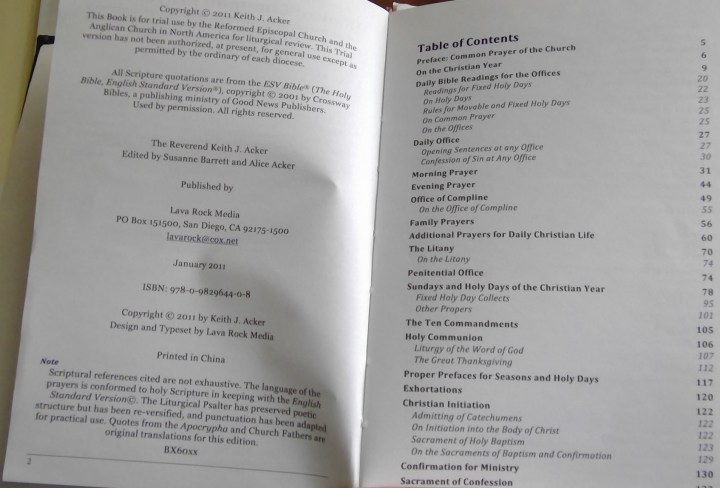
WIN_20190208_13_08_01_Pro (2)

Most of this Prayer Book is in line with the 1928 Prayer Book‘s order and content.  Its Daily Office is more in line with the English books (such as the 1662).  In accord with the spirit of the newer additions of 1979, though, this book also has a liturgy for Confession, a Healing Service, shorter Family Prayers, and special liturgies for Ash Wednesday, Palm Sunday, and Good Friday.  All of this is in modern English, even the Psalter is the ESV translation (with the verse numbers fixed to match the traditional Coverdale versification).  The “translation” style is a bit clunky for the modern reader, though careful use of punctuation can help one navigate the long compound sentences.  For example, the Prayer of Consecration begins this way:

ALL glory be to you, Almighty God, our heavenly Father, for you, of your tender mercy, gave your only Son Jesus Christ to suffer death on the cross for our redemption; Who made there (by his one oblation of himself once offered) a full, perfect, and sufficient sacrifice, oblation, and satisfaction for the sins of the whole world; And did institute, and in his holy Gospel command us to continue, a perpetual memory of his most precious death and sacrifice until his coming again.

So it is very traditional in its content, preferring faithful adherence to original words over contemporary readability.  Some will like this, some may not.

Another feature of this book that is common to modern Prayer Books is that it has explanatory notes at the beginning or end of most sections.  For example, between the liturgy for Admitting of Catechumens and the liturgy for Holy Baptism, there is this note:

On Initiation into the Body of Christ

We are initiated into a relationship with the Body of Christ by God’s grace in the Sacrament of Baptism.  God has supplied us with a fellowship of disciples, his Church, in which we are to live out that relationship with him.  The Church is God’s family and the household of Faith into which we are adopted, receiving the gift of being born anew and the indwelling of the Holy Spirit.

Converts are instructed in the Christian Faith.  Catechumens (Greek for instructed) are taught the need for repentance and faith in Jesus Christ and the practices of prayer, devotion, and fasting in preparation for Baptism.

In general, this book leans high church.  Confirmation, Confession, and Matrimony are referred to as Sacraments, the 1549 Prayer Book is expressly named as the primary foundation underlying this book, and (in line with REC polity) Holy Orders are explained as a male-only ministry.

Now, between the fact that it has only been authorized for use by one or two bishops in the ACNA, that its translation style is slightly different from what the 2019 Prayer Book is going to be, and that it doesn’t really supply anything that we don’t already have in the 2019 or 1928 Prayer Books, it has to be admitted that from a functional point of view this book isn’t really all that useful.  I will probably never use its Daily Office or its Communion liturgy, much less its pastoral services.  The fact that is retains the historic Communion lectionary is nice, and its suggested additional (usually Old Testament) reading to match the traditional Epistles & Gospels is excellent, but ultimately it’s a redundant book on my shelf.

However, it has something going for it that pays untold dividends in my understanding of the liturgy: it’s ANNOTATED!  Check it out:

WIN_20190208_13_38_41_Pro (2)

The rubrics are in red (as was traditional back in the day) and its annotations are in blue.  So you can look at a Collect or other prayer or exhortation in this book and see some of their origin from the Bible (or occasionally other sources).  This is immensely useful for a student of the liturgy.  It does make the book a little more complicated to use, because in the ordinary course of prayer your eyes have to ignore those blue reference notes.  It also makes the “Sundays and Holy Days of the Christian Year” a bit more complicated to navigate, as in the picture above – Matthew 4:1-2 is an annotated reference for the Collect for Lent I, but (in black text) Matthew 4:1-11 is the actual Gospel lesson for that Communion service.

Further, looking at this picture some more, there is a handy reference line under each Collect.  The first two blocks are the two traditional lessons for the Communion service on that day.  The second two blocks are the traditional Introit and Gradual (usually psalms) for that day, and the last block on the right is the recommended “third” lesson to add to the traditional two.

The ratings in short:

Accessibility: 3/5
It’s not really any more complicated to use than the 1662 or 1928 Prayer Books, which I rated as 4, but the visual formatting of this book (mainly due to the annotations) make it a little harder to follow.  There’s also the practical challenge of getting a physical copy.  Mine is from the first printing, which had notoriously horrible quality – I’ve barely used it and the front cover has almost torn off!  But there are nicer prints of it available now, apparently.  Its official page is here: http://www.bcp2011.com/node/1.

Devotional Usefulness: 5/5
If one can get past the issues of authorization, visual accessibility, and translation style, the spirituality of this book is almost perfect.  It pretty much fits the bill of my personal opinion of an ideal Prayer Book.  My only actual complaint about its content is that its Daily Office Lectionary seems a bit too scatter-brained.

Reference Value: 5/5
Even though very few people in the world use this, and it will probably be forgotten in a couple decades, the fact that it is similar in content to the 2019 Prayer Book makes it annotations extremely relevant for cross-comparison.  If you want to explore the Scriptural basis for part of our liturgy, you can look it up in this 2011 book and find out.  Unless someone makes an annotated 2019 book, this volume will be a precious asset to me for the rest of my life.

So, final recommendation… if you want to study the Prayer Book liturgy, and don’t have another annotated Prayer Book already, this is worth getting.


Pairing: a Collect & a Hymn

Our Collect of the Day from Sunday, the fourth in Epiphanytide, is the first Sunday Collect this season that matches the old Prayer Book tradition.  The first three Sundays have modern Collects to reflect the modern Epiphany emphasis on missions, and now this fourth one takes us back to the original Epiphany tradition.  Here it is:

O God, you know that we are set in the midst of so many and grave dangers that in the frailty of our nature we cannot always stand upright: Grant us your strength and protection to support us in all dangers and carry us through every temptation; through Jesus Christ our Lord, who lives and reigns with you and the Holy Spirit, one God, world without end. Amen.

What I thought we’d do with this Collect today, rather than analyze it or link to a Scripture reading, is match it up with a hymn.  And, rather than dig up a lesser-known song as we’ve done a few times already, let’s pair this classic Collect with a classic hymn: O worship the King.

According to hymnary.org this song appears in nearly 1,000 different books, and probably hundreds more that aren’t compiled on that site.  The lyrics were written by Robert Grant in 1833, loosely based on Psalm 104.  It has been set to a couple different tunes, so I’ll let you readers fight over if LYONS or HANOVER is best, or if one should vote third party.

It is the 5th verse that especially links up with the Collect for Epiphany IV.

Frail children of dust, and feeble as frail,
In thee, Lord, we trust, nor find thee to fail;
Thy mercies, how tender! how firm to the end!
Our Maker, Defender, Redeemer, and friend!

Both the prayer and the hymn consider us in terms of frailty.  We are “set in the midst of so many and grave dangers”, we need God’s “strength and protection” that, unlike us, are “firm to the end!”  It seems appropriate to consider this hymn a sort of response or follow-up to the Collect: we pray for God’s promised protection, and then we sing joyfully of his steadfast love, his covenant faithfulness, by which we know that our maker, defender, and redeemer is also our friend.