Is it All Souls’ Day?

Day two of the All Saints Octave is known, among the Papists, as All Souls’ Day.  A lot of Anglicans use this term also, though what our prayer book actually offers for November 2nd (on page 709) is the optional Commemoration of the Faithful Departed.  Granted, that rolls off the tongue far less easily than “All Souls”, but it’s more theologically accurate: we can only commemorate the faithful departed, not the damned departed.

Another reason to consider avoiding the name “All Souls Day” is because of the false doctrines that the Papists put forth with respect to this day.  They teach of a place of Purgatory, where most Christians souls go after death, to complete their process of sanctification and finally be completely purged of their sins.  Although traces of this sort of concept are almost see-able in the Bible, it makes for rather untenable doctrine.  All Souls’ Day, in Roman reckoning, is a special day to pray for the souls in purgatory; it’s a neat complement to All Saints Day, celebrating the souls now fully glorified in heaven.

Indeed, there is a neat three-fold structure of the church that they put forth: the church militant (us on earth, still fighting sin), the church expectant (in purgatory, awaiting full release), and the church triumphant (in heaven, at rest).  But the Scriptures don’t permit us to make a full distinction between the last two.  The dead are both at rest with Christ and awaiting their resurrection unto glory.  (The tension between these two realities plays heavily into divergent traditional & modern approaches to the Burial service.)

On those grounds we can still have All Saints’ Day (to emphasize their glorious rest) and Commemoration of the Faithful Departed (to emphasize their yet-unfinished story).  Indeed, it is the recommendation of this Customary to treat this day as if it were a major feast day, using Occasional Prayer #113 as the Collect of the Day:

O eternal Lord God, you hold all souls in life: Shed forth upon your whole Church in Paradise and on earth the bright beams of your light and heavenly comfort; and grant that we, following the good examples of those who have loved and served you here and are now at rest, may enter with them into the fullness of your unending joy; through Jesus Christ our Lord.

If you still want to nickname it “All Souls’ Day” that’s fine… the phrase is in that collect after all.  But it’s best to think of it as a complement to All Saints’ Day, considering the faithful departed from a slightly different angle.
People of the Books

The phrase “people of the book”, as far as I’m aware, originates in Islam, and is usually used referred to the three religions that respect the Torah: Judaism, Christianity and Islam.  Obviously the way in which we each “respect” the Torah is worlds apart, not to mention how we interpret it; the only thing we have in common is that really just the book.  Several Christian traditions have come to refer to themselves as “people of the book”, in reference to the Old and New Testaments together, and I’ve read that there are some Jews that refer to themselves along similar lines also.

And why not?  It makes sense: our respective religions are particularly focused on a central book that defines us.  Most of the rest of the major world religions have no single identifiable constitution or text that sets the precedent for or holds authority over its members like we do.

And so, at least in the sort of evangelical circles I grew up in, there is a culture of having a Bible for everywhere you go.  You have one at home, you have one under the bathroom sink, one in the car, one at the office at work, and so on.  You have one to study and take notes in and another to read to the kids.  Always gotta have a Bible nearby.  I suppose now that most people have smart phones, this trend may have lessened somewhat.

But you know what isn’t on a phone app (yet)…?  The Prayer Book.  As Anglicans we’re not just “people of the book”, we’re “people of the books.”  The Bible is our rule for doctrine, and the Prayer Book is our rule for worship.  There’s no comparing the two when it comes to ultimate authority, but on the level of practical use we are a two-book people.  (And if you want a singing congregation, add the hymnal as the third book!)

Imagine, especially if you’re a clergyman, making a point of having your prayer book (or an extra prayer book) virtually everywhere you go.  If you came from that evangelical culture that did this with Bibles, perhaps you can make the jump with the Prayer Book too?

Just a thought. 🙂

Friday Devotions

Hey, everyone, it’s Friday again.

It’s all well and good to enjoy the appropriate Cross-related prayers that modern prayer book tradition has given us.  But there are even more traditional options that should be considered for our praying of the Office on Fridays.

#1 – Read the whole Venite.  The American Prayer Book tradition, I think from the very first in this country, has shortened the Venite (Psalm 95) and provided either additional options or alternative endings for it.  Our new prayer book represents an almost-complete-return to the English order on this point, except the “wrathful” second half of the Venite is optional.  The rubrics direct it to be added during Lent and other penitential occasions.  Consider every Friday (with a couple seasonal exceptions) a penitential occasion.  Read the whole Venite this morning.

#2 – Pray the Great Litany.  As discussed some time in the past, the Litany was originally appointed for the end of Morning Prayer on every Sunday, Wednesday, and Friday, plus any other occasion deemed appropriate.  The 2019 Prayer Book is not so specific in its direction for the Litany, but absent of any other plan for regular use, we’re best off simply continuing what the classical tradition appoints.  Say the Litany today.

#3 – Oh, and don’t forget to fast.  It’s not a “Roman thing”, it’s a “catholic thing”, and the Reformers (especially English reformers) saw themselves as the true catholics over against the Papists who had deviated from the catholic tradition.  Fasting on Fridays is thoroughly Anglican; only in recent times have prayer books gotten lazy about that.  The easiest way to fast is to have a small breakfast and eat nothing else until dinner.  This gives you lunchtime, at least, to spend in prayer and rest before God where one might normally be attending to one’s bodily hungers.

St. James of Jerusalem Day

October 23rd is the feast of St. James of Jerusalem in modern calendars.  The traditional calendar didn’t give him a separate day of his own because for a large chunk of history he was identified as one of the twelve apostles, commemorated along with Philip on May 1st.  Recent trends of interpretation have preferred to see this James as a separate person, not one of the twelve.  You can read a little bit more about that in last year’s entry.  I suppose it’s better accidentally to commemorate one person twice a year than to forget to commemorate someone because we confused him with someone else.  We’ve got that same problem with St. Aelfric, too, to be fair.

Anyway, let’s move on and look at the Collect of this Day.

Grant, O God, that following the example of your apostle James the Just, kinsman of our Lord, your Church may give itself continually to prayer and to the reconciliation of all who are at variance and enmity; through Jesus Christ our Lord…

It’s interesting to come across this just as a public strife has arisen between fans of John MacArthur and Beth Moore surrounding recent comments of the former against the latter.  There is, indeed, something of a theological gap between the two of them, and, further, a theological gap between both of them and the Anglican tradition from which we could stand aloof to their quarrel – or at least the quarrels of their respective fandoms and supporters.  “I follow Johnny Mac!” and “I follow Beth!” are voraciously-defended causes right now.

St. James of Jerusalem presided at a church council in Jerusalem around the year 50.  The primary issue was responding to Judaizers – people who insisted that Gentiles had to become practicing Jews in order to be proper Christians.  Circumcision, the keeping of the Law of Moses, the Saturday Sabbath, dietary regulations, and the like, were the prominent visible aspects of their cause.  The apostles, including Sts. Peter and Paul, had already been teaching against the Judaizers’ cause, though the former had paid lip service to them in the recent past, much to St. Paul’s consternation.  But a case had been made against St. Paul and his company, and it was time to settle the matter formally.  The full story can be read in Acts 15, and I put together a walk-through of that text a few years ago if you care to read it.

The short of it is that James, acting as what we would now call the diocesan bishop of Jerusalem, heard the case, made a ruling, saw it confirmed by the assembly, and released an official statement to make their decision public.  Enmity and strife was resolved with a little bit of comprise, but primarily a restatement of gospel truth.  Remember, godly compromise is only possible when both sides are essentially correct and only peripherally in disagreement… many of the judaizers were outright heretics (cf. the epistle to the Galatians), so there was very little room for compromise anyway.

What makes this episode particularly noteworthy is that St. James was supposed to be a “safe” choice for the judaizer cause.  He had been a faithful Jew, like most of the first disciples and apostles, and he was known continually as a devout Jewish man even after his conversion to Christ.  Simply the fact that he continued to live, minister, and lead the church in Jerusalem when all the other apostles had fled due to persecution by Jewish authorities (cf. Acts 12) is a significant clue to how Jewish James must have appeared.  If the judaizers were going to get a bishop on their side, James would be their man.  But, of course, he wasn’t.  He had a strong personal affinity for the Jewish religion and culture, and he was among the least willing to give up the formal trappings of the Old Covenant, but despite that he understood that this was a voluntary choice and not a Gospel mandate.

Only with the Gospel mandate, or creedal orthodoxy, or however you care to summarize it, can “reconciliation of all who are at variance and enmity” be achieved.  This speaks volumes to the MacArthur versus Moore conflict; this speaks to the ordination of women conflict within the ACNA; this speaks to the substantial disagreements between parties within the Anglican tradition, not to mention the many denominations beyond the confines of the Anglican Way.  Some compromises are possible, but ultimately one truth will prevail over the other(s) if unity is to be achieved.  Let us pray for leaders akin to the spirit and wisdom of St. James of Jerusalem – bishops who can discern biblical truth from personal preference and piety – through whom Christ can bring true reconciliation to his people in variance and enmity.

The Singing Schedule has changed

Did you know that The Saint Aelfric Customary offers a sing-the-hymnal-in-a-year plan, for the Book of Common Praise (2017) put out by the Reformed Episcopal Church – a subjurisdiction of the Anglican Church in North America?  It’s true, and you can read about it here.  Like the Bible, thanks to the daily office lectionary with its expansion, and like the options in the Prayer Book itself, the principle of completionism is at work here.  The idea of completionism is that if (or as) these books are fully authorized and endorsed by ecclesiastical authority, it is right and good for the Christian to (at least have a means to) read or make use of every page in its appropriate time.

Even if you’re not using this daily hymnody plan, at least skip to the last paragraph for a calendar insight.

With the hymnal, as we draw near the end of the liturgical year, the pace of the hymnody has changed.  From Trinity Sunday until this past Sunday (Proper 24) it has brought us two hymns almost every day of the week, working through the bulk of the General Hymns half of the book.  The “Christian Warfare” section has been running its course for the past week or so, some of it lining up neatly with the war stories of 1 & 2 Maccabees.  But now we’re down to one hymn a day, allowing more room for the Morning & Evening Hymns, and generally decreasing the time it takes to say the Office.  But there’s another practical reason also…

As the month of November approaches, the number of holy days increases.  The second half of October is unusually rich with major feast days but November starts off with All Saints’ Day, which is one of the seven principle feasts of the year, and includes Thanksgiving Day.  Both of these holidays have a substantial number of hymns associated with them, and therefore the regular progress through the hymnal is slowed at this to make room for the numerous special hymns of the season.  More than half of the days in November have at least one holiday hymn appointed for them.  So if you’re not normally a user of the hymnal in the rounds of daily worship, this time of year is a good one to consider picking one up and giving it a try on occasion.  Here are some of the hymns coming up, for your consideration:

  • 23 Oct. (St. James) – #195 Rise again, ye lion-hearted
  • 28 Oct. (Sts. Simon & Jude)- #169v20 From all the saints in warfare
  • 31 Oct. – #617 Day of wrath! O day of mourning!
  • 1 Nov. (All Saints’) – #186 For all the saints, #193 Lord, who shall come to thee
  • 2 Nov. (Commemoration of the faithful departed)
    – #187 Behold a host, arrayed in white, #319 O Lord, my God, I cry to thee
  • 3 Nov. (now filling out the All Saints/Souls Octave)
    – #191 Who are these like stars appearing
  • 4 Nov. – #192 I sing a song of the saints of God
  • 5 Nov. – #194  The saints of God! their conflict past
  • 6 Nov. – #318 Tempted and tried
  • 7 Nov. – #320 I fall asleep in Jesus’ wounds
  • 8 Nov. (now leading to Veteran’s/Remembrance Day)
    – #215 Thou by heav’nly hosts adored
  • 9 Nov. – #216 Rejoice, O land
  • 10 Nov. – #217 God bless our native land
  • 11 Nov. – #218 God of our fathers, whose almighty hand

Historical Accuracy in the Bible

This evening we reach Matthew 26, including the Last Supper.  This is a very familiar part of the Gospel for many readers, and yet it can also be one of the most frustrating stories to get straight.

When it comes to identifying the betrayer, according to St. Matthew, the disciples ask “is it I?” and Jesus answers to Judas “yes.”  According to St. Mark, the disciples ask “is it I?” and Jesus says it’s someone who’s eating bread from the dish like he is.  St. Luke doesn’t specify Jesus’ answer to the question.  According to St. John, John and Peter ask who the traitor is, Jesus indicates by giving a piece of bread to Judas, who then leaves, but the other disciples don’t know why.  How do you reconcile this? It’s pretty complicated.

There are several places in the Bible where the level of detail and precision leave the modernist’s desire for strict chronology not a little frustrated.  The underlying reality is that, even when a part of the Bible is labeled “historical”, its purpose is not to relate history, but to reveal God, specifically the person of Jesus Christ, to us.  We preach the Gospel, not history lessons; the unfailing authority of the Bible is not based upon what it has to say about science or about history, but about God and mankind.  Some people get overly hung up over this sort of issue, and we have to assure them that even in those little corners where the Scriptures don’t seem to add up historically or archaeologically or whatever, there is no cause for alarm.

If you want to share a whole video on the subject, feel free:

Imagery in Zechariah 14

If Evening Prayer has been tough to get through lately, I understand; Zechariah is not an easy book for a lot of people to read.  It is one of the most apocalyptic texts in the Old Testament (after Daniel), which really just takes the challenges of prophetic literature and dials them up to 11.

It goes beyond the purpose and scope of this blog to provide a Bible Study, not to mention the time availability of this chronically-fatigued stay-at-home-dad, but there are definitely a few features of the last chapter of Zechariah, that we’ll be reading tonight, which I can point out.

Behold, a day is coming for the Lord, when the spoil taken from you will be divided in your midst.  For I will gather all the nations against Jerusalem to battle…

The chapter begins with a “Day of the Lord” reference.  Like “D-Day” when talking about the second world war, the Day of the Lord is a title for the time of a great invasion, a the decisive turning point in the great spiritual war.  We understand this in two parts: first, the Cross, and second, the return of Christ.  There are many moments in history that serve as pictures for these moments of ultimate spiritual importance, such as the conquest of Jerusalem by the Babylonians, the desecration of the Temple by the Greeks, the destruction of Jerusalem by the Romans… yet all these serve merely as pictures of the greater judgment that takes place when Christ was crucified and when Christ will return again.

It is an error of certain Protestant sects to mis-read Old Testament prophetic literature, especially the apocalyptic writings, without Christ in mind.  What follows in this chapter, to finish the book, is not a visual prediction of future events, but a prototype or foreshadowing of judgment day when Christ returns to Earth to consumate his kingdom forever.  Don’t try to figure out what’s going to happen to the geography of Palestinian mountains and valleys in verses 4 & 5, but rather, focus on the fact that “the Lord my God will come, and all the holy ones with him” at the end of the age.

There shall be a unique day, which is known to the Lord, neither day nor night, but at evening time there shall be light,” (14:6), because Christ himself is the light of the world.

On that day living waters shall flow out from Jerusalem,” (14:7) just as Jesus promised of the Holy Spirit in John 4:14 and especially 7:37-39.

And the wealth of all the surrounding nations shall be collected, gold, silver, and garments in great abundance.” (14:14) Think of texts like Isaiah 60, which also depict the nations bringing their wealth to Jerusalem to honor the Lord.  These are pictures, not of earthly nations paying homage to the earthly nation of Israel, but of gentile believers turning to worship the God of Israel – Jesus.  So don’t get carried away with the images of wars and horrible plagues and panics; those are exactly what sin is.  Only the victory of the returning Christ will bring all the terrors of sin to an end in this world; the epic apocalyptic style just makes spiritual reality more vivid.

Similarly, we aren’t literally going to go to Jerusalem “year after year to worship the King, the Lord of hosts, and to keep the Feast of Booths” (14:16), for that holy day has been and subsumed under the New Pentecost – the gift of the Holy Spirit.  No longer must we celebrate the days of the Exodus when our forefathers dwelt in booths (or tents) and received the Word of God on tablets of stone; rather we now celebrate the greater present reality that we ourselves are dwellings of the Holy Spirit (1 Corinthians 6:19).  That’s why in Revelation, the end-times city image doesn’t have a temple building at all (Revelation 12:2).

Thanks be to God!

Readings Review & Planning Propers 9/30

What we’re doing on this blog on Mondays is looking back and forth at the Daily Office readings (or lessons) so we can better process together what the Scriptures are saying, and list the recommended Propers for the Communion or Antecommunion service for each day of the week.

Readings Review

Last week: 1 Kings 12-14, 2 Chronicles 12-15, Hebrews 11-13, James 1-2, Zechariah 2-8, Matthew 16-20

Next week: 1 Chronicles 16, 1 Kings 15-19, James 3-5, 1 Peter 1-4:6, Zechariah 9-15, Malachi 1, Matthew 21-24

The “crazy visions” of Zechariah are drawing to a close and we’re getting to the second half of the book, populated by oracles – messages from God to various contemporaries of Zechariah.  The visions of chapters 1-6 in particular were apocalyptic in nature, functioning on one level to encourage the then-leaders of Jerusalem to continue rebuilding the Temple (much like Haggai did in the previous book), and on another level providing pictures of judgment that would only find their proper fulfillment in the ministry of Christ Jesus.  The oracles of Zechariah, primarily in chapters 9-4, speak against the oppressive regimes of foreign powers such as Persia, foretell the coming Christ (or Messiah), and look forward to when God’s people will be perfectly cleansed and united under their Good Shepherd.

Appropriately, our readings from the Gospel of St. Matthew are also reaching an apocalyptic section as the coming week unfolds: our Lord’s parables after his triumphal entry in Jerusalem become increasingly focused on the Kingdom of God and the day of judgment.  At the end of the week we’ll read through chapter 24’s famous discourse about the destruction of the Temple (which was fulfilled about 35 years later).

The Old Testament lessons in Morning Prayer, meanwhile, continue through the much more mundane writing style of Israelite history.  As the kings of Israel and Judah get increasingly apostate from the true worship of the Lord, the narrative spends less time with them and more time with the prophets, especially Elijah, who were faithful to Him.

Planning Propers

This is the week of Proper 21 (or 15th after Trinity in the traditional calendar), so keep in mind that the historic Prayer Book default is that a mid-week Eucharist will repeat the Collect & Lessons (the propers) for yesterday.  Otherwise, we recommend…

  • Monday 9/30 = St. Jerome or Votive *
  • Tuesday 10/1 = St. Remigius or Votive
  • Wednesday 10/2 = Votive
  • Thursday 10/3 = Votive
  • Friday 10/4 = St. Francis of Assisi or Votive
  • Saturday 10/5 = Votive

* A Votive is a “Various Occasion” (page 733 in the BCP 2019).  The traditional appointments are Holy Trinity on Sunday, Holy Spirit on Monday, Holy Angels on Tuesday, of the Incarnation on Wednesdays, of the Holy Eucharist on Thursdays, the Holy Cross on Fridays, and of the Blessed Virgin Mary on Saturdays.

Happy Michaelmas!

On this special occasion of celebrating the feast of St. Michael and All Angels with the whole congregation on a Sunday morning, I thought it would be fun to share our liturgy here.  The Communion rite we’re using is the Anglican Standard Text, as usual.

OPENING HYMN: Christ the fair glory of the holy angels

ACCLAMATION: Worthy is the Lord our God: / To receive glory and honor and power.

COLLECT FOR PURITY, SUMMARY OF THE LAW, KYRIE,

GLORIA IN EXCELSIS sung to the setting #784 in the Book of Common Praise 2017

CHILDREN’S MINISTRY MOMENT

  • Revelation 12:7-12, followed by a 1-minute Children’s sermon
  • explanation: my church has two children, ages 2 and 4, so they spend most of the liturgy playing in a separate room.  I’m a big believer in including young children in the liturgy, but sometimes they need space to move around, and our context is so small that it wouldn’t work so well at the moment.  Soon the older will be able to sit/draw/play/read quietly in the worship space with the adults, and this addition to the liturgy will be removed.
    Normally, this ministry moment includes a few-verse Bible reading followed by a one-minute teaching, but on this occasion the short reading is actually the same as the Epistle Lesson, so it’s just being moved up here wholesale.  Yes it’s a strange way to tinker with the liturgy, and no I’m not crazy about it, but I’ve got to minister to everyone I can with the very limited resources and manpower available.

HYMN: Ye holy angels bright

COLLECT OF THE DAY, OLD TESTAMENT LESSON: Genesis 28:10-17

PSALM: 103, SEQUENCE HYMN: Life and strength of all thy servants

GOSPEL LESSON: John 1:47-51

THE SERMON, THE NICENE CREED, THE PRAYERS OF THE PEOPLE

THE CONFESSION AND ABSOLUTION OF SIN, THE PEACE

OFFERTORY HYMN: Bread of heav’n on thee we feed

THE SURSUM CORDA, leading to the Preface for Trinity Sunday

THE SANCTUS, THE PRAYER OF CONSECRATION, THE LORD’S PRAYER

THE FRACTION, THE PRAYER OF HUMBLE ACCESS, THE AGNUS DEI

THE MINISTRATION OF COMMUNION

POST-COMMUNION CANTICLE: #6 Dignus es (from page 84)

THE POST-COMMUNION PRAYER, THE BLESSING

CLOSING HYMN: Ye watchers and ye holy ones

THE DISMISSAL

Singing Psalm 121

We all know that the Psalms were originally meant to be sung.  There is, wonderfully, a new movement these days, mostly grassroots, to put music to the Psalms and put them into the hands of the congregations.  I’ve jumped on that bandwagon a little, providing an explanation of Simplified Anglican Chant, and I know others others on YouTube and even in the ACNA have made resources to encourage and enable to chant the psalms.

The wonderful thing about chant is that it provides you with some very simple music that you can then apply to any set of lyrics.  You don’t have to “learn a whole song”, just memorize a few notes and get a feel for where in each half-verse to move from note to note, and you’re good to go.  What makes Anglican Chant different from historic Plainchant is that 1, the chant tunes are written in more recent times and are rarely “tied down” to any particular Psalm or Canticle, and 2, ours come with classical four-part harmonies allowing a choir (or at least a keyboardist) to beautify the music.

What I thought would be fun to try today is providing a set of examples of how one short Psalm can be done in different styles of chant.  This will, I think, help clarify how the more “complicated” forms of chant work, by working our way up to them through some simpler forms.

Here’s the text as used:

1 I will lift up my eyes un|to the | hills; *
from | whence | comes my | help?
2 My help comes | from the | Lord, *
who | has made | heaven and | earth.
3 He will not let your | foot be | moved, *
and he who | keeps you | will not | sleep.
4 Behold, he who keeps | Israel *
shall | neither | slumber nor | sleep.
5 The Lord himself | is your | keeper; *
The Lord is your defense | upon | your right | hand,
6 So that the sun shall not burn |you by | day, *
nei|ther the | moon by | night.
7 The Lord shall preserve you| from all | evil; *
indeed, it is he | who shall | keep your | soul.
8 The Lord shall preserve your going out and your | coming | in, *
from this time | forth for|ever|more.

– Sample 1 –

Omitting the usual Gloria Patri at the end of the Psalm, here it simply read aloud with the musical rhythm of the ending of each verse in mind.  Always make sure you can read the Psalm comfortably before you sing or chant it!


– Sample 2 –

Now let’s use Fr. Ben Jeffries’ Simplified Plainchant.


– Sample 3 –

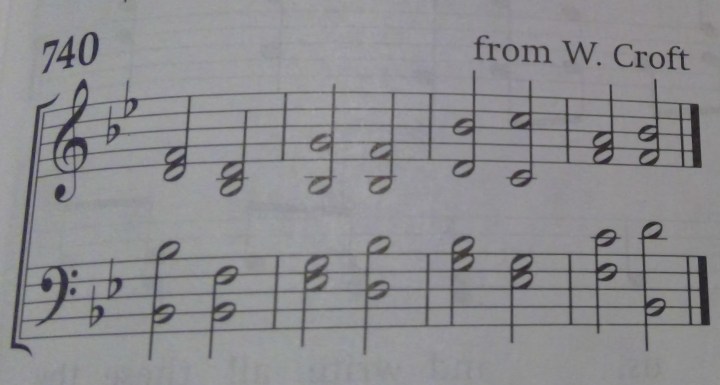
Next let’s move up to Simplified Anglican Chant. This and the following images are from the hymnal, Book of Common Praise 2017.

simplifiedchant740


– Sample 4 –

Now we’re ready for a fully-fledged Anglican Chant.  First let’s go for a Single Chant, which means each verse gets the same tune.

singlechant653


– Sample 5 –

Last of all, here’s a Double Chant, meaning the repeated tune spans two verses.

doublechant660