The Fraction, or breaking of the bread, is permitted to take place either at the Words of Institution or after the Consecration and Lord’s Prayer. While the Reformed tradition, with most classical Prayer Books, has preferred the breaking of the bread at the Words of Christ, the summary in the biblical narrative commends a later fraction: taking bread, blessing it, breaking it, and then giving it (Matthew 26:26, Mark 14:22, Luke 22:19). Thus the Fraction is permitted to take place after the Prayer of Consecration and the Lord’s Prayer, as is the case with the Roman Rite and the 1549 Prayer Book.
In the former case, the breaking of the bread during the Words emphasizes the narrative of the Last Supper, and points the worshiper toward that ancient Passover celebration in which the New Covenant was brokered. In the latter, the breaking of the bread as its own ceremonial moment in the liturgy emphasizes the sacrifice of Christ upon the Cross, to which this entire liturgy directs us. It is best when the celebrant chooses one pattern or the other, rather than snapping the bread during the Words of Institution and then actually breaking it at this point in the liturgy.
The Fraction Anthem, too, is drawn from the 1549 liturgy, which reads “Christ our Paschal lamb is offered up for us, once for all, when he bare our sins on his body upon the cross, for he is the very lamb of God, that taketh away the sins of the world: wherefore let us keep a joyful and holy feast with the Lord.” This anthem, drawing largely from 1 Corinthians 5:7 and John 1:29, is parsed out into two options. The first option, using the present tense, highlights the role of Holy Communion in communicating the Sacrifice of Christ to us. The second option uses the past tense, rendering a version of the 1549 text in accord with how 1 Corinthians 5:7 is translated today.
The two versions of the anthem also represent slightly different emphases on the eucharistic sacrifice, often in line with high- and low-church perspectives. The first declares the timeless nature of Christ’s sacrifice by using the present tense – this holy feast makes present to us now the atoning death of Christ. The second uses the past tense to point us back in time, emphasizing the historicity of Christ’s sacrifice. The worshiping community may benefit from using both of these anthems, perhaps appointing the former during seasons of joy and the latter during seasons of penitence.
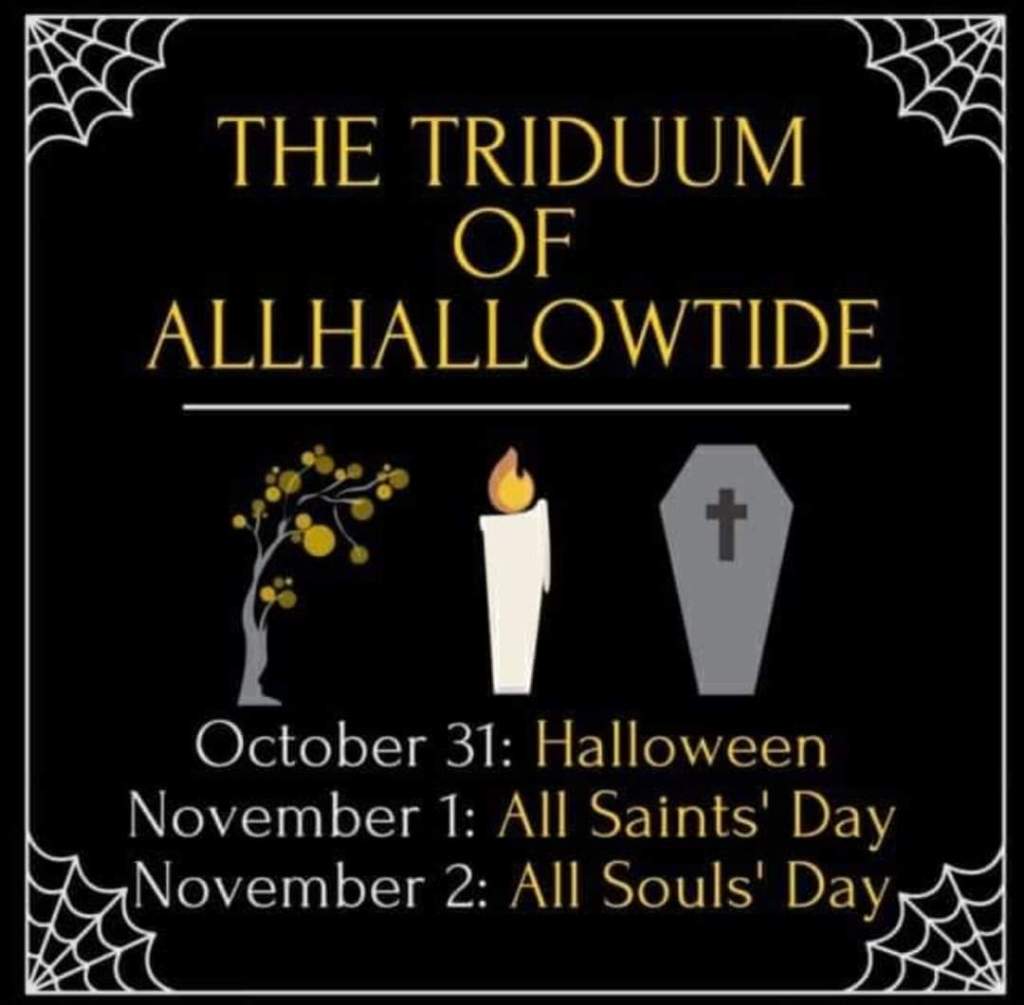
October 31st begins a stretch of time known informally as Hallowtide – an Old English word for “Saints Season”. One way to understand this holy moment in the Church Calendar is call it a Triduum, a three-day period.
Image pulled from Facebook
October 31st, Halloween, is the opening celebration in which we acknowledge the thinning of the barrier between the living and the dead. Some say this derives from the language of Celtic Christianity, but it’s very difficult to discern fact from fad when it comes to referencing the belief in practice of the early Church in the British isles, so let’s not take that too seriously. In any case, this evening, All hallows eve, is the liturgical start of All Saints Day itself, and the party begins.
All Saints Day, November 1st, is when we particularly celebrate the church triumphant – that victory over sin and death itself that God’s people have in Christ and even now enjoy in paradise, even though they have not yet tasted of the general Resurrection of the Body.
All Souls Day, November 2nd is when the Roman Church remembers those who are still in purgatory, and have not yet attained to the beatific vision of the Saints in heaven. This is not an Anglican take on the holy day, obviously, and so the optional commemoration on this day in our prayer books now typically turn it the commemoration of the faithful departed. So rather than talking about those in heaven and those in purgatory, as the Romans erroneously do, we celebrate two different aspects or realities that the Saints departed presently experience. November 1st is the day of joy in triumph, we give thanks to God for their victory in him, and we are stirred up to follow their good examples that we might share in that eternal inheritance with them. November 2nd is the day of rest and mourning, where we lament the ongoing present reality of death, acknowledge the pain of losing people to that death even temporarily, and are comforted in the knowledge that they are at rest with the Lord.
Beyond this triduum one could also identify hallowtide as an octave. An octave is a stretch of eight days, which is represented in our prayer book by the fact that when All Saints Day is not on a Sunday we are allowed to celebrate it on the first Sunday in November. This results in a span of 7 days (November 1st through 7th) in addition to the evening of October 31st bringing us to a total of eight different days in which we could be celebrating the hallowed ones continuously!
One way this can be observed is by singing. This customary has proposed the following recommendations for observing the All Saints / All Souls dynamic throughout the octave:
31st: Day of wrath! O day of mourning!
1st: For all the saints, and, Lord who shall come to thee
2nd: Behold a host arrayed in white, and, O Lord my God I cry to thee
Sunday mornings can be very busy times for pastors and other ministers, there can be a lot of preparation involved before the liturgy begins, especially a Communion service, and double-especially a Communion service with any semblance of high church ceremonial – candles to light, vestments to don, ministers to assemble and coordinate. It’s wonderful when everything goes to plan and everyone does their part and the whole result is a dignified and beautiful offering of the people of themselves unto God and a faithful reception of His Word and Sacrament.
But, as Mother Teresa said when her sisters warned her that the work was getting to be too much, the answer to a busy situation is not to pray less, but to pray more. Sure, it’s “inconvenient”, but it’s often what we need. So, straight to the point, what or how should we pray before the Sunday Communion?
There are a number of possibilities.
Some like to gather the ministers together beforehand and offer/prompt spontaneous prayers unscripted.
Some like to use traditional forms of preparation descended from the traditional “Fore-Mass” (prayers before the Introit where the Mass formally begins). There are also traditional prayers for the minister to consider the Gospel in the donning of each vestment, as well as prayers that are written to prepare priests and other servers for the liturgy. There are also some preparatory prayers in the draft ACNA Altar Book; you should check them out if you haven’t yet!
If you want something more middle-of-the-road in terms of churchmanship – you don’t want to troll an Anglo-Catholic agenda, and you don’t want to go all loosey-goosey about it either, how about grab the Prayer Book for a 5 minute block of time sometime before the liturgy starts?
the Great Litany in the Prayer Book (2019) next to my photogenic Bible (left)
Yesterday I grabbed a few minutes to pray the Great Litany before people arrived for Holy Communion. It was a little hectic with my kids running around and I must admit I had to interrupt myself at one point (and not just to take this picture!). Still, it was a moment of stillness for my soul, which would then go on to share the burdens of my parishioners and feel rather more clogged up thereafter. Praying for them, the whole church, and the world, in the words of the Litany prepared myself for ministering to them. It also just plain gave me a chance to worship and pray on my own, which can be something that priests and ministers sometimes struggle with, especially in small congregations where the leadership roles are not as widely shared.
The Litany is a great traditional choice for an Anglican, also, because the original Prayer Book order for Sunday morning expected Morning Prayer, Litany, and Communion all in a row! So bringing some of that back, even if only by yourself (as a clergyman or as a lay person) can only be good and upbuilding for us.
Any other tips or approaches that you like which help you (and/or the ministry team) prepare spiritually for the worship service? Leave a comment!
I have always served a small church. And for all but one year of my pastoral ministry I have doubled as the musician, which is how I actually began my service for Grace Anglican Church. As a result (by necessity) the selection of music has been part and parcel of liturgical planning. This is sometimes a fair bit of extra work for me, but also can be pretty rewarding for all of us in that the songs we sing usually tie closely with the Scriptures and prayers of the day. In fact, I’ve even started working on a booklet to collect the “best practices” I’ve developed (and learned from others) which will be available for sale sometime in the coming months.
One thing which is common in many Anglican (and Episcopalian) churches which we’ve only dabbled in, however, is the singing or chanting of mass parts. “Mass parts” is a phrase that refers to the parts of the mass, or Communion service, that are traditionally sung or chanted by a choir and/or the congregation. Traditionally there are quite a few of these, but the main ones are:
the Kyrie
the Gloria in excelsis
the Sanctus
the Agnus Dei
In the classical Prayer Book tradition, there is no Kyrie but instead the Decalogue (Ten Commandments) which could have chanted/sung responses, and the Gloria is placed near the end of the liturgy instead of near the beginning. And most of the old Prayer Books had no place for the Agnus Dei, either, come to think of it. But contemporary Prayer Books (and contemporized versions of the classical Prayer Books) restore all four of these to the liturgy one way or another. Every Anglican hymnal these days worth its salt has at least one (if not a handful) of different musical settings for these parts of the liturgy.
The main reason my church never got into these is because we used the 1940 hymnal for years, and then switched to the 2017 hymnal. The former only has the traditional-language texts for the liturgy and the latter has only one setting for the contemporary language that we use 96% of the year. When we had a different music minister for a little while, he brought in a contemporary Gloria and Sanctus, which we appreciated, but I was not able to keep them up when he was gone. In fact, after his departure I quickly became a hymnal-only musician, no longer having the energy to learn and teach contemporary-style worship songs. The demographics of our congregation matched this preference anyway, so it was not an issue one way or the other.
But this past year, coming out of COVID-tide, I’ve started taking these mass parts seriously. It was time to start singing or chanting these parts of the liturgy again. I started at the Easter Vigil this year, introducing the Gloria in excelsis Deo. The contemporary-language set in our new hymnal is the New Plainsong set by David Hurd, first copyrighted in 1981 and featured in the 1980 Episcopal hymnal. It’s not an especially ground-breaking new and exciting set of music, nor is it a re-make of one of the old classics, but it is stately and singable. Since Easter, we’ve sung that Gloria on the major Sundays of the year, but not every Sunday… yet.
Shortly thereafter I introduced the Sanctus (Holy, holy, holy), which went over pretty well. We’ve been singing it ever since.
And now that we’re moving our worship indoors for the season I’m about to introduce the Agnus Dei which is nicely similar in sound and contour to the others. After about a month to get used to that, I’ll add the sung Kyrie (just threefold, not ninefold), and then we’ll have all four together for a solemn few Sundays before Advent.
In Advent it is traditional to omit the Gloria, so we will not sing or say it at all for those four weeks until it returns at Christmas. From there I will be free to use or omit some or all of these sung parts to emphasize the tone of the church calendar. We can sing everything on the most celebratory Sundays and other feast days, sing some of them on more ‘normal’ Sundays, or simply just speak them at penitential times. The solemnity of the liturgy style can become a tool in the celebration of the Gospel from week to week, and season to season.
As I was planning this, though, and preparing to type this up, I could just hear in my head the anti-traditionalists, as the ACNA is sometimes a bit infamous for, asking the question “and how will this help the mission of your church and its growth?” To which I will confidently reply that it will neither help nor hinder the missional character of Grace Anglican Church… at least directly. Instead, it will help teach us to worship with reverence, and perhaps to respect the Lord just that little bit more. And, with its periodic use and omission to accentuate the gospel that we proclaim over the course of the year, it may just help people grasp that gospel more nearly to their hearts. In which case, I dare say, we may become a people more apt for the missio Dei.
I have often joked with people that we, in the Anglican tradition, only have a collect for rain, not a collect for not-rain. So in the midst of flood situations we’re kinda outta luck. Here in New England where I live, anyway, it rained nearly every day in July. We weren’t in any serious danger of flooding as far as I know, but there certainly have been farms that struggled to keep their crops healthy with all the constant water and the lack of sunshine. My family’s splitting a crop share this year, and the farmers were apologizing for the weather’s adverse impact on the veggies – last year was too hot and dry, this year has been too rainy.
So I guess it was about time to set about writing that collect for no-more-rain-please.
I’m billing this as Weird Rubric Wednesday because this idea came from conversations that were flippant and silly, even though the resulting prayer is actually legit.
You see, the challenge is that the primary concern in the Lord’s heart is that his people pray with humility, penitence, honesty, and faith. We don’t have to concoct the Perfect Prayer to make our supplications satisfactory in His sight. Eloquence is not a requirement for efficacy. The child-like cry for help is really all he wants from his children. Yet at the same time, when we come together to worship with one voice and one heart, it is right and good that we present to the Lord something not only of our hearts and desires but also of our intellect and efforts. We are taught to worship in spirit and truth, and in the corporate assembly it is especially important that we model truth in our prayers and utterances.
Thus, while on your own it may be perfectly appropriate to cry out “Please God stop all this rain!” it behooves a congregation to clothe that honest and faith-filled prayer with a layer of biblical truth and assurance.
So here is what I came up with:
O Lord Jesus Christ, who stills the storm and calms the waves of the sea: Deliver us, we beseech you, from excess of rain and save us from flood; that the fruit of the earth may yield its increase, and at the harvest we all may enjoy its bounty, even as we await your great Harvest on the Last Day, with the Father and the Holy Spirit in one eternal glory. Amen.
A Collect for the Cessation of Rain, composed by the Rev. M. Brench
The classic Collect Formula is executed quite regularly:
The Address is to Jesus, rather than the Father, which is a little rare but regular enough. This is most appropriate because it is in the person of Jesus Christ that we see (in the Gospels) both weather and wave commanded and calmed. So we open with that reference, proclaiming God’s power over the forces of nature.
The Petition is, simply, for deliverance from excess of rain and salvation from flood. I almost added a third phrase about the restoration of sunlight, but couldn’t figure out how to fit it in without making the prayer too crowded. And, as it would turn out, the next section of the prayer is where the majority of the focus ends up anyway. As it happens, the petition is often the simplest and shortest part of a prayer anyway. That is the “simple cry of the heart” at the center of a collect, which the liturgy clothes with dignity and clarity in the Address and the Purpose.
The Purpose is where things get more specific. We don’t ask for God’s intervention in the weather for frivolous or selfish reasons. Our children may prefer to play in a dry playground and someone may want to go to the beach and get a tan, but one of the greater concerns about excessive rain is the ecosystem. Too much rain means too many mosquitos, and flooded crop fields, and hardship for those who labor outdoors. Again, there is more than can be crammed comfortably into one short prayer, so I honed in on the concern for agriculture. The language of “the fruit of the earth” and “all enjoying its bounty” is borrowed from Occasional Prayers in the Prayer Book (2019) on page 653 For the Harvest of Lands and Waters, For Rain, and In Time of Scarcity and Famine, where this collect thematically fits right in.
The prayer transitions into its Doxology which I’ve made trinitarian – not a requirement for a collect, but a common feature. (The doxologies of the modern collects for Sundays & Holy Days are all standardized to be Trinitarian, but that was not historically the case.) The transition is smoothed over by linking the awaited earthly harvest with the eschatological harvest when Christ returns, which is a theme that is also picked up on Thanksgiving Day and especially one of my favorite Thanksgiving Hymns. Thus as we pray for such earthly concerns as the weather and its impact upon our lives, our hearts and minds are still lifted to spiritual things, matters of eternity. This is precisely what the parables of Jesus and indeed much of biblical teaching does – use ordinary images and concepts to point us heavenward.
So while praying for no-more-rain can seem like a weird prayer request, it can have its place in the church’s treasury of worship.
In the classical Prayer Books these commandments were the first words the priest spoke to the congregation in the Communion liturgy (although Communion at that time would almost never be celebrated alone, but typically after Morning Prayer with the Litany). The inclusion of the Decalogue, or Ten Commandments, in the Prayer Book began in 1552. After praying the Lord’s Prayer and the Collect for Purity, the priest would stand and turn to the congregation, reading each commandment, and the people responding “Lord, have mercye upon us, and encline our heartes to kepe this lawe.” Apart from the 1979 Prayer Book, these responses have remained unchanged.
The anomalous change to the responses in 1979’s Rite II to “Amen. Lord have mercy” expressed godly sorrow but not the full resolution to the amendment of life. Proposed improvements included the phrase “give us grace to keep this law”, but even this was an ironic misappropriation of the doctrine of grace: we need not only grace or assistance to live holy lives, but our very hearts need to be “inclined” or redirected by the Holy Spirit.
As for the text of the commandments, the first American Prayer Book added the option of reading the Summary of the Law after the Ten Commandments (“Here also what our Lord Jesus Christ saith”), and in 1892 a rubric was added permitting the Decalogue to be skipped entirely, in which case the Kyrie should follow the Summary of the Law. It was stipulated that the Decalogue should still be read at least once per month. In 1928, the very text of the commandments was given an option to be shortened, which then became the normative text for the Decalogue in 1979 and the present edition.
Although the Decalogue remains optional in modern liturgies, it is a significant part not only of our history but of the Communion Rite in the Anglican (and broader reformation) tradition. It is not only the biblical standard which the Summary of the Law only summarizes, but it is one of the three definitive texts of Christian catechesis alongside the Apostles’ Creed and the Lord’s Prayer. It is vital that our tradition uses all three of those texts in the course of regular worship – putting the foundational words of belief (Creed), spirituality (Lord’s Prayer), and ethics (Decalogue) upon the lips and ears of every worshiper.
Fasting is perhaps the most prominent and well-known feature of the season of Lent, even though many people today don’t practice it. One of the issues that presents itself to people seems to be that fasting is often misunderstood. Since today is Friday, a fast day, let’s take a look at a few examples of what fasting isn’t, and what it actually is.
Fasting is not an end unto itself
Simply “giving something up for Lent” or refraining from eating certain foods at certain times does not make a person more holy. All foods were created for our enjoyment, provided we give thanks to God. For the kingdom of God is not a matter of eating and drinking but of righteousness and peace and joy in the Holy Spirit (Romans 14:17). Fasting, however, is a powerful tool in the toolbox of spiritual disciplines if used rightly. Fasting is a discipline that we can celebrate and use in conjunction with prayer and alms-giving. You can read more about that connection in Isaiah 58 and in part of this short article.
Fasting is not abstinence
It is not always clear in the Bible, but there is a difference between fasting and abstinence. Fasting is a reduction, abstinence is an elimination. When Moses, Jesus, or others fasted for 40 days, it does not typically mean that they ate or drank nothing at all – the human body can survive without food that long if properly prepared, but certainly not without water. One might appeal to divine providence in certain cases, but to belabor that point would be to miss the spiritual point: the discipline of fasting before special occasions or for special intercessory or penitential purposes is valuable to every believer. To fast is to reduce the amount or luxury of a thing. The biggest traditional example of this is to cut meat out of the diet because eating meat was associated with feasting, celebration, even worship. If you want some tips on what fasting might look like in today’s world, you can check out this article.
Fasting is not self-harm
Again, fasting is a spiritual discipline. It is geared toward exercising self-denial such that your spiritual attentions are provoked and improved in some way. Thus, fasting in such a way that your health suffers is not a true fast. The goal is redirect your passions, not make yourself sick. This is not about self-punishment, but self-control. This is why, traditionally, the young, the old, the sick, and pregnant women have been exempt from rules of fasting. It’s not that we’re going easy on “the weak”, but that people must not be encouraged to harm themselves. If you’re on medication, have dietary issues, or other food-related situation, fasting from food is something that you should not pursue without pastoral and medical advice.
Fasting is not just about food
Last of all, there are many other things that can be reduced or eliminated by way of the spiritual discipline of fasting. Social media, television, other activities of leisure or entertainment, are all excellent examples of things that can profitably be reduced or set aside for the sake of increased spiritual pursuits. Don’t get hung up on “I’m giving up chocolate for Lent!” when there are so many other possibilities out there. Look to where your habits and desires are found, and explore ways to curb and control those habits and desires – that is where you truly learn self-control.
After someone has died, there are mourners to comfort. That’s where the Prayer Book’s Prayers for a Vigil come in – after the death but before the burial/funeral. It’s not a feature of the classical Prayer Books, though it is a long-standing custom and a very real practical and pastoral need.
One of the biggest challenges in life, especially in ministry, is knowing what to say at critical moments. Obviously, when someone dies, one can’t just spout off any old sentimental drivel, toxic positivity, or (in the opposite extreme) act callously and flippantly toward those who grieve a loss. This rite helps give us sound words to say: two excellent Psalm examples, two excellent brief Scripture readings, and a set of prayers all geared to help people understand and process the painful reality of death, and the Christian hope to be found therein.
The contexts in which people are unable to attend church services may have changed somewhat since the early prayer books, but the need remains: sometimes there are those who are sick, elderly, or otherwise incapacitated who need the visitation of their pastor (or other authorized minister) bring the ministry of the church to them. The Communion of the Sick, in the 2019 Prayer Book, is our template for such home or hospital visitations.
If people are unable to attend church due to, say, a global pandemic in progress, elements of this liturgy might help parish priests work out how to make door-to-door Communion visits also!
There you will find guidance for selecting Psalm and Scripture according to the situation, notes about the need for recurring visits, and even insight and advice on how to handle preaching and prayers.
Private confession of sin to a priest is a subject of some controversy among Anglicans. Some argue that it has no place in our tradition whatsoever, while others advocate it as a good and proper practice worthy of normalization. A look at the historical Prayer Books reveals something in between: this practice was allowed, but not normal. Two references to private confession stand in the old Prayer Books:
The Communion of the Sick provide an absolution for the Priest to say if the sick person wants to make a confession to him.
The Exhortation at Holy Communion (the one announcing an upcoming celebration of Holy Communion) invites people to make a private confession if their consciences are particularly troubled, “to remove all scruple and doubt” and receive godly counsel.
Thus we find a clear outline of an authentically Anglican approach to private confession: it is a special pastoral ministry whereby a priest can provide more particular spiritual guidance to his flock and bring the benefits and comforts of the regular liturgy to those who are shut up sick at home.
To this end, modern Prayer Books (like our new one) provide an actual form for private confession. In the 2019 Prayer Book, the absolution from the old 1662 Visitation of the Sick is retained for this very purpose! It’s an excellent resource for priestly/pastoral ministry, drawing upon both ancient and specifically-Anglican tradition, in our modern context.
One of the things that people new to the practice often misunderstand is the issue of secrecy. Our Prayer Book notes that “The secrecy of a confession is morally binding for the confessor and is not to be broken” – no exception is provided. As far as the East is from the West, so far has the Lord put away our sins from us. That established, it must also be noted that a true confession involves contrition. The penitent concludes “I am truly sorry” and “I firmly intend amendment of life” and “ask for counsel.” The confessional is no more a place for ‘cheap grace’ than the Holy Table or the pulpit. For more specific guidance on how to use this rite, and how to handle the issues of particular sorts of sins that may be confessed, read the full Customary entry here: https://saint-aelfric-customary.org/customary-reconciliation-of-a-penitent/